Sarga 49
एकोनपञ्चाशः सर्गः (Sarga 49) — Aṅgada Re-energizes the Southern Search Party
किष्किन्धाकाण्ड
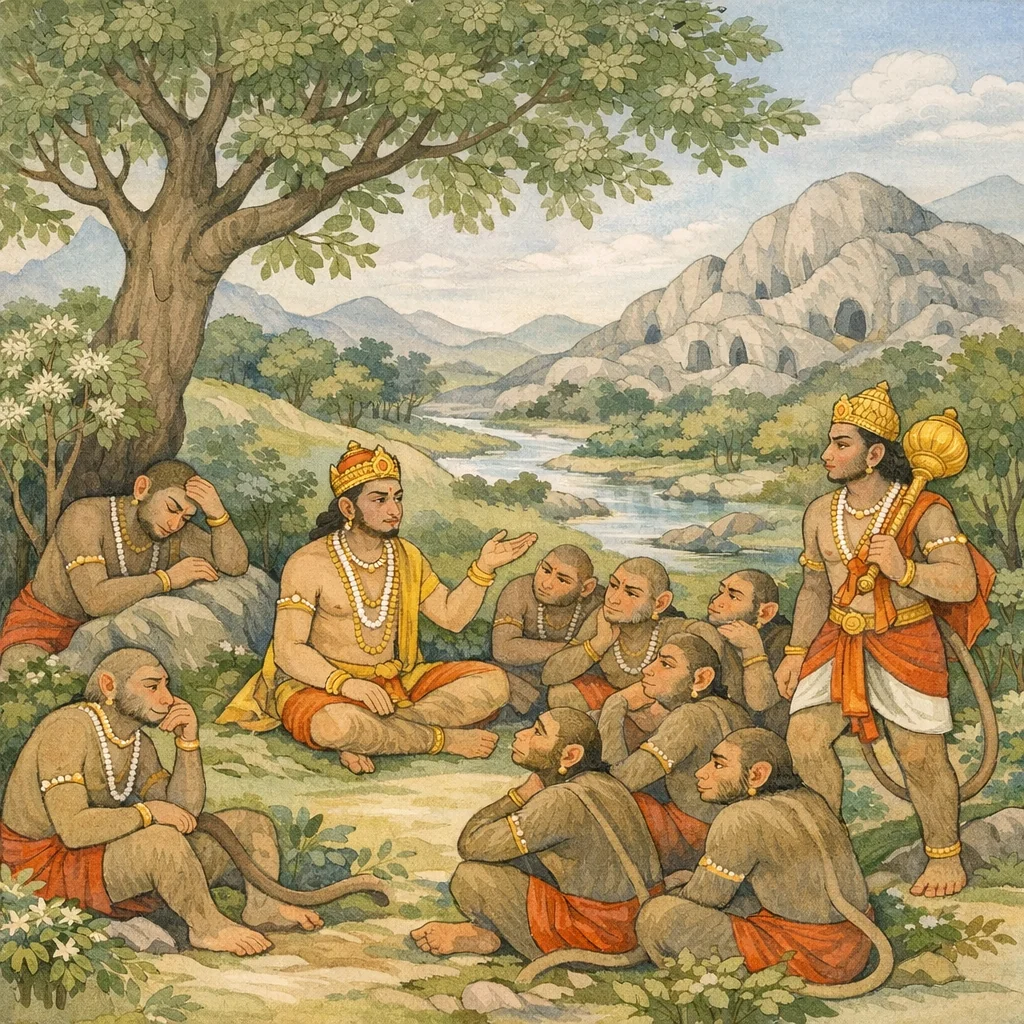
This sarga records a crisis of exhaustion in the southern search party and its resolution through Aṅgada’s leadership. Though weary, Aṅgada is keen-minded; he gathers the vānaras and gently instructs them that they have searched forests, mountains, rivers, forts, dense tracts, caves, and mountain hollows, yet neither Jānakī nor the abductor has been seen. He reframes the moment as a test of perseverance under time pressure and strict accountability to Sugrīva’s command. He urges them to abandon lethargy, grief, and sleep, and to uphold success-bearing virtues—unflagging zeal (anirveda), capability (dākṣya), and mental invincibility (aparājaya)—rejecting despair as negligence. He also invites objections or alternative proposals for the troop’s welfare, modeling consultative command. Gandhamādana, weakened by thirst and exertion, endorses Aṅgada’s plan as beneficial and auspicious. The troop resumes systematic exploration: re-checking mountains, caverns, forests, desolate zones, and streams; moving through the Vindhya ranges; ascending the “silver mountain” of peaks and caves; surveying the Lodhra grove and saptaparṇa gardens. Failing to find Vaidehī, they descend, rest briefly under a tree, and set out again, with Hanumān prominent among the seekers.
Shlokas
Verse 1
अथाङ्गदस्तदा सर्वान्वानरानिदमब्रवीत्।परिश्रान्तो महाप्राज्ञस्समाश्वास्य शनैर्वचः।।।।
Then Angada—wise though exhausted—gathered all the Vānaras, reassured them, and spoke these words gently and slowly.
Verse 2
वनानि गिरयो नद्यो दुर्गाणि गहनानि च।दर्यो गिरिगुहाश्चैव विचितानि समन्ततः।।।।तत्र तत्र सहास्माभिर्जानकी न च दृश्यते।तद्वा रक्षो हृता येन सीता सुरसुतोपमा।।।।
Forests and mountains, rivers, impassable strongholds and dense tracts—caves and mountain caverns too—have been searched everywhere by us together. Yet Jānakī is not seen anywhere; nor do we find that rākṣasa by whom Sītā—like a daughter of the gods—was carried off.
Verse 3
वनानि गिरयो नद्यो दुर्गाणि गहनानि च।दर्यो गिरिगुहाश्चैव विचितानि समन्ततः।।4.49.2।।तत्र तत्र सहास्माभिर्जानकी न च दृश्यते।तद्वा रक्षो हृता येन सीता सुरसुतोपमा।।4.49.3।।
We have searched everywhere—forests, mountains, rivers, hard-to-reach strongholds, dense thickets, ravines, and mountain-caves. Yet nowhere do we see Jānakī; nor do we find the rākṣasa by whom Sītā—like a daughter of the gods—was carried off.
Verse 4
कालश्च नो महान्यातस्सुग्रीवश्चोग्रशासनः।तस्माद्भवन्तस्सहिता विचिन्वन्तु समन्ततः।।4.49.4।।
Much time has passed for us, and Sugrīva is a stern ruler; therefore, all of you together must search everywhere.
Verse 5
विहाय तन्द्रीं शोकं च निद्रां चैव समुत्थिताम्।विचिनुध्वं यथा सीतां पश्यामो जनकात्मजाम्।।।।
Cast off lethargy, grief, and the sleep that has come upon us; press on in the search, that we may behold Sītā, Janaka’s daughter.
Verse 6
अनिर्वेदं च दाक्ष्यं च मनसश्चापराजयः।कार्यसिद्धिकराण्याहुस्तस्मादेतद्ब्रवीम्यहम्।।।।
They say that unflagging zeal, skill, and an unconquered mind bring success in one’s task; therefore I speak these words.
Verse 7
अद्यापि तद्वनं दुर्गं विचिन्वन्तु वनौकसः।खेदं त्यक्त्वा पुनस्सर्वैर्वनमेतद्विचीयताम्।।।।
Even now, O dwellers of the forest, search that hard-to-enter woodland; casting off dejection, let all of us once again comb through this forest.
Verse 8
अवश्यं क्रियमाणस्य दृश्यते कर्मणः फलम्।अलं निर्वेदमागम्य न हि नो मीलनं क्षमम्।।4.49.8।।
Surely, for work that is truly carried through, its result is seen. Enough of despair—closing our eyes and giving up is not proper for us.
Verse 9
सुग्रीवः कोपनो राजा तीक्ष्णदण्डश्च वानरः।भेतव्यं तस्य सततं रामस्य च महात्मनः।।।।
Sugrīva, the Vānara king, is quick to anger and severe in punishment; we must always remember our accountability—both to him and to the great-souled Rāma.
Verse 10
हितार्थमेतदुक्तं वः क्रियतां यदि रोचते।उच्यतां वा क्षमं यन्नस्सर्वेषामेव वानराः।।।।
“I have spoken this for your welfare. Do it if it pleases you; otherwise, tell what you deem right for all of us, O Vānaras.”
Verse 11
अङ्गदस्य वचश्श्रुत्वा वचनं गन्धमादनः।उवाचाव्यक्तया वाचा पिपासाश्रमखिन्नया।।।।
Hearing Angada’s words, Gandhamādana—worn down by thirst and exhaustion—replied in a faint, indistinct voice.
Verse 12
सदृशं खलु वो वाक्यमङ्गदो यदुवाच ह।हितं चैवानुकूलं च क्रियतामस्य भाषितम्।।।।
“Angada’s words are indeed fitting for us—beneficial and favorable. Let his counsel be carried out.”
Verse 13
पुनर्मार्गामहै शैलान्कन्दरांश्च दरीस्तथा।काननानि च शून्यानि गिरिप्रस्रवणानि च।।।।
Let us search once again—mountains, valleys and caverns, as well as empty forests, desolate tracts, and the mountain streams.
Verse 14
यथोद्दिष्टानि सर्वाणि सुग्रीवेण महात्मना।विचिन्वन्तु वनं सर्वे गिरिदुर्गाणि सर्वशः।।4.49.14।।
Let all of you search, in every way, the forests and the mountain-fastnesses—exactly as the great-souled Sugrīva has assigned.
Verse 15
ततस्समुत्थाय पुनर्वानरास्ते महाबलाः।विन्ध्यकाननसङ्कीर्णां विचेरुर्दक्षिणां दिशम्।।।।
Then the mighty monkeys rose again and ranged through the southern quarter, thick with the Vindhya forests.
Verse 16
ते शारदाभ्रप्रतिमं श्रीमद्रजतपर्वतम्।शृङ्गवन्तं दरीमन्तमधिरुह्य च वानराः।।।।तत्र लोध्रवनं रम्यं सप्तपर्णवनानि च।व्यचिन्वंस्ते हरिवरास्सीता दर्शनकाङ्क्षिणः।।।।
Eager to behold Sītā, the foremost of the monkeys climbed the splendid Silver Mountain, like autumn clouds, crowned with peaks and riddled with caves; there they searched the delightful lodhra-groves and the saptaparṇa woods as well.
Verse 17
ते शारदाभ्रप्रतिमं श्रीमद्रजतपर्वतम्।शृङ्गवन्तं दरीमन्तमधिरुह्य च वानराः।।4.49.16।।तत्र लोध्रवनं रम्यं सप्तपर्णवनानि च।व्यचिन्वंस्ते हरिवरास्सीता दर्शनकाङ्क्षिणः।।4.49.17।।
Eager to see Sītā, the foremost monkeys climbed the splendid Silver Mountain—cloudlike in autumn—full of peaks and caves; and there they searched the lovely lodhra-groves and the saptaparṇa woods.
Verse 18
तस्याग्रमधिरूढास्ते श्रान्ता विपुलविक्रमाः।न पश्यन्ति स्म वैदेहीं रामस्य महिषीं प्रियाम्।।।।
Even after reaching its summit, those mighty heroes—now exhausted—still did not see Vaidehī, Rāma’s beloved queen.
Verse 19
ते तु दृष्टिगतं कृत्वा तं शैलं बहुकन्दरम्।अवारोहन्त हरयो वीक्षमाणास्समन्ततः।।।।
But after bringing that many-caved mountain fully within their view—looking all around—they, the monkeys, descended.
Verse 20
अवरुह्य ततो भूमिं श्रान्ता विगतचेतसः।स्थित्वा मुहूर्तं तत्राथ वृक्षमूलमुपाश्रिताः।।।।
Then, descending to the ground, weary and downcast, they stood there for a moment and thereafter took shelter at the root of a tree.
Verse 21
ते मुहूर्तं समाश्वस्ताः किञ्चिद्भग्नपरिश्रमाः।पुनरेवोद्यताः कृत्स्नां मार्गितुं दक्षिणां दिशम्।।।।
After resting for a short while and easing their fatigue a little, they once again set out, resolved to search the entire southern direction.
Verse 22
हनुमत्प्रमुखास्ते तु प्रस्थिताः प्लवगर्षभाः।विन्ध्यमेवादितस्तावद्विचेरुस्ते समन्ततः।।।।
Led by Hanumān, those foremost of the Vānara host set out and then ranged everywhere, searching through the Vindhya mountains from end to end.
Frequently Asked Questions
The dilemma is whether exhaustion justifies stopping the mission; Aṅgada frames withdrawal as improper negligence under entrusted duty and directs the group to abandon despair, rest briefly if needed, and continue a systematic re-search of difficult terrain.
The upadeśa is that success is correlated with sustained, skillful effort supported by mental resilience: zeal, capability, and an undefeated mind are presented as practical virtues that transform adverse conditions into achievable outcomes.
The narrative foregrounds the Vindhya region and a distinctive “Rajataparvata” (Silver Mountain) with peaks and caverns, along with the Lodhravana and saptaparṇa groves—landscape markers used to structure the search grid and emphasize terrain-based reconnaissance.