Sarga 38
उद्योगप्रवर्तनम् (Mobilization and Counsel on Kingship)
किष्किन्धाकाण्ड
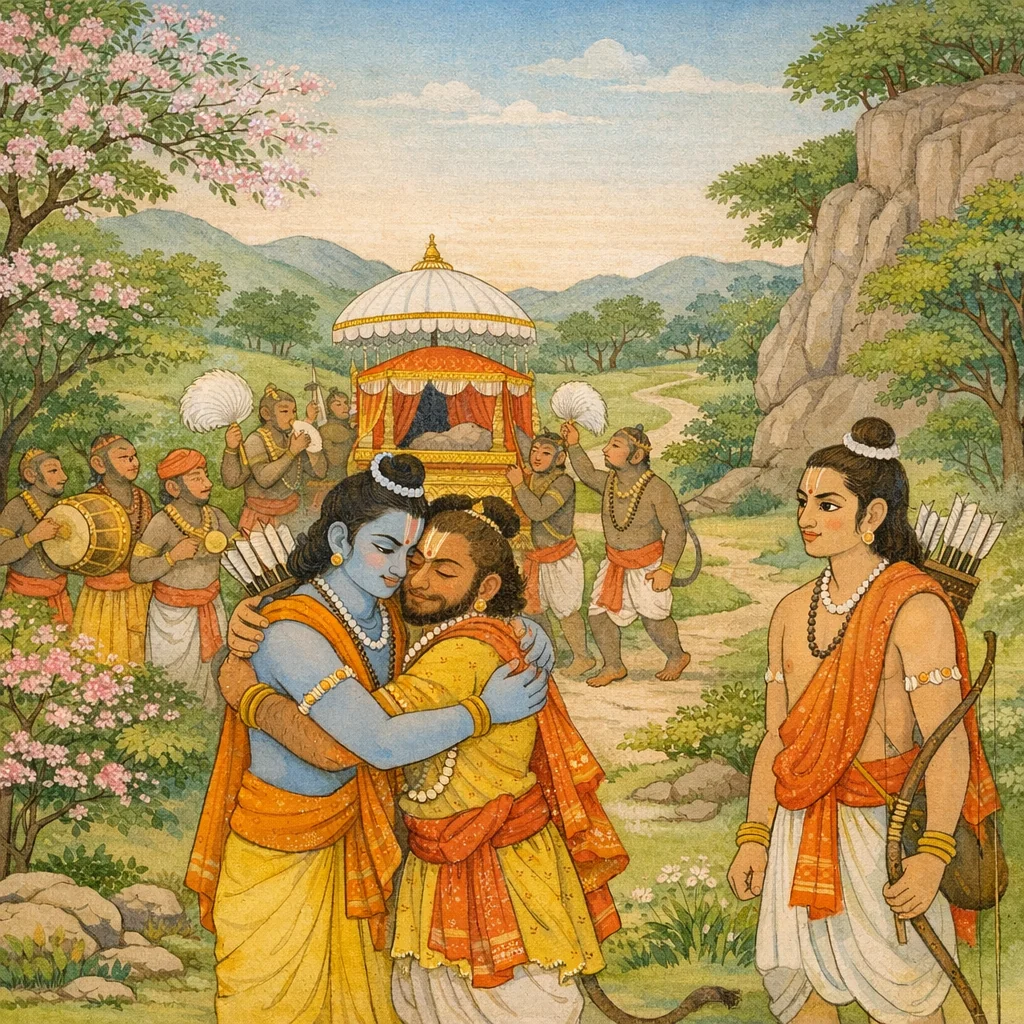
Sarga 38 shows Sugrīva turning from courtly ease to readiness for the sacred task. After accepting the gifts offered by the vānaras and dismissing them content, Lakṣmaṇa respectfully urges him to leave Kiṣkindhā and meet Rāma. Sugrīva agrees, declares his willingness to follow Lakṣmaṇa’s command, dismisses Tārā and the palace women, summons fit vānaras, orders a palanquin, and sets out in royal procession—umbrella, yak-tail fans, conch and drums—guarded by armed troops. Reaching Rāma’s dwelling, Sugrīva descends, approaches with folded hands, and is warmly embraced by Rāma. Rāma then gives a concise teaching in rājanīti: a king must apportion time among dharma, artha, and kāma; the exclusive pursuit of pleasure brings ruin; righteous rule restrains enemies, secures friends, and enjoys the fruits of the three aims in proper order. Declaring that the time for enterprise has come, he calls for strategic counsel. Sugrīva replies with gratitude, acknowledging that by Rāma’s grace he has regained lost fortune, fame, and sovereignty. He reports the vast mustering of vānaras and allied forces, sufficient to defeat Rāvaṇa and recover Maithilī.
Shlokas
Verse 1
प्रतिगृह्य च तत्सर्वमुपायनमुपाहृतम्।वानरान्सान्त्वयित्वा च सर्वानेव व्यसर्जयत्।।4.38.1।।
Having accepted all the gifts that were brought, he comforted the monkeys and then dismissed them all.
Verse 2
विसर्जयित्वा स हरीन् शूरांस्तान्कृतकर्मणः।मेने कृतार्थमात्मानं राघवं च महाबलम्।।4.38.2।।
Having dismissed those heroic vānaras who had accomplished their appointed work, Sugrīva deemed that both he and mighty Rāghava had attained their purpose.
Verse 3
स लक्ष्मणो भीमबलं सर्ववानरसत्तमम्।अब्रवीत्प्रश्रितं वाक्यं सुग्रीवं सम्प्रहर्षयन्।।4.38.3।।किष्किन्धाया विनिष्क्राम यदि ते सौम्य रोचते।
Then Lakṣmaṇa, of formidable strength, addressed Sugrīva—the foremost among the vanaras—with courteous words, encouraging him: “If it pleases you, gentle one, come out from Kiṣkindhā.”
Verse 4
तस्य तद्वचनं श्रुत्वा लक्ष्मणस्य सुभाषितम्।।4.38.4।।सुग्रीवः परमप्रीतो वाक्यमेतदुवाच ह।एवं भवतु गच्छाव: स्थेयं त्वच्छासने मया।।4.38.5।।
Hearing Lakṣmaṇa’s well-spoken words, Sugrīva was greatly pleased and replied: “So be it. Let us go. I shall abide by your command.”
Verse 5
तस्य तद्वचनं श्रुत्वा लक्ष्मणस्य सुभाषितम्।।4.38.4।।सुग्रीवः परमप्रीतो वाक्यमेतदुवाच ह।एवं भवतु गच्छाव: स्थेयं त्वच्छासने मया।।4.38.5।।
Then, beholding that vigorous endeavor of the foremost monkey-hero and of those who moved under his command, the wise son of the lord of the earth (Rāma) shone with joy—like a fully blossomed blue lotus.
Verse 6
तमेवमुक्त्वा सुग्रीवो लक्ष्मणं शुभलक्षणम्।विसर्जयामास तदा तारामन्याश्च योषितः।।4.38.6।।
Having thus spoken to Lakṣmaṇa of auspicious marks, Sugrīva then dismissed Tārā and the other women.
Verse 7
एतेत्युच्चैर्हरिवरान्सुग्रीवस्समुदाहरत्।तस्य तद्वचनं श्रुत्वा हरयश्शीघ्रमाययुः।।4.38.7।।बद्धाञ्जलिपुटास्सर्वे ये स्युः स्त्रीदर्शनक्षमाः।
Crying aloud, “Come here!”, Sugrīva summoned the foremost monkeys. Hearing his words, the monkeys hurried in—all with hands folded—those who were fit to enter the women’s presence.
Verse 8
तानुवाच ततः प्राप्तान्राजाऽर्कसदृशप्रभः।।4.38.8।।उपस्थापयत क्षिप्रं शिबिकां मम वानराः।
Then the king, radiant like the sun, addressed those who had arrived: “Vānaras, quickly bring my palanquin.”
Verse 9
श्रुत्वा तु वचनं तस्य हरयश्शीघ्रविक्रमाः।।4.38.9।।समुपस्थापयामासुश्शिबिकां प्रियदर्शनाम्।
Hearing his command, the swift-acting monkeys promptly brought forward a palanquin that was pleasing to behold.
Verse 10
तामुपस्थापितां दृष्ट्वा शिबिकां वानराधिपः।।4.38.10।।लक्ष्मणाऽरुह्यतां शीघ्रमिति सौमित्रिमब्रवीत्।
Seeing the palanquin brought forward, the lord of the monkeys said to Saumitrī: “Lakṣmaṇa, mount quickly.”
Verse 11
इत्युक्त्वा काञ्चनं यानं सुग्रीवस्सूर्यसन्निभम्।।4.38.11।।बृहद्भिर्हरिभिर्युक्तमारुरोह सलक्ष्मणः।
Having spoken thus, Sugriva—radiant like the sun—mounted the golden conveyance borne by strong monkeys, together with Lakṣmaṇa.
Verse 12
पाण्डुरेणातपत्रेण म्रियमाणेन मूर्धनि।।4.38.12।।शुक्लैश्च वालव्यजनैर्धूयमानैस्समन्ततः।शङ्खभेरीनिनादैश्च हरिभिश्चाभिवन्दितः।।4.38.13।।निर्ययौ प्राप्य सुग्रीवो राज्यश्रियमनुत्तमाम्।
With a pale-white royal umbrella held above his head, fanned on every side with white yak-tail whisks, and greeted by the monkeys amid the sounds of conches and drums, Sugrīva set out, rejoicing in the unsurpassed splendor of kingship he had attained.
Verse 13
पाण्डुरेणातपत्रेण म्रियमाणेन मूर्धनि।।4.38.12।।शुक्लैश्च वालव्यजनैर्धूयमानैस्समन्ततः।शङ्खभेरीनिनादैश्च हरिभिश्चाभिवन्दितः।।4.38.13।।निर्ययौ प्राप्य सुग्रीवो राज्यश्रियमनुत्तमाम्।
Fanned all around with white yak-tail fans, amid the blare of conches and kettle-drums, and greeted by the monkeys, Sugrīva set out, having attained unsurpassed royal splendor.
Verse 14
स वानरशतैस्तीक्ष्णैर्बहुभि श्शस्त्रपाणिभिः।।4.38.14।।परिकीर्णो ययौ तत्र यत्र रामो व्यवस्थितः।
Surrounded by hundreds of monkeys bearing many sharp weapons, Sugrīva went to the place where Rāma was staying.
Verse 15
स तं देशमनुप्राप्य श्रेष्ठं रामनिषेवितम्।।4.38.15।।अवातरन्महातेजा श्शिबिकायास्सलक्ष्मणः।
Reaching that excellent place where Rāma was staying, the radiant Sugrīva—together with Lakṣmaṇa—stepped down from the palanquin.
Verse 16
आसाद्य च ततो रामं कृताञ्जलिपुटोऽभवत्।।4.38.16।।कृताञ्जलौ स्थिते तस्मिन्वानराश्चाभवंस्तथा।
Then, approaching Rāma, Sugrīva stood with hands joined in reverence; and when he stood thus, the monkeys also stood in the same manner.
Verse 17
तटाकमिव तं दृष्ट्वा रामः कुड्मलपङ्कजम्।।4.38.17।।वानराणां महत्सैन्यं सुग्रीवे प्रीतिमानभूत्।
Seeing that great host of vānaras—like a pond filled with lotus buds—Rāma was filled with joy toward Sugrīva.
Verse 18
पादयोः पतितं मूर्ध्ना तमुत्थाप्य हरीश्वरम्।।4.38.18।।प्रेम्णा च बहुमानाच्च राघवः परिषस्वजे।
When Sugrīva, lord of the vānaras, bowed at his feet with head lowered, Rāghava lifted him up and embraced him with affection and high regard.
Verse 19
परिष्वज्य च धर्मात्मा निषीदेति ततोऽब्रवीत्।।4.38.19।।निषण्णं तं ततो दृष्ट्वा क्षितौ रामोऽब्रवीद्वचः।
After embracing him, righteous Rāma said, “Sit.” And seeing Sugrīva seated upon the ground, Rāma then spoke these words.
Verse 20
धर्ममर्थं च कामं च यस्तु काले निषेवते।।4.38.20।।विभज्य सततं वीर स्स राजा हरिसत्तम।
“O best of vānaras: the one who, as a hero, ever apportions his time and in the proper season pursues dharma, artha, and kāma—he truly is a king.”
Verse 21
हित्वा धर्मं तथाऽर्थं च कामं यस्तु निषेवते।।4.38.21।।स वृक्षाग्रे यथा सुप्तः पतितः प्रतिबुध्यते।
But one who forsakes dharma and artha and pursues only kāma is like a man asleep atop a tree—he awakens only after he has fallen.
Verse 22
अमित्राणां वधे युक्तो मित्राणां सङ्ग्रहे रतः।।4.38.22।।त्रिवर्गफलभोक्ता तु राजा धर्मेण युज्यते।
A king, fit to subdue enemies and devoted to securing friends, enjoys the fruits of the three aims of life; such a ruler is truly joined to dharma.
Verse 23
उद्योगसमयस्त्वेषप्राप्तश्शत्रुविनाशन।।4.38.23।।सञ्चिन्त्यतां हि पिङ्गेश हरिभिस्सह मन्त्रिभिः।
O slayer of enemies, O lord of the tawny-eyed monkeys: the time for decisive action has now arrived. Deliberate well with your ministers and the vanaras.
Verse 24
एवमुक्तस्तु सुग्रीवो रामं वचनमब्रवीत्।।4.38.24।।प्रणष्टा श्रीश्च कीर्तिश्च कपिराज्यं च शाश्वतम्।त्वत्प्रसादान्महाबाहो पुनःप्राप्तमिदं मया।।4.38.25।।
Thus addressed, Sugriva spoke to Rama: “My lost prosperity and fame—and even this enduring sovereignty over the vanaras—have been regained by me only through your favor, O mighty-armed one.”
Verse 25
एवमुक्तस्तु सुग्रीवो रामं वचनमब्रवीत्।।4.38.24।।प्रणष्टा श्रीश्च कीर्तिश्च कपिराज्यं च शाश्वतम्।त्वत्प्रसादान्महाबाहो पुनःप्राप्तमिदं मया।।4.38.25।।
O lord, best among the victorious: by your grace and by your brother’s, my work has been accomplished. Whoever does not repay a good deed is blameworthy among men.
Verse 26
तव देव प्रसादाच्च भ्रातुश्च जयतां वर।कृतं न प्रतिकुर्याद्यः पुरुषाणां स दूषकः।।4.38.26।।
O lord, best among the victorious: by your grace and by your brother’s, my work has been accomplished. Whoever does not repay a good deed is blameworthy among men.
Verse 27
एते वानरमूख्याश्च शतशश्शत्रुसूदन।प्राप्ताश्चादाय बलिनः पृथिव्यां सर्ववानरान्।।4.38.27।।
O destroyer of enemies, these foremost vanaras have arrived in hundreds—mighty ones who have gathered vanaras from all over the earth and brought them here.
Verse 28
ऋक्षाश्चावहिताश्शूरा गोलाङ्गूलाश्च राघव।कान्तारवनदुर्गाणामभिज्ञा घोरदर्शनाः।।4.38.28।।देवगन्धर्वपुत्राश्च वानराः कामरूपिणः।स्वैस्स्वै: परिवृतास्सैन्यैर्वर्तन्ते पथि राघव।।4.38.29।।
O Rāghava, valiant bears and golāṅgūlas too have come—grim in appearance and skilled in the ways of dense wilderness and forest strongholds. Vanaras as well, said to be sons of devas and gandharvas, able to assume forms at will, are on the road, each surrounded by his own troops.
Verse 29
ऋक्षाश्चावहिताश्शूरा गोलाङ्गूलाश्च राघव।कान्तारवनदुर्गाणामभिज्ञा घोरदर्शनाः।।4.38.28।।देवगन्धर्वपुत्राश्च वानराः कामरूपिणः।स्वैस्स्वै: परिवृतास्सैन्यैर्वर्तन्ते पथि राघव।।4.38.29।।
Then Lakṣmaṇa, of formidable strength, addressed Sugrīva—the foremost among the vanaras—with courteous words, encouraging him: “If it pleases you, gentle one, come out from Kiṣkindhā.”
Verse 30
शतैश्शतसहस्रैश्च वर्तन्ते कोटिभिश्च प्लवङ्गमाः।अयुतैश्चावृता वीराश्शङ्कुभिश्च परन्तप ।।4.38.30।।अर्बुदैरर्बुदशतैर्मध्यैश्चान्त्यैश्च वानराः।समुद्रैश्च परार्धैश्च हरयो हरियूथपाः।।4.38.31।।आगमिष्यन्ति ते राजन्महेन्द्रसमविक्रमाः।मेरुमन्दरसङ्काशा विन्ध्य मेरुकृतालयाः।।4.38.32।।
O scorcher of foes, the plavaṅgamas are assembling in vast numbers—by hundreds, by hundreds of thousands, and by crores; in ayutas and in multitudes as well. In still greater counts gather the vanaras and their troop-leaders—arbudas and hundreds of arbudas, and other immense reckonings. They will come to you, O king—mighty as Mahendra, resembling Meru and Mandara, dwelling in the Vindhya and Meru ranges.
Verse 31
शतैश्शतसहस्रैश्च वर्तन्ते कोटिभिश्च प्लवङ्गमाः।अयुतैश्चावृता वीराश्शङ्कुभिश्च परन्तप ।।4.38.30।।अर्बुदैरर्बुदशतैर्मध्यैश्चान्त्यैश्च वानराः।समुद्रैश्च परार्धैश्च हरयो हरियूथपाः।।4.38.31।।आगमिष्यन्ति ते राजन्महेन्द्रसमविक्रमाः।मेरुमन्दरसङ्काशा विन्ध्य मेरुकृतालयाः।।4.38.32।।
O scorcher of foes! The hosts of the plavaṅgamas are arriving in numbers—by hundreds, by hundreds of thousands, and even by koṭis; also in ayutas and in vast, uncountable multitudes.
Verse 32
शतैश्शतसहस्रैश्च वर्तन्ते कोटिभिश्च प्लवङ्गमाः।अयुतैश्चावृता वीराश्शङ्कुभिश्च परन्तप ।।4.38.30।।अर्बुदैरर्बुदशतैर्मध्यैश्चान्त्यैश्च वानराः।समुद्रैश्च परार्धैश्च हरयो हरियूथपाः।।4.38.31।।आगमिष्यन्ति ते राजन्महेन्द्रसमविक्रमाः।मेरुमन्दरसङ्काशा विन्ध्य मेरुकृतालयाः।।4.38.32।।
O scorcher of foes! The hosts of the plavaṅgamas are arriving in numbers—by hundreds, by hundreds of thousands, and even by koṭis; also in ayutas and in vast, uncountable multitudes.
Verse 33
ते त्वामभिगमिष्यन्ति राक्षसं ये सबान्धवम्।निहत्य रावणं सख्ये ह्यानयिष्यन्ति मैथिलीम्।।4.38.33।।
They will come to you—those who, having slain the rākṣasa Rāvaṇa together with his kin in battle, will bring back Maithilī.
Verse 34
ततस्तमुद्योगमवेक्ष्य बुद्धिमान्हरिप्रवीरस्य निदेशवर्तिनः।बभूव हर्षाद्वसुधाधिपात्मजःप्रबुद्धनीलोत्पलतुल्यदर्शनः।।4.38.34।।
Then, beholding that vigorous endeavor of the foremost monkey-hero and of those who moved under his command, the wise son of the lord of the earth (Rāma) shone with joy—like a fully blossomed blue lotus.
Frequently Asked Questions
The pivotal action is the shift from celebration of regained kingship to obligation-bound enterprise: Sugrīva must convert royal prosperity into timely service of the alliance, demonstrating that sovereignty is validated by responsibility, not indulgence.
Rāma’s upadeśa frames ideal kingship as disciplined governance: dividing time appropriately among dharma, artha, and kāma; avoiding pleasure as the sole aim; protecting friends, subduing enemies, and acting with righteous strategy (dharmeṇa).
Kiṣkindhā is the political center from which mobilization proceeds; the procession’s insignia (ātapatra, vālavyajana, śaṅkha-bherī) mark courtly culture; Vindhya, Meru, and Mandara appear as geographic-mythic reference points describing the scale and stature of arriving forces.