Adhyaya 119: The Cave-Sanctuary: Jewel-Lake, Gem-Palace, and the Iconography of Vishnu Reposing on Śeṣa
गुहान्तर्वर्तिसरः-रत्नप्रासाद-विष्णुशयनमूर्ति-लक्षणम्
Speaker: Sūta
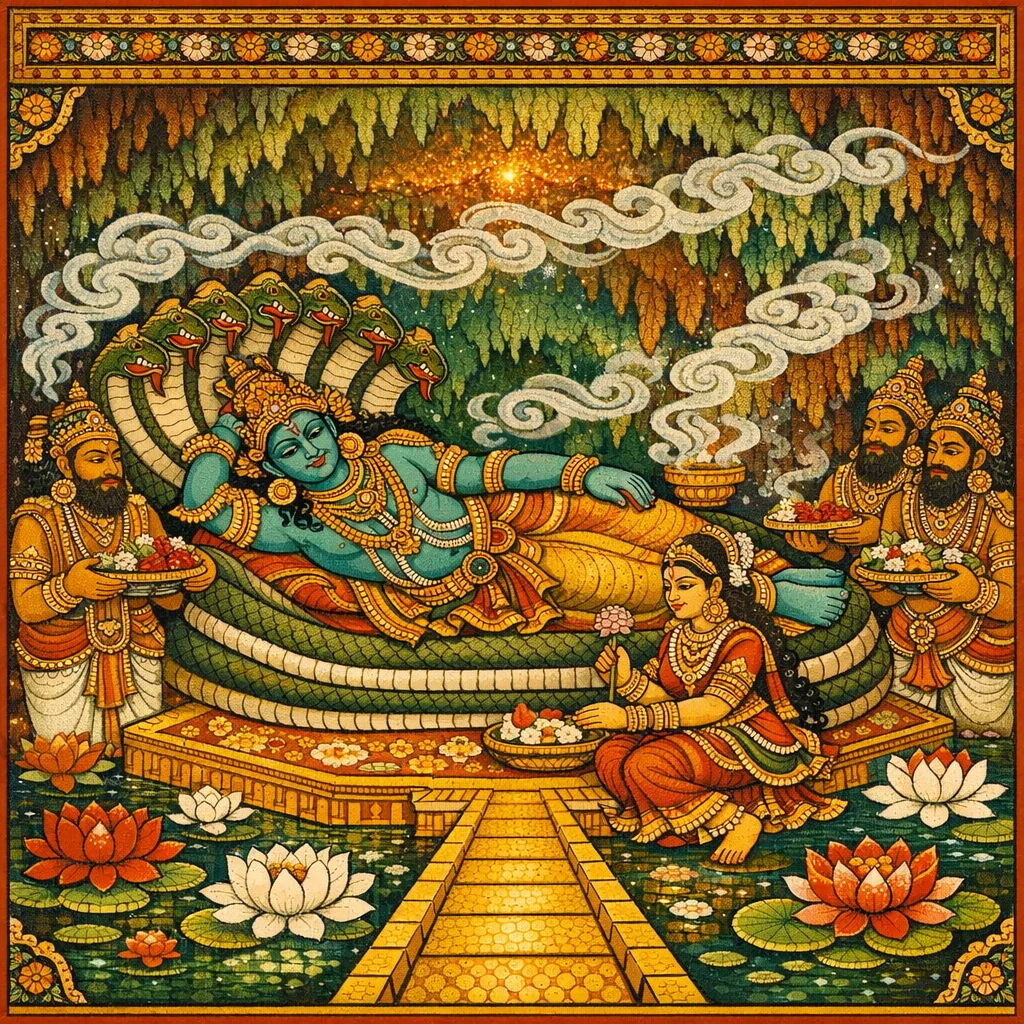
Sūta describes a mountainous land hiding a secret cavern. A king finds a jasmine-ringed opening, enters, and crosses a perilous stretch of dense darkness into a naturally radiant subterranean realm. He beholds a gem-adorned lake, terraces with golden and silver trees and coral, and a central island-like area laid out as a square with prescribed measure. A jewel palace/temple is detailed architecturally—silver brilliance, vaidūrya steps, sapphire pillars, emerald inlays. Within, Janārdana (Vishnu) reclines upon Śeṣa; the chapter gives precise iconographic rules for limbs, mudrās, ornaments, and Lakṣmī’s attendance. Atri is said to have installed the deity; Siddhas worship with santāna flowers, fruits, incense, and perfumes. The king prostrates, praises with a thousand names, circumambulates, and then performs long austerities nearby: tri-sandhyā bathing, fire worship, renouncing food, living on consecrated reservoir water, and dwelling in a bare cave without fatigue, as though in heaven.
Key Concepts
Shlokas in Adhyaya 119
Verse 1
*सूत उवाच तत्र यौ तौ महाशृङ्गौ महावर्णौ महाहिमौ तृतीयं तु तयोर्मध्ये शृङ्गमत्यन्तमुच्छ्रितम् //
Sūta said: There stood two great peaks—vast in their heights, splendid in appearance, and heavy with snow; and between those two rose a third summit, exceedingly lofty.
Verse 2
नित्यातप्तशिलाजातं सदाभ्रपरिवर्जितम् तस्याधस्ताद्वृक्षगणे दिशां भागे च पश्चिमे //
One should choose a place formed of rock, ever warmed by the sun and not perpetually covered by clouds. Below it there should be a cluster of trees, and it should lie toward the western quarter.
Verse 3
जातीलतापरिक्षिप्तं विवरं चारुदर्शनम् दृष्ट्वैव कौतुकाविष्टस् तं विवेश महीपतिः //
Seeing a beautiful-looking opening encircled by jasmine creepers, the king—seized by curiosity—entered it at once.
Verse 4
तमसा चातिनिबिडं नल्वमात्रं सुसंकटम् नल्वमात्रमतिक्रम्य स्वप्रभाभरणोज्ज्वलम् //
There was a stretch of exceedingly dense darkness, perilous for the space of a nalva. Having crossed that nalva-long passage, one beheld a radiant expanse—brilliant with its own natural splendor, as though adorned with light itself.
Verse 5
तम् उच्छ्रितम् अथात्यन्तं गम्भीरं परिवर्तुलम् न तत्र सूर्यस्तपति न विराजति चन्द्रमाः //
It is described as exceedingly lofty, profoundly deep, and circular in form; there the sun does not burn, and the moon does not shine.
Verse 6
तथापि दिवसाकारं प्रकाशं तदहर्निशम् क्रोशाधिकपरीमाणं सरसा च विराजितम् //
Even so, it shines with a daylight-like radiance, day and night; it extends for more than a krośa in measure, and is beautified by a lake.
Verse 7
समन्तात्सरसस्तस्य शैललग्ना तु वेदिका सौवर्णै राजतैर्वृक्षैर् विद्रुमैरुपशोभितम् //
All around that lake there was a platform (vedikā) set against the hillside, beautifully adorned with golden and silver trees and with coral embellishments.
Verse 8
नानामाणिक्यकुसुमैः सुप्रभाभरणोज्ज्वलैः तस्मिन्सरसि पद्मानि पद्मरागच्छदानि तु //
In that lake were lotus-flowers, their petals like padmarāga (rubies), shining with splendid brilliance, as though adorned with blossoms made of many kinds of jewels.
Verse 9
वज्रकेसरजालानि सुगन्धीनि तथा युतम् पत्त्रैर् मरकतैर् नीलैर् वैडूर्यस्य महीपते //
O king, it should be furnished with fragrant, vajra-like filigreed networks, and adorned with leaves of emerald and dark-blue gems, together with vaidūrya (cat’s-eye) stones.
Verse 10
कर्णिकाश्च तथा तेषां जातरूपस्य पार्थिव तस्मिन्सरसि या भूमिर् न सा वज्रसमाकुला //
And their pericarps (karnikā), O king, are of gold as well. The ground within that lake is not strewn with vajra-like hard stones and is free from obstructive gravel.
Verse 11
नानारत्नैरुपचिता जलजानां समाश्रयः कपर्दिकानां शुक्तीनां शङ्खानां च महीपते //
O king, it is richly filled with many kinds of gems, being the common abode of aquatic creatures, of kapardikā (cowries), of pearl-oysters, and of śaṅkha (conches) as well.
Verse 12
मकराणां च मत्स्यानां चण्डानां कच्छपैः सह तत्र मरकतखण्डानि वज्राणां च सहस्रशः //
There are makaras, crocodile-like, and fierce fish together with tortoises; and there, in their thousands, are fragments of emerald and also vajras (diamonds).
Verse 13
पद्मरागेन्द्रनीलानि महानीलानि पार्थिव पुष्परागाणि सर्वाणि तथा कर्कोटकानि च //
O king, there are padmarāgas and indranīlas, the deep-blue mahānīlas, all varieties of puṣparāgas, and also the gems known as karkoṭakas.
Verse 14
तुत्थकस्य तु खण्डानि तथा शेषस्य भागशः राजावर्तस्य मुख्यस्य रुचिराक्षस्य चाप्यथ //
Likewise, take pieces of tutthaka and portions of the remaining ingredients in due measure; include also the principal rājāvarta and rucirākṣa.
Verse 15
सूर्येन्दुकान्तयश्चैव नीलो वर्णान्तिमश्च यः ज्योतीरसस्य रम्यस्य स्यमन्तस्य च भागशः //
Likewise, there are the Sun-stone (sūryakānta) and Moon-stone (candrakānta); and that gem which is deep blue as the final shade of color—these, in due portions, are shares of the lovely radiance-essence (jyotīrasa), namely the Syamantaka.
Verse 16
सुरोरगवलक्षाणां स्फटिकस्य तथैव च गोमेदपित्तकानां च धूलीमरकतस्य च //
And likewise, the text sets forth the distinguishing characteristics of the sura-stone and the serpent-stone, of sphaṭika (crystal) as well, and also of the gomedaka and pīttaka gems, and of the so-called “dusty emerald” (dhūli-marakata).
Verse 17
वैडूर्यसौगन्धिकयोस् तथा राजमणेर्नृप वज्रस्यैव च मुख्यस्य तथा ब्रह्ममणेरपि //
O king, the same principles apply to vaidūrya (cat’s-eye), saugandhika, the royal gem (rāja-maṇi), the foremost vajra (diamond), and also to the brahma-gem (brahma-maṇi).
Verse 18
मुक्ताफलानि मुक्तानां ताराविग्रहधारिणाम् //
Pearl-fruits (pearls) belong to the liberated—those who bear the embodied form of the stars, the radiant celestial deities.
Verse 19
सुखोष्णं चैव तत्तोयं स्नानाच्छीतविनाशनम् वैडूर्यस्य शिला मध्ये सरसस्तस्य शोभना //
The water there is pleasantly warm, and bathing in it destroys ailments born of cold. In the midst of that lovely lake lies a slab of vaidūrya (cat’s-eye gemstone), adding to its splendor.
Verse 20
प्रमाणेन तथा सा च द्वे च राजन्धनुःशते चतुरस्रा तथा रम्या तपसा निर्मितात्रिणा //
By proper measure, O King, it should extend to two hundred dhanus; it is to be square in plan, pleasing in appearance, and fashioned with disciplined tapas, using grass as the laying or marking material.
Verse 21
बिलद्वारसमो देशो यत्र यत्र हिरण्मयः प्रदेशः स तु राजेन्द्र द्वीपे तस्मिन्मनोहरे //
O best of kings, on that enchanting island the land is like the mouth of a cavern; and here and there the region shines as though made of gold.
Verse 22
तथा पुष्करिणी रम्या तस्मिन्राजञ्शिलातले सुशीतामलपानीया जलजैश्च विराजिता //
Likewise, O King, upon that stone-laid ground there was a delightful lotus-tank (puṣkariṇī), whose drinking-water was clear and pleasantly cool, and which shone adorned with water-born plants.
Verse 23
आकाशप्रतिमा राजंश् चतुरस्रा मनोहरा तस्यास्तदुदकं स्वादु लघु शीतं सुगन्धिकम् //
O King, it is like the very sky—square in form and delightful to behold; and the water within it is sweet, light (easy to digest), cool, and fragrant.
Verse 24
न क्षिणोति यथा कण्ठं कुक्षिं नापूरयत्यपि तृप्तिं विधत्ते परमां शरीरे च महत्सुखम् //
It does not wear out the throat as it goes down; it does not even overfill the belly—yet it brings supreme satisfaction, and in the body it produces great comfort.
Verse 25
मध्ये तु तस्याः प्रासादं निर्मितं तपसात्रिणा रुक्मसेतुप्रवेशान्तं सर्वरत्नमयं शुभम् //
In the very middle of that place, an auspicious palace was built by the power of austerity; its approach extended up to a golden causeway/bridge, and it was fashioned entirely of every kind of precious gem.
Verse 26
शशाङ्करश्मेः संकाशं प्रासादं राजतं हितम् रम्यवैडूर्यसोपानं विद्रुमामलसारकम् //
A palace, gleaming like the rays of the moon, should be made of silver and be auspicious; its stairways should be charming, fashioned of vaidūrya (cat’s-eye gem), and its refined essence adorned with flawless coral.
Verse 27
इन्द्रनीलमहास्तम्भं मरकतासक्तवेदिकम् वज्रांशुजालैः स्फुरितं रम्यं दृष्टिमनोरमम् //
It had great pillars of sapphire (indranīla), an altar-platform inlaid with emeralds, and it glittered with a network of diamond-like rays—charming, and delightful to behold.
Verse 28
प्रासादे तत्र भगवान् देवदेवो जनार्दनः भोगिभोगावलीसुप्तः सर्वालंकारभूषितः //
There, within the temple‑palace, the Blessed Lord Janārdana—the God of gods—reposes upon the coiled serpent‑couch, adorned with every kind of ornament.
Verse 29
जानुनाकुञ्चितस्त्वेको देवदेवस्य चक्रिणः फणीन्द्रसंनिविष्टो ऽङ्घ्रिर् द्वितीयश्च तथानघ //
O sinless one, of the Lord of gods who bears the discus, one leg should be bent at the knee, and the second foot should be placed upon the serpent‑king (Śeṣa).
Verse 30
लक्षयुत्सङ्गगतो ऽङ्घ्रिस्तु शेषभोगप्रशायिनः फणीन्द्रभोगसंन्यस्तबाहुः केयूरभूषणः //
In the icon of the Lord reclining upon Śeṣa, one foot is shown resting upon the thigh, while the arms are placed upon the coils of the serpent‑king; the form is adorned with armlets (keyūra).
Verse 31
अङ्गुलीपृष्ठविन्यस्तदेवशीर्षधरं भुजम् एकं वै देवदेवस्य द्वितीयं तु प्रसारितम् //
One arm of the Lord of gods should be shown bearing the divine head, with it placed upon the back of the fingers; the second arm should be depicted as extended outward.
Verse 32
समाकुञ्चितजानुस्थमणिबन्धेन शोभितम् किंचिदाकुञ्चितं चैव नाभिदेशकरस्थितम् //
Adorned by a bracelet (maṇibandha) near the evenly bent knee, and with the arm slightly flexed, the hand is to be placed at the region of the navel.
Verse 33
तृतीयं तु भुजं तस्य चतुर्थं तु तथा शृणु आत्तसंतानकुसुमं घ्राणदेशानुसर्पिणम् //
Now hear of the third arm of that deity-image, and likewise the fourth: it should be shown as taking the fragrant santāna flower and moving it toward the region of the nose, as though to smell it.
Verse 34
लक्ष्म्या संवाह्यमानाङ्घ्रिः पद्मपत्त्रनिभैः करैः संतानमालामुकुटं हारकेयूरभूषितम् //
His feet are gently massaged by Lakṣmī with hands as delicate as lotus-petals; he is adorned with a saṃtāna garland and a crown, and ornamented with necklaces and armlets.
Verse 35
भूषितं च तथा देवम् अङ्गदैरङ्गुलीयकैः फणीन्द्रफणविन्यस्तचारुरत्नशिरोज्ज्वलम् //
And in that manner the Deity should be adorned with armlets and finger-rings, shining with a beautiful jewel set upon the hood of the lord of serpents (Śeṣa).
Verse 36
अज्ञातवस्तुचरितं प्रतिष्ठितम् अथात्रिणा सिद्धानुपूज्यं सततं संतानकुसुमार्चितम् //
Then Atri installed that sacred form, whose deeds and true nature are beyond ordinary knowing; it is ever worshipped by the Siddhas, and is honored with offerings of saṃtānaka flowers.
Verse 37
दिव्यगन्धानुलिप्ताङ्गं दिव्यधूपेन धूपितम् सुरसैः सुफलैर्हृद्यैः सिद्धैरुपहृतैः सदा //
His limbs are anointed with celestial fragrances and perfumed with divine incense; and he is ever worshipped with delicious, choice, heart-pleasing fruits—offerings presented by the Siddhas always.
Verse 38
शोभितोत्तमपार्श्वं तं देवमुत्पलशीर्षकम् ततः सम्मुखम् उद्वीक्ष्य ववन्दे स नराधिपः //
Beholding that deity—whose excellent sides were beautifully adorned and whose head was like a lotus—then looking straight at him, the king bowed down in reverence.
Verse 39
जानुभ्यां शिरसा चैव गत्वा भूमिं यथाविधि नाम्नां सहस्रेण तदा तुष्टाव मधुसूदनम् //
Then, in the prescribed manner, he went down to the ground—kneeling and bowing his head—and praised Madhusūdana with a thousand names.
Verse 40
प्रदक्षिणमथो चक्रे स तूत्थाय पुनः पुनः रम्यमायतनं दृष्ट्वा तत्रोवासाश्रमे पुनः //
Then he performed circumambulation; rising again and again, and seeing that delightful sanctuary, he once more took up residence there in the hermitage.
Verse 41
बिलाद्बहिर्गुहां कांचिद् आश्रित्य सुमनोहराम् तपश्चकार तत्रैव पूजयन्मधुसूदनम् //
Leaving the mouth of the cavern, he took shelter in a certain exceedingly beautiful cave; there itself he practiced austerities, worshipping Madhusūdana (Viṣṇu), the slayer of Madhu.
Verse 42
नानाविधैस्तथा पुष्पैः फलमूलैः सगोरसैः नित्यं त्रिषवणस्नायी वह्निपूजापरायणः //
With many kinds of flowers, and with fruits and roots along with cow-derived offerings, he should bathe regularly at the three daily junctions and remain devoted to the worship of the sacred fire.
Verse 43
देववापीजलैः कुर्वन् सततं प्राणधारणम् सर्वाहारपरित्यागं कृत्वा तु मनुजेश्वरः //
Using only the water of the consecrated divine reservoir (devavāpī), Manu, lord among men, continually sustained his vital breath, having wholly renounced all food.
Verse 44
अनास्तृतगुहाशायी कालं नयति पार्थिवः त्यक्ताहारक्रियश्चैव केवलं तोयतो नृपः न तस्य ग्लानिमायाति शरीरं च तदद्भुतम् //
The king passed his time lying in a cave without any bedding. Having abandoned food and all ordinary acts, he lived on water alone; no weariness came upon him, and his body became wondrously enduring.
Verse 45
एवं स राजा तपसि प्रसक्तः सम्पूजयन्देववरं सदैव तत्राश्रमे कालमुवास कंचित् स्वर्गोपमे दुःखम् अविन्दमानः //
Thus that king, absorbed in austerity (tapas) and ever worshipping the most excellent of the gods, dwelt for some time in that hermitage, finding no suffering, as though in heaven.
Frequently Asked Questions
Adhyāya 119 primarily teaches how a sacred space is envisioned and realized through Vastu-like spatial ordering and precise iconography: a measured, square sanctuary with a central palace-temple culminates in detailed instructions for depicting Janārdana (Viṣṇu) reclining on Śeṣa (Anantaśayana). The chapter also frames consecration (Atri’s pratiṣṭhā), continuous worship, and disciplined austerity as the means by which a hidden tīrtha becomes a living divine abode.
This chapter is predominantly Vastu/Śilpa-oriented: it describes a planned sacred landscape (lake, terrace, island-center), gives a key dimensional note (two hundred dhanus; square plan), and provides extensive iconographic lakṣaṇas for Viṣṇu Anantaśayana and the attendant Lakṣmī. In dharma/ritual terms, it includes pratiṣṭhā, sahasranāma praise, pradakṣiṇā, tri-sandhyā bathing, agni-pūjā, and ascetic water-only observance. Genealogy is not a focus in this adhyāya.
The text explicitly emphasizes a square (चतुरस्र) form and states a measure of “two hundred dhanus” (द्वे च राजन् धनुःशते) for the specified feature, presented as being made according to proper standards (प्रमाणेन) and with disciplined care. These cues function as Vastu-style planning markers within the narrative description.
The chapter specifies Anantaśayana posture and gestures: one leg bent at the knee, the other foot placed upon Śeṣa; one foot resting on the thigh; arms resting upon the serpent coils; one arm supporting the head with placement on the back of the fingers; another arm extended; a hand positioned near the navel with a bracelet near the bent knee; the remaining hands shown holding and smelling a fragrant santāna flower; Lakṣmī massages the feet; and ornaments include crown, garlands, necklaces, armlets (keyūra), rings, and a jewel shining on Śeṣa’s hood.