Adhyaya 144: Characteristics of Dvāpara and Kali Yugas, Vedic Division, and Manvantara Reckoning
द्वापर-कलियुग-लक्षणं वेद-व्यास-प्रभेदश्च
Speaker: Sūta
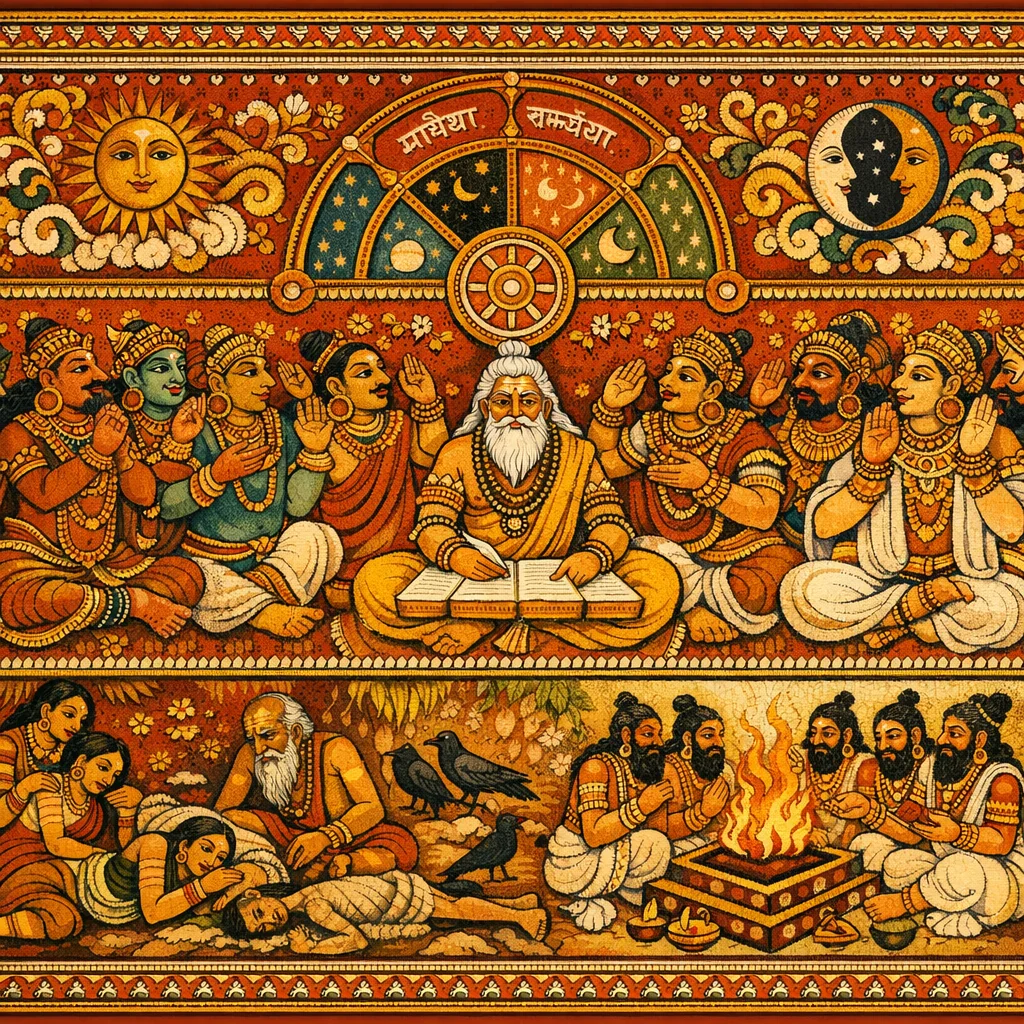
Sūta continues his cosmological-dharma discourse, declaring that after Tretā the rule of Dvāpara begins. He describes moral, social, and intellectual decline: siddhis wane, varṇa–āśrama boundaries blur, and interpretive divisions arise within Śruti and Smṛti. He then explains why the single Veda is repeatedly systematized and how, in Dvāpara, Vyāsa divides it into four; later lineage-based differentiations yield many streams of saṃhitā, brāhmaṇa, kalpa, bhāṣya, smṛti, and philosophical prasthāna. The narrative turns to Kali (notably the Puṣya phase), portraying famine, disease, political disorder, heresy, and collapsing norms, culminating in depopulation and survival on roots, meat, and fish, with social leveling. Yet a counter-current follows: suffering gives rise to dispassion, inquiry, and knowledge; the remnants regenerate and Kṛta returns, as the Saptarṣis restore śrauta–smārta dharma. Sūta closes by formalizing yuga-sandhyā rules and Manvantara counts and transitions, then moves on to describe the Manvantaras of this kalpa.
Key Concepts
Shlokas in Adhyaya 144
Verse 1
*सूत उवाच अत ऊर्ध्वं प्रवक्ष्यामि द्वापरस्य विधिं पुनः तत्र त्रेतायुगे क्षीणे द्वापरं प्रतिपद्यते //
Sūta said: “Now, further, I shall again declare the prescribed order and rule of the Dvāpara age. When the Tretā-yuga comes to its end, the Dvāpara-yuga begins.”
Verse 2
द्वापरादौ प्रजानां तु सिद्धिस्त्रेतायुगे तु या परिवृत्ते युगे तस्मिंस् ततः सा वै प्रणश्यति //
At the beginning of the Dvāpara Yuga, the siddhi (spiritual attainment) of people that existed in the Tretā Yuga—when that age turns over and changes—then indeed perishes.
Verse 3
ततः प्रवर्तिते तासां प्रजानां द्वापरे पुनः लोभो धृतिर्वणिग्युद्धं तत्त्वानाम् अविनिश्चयः //
Then, when those peoples come to be established again in the Dvāpara Yuga, greed arises; steadfastness becomes bound up with trade and conflict, and there is no clear ascertainment of the true principles (tattvas).
Verse 4
प्रध्वंसश्चैव वर्णानां कर्मणां तु विपर्ययः यात्रा वधः परो दण्डो मानो दर्पो ऽक्षमा बलम् //
There will be the ruin of the social orders (varṇas), and the proper duties (works) will be turned upside down. Expeditions will become slaughter; excessive punishment will prevail; and pride, arrogance, and intolerance will be taken as strength.
Verse 5
तथा रजस्तमो भूयः प्रवृत्ते द्वापरे पुनः आद्ये कृते नाधर्मो ऽस्ति स त्रेतायां प्रवर्तितः //
Likewise, in the Dvāpara Yuga, rajas and tamas become predominant again. In the first age, the Kṛta (Satya) Yuga, there is no adharma; it begins to manifest in the Tretā Yuga.
Verse 6
द्वापरे व्याकुलो भूत्वा प्रणश्यति कलौ पुनः वर्णानां द्वापरे धर्माः संकीर्यन्ते तथाश्रमाः //
In the Dvāpara Yuga, (dharma) becomes disturbed and confused, and in the Kali Yuga it again falls into ruin. In Dvāpara itself, the duties of the social classes (varṇas) become mixed, and likewise the disciplines of the life-stages (āśramas) become intermixed.
Verse 7
द्वैधमुत्पद्यते चैव युगे तस्मिञ्श्रुतिस्मृतौ द्विधा श्रुतिः स्मृतिश्चैव निश्चयो नाधिगम्यते //
In that age, a duality arises concerning Śruti and Smṛti: both Śruti and Smṛti become divided, and a clear determination (of what is right) cannot be ascertained.
Verse 8
अनिश्चयावगमनाद् धर्मतत्त्वं न विद्यते धर्मतत्त्वे ह्यविज्ञाते मतिभेदस्तु जायते //
Because Dharma is approached without firm ascertainment, the true principle of Dharma is not known; and when the truth of Dharma remains unknown, differences of opinion inevitably arise.
Verse 9
परस्परं विभिन्नास्ते दृष्टीनां विभ्रमेण तु अतो दृष्टिविभिन्नैस्तैः कृतमत्याकुलं त्विदम् //
Because their viewpoints are mutually divergent, and because perception itself is prone to confusion, this teaching has been rendered mentally bewildering by those whose outlooks differ.
Verse 10
एको वेदश्चतुष्पादः संहृत्य तु पुनः पुनः संक्षेपादायुषश्चैव व्यस्यते द्वापरेष्विह //
The one Veda, four-footed (complete in four quarters), is repeatedly gathered up; and then, for the sake of brevity and in view of the shortening of human lifespan, it is here arranged and divided in the Dvāpara ages.
Verse 11
वेदश्चैकश्चतुर्धा तु व्यस्यते द्वापरादिषु ऋषिपुत्रैः पुनर्वेदा भिद्यन्ते दृष्टिविभ्रमैः //
The Veda is one, yet in the Dvāpara age and thereafter it is arranged into four divisions. Then again, through the sons of the seers, the Vedas become further differentiated—owing to variations and confusions in human understanding.
Verse 12
ते तु ब्राह्मणविन्यासैः स्वरक्रमविपर्ययैः संहृता ऋग्यजुःसाम्नां संहितास्तैर्महर्षिभिः //
But those great sages compiled and arranged the Saṃhitās of the Ṛg-, Yajur-, and Sāma-Vedas, ordering the Brāhmaṇa portions and regulating variations of accent and sequence.
Verse 13
सामान्याद्वैकृताच्चैव दृष्टिभिन्नैः क्वचित्क्वचित् ब्राह्मणं कल्पसूत्राणि भाष्यविद्यास्तथैव च //
In some places, owing to differences of viewpoint, one finds teachings that diverge from what is general and from what is specialized; likewise there are the Brāhmaṇa texts, the Kalpa-sūtras, and the disciplines of commentary (bhāṣya) as well.
Verse 14
अन्ये तु प्रस्थितास्तान्वै केचित् तान् प्रत्यवस्थिताः द्वापरेषु प्रवर्तन्ते भिन्नार्थैस्तैः स्वदर्शनैः //
Others indeed set forth on their own paths, and some stand in opposition to them. In the Dvāpara age they become active, each through their own philosophical viewpoint (darśana), interpreting the meaning in divergent ways.
Verse 15
एकमाध्वर्यवं पूर्वम् आसीद्द्वैधं तु तत्पुनः सामान्यविपरीतार्थैः कृतं शास्त्राकुलं त्विदम् //
Formerly the Adhvaryu tradition—the ritual procedure of the Yajurvedic priest—was one and unified; later, however, it became twofold. Through interpretations that were merely generalized or even contrary in meaning, this body of ritual teaching has become confused and entangled.
Verse 16
आध्वर्यवं च प्रस्थानैर् बहुधा व्याकुलीकृतम् तथैवाथर्वणां साम्नां विकल्पैः स्वस्य संक्षयैः //
The Adhvaryu tradition (of the Yajurveda) was thrown into confusion in many ways by divergent lineages and procedures; likewise, the Atharvan and the Sāman traditions were affected by alternative readings and by the decline or loss of their own corpus.
Verse 17
व्याकुलो द्वापरेष्वर्थः क्रियते भिन्नदर्शनैः द्वापरे संनिवृत्ते ते वेदा नश्यन्ति वै कलौ //
In the Dvāpara age, the meaning of the sacred teaching becomes confused, being construed through divergent viewpoints. When that Dvāpara has passed, then in the Kali age the Vedas indeed decline and disappear from practice.
Verse 18
तेषां विपर्ययोत्पन्ना भवन्ति द्वापरे पुनः अदृष्टिर्मरणं चैव तथैव व्याध्युपद्रवाः //
For them, in the Dvāpara age, reversals and perversions arise again—loss of right discernment, death, and likewise the assaults of diseases and calamities.
Verse 19
वाङ्मनःकर्मभिर्दुःखैर् निर्वेदो जायते ततः निर्वेदाज्जायते तेषां दुःखमोक्षविचारणा //
From the sufferings born of speech, mind, and actions, dispassion (nirveda) arises; and from that dispassion there arises in them the inquiry into liberation from sorrow.
Verse 20
विचारणायां वैराग्यं वैराग्याद्दोषदर्शनम् दोषाणां दर्शनाच्चैव ज्ञानोत्पत्तिस्तु जायते //
From discriminative inquiry (vicāraṇā) arises dispassion (vairāgya); from dispassion comes the perception of faults. And from clearly seeing those faults, the arising of true knowledge is born.
Verse 21
तेषां मेधाविनां पूर्वं मर्त्ये स्वायम्भुवे ऽन्तरे उत्पस्यन्तीह शास्त्राणां द्वापरे परिपन्थिनः //
Before those wise ones fully arise, in the mortal world—within the Svāyambhuva Manvantara—there will appear here, in the Dvāpara age, adversaries who follow a contrary path and oppose the śāstras (sacred disciplines and authoritative teachings).
Verse 22
आयुर्वेदविकल्पाश्च अङ्गानां ज्योतिषस्य च अर्थशास्त्रविकल्पाश्च हेतुशास्त्रविकल्पनम् //
And there are the various branches of Āyurveda, the subsidiary Vedic disciplines (Vedāṅgas), and Jyotiṣa (astral science); likewise, the various branches of Arthaśāstra (polity and statecraft) and the systematic formulations of Hetuśāstra (logic and reasoning).
Verse 23
प्रक्रिया कल्पसूत्राणां भाष्यविद्याविकल्पनम् स्मृतिशास्त्रप्रभेदाश्च प्रस्थानानि पृथक् पृथक् //
The procedural methods of the Kalpa-sūtras, the various disciplines of commentary (bhāṣya) and learning, the diverse branches of Smṛti-śāstra, and the distinct doctrinal standpoints (prasthānas)—all are set forth separately, each in its own category.
Verse 24
द्वापरेष्वभिवर्तन्ते मतिभेदास्तथा नृणाम् मनसा कर्मणा वाचा कृच्छ्राद्वार्त्ता प्रसिध्यति //
In the Dvāpara age, divisions of opinion and outlook arise among people. Even livelihood and worldly dealings succeed only with difficulty—whether by thought, by action, or by speech.
Verse 25
द्वापरे सर्वभूतानां कालः क्लेशपरः स्मृतः लोभो ऽधृतिर्वणिग्युद्धं तत्त्वानामविनिश्चयः //
In the Dvāpara age, time is remembered as hardship-laden for all beings: greed prevails, steadfastness declines, trade turns into conflict, and certainty regarding true principles is lost.
Verse 26
वेदशास्त्रप्रणयनं धर्माणां संकरस्तथा वर्णाश्रमपरिध्वंसः कामद्वेषौ तथैव च //
There will be the fabrication of new Vedic and legal treatises; a confusion and intermixture of dharmic norms; the destruction of the system of social and spiritual orders (varṇa and āśrama); and likewise the rise of desire (kāma) and hatred (dveṣa).
Verse 27
पूर्णे वर्षसहस्रे द्वे परमायुस्तदा नृणाम् निःशेषे द्वापरे तस्मिंस् तस्य संध्या तु पादतः //
When two full thousand years have elapsed, that is the maximum lifespan of human beings at that time. And when that Dvāpara Yuga comes to its complete end, its twilight-period (yuga-sandhyā) is only one quarter in measure.
Verse 28
गुणहीनास्तु तिष्ठन्ति धर्मस्य द्वापरस्य तु तथैव संध्या पादेन अंशस्तस्यां प्रतिष्ठितः //
In the Dvāpara age, people remain lacking in virtues; and likewise, the transitional period (sandhyā) is established with only a quarter share of that dharma.
Verse 29
द्वापरस्य तु पर्याये पुष्यस्य च निबोधत द्वापरस्यांशशेषे तु प्रतिपत्तिः कलेरथ //
Now understand the concluding phase of the Dvāpara age and the time marked by Puṣya. When the remaining portion of Dvāpara is exhausted, then indeed begins the advent of the Kali age.
Verse 30
हिंसा स्तेयानृतं माया दम्भश्चैव तपस्विनाम् एते स्वभावाः पुष्यस्य साधयन्ति च ताः प्रजाः //
Violence, theft, falsehood, deceit, and hypocrisy—these become the very dispositions of ascetics. Such are the innate tendencies of the Puṣya age, and they come to govern and shape the people accordingly.
Verse 31
एष धर्मः स्मृतः कृत्स्नो धर्मश्च परिहीयते मनसा कर्मणा वाचा वार्त्ताः सिध्यन्ति वा न वा //
This is remembered as the whole of dharma; and dharma is diminished when one errs in mind, deed, and speech—whether one’s worldly pursuits and undertakings succeed or do not succeed.
Verse 32
कलिः प्रमारको रोगः सततं चापि क्षुद्भयम् अनावृष्टिभयं चैव देशानां च विपर्ययः //
In the age of Kali there will arise a destructive affliction like a plague; there will also be continual fear of famine, fear of drought, and the overturning of order in regions and kingdoms.
Verse 33
न प्रमाणे स्थितिर्ह्यस्ति पुष्ये घोरे युगे कलौ गर्भस्थो म्रियते कश्चिद् यौवनस्थस्तथा परः //
In the dreadful Kali age, when Puṣya (once deemed auspicious) prevails, there is no stability in any measure or standard; some die even in the womb, and others likewise perish while still in youth.
Verse 34
स्थाविर्ये मध्यकौमारे म्रियन्ते च कलौ प्रजाः अल्पतेजोबलाः पापा महाकोपा ह्यधार्मिकाः //
In the Kali age, people die both in old age and in the midst of youth; they are of little radiance and strength, sinful, prone to great anger, and devoid of dharma.
Verse 35
अनृतव्रतलुब्धाश्च पुष्ये चैव प्रजाः स्थिताः दुरिष्टैर्दुरधीतैश्च दुराचारैर्दुरागमैः //
In the (inauspicious) time of Puṣya, people will live as those devoted to false vows and driven by greed—corrupted by defective rites, faulty learning, wicked conduct, and evil teachings (scriptures and traditions).
Verse 36
विप्राणां कर्मदोषैस्तैः प्रजानां जायते भयम् हिंसा मानस्तथेर्ष्या च क्रोधो ऽसूयाक्षमाधृतिः //
From those faults in the actions of the Brahmanas (vipra), fear arises among the people—violence, arrogance, jealousy, anger, malice, lack of forgiveness, and loss of steadiness (self-control).
Verse 37
पुष्ये भवन्ति जन्तूनां लोभो मोहश्च सर्वशः संक्षोभो जायते ऽत्यर्थं कलिमासाद्य वै युगम् //
When the time called Puṣya prevails, greed and delusion arise among living beings on every side; and upon the advent of the age of Kali, intense agitation and turmoil come to be.
Verse 38
नाधीयते तथा वेदान् न यजन्ते द्विजातयः उत्सीदन्ति तथा चैव वैश्यैः सार्धं तु क्षत्रियाः //
The twice-born no longer study the Vedas, nor do they perform sacrifices; and the Kṣatriyas too decline, along with the Vaiśyas.
Verse 39
शूद्राणां मन्त्रयोनिस्तु सम्बन्धो ब्राह्मणैः सह भवतीह कलौ तस्मिञ् छयनासनभोजनैः //
In that Kali age, a Śūdra’s claim to mantra-initiation (as a ‘source of mantra’) and close association with Brāhmaṇas will come to be—sharing beds, seats, and food together.
Verse 40
राजानः शूद्रभूयिष्ठाः पाषण्डानां प्रवृत्तयः काषायिणश्च निष्कच्छास् तथा कापालिनश्च ह //
Kings will become largely śūdra-like in conduct; heretical sects will proliferate. There will be many who wear ochre robes, along with outcast wanderers, and also skull-bearing ascetics (kāpālikas).
Verse 41
ये चान्ये देवव्रतिनस् तथा ये धर्मदूषकाः दिव्यवृत्ताश्च ये केचिद् वृत्त्यर्थं श्रुतिलिङ्गिनः //
And also those others who pose as devotees under religious vows, as well as those who corrupt dharma; and certain people who feign a “divine” way of life—wearing the marks and outward signs sanctioned by scripture only for the sake of livelihood.
Verse 42
एवंविधाश्च ये केचिद् भवन्तीह कलौ युगे अधीयते तदा वेदाञ् छूद्रा धर्मार्थकोविदाः //
Thus, people of such kinds—whoever they may be—arise here in the Kali age; and then even Śūdras study the Vedas and become proficient in dharma and artha, righteous duty and practical welfare.
Verse 43
यजन्ते ह्यश्वमेधैस्तु राजानः शूद्रयोनयः स्त्रीबालगोवधं कृत्वा हत्वा चैव परस्परम् //
Indeed, kings born of Śūdra lineage will perform Aśvamedha sacrifices; having slain women, children, and cows, they will also kill one another.
Verse 44
उपहत्य तथान्योन्यं साधयन्ति तदा प्रजाः दुःखप्रचुरताल्पायुर् देशोत्सादः सरोगता //
Then the people, injuring one another, pursue their own ends; sorrow becomes abundant, lifespans grow short, the land falls into ruin, and disease becomes widespread.
Verse 45
अधर्माभिनिवेशित्वं तमोवृत्तं कलौ स्मृतम् भ्रूणहत्या प्रजानां न तथा ह्येवं प्रवर्तते //
In the age of Kali, the settled attachment to adharma is remembered as a dark, tamasic disposition. Even the killing of embryos among people is no longer treated or regarded as it should be—so pervasive is this tendency.
Verse 46
तस्मादायुर्बलं रूपं प्रहीयन्ते कलौ युगे दुःखेनाभिप्लुतानां च परमायुः शतं नृणाम् //
Therefore, in the Kali age, lifespan, strength, and bodily beauty steadily decline; and for people overwhelmed by suffering, the utmost span of life is only a hundred years.
Verse 47
भूत्वा च न भवन्तीह वेदाः कलियुगे ऽखिलाः उत्सीदन्ते तथा यज्ञाः केवलं धर्महेतवः //
In the Kali Yuga, the Vedas—though they exist—do not remain fully manifest in this world; likewise the sacrificial rites (yajñas) decline, surviving only as means for the maintenance of dharma.
Verse 48
एषा कलियुगावस्था संध्यांशौ तु निबोधत युगे युगे तु हीयन्ते त्रींस्त्रीन्पादांश्च सिद्धयः //
Know this as the condition of the Kali Yuga, especially in its twilight junction (sandhyā): in each succeeding yuga, the spiritual attainments (siddhis) diminish, losing in turn three and three ‘quarters’ (parts/steps).
Verse 49
युगस्वभावाः संध्यासु अवतिष्ठन्ति पादतः संध्यास्वभावाः स्वांशेषु पादेनैवावतस्थिरे //
The inherent qualities of each Yuga persist in the twilight junctions (sandhyās) only to the extent of a quarter; and the qualities of the sandhyās themselves likewise remain established within their own portions by just a quarter.
Verse 50
एवं संध्यांशके काले सम्प्राप्ते तु युगान्तिके तेषामधर्मिणां शास्ता भृगूणां च कुले स्थितः //
Thus, when the twilight-fraction of the age arrived—at the very verge of the yuga’s end—there appeared a chastiser of those unrighteous ones, established in the lineage of the Bhṛgus.
Verse 51
गोत्रेण वै चन्द्रमसो नाम्ना प्रमतिरुच्यते कलिसंध्यांशभागेषु मनोः स्वायम्भुवे ऽन्तरे //
In Manu’s Svāyambhuva Manvantara, within the fractional divisions known as the Kali-sandhyā portions, Pramati is indeed spoken of by name as belonging to the Candramas (Moon) gotra.
Verse 52
समास्त्रिंशत्तु सम्पूर्णाः पर्यटन्वै वसुंधराम् अश्वकर्मा स वै सेनां हस्त्यश्वरथसंकुलाम् //
For a full thirty years indeed, Aśvakarmā roamed over the earth, moving with an army crowded with elephants, horses, and chariots.
Verse 53
प्रगृहीतायुधैर्विप्रैः शतशो ऽथ सहस्रशः स तदा तैः परिवृतो म्लेच्छान्सर्वान् निजघ्निवान् //
Then, surrounded by Brahmins who had taken up weapons—by the hundreds and even by the thousands—he proceeded at that time to strike down all the mlecchas.
Verse 54
स हत्वा सर्वशश्चैव राजानः शूद्रयोनयः पाषण्डान्स सदा सर्वान् निःशेषानकरोत्प्रभुः //
Having slain, in every way, the kings born of Śūdra lineage, that mighty lord also always exterminated all the pāṣaṇḍas (heretical, anti-Vedic sectarians) without remainder.
Verse 55
अधार्मिकाश्च ये केचित् तान्सर्वान्हन्ति सर्वशः उदीच्यान्मध्यदेशांश्च पार्वतीयांस्तथैव च //
Whoever are unrighteous, he destroys them all, in every way—whether they are in the northern regions, the Middle Country, or likewise among the mountain-dwellers.
Verse 56
प्राच्यान्प्रतीच्यांश्च तथा विन्ध्यपृष्ठापरान्तिकान् तथैव दाक्षिणात्यांश्च द्रविडान्सिंहलैः सह //
Likewise (they enumerated) the Easterners and the Westerners, those dwelling along the Vindhya back-slopes and in Aparānta (the western coastal tract), and also the Southerners—the Draviḍas—together with the Siṃhalas (people of Laṅkā/Sri Lanka).
Verse 57
गान्धारान्पारदांश्चैव पह्लवान्यवनाञ्छकान् तुषारान्बर्बराञ्छ्वेतान् हलिकान्दरदान्खसान् //
He also mentions the Gāndhāras and the Pāradas, the Pahlavas, the Yavanas and the Śakas; the Tuṣāras, the Barbarians, the Śvetas, the Halikas, the Daradas, and the Khaśas.
Verse 58
लम्पकान् आन्ध्रकांश्चापि चोरजातींस्तथैव च प्रवृत्तचक्रो बलवाञ् छूद्राणामन्तकृद्बभौ //
He powerfully set the wheel of conquest in motion, and he became a destroyer of the Lampakas, the Andhrakas, and likewise the thief-tribes—an exterminator of the Śūdras.
Verse 59
विद्राव्य सर्वभूतानि चचार वसुधामिमाम् मानवस्य तु वंशे तु नृदेवस्येह जज्ञिवान् //
Having put all beings to flight, he ranged over this earth; and in this very world he was born in the human lineage, in the line of King Nṛdeva.
Verse 60
पूर्वजन्मनि विष्णुश्च प्रमतिर्नाम वीर्यवान् सुतः स वै चन्द्रमसः पूर्वे कलियुगे प्रभुः //
In a former birth, Viṣṇu was the valiant son named Pramati; indeed, he was a lord in the earlier Kali Yuga, belonging to the lunar line (Candramas).
Verse 61
द्वात्रिंशे ऽभ्युदिते वर्षे प्रक्रान्तो विंशतिं समाः निजघ्ने सर्वभूतानि मानुषाण्येव सर्वशः //
When the thirty-second year had dawned, having set out and spent twenty years (on campaign), he slaughtered all beings—indeed, human beings everywhere, without exception.
Verse 62
कृत्वा बीजावशिष्टां तां पृथ्वीं क्रूरेण कर्मणा परस्परनिमित्तेन कालेनाकस्मिकेन च //
Having reduced the earth to a condition where only seed remained, through cruel deeds—arising from the mutual causation among beings and from the sudden, unforeseen workings of Time—so it came to pass.
Verse 63
संस्थिता सहसा या तु सेना प्रमतिना सह गङ्गायमुनयोर्मध्ये सिद्धिं प्राप्ता समाधिना //
But that army, suddenly coming to a halt together with Pramati, attained spiritual accomplishment (siddhi) through samādhi in the region between the Gaṅgā and the Yamunā.
Verse 64
ततस्तेषु प्रनष्टेषु संध्यांशे कूरकर्मसु उत्साद्य पार्थिवान्सर्वांस् तेष्वतीतेषु वै तदा //
Then, when those (times and observances) had perished—when the twilight-junction of the age had set in and base deeds prevailed—he brought about the destruction of all earthly kings; and when they had passed away, then the next phase unfolded.
Verse 65
ततः संध्यांशके काले सम्प्राप्ते च युगान्तिके स्थितास्वल्पावशिष्टासु प्रजास्विह क्वचित् क्वचित् //
Then, when the twilight-fraction of the age arrived and the end of the Yuga drew near, the creatures here and there remained only in scant, residual numbers.
Verse 66
स्वाप्रदानास् तदा ते वै लोभाविष्टास्तु वृन्दशः उपहिंसन्ति चान्योन्यं प्रलुम्पन्ति परस्परम् //
Then, impelled by greed, those groups—clinging to what they claim as their own—injure one another and plunder each other in turn.
Verse 67
अराजके युगांशे तु संक्षये समुपस्थिते प्रजास्ता वै तदा सर्वाः परस्परभयार्दिताः //
When the age declines and the time of kinglessness arrives, then indeed all the people are afflicted by fear of one another.
Verse 68
व्याकुलास्ताः परावृत्तास् त्यक्त्वा देवं गृहाणि तु स्वान्स्वान्प्राणानवेक्षन्तो निष्कारुण्यात् सुदुःखिताः //
Agitated and turning back, they abandoned the deity and even their homes; through pitilessness they did not look after one another’s very lives, and thus became exceedingly sorrowful.
Verse 69
नष्टे श्रौतस्मृते धर्मे कामक्रोधवशानुगाः निर्मर्यादा निरानन्दा निःस्नेहा निरपत्रपाः //
When dharma founded on Śruti and Smṛti is lost, people become driven by lust and anger—without restraint, without joy, without affection, and without shame.
Verse 70
नष्टे धर्मे प्रतिहता ह्रस्वकाः पञ्चविंशकाः हित्वा दारांश्च पुत्रांश्च विषादव्याकुलप्रजाः //
When dharma has perished, people become thwarted and diminished—their lives reduced to twenty-five years; abandoning wives and sons, the populace is shaken and distressed by sorrow.
Verse 71
अनावृष्टिहतास्ते वै वार्त्तामुत्सृज्य दुःखिताः आश्रयन्ति स्म प्रत्यन्तान् हित्वा जनपदान्स्वकान् //
Struck by drought, they—distressed—abandoned their agrarian means of livelihood and took refuge in the frontier regions, leaving behind their own home provinces.
Verse 72
सरितः सागरानूपान् सेवन्ते पर्वतानपि चीरकृष्णाजिनधरा निष्क्रिया निष्परिग्रहाः //
Clad in garments of bark and in black antelope-skins, inactive in worldly pursuits and free from possessions, they dwell by rivers, on seacoasts and marshlands, and also among mountains.
Verse 73
वर्णाश्रमपरिभ्रष्टाः संकरं घोरमास्थिताः एवं कष्टमनुप्राप्ता ह्य् अल्पशेषाः प्रजास्ततः //
Having fallen away from the discipline of varṇa and āśrama, the people entered a dreadful state of social mixture and disorder. Thus they came to great suffering, and as a result only a small remnant of the population was left.
Verse 74
जन्तवश्च क्षुधाविष्टा दुःखान्निर्वेदमागमन् संश्रयन्ति च देशांस्तांश् चक्रवत्परिवर्तनाः //
And living beings, seized by hunger, fell into despondency from their sufferings; and, turning about like a wheel, they sought refuge again and again in those very regions.
Verse 75
ततः प्रजास्तु ताः सर्वा मांसाहारा भवन्ति हि मृगान्वराहान्वृषभान् ये चान्ये वनचारिणः //
Thereafter, all those beings indeed become flesh-eaters, consuming deer, boars, bulls, and other creatures that roam the forests.
Verse 76
भक्ष्यांश्चैवाप्यभक्ष्यांश्च सर्वांस्तान्भक्षयन्ति ताः समुद्रं संश्रिता यास्तु नदीश्चैव प्रजास्तु ताः //
Those waters consume everything—both what is fit to be eaten and what is unfit. And those beings that have taken refuge in the ocean are called “rivers”; indeed, they are the “offspring” (progeny) of the sea.
Verse 77
ते ऽपि मत्स्यान्हरन्तीह आहारार्थं च सर्वशः अभक्ष्याहारदोषेण एकवर्णगताः प्रजाः //
They too, everywhere in this world, seize fish merely for the sake of food; and through the fault of eating what is forbidden, the people fall into a single, undifferentiated social condition, losing the proper distinctions of varṇa.
Verse 78
यथा कृतयुगे पूर्वम् एकवर्णमभूत्किल तथा कलियुगस्यान्ते शूद्रीभूताः प्रजास्तथा //
Just as it is said that in the former Kṛta Yuga there was a single social order (one varṇa), so too, at the end of the Kali Yuga, the people likewise become as though reduced to the condition of Śūdras.
Verse 79
एवं वर्षशतं पूर्णं दिव्यं तेषां न्यवर्तत षट्त्रिंशच्च सहस्राणि मानुषाणि तु तानि वै //
Thus, when their full span of one hundred divine years had elapsed, that amounted indeed to thirty-six thousand human years.
Verse 80
अथ दीर्घेण कालेन पक्षिणः पशवस्तथा मत्स्याश्चैव हताः सर्वैः क्षुधाविष्टैश्च सर्वशः //
Then, after a long time had passed, birds, beasts, and even fish were slaughtered everywhere by all people, driven on every side by the torment of hunger.
Verse 81
निःशेषेष्वथ सर्वेषु मत्स्यपक्षिपशुष्वथ संध्यांशे प्रतिपन्ने तु निःशेषास्तु तदा कृताः //
Then, when all had been completely exhausted—fish, birds, and beasts alike—and when the world had entered the twilight-portion (the liminal time of dissolution), they were at that time made utterly without remainder.
Verse 82
ततः प्रजास्तु सम्भूय कन्दमूलमथो ऽखनन् फलमूलाशनाः सर्वे अनिकेतास्तथैव च //
Then the people gathered together and dug up bulbs and roots; all of them lived on fruits and roots, and likewise remained without fixed dwellings.
Verse 83
वल्कलान्यथ वासांसि अधःशय्याश्च सर्वशः परिग्रहो न तेष्वस्ति धनशुद्धिमवाप्नुयुः //
Wearing bark-garments and simple clothes, and sleeping on the ground in every way—when there is no possessiveness toward such things, they attain purity of wealth.
Verse 84
एवं क्षयं गमिष्यन्ति ह्य् अल्पशिष्टाः प्रजास्तदा तासामल्पावशिष्टानाम् आहारादृद्धिरिष्यते //
Thus, the remaining creatures will indeed go to ruin; and then, for those who are left in only small number, their increase will be said to arise from food (i.e., by the availability of sustenance).
Verse 85
एवं वर्षशतं दिव्यं संध्यांशस्तस्य वर्तते ततो वर्षशतस्यान्ते अल्पशिष्टाः स्त्रियः सुताः //
Thus, for a hundred divine years, its twilight-phase (the residual interval) continues; and when that hundred years comes to an end, only a small remnant remains—women and children.
Verse 86
मिथुनानि तु ताः सर्वा ह्य् अन्योन्यं सम्प्रजज्ञिरे ततस्तास्तु म्रियन्ते वै पूर्वोत्पन्नाः प्रजास्तु याः //
All those beings, forming into pairs, generated offspring with one another; and then, indeed, the earlier-born creatures among them die.
Verse 87
जातमात्रेष्वपत्येषु ततः कृतमवर्तत यथा स्वर्गे शरीराणि नरके चैव देहिनाम् //
From the very moment offspring are born, the deed (karma) set in motion begins to bear its effect—just as embodied beings obtain bodies in heaven, and likewise in hell.
Verse 88
उपभोगसमर्थानि एवं कृतयुगादिषु एवं कृतस्य संतानः कलेश्चैव क्षयस्तथा //
Thus, in the Kṛta Yuga and the other ages, beings were fit for enjoyment and prosperity; but in Kali as well there is decline—so too the diminution of the offspring (lineages) of the Kṛta age.
Verse 89
विचारणात्तु निर्वेदः साम्यावस्थात्मना तथा ततश्चैवात्मसम्बोधः सम्बोधाद्धर्मशीलता //
From deep inquiry arises dispassion; and from abiding in inner equanimity as one’s very nature arises awakening to the Self. From that awakening comes a steadfast disposition toward dharma.
Verse 90
कलिशिष्टेषु तेष्वेवं जायन्ते पूर्ववत्प्रजाः भाविनो ऽर्थस्य च बलात् ततः कृतमवर्तत //
When those remnants of the Kali age remained thus, beings were born again as before; and by the compelling force of what was destined to unfold, the Kṛta age then came into operation once more.
Verse 91
अतीतानागतानि स्युर् यानि मन्वन्तरेष्विह एते युगस्वभावास्तु मयोक्तास्तु समासतः //
Whatever events and patterns belong to past and future Manvantaras—these intrinsic characteristics of the Yugas have been stated by me here in summary.
Verse 92
विस्तरेणानुपूर्व्याच्च नमस्कृत्य स्वयम्भुवे प्रवृत्ते तु ततस्तस्मिन् पुनः कृतयुगे तु वै //
Then, having paid homage to Svayambhū (Brahmā) and having set forth the account in due sequence and in full detail, he continued; and in that course it was indeed said again that the Kṛta Yuga (Satya Yuga) returns once more.
Verse 93
उत्पन्नाः कलिशिष्टेषु प्रजाः कार्तयुगास्तथा तिष्ठन्ति चेह ये सिद्धा अदृष्टा विहरन्ति च //
Among the remnants of the Kali age there arise people who bear the qualities of the Kṛta (Satya) Yuga; and here as well the Siddhas, perfected beings, remain—unseen, moving about freely at will.
Verse 94
सह सप्तर्षिभिर्ये तु तत्र ये च व्यवस्थिताः ब्रह्मक्षत्रविशः शूद्रा बीजार्थे य इह स्मृताः कार्तयुगभवैः सार्धं निर्विशेषास्तदाभवन् //
And those who were established there together with the Seven Ṛṣis—remembered here as the “seeds” (origins) of the brāhmaṇa, kṣatriya, vaiśya, and śūdra orders—became, in that Kṛta Yuga, without distinction among themselves.
Verse 95
तेषां सप्तर्षयो धर्मं कथयन्तीह तेषु च //
To them the Seven Sages here expounded dharma—the principles of righteous order—and they did so in the midst of their own assembly as well.
Verse 96
वर्णाश्रमाचारयुतं श्रौतस्मार्तविधानतः एवं तेषु क्रियावत्सु प्रवर्तन्तीह वै कृते //
In the Kṛta Yuga, people here were established in the proper conduct of the varṇas and āśramas, acting in accordance with the ordinances of both Śruti (Vedic revelation and rites) and Smṛti (traditional law). Thus, among those devoted to prescribed duties, right practice prevailed.
Verse 97
श्रौतस्मार्तस्थितानां तु धर्मे सप्तर्षिदर्शिते ते तु धर्मव्यवस्थार्थं तिष्ठन्तीह कृते युगे //
But for those established in śrauta and smārta dharma—the dharma shown by the Seven Sages (Saptarṣis)—the Saptarṣis remain here in the Kṛta Yuga in order to regulate and firmly establish the order of dharma.
Verse 98
मन्वन्तराधिकारेषु तिष्ठन्ति ऋषयस्तु ते यथा दावप्रदग्धेषु तृणेष्वेवापरं तृणम् //
In the successive jurisdictions of the Manvantaras, those sages continue to abide—just as, when grass has been scorched by a forest-fire, fresh grass again appears upon the very same ground.
Verse 99
वनानां प्रथमं वृष्ट्या तेषां मूलेषु सम्भवः एवं युगाद्युगानां वै संतानस्तु परस्परम् //
By the first rainfall, forests arise first—sprouting from their very roots. In the same way, from one age to the next, the succession of the yugas proceeds in mutual continuity.
Verse 100
प्रवर्तते ह्यविच्छेदाद् यावन्मन्वन्तरक्षयः सुखमायुर्बलं रूपं धर्मार्थौ काम एव च //
Indeed, without interruption it continues until the end of a Manvantara—bringing happiness, long life, strength, beauty, and the attainments of dharma and artha, and also kāma.
Verse 101
युगेष्वेतानि हीयन्ते त्रयः पादाः क्रमेण तु इत्येष प्रतिसंधिर्वः कीर्तितस्तु मया द्विजाः //
Across the successive yugas these (virtues of dharma) diminish—three ‘quarters’ step by step. Thus has this junctional rule of transition between the ages (pratisaṃdhi) been declared by me to you, O twice-born ones (dvijas).
Verse 102
चतुर्युगाणां सर्वेषाम् एतदेव प्रसाधनम् एषां चतुर्युगाणां तु गणिता ह्येकसप्ततिः //
This alone is the established rule for the reckoning of all the cycles of the four Yugas; and the computed number of these Caturyugas is indeed seventy-one.
Verse 103
क्रमेण परिवृत्तास्ता मनोरन्तरमुच्यते युगाख्यासु तु सर्वासु भवतीह यदा च यत् //
As they revolve successively in due order, this is called the interval of a Manu (a Manvantara). And within all the named Yugas, whatever occurs here does so at the proper time and in its proper measure.
Verse 104
तदेव च तदन्यासु पुनस्तद्वै यथाक्रमम् सर्गे सर्गे यथा भेदा ह्य् उत्पद्यन्ते तथैव च //
And that very same process occurs again in the others as well, indeed in due order; in each cycle of creation, the distinctions and varieties arise exactly as they do each time.
Verse 105
चतुर्दशसु तावन्तो ज्ञेया मन्वन्तरेष्विह आसुरी यातुधानी च पैशाची यक्षराक्षसी //
Across the fourteen Manvantaras, these are to be understood as existing here in like measure: the Asuric, the Yātudhānī, the Paiśācī, and the Yakṣa–Rākṣasī classes of beings.
Verse 106
युगे युगे तदा काले प्रजा जायन्ति ताः शृणु यथाकल्पं युगैः सार्धं भवन्ते तुल्यलक्षणाः इत्येतल्लक्षणं प्रोक्तं युगानां वै यथाक्रमम् //
In each and every Yuga, at the proper time, living beings are born—listen to this. In accordance with the Kalpa, and with the succession of Yugas, they arise bearing characteristics appropriate to each Yuga. Thus, in due order, the defining marks of the Yugas have been declared.
Verse 107
मन्वन्तराणां परिवर्तनानि चिरप्रवृत्तानि युगस्वभावात् क्षणं न संतिष्ठति जीवलोकः क्षयोदयाभ्यां परिवर्तमानः //
The alternations of the Manvantaras have been proceeding since ancient times, by the very nature of the Yugas. The world of living beings does not remain fixed even for a moment, ever turning through decline and rise.
Verse 108
एते युगस्वभावा वः परिक्रान्ता यथाक्रमम् मन्वन्तराणि यान्यस्मिन् कल्पे वक्ष्यामि तानि च //
Thus the characteristics of the Yugas have been set forth to you in due order. Now I shall also describe the Manvantaras that occur in this Kalpa.
Frequently Asked Questions
It teaches how dharma, social order, and even interpretive certainty decline across yugas—especially in Dvāpara and Kali—and why scripture and practice become fragmented. It also gives a spiritual remedy: suffering leads to dispassion (nirveda), inquiry (vicāra), fault-perception, and true knowledge, enabling renewal when Kṛta Yuga returns.
This chapter is primarily Dharma and Creation-timekeeping: yuga-lakṣaṇa (Dvāpara/Kali traits), varṇa–āśrama dharma disruption, Śruti–Smṛti and śāstra-bheda, Veda division into four, and Manvantara/caturyuga reckoning (71 caturyugas). It is not a Vāstu-śāstra or architectural chapter.
It states the Veda is fundamentally one, but in Dvāpara it is arranged into four for brevity as human lifespan and capacity diminish. Later, through seers’ lineages and differing understandings, further textual differentiation appears (saṃhitā/brāhmaṇa/kalpa/bhāṣya and distinct doctrinal standpoints).
Puṣya-Kali is portrayed as a time of instability and norm-collapse: ascetics adopt हिंसा/स्तेय/अनृत/माया/दम्भ; famine, drought, disease, and political disorder arise; Vedic study and sacrifices decline; heresies proliferate; and society moves toward fear, migration, and subsistence living.
It states that 71 caturyugas (four-yuga cycles) constitute the computed measure associated with a Manu’s interval (Manvantara), alongside rules about sandhyā/sandhyāṃśa where yuga qualities persist only in quarter measures.