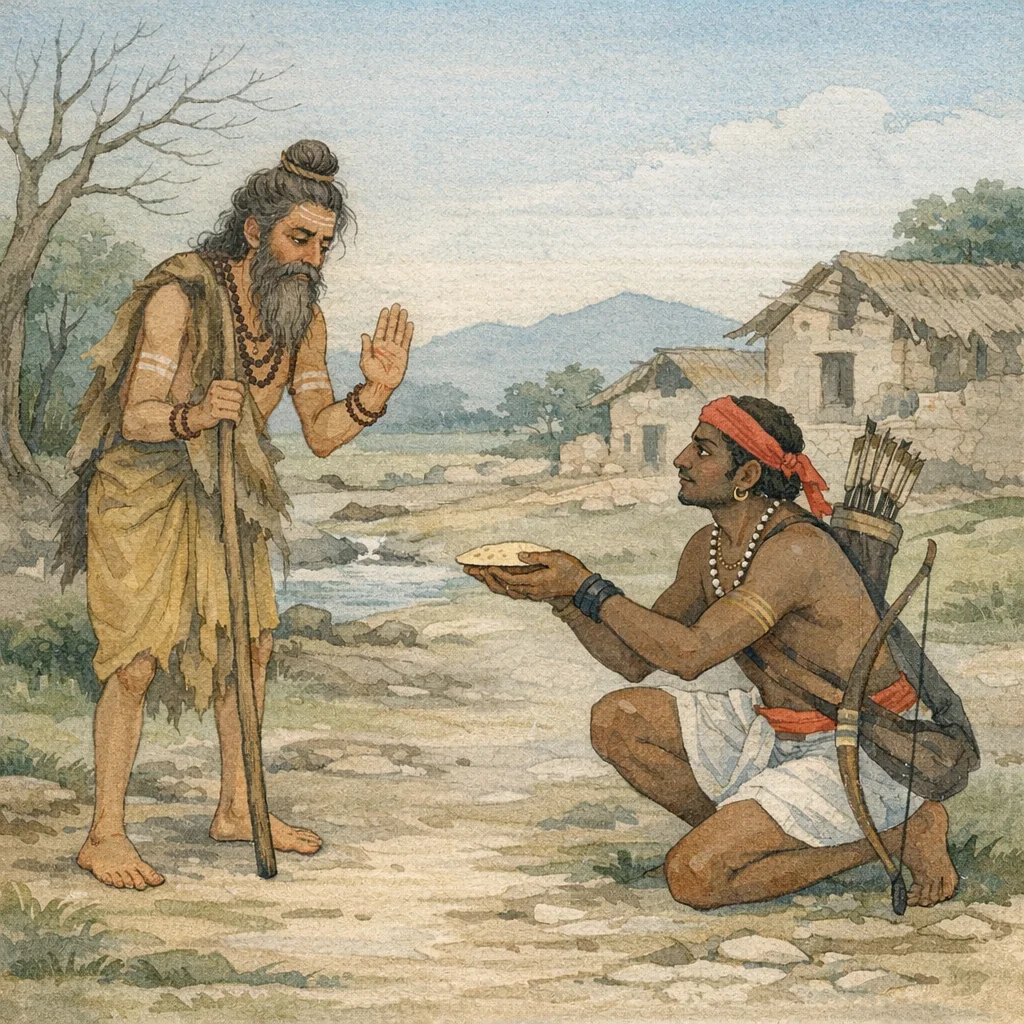
Adhyaya 142
Śaraṇāgata-Atithi-Dharma in the Kapota Narrative (कपोत-आख्यानम्—शरणागतधर्मः)
Upa-parva: Rājadharmānuśāsana (Śaraṇāgata-Atithi-Dharma Episode)
Bhīṣma narrates a forest exemplum in which a bird (host) laments the absence of his spouse and extols the wife as the principal support of household life—emotionally, ethically, and pragmatically—especially in adversity. The spouse returns having been seized by a hunter; hearing her husband’s distress, she counsels him toward śreyas: to become a protector of one who has sought refuge, even if the seeker is the hunter himself. The host then welcomes the hunter as a guest, offers warmth by arranging fuel and lighting a fire, and speaks the language of non-fear and belonging within the host’s dwelling. When asked for food, the host confesses scarcity and the absence of stored provisions typical of forest life. Resolving the dharmic tension between inability and obligation, the host affirms a firm intention toward atithi-pūjā and, after circumambulating the fire, enters it—an act presented as the extreme completion of hospitality. The hunter, witnessing this, collapses into remorse, recognizing the ethical gravity of harming such a host and anticipating the consequences of adharma.
Chapter Arc: युधिष्ठिर, युद्धोत्तर ध्वंस और लोक-व्यवस्था के टूटने का चित्र खींचते हुए पूछते हैं—जब मर्यादाएँ नष्ट हों, धर्म-निश्चय डगमगा जाए, और भय-भूख से जन-जीवन उजड़ जाए, तब मनुष्य किस धर्म का आश्रय ले? → भीषण आपत्ति-काल का दृश्य उभरता है—कहीं चोरों का आतंक, कहीं शस्त्रों का भय, कहीं राजाओं का उत्पीड़न; ब्राह्मण और रक्षक-वृन्द नष्ट, औषधि-अन्न के संचय मिटे, पृथ्वी मानो करुण-ध्वनियों से भर उठी। इसी पृष्ठभूमि में विश्वामित्र–चाण्डाल संवाद का प्रसंग आता है, जहाँ महर्षि भूख से विवश होकर निषिद्ध कर्म की ओर झुकते हैं। → विश्वामित्र जानते हुए भी कहते हैं कि यह अधर्म है, फिर भी वे कुत्ते की जाँघ (श्वजाघनी) उठा ले जाने का निश्चय करते हैं—यहीं आपद्धर्म की सीमा और आत्म-धर्म का संकट चरम पर पहुँचता है। चाण्डाल घबराकर उठता है और रोकता है: किसी असाधु के अनुचित कर्म को सनातन धर्म नहीं कहा जा सकता; आप बहाने से भी अकरणीय कर्म न करें—धर्म न हीयते, ऐसा आचरण करें। → चाण्डाल का उपदेश कथा को एक नैतिक कसौटी पर टिकाता है—आपत्ति में भी ‘धर्म-हानि’ का भय वास्तविक है; अतः निर्णय ऐसा हो जो जीवन-रक्षा और धर्म-रक्षा—दोनों के बीच न्यूनतम पतन का मार्ग चुने। अध्याय का निष्कर्ष संवादात्मक है: आपद्धर्म का प्रश्न नियमों की सूची नहीं, विवेक और मर्यादा की परीक्षा है। → विश्वामित्र की विवशता और चाण्डाल की रोक—इन दोनों के बीच अंतिम निर्णय किस ओर झुकेगा, और ‘धर्म न हीयते’ की शर्त कैसे पूरी होगी—यह तनाव आगे के संवाद के लिए छोड़ दिया जाता है।
Shlokas
Verse 1
- कोयलका श्रेष्ठ गुण है कण्ठकी मधुरता, सूअरके आक्रमणको रोकना कठिन है, यही उसकी विशेषता है; मेरुका गुण है सबसे अधिक उन्नत होना, सूने घरकी विशेषता है अनेकको आश्रय देना, नटका गुण है दूसरोंको अपने क्रिया- कौशलद्दारा संतुष्ट करना तथा अनुरक्त सुहृदकी विशेषता है हितपरायणता। ये सारे गुण राजाको अपनाने चाहिये। एकचत्वारिंशर्दाधिकशततमो< ध्याय: 'ब्राह्ण भयंकर संकटकालमें किस तरह जीवन-निर्वाह करे” इस विषयमें विश्वामित्र मुनि और चाण्डालका संवाद युधिछिर उवाच हीने परमके धर्मे सर्वतोकाभिलड्घिते । अधर्मे धर्मतां नीते धर्मे चाधर्मतां गते,युधिष्ठिरने पूछा--प्रजानाथ! भरतनन्दन! भूपाल-शिरोमणे! जब सब लोगोंके द्वारा धर्मका उल्लंघन होनेके कारण श्रेष्ठ धर्म क्षीण हो चले, अधर्मको धर्म मान लिया जाय और धर्मको अधर्म समझा जाने लगे, सारी मर्यादाएँ नष्ट हो जाया, धर्मका निश्चय डावाँडोल हो जाय, राजा अथवा शत्रु प्रजाको पीड़ा देने लगें, सभी आश्रम किंकर्तव्यविमूढ़ हो जायूँ, धर्म-कर्म नष्ट हो जायूँ, काम, लोभ तथा मोहके कारण सबको सर्वत्र भय दिखायी देने लगे, किसीका किसीपर विश्वास न रह जाय, सभी सदा डरते रहें, लोग धोखेसे एक-दूसरेको मारने लगें, सभी आपसमें ठगी करने लगें, देशमें सब ओर आग लगायी जाने लगे, ब्राह्मण अत्यन्त पीड़ित हो जाय, वृष्टि न हो, परस्पर वैर-विरोध और फूट बढ़ जाय और पृथ्वीपर जीविकाके सारे साधन लुटेरोंके अधीन हो जाय, तब ऐसा अधम समय उपस्थित होनेपर ब्राह्मण किस उपायसे जीवन-निर्वाह करे?
Yudhiṣṭhira said: When the highest dharma has declined and is violated on all sides; when adharma is treated as dharma, and dharma itself is judged to be adharma—then, in such a terrifying collapse of moral order, by what means should a brāhmaṇa sustain life?
Verse 2
मर्यादासु विनष्टास क्षुभिते धर्मनिश्चये । राजशि: पीडिते लोके परैर्वापि विशाम्पते,युधिष्ठिरने पूछा--प्रजानाथ! भरतनन्दन! भूपाल-शिरोमणे! जब सब लोगोंके द्वारा धर्मका उल्लंघन होनेके कारण श्रेष्ठ धर्म क्षीण हो चले, अधर्मको धर्म मान लिया जाय और धर्मको अधर्म समझा जाने लगे, सारी मर्यादाएँ नष्ट हो जाया, धर्मका निश्चय डावाँडोल हो जाय, राजा अथवा शत्रु प्रजाको पीड़ा देने लगें, सभी आश्रम किंकर्तव्यविमूढ़ हो जायूँ, धर्म-कर्म नष्ट हो जायूँ, काम, लोभ तथा मोहके कारण सबको सर्वत्र भय दिखायी देने लगे, किसीका किसीपर विश्वास न रह जाय, सभी सदा डरते रहें, लोग धोखेसे एक-दूसरेको मारने लगें, सभी आपसमें ठगी करने लगें, देशमें सब ओर आग लगायी जाने लगे, ब्राह्मण अत्यन्त पीड़ित हो जाय, वृष्टि न हो, परस्पर वैर-विरोध और फूट बढ़ जाय और पृथ्वीपर जीविकाके सारे साधन लुटेरोंके अधीन हो जाय, तब ऐसा अधम समय उपस्थित होनेपर ब्राह्मण किस उपायसे जीवन-निर्वाह करे?
Yudhiṣṭhira said: When the established boundaries of conduct have collapsed, when certainty about dharma is thrown into confusion, when the people are oppressed—whether by the king-sage himself or by hostile powers—O lord of the subjects, what means of livelihood should a brāhmaṇa adopt in such a degraded time?
Verse 3
सर्वाश्रमेषु मूढेषु कर्मसूपहतेषु च । कामाल्लोभाच्च मोहाच्च भयं पश्यत्सु भारत,युधिष्ठिरने पूछा--प्रजानाथ! भरतनन्दन! भूपाल-शिरोमणे! जब सब लोगोंके द्वारा धर्मका उल्लंघन होनेके कारण श्रेष्ठ धर्म क्षीण हो चले, अधर्मको धर्म मान लिया जाय और धर्मको अधर्म समझा जाने लगे, सारी मर्यादाएँ नष्ट हो जाया, धर्मका निश्चय डावाँडोल हो जाय, राजा अथवा शत्रु प्रजाको पीड़ा देने लगें, सभी आश्रम किंकर्तव्यविमूढ़ हो जायूँ, धर्म-कर्म नष्ट हो जायूँ, काम, लोभ तथा मोहके कारण सबको सर्वत्र भय दिखायी देने लगे, किसीका किसीपर विश्वास न रह जाय, सभी सदा डरते रहें, लोग धोखेसे एक-दूसरेको मारने लगें, सभी आपसमें ठगी करने लगें, देशमें सब ओर आग लगायी जाने लगे, ब्राह्मण अत्यन्त पीड़ित हो जाय, वृष्टि न हो, परस्पर वैर-विरोध और फूट बढ़ जाय और पृथ्वीपर जीविकाके सारे साधन लुटेरोंके अधीन हो जाय, तब ऐसा अधम समय उपस्थित होनेपर ब्राह्मण किस उपायसे जीवन-निर्वाह करे?
Yudhiṣṭhira said: “O Bhārata, when people in every stage of life become bewildered and their rightful duties are shattered; when, driven by desire, greed, and delusion, they see fear everywhere—what is to be done in such a time?”
Verse 4
अविश्वस्तेषु सर्वेषु नित्यं भीतेषु पार्थिव । निकृत्या हन्यमानेषु वज्चयत्सु परस्परम्,युधिष्ठिरने पूछा--प्रजानाथ! भरतनन्दन! भूपाल-शिरोमणे! जब सब लोगोंके द्वारा धर्मका उल्लंघन होनेके कारण श्रेष्ठ धर्म क्षीण हो चले, अधर्मको धर्म मान लिया जाय और धर्मको अधर्म समझा जाने लगे, सारी मर्यादाएँ नष्ट हो जाया, धर्मका निश्चय डावाँडोल हो जाय, राजा अथवा शत्रु प्रजाको पीड़ा देने लगें, सभी आश्रम किंकर्तव्यविमूढ़ हो जायूँ, धर्म-कर्म नष्ट हो जायूँ, काम, लोभ तथा मोहके कारण सबको सर्वत्र भय दिखायी देने लगे, किसीका किसीपर विश्वास न रह जाय, सभी सदा डरते रहें, लोग धोखेसे एक-दूसरेको मारने लगें, सभी आपसमें ठगी करने लगें, देशमें सब ओर आग लगायी जाने लगे, ब्राह्मण अत्यन्त पीड़ित हो जाय, वृष्टि न हो, परस्पर वैर-विरोध और फूट बढ़ जाय और पृथ्वीपर जीविकाके सारे साधन लुटेरोंके अधीन हो जाय, तब ऐसा अधम समय उपस्थित होनेपर ब्राह्मण किस उपायसे जीवन-निर्वाह करे?
Yudhiṣṭhira said: “O king, when all people have become distrustful, when they live in constant fear, when they are slain through treachery, and when they deceive one another—when such a degraded time prevails and the very standards of right conduct collapse—by what means should a brāhmaṇa sustain his life?”
Verse 5
सम्प्रदीप्तेषु देशेषु ब्राह्मणे चातिपीडिते । अवर्षति च पर्जन्ये मिथो भेदे समुत्थिते,युधिष्ठिरने पूछा--प्रजानाथ! भरतनन्दन! भूपाल-शिरोमणे! जब सब लोगोंके द्वारा धर्मका उल्लंघन होनेके कारण श्रेष्ठ धर्म क्षीण हो चले, अधर्मको धर्म मान लिया जाय और धर्मको अधर्म समझा जाने लगे, सारी मर्यादाएँ नष्ट हो जाया, धर्मका निश्चय डावाँडोल हो जाय, राजा अथवा शत्रु प्रजाको पीड़ा देने लगें, सभी आश्रम किंकर्तव्यविमूढ़ हो जायूँ, धर्म-कर्म नष्ट हो जायूँ, काम, लोभ तथा मोहके कारण सबको सर्वत्र भय दिखायी देने लगे, किसीका किसीपर विश्वास न रह जाय, सभी सदा डरते रहें, लोग धोखेसे एक-दूसरेको मारने लगें, सभी आपसमें ठगी करने लगें, देशमें सब ओर आग लगायी जाने लगे, ब्राह्मण अत्यन्त पीड़ित हो जाय, वृष्टि न हो, परस्पर वैर-विरोध और फूट बढ़ जाय और पृथ्वीपर जीविकाके सारे साधन लुटेरोंके अधीन हो जाय, तब ऐसा अधम समय उपस्थित होनेपर ब्राह्मण किस उपायसे जीवन-निर्वाह करे?
Yudhiṣṭhira said: “O lord of the people, when regions are ablaze with turmoil, when the brāhmaṇa is grievously oppressed, when the rain-god withholds his showers, and when mutual divisions and hostilities have arisen—when such a degraded time prevails—by what means should a brāhmaṇa sustain his life?”
Verse 6
सर्वस्मिन् दस्युसाद् भूते पृथिव्यामुपजीवने । केनस्विद् ब्राह्म॒णो जीवेज्जघन्ये काल आगते,युधिष्ठिरने पूछा--प्रजानाथ! भरतनन्दन! भूपाल-शिरोमणे! जब सब लोगोंके द्वारा धर्मका उल्लंघन होनेके कारण श्रेष्ठ धर्म क्षीण हो चले, अधर्मको धर्म मान लिया जाय और धर्मको अधर्म समझा जाने लगे, सारी मर्यादाएँ नष्ट हो जाया, धर्मका निश्चय डावाँडोल हो जाय, राजा अथवा शत्रु प्रजाको पीड़ा देने लगें, सभी आश्रम किंकर्तव्यविमूढ़ हो जायूँ, धर्म-कर्म नष्ट हो जायूँ, काम, लोभ तथा मोहके कारण सबको सर्वत्र भय दिखायी देने लगे, किसीका किसीपर विश्वास न रह जाय, सभी सदा डरते रहें, लोग धोखेसे एक-दूसरेको मारने लगें, सभी आपसमें ठगी करने लगें, देशमें सब ओर आग लगायी जाने लगे, ब्राह्मण अत्यन्त पीड़ित हो जाय, वृष्टि न हो, परस्पर वैर-विरोध और फूट बढ़ जाय और पृथ्वीपर जीविकाके सारे साधन लुटेरोंके अधीन हो जाय, तब ऐसा अधम समय उपस्थित होनेपर ब्राह्मण किस उपायसे जीवन-निर्वाह करे?
Yudhiṣṭhira said: “When, on this earth, the very means of livelihood have everywhere fallen under the power of bandits and plunderers, by what means should a brāhmaṇa sustain his life when such a most degraded time has arrived?”
Verse 7
अतित्तिक्षु: पुत्रपौत्राननुक्रोशान् नराधिप । कथमापत्सु वर्तेत तन्मे ब्रूहि पितामह,नरेश्वर! पितामह! यदि ब्राह्मण ऐसी आपत्तिके समय दयावश अपने पुत्र-पौत्रोंका परित्याग करना न चाहे तो वह कैसे जीविका चलावे, यह मुझे बतानेकी कृपा करें
Yudhiṣṭhira said: “O ruler of men, if a person—out of compassion—cannot bring himself to abandon his sons and grandsons, then how should he conduct himself in times of calamity? Grandfather, O lord among kings, please tell me.”
Verse 8
कथं च राजा वर्तेत लोके कलुषतां गते । कथमर्थाच्च धर्माच्च न हीयेत परंतप,परंतप! जब लोग पापपरायण हो जाये, उस अवस्थामें राजा कैसा बर्ताव करे, जिससे वह धर्म और अर्थसे भी भ्रष्ट न हो?
Yudhiṣṭhira said: “When the world has fallen into moral taint and people become inclined to sin, how should a king conduct himself? And how can he ensure that, even in such a time, he does not decline from both dharma (righteous duty) and artha (sound governance and material welfare), O Parantapa?”
Verse 9
भीष्म उवाच राजमूला महाबाहो योगक्षेमसुवृष्टय: । प्रजासु व्याधयश्वचैव मरणं च भयानि च,भीष्मजीने कहा--महाबाहो! प्रजाके योग, क्षेम, उत्तम वृष्टि, व्याधि, मृत्यु और भय --इन सबका मूल कारण राजा ही है
Bhishma said: O mighty-armed one, the welfare and security of the people, timely and excellent rains, as well as disease, death, and fears among the subjects—all these have the king as their root. In other words, the ruler’s conduct and governance become the decisive cause of both public flourishing and public suffering.
Verse 10
कृतंत्रेतां द्वापरं च कलिश्न भरतर्षभ । राजमूला इति मतिर्मम नास्त्यत्र संशय:,भरतश्रेष्ठ! सत्ययुग, त्रेता, द्वापर और कलियुग--इन सबका मूल कारण राजा ही है, ऐसा मेरा विचार है। इसकी सत्यतामें मुझे तनिक भी संदेह नहीं है
Bhīṣma said: “O bull among the Bharatas, the ages—Kṛta, Tretā, Dvāpara, and Kali—are rooted in the king. Such is my settled conviction; in this matter I have no doubt at all.”
Verse 11
तम्मिंस्त्वभ्यागते काले प्रजानां दोषकारके । विज्ञानबलमास्थाय जीवितव्यं भवेत् तदा,प्रजाओंके लिये दोष उत्पन्न करनेवाले ऐसे भयानक समयके आनेपर ब्राह्मणको विज्ञानबलका आश्रय लेकर जीवन-निर्वाह करना चाहिये
Bhishma said: When such a dreadful time arrives—one that breeds faults and harms among the people—then a brāhmaṇa should sustain life by taking refuge in the strength of discernment and true knowledge, choosing a livelihood guided by wisdom rather than by ruinous impulses.
Verse 12
अत्राप्युदाहरन्तीममितिहासं पुरातनम् । विश्वामित्रस्य संवाद चाण्डालस्य च पक्कणे,इस विषयमें चाण्डालके घरमें चाण्डाल और विश्वामित्रका जो संवाद हुआ था, उस प्राचीन इतिहासका उदाहरण लोग दिया करते हैं
Bhīṣma said: “Here too, people cite an ancient precedent: the old tale of the dialogue between Viśvāmitra and a Cāṇḍāla, which took place at Pakkaṇa (in the Cāṇḍāla’s dwelling).”
Verse 13
त्रेताद्वापरयो: संधौ तदा दैवविधिक्रमात् । अनावृष्टिरभूद् घोरा लोके द्वादशवार्षिकी,त्रेता और द्वापरके संधिकी बात है, दैववश संसारमें बारह वर्षोतक भयंकर अनावृष्टि हो गयी (वर्षा हुई ही नहीं)
Bhīṣma said: At the juncture between the Tretā and Dvāpara ages, by the turn of divine ordinance, a dreadful drought arose in the world—lasting twelve years.
Verse 14
प्रजानामतिवृद्धानां युगान्ते समुपस्थिते । त्रेताविमोक्षसमये द्वापरप्रतिपादने,त्रेतायुग प्रायः बीत गया था, द्वापरका आरम्भ हो रहा था, प्रजाएँ बहुत बढ़ गयी थीं, जिनके लिये वर्षा बंद हो जानेसे प्रलयकाल-सा उपस्थित हो गया
Bhīṣma said: When the end of an age had arrived and the peoples had grown exceedingly numerous—at the time when the Tretā age was passing away and the Dvāpara age was being ushered in—conditions arose that felt like a dissolution of the world.
Verse 15
न ववर्ष सहस्राक्ष: प्रतिलोमो5भवद् गुरु: । जगाम दक्षिण मार्ग सोमो व्यावृत्तलक्षण:,इन्द्रने वर्षा बंद कर दी थी, बृहस्पति प्रतिलोम (वक्री) हो गया था, चन्द्रमा विकृत हो गया था और वह दक्षिण मार्गपर चला गया था
Bhīṣma said: “Sahasrākṣa (Indra) did not send rain; Guru (Bṛhaspati) moved in a contrary course; and the Moon, with its signs disturbed, turned and proceeded along the southern path.”
Verse 16
नावश्यायो5पि तत्रा भूत् कुत एवाभ्रजातय: । नद्य: संक्षिप्ततोयौघा: किंचिदन्तर्गतास्तत:,उन दिनों कुहासा भी नहीं होता था, फिर बादल कहाँसे उत्पन्न होते। नदियोंका जलप्रवाह अत्यन्त क्षीण हो गया और कितनी ही नदियाँ अदृश्य हो गयीं
Bhīṣma said: “In those days, even mist did not appear there—how then could clouds be born? The rivers’ streams dwindled to a mere trickle, and from that time many rivers even disappeared from sight.”
Verse 17
सरांसि सरितश्लैव कूपा: प्रस्रवणानि च । हतत्विषो न लक्ष्यन्ते निसर्गाद् दैवकारितात्,बड़े-बड़े सरोवर, सरिताएँ, कूप और झरने भी उस दैवविहित अथवा स्वाभाविक अनावृष्टिसे श्रीहीन होकर दिखायी ही नहीं देते थे
Bhīṣma said: “Even the great lakes, the rivers, the wells, and the mountain-springs could no longer be seen as before; their radiance and fullness had been struck down by a drought that was either natural in course or ordained by fate.”
Verse 18
उपशुष्कजलस्थाया विनिवृत्तसभाप्रपा । निवृत्तयज्ञस्वाध्याया निर्वषट्कारमज्ला,छोटे-छोटे जलाशय सर्वथा सूख गये। जलाभावके कारण पौंसले बंद हो गये। भूतलपर यज्ञ और स्वाध्यायका लोप हो गया। वषट्कार और मांगलिक उत्सवोंका कहीं नाम भी नहीं रह गया। खेती और गोरक्षा चौपट हो गयी, बाजार-हाट बंद हो गये। यूप और यज्ञोंका आयोजन समाप्त हो गया तथा बड़े-बड़े उत्सव नष्ट हो गये
Bhishma said: “The land’s waters had dried up; public halls and roadside drinking-stations had fallen into disuse. Sacrifices and Vedic study had ceased, and the cry of ‘vaṣaṭ’ in ritual offerings was no longer heard; auspicious rites and celebrations had vanished. With water gone, agriculture and the protection of cattle collapsed, markets and fairs shut down, sacrificial posts stood unused, and great festivals were destroyed.”
Verse 19
उच्छिन्नकृषिगोरक्षा निवृत्तविपणापणा । निवृत्तयूपसम्भारा विप्रणष्टमहोत्सवा,छोटे-छोटे जलाशय सर्वथा सूख गये। जलाभावके कारण पौंसले बंद हो गये। भूतलपर यज्ञ और स्वाध्यायका लोप हो गया। वषट्कार और मांगलिक उत्सवोंका कहीं नाम भी नहीं रह गया। खेती और गोरक्षा चौपट हो गयी, बाजार-हाट बंद हो गये। यूप और यज्ञोंका आयोजन समाप्त हो गया तथा बड़े-बड़े उत्सव नष्ट हो गये
Bhishma said: In that time of decline, agriculture and the protection of cattle were ruined; markets and trade came to a halt. The preparations for sacrificial rites—marked by the sacrificial posts—ceased, and the great auspicious festivals disappeared. The picture is of a society where dharma’s public supports (livelihood, exchange, sacrifice, and communal celebration) have collapsed, signaling moral and ritual disintegration.
Verse 20
अस्थिसंचयसंकीर्णा महाभूतरवाकुला । शून्यभूयिष्तनगरा दग्धग्रामनिवेशना,सब ओर हड्ियोंके ढेर लग गये। प्राणियोंके महान् आर्तनाद सब ओर व्याप्त हो रहे थे। नगरके अधिकांश भाग उजाड़ हो गये थे तथा गाँव और घर जल गये थे
Bhishma said: “Everywhere was strewn with heaps of gathered bones; the whole region was shaken by the great cries of living beings. Most of the city lay deserted, and the villages and homesteads had been burned down.”
Verse 21
क्वचिच्चोरै: क्वचिच्छस्त्रै: क्वचिद् राजभिरातुरै: । परस्परभयाच्चैव शून्यभूयिष्ठनिर्जना,कहीं चोरोंसे, कहीं अस्त्र-शस्त्रोंसे, कहीं राजाओंसे और कहीं श्षुधातुर मनुष्योंद्वारा उपद्रव खड़ा होनेके कारण तथा पारस्परिक भयसे भी वसुधाका बहुत बड़ा भाग उजाड़ होकर निर्जन बन गया था
Bhishma said: “In some places, bandits caused terror; in others, weapons and armed violence did so; elsewhere, distressed rulers became the source of oppression. And because of mutual fear among people as well, a great portion of the earth became largely empty—desolate and without inhabitants.”
Verse 22
गतदैवतसंस्थाना वृद्धबालविनाकृता । गोजाविमहिषीहीना परस्परपराहता,देवालय तथा मठ-मन्दिर आदि संस्थाएँ उठ गयी थीं, बालक और बूढ़े मर गये थे, गाय, भेड़, बकरी और भैंसें प्रायः समाप्त हो गयी थीं, क्षुधातुर प्राणी एक-दूसरेपर आघात करते थे
Bhishma said: The land had lost its sacred institutions and places of worship; the old and the young had perished. Cows, sheep, goats, and buffaloes were largely gone. Driven by hunger, living beings struck one another—an image of society collapsing when dharma and sustenance are destroyed.
Verse 23
हतविप्रा हतारक्षा प्रणष्टौषधिसंचया । सर्वभूतरुतप्राया बभूव वसुधा तदा,ब्राह्मण नष्ट हो गये थे। रक्षकवृन्दका भी विनाश हो गया था, ओषधियोंके समूह (अनाज और फल आदि) भी नष्ट हो गये थे, वसुधापर सब ओर समस्त प्राणियोंका हाहाकार व्याप्त हो रहा था
Bhishma said: “At that time the Brahmins had been slain, the protectors and guardians were destroyed, and the stores of medicinal herbs and provisions were wiped out. The earth then became filled on all sides with the cries and lamentations of living beings.”
Verse 24
तस्मिन् प्रतिभये काले क्षते धर्मे युधिष्ठिर । बभूवु: क्षुधिता मर्त्या: खादमाना: परस्परम्,युधिष्ठिर! ऐसे भयंकर समयमें धर्मका नाश हो जानेके कारण भूखसे पीड़ित हुए मनुष्य एक-दूसरेको खाने लगे
Bhishma said: “O Yudhiṣṭhira, when that dreadful time arrived and dharma had been shattered, mortals, tormented by hunger, came to the point of eating one another.”
Verse 25
ऋषयो नियमांस्त्यक्त्वा परित्यज्याग्निदेवता: । आश्रमान् सम्परित्यज्य पर्यधावन्नितस्तत:,अग्निके उपासक ऋषिगण नियम और अमन्निहोत्र त्यागकर अपने आश्रमोंको भी छोड़कर भोजनके लिये इधर-उधर दौड़ रहे थे
Bhīṣma said: “The sages, abandoning their prescribed disciplines and even giving up their sacred fire-rites and the deities of the fire, left their hermitages behind and ran about here and there in search of food.”
Verse 26
विश्वामित्रो5थ भगवान् महर्षिरनिकेतन: । क्षुधापरिगतो धीमान् समन्तात् पर्यधावत,इन्हीं दिनों बुद्धिमान् महर्षि भगवान् विश्वामित्र भूखसे पीड़ित हो घर छोड़कर चारों ओर दौड़ लगा रहे थे
Bhīṣma said: “Then the revered great seer Viśvāmitra, having no fixed abode, was afflicted by hunger; the wise sage, leaving his home behind, ran about in all directions in search of sustenance.”
Verse 27
त्यक्त्वा दारांश्व पुत्रांश्व कस्मिंश्व॒ जनसंसदि । भक्ष्याभक्ष्यसमो भूत्वा निरग्निरनिकेतन:,उन्होंने अपनी पत्नी और पुत्रोंकोी किसी जन-समुदायमें छोड़ दिया और स्वयं अनग्निहोत्र तथा आश्रम त्यागकर भक्ष्य और अभक्ष्यमें समान भाव रखते हुए विचरने लगे
Bhīṣma said: “Having abandoned wife and sons—leaving them in some public assembly—he then wandered on, giving up the sacred household fires and any fixed dwelling, and maintaining an equal attitude toward what is fit to eat and what is unfit.”
Verse 28
स कदाचित्् परिपतन् श्वपचानां निवेशनम् | हिंस्राणां प्राणिघातानामाससाद वने क्वचित्,एक दिन वे किसी वनके भीतर प्राणियोंका वध करनेवाले हिंसक चाण्डालोंकी बस्तीमें गिरते-पड़ते जा पहुँचे
Bhishma said: “Once, as he stumbled and fell again and again, he chanced to reach, somewhere in a forest, the settlement of the dog-cookers (outcastes)—a violent community devoted to the slaughter of living beings.”
Verse 29
विभिन्नकलशाकीर्ण श्वरचर्मच्छेदनायुतम् । वराहखरभग्नास्थिकपालघटसंकुलम्,वहाँ चारों ओर टूटे-फूटे घरोंके खपरे और ठीकरे बिखरे पड़े थे, कुत्तोंके चमड़े छेदनेवाले हथियार रखे हुए थे, सूअरों और गदहोंकी टूटी हड्डियाँ, खपड़े और घड़े वहाँ सब ओर भरे दिखायी दे रहे थे
There, broken roof-tiles and shards of pots lay scattered on every side; tools for cutting and piercing dog-skins were set about; and the place was crowded with the splintered bones of boars and donkeys, with skulls and fragments of jars and pitchers everywhere.
Verse 30
मृतचैलपरिस्तीर्ण निर्माल्यकृत भूषणम् । सर्पनिर्मोकमालाभि: कृतचिह्लकुटीमठम्,मुर्दोके ऊपरसे उतारे गये कपड़े चारों ओर फैलाये गये थे और वहींसे उतारे हुए फ़ूलकी मालाओंसे उन चाण्डालोंके घर सजे हुए थे। चाण्डालोंकी कुटियों और मठोंको सर्पकी केंचुलोंकी मालाओंसे विभूषित एवं चिह्नित किया गया था
Bhishma said: “Cloths taken from the dead were spread all around, and ornaments were fashioned from discarded garlands. The huts and little monasteries of those Chandala were marked and decorated with garlands made of cast-off snake-skins.”
Verse 31
कुक्कुटारावबहुल॑ गर्दभध्वनिनादितम् । उदघोषद्धिः खरैरवाकक््ये: कलहद्धिः परस्परम्,उस फललीमें सब ओर मुर्गोकी “कुकुहकू” की आवाज गूँज रही थी। गदहोंके रेंकनेकी ध्वनि भी प्रतिध्वनित हो रही थी। वे चाण्डाल आपसमें झगड़ा-फसाद करके कठोर वचनोंद्वारा एक-दूसरेको कोसते हुए कोलाहल मचा रहे थे
Bhishma said: “That place resounded on all sides with the frequent crowing of cocks and the braying of donkeys. Harsh-voiced men, quarrelling among themselves, raised a tumult, hurling bitter words and curses at one another.”
Verse 32
उलूकपक्षिध्वनिभिद्देवतायतनैर्व॒॑तम् । लोहघण्टापरिष्कारं श्वयूथपरिवारितम्,वहाँ कई देवालय थे, जिनके भीतर उल्लू पक्षीकी आवाज गूँजती रहती थी। वहाँके घरोंको लोहेकी घंटियोंसे सजाया गया था और झुंड-के-झुंड कुत्ते उन घरोंको घेरे हुए थे
Bhishma said: “It was surrounded by shrines of the gods, within which the cries of owls and other birds kept echoing. The dwellings there were adorned with iron bells, and packs of dogs stood all around them.”
Verse 33
तत् प्रविश्य क्षुधाविष्टो विश्वामित्रो महानृषि: । आहारान्वेषणे युक्त: पर यत्नं समास्थित:,उस बस्तीमें घुसकर भूखसे पीड़ित हुए महर्षि विश्वामित्र आहारकी खोजमें लगकर उसके लिये महान् प्रयत्न करने लगे
Bhishma said: Entering that settlement, the great sage Viśvāmitra—overcome by hunger—set himself to the search for food, undertaking the utmost effort to obtain sustenance.
Verse 34
न च क्वचिदविन्दत् स भिक्षमाणो5पि कौशिक: । मांसमन्नं फलं मूलमन्यद् वा तत्र किउ्चन,विश्वामित्र वहाँ घर-घर घूम-घूमकर भीख माँगते फिरे, परंतु कहीं भी उन्हें मांस, अन्न, फल, मूल या दूसरी कोई वस्तु प्राप्त न हो सकी
Bhishma said: Even though Kauśika (Viśvāmitra) went about begging, he could not obtain alms anywhere. In that place he received nothing at all—neither meat, nor grain, nor fruit, nor roots, nor any other kind of food.
Verse 35
अहो कृच्छूं मया प्राप्तमिति निश्चित्य कौशिक: । पपात भूमौ दौर्बल्यात् तस्मिंश्ञाण्डालपक्कणे,“अहो! यह तो मुझपर बड़ा भारी संकट आ गया।” ऐसा सोचते-सोचते विश्वामित्र अत्यन्त दुर्बलताके कारण वहीं एक चाण्डालके घरमें पृथ्वीपर गिर पड़े
Bhishma said: “Alas, a grievous calamity has befallen me,”—so concluding, Kauśika (Viśvāmitra), overcome by weakness, collapsed to the ground right there, in the dwelling of a Caṇḍāla.
Verse 36
स चिन्तयामास मुनि: कि नु मे सुकृतं भवेत् । कथं वृथा न मृत्यु: स्यादिति पार्थिवसत्तम,नृपश्रेष्ठ अब वे मुनि यह विचार करने लगे कि किस तरह मेरा भला होगा? क्या उपाय किया जाय, जिससे अन्नके बिना मेरी व्यर्थ मृत्यु न हो सके?
Bhishma said: That sage began to reflect: “What good deed or true merit might yet arise for me? How can it be that my death does not become futile?”—so he pondered, O best of kings.
Verse 37
स ददर्श श्वमांसस्य कुतन्त्रीं विततां मुनि: । चाण्डालस्य गृहे राजन् सद्यः शस्त्रहतस्य वै,राजन! इतने हीमें उन्होंने देखा कि चाण्डालके घरमें तुरंतके शस्त्रद्वारा मारे हुए कुत्तेकी जाँघके मांसका एक बड़ा-सा टुकड़ा पड़ा है
Bhishma said: O King, the sage then saw, in a Caṇḍāla’s house, a strip of dog’s flesh laid out—taken from a dog that had just been killed by a weapon.
Verse 38
स चिन्तयामास तदा स्तैन्यं कार्यमितो मया । न हीदानीमुपायो मे विद्यते प्राणधारणे,तब मुनिने सोचा कि “मुझे यहाँसे इस मांसकी चोरी करनी चाहिये; क्योंकि इस समय मेरे लिये अपने प्राणोंकी रक्षाका दूसरा कोई उपाय नहीं है
Bhīṣma said: “Then he reflected, ‘I must commit theft here; for at this moment I have no other means by which to preserve my life.’”
Verse 39
आपपत्सु विहितं स्तैन्यं विशिष्टसममहीनतः । विप्रेण प्राणरक्षार्थ कर्तव्यमिति निश्चय:,“आपत्तिकालमें प्राणरक्षाके लिये ब्राह्मणको श्रेष्ठ, समान तथा हीन मनुष्यके घरसे चोरी कर लेना उचित है, यह शास्त्रका निश्चित विधान है
Bhīṣma said: “In times of calamity, the scriptures permit theft as an emergency measure. A brāhmaṇa, for the sake of preserving life, may take by stealth from the house of one who is superior, equal, or even inferior—this is the settled rule of dharma for distress.”
Verse 40
हीनादादेयमादौ स्यात् समानात् तदनन्तरम् । असम्भवे वा55ददीत विशिष्टादपि धार्मिकात्,“पहले हीन पुरुषके घरसे उसे भक्ष्य पदार्थकी चोरी करनी चाहिये। वहाँ काम न चले तो अपने समान व्यक्तिके घरसे खानेकी वस्तु लेनी चाहिये, यदि वहाँ भी अभीष्टसिद्धि न हो सके तो अपनेसे विशिष्ट धर्मात्मा पुरुषके यहाँसे वह खाद्य वस्तुका अपहरण कर ले
Bhīṣma said: “At first, one should take (food) from a person of lesser means; next, from one of equal standing. If that is not possible, then one may even take it from a superior person—provided he is righteous.”
Verse 41
सो5हमन्त्यावसायानां हराम्येनां प्रतिग्रहात् । न स्तैन्यदोषं पश्यामि हरिष्यामि श्वजाघनीम्,“अतः इन चाण्डालोंके घरसे मैं यह कुत्तेकी जाँघ चुराये लेता हूँ। किसीके यहाँ दान लेनेसे अधिक दोष मुझे इस चोरीमें नहीं दिखायी देता है; अतः अवश्य ही इसका अपहरण करूँगा!”
“Therefore I shall steal this dog’s thigh from the house of the Caṇḍālas, the lowest of men. I see no fault in this theft greater than in accepting alms; therefore I will surely take it!”
Verse 42
एतां बुद्धि समास्थाय विश्वामित्रो महामुनि: । तस्मिन् देशे स सुष्वाप श्वपचो यत्र भारत,भरतनन्दन! ऐसा निश्चय करके महामुनि विश्वामित्र उसी स्थानपर सो गये, जहाँ चाण्डाल रहा करते थे
Bhīṣma said: “Having adopted this resolve, the great sage Vishvamitra lay down to sleep in that very place, O Bharata, where the outcaste (śvapaca) dwelt.”
Verse 43
स विगाढां निशां दृष्टवा सुप्ते चाण्डालपक्कणे । शनैरुत्थाय भगवान् प्रविवेश कुटीमठम्,जब प्रगाढ़ अन्धकारसे युक्त आधी रात हो गयी और चाण्डालके घरके सभी लोग सो गये, तब भगवान् विश्वामित्र धीरेसे उठकर उस चाण्डालकी कुटियामें घुस गये
Bhīṣma said: Seeing that the night had grown deep and that the people of the Caṇḍāla household were asleep, the revered sage Viśvāmitra quietly rose and entered the Caṇḍāla’s hut. The episode underscores a deliberate, ethically charged act carried out in secrecy, setting up a reflection on dharma under constraint and the tension between social boundaries and higher purpose.
Verse 44
स सुप्त इव चाण्डाल: श्लेष्मापिहितलोचन: । परिभिजन्नस्वरो रूक्ष: प्रोवाचाप्रियदर्शन:,वह चाण्डाल सोया हुआ जान पड़ता था। उसकी आँखें कीचड़से बंद-सी हो गयी थीं; परंतु वह जागता था। वह देखनेमें बड़ा भयानक था। स्वभावका रूखा भी प्रतीत होता था। मुनिको आया देख वह फटे हुए स्वरमें बोल उठा
Bhishma said: The outcaste (Caṇḍāla) appeared as though asleep, his eyes seemingly sealed over with phlegm. Yet he was awake. Terrifying to behold and harsh in disposition, he spoke in a broken, grating voice—an image that frames the ethical tension of judging by outward appearance versus discerning inner awareness and intent.
Verse 45
घपच उवाच कः कुतन्त्रीं घटयति सुप्ते चाण्डालपक्कणे । जागर्मि नात्र सुप्तोडस्मि हतो5सीति च दारुण:,चाण्डालने कहा--अरे! चाण्डालोंके घरोंमें तो सब लोग सो गये हैं, फिर कौन यहाँ आकर कुत्तेकी जाँघ लेनेकी चेष्टा कर रहा है? मैं जागता हूँ, सोया नहीं हूँ। मैं देखता हूँ, तू मारा गया। उस क्रूर स्वभाववाले चाण्डालने जब ऐसी बात कही, तब विश्वामित्र उससे डर गये। उनके मुखपर लज्जा घिर आयी। वे उस नीच कर्मसे उद्विग्न हो सहसा बोल उठे --
Ghapača said: “Who is trying to contrive this vile act here, when the Caṇḍāla hamlet is asleep? I am awake—I am not asleep here. I can see it: you are as good as slain!” When the Caṇḍāla of cruel disposition spoke in this way, Viśvāmitra became afraid; shame spread over his face. Distressed by that base deed, he suddenly spoke out.
Verse 46
विश्वामित्रस्ततो भीतः सहसा तमुवाच ह | तत्र व्रीडाकुलमुख: सोद्वेगस्तेन कर्मणा,चाण्डालने कहा--अरे! चाण्डालोंके घरोंमें तो सब लोग सो गये हैं, फिर कौन यहाँ आकर कुत्तेकी जाँघ लेनेकी चेष्टा कर रहा है? मैं जागता हूँ, सोया नहीं हूँ। मैं देखता हूँ, तू मारा गया। उस क्रूर स्वभाववाले चाण्डालने जब ऐसी बात कही, तब विश्वामित्र उससे डर गये। उनके मुखपर लज्जा घिर आयी। वे उस नीच कर्मसे उद्विग्न हो सहसा बोल उठे --
Then Viśvāmitra, frightened, suddenly spoke to him. His face was clouded with shame, and he was shaken with anxiety because of that degrading act he had attempted. The scene underscores the moral tension between desperate survival and the loss of dignity that accompanies a fall into prohibited conduct.
Verse 47
विश्वामित्रो5हमायुष्मन्नागतो<हं बुभुक्षित: | मा वधीर्मम सदबुद्धे यदि सम्यक् प्रपश्यसि,'आयुष्मन्! मैं विश्वामित्र हूँ। भूखसे पीड़ित होकर यहाँ आया हूँ। उत्तम बुद्धिवाले चाण्डाल! यदि तू ठीक-ठीक देखता और समझता है तो मेरा वध न कर”
“O long-lived one, I am Viśvāmitra. I have come here tormented by hunger. O noble-minded Caṇḍāla, if you truly see and understand rightly, do not kill me.”
Verse 48
चाण्डालस्तद् वच: श्रुत्वा महर्षेर्भावितात्मन: । शयनादुपसम्भ्रान्त उद्ययौ प्रति तं ततः,पवित्र अन्तःकरणवाले उस महर्षिका वह वचन सुनकर चाण्डाल घबराकर अपनी शय्यासे उठा और उनके पास चला गया
Hearing the words of the great sage—whose inner self was purified and disciplined—the Caṇḍāla, startled, rose quickly from his bed and then went toward him.
Verse 49
स विसृज्याश्रु नेत्रा भ्यां बहुमानात् कृताञ्जलि: । उवाच कौशिक रात्रौ ब्रह्मन् कि ते चिकीर्षितम्
Letting tears fall from both eyes, and with deep reverence, his hands joined in salutation, he addressed Kauśika: “O Brahmin, what do you intend to do tonight?”
Verse 50
उसने बड़े आदरके साथ हाथ जोड़कर नेत्रोंसे आँसू बहाते हुए वहाँ विश्वामित्रसे कहा --“ब्रह्मन! इस रातके समय आपकी यह कैसी चेष्टा है?--आप क्या करना चाहते हैं?” ।। ४९ || विश्वामित्रस्तु मातज्रमुवाच परिसान्त्वयन् । क्षुधितो5हं गतप्राणो हरिष्यामि श्वजाघनीम्,विश्वामित्रने चाण्डालको सान्त्वना देते हुए कहा--'भाई! मैं बहुत भूखा हूँ। मेरे प्राण जा रहे हैं; अतः मैं यह कुत्तेकी जाँघ ले जाऊँगा
The outcaste, with folded hands and tears streaming from his eyes, addressed Viśvāmitra: “O brāhmaṇa, what is this strange act of yours at such a time of night? What do you intend to do?” Viśvāmitra, soothing him, replied: “Brother, I am tormented by hunger and my life is failing. Therefore I will take this dog’s thigh.”
Verse 51
क्षुधित: कलुषं यातो नास्ति हीरशनार्थिन: । क्षुच्च मां दूषयत्यत्र हरिष्यामि श्वजाघनीम्,“भूखके मारे यह पापकर्म करनेपर उतर आया हूँ। भोजनकी इच्छावाले भूखे मनुष्यको कुछ भी करनेमें लज्जा नहीं आती। भूख ही मुझे कलंकित कर रही है, अतः मैं यह कुत्तेकी जाँघ ले जाऊँगा
Overcome by hunger, he admits he has fallen into a tainted course: for one who seeks food, shame does not restrain action. Hunger itself, he says, is what is staining him here; therefore he resolves to take away the dog’s thigh.
Verse 52
अवसीद-न्ति मे प्राणा: श्रुतिर्मे नश्यति क्षुधा । दुर्बलो नष्ट्ंज्ञश्न भक्ष्याभक्ष्यविवर्जित:,मेरे प्राण शिथिल हो रहे हैं। क्षुधासे मेरी श्रवणशक्ति नष्ट होती जा रही है। मैं दुबला हो गया हूँ। मेरी चेतना लुप्त-सी हो रही है; अत: अब मुझमें भक्ष्य और अभक्ष्यका विचार नहीं रह गया है
My vital energies are failing; hunger is destroying my power of hearing. I have grown weak, my awareness is slipping away, and I no longer retain the discernment to distinguish what is fit to eat from what is unfit.
Verse 53
सो<धर्म बुद्धयमानो<पि हरिष्यामि श्वजाघनीम् । अटगन् भैक्ष्यं न विन्दामि यदा युष्माकमालये
Even though I know what dharma requires, I will take away the dog’s thigh (śvajāghanī). When I wander seeking alms, I find none—especially when I come to your dwelling.
Verse 54
अन्निर्मुखं पुरोधाश्व देवानां शुचिषाड् विभुः
Agni, the all-pervading one, seated in purity among the gods, is the foremost priest; his face is turned toward the offering of food.
Verse 55
यथावत् सर्वभूग ब्रह्मा तथा मां विद्धि धर्मत: । “अग्निदेव देवताओंके मुख हैं, पुरोहित हैं, पवित्र द्रव्य ही ग्रहण करते हैं और महान् प्रभावशाली हैं तथापि वे जैसे अवस्थाके अनुसार सर्वभक्षी हो गये हैं, उसी प्रकार मैं ब्राह्मण होकर भी सर्वभक्षी बनूँगा; अतः तुम धर्मतः मुझे ब्राह्मण ही समझो” ।। ५४ ई ।। तमुवाच स चाण्डालो महर्षे शूणु मे वच:
Know me, in accordance with dharma, to be like Brahmā who is said to partake of all beings. Agni, though the mouth of the gods, their priest, one who accepts only pure offerings and is of great power, nevertheless becomes—according to circumstance—an eater of everything. In the same way, though I am a brāhmaṇa, I too will become an eater of everything; therefore, by the standard of dharma, you should still regard me as a brāhmaṇa.” Then the Caṇḍāla replied, “O great sage, listen to my words.”
Verse 56
धर्म तवापि विप्रर्षे शुणु यत् ते ब्रवीम्पहम्,“ब्रह्मर्ष! मैं आपके लिये भी जो धर्मकी ही बात बता रहा हूँ, उसे सुनिये। मनीषी पुरुष कहते हैं कि कुत्ता सियारसे भी अधम होता है। कुत्तेके शरीरमें भी उसकी जाँघचका भाग सबसे अधम होता है
Ghapaca said: “O brahmin seer, listen to what I tell you—this too is a teaching of dharma meant for you. The wise declare that a dog is even more base than a jackal; and even within a dog’s body, its thigh-part is considered the most contemptible.”
Verse 57
शृगालादथमं श्वानं प्रवदन्ति मनीषिण: । तस्याप्यधम उद्देश: शरीरस्य श्वजाघनी,“ब्रह्मर्ष! मैं आपके लिये भी जो धर्मकी ही बात बता रहा हूँ, उसे सुनिये। मनीषी पुरुष कहते हैं कि कुत्ता सियारसे भी अधम होता है। कुत्तेके शरीरमें भी उसकी जाँघचका भाग सबसे अधम होता है
“O Brahmarṣi, listen to this teaching on dharma that I am stating for you as well. The wise declare that a dog is even more base than a jackal; and even within the dog’s body, the most contemptible part is said to be its thigh.”
Verse 58
नेदं सम्यग् व्यवसितं महर्षे धर्मगर्हितम् । चाण्डालस्वस्य हरणमभक्ष्यस्य विशेषत:,“महर्ष) आपने जो निश्चय किया है, यह ठीक नहीं है, चाण्डालके धनका, उसमें भी विशेषरूपसे अभक्ष्य पदार्थका अपहरण धर्मकी दृष्टिसे अत्यन्त निन्दित है
“O great sage, this resolve of yours is not proper; it is blameworthy in terms of dharma. To seize the property of a Caṇḍāla—especially when it consists of what is forbidden to consume—is an act particularly censured by righteousness.”
Verse 59
साध्वन्यमनुपश्य त्वमुपायं प्राणधारणे । न मांसलोभात् तपसो नाशस्ते स्यान्महामुने,“महामुने! अपने प्राणोंकी रक्षाके लिये कोई दूसरा अच्छा-सा उपाय सोचिये। मांसके लोभसे आपकी तपस्याका नाश नहीं होना चाहिये
“O great sage, consider some other proper means for sustaining your life. Your austerities should not be ruined because of craving for flesh.”
Verse 60
जानता विद्िितं धर्म न कार्यो धर्मसंकर: । मा सम धर्म परित्याक्षीस्त्वं हि धर्मभूतां वर:,“आप शास्त्रविहित धर्मको जानते हैं, अतः आपके द्वारा धर्मसंकरताका प्रचार नहीं होना चाहिये। धर्मका त्याग न कीजिये; क्योंकि आप धर्मात्माओंमें श्रेष्ठ समझे जाते हैं!
You know the dharma that is laid down by the śāstras; therefore you should not promote a confusion or mixing of dharma. Do not abandon dharma, for you are regarded as the foremost among the righteous.
Verse 61
विश्वामित्रस्ततो राजन्नित्युक्तो भरतर्षभ । क्षुधार्त: प्रत्युवाचेदं पुनरेव महामुनि:,भरतश्रेष्ठ! नरेश्वर! चाण्डालके ऐसा कहनेपर क्षुधासे पीड़ित हुए महामुनि विश्वामित्रने उसे इस प्रकार उत्तर दिया--
O king, O bull among the Bharatas—when he was addressed in this way, the great sage Viśvāmitra, tormented by hunger, replied once again.
Verse 62
निराहारस्य सुमहान् मम कालोडभिधावत: । न विद्यते5प्युपायश्व कश्रनिन्मे प्राणधारणे,“मैं भोजन न मिलनेके कारण उसकी प्राप्तिके लिये इधर-उधर दौड़ रहा हूँ। इसी प्रयत्नमें एक लंबा समय व्यतीत हो गया, किंतु मेरे प्राणोंकी रक्षाके लिये अबतक कोई उपाय हाथ नहीं आया
“Because I have found no food, I have been running here and there in search of it. In this effort a long time has passed, yet even now I have found no means by which to sustain my life.”
Verse 63
येन येन विशेषण कर्मणा येन केनचित् | अभ्युज्जीवेत् साद्यमान: समर्थों धर्ममाचरेत्,“जो भूखों मर रहा हो, वह जिस-जिस उपायसे अथवा जिस किसी भी कर्मसे सम्भव हो, अपने जीवनकी रक्षा करे, फिर समर्थ होनेपर वह धर्मका आचरण कर सकता है
He said: “When a person is being driven to the edge of death by hunger, he should preserve his life by whatever special means, by whatever work is possible. Once he has regained the capacity and stability to live, then he may practice dharma.”
Verse 64
ऐन्द्रो धर्म: क्षत्रियाणां ब्राह्मणानामथाग्निक: । ब्रह्मवह्निर्मम बल॑ भक्ष्यामि शमयन् क्षुधाम्
Ghapača said: “For kṣatriyas, the dharma is Indra-like—heroic rule and the force of sovereignty; for brāhmaṇas, it is the fire-rite, the discipline of sacred flame. I am the ‘Brahma-fire’—my strength is to consume. I shall devour, thereby quieting my hunger.”
Verse 65
“इन्द्रदेवताका जो पालनरूप धर्म है, वही क्षत्रियोंका भी है और अग्निदेवका जो सर्वभक्षित्व नामक गुण है, वह ब्राह्मणोंका है। मेरा बल वेदरूपी अग्नि है; अतः मैं क्षुधाकी शान्तिके लिये सब कुछ भक्षण करूँगा ।। यथा यथैव जीवेद्धि तत् कर्तव्यमहेलया । जीवितं मरणाच्छेयो जीवन् धर्ममवाप्लुयात्
He said: “The protective duty that belongs to Indra is also the dharma of kṣatriyas; and the quality of Agni—being able to consume everything—belongs to brāhmaṇas. My strength is the fire that is the Veda; therefore, to quiet my hunger I will eat whatever there is. In whatever way one can stay alive, that should be done without hesitation; life is better than death, for by living one may still attain dharma.”
Verse 66
“जैसे-जैसे ही जीवन सुरक्षित रहे, उसे बिना अवहेलनाके करना चाहिये। मरनेसे जीवित रहना श्रेष्ठ है, क्योंकि जीवित पुरुष पुन: धर्मका आचरण कर सकता है ।। सो<5हं जीवितमाकाडुक्षन्नभक्ष्यस्यापि भक्षणम् | व्यवस्ये बुद्धिपूर्व वै तद् भवाननुमन्यताम्,“इसलिये मैंने जीवनकी आकांक्षा रखकर इस अभक्ष्य पदार्थका भी भक्षण कर लेनेका बुद्धिपूर्वक निश्चय किया है। इसका तुम अनुमोदन करो
“So long as one’s life can be kept safe, it should be preserved without contempt for it. Living is better than dying, because a man who remains alive can again practice dharma. Therefore, desiring to live, I have deliberately resolved to eat even what is normally forbidden; please approve this.”
Verse 67
बलवन्तं करिष्यामि प्रणोत्स्याम्पशुभानि तु । तपोभिर्विद्यया चैव ज्योतींषीव महत्तम:,'जैसे सूर्य आदि ज्योतिर्मय ग्रह महान् अन्धकारका नाश कर देते है, उसी प्रकार मैं पुनः तप और विद्याद्वारा जब अपने-आपको सबल कर लूँगा, तब सारे अशुभ कर्मोंका नाश कर डालूँगा'
“I shall make myself strong again, and I shall drive away all inauspiciousness. By austerity and by knowledge, I will destroy evil deeds—just as the great lights, like the sun and other luminous heavenly bodies, dispel darkness.”
Verse 68
घपच उवाच नैतत् खादन प्राप्तुते दीर्घमायु- नैंव प्राणान्नामृतस्थेव तृप्ति: । भिक्षामन्यां भिक्ष मा ते मनोस्तु श्वभक्षणे श्वा हाभक्ष्यो द्विजानाम्,चाण्डालने कहा--मुने! इसे खाकर कोई बहुत बड़ी आयु नहीं प्राप्त कर सकता। न तो इससे प्राणशक्ति प्राप्त होती है और न अमृतके समान तृप्ति ही होती है; अत: आप कोई दूसरी भिक्षा माँगिये। कुत्तेका मांस खानेकी ओर आपका मन नहीं जाना चाहिये। कुत्ता द्विजोंके लिये अभक्ष्य है
Ghapaca said: “By eating this, one does not gain long life. It gives neither vital strength nor the satisfying fullness that is like nectar. Therefore, ask for some other alms; let not your mind turn toward eating dog’s flesh. For a dog is forbidden as food for the twice-born.”
Verse 69
विश्वामित्र उवाच नदुर्भिक्षे सुलभं मांसमन्यत् श्रुपाक मन्ये नच मे<स्ति वित्तम् क्षुधार्तक्षाहमगतिर्निराश: श्वमांसे चास्मिन् षपड़सान् साधु मन्ये,विश्वामित्र बोले--श्वपाक! सारे देशमें अकाल पड़ा है; अतः दूसरा कोई मांस सुलभ नहीं होगा, यह मेरी दृढ़ मान्यता है। मेरे पास धन नहीं है कि मैं भोज्य पदार्थ खरीद सकूँ, इधर भूखसे मेरा बुरा हाल है। मैं निराश्रय तथा निराश हूँ। मैं समझता हूँ कि मुझे इस कुत्तेके मांसमें ही षबड्रस भोजनका आनन्द भलीभाँति प्राप्त होगा
Viśvāmitra said: “O outcaste (dog-cooker), in this time of famine I am convinced that no other meat will be easily obtainable. Nor do I have any wealth with which to buy food. Worn down and tormented by hunger, without any refuge or recourse, and stripped of hope, I judge that even in this dog’s flesh I may properly obtain the satisfaction of a full ‘six-flavoured’ meal.”
Verse 70
श्षपच उवाच पज्च पञ्चनखा भक्ष्या ब्रद्मक्षत्रस्य वै विश: । यथा शास्त्र प्रमाणं ते माभक्ष्ये मानसं कृथा:,चाण्डालने कहा--्राह्मण, क्षत्रिय और वैश्यके लिये पाँच नखोंवाले पाँच प्रकारके प्राणी आपत्कालमें भक्ष्य बताये गये हैं। यदि आप शास्त्रको प्रमाण मानते हैं तो अभक्ष्य पदार्थकी ओर मन न ले जाइये
The Śvapaca said: “For Brahmins, Kshatriyas, and Vaishyas, five kinds of five-clawed creatures are declared permissible to eat (in exigency), according to the authority of the scriptures. If you accept scripture as your standard, then do not let your mind incline toward what is forbidden.”
Verse 71
विश्वामित्र उवाच अगस्त्येनासुरो जग्धो वातापि: क्षुधितेन वै । अहमापदगत: क्षुत्तो भक्षयिष्ये श्वजाघनीम्,विश्वामित्र बोले--भूखे हुए महर्षि अगस्त्येने वातापि नामक असुरको खा लिया था। मैं तो क्षुधाके कारण भारी आपत्तिमें पड़ गया हूँ; अतः यह कुत्तेकी जाँच अवश्य खाऊँगा
Viśvāmitra said: “When the sage Agastya was hungry, he even ate the asura named Vātāpi. I too have fallen into dire distress, tormented by hunger; therefore I will eat this dog’s haunch.”
Verse 72
श्षपच उवाच भिक्षामन्यामाहरेति न च कर्तुमिहाहसि । न नूनं कार्यमेतद् वै हर काम॑ श्वजाघनीम्,चाण्डालने कहा--मुने! आप दूसरी भिक्षा ले आइये। इसे ग्रहण करना आपके लिये उचित नहीं है। आपकी इच्छा हो तो यह कुत्तेकी जाँघ ले जाइये; परंतु मैं निश्चितरूपसे कहता हूँ कि आपको इसका भक्षण नहीं करना चाहिये
The outcaste (śvapaca) said: “Bring some other alms; it is not proper for you to accept this here. Truly, this should not be done. If you wish, take away this dog’s thigh—but I say with certainty that you ought not to eat it.”
Verse 73
विश्वामित्र उवाच शिष्टा वै कारणं धर्मे तद्वृत्तमनुवर्तये । परां मेध्याशनामेनां भक्ष्यां मन्ये श्वजाघनीम्,विश्वामित्र बोले-शिष्टपुरुष ही धर्मकी प्रवृत्तिके कारण हैं। मैं उन्हींके आचारका अनुसरण करता हूँ; अतः इस कुत्तेकी जाँघको मैं पवित्र भोजनके समान ही भक्षणीय मानता हूँ
Viśvāmitra said: “The conduct of the cultured and disciplined is indeed the source and guide of dharma; I follow their way of life. Therefore I regard this dog’s thigh as fit to be eaten, as though it were a pure and sanctified food.”
Verse 74
श्षपच उवाच असता यत् समाचीर्ण न च धर्म: सनातन: । नाकार्यमिह कार्य वै मा छलेनाशुभं कृथा:
The outcaste said: “What has been practiced by the unrighteous is not the eternal Dharma. Here, do not treat what ought not be done as something to be done; do not commit wrongdoing through deceit.”
Verse 75
चाण्डालने कहा--किसी असाधु पुरुषने यदि कोई अनुचित कार्य किया हो तो वह सनातन धर्म नहीं माना जायगा; अत: आप यहाँ न करनेयोग्य कर्म न कीजिये। कोई बहाना लेकर पाप करनेपर उतारू न हो जाइये ।। विश्वामित्र उवाच न पातकं नावमतमृषि: सन् कर्तुमर्हति । समौ च श्वमृगौ मन्ये तस्माद् भोक्ष्ये श्वजाघनीम्,विश्वामित्र बोले--कोई श्रेष्ठ ऋषि ऐसा कर्म नहीं कर सकता, जो पातक हो अथवा जिसकी निन्दा की गयी हो। कुत्ते और मृग दोनों ही पशु होनेके कारण मेरे मतमें समान हैं, अतः मैं यह कुत्तेकी जाँच अवश्य खाऊँगा
The Caṇḍāla said: “If some wicked man has done an improper deed, it cannot be taken as the eternal Dharma; therefore, here do not do what ought not be done. Do not, under some pretext, set your mind on sin.” Viśvāmitra said: “A sage should not commit an act that is sinful or condemned. Yet, in my judgment, a dog and a deer are alike in being animals; therefore I will eat this dog’s haunch.”
Verse 76
श्षपच उवाच यद् ब्राह्मणार्थे कृतमर्थितेन तेनर्षिणा तदवस्थाधिकारे | स वै धर्मो यत्र न पापमस्ति सर्वैरुपायैर्गुरवो हि रक्ष्या:,चाण्डालने कहा--महर्षि अगस्त्यने ब्राह्म॒णोंकी रक्षाके लिये प्रार्थना की जानेपर वैसी अवस्थामें वातापिका भक्षणरूप कार्य किया था (उनके वैसा करनेसे बहुतसे ब्राह्मणोंकी रक्षा हो गयी; अन्यथा वह राक्षस उन सबको खा जाता; अतः महर्षिका वह कार्य धर्म ही था)। धर्म वही है, जिसमें लेशमात्र भी पाप न हो। ब्राह्मण गुरुजन हैं; अतः सभी उपायोंसे उनकी एवं उनके धर्मकी रक्षा करनी चाहिये
The Śvapaca said: “That deed which the sage performed, when entreated, for the sake of protecting the brāhmaṇas—done in that particular exigency and circumstance—was indeed rightful. Dharma is that in which there is not even the slightest taint of sin. Since brāhmaṇas are venerable teachers, they—and their dharma—must be safeguarded by every possible means.”
Verse 77
विश्वामित्र उवाच मित्र च मे ब्राह्मणस्यथायमात्मा प्रियश्न मे पूज्यतमश्न लोके । त॑ धर्तुकामो5हमिमां जिहीर्षे नृशंसानामीदृशानां न बिभ्ये,विश्वामित्र बोले--(यदि अगस्त्यने ब्राह्मणोंकी रक्षाके लिये वह कार्य किया था तो मैं भी मित्रकी रक्षाके लिये उसे करूँगा) यह ब्राह्मणका शरीर मेरा मित्र ही है। यही जगत्में मेरे लिये परम प्रिय और आदरणीय है। इसीको जीवित रखनेके लिये मैं यह कुत्तेकी जाँघ ले जाना चाहता हूँ, अतः ऐसे नृशंस कर्मोंसे मुझे तनिक भी भय नहीं होता है
Viśvāmitra said: “This body of the brāhmaṇa is my very friend; in this world it is dearest to me and most worthy of reverence. Wishing to preserve it, I intend to take away this dog’s thigh. I do not fear such harsh, blame-inviting acts when they are undertaken for this purpose.”
Verse 78
श्षपच उवाच काम नरा जीवितं संत्यजन्ति न चाभक्ष्ये क्वचित् कुर्वन्ति बुद्धिम् । सर्वान् कामानू प्राप्तुवन्तीह विद्वन् प्रियस्व काम॑ सहित: क्षुधैव,चाण्डालने कहा--विद्वन्! अच्छे पुरुष अपने प्राणोंका परित्याग भले ही कर दें, परंतु वे कभी अभक्ष्य-भक्षणका विचार नहीं करते हैं। इसीसे वे अपनी सम्पूर्ण कामनाओंको प्राप्त कर लेते हैं; अत: आप भी भूखके साथ ही--उपवासद्दवारा ही अपनी मन:ःकामनाकी पूर्ति कीजिये
The Śvapaca said: “For the sake of desire, men may even abandon their lives; yet they never set their mind on eating what is forbidden. By that very restraint they attain all their aims here. Therefore, O wise one, fulfill your wish by enduring hunger itself—by fasting—rather than by resorting to impure food.”
Verse 79
विश्वामित्र उवाच स्थाने भवेत् संशय: प्रेत्यभावे नि:संशय: कर्मणां वै विनाश: । अहं पुनर्व॒तनित्य: शमात्मा मूलं रक्ष्यं भक्षयिष्याम्यभक्ष्यम्,विश्वामित्र बोले--यदि उपवास करके प्राण दे दिया जाय तो मरनेके बाद क्या होगा? यह संशययुक्त बात है; परंतु ऐसा करनेसे पुण्यकर्मोका विनाश होगा, इसमें संशय नहीं है, (क्योंकि शरीर ही धर्माचरणका मूल है) अतः मैं जीवनरक्षाके पश्चात् फिर प्रतिदिन व्रत एवं शम, दम आदिमें तत्पर रहकर पापकर्मोंका प्रायश्चित्त कर लूँगा। इस समय तो धर्मके मूलभूत शरीरकी ही रक्षा करना आवश्यक है; अतः मैं इस अभक्ष्य पदार्थका भक्षण करूँगा
Viśvāmitra said: “It is understandable to doubt what becomes of one after death; but there is no doubt that by dying through fasting one brings about the ruin of one’s meritorious works. Since the body is the very root that supports the practice of dharma, I will first protect that root. Afterwards, living with daily vows and a mind devoted to restraint and tranquility, I will atone for any fault. Therefore, for the sake of preserving the foundation of dharma, I will eat what is ordinarily not to be eaten.”
Verse 80
बुद्धयात्मके व्यक्तमस्तीति पुण्यं मोहात्मके यत्र यथा श्वृभक्ष्ये । यद्यप्येतत् संशयात्मा चरामि नाहं भविष्यामि यथा त्वमेव,यह कुत्तेका मांस-भक्षण दो प्रकारसे हो सकता है--एक बुद्धि और विचारपूर्वक तथा दूसरा अज्ञान एवं आमसत्तिपूर्वक। बुद्धि एवं विचारद्वारा सोचकर धर्मके मूल तथा ज्ञानप्राप्तिके साधनभूत शरीरकी रक्षामें पुण्य है, यह बात स्वतः स्पष्ट हो जाती है। इसी तरह मोह एवं आसक्तिपूर्वक उस कार्यमें प्रवृत्त होनेसे दोषका होना भी स्पष्ट ही है। यद्यपि मैं मनमें संशय लेकर यह कार्य करने जा रहा हूँ तथापि मेरा विश्वास है कि मैं इस मांसको खाकर तुम्हारे-जैसा चाण्डाल नहीं बन जाऊँगा। (तपस्याद्वारा इसके दोषका मार्जन कर लूँगा)
Viśvāmitra said: “In an act done with awakened understanding, merit is plainly present; but in an act driven by delusion—such as this eating of dog’s flesh—fault arises according to the manner and motive. If one reflects with intelligence, it becomes self-evident that there is merit in protecting the body, which is the very basis of dharma and a means toward knowledge. Likewise, it is equally clear that when one engages in the same act out of infatuation and attachment, blame attaches to it. Though I proceed while still carrying doubt within, I am confident that by eating this meat I shall not become like you—a caṇḍāla; I will cleanse its taint through austerity.”
Verse 81
श्षपच उवाच गोपनीयमिदं दुःखमिति मे निश्चिता मतिः । दुष्कृतो5ब्राह्मण: सत्र यस्त्वामहमुपालभे,चाण्डालने कहा--यह कुत्तेका मांस खाना आपके लिये अत्यन्त दुःखदायक पाप है। इससे आपको बचना चाहिये। यह मेरा निश्चित विचार है, इसीलिये मैं महान् पापी और ब्राह्मणेतर होनेपर भी आपको बारंबार उलाहना दे रहा हूँ। अवश्य ही यह धर्मका उपदेश करना मेरे लिये धूर्ततापूर्ण चेष्टा ही है
The Śvapaca said: “My settled conviction is that this sorrowful matter should be kept hidden. Yet, though I am a sinner and no brāhmaṇa, I still reproach you here. Indeed, for one like me to offer instruction in dharma is itself a crafty presumption.”
Verse 82
विश्वामित्र उवाच पिबन्त्येवोदकं गावो मण्ड्रकेषु रुवत्स्वपि । न ते5थिकारो धर्मे5स्ति मा भूरात्मप्रशंसक:,विश्वामित्र बोले--मेढकोंके टर्र-टर्र करते रहनेपर भी गौएँ जलाशयोंमें जल पीती ही हैं। (वैसे ही तुम्हारे मना करनेपर भी मैं तो यह अभक्ष्य-भक्षण करूँगा ही)। तुम्हें धर्मोपदेश देनेका कोई अधिकार नहीं है; अतः तुम अपनी प्रशंसा करनेवाले न बनो
Viśvāmitra said: “Cows drink water all the same, even while frogs croak in the ponds. In the same way, despite your objections, I will proceed as I have resolved. You have no authority to instruct me on dharma; therefore do not become one who praises himself.”
Verse 83
श्षपच उवाच सुहृद् भूत्वानुशासे त्वां कृपा हि त्वयि मे द्विज । यदिदं श्रेय आधत्स्व मा लोभात् पातकं कृथा:
The śvapaca said: “Having become your well-wisher, I instruct you, O brāhmaṇa, for I truly feel compassion for you. Embrace what is truly beneficial here; do not, out of greed, commit a sinful act.”
Verse 84
चाण्डालने कहा--ब्रह्मन! मैं तो आपका हितैषी सुहृद् बनकर ही यह धर्माचरणकी सलाह दे रहा हूँ; क्योंकि आपपर मुझे दया आ रही है। यह जो कल्याणकी बात बता रहा हूँ, इसे आप ग्रहण करें। लोभवश पाप न करें ।। विश्वामित्र उवाच सुहन्मे त्वं सुखेप्सुश्वेदापदो मां समुद्धर । जाने5हं धर्मतो55त्मानं शौनीमुत्सूज जाघनीम्,विश्वामित्र बोले--भैया! यदि तुम मेरे हितैषी सूह॒द् हो और मुझे सुख देना चाहते हो तो इस विपत्तिसे मेरा उद्धार करो। मैं अपने धर्मको जानता हूँ। तुम तो यह कुत्तेकी जाँघ मुझे दे दो
Viśvāmitra said: “If you are truly my well-wishing friend and desire my welfare, then rescue me from this distress. I know my own duty and what is right for me. So give up that dog’s thigh and hand it over.”
Verse 85
श्षपच उवाच नैवोत्सहे भवतो दातुमेतां नोपेक्षितुं हियमाणं स्वमन्नम् । उभौ स्याव: पापलोकावलि प्तौ दाता चाहं ब्राह्मणस्त्वं प्रतीच्छन्,चाण्डालने कहा--ब्रह्मन! मैं यह अभक्ष्य वस्तु आपको नहीं दे सकता और मेरे इस अन्नका आपके द्वारा अपहरण हो, इसकी उपेक्षा भी नहीं कर सकता। इसे देनेवाला मैं और लेनेवाले आप ब्राह्मण दोनों ही पापलिप्त होकर नरकमें पड़ेंगे
The outcaste said: “I cannot bring myself to give you this (impure) thing; nor can I stand by while my own food is being taken away. If this happens, both of us will be stained by sin and fall into a realm of wrongdoing— I as the giver, and you, O Brahmin, as the one who accepts.”
Verse 86
विश्वामित्र उवाच अद्याहमेतद् वृजिनं कर्म कृत्वा जीवंश्नरिष्यामि महापवित्रम् | स पूतात्मा धर्ममेवाभिपत्स्ये यदेतयोर्गुरु तद् वै ब्रवीहि,विश्वामित्र बोले--आज यह पापकर्म करके भी यदि मैं जीवित रहा तो परम पवित्र धर्मका अनुष्ठान करूँगा। इससे मेरे तन, मन पवित्र हो जायूँगे और मैं धर्मका ही फल प्राप्त करूँगा। जीवित रहकर धर्माचरण करना और उपवास करके प्राण देना--इन दोनोंमें कौन बड़ा है, यह मुझे बताओ
Viśvāmitra said: “Today, even if I commit this sinful act, if I yet remain alive, I shall thereafter undertake a supremely purifying course of dharma. With my inner self purified, I shall seek only dharma and attain its fruit. Tell me truly—which is greater: to live on and practice dharma, or to fast and give up one’s life?”
Verse 87
श्षपच उवाच आत्मैव साक्षी कुलधर्मकृत्ये त्वमेव जानासि यदत्र दुष्कृतम् । यो ह्ाद्रियाद् भक्ष्यमिति श्वमांसं मन्ये न तस्यास्ति विवर्जनीयम्,चाण्डालने कहा--किस कुलके लिये कौन-सा कार्य धर्म है, इस विषयमें यह आत्मा ही साक्षी है। इस अभक्ष्य-भक्षणमें जो पाप है, उसे आप भी जानते हैं। मेरी समझमें जो कुत्तेके मांसको भक्षणीय बताकर उसका आदर करे, उसके लिये इस संसारमें कुछ भी त्याज्य नहीं है
The outcaste said: “In matters of what constitutes one’s family-duty and rightful conduct, the Self alone is the witness. You too know what wrongdoing lies in this act of eating what should not be eaten. In my view, whoever honors dog’s flesh as ‘fit to be eaten’ has nothing left in this world that he would refrain from.”
Verse 88
विश्वामित्र उवाच उपादाने खादने चास्ति दोष: कार्यात्यये नित्यमत्रापवाद: । यस्मिन् हिंसा नानृतं वाच्यलेशो- $भक्ष्यक्रिया यत्र न तदगरीय:,विश्वामित्र बोले--चाण्डाल! मैं इसे मानता हूँ कि तुमसे दान लेने और इस अभक्ष्य वस्तुको खानेमें दोष है फिर भी जहाँ न खानेसे प्राण जानेकी सम्भावना हो, वहाँके लिये शास्त्रोंमें सदा ही अपवाद वचन मिलते हैं। जिसमें हिंसा और असत्यका तो दोष है ही नहीं, लेशमात्र निन्दारूप दोष है। प्राण जानेके अवसरोंपर भी जो अभक्ष्य-भक्षणका निषेध ही करनेवाले वचन हैं, वे गुरुतर अथवा आदरणीय नहीं हैं
Viśvāmitra said: “There is indeed fault in accepting such a gift and in eating what is forbidden. Yet when a vital necessity is at hand—when life itself is at stake—the scriptures always provide an exception. In a case where there is no violence and no falsehood, the blame is only a slight, censuring trace. Therefore, injunctions that insist on an absolute prohibition of eating the inedible even in life-threatening circumstances are not weightier or more authoritative.”
Verse 89
चपच उवाच यद्येष हेतुस्तव खादने स्या- न्न ते वेद: कारण नार्यधर्म: | तस्माद् भक्ष्येडभक्षणे वा द्विजेन्द्र दोषं न पश्यामि यथेदमत्र,चाण्डालने कहा-द्विजेन्द्र! यदि इस अभक्ष्य वस्तु-को खानेमें आपके लिये यह प्राणरक्षारूपी हेतु ही प्रधान है तब तो आपके मतमें न वेद प्रमाण है और न श्रेष्ठ पुरुषोंका आचार-धर्म ही। अतः मैं आपके लिये भक्ष्य वस्तुके अभक्षणमें अथवा अभक्ष्य वस्तुके भक्षणमें कोई दोष नहीं देख रहा हूँ, जैसा कि यहाँ आपका इस मांसके लिये यह महान् आग्रह देखा जाता है
Capaca said: “If the decisive reason for your eating is only the need to preserve life, then in your view neither the Veda is an authority nor the dharma of the noble (as embodied in right conduct). Therefore, O best of Brahmins, I see no fault for you either in refraining from what is edible or in eating what is forbidden—just as is evident here from your intense insistence on this meat.”
Verse 90
विश्वामित्र उवाच नैवातिपापं भक्ष्यमाणस्य दुष्ट सुरां तु पीत्वा पततीति शब्द: । अन्योन्यकार्याणि यथा तथैव न पापमात्रेण कृतं हिनस्ति,विश्वामित्र बोले--अखाद्य वस्तु खानेवालेको ब्रह्महत्या आदिके समान महान् पातक लगता हो, ऐसा कोई शास्त्रीय वचन देखनेमें नहीं आता। हाँ, शराब पीकर ब्राह्मण पतित हो जाता है, ऐसा शास्त्रवाक्य स्पष्टरूपसे उपलब्ध होता है; अतः वह सुरापान अवश्य त्याज्य है। जैसे दूसरे-दूसरे कर्म निषिद्ध हैं, वैसा ही अभक्ष्य-भक्षण भी है। आपत्तिके समय एक बार किये हुए किसी सामान्य पापसे किसीके आजीवन किये हुए पुण्यकर्मका नाश नहीं होता
Viśvāmitra said: “There is no scriptural statement that merely eating what is forbidden becomes an extreme sin on the level of brahmin-slaying and the like. But there is a clear injunction that a Brāhmaṇa falls from his status by drinking liquor; therefore, drinking surā must certainly be abandoned. Just as various acts are prohibited in their own ways, so too is the eating of what is unfit. Yet a single, ordinary wrongdoing committed once in a time of distress does not destroy the merit accumulated through a lifetime of virtuous deeds.”
Verse 91
श्षपच उवाच अस्थानतो हीनत: कुत्सिताद् वा तद् विद्वांसं बाधते साधुवृत्तम् । श्वानं पुनर्यो लभते5भिषज्भात् तेनापि दण्ड: सहितव्य एव,चाण्डालने कहा--जो अयोग्य स्थानसे, अनुचित कर्मसे तथा निन्दित पुरुषसे कोई निषिद्ध वस्तु लेना चाहता है, उस विद्वानको उसका सदाचार ही वैसा करनेसे रोकता है (अत: आपको तो ज्ञानी और धर्मात्मा होनेके कारण स्वयं ही ऐसे निन्द्य कर्मसे दूर रहना चाहिये); परंतु जो बारंबार अत्यन्त आग्रह करके कुत्तेका मांस ग्रहण कर रहा है, उसीको इसका दण्ड भी सहन करना चाहिये (मेरा इसमें कोई दोष नहीं है)
The Śvapaca said: “A learned man’s good conduct restrains him from accepting what is forbidden—whether it is sought from an improper place, through a degrading means, or from a contemptible person. But whoever repeatedly, with excessive insistence, takes dog’s flesh even from a physician—he alone must bear the penalty for it. In this, I am not at fault.”
Verse 92
भीष्म उवाच एवमुक््त्वा निववृते मातड्र: कौशिकं तदा । विश्वामित्रो जहारैव कृतबुद्धि: श्वजाघनीम्,भीष्मजी कहते हैं--युधिष्ठि!! ऐसा कहकर चाण्डाल मुनिको मना करनेके कार्यसे निवृत्त हो गया। विश्वामित्र तो उसे लेनेका निश्चय कर चुके थे; अतः कुत्तेकी जाँघ ले ही गये
Bhīṣma said: “Having spoken thus, Mātanga, the Caṇḍāla, then ceased trying to restrain Kauśika (Viśvāmitra). But Viśvāmitra, his resolve already fixed, took the dog’s thigh and carried it away.”
Verse 93
ततो जग्राह स श्वाड़ं जीवितार्थी महामुनि: । सदारस्तामुपाह्त्य वने भोक्तुमियेष सः,जीवित रहनेकी इच्छावाले उन महामुनिने कुत्तेके शरीरके उस एक भागको ग्रहण कर लिया और उसे वनमें ले जाकर पत्नीसहित खानेका विचार किया
Then that great sage, driven by the desire to preserve his life, took a portion of the dog’s flesh. Carrying it away along with his wife, he intended to eat it in the forest—an episode that starkly frames the moral tension between sheer survival and the restraints of dharma.
Verse 94
अथास्य बुद्धिरभवद् विधिनाहं श्वजाघनीम् । भक्षयामि यथाकामं पूर्व संतर्प्प देवता:,इतनेहीमें उनके मनमें यह विचार उठा कि मैं कुत्तेकी जाँघके इस मांसको विधिपूर्वक पहले देवताओंको अर्पण करूँगा और उन्हें संतुष्ट करके फिर अपनी इच्छानुसार उसे खाऊँगा
Then a thought arose in him: “I shall eat this dog’s thigh-flesh in due form. First I will offer it to the gods and satisfy them; only afterward will I eat it as I wish.”
Verse 95
ततोडग्निमुपसंहृत्य ब्राह्ेण विधिना मुनि: । ऐन्द्राग्नेयेन विधिना चरुं श्रपयत स्वयम्,ऐसा सोचकर मुनिने वेदोक्त विधिसे अग्निकी स्थापना करके इन्द्र और अग्निदेवताके उद्देश्यसे स्वयं ही चरु पकाकर तैयार किया
Then, having duly arranged and concluded the fire-rite, the sage—following the Brahmanical procedure taught in the Vedas—personally cooked the sacrificial porridge (caru) according to the ritual method prescribed for Indra and Agni.
Verse 96
ततः समारभत् कर्म दैवं पित्रयं च भारत । आहूय देवानिन्द्रादीन् भागं भागं विधिक्रमात्,भरतनन्दन! फिर उन्होंने देवकर्म और पितृकर्म आरम्भ किया। इन्द्र आदि देवताओंका आवाहन करके उनके लिये क्रमश: विधिपूर्वक पृथक्-पृथक् भाग अर्पित किया
Bhīṣma said: “Then he began the prescribed rites—both those meant for the gods and those meant for the ancestors, O Bhārata. Having invoked the deities beginning with Indra, he offered to each, in due order, their distinct share according to ritual rule.”
Verse 97
एतस्मिन्नेव काले तु प्रववर्ष स वासव: । संजीवयन् प्रजा: सर्वा जनयामास चौषधी:,इसी समय इन्द्रने समस्त प्रजाको जीवनदान देते हुए बड़ी भारी वर्षा की और अन्न आदि ओषधियोंको उत्पन्न किया
At that very time, Vāsava (Indra) poured down a great rain; reviving all creatures, he caused the herbs and food-plants to spring forth—thus sustaining life through timely nourishment.
Verse 98
विश्वामित्रो5पि भगवांस्तपसा दग्धकिल्बिष: । कालेन महता सिद्धिमवाप परमाद्भुताम्,भगवान् विश्वामित्र भी दीर्घकालतक निराहार व्रत एवं तपस्या करके अपने सारे पाप दग्ध कर चुके थे; अतः उन्हें अत्यन्त अद्भुत सिद्धि प्राप्त हुई
Bhīṣma said: “Even the venerable Viśvāmitra, having burned away his sins through austerity, attained—after a very long time—an extraordinarily wondrous spiritual accomplishment.”
Verse 99
स संहृत्य च तत् कर्म अनास्वाद्य च तद्धवि: । तोषयामास देवांश्व पितृश्च द्विजसत्तम:,उन द्विजश्रेष्ठ मुनिने वह कर्म समाप्त करके उस हविष्यका आस्वादन किये बिना ही देवताओं और पितरोंको संतुष्ट कर दिया और उन्हींकी कृपासे पवित्र भोजन प्राप्त करके उसके द्वारा जीवनकी रक्षा की
That foremost of twice-born sages, having gathered up and completed that rite, did not taste the oblation (havis). He satisfied the gods and the Fathers (pitṛs), and by their grace obtained pure food, by which he preserved his life.
Verse 100
एवं विद्वानदीनात्मा व्यसनस्थो जिजीविषु: । सर्वोपायैरुपायज्ञो दीनमात्मानमुद्धरेत्,राजन! इस प्रकार संकटमें पड़कर जीवनकी रक्षा चाहनेवाले विद्वान् पुरुषको दीनचित्त न होकर कोई उपाय दढूँढ़ निकालना चाहिये और सभी उपायोंसे अपने आपका आपत्कालमें परिस्थितिसे उद्धार करना चाहिये
Bhīṣma said: “Thus, a wise man who has fallen into calamity yet wishes to preserve life should not sink into dejection. Knowing the means, he should search out a workable remedy by every possible method and, in a time of distress, rescue himself from the situation.”
Verse 101
एतां बुद्धिं समास्थाय जीवितव्यं सदा भवेत् | जीवन पुण्यमवाप्रोति पुरुषो भद्रमश्लुते,इस बुद्धिका सहारा लेकर सदा जीवित रहनेका प्रयत्न करना चाहिये; क्योंकि जीवित रहनेवाला पुरुष पुण्य करनेका अवसर पाता और कल्याणका भागी होता है
Bhīṣma said: “Holding firmly to this understanding, one should always strive to preserve life. For a person who remains alive gains the opportunity to perform meritorious deeds and thereby comes to partake of welfare and auspicious good.”
Verse 102
तस्मात् कौन्तेय विदुषा धर्माधर्मविनिश्चये | बुद्धिमास्थाय लोके5स्मिन् वर्तितव्यं कृतात्मना,अतः कुन्तीनन्दन! अपने मनको वशमें रखनेवाले विद्वान् पुरुषको चाहिये कि वह इस जगत्में धर्म और अधर्मका निर्णय करनेके लिये अपनी ही विशुद्ध बुद्धिका आश्रय लेकर यथायोग्य बर्ताव करे
Therefore, O son of Kuntī, when one must decide between dharma and adharma, a wise person—self-controlled and inwardly disciplined—should rely on one’s own purified discernment and conduct oneself in this world in the manner that is truly fitting.
Verse 141
इति श्रीमहाभारते शान्तिपर्वणि आपद्धर्मपर्वणि विश्वामित्रश्नपचसंवादे एकचत्वारिंशदधिकशततमो<ध्याय:
Thus ends, in the Śrī Mahābhārata, within the Śānti Parva—specifically the section on dharma in times of distress (Āpaddharma)—the dialogue between Viśvāmitra and the outcaste (śvapaca): the one hundred and forty-first chapter. This closing colophon frames the foregoing teaching as guidance for dharma under extreme necessity, where moral judgment must heed circumstance and survival without forsaking the spirit of righteousness.
Verse 533
तदा बुद्धि: कृता पापे हरिष्यामि श्वजाघनीम् । “मैं जानता हूँ कि यह अधर्म है तो भी यह कुत्तेकी जाँघ ले जाऊँगा। मैं तुमलोगोंके घरोंपर घूम-घूमकर माँगनेपर भी जब भीख नहीं पा सका हूँ, तब मैंने यह पापकर्म करनेका विचार किया है; अतः कुत्तेकी जाँघ ले जाऊँगा
Then he resolved upon a sinful act, saying, “I will take the dog’s thigh.” Though he knows it to be unrighteous, hunger and repeated failure to obtain alms by going from house to house drive him to this decision; therefore he is determined to carry off the dog’s thigh.
Verse 556
श्रुत्वा तत् त्वं तथा55तिष्ठ यथा धर्मो न हीयते । तब चाण्डालने उनसे कहा--“महर्षे! मेरी बात सुनिये और उसे सुनकर ऐसा काम कीजिये, जिससे आपका धर्म नष्ट न हो
“Having heard this, you should act and hold yourself in such a way that your dharma does not diminish.” Thus the Caṇḍāla addresses the sage, urging him to choose a course of action that preserves righteousness and avoids moral decline.
Frequently Asked Questions
A host must honor and protect a śaraṇāgata guest who is also a hunter, while lacking resources to provide food—forcing a choice between self-preservation, capacity limits, and the binding nature of hospitality.
Hospitality and refuge-protection are portrayed as decisive tests of dharma: the ethical identity of a householder is measured by disciplined generosity and non-betrayal of refuge even when circumstances are adverse.
No explicit phalaśruti is stated in the provided passage; the meta-logic is implicit—actions aligned with atithi-dharma and śaraṇāgata principles are treated as spiritually weighty, while remorse signals recognition of adharma’s consequences.