Adhyaya 25
Nārada Instructs Prācīnabarhiṣat: The Purañjana Narrative Begins (City of Nine Gates)
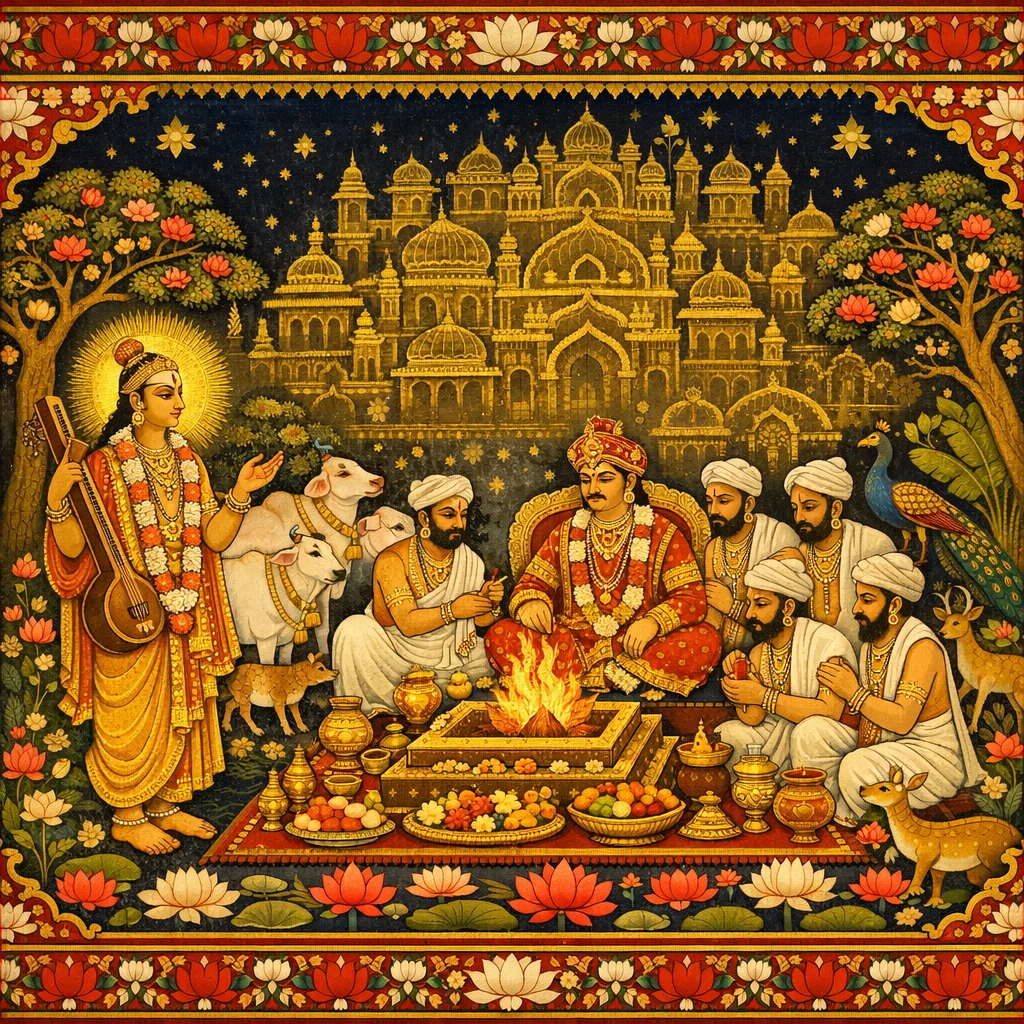
After Lord Śiva blesses the Pracetās and disappears, the princes remain in the water for ten thousand years, constantly reciting Śiva’s prayers. Meanwhile their father, King Prācīnabarhiṣat, intensifies fruit-seeking yajñas. Seeing the king’s karmic bondage and the violence implicit in such sacrifices, the sage Nārada approaches with compassion and challenges the belief that ritual action can grant freedom from misery and lasting happiness. He warns the king by revealing the sacrificed animals awaiting vengeance, awakening detachment (vairāgya). To turn him toward ātma-tattva, Nārada begins an ancient allegory of King Purañjana and his mysterious friend Avijñāta: Purañjana searches for fulfillment, finds a splendid city with nine gates, and meets a captivating woman guarded by a five-hooded serpent who offers him a hundred years of sense enjoyment. The chapter lays the allegorical framework (body, senses, mind, prāṇa, companions) and shows the jīva’s growing captivity through identification and imitation, setting up the next chapters to decode the gates and the consequences of absorption in household pleasure.
Shlokas
Verse 1
मैत्रेय उवाच इति सन्दिश्य भगवान् बार्हिषदैरभिपूजित: । पश्यतां राजपुत्राणां तत्रैवान्तर्दधे हर: ॥ १ ॥
Maitreya said: Thus, after instructing them, the blessed Lord Hara (Śiva) was worshiped by the sons of King Barhiṣat with devotion and reverence. Before the princes’ very eyes, Lord Śiva then disappeared from that place.
Verse 2
रुद्रगीतं भगवत: स्तोत्रं सर्वे प्रचेतस: । जपन्तस्ते तपस्तेपुर्वर्षाणामयुतं जले ॥ २ ॥
All the Pracetā princes stood in the water for ten thousand years, continuously chanting the hymn of praise given to them by Lord Rudra (Śiva).
Verse 3
प्राचीनबर्हिषं क्षत्त: कर्मस्वासक्तमानसम् । नारदोऽध्यात्मतत्त्वज्ञ: कृपालु: प्रत्यबोधयत् ॥ ३ ॥
O Kṣattā, King Prācīnabarhiṣ had a mind absorbed in fruitive works. At that time the compassionate sage Nārada, knower of spiritual truth, took mercy on the King and awakened him by instructing him in spiritual life.
Verse 4
श्रेयस्त्वं कतमद्राजन् कर्मणात्मन ईहसे । दु:खहानि: सुखावाप्ति: श्रेयस्तन्नेह चेष्यते ॥ ४ ॥
Nārada Muni asked: “O King, what highest good do you seek by these fruit-seeking works? The supreme aim of life is the removal of all misery and the attainment of true happiness, yet these are not realized by fruitive action alone.”
Verse 5
राजोवाच न जानामि महाभाग परं कर्मापविद्धधी: । ब्रूहि मे विमलं ज्ञानं येन मुच्येय कर्मभि: ॥ ५ ॥
The King replied: “O Nārada, great soul, my intelligence is entangled in fruitive work; therefore I do not know the ultimate goal. Please teach me pure knowledge, by which I may be freed from the bondage of karma.”
Verse 6
गृहेषु कूटधर्मेषु पुत्रदारधनार्थधी: । न परं विन्दते मूढो भ्राम्यन् संसारवर्त्मसु ॥ ६ ॥
One who is absorbed only in a so-called dutiful household life—fixing the mind on children, spouse, and wealth—does not find the supreme goal. Such a deluded person merely wanders the paths of saṁsāra through many kinds of bodies.
Verse 7
नारद उवाच भो भो: प्रजापते राजन् पशून् पश्य त्वयाध्वरे । संज्ञापिताञ्जीवसङ्घान्निर्घृणेन सहस्रश: ॥ ७ ॥
Nārada said: “O ruler of the people, my King, behold the animals that in your sacrificial arena you have slain by the thousands, without compassion.”
Verse 8
एते त्वां सम्प्रतीक्षन्ते स्मरन्तो वैशसं तव । सम्परेतम् अय:कूटैश्छिन्दन्त्युत्थितमन्यव: ॥ ८ ॥
All these animals await your death, remembering the harm you inflicted upon them. When you have departed this world, they will rise in anger and pierce your body with iron-like horns.
Verse 9
अत्र ते कथयिष्येऽमुमितिहासं पुरातनम् । पुरञ्जनस्य चरितं निबोध गदतो मम ॥ ९ ॥
In this connection I shall recount to you an ancient history concerning the life of King Purañjana. Hear my words with careful attention.
Verse 10
आसीत्पुरञ्जनो नाम राजा राजन् बृहच्छ्रवा: । तस्याविज्ञातनामासीत्सखाविज्ञातचेष्टित: ॥ १० ॥
O King, in ancient times there lived a ruler named Purañjana, renowned for mighty deeds. He had a friend called Avijñāta, “the unknown,” whose activities none could fathom.
Verse 11
सोऽन्वेषमाण: शरणं बभ्राम पृथिवीं प्रभु: । नानुरूपं यदाविन्ददभूत्स विमना इव ॥ ११ ॥
Seeking a fitting shelter, he wandered over the whole earth. Yet, despite much travel, he found no place to his liking, and at last became downcast and disappointed.
Verse 12
न साधु मेने ता: सर्वा भूतले यावती: पुर: । कामान् कामयमानोऽसौ तस्य तस्योपपत्तये ॥ १२ ॥
Driven by limitless desires for sense enjoyment, he sought a place where each wish might be fulfilled, yet no city on earth seemed sufficient; everywhere he felt want.
Verse 13
स एकदा हिमवतो दक्षिणेष्वथ सानुषु । ददर्श नवभिर्द्वार्भि: पुरं लक्षितलक्षणाम् ॥ १३ ॥
Once, on the southern side of the Himalayas in Bhārata-varṣa, he beheld a city with nine gates, distinguished by every auspicious feature.
Verse 14
प्राकारोपवनाट्टालपरिखैरक्षतोरणै: । स्वर्णरौप्यायसै: शृङ्गै: सङ्कुलां सर्वतो गृहै: ॥ १४ ॥
That city was guarded on all sides by walls, gardens, lofty towers, moats, and protected gateways. Houses filled every quarter, their rooftops crowned with domes of gold, silver, and iron.
Verse 15
नीलस्फटिकवैदूर्यमुक्तामरकतारुणै: । क्लृप्तहर्म्यस्थलीं दीप्तां श्रिया भोगवतीमिव ॥ १५ ॥
The floors of its mansions were set with sapphire, crystal, vaidūrya, pearls, emeralds, and rubies. By the radiance of those dwellings, the capital was likened to the celestial city called Bhogavatī.
Verse 16
सभाचत्वररथ्याभिराक्रीडायतनापणै: । चैत्यध्वजपताकाभिर्युक्तां विद्रुमवेदिभि: ॥ १६ ॥
Within that city were assembly halls, squares and crossings, streets, places of sport, taverns, gambling houses, markets, resting places, shrines, banners and festoons, and coral altars that added splendor. All these adorned the city on every side.
Verse 17
पुर्यास्तु बाह्योपवने दिव्यद्रुमलताकुले । नदद्विहङ्गालिकुलकोलाहलजलाशये ॥ १७ ॥
On the city’s outskirts lay an outer garden, rich with wondrous trees and creepers encircling a lovely lake. Around that lake, flocks of birds and swarms of bees were ever singing and humming.
Verse 18
हिमनिर्झरविप्रुष्मत्कुसुमाकरवायुना । चलत्प्रवालविटपनलिनीतटसम्पदि ॥ १८ ॥
Spray from waterfalls descending the icy mountain was borne by the spring breeze and sprinkled the branches of trees along the lake’s bank. Coral-red tender shoots swayed, and the lotus-lined shore grew ever more splendid.
Verse 19
नानारण्यमृगव्रातैरनाबाधे मुनिव्रतै: । आहूतं मन्यते पान्थो यत्र कोकिलकूजितै: ॥ १९ ॥
In that lovely grove, even the beasts of the forest became nonviolent and free from envy, like great sages; thus they harmed no one. Above all, the cuckoos’ sweet calls seemed to invite any traveler on that path to pause and rest in that beautiful garden.
Verse 20
यदृच्छयागतां तत्र ददर्श प्रमदोत्तमाम् । भृत्यैर्दशभिरायान्तीमेकैकशतनायकै: ॥ २० ॥
While roaming about that wondrous garden, King Purañjana suddenly beheld a woman of surpassing beauty, walking as if unoccupied. Ten attendants accompanied her, and each attendant was followed by hundreds of wives.
Verse 21
पञ्चशीर्षाहिना गुप्तां प्रतीहारेण सर्वत: । अन्वेषमाणामृषभमप्रौढां कामरूपिणीम् ॥ २१ ॥
The woman was guarded on every side by a five-hooded serpent, and also by a doorkeeper-like protector. She was youthful and exceedingly beautiful; though able to assume forms at will, she seemed anxious to find a worthy husband.
Verse 22
सुनासां सुदतीं बालां सुकपोलां वराननाम् । समविन्यस्तकर्णाभ्यां बिभ्रतीं कुण्डलश्रियम् ॥ २२ ॥
Her nose, teeth, and forehead were all exquisitely beautiful. Her cheeks were charming and her face most lovely. Her ears were well set and adorned with the radiant splendor of dazzling earrings.
Verse 23
पिशङ्गनीवीं सुश्रोणीं श्यामां कनकमेखलाम् । पद्भ्यां क्वणद्भ्यां चलन्तीं नूपुरैर्देवतामिव ॥ २३ ॥
Her waist and hips were exquisitely graceful. She wore yellow garments and a golden girdle. As she walked, her anklebells chimed; she appeared like a celestial maiden, an apsarā from the heavens.
Verse 24
स्तनौ व्यञ्जितकैशोरौ समवृत्तौ निरन्तरौ । वस्त्रान्तेन निगूहन्तीं व्रीडया गजगामिनीम् ॥ २४ ॥
Walking with the stately gait of a great elephant, the woman, out of shyness, again and again tried to cover with the end of her sārī her youthful, equally rounded breasts set close together.
Verse 25
तामाह ललितं वीर: सव्रीडस्मितशोभनाम् । स्निग्धेनापाङ्गपुङ्खेन स्पृष्ट: प्रेमोद्भ्रमद्भ्रुवा ॥ २५ ॥
The hero Purañjana addressed the exquisitely beautiful girl, radiant with a shy smile, in gentle words; struck by the arrows of her affectionate sidelong glance, he became bewildered in the stirrings of love.
Verse 26
का त्वं कञ्जपलाशाक्षि कस्यासीह कुत: सति । इमामुप पुरीं भीरु किं चिकीर्षसि शंस मे ॥ २६ ॥
O lotus-eyed one, tell me—who are you, from where have you come, and whose daughter are you? You appear most chaste. O timid lady, for what purpose have you approached this city, and what do you seek to do? Please explain everything to me.
Verse 27
क एतेऽनुपथा ये त एकादश महाभटा: । एता वा ललना: सुभ्रु कोऽयं तेऽहि: पुर:सर: ॥ २७ ॥
O fair-browed lady, who are those eleven mighty guards accompanying you on the path? Who are those ten particular attendants? Who are the women following behind them, and who is the serpent that goes before you?
Verse 28
त्वं ह्रीर्भवान्यस्यथ वाग्रमा पतिं विचिन्वती किं मुनिवद्रहो वने । त्वदङ्घ्रिकामाप्तसमस्तकामं क्व पद्मकोश: पतित: कराग्रात् ॥ २८ ॥
O beautiful girl, you seem like Śrī Lakṣmī, like Bhavānī, or like Sarasvatī, the consort of Brahmā; yet why do you wander in this forest, silent like a sage? Are you seeking your husband? Whoever he may be, knowing your steadfast devotion, he will attain all opulences. You appear to me as Lakṣmī, yet I do not see the lotus in your hand—where has that lotus fallen from your fingertips, or where have you cast it?
Verse 29
नासां वरोर्वन्यतमा भुविस्पृक् पुरीमिमां वीरवरेण साकम् । अर्हस्यलङ्कर्तुमदभ्रकर्मणा लोकं परं श्रीरिव यज्ञपुंसा ॥ २९ ॥
O most fortunate lady, since I see your feet touching the earth, you do not seem to be one of the celestial women I mentioned. If you are a woman of this world, then, just as Śrī-devī, in the company of Bhagavān Viṣṇu, enhances the splendor of Vaikuṇṭha, so too may you, by associating with me, increase the beauty of this city; know that I am a great hero and a powerful king.
Verse 30
यदेष मापाङ्गविखण्डितेन्द्रियं सव्रीडभावस्मितविभ्रमद्भ्रुवा । त्वयोपसृष्टो भगवान्मनोभव: प्रबाधतेऽथानुगृहाण शोभने ॥ ३० ॥
Today your sidelong glance has greatly disturbed my mind and senses. Your smile—shy, yet tinged with desire—and the play of your brows have powerfully aroused Manobhava (Cupid) within me; therefore, O most beautiful one, be merciful to me.
Verse 31
त्वदाननं सुभ्रु सुतारलोचनं व्यालम्बिनीलालकवृन्दसंवृतम् । उन्नीय मे दर्शय वल्गुवाचकं यद्व्रीडया नाभिमुखं शुचिस्मिते ॥ ३१ ॥
O girl with lovely brows, your face is enchanting—adorned with bright eyes and framed by hanging locks of bluish hair. Sweet words flow from your mouth, yet out of shyness you do not look at me directly. Therefore, O pure-smiling one, please raise your head, look upon me, and smile gently.
Verse 32
नारद उवाच इत्थं पुरञ्जनं नारी याचमानमधीरवत् । अभ्यनन्दत तं वीरं हसन्ती वीर मोहिता ॥ ३२ ॥
Nārada continued: O King, in this way Purañjana, becoming impatient, pleaded with the girl. Attracted by his words, she too smiled and accepted the hero’s request; by then she was certainly captivated by the King.
Verse 33
न विदाम वयं सम्यक्कर्तारं पुरुषर्षभ । आत्मनश्च परस्यापि गोत्रं नाम च यत्कृतम् ॥ ३३ ॥
The girl said: O best of men, I do not know for certain who has begotten me. Nor do I know my own lineage (gotra) and name, or the names and origins of those who are with me.
Verse 34
इहाद्य सन्तमात्मानं विदाम न तत: परम् । येनेयं निर्मिता वीर पुरी शरणमात्मन: ॥ ३४ ॥
O great hero, we only know that we are existing in this place. We do not know what will come after. Indeed, we are so foolish that we do not care to understand who has created this beautiful place for our residence.
Verse 35
एते सखाय: सख्यो मे नरा नार्यश्च मानद । सुप्तायां मयि जागर्ति नागोऽयं पालयन् पुरीम् ॥ ३५ ॥
My dear gentleman, all these men and women with me are known as my friends, and the snake, who always remains awake, protects this city even during my sleeping hours. So much I know. I do not know anything beyond this.
Verse 36
दिष्ट्यागतोऽसि भद्रं ते ग्राम्यान् कामानभीप्ससे । उद्वहिष्यामि तांस्तेऽहं स्वबन्धुभिररिन्दम ॥ ३६ ॥
O killer of the enemy, you have somehow or other come here. This is certainly great fortune for me. I wish all auspicious things for you. You have a great desire to satisfy your senses, and all my friends and I shall try our best in all respects to fulfill your desires.
Verse 37
इमां त्वमधितिष्ठस्व पुरीं नवमुखीं विभो । मयोपनीतान् गृह्णान: कामभोगान् शतं समा: ॥ ३७ ॥
My dear lord, I have just arranged this city of nine gates for you so that you can have all kinds of sense gratification. You may live here for one hundred years, and everything for your sense gratification will be supplied.
Verse 38
कं नु त्वदन्यं रमये ह्यरतिज्ञमकोविदम् । असम्परायाभिमुखमश्वस्तनविदं पशुम् ॥ ३८ ॥
How can I expect to unite with others, who are neither conversant about sex nor capable of knowing how to enjoy life while living or after death? Such foolish persons are like animals because they do not know the process of sense enjoyment in this life and after death.
Verse 39
धर्मो ह्यत्रार्थकामौ च प्रजानन्दोऽमृतं यश: । लोका विशोका विरजा यान्न केवलिनो विदु: ॥ ३९ ॥
The woman continued: In this world, the householder āśrama grants happiness in dharma, artha, and kāma, along with the joy of children and descendants. Thereafter arise desires for liberation and for good repute. By the fruits of sacrifice one attains higher worlds. Such material happiness is scarcely known to the renounced transcendentalists; they cannot even imagine it.
Verse 40
पितृदेवर्षिमर्त्यानां भूतानामात्मनश्च ह । क्षेम्यं वदन्ति शरणं भवेऽस्मिन् यद्गृहाश्रम: ॥ ४० ॥
The woman continued: Authorities declare that in this world the householder āśrama is a pleasing and auspicious shelter—not only for oneself, but for the forefathers, the demigods, the sages, human beings, and all living creatures. Thus it is truly beneficial.
Verse 41
का नाम वीर विख्यातं वदान्यं प्रियदर्शनम् । न वृणीत प्रियं प्राप्तं मादृशी त्वादृशं पतिम् ॥ ४१ ॥
O my dear hero, who in this world would not choose a husband like you? You are renowned, generous, pleasing to behold, and easily attained. A woman like me, having found you as her beloved, why would she not accept you?
Verse 42
कस्या मनस्ते भुवि भोगिभोगयो: स्त्रिया न सज्जेद्भुजयोर्महाभुज । योऽनाथवर्गाधिमलं घृणोद्धत स्मितावलोकेन चरत्यपोहितुम् ॥ ४२ ॥
O mighty-armed one, what woman on earth would not be drawn to your arms, like the sinuous bodies of serpents? By your captivating smile and your bold, compassionate glance, you remove the sorrow of unprotected women like us. We feel you roam the earth only to bestow benefit upon us.
Verse 43
नारद उवाच इति तौ दम्पती तत्र समुद्य समयं मिथ: । तां प्रविश्य पुरीं राजन्मुमुदाते शतं समा: ॥ ४३ ॥
Nārada said: My dear King, thus the man and the woman, supporting one another through mutual understanding, entered that city and enjoyed life for one hundred years.
Verse 44
उपगीयमानो ललितं तत्र तत्र च गायकै: । क्रीडन् परिवृत: स्त्रीभिर्ह्रदिनीमाविशच्छुचौ ॥ ४४ ॥
Here and there, skilled singers sweetly sang of King Purañjana’s fame and noble deeds. When the summer heat grew intense, he would enter a cool reservoir, surrounded by many women, and take pleasure in their company.
Verse 45
सप्तोपरि कृता द्वार: पुरस्तस्यास्तु द्वे अध: । पृथग्विषयगत्यर्थं तस्यां य: कश्चनेश्वर: ॥ ४५ ॥
In that city there were nine gates—seven on the surface and two below, subterranean. Built for passage to different destinations, all of them were used by the city’s ruler.
Verse 46
पञ्च द्वारस्तु पौरस्त्या दक्षिणैका तथोत्तरा । पश्चिमे द्वे अमूषां ते नामानि नृप वर्णये ॥ ४६ ॥
My dear King, of the nine gates, five faced east, one faced north, one faced south, and two faced west. Now I shall describe the names of these different gates.
Verse 47
खद्योताविर्मुखी च प्राग्द्वारावेकत्र निर्मिते । विभ्राजितं जनपदं याति ताभ्यां द्युमत्सख: ॥ ४७ ॥
The two gates named Khadyotā and Āvirmukhī faced the east and were built together in one place. Through them the King would go to the province of Vibhrājita, accompanied by his friend Dyumān.
Verse 48
नलिनी नालिनी च प्राग्द्वारावेकत्र निर्मिते । अवधूतसखस्ताभ्यां विषयं याति सौरभम् ॥ ४८ ॥
Similarly, in the east there was another pair of gates, Nalinī and Nālinī, built together in one place. Through them the King would go to the region of Saurabha, accompanied by his friend Avadhūta.
Verse 49
मुख्या नाम पुरस्ताद् द्वास्तयापणबहूदनौ । विषयौ याति पुरराड्रसज्ञविपणान्वित: ॥ ४९ ॥
The fifth gate on the eastern side was called Mukhyā, “the chief.” Through it King Purañjana, accompanied by his friends Rasajña and Vipaṇa, would go to the two places named Bahūdana and Āpaṇa.
Verse 50
पितृहूर्नृप पुर्या द्वार्दक्षिणेन पुरञ्जन: । राष्ट्रं दक्षिणपञ्चालं याति श्रुतधरान्वित: ॥ ५० ॥
The city’s southern gate was known as Pitṛhū. Through it King Purañjana would go, accompanied by his friend Śrutadhara, to the land called Dakṣiṇa-pañcāla.
Verse 51
देवहूर्नाम पुर्या द्वा उत्तरेण पुरञ्जन: । राष्ट्रमुत्तरपञ्चालं याति श्रुतधरान्वित: ॥ ५१ ॥
On the northern side was the gate named Devahū. Through it King Purañjana would go with his friend Śrutadhara to the region known as Uttara-pañcāla.
Verse 52
आसुरी नाम पश्चाद् द्वास्तया याति पुरञ्जन: । ग्रामकं नाम विषयं दुर्मदेन समन्वित: ॥ ५२ ॥
On the western side was a gate named Āsurī. Through it King Purañjana would go to the city of Grāmaka, accompanied by his friend Durmada.
Verse 53
निऋर्तिर्नाम पश्चाद् द्वास्तया याति पुरञ्जन: । वैशसं नाम विषयं लुब्धकेन समन्वित: ॥ ५३ ॥
Another gate on the western side was known as Nirṛti. Through it Purañjana would go to the place called Vaiśasa, accompanied by his friend Lubdhaka.
Verse 54
अन्धावमीषां पौराणां निर्वाक्पेशस्कृतावुभौ । अक्षण्वतामधिपतिस्ताभ्यां याति करोति च ॥ ५४ ॥
In that city were many citizens, among whom were two blind men named Nirvāk and Peśaskṛt. Though King Purañjana ruled over citizens who had eyes, he misfortunately kept company with those blind ones. With them he would wander here and there and carry out various deeds.
Verse 55
स यर्ह्यन्त:पुरगतो विषूचीनसमन्वित: । मोहं प्रसादं हर्षं वा याति जायात्मजोद्भवम् ॥ ५५ ॥
Whenever he entered his private quarters, he was accompanied by his chief attendant—the mind—named Viṣūcīna. At that time, from wife and children there arose within him illusion, contentment, and joy.
Verse 56
एवं कर्मसु संसक्त: कामात्मा वञ्चितोऽबुध: । महिषी यद्यदीहेत तत्तदेवान्ववर्तत ॥ ५६ ॥
Thus entangled in actions and driven by desire, the unwise King Purañjana was cheated under the sway of material intelligence. Whatever the Queen desired, he would follow and fulfill.
Verse 57
क्वचित्पिबन्त्यां पिबति मदिरां मदविह्वल: । अश्नन्त्यां क्वचिदश्नाति जक्षत्यां सह जक्षिति ॥ ५७ ॥ क्वचिद्गायति गायन्त्यां रुदत्यां रुदति क्वचित् । क्वचिद्धसन्त्यां हसति जल्पन्त्यामनु जल्पति ॥ ५८ ॥ क्वचिद्धावति धावन्त्यां तिष्ठन्त्यामनु तिष्ठति । अनु शेते शयानायामन्वास्ते क्वचिदासतीम् ॥ ५९ ॥ क्वचिच्छृणोति शृण्वन्त्यां पश्यन्त्यामनु पश्यति । क्वचिज्जिघ्रति जिघ्रन्त्यां स्पृशन्त्यां स्पृशति क्वचित् ॥ ६० ॥ क्वचिच्च शोचतीं जायामनुशोचति दीनवत् । अनु हृष्यति हृष्यन्त्यां मुदितामनु मोदते ॥ ६१ ॥
When the Queen drank liquor, Purañjana too drank, bewildered by intoxication. When she ate, he ate; when she chewed, he chewed with her. When she sang, he sang; when she wept, he wept; when she laughed, he laughed; when she spoke frivolously, he spoke the same. When she ran, he ran; when she stood still, he stood; when she lay down, he lay with her; when she sat, he sat. When she listened, he listened; when she looked, he looked; when she smelled, he smelled; when she touched, he touched. When the beloved Queen lamented, he lamented like a wretch; when she delighted, he delighted; when she was satisfied, he too felt satisfaction.
Verse 58
क्वचित्पिबन्त्यां पिबति मदिरां मदविह्वल: । अश्नन्त्यां क्वचिदश्नाति जक्षत्यां सह जक्षिति ॥ ५७ ॥ क्वचिद्गायति गायन्त्यां रुदत्यां रुदति क्वचित् । क्वचिद्धसन्त्यां हसति जल्पन्त्यामनु जल्पति ॥ ५८ ॥ क्वचिद्धावति धावन्त्यां तिष्ठन्त्यामनु तिष्ठति । अनु शेते शयानायामन्वास्ते क्वचिदासतीम् ॥ ५९ ॥ क्वचिच्छृणोति शृण्वन्त्यां पश्यन्त्यामनु पश्यति । क्वचिज्जिघ्रति जिघ्रन्त्यां स्पृशन्त्यां स्पृशति क्वचित् ॥ ६० ॥ क्वचिच्च शोचतीं जायामनुशोचति दीनवत् । अनु हृष्यति हृष्यन्त्यां मुदितामनु मोदते ॥ ६१ ॥
When the Queen drank liquor, Purañjana too drank, bewildered by intoxication. When she ate, he ate; when she chewed, he chewed with her. When she sang, he sang; when she wept, he wept; when she laughed, he laughed; when she spoke frivolously, he spoke the same. When she ran, he ran; when she stood still, he stood; when she lay down, he lay with her; when she sat, he sat. When she listened, he listened; when she looked, he looked; when she smelled, he smelled; when she touched, he touched. When the beloved Queen lamented, he lamented like a wretch; when she delighted, he delighted; when she was satisfied, he too felt satisfaction.
Verse 59
क्वचित्पिबन्त्यां पिबति मदिरां मदविह्वल: । अश्नन्त्यां क्वचिदश्नाति जक्षत्यां सह जक्षिति ॥ ५७ ॥ क्वचिद्गायति गायन्त्यां रुदत्यां रुदति क्वचित् । क्वचिद्धसन्त्यां हसति जल्पन्त्यामनु जल्पति ॥ ५८ ॥ क्वचिद्धावति धावन्त्यां तिष्ठन्त्यामनु तिष्ठति । अनु शेते शयानायामन्वास्ते क्वचिदासतीम् ॥ ५९ ॥ क्वचिच्छृणोति शृण्वन्त्यां पश्यन्त्यामनु पश्यति । क्वचिज्जिघ्रति जिघ्रन्त्यां स्पृशन्त्यां स्पृशति क्वचित् ॥ ६० ॥ क्वचिच्च शोचतीं जायामनुशोचति दीनवत् । अनु हृष्यति हृष्यन्त्यां मुदितामनु मोदते ॥ ६१ ॥
When the Queen drank liquor, King Purañjana too drank, overcome by intoxication. When she ate, chewed, sang, wept, laughed, or spoke frivolously, he did the same. When she walked, he followed behind; when she stood still, he stood; when she lay upon the bed, he lay with her. When she sat, heard, saw, smelled, or touched anything, he likewise followed. When the beloved Queen lamented, the poor King lamented with her; and when she delighted and felt satisfied, he too tasted enjoyment and contentment.
Verse 60
क्वचित्पिबन्त्यां पिबति मदिरां मदविह्वल: । अश्नन्त्यां क्वचिदश्नाति जक्षत्यां सह जक्षिति ॥ ५७ ॥ क्वचिद्गायति गायन्त्यां रुदत्यां रुदति क्वचित् । क्वचिद्धसन्त्यां हसति जल्पन्त्यामनु जल्पति ॥ ५८ ॥ क्वचिद्धावति धावन्त्यां तिष्ठन्त्यामनु तिष्ठति । अनु शेते शयानायामन्वास्ते क्वचिदासतीम् ॥ ५९ ॥ क्वचिच्छृणोति शृण्वन्त्यां पश्यन्त्यामनु पश्यति । क्वचिज्जिघ्रति जिघ्रन्त्यां स्पृशन्त्यां स्पृशति क्वचित् ॥ ६० ॥ क्वचिच्च शोचतीं जायामनुशोचति दीनवत् । अनु हृष्यति हृष्यन्त्यां मुदितामनु मोदते ॥ ६१ ॥
Whatever the Queen did—drinking, eating, chewing, singing, weeping, laughing, idle talk, running, standing, lying down, sitting, hearing, seeing, smelling, or touching—King Purañjana followed her and imitated her in all things. When she grieved, he grieved; when she rejoiced, he too rejoiced and felt satisfied.
Verse 61
क्वचित्पिबन्त्यां पिबति मदिरां मदविह्वल: । अश्नन्त्यां क्वचिदश्नाति जक्षत्यां सह जक्षिति ॥ ५७ ॥ क्वचिद्गायति गायन्त्यां रुदत्यां रुदति क्वचित् । क्वचिद्धसन्त्यां हसति जल्पन्त्यामनु जल्पति ॥ ५८ ॥ क्वचिद्धावति धावन्त्यां तिष्ठन्त्यामनु तिष्ठति । अनु शेते शयानायामन्वास्ते क्वचिदासतीम् ॥ ५९ ॥ क्वचिच्छृणोति शृण्वन्त्यां पश्यन्त्यामनु पश्यति । क्वचिज्जिघ्रति जिघ्रन्त्यां स्पृशन्त्यां स्पृशति क्वचित् ॥ ६० ॥ क्वचिच्च शोचतीं जायामनुशोचति दीनवत् । अनु हृष्यति हृष्यन्त्यां मुदितामनु मोदते ॥ ६१ ॥
When the Queen rejoiced, the King rejoiced; when she lamented, he lamented. In every movement of the senses, Purañjana simply followed her. Thus, in enjoyment and in satisfaction, the King also delighted along with her.
Verse 62
विप्रलब्धो महिष्यैवं सर्वप्रकृतिवञ्चित: । नेच्छन्ननुकरोत्यज्ञ: क्लैब्यात्क्रीडामृगो यथा ॥ ६२ ॥
Thus King Purañjana, enchanted by his beautiful queen, was deceived and cheated throughout his life in the material world. Even against his will, that foolish king remained under her control and imitated her—like a pet animal that dances at its master’s command.
Frequently Asked Questions
Nārada targets the king’s kāmya orientation—rituals performed for results rather than for Bhagavān—and highlights their हिंसा (violence) and karmic backlash. The vision of sacrificed animals awaiting revenge dramatizes the doctrine of karma: even religiously framed action can bind when driven by desire, cruelty, or ego, whereas true dharma culminates in ātma-jñāna and devotion.
Avijñāta signifies the unknowable controller within worldly perception—often explained in the tradition as Paramātmā (the indwelling Lord) whose guidance is present yet not recognized by the materially absorbed jīva. The name underscores that without spiritual knowledge, the soul cannot properly interpret the divine witness and director accompanying it through embodied life.
The ‘city of nine gates’ (nava-dvāra-purī) denotes the human body with its primary openings through which consciousness engages the world. The allegory teaches that when the soul (Purañjana) identifies with this city and accepts sense gratification as life’s aim, it becomes governed by the mind, senses, and prāṇa, losing autonomy and forgetting its spiritual purpose.
She represents the allure of material enjoyment and household entanglement—often mapped to buddhi/pravṛtti that promises happiness through sense life—while the five-hooded serpent commonly indicates prāṇa (life-air) or the vital force sustaining the body. Together they portray how embodied life is maintained and defended while simultaneously pulling the jīva into deeper identification and dependence.