Adhyaya 320
Aghīrāstra-ādi-Śānti-kalpaḥ (Rite for Pacification of Aghora-Astra and Other Weapons)
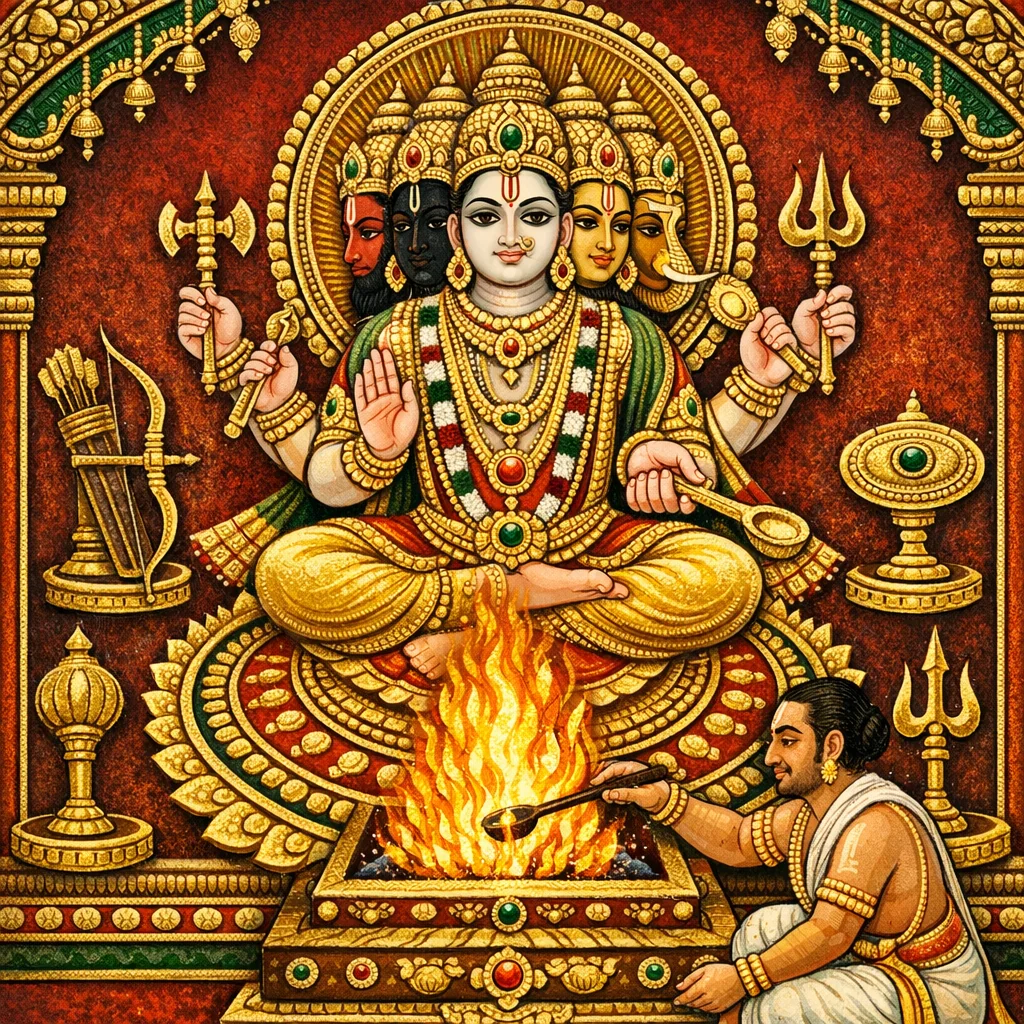
Lord Agni (Īśvara) teaches a structured rite of protection in which martial and cosmic forces are ritually harmonized before any undertaking. He first extols astra-yāga, the propitiation of presiding weapons, as a universal giver of success, arranged in a mandala with Śiva’s weapon at the center and Vajra and other weapons placed by directions beginning from the east. A parallel layout is prescribed for graha-pūjā: the Sun at the center and the remaining planets ordered from the eastern station, making planetary alignment a prerequisite for auspicious results. The main teaching then details astra-śānti through japa and homa of the Aghora-Astra, said to pacify graha-doṣas, diseases, inimical forces (māri), and Vināyaka-related obstacles. Graded counts (lakṣa/ayuta/sahasra) and offerings (tila, ghṛta, guggulu, dūrvā, akṣata, javā) are matched to specific omens—meteors, earthquakes, forest entry, blood-like tree sap, out-of-season fruiting, epidemics, elephant disorders, miscarriage, and travel signs—culminating in nyāsa and meditation on the powerful five-faced deity to secure victory and the highest siddhi.
Shlokas
Verse 1
इत्य् आग्नेये महापुराणे मण्डलानि नामोनविंशत्यधिकत्रिशततमो ऽध्यायः अथ विंशत्यधिकत्रिशततमो ऽध्यायः अघीरास्त्रादिशान्तिकल्पः ईश्वर उवाच अस्त्रयागः पुरा कार्यः सर्वकर्मसु सिद्धिदः मध्ये पूज्यं शिवाद्यस्त्रं वज्रादीन् पूर्वतः क्रमात्
Thus, in the Agni Mahāpurāṇa, the three-hundred-and-nineteenth chapter is called “Maṇḍalas (ritual diagrams).” Now begins the three-hundred-and-twentieth chapter, “The Śānti rite for pacifying Aghīrāstra and other weapons.” The Lord said: “First, the astra-yāga (sacrificial propitiation of the weapons) should be performed; it bestows success in all rites. In the center one should worship Śiva’s weapon and the other presiding weapons; beginning from the east, one should worship the Vajra and the rest in due order.”
Verse 2
पञ्चचक्रं दशकरं रणादौ पूजितं जये ग्रहपूजा रविर्मध्ये पूर्वाद्याः सोमकादयः
A fivefold chakra, having ten “arms” (spokes/divisions), when worshipped at the outset of battle, leads to victory. In planetary worship (graha-pūjā), the Sun is placed in the center; beginning from the east are the Moon and the other grahas in order.
Verse 3
सर्व एकादशस्थास्तु ग्रहाः स्युः ग्रहपूजनात् अस्त्रशान्तिं प्रवक्ष्यामि सर्वोत्पातविनाशिनीं
By worship of the grahas (planetary powers), all the grahas become well placed in the eleven stations. Now I shall teach the rite of pacification for weapons (astra-śānti), the destroyer of all ominous portents (utpāta).
Verse 4
ग्रहरोगादिशमनीं मारीशत्रुविमर्दनीं विनायकोपतप्तिघ्नमघोरास्त्रं जपेन्नरः
A man should perform japa of the Aghora-Astra mantra, which pacifies afflictions such as planetary disorders (graha) and diseases, crushes enemies like Māri, and destroys the torment arising from Vināyaka’s (Gaṇeśa’s) displeasure.
Verse 5
लक्षं ग्रहादिनाशः स्यादुत्पाते तिलहोमनम् दिव्ये लक्षं तदर्धेन व्योमजोत्पातनाशनं
A lakṣa (one hundred thousand) offerings is said to remove the affliction caused by the grahas and the like; when an utpāta (evil portent) occurs, one should perform tilahoma, a sesame fire-offering. For a divine (celestial) portent, perform a lakṣa; and by half of that, the evil portent arising in the sky is destroyed.
Verse 6
घृतेन लक्षपातेन उत्पाते भुमिजे हितम् घृतगुग्गुलुहोमे च सर्वोत्पातादिमर्दनम्
In the case of an earth-born portent (bhūmija), an oblation of a lakṣa with ghee (ghṛta) is beneficial. And a homa with ghee and guggulu suppresses all portents and the like.
Verse 7
दूर्वाक्षताज्यहोमेन व्याधयो ऽथ घृतेन च सहस्रेण तु दुःखस्वप्ना विनशन्ति न संशयः
By a homa using dūrvā grass, akṣata (unbroken rice), and ājya/ghṛta (ghee), diseases are pacified; and by offering ghee a thousand times, distressing dreams are destroyed—there is no doubt.
Verse 8
अयुताद् ग्रहदोषघ्नो जवाघृतविमिश्रितात् विनायकार्तिशमनमयुतेन घृतस्य च
From an ayuta (ten thousand) of offerings mixed with javā (hibiscus) and ghee, it becomes a destroyer of afflictions arising from planetary faults; and with an ayuta of ghee, it also brings about the pacification of distress caused by Vināyaka (Gaṇeśa-related impediments).
Verse 9
भूतवेदालशान्तिस्तु गुग्गुलोरयुतेन च महावृक्षस्य भङ्गेतु व्यालकङ्के गृहे स्थिते
For the pacification of bhūtas and vetālas, one should also perform the śānti rite with an ayuta (ten thousand) measure of guggulu. Likewise, when a great tree breaks as an ominous sign, or when a house is occupied by inauspicious beings such as a serpent or a heron, the same śānti is to be undertaken.
Verse 10
आरण्यानां प्रवेशे दूर्वाज्याक्षतहावनात् उल्कापाते भूमिकम्पे तिलाज्येनाहुताच्छिवम्
When entering forests, one should perform oblations (āhuti/homa) with dūrvā grass, ghee, and unhusked rice (akṣata); and when a meteor falls or the earth quakes, auspiciousness is secured by offering oblations with sesame and ghee.
Verse 11
रक्तस्रावे तु वृक्षाणामयुताद् गुग्गुलोः शिवं अकाले फलपुष्पाणां राष्ट्रभङ्गे च मारणे
If trees exude blood-like sap, auspiciousness is obtained through guggulu in an ayuta (ten thousand) measure; but if fruits and flowers appear out of season, it signifies the breaking of the kingdom and death.
Verse 12
द्विपदादेर्यदा मारि लक्षार्धाच्च तिलाज्यतः हस्तिमारीप्रशान्त्यर्थं करिणीदन्तवर्धने
When a māri (epidemic affliction) arises among bipeds and other beings, one should prepare a remedy using half a lakṣā (fifty thousand) together with sesame and ghee—intended to pacify elephant-plague and to promote the growth and strength of a female elephant’s tusks.
Verse 13
हस्तिन्यां मददृष्टौ च अयुताच्छान्तिरिष्यते अकाले गर्भपाते तु जातं यत्र विनश्यति
If a female elephant is seen in musth, with an intoxicated or deranged look, a major pacificatory rite (a great śānti) valued at ten thousand is prescribed. Likewise, when a miscarriage occurs out of season, whatever is born there is said to perish.
Verse 14
विकृता यत्र जायन्ते यात्राकाले ऽयुतं हुनेत् तिलाज्यलक्षहोमन्तु उत्तमासिद्धिसाधने
Where ominous abnormalities arise, at the time of setting out on a journey one should offer a thousand oblations in the homa. But for accomplishing the highest success, one should perform a hundred-thousand oblations with sesame and ghee.
Verse 15
मध्यमायां तदर्धेन तत्पादादधमासु च यथा जपस् तथा होमः संग्रामे विजयो भवेत् अघोरास्त्रं जपेन्न्यस्य ध्यात्वा पञ्चास्यमूर्जितम्
In the middle grade, one should do it with half that measure, and in the lower grade with a quarter. The homa should be performed in the same count as the japa; then victory in battle is attained. Having performed nyāsa, one should recite the Aghora-astra, meditating on the powerful Five-faced deity.
Frequently Asked Questions
A precise ritual-architecture of protection: mandala placement (center and directional order), graded japa/homa counts (lakṣa, ayuta, sahasra; with middle/low reductions), and substance-specific offerings (tila, ghṛta, guggulu, dūrvā, akṣata, javā) mapped to distinct omens and afflictions.
It frames protective and martial efficacy as dharmically regulated power: by nyāsa, mantra-japa, and śānti rites, the practitioner disciplines fear and violence through devotion and cosmic alignment, converting worldly success (bhukti) into a purified support for steadiness in dharma and eventual liberation (mukti).
Weapons are treated as presiding energies requiring propitiation (astra-yāga), while planets are stabilized through graha-pūjā in an ordered mandala; together they establish a harmonized field in which astra-śānti and battle-oriented rites can succeed without omen-driven obstruction.