Adhyaya 307
Trailokya-mohinī Śrī-Lakṣmī-ādi-pūjā and Durgā-yoga (Protective and Siddhi Rites)
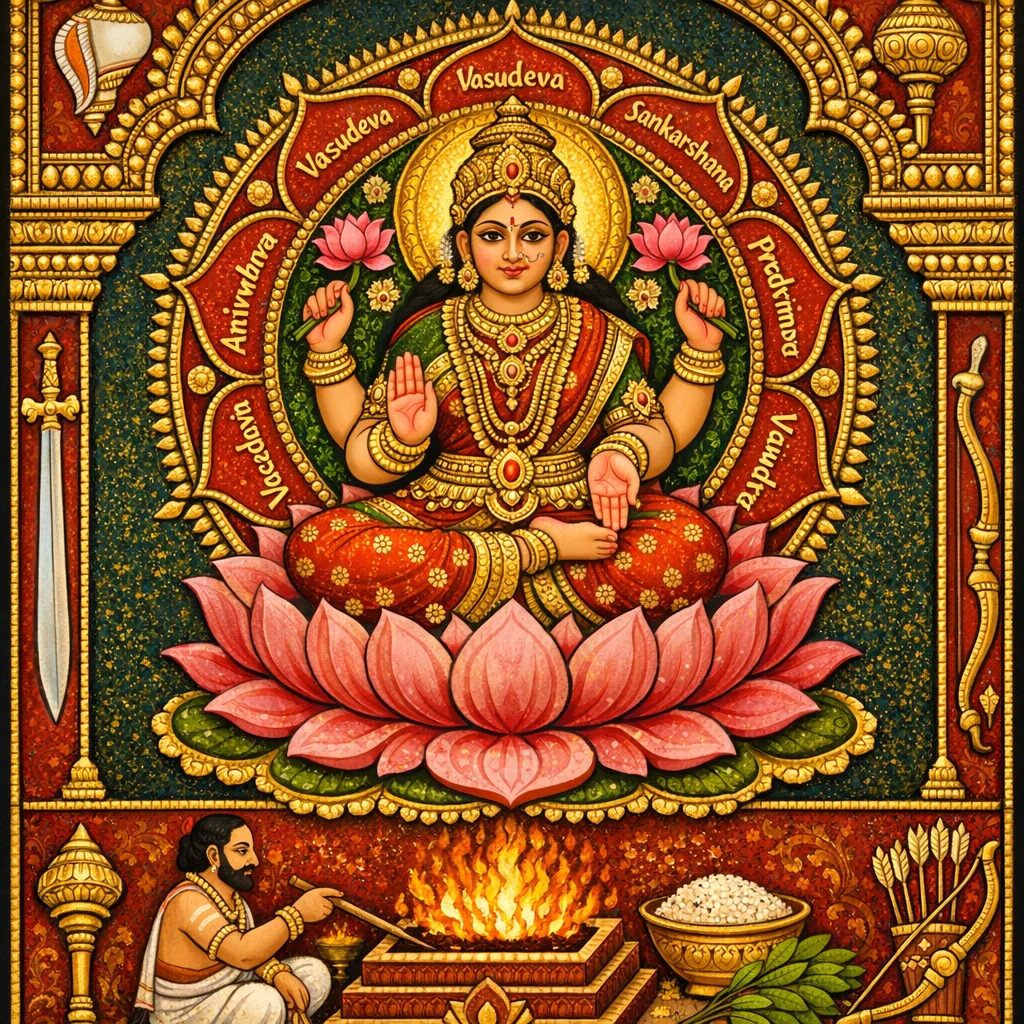
Lord Agni teaches Vasiṣṭha a ritual regimen that unites prosperity rites centered on Trailokya-mohinī Śrī (Lakṣmī) with Durgā practices for protection and victory. It begins with a Lakṣmī mantra-series and nine aṅga formulas applied through nyāsa, prescribing very high japa counts (one to three lakhs) with a lotus-seed rosary. It then describes wealth-producing worship in Śrī or Viṣṇu shrines, including homa protocols (ghee-smeared rice in a khadira fire; bilva-based offerings) and remedial rites such as mustard-water abhiṣeka for graha-śānti and for gaining royal favor or influence (vaśyatā). A structured visualization follows: Śakra’s four-gated mansion, door-guarding Śrī-dūtīs, and an eight-petalled lotus mapped to the four Vyūhas (Vāsudeva, Saṅkarṣaṇa, Pradyumna, Aniruddha), culminating in Lakṣmī’s iconographic dhyāna in the lotus pericarp. Dietary and calendrical restraints are stated, along with offering sets (bilva, ghee, lotus, pāyasa). The chapter then turns to Durgā’s “hṛdaya” mantra with aṅgas, leaf-supported worship of her forms, offerings to weapon-deities, and homa substitutions for specific aims (vaśīkaraṇa, jaya, śānti, kāma, puṣṭi), concluding with battlefield invocation for victory.
Shlokas
Verse 1
इत्य् आग्नेये महापुराणे त्रैलोक्यमोहनमन्त्रो नाम षष्ठाधिकत्रिशततमो ऽध्यायः अथ सप्ताधिकत्रिशततमो ऽध्यायः त्रैलोक्यमोहनीलक्ष्म्यादिपूजा अग्निर् उवाच वक्षः सवह्निर्यामाक्षौ दण्डीः श्रीः सर्वसिद्धिदा महाश्रिये महासिद्धे महाविद्युत्प्रभे नमः
Thus, in the Agni Mahāpurāṇa, the chapter entitled “The Three-Worlds-Enchanting Mantra,” the three-hundred-and-seventh, concludes. Now begins the three-hundred-and-eighth chapter: the worship of Trailokya-mohinī Lakṣmī and related deities. Agni said: “Salutations to the Great Śrī—bestower of all siddhis—the Greatly Auspicious One, the Greatly Accomplished One, blazing with great lightning-like radiance—manifesting as the Chest, together with Fire, the Yāma-eyed forms, and the Staff-bearing (Daṇḍinī).”
Verse 2
श्रिये देवि विजये नमः गौरि महाबले बन्ध नमः हूं महाकाये पद्महस्ते हूं फट् श्रियै नमः श्रियै फट् श्रियै नमः श्रियै फट् श्रीं नमः श्रिये श्रीद नमः स्वाहा स्वाहा श्रीफट् अस्याङ्गानि नवोक्तानि तेष्वेकञ्च समाश्रयेत् त्रिलक्षमेकलक्षं वा जप्त्वाक्षाब्जैश् च भूतिदः
“Obeisance to Śrī, to the Goddess, to (Her form as) Victory; obeisance to Gaurī, the greatly powerful one—bandha (bind and restrain)—obeisance! Hūṃ, obeisance to the great-bodied one; to the lotus-handed one—hūṃ phaṭ. Obeisance to Śrī; phaṭ to Śrī; obeisance to Śrī; phaṭ to Śrī; śrīṃ—obeisance to Śrī; obeisance to Śrī, bestower of prosperity; svāhā, svāhā—śrīphaṭ!” These nine aṅga-formulas have been stated; one should apply nyāsa to each. Having repeated (the mantra) three lakhs—or one lakh—(times), and counted with a rosary of lotus-seeds, one becomes an attainer/bestower of prosperity and welfare.
Verse 3
श्रीगेहे विष्णुगेहे वा श्रियं पूज्य धनं लभेत् आज्याक्तैस्तण्डुलैर् लक्षं जुहुयात् खादिरानले
In a shrine of Śrī (Lakṣmī) or in a shrine of Viṣṇu, having worshipped Śrī one obtains wealth. One should offer one hundred thousand oblations of rice-grains anointed with ghee into a fire kindled with khadira wood.
Verse 4
राजा वश्यो भवेद्वृद्धिः श्रीश् च स्यादुत्तरोत्तरं सर्षपाम्भोभिषेकेण नश्यन्ते सकला ग्रहाः
By bathing (abhiṣeka) with water infused with mustard seeds, the king becomes compliant and favourable; growth and prosperity arise; fortune increases progressively; and all planetary afflictions (graha-doṣa) are destroyed.
Verse 5
बिल्वलक्षहुता लक्ष्मीर्वित्तवृद्धिश् च जायते शक्रवेश्म चतुर्द्वारं हृदये चिन्तयेदथ
When offerings are made into the fire with bilva (leaves/wood) a hundred thousand times, Lakṣmī arises and an increase of wealth is produced. Then one should meditate within the heart on Śakra’s mansion, having four gates.
Verse 6
बलाकां वामनां श्यामां श्वेतपङ्कजधारिणीम् ऊर्ध्ववाहुद्वयं ध्यायेत्क्रीडन्तीं द्वारि पूर्ववत्
One should visualize her, as previously described, at the doorway: graceful like a crane, dwarf in stature (vāmana), dark-hued, holding a white lotus; with both arms raised upward, in a playful pose.
Verse 7
उर्ध्वीकृतेन हस्तेन रक्तपङ्कजधारिणीं श्वेताङ्गीं दक्षिणे द्वारि चिन्तयेद्वनमालिनीम्
With the hand raised upward, one should visualize at the southern gate a fair-limbed goddess adorned with a forest-garland (vanamālinī), holding a red lotus.
Verse 8
हरितां दोर्द्वयेनोर्धमुद्वहन्तीं सिताम्बुजम् ध्यायेद्विभीषिकां नाम श्रीदूतीं द्वारि पश्चिमे
At the western doorway, one should meditate upon the Śrīdūtī named Vibhīṣikā, green in complexion, who with both arms holds aloft a white lotus.
Verse 9
शाङ्करीमुक्क्तरे द्वारि तन्मध्ये ऽष्टदलपङ्कजं वासुदेवः सङ्कर्षणः प्रद्युम्नश्चानिरुद्धकः
At the Śāṅkarī (Śaiva) gateway is the Mukta-tara marking, pearl-like and white; and in its midst is an eight-petalled lotus, assigned to Vāsudeva, Saṅkarṣaṇa, Pradyumna, and Aniruddha.
Verse 10
ध्येयास्ते पद्मपत्रेषु शङ्खचक्रगदाधराः अञ्जनक्षीरकाश्मीरहेमाभास्ते सुवाससः
They are to be meditated upon as standing upon lotus-petals, bearing the conch, discus, and mace; their radiance is like collyrium-black, milk-white, saffron-hued, and golden, and they are clad in beautiful garments.
Verse 11
आग्नेयादिषु पत्रेषु गुग्गुलुश् च कुरुण्टकः दमकः सलिलश्चेति हस्तिनी रजतप्रभाः
Among the leaf-group beginning with the plant called Āgneyā, there are also the plants known as Guggulu, Kuruṇṭaka, Damaka, and Salila; they are further known by the synonymous names Hastinī and Rajataprabhā.
Verse 12
हेमकुम्भधराश् चैते कर्णिकायां श्रियं स्मरेत् चतुर्भुजां सुवर्णाभां सपद्मोर्ध्वभुजद्वयां
These attendants are bearers of golden pitchers; in the pericarp of the lotus one should meditate upon Śrī (Lakṣmī)—four-armed, radiant like gold, with her two upper arms uplifted and holding lotuses.
Verse 13
दक्षिणाभयहस्ताभां वामहस्तवरप्रदां श्वेतगन्धांशुकामेकरौम्यमालास्त्रधारिणीं
With her right hands displaying the Abhaya gesture of fearlessness, and her left hand granting boons; clad in white, fragrant garments; bearing a single auspicious garland and weapons.
Verse 14
ध्यात्वा सपरिवारान्तामभ्यर्च्य सकलं लभेत् द्रोणाब्जपुष्पश्रीवृक्षपर्णं मूर्ध्नि न धारयेत्
Having meditated upon her together with her retinue and having duly worshipped her, one obtains complete success in the intended aim. But one should not place upon the head a leaf of the śrī-vṛkṣa (bilva/auspicious tree) or a droṇa-lotus flower.
Verse 15
लवणामलकं वर्ज्यं नागादित्यतिथौ क्रमात् पायसाशी जपेत् सूक्तं श्रियस्तेनाभिषेचयेत्
On the Nāga and Āditya lunar days, in due order, one should avoid salt and āmalaka (Indian gooseberry). Eating pāyasa (rice-milk), one should recite the sūkta; and by that recitation one should perform an abhiṣeka (ritual anointing) for Śrī (Lakṣmī/prosperity).
Verse 16
आवाहादिविसर्गान्तां मूर्ध्नि ध्यात्वार्चयेत् श्रियम् विल्वाज्याब्जपायसेन पृथक् योगः श्रिये भवेत्
Having meditated on Śrī (Lakṣmī) upon the crown of the head—from the rite of invocation (āvāhana) up to the rite of dismissal (visarga)—one should worship her. By offering bilva leaves, ghee, lotus offerings, and pāyasa (rice-milk) each separately, the specific ritual-yoga for Śrī is accomplished.
Verse 17
विषं महिषकान्ताग्निरुद्रिज्योतिर्वकद्वयम् ॐ ह्रीं महामहिषमर्दिनि ठ ठ मूलमन्त्रं भहिषहिंसके नमः महिषशत्रुं भ्रामय हूं फट् ठ ठ महिषं हेषय हूं महिषं हन२ देवि हूं महिषनिसूदनि फट् दुर्गाहृदयमित्युक्तं साङ्गं सर्वार्थसाधकम्
“Poison; the ‘fire beloved of the buffalo’; the upward-rising light (udri-jyotis); and the pair of seed-syllables”—these are the preliminaries. “Oṃ hrīṃ, O Great Slayer of the Buffalo-demon, ṭha ṭha”—this is declared to be the root-mantra; add: “obeisance to the destroyer of the buffalo(-demon).” For application: “Confuse the enemy of the Buffalo(-demon), hūṃ phaṭ, ṭha ṭha”; “make the buffalo bellow, hūṃ”; “strike, strike the buffalo, O Goddess, hūṃ”; “O buffalo-slayer, phaṭ.” This is called the “Heart (hṛdaya) of Durgā”; together with its limbs (aṅgas), it accomplishes all aims.
Verse 18
यजेद्यथोक्तं तां देवीं पीठञ्चैवाङ्गमध्यगम् ॐ ह्रीं दुर्गे रक्षणि स्वाहा चेति दुर्गायै नमः वरवर्ण्यै नमः आर्यायै कनकप्रभायै कृत्तिकायै अभयप्रदायै कन्यकायै सुरूपायै पत्रस्थाः पूजयेदेता मूर्तीराद्यैः स्वरैः क्रमात्
He should worship that Goddess exactly as prescribed, and also worship the Pīṭha established in the midst of the limbs (that is, set within the body through nyāsa). Reciting: “Oṃ hrīṃ, O Durgā the Protectress—svāhā,” he should then offer salutations: “Obeisance to Durgā; obeisance to the most excellent in complexion; obeisance to the Noble One of golden radiance; to Kṛttikā; to the Bestower of fearlessness; to the Virgin Maiden; to the Beautiful-formed One.” These embodied forms, placed upon leaves as supports of worship, should be honored in due sequence with the initial vowels (beginning from ‘a’).
Verse 19
चक्राय शङ्खाय गदायै खड्गाय धनुषे वाणाय अष्टम्याद्यैर् इमां दुर्गां लोकेशान्तां यजेदिति दुर्गायोगः समायुःश्रीस्वामिरक्ताजयादिकृत्
“(Offer worship) to the discus, to the conch, to the mace, to the sword, to the bow, and to the arrow; and on Aṣṭamī and the other prescribed lunar days, one should worship this Durgā who brings peace to the worlds.” Thus is the Durga-yoga (ritual discipline); it bestows longevity and prosperity, mastery, the subjugation of enemies, victory, and other results.
Verse 20
समाध्येशानमन्त्रेण तिलहोमो वशीकरः जयः पद्मैस्तु दुर्वाभिः शान्तिः कामः पलाशजैः
With the Īśāna-mantra, a fire-offering of sesame (tila-homa) brings vaśīkaraṇa (subjugation). Victory is attained by offerings of lotus-flowers; peace by offerings of durvā grass; and the fulfillment of desire by offerings made with palāśa blossoms.
Verse 21
पुष्टिः स्यात् काकपक्षेण मृतिद्वेषादिकं भवेत् ब्रह्मक्षुद्रभयापत्तिं सर्वमेव मनुर्हरेत्
By the mantra-rite indicated with the “crow’s-wing” (kākapakṣa) sign, puṣṭi—nourishment and thriving—arises; (conversely) death, hostility, and the like may occur. Yet the mantra removes all of it: perils arising from brahma-forces, from petty or malevolent beings, from fear and calamity—altogether.
Verse 22
ॐ दुर्गे दुर्गे रक्षणि स्वाहा रक्षाकरीयमुदिता जयदुर्गाङ्गसंयुता श्यामां त्रिलिचनां देवीं ध्यात्वात्मानं चतुर्भुजम्
“Oṃ. O Durge, O Durge—Protectress—svāhā!” Thus is the protective rite proclaimed. United with the power of Jayadurgā, one should meditate on the dark-hued, three-eyed Goddess, and then visualize oneself as four-armed.
Verse 23
शङ्खचक्राब्जशूलादित्रिशूलां रौद्ररूपिणीं युद्धादौ सञ्जयेदेतां यजेत् खड्गादिके जये
At the outset of battle, one should mentally invoke and empower the Goddess of Raudra form, bearing the conch, discus, lotus, spear and other weapons, together with the trident; and for victory with the sword and other arms, one should worship her.
Frequently Asked Questions
Precise ritual engineering: navāṅga (nine limb-mantras) with nyāsa, fixed japa targets (1–3 lakhs) using lotus-seed counting, and outcome-specific homa materials (khadira fire, ghee-rice, bilva, sesame, lotus, durvā, palāśa).
It frames prosperity and protection as dharmic stabilizers—through disciplined mantra, homa, and visualization—so the practitioner gains order (śānti), capacity (siddhi), and ethical sovereignty over fear and adversity, supporting higher sādhana.
Śrī (Lakṣmī) in the lotus pericarp, with a mandala-like structure: four gates, attendant Śrī-dūtīs at doorways, and an eight-petalled lotus assigned to the four Vyūhas—Vāsudeva, Saṅkarṣaṇa, Pradyumna, and Aniruddha.
Longevity and prosperity, mastery/authority, subjugation of enemies, victory, peace, and protective removal of dangers including fear and calamity.