Adhyaya 325
Worship of Gaurī and Others (Gauryādi-pūjā) — Mantra, Maṇḍala, Mudrā, Homa, and Mṛtyuñjaya Kalaśa-Rite
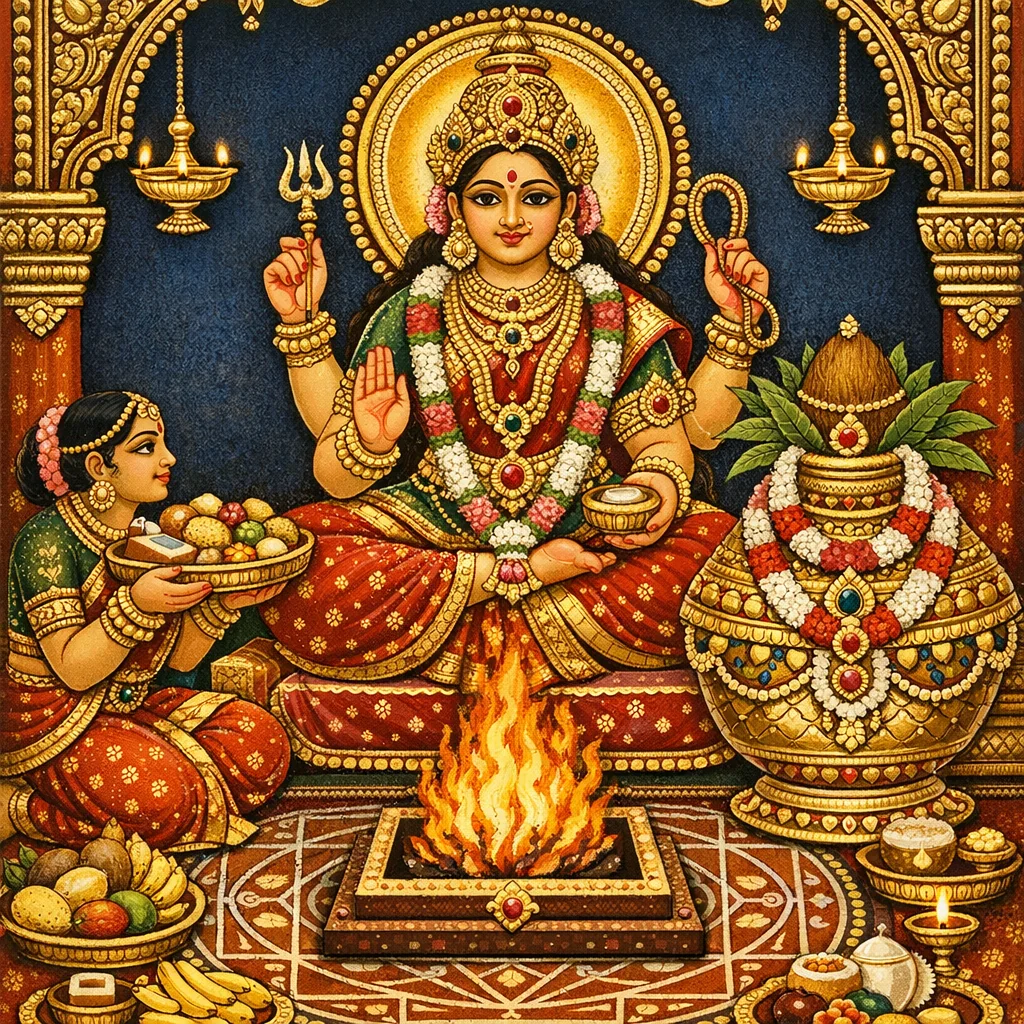
This chapter presents Umā/Gaurī worship as a complete sādhana granting both Bhukti and Mukti, promising a full toolkit of mantra-dhyāna, maṇḍala construction, mudrā, and homa. It gives cues for mantra derivation (bīja formation, phonetic/jāti classes, ṣaḍaṅga linkage) and lays down core preliminaries: establishing an āsana with Praṇava, performing hṛdaya-based mūrti-nyāsa, and selecting worship materials and icon media (gold, silver, wood, stone). A fivefold layout of piṇḍas with the avyakta placed at the center/corners, along with directional and circular deity sequences, systematizes the maṇḍala’s ritual geography. Iconographic options for Tārā (arms, mount, hand-held implements) are detailed, implements and gestures assigned, and the teaching culminates in a mudrā taxonomy (Padma, Tiṅga, Āvāhanī, Śakti/Yoni) and a measured square maṇḍala with proportional expansions and gateways. The chapter concludes with offering rules (red flowers, north-facing homa, pūrṇāhuti), social-ritual ethics (bali, feeding kumārīs, distributing naivedya), siddhi claims (vāk-siddhi through large japa), and a focused Mṛtyuñjaya kalaśa-pūjā with homa substances and mantra counts for health, longevity, and protection from untimely death.
Shlokas
Verse 1
इत्य् आग्नेये महापुराणे अंशकादिर्नाम चतुर्विंशत्यधिकत्रिशततमो ऽध्यायः कर्षकादिकमिति ख , छ च अथ पञ्चविंशत्यधिकत्रिशततमो ऽध्यायः गौर्यादिपूजा ईश्वर उवाच सौभाग्यादेरुमापूजां वक्ष्ये ऽहं भुक्तिमुक्तिदां मन्त्रध्यानं मण्डलञ्च मुद्रां होमादिसाधनम्
Thus, in the Agni Mahāpurāṇa ends the three-hundred-and-twenty-fourth chapter called “Aṃśakādi” (in the Kha and Cha recensions it is titled “Karṣakādi”). Now begins the three-hundred-and-twenty-fifth chapter, “Worship of Gaurī and others.” The Lord (Īśvara) said: “I shall teach the worship of Umā, beginning with (the rites for attaining) good fortune—(a worship) that bestows both worldly enjoyment (bhukti) and liberation (mukti)—together with mantra-meditation, the maṇḍala, the mudrā, and the means of accomplishment such as homa and the rest.”
Verse 2
चित्रभानुं शिवं कालं महाशक्तिसमन्वितम् इडाद्यं परतोद्वृत्य सदेवः सविकारणम्
One should contemplate/utter (the deity) as Citrabhānu, as Śiva, as Time (Kāla), endowed with the Great Power (Mahāśakti); beginning with (the syllable) iḍā, and then raising it ‘from beyond’ (from the transcendent source). (He is) with the gods (sadevaḥ) and with the causal basis of manifestation (savikāraṇam).
Verse 3
द्वितीयं द्वारकाक्रान्तं गौरीप्रीतिपदान्वितं चतुर्थ्यन्तं प्रकर्तव्यं गौय्या वै मूलवाचकं
The second (syllabic element) is to be taken as “dvārakākrānta”; it is to be joined with the word denoting “Gaurī’s delight” and then formed with the dative (caturthī) ending. Indeed, “gauyyā” is declared to be the root-signifying term.
Verse 4
ॐ ह्रीं सः शौं गौर्यै नमः तत्रार्णत्रितयेनैव जातियुक्तं षडङ्गुलम् आसनं प्रणवेणैव मूर्तिं वै हृदयेन तु
“(One should employ the mantra) ‘Oṃ, Hrīṃ, Saḥ, Śauṃ—salutation to Gaurī.’ There, with that very triad of syllables, one should prepare a six-aṅgula seat, furnished with the prescribed jāti. With the Praṇava (Oṃ) alone one should install (consecrate) the image, and with the Hṛdaya (heart-mantra/nyāsa) one should perform the inner placement.”
Verse 5
उदकाञ्च तथा कालं शिववीजं समुद्धरेत् प्राणं दीर्घस्वराक्रान्तं षडङ्गं जातिसंयुतम्
Likewise, one should extract (derive) the mantric forms for “water” and for “time,” and should also extract the Śiva-seed (bīja). That bīja is to be taken with prāṇa (nasal/aspirated resonance), marked by a long vowel, furnished with the six auxiliaries (ṣaḍaṅga), and conjoined with its proper jāti-class (phonetic category).
Verse 6
आसनं प्रणवेनात्र मूर्तिन्यासं हृदाचरेत् यामलं कथितं वत्स एकवीरं वदाम्य् अथ
Here, one should first establish the seat with the Praṇava (Oṃ), and then perform mūrti-nyāsa within the Hṛdaya (heart). The Yāmala has been explained, dear one; now I shall speak of Ekavīrā.
Verse 7
व्यापकं सृष्टिसंयुक्तं वह्निमायाकृशानुभिः शिवशक्तिमयं वीजं वीजं हृदयादिविवर्जितं
The bīja (seed-mantra) is all-pervading and conjoined with the manifestation of creation (sṛṣṭi); it is constituted of fire (vahni), māyā, and kṛśānu—the “fire in speech” (phonemic fiery energy). That bīja is of the nature of Śiva and Śakti, and is devoid of gross placements (nyāsa) such as the heart and the like.
Verse 8
गौरीं यजेद्धेमरूप्यां काष्ठजां शैलजादिकां पञ्चपिण्डां तथाव्यक्तां कोणे मध्ये तु पञ्चमं
One should worship Gaurī as an image made of gold or silver, or fashioned from wood, stone, and the like; and one should arrange five ritual piṇḍas (lumps/offerings), including the avyakta (the unmanifest), placing them at the four corners, with the fifth in the center.
Verse 9
ललिता सुभगा गौरी क्षोभणी चाग्नितः क्रमात् पञ्चमी इति ञ वामा ज्येष्ठा क्रिया ज्ञाना वृत्ते पूर्वादितो यजेत्
In sequence beginning from Agni (the fire-direction), one should worship the Goddess as Lalitā, Subhagā, Gaurī, and Kṣobhaṇī; the fifth is said to be “Ña”. In the circular arrangement (vṛtta), one should worship beginning from the East: Vāmā, Jyeṣṭhā, Kriyā, and Jñānā.
Verse 10
सपीठे वामभागे तु शिवस्याव्यक्तरूपकम् व्यक्ता द्विनेत्रा त्र्यक्षरा शुद्धा वा शङ्करान्विता
On the pedestal (pīṭha), on Śiva’s left side, one should contemplate the unmanifest form (avyakta). When manifest, she is two-eyed, of the three-syllabled mantra-form (triyakṣara), pure, and united with Śaṅkara (Śiva).
Verse 11
पीठपद्मद्वयं तारा द्विभुजा वा चतुर्भजा सिंहस्था वा वृकस्था वा अष्टाष्टादशसत्करा
Tārā is to be visualized seated upon a double-lotus throne; she may be two-armed or four-armed; she may be seated upon a lion or upon a wolf; and she may possess eight or eighteen auspicious hands.
Verse 12
स्रगक्षसूत्रकलिका गलकोत्पलपिण्डिका शरं धनुर्वा सव्येन पाणिनान्यतमं वहत्
Wearing a garland, a rudrākṣa rosary, and a flower-bud ornament, with a neck-adornment and a lotus-bundle, he bears—in his left hand—either an arrow or a bow, or some other weapon.
Verse 13
वामेन पुस्तताम्बूलदण्डाभयकमण्डलुम् गणेशदर्पणेष्वासान्दद्यादेकैकशः क्रमात्
With the left hand, one should assign, one by one and in proper order, to the image of Gaṇeśa: the book, the tāmbūla offering (betel leaf), the staff, the Abhaya-mudrā (gesture of fearlessness), and the kamaṇḍalu (water-pot), as well as the mirror and the bow.
Verse 14
व्यक्ताव्यक्ताथवा कार्या पद्ममुद्रा स्मृतासने तिङ्गमुद्रा शिवस्योक्ता मुदा चावाहनी द्वयोः
Seated in the prescribed posture, the Padma-mudrā is to be performed, whether for the manifest (vyakta) or the unmanifest (avyakta) form of the deity. The Tiṅga-mudrā is taught as belonging to Śiva; and the Āvāhanī-mudrā, the gesture of invocation, is to be performed for both.
Verse 15
शक्तिमुद्रा तु योन्याख्या चतुरस्रन्तु मण्डलं चतुरस्रं त्रिपत्राब्जं मध्यकोष्ठचतुष्टये
The Śakti-mudrā is also called the Yoni(-mudrā). The maṇḍala is to be a square; within it another square is drawn, and a three-petalled lotus is placed in the set of the four central compartments.
Verse 16
त्र्यश्रोर्धे चार्धचन्द्रस्तु द्विपदं द्विगुणं क्रमात् द्विगुणं द्वारकण्ठन्तु द्विगुणादुपकण्ठतः
Above the triangular member (try-aśra), the semicircular, half-moon element is prescribed. The next measure is set at two padas; thereafter, in due sequence, each succeeding member is to be made double. The doorway-neck (dvāra-kaṇṭha) is to be twice the preceding measure, and the subsidiary neck (upakaṇṭha) is to be twice that.
Verse 17
द्वारत्रयं त्रयं दिक्षु अथ वा भद्रके यजेत् स्थण्डिले वाथ संस्याप्य पञ्चगव्यामृतादिना
One should arrange three gateways—three in the directions; or else perform worship in the Bhadraka diagram. Or, having established (the deity or altar) upon a prepared earthen altar (sthaṇḍila), one should consecrate it with pañcagavya, amṛta, and the like.
Verse 18
रक्तपुष्पाणि देयानि पूजयित्वा ह्य् उदङ्मुखः शतं हुत्वामृताज्यञ्च पूर्णादः सर्वसिद्धिभाक्
Red flowers should be offered. Having performed worship while facing north, one should make a hundred oblations (homa) with ghee that is “nectar-like”; then, having performed the pūrṇāhuti (final full offering), one becomes a recipient of all attainments (siddhis).
Verse 19
बलिन्दत्वा कुमारीश् च तिस्रो वा चाष्ट भोजयेत् नैवेद्यं शिवभक्तेषु दद्यान्न स्वयमाचरेत्
Having first presented the bali-offering, one should feed young maidens (kumārīs)—either three or eight. One should distribute the naivedya (consecrated food) among devotees of Śiva, and should not consume it oneself.
Verse 20
सिंहस्थावाह्यसिंहस्थेति ख , छ , ञ , ट च स्त्रियो वाष्ट च भोजयेदिति ख , छ च कन्यार्थौ लभते कन्यां अपुत्रः पुत्रमाप्नुयात् दुर्भगा चैव सौभाग्यं राजा राज्यं जयं रणे
By reciting/using the syllables kha, cha, ña, and ṭa together with the mantric formula “siṃhasthā-vāhya-siṃhasthā,” and by observing the injunction “one should feed women and the eight (persons),” the stated results arise: one desiring a maiden obtains a maiden; one without a son obtains a son; an unfortunate woman attains good fortune; and a king gains sovereignty and victory in battle.
Verse 21
अष्टलक्षैश् च वाक्सिद्धिर्देवाद्या वशमाप्नुयुः न निवेद्य न चास्नीयाद्वामहस्तेन चार्चयेत्
By the japa of eight lakhs (800,000 repetitions), vāk-siddhi—mastery of speech—is attained, and even gods and the like come under one’s control. One should not offer nivedya and should not eat; and one should not perform worship with the left hand.
Verse 22
अष्टम्याञ्च चतुर्दश्यां तृतीयायां विशेषतः मृत्युञ्चयार्चनं वक्ष्ये पूजयेत् कलसोदरे
On the eighth lunar day (aṣṭamī), the fourteenth (caturdaśī), and especially on the third (tṛtīyā), I shall describe the worship of Mṛtyuñjaya. One should perform the veneration within the interior of the consecrated ritual pot (kalaśa).
Verse 23
हूयमानञ्च प्रणवो मूर्तिरोजस ईदृशं मूलञ्च वौषडन्तेन कुम्भमुद्रां प्रदर्शयेत्
While offering the oblation, one should utter the Praṇava “Oṃ” and, with vigorous force, manifest the form in this manner; then, ending the root-mantra with the exclamation “vauṣaṭ,” one should display the Kumbha-mudrā (the “pot” hand-gesture).
Verse 24
होमयेत् क्षीरदुर्वाज्यममृताञ्च पुनर्नवाम् पायसञ्च पुराडाशमयुतन्तु जपेन्मनुं
One should perform homa with milk, dūrvā grass, and ghee, as well as with amṛtā (guḍūcī) and punarnavā; and with pāyasa (milk-rice) and purōḍāśa (a sacrificial cake). One should then recite the mantra ten thousand times.
Verse 25
चतुर्मुखं चतुर्वाहुं द्वाभ्याञ्च कलसन्दधत् वरदाभयकं द्वाभ्यां स्नायाद्वैकुम्भमुद्रया
One should bathe (snāna) the deity/its icon as four-faced and four-armed: with two hands placing/holding the water-pitcher(s) (kalaśa), and with the other two displaying the boon-giving (varada) and fear-dispelling (abhaya) gestures—performing the bath in the Vaikuṇṭha-mudrā.
Verse 26
आरोग्यैश् चर्यदीर्घायुरौषधं मन्त्रितं शुभम् अपमृत्युहरो ध्यातः पूजितो ऽद्भुत एव सः
Auspicious medicine, consecrated with mantras, bestows health, good conduct, and long life. When meditated upon and worshipped, it removes untimely death (apamṛtyu)—indeed, its effect is wondrous.
Frequently Asked Questions
The chapter states: “ॐ ह्रीं सः शौं गौर्यै नमः” (Oṃ Hrīṃ Saḥ Śauṃ Gauryai Namaḥ) as the operative Gaurī salutation-mantra.
It explicitly integrates mantra-dhyāna, maṇḍala construction, mudrā practice, nyāsa (including hṛdaya-based mūrti-nyāsa), and homa—ending with pūrṇāhuti and regulated distribution of naivedya.
Red flowers are offered; worship is performed facing north; a hundred oblations are made with “nectar-like” ghee, followed by pūrṇāhuti for siddhi attainment.
It frames Umā-pūjā as bhukti-mukti-dā (granting enjoyment and liberation) while giving concrete procedures (mantra, maṇḍala, mudrā, homa, social offerings) that align ritual efficacy with disciplined, dharmic conduct.
It is presented as apamṛtyu-hara (removing untimely death) and as supporting health and long life, performed as kalaśa-internal worship with homa substances and a stated japa count.