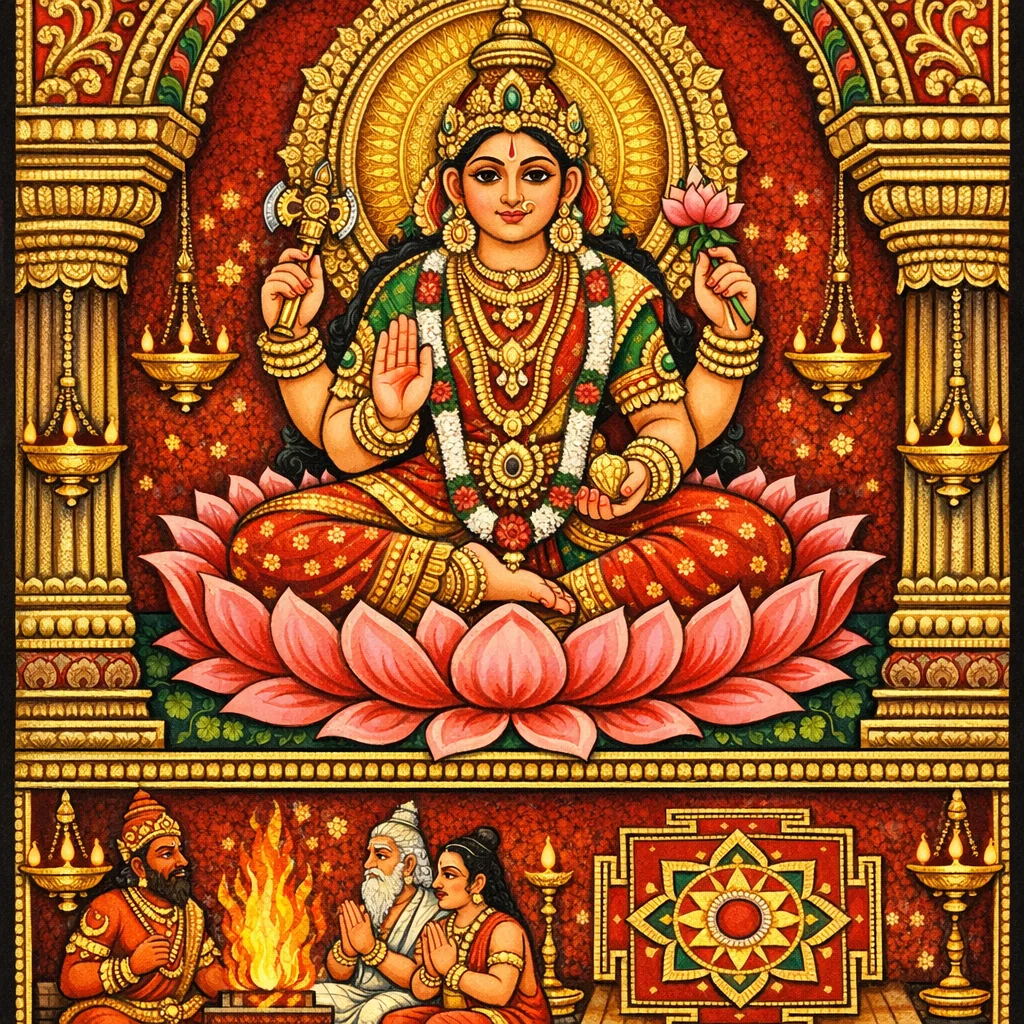
Adhyaya 309
Tvaritā-pūjā (The Worship of Tvaritā) — Transition Verse and Context
This closing transition sets a Tantric frame: Agni, speaking to Vasiṣṭha, turns from the prior material to the upāsanā of Tvaritā-devī. It stresses ritual exactitude as a revealed science—worship is not only devotion but an architectonic, operational discipline requiring a prepared locus (pura/fortified place) and a ritually drawn representation (rajo-likhita). In the Agni Purāṇa’s encyclopedic mode, Agni signals that the coming vidyā grants both Bhukti (worldly efficacy) and Mukti (liberative orientation), legitimizing technical rite as dharmic knowledge. The chapter stands as a threshold: it names the practice, frames its fruits, and introduces the Devī’s Vajrākulā mode as the governing iconographic and mantra-ritual identity for the instructions to follow.
Shlokas
Verse 1
इत्य् आग्नेये महापुराणे त्वरितापूजा नामाष्टाधिकत्रिशततमो ऽध्यायः अथ नवाधिकत्रिशततमो ऽध्यायः त्वरितामन्त्रादिः अग्निर् उवाच अपरां त्वरिताविद्यां वक्ष्ये ऽहं भुक्तिमुक्तिदां पुरे वज्राकुले देवीं रजोभिर्लिखिते यजेत्
Thus, in the Agni Mahāpurāṇa ends the three-hundred-and-ninth chapter called “The Worship of Tvaritā”. Now begins the three-hundred-and-tenth chapter: “Tvaritā—mantras and related rites.” Agni said: “I shall declare the further, more esoteric Tvaritā-vidyā, the bestower of both bhukti (worldly enjoyment) and mukti (liberation). In a city or fortified place, one should worship the Goddess in the Vajrākulā form, installing her as a figure drawn with dust/powder (rajas).”
Verse 2
पद्मगर्भे दिग्विदिक्षु चाष्टौ वज्राणि वीथिकां द्वारशोभोपशोभाञ्च लिखेच्छ्रीघ्रं स्मरेन्नरः
In the lotus-centre (padma-garbha), and in the eight directions and intermediate directions, one should draw vajra-symbols; likewise one should mark the circumambulatory path (vīthikā) and the principal and subsidiary door-ornaments. Having drawn these, one should swiftly recollect—invoking and meditating upon—the deity’s protective presence.
Verse 3
अष्टादशभुजां सिंहे वामजङ्घा प्रतिष्ठिता दक्षिणा द्विगुणा तस्याः पादपीठे समर्पिता
The eighteen-armed Goddess is installed upon a lion: her left leg is firmly set upon it, while her right leg—more fully bent—is placed upon the footstool (pādapīṭha).
Verse 4
नागभूषां वज्रकुण्डे खड्गं चक्रं गदां करमात् शूलं शरं तथा शक्तिं वरदं दक्षिणैः करैः
Adorned with serpents and wearing vajra-shaped earrings, the deity should hold in the right hands, in proper sequence, a sword, a discus (cakra), a mace; then a trident, an arrow, a spear (śakti), and the boon-bestowing gesture (varada).
Verse 5
धनुः पाशं शरं घण्टां तर्जनींशङ्खमङ्कुशम् अभयञ्च तथा वर्जं वामपार्श्वे धृतायुधम्
On the left side, the deity is to be depicted holding the implements: a bow, a noose (pāśa), an arrow, a bell, the tarjanī (admonishing/indicatory gesture), a conch (śaṅkha), a goad (aṅkuśa), the abhaya (fear-dispelling gesture), and also a vajra (thunderbolt).
Verse 6
पूजनाच्छत्रुनाशः स्याद्राष्ट्रं जयति लीलया दीर्घायूराष्ट्रभूतिः स्याद्दिव्यादिसिद्धिभाक्
From proper worship, the destruction of enemies is attained; one conquers the kingdom with ease. One gains long life and the prosperity of the realm, and becomes a possessor of divine and other siddhis (extraordinary attainments).
Verse 7
वज्रार्गले इति ञ तलेतिसप्तपातालाः कालाग्निभुवनान्तकाः ॐ कारादिस्वरारभ्य यावद्ब्रह्माण्डवाचकम्
“Vajrārgale” is the occult designation of the syllable ña; “Tala” denotes the seven netherworlds (Pātāla), also called Kālāgni and Bhuvanāntaka. From the vowels beginning with Oṃ down to the expression signifying the “cosmic egg” (brahmāṇḍa), the series of sacred phonemes is to be understood/recited.
Verse 8
ॐ काराद्भ्रामयेत्तोयन्तोतला त्वरिता ततः प्रस्तावं सम्प्रवक्ष्यामि स्वरवर्गं लिखेद्भुवि
Beginning with the syllable Oṁ, one should whirl or stir the water; then swiftly prepare the creeping line (latā). Thereafter I shall fully explain the prastāva, the introductory prelude of intonation; and one should write the vowel-series (svaravarga) upon the ground.
Verse 9
तालुर्वर्गः कवर्गः स्यात्तृतीयो जिह्वतालुकः चतुर्थस्तालुजिह्वाग्रो जिह्वादन्तस्तु पञ्चमः
The palatal group is the ka-varga; the third is formed by the tongue together with the palate. The fourth is formed by the palate and the tip of the tongue; but the fifth is formed by the tongue and the teeth.
Verse 10
षष्ठो ऽष्टपुटसम्पन्नो मिश्रवर्गस्तु सप्तमः ऊष्माणः स्याच्छ्वर्गस्तु उद्धरेच्च मनुं ततः
The sixth class is furnished with eight “groups” (puṭas); the seventh is the mixed class. The sibilants are called the ūṣmāṇas; and thereafter one should also extract and identify the “manu”, that is, the semi-vowels, from that arrangement.
Verse 11
षष्ठस्वरसमारूढं ऊष्मणान्तं सविन्दुकम् तालुवर्गद्वितीयन्तु स्वरैकादशयोजितम्
It is to be set upon the sixth vowel, to end with a sibilant (ūṣman), and to be furnished with the nasal dot (bindu). Further, it is to terminate in the second letter of the palatal class, and to be conjoined with the eleventh vowel.
Verse 12
जिह्वातालुसमायोगः प्रथमं केवलं भवेत् तदेव च द्वितीयन्तु अधस्ताद्विनियोजयेत्
The first practice is to make only the conjunction of the tongue with the palate. The second, however, is to apply that same conjunction by directing it downward, that is, by placing or pressing the tongue to the lower region.
Verse 13
एकादशस्वरैर् युक्तं प्रथमं तालुवर्गतः ऊष्माणस्य द्वितीयन्तु अधस्ताद् दृश्य योजयेत्
The first row should be arranged together with the eleven vowels, beginning from the palatal series; and the second row, belonging to the ūṣmāṇa (sibilant/aspirate) group, should be set beneath, as is seen in the established layout.
Verse 14
षोडशस्वरसंयुक्तमूष्माणस्य द्वितीयकम् जिह्वादन्तसमायोगे प्रथमं योजयेदधः
The second letter of the ūṣmāṇa series, when combined with the sixteen vowels, is to be applied (pronounced) with tongue–teeth contact; the first is to be placed below.
Verse 15
मिश्रवर्गाद् द्वितीयन्तु अधस्तात् पुनरेव तु चतुर्थस्वरसम्भिन्नं तालुवर्गादिसंयुतम्
Below the mixed class (miśra-varga), the second arrangement is again stated: it is combined with the palatal class and the rest, and is differentiated by the fourth vowel (grade/tonal value).
Verse 16
ऊष्मणश् च द्वितीयन्तु अधस्ताद्विनियोजयेत् स्वरैकादशभिन्नन्तु ऊष्मणान्तं सविन्दुकम्
And the second of the ūṣman (sibilant/aspirate) series should be placed below; and that which is distinguished by the eleven vowels is to be set at the end of the ūṣman group, together with the dot (anusvāra).
Verse 17
पञ्चस्वरसमारूढं ओष्ठसम्पुटयोगतः द्वितीयमक्षरञ्चान्यज्जिह्वाग्रे तालुयोगतः
Resting upon the five vowel-sounds, it is produced by bringing the lips together into closure; the second letter, however, is produced when the tip of the tongue makes contact with the palate.
Verse 18
ऊष्माणस्येत्ययं पाठो न साधुः प्रथमं पञ्चमे योज्यं स्वरार्धेनोद्धृता इमे ओंकाराद्या नमोन्ताश् च जपेत् स्वाहाग्निकार्यके
The reading “ūṣmāṇasya …” is not proper. The first is to be joined with the fifth. These syllables/mantras, extracted by the half-portion of the vowel element (svarārdha), beginning with Oṃ and ending with “namaḥ”, should be recited in the fire-rite (agnikārya) with the utterance “svāhā”.
Verse 19
ॐ ह्रीं ह्रूं ह्रः हृदयं हां हृश्चेति शिरः ह्रीं ज्वल ज्जलशिखा स्यात् कवचं हनुद्वयम् ह्रीं श्रीं क्षून्नेत्रत्रयाय विद्यानेत्रं प्रकीर्तितम् क्षौं हः खौं हूं फडस्त्राय गुह्याङ्गानि पुरा न्यसेत् त्वरिताङ्गानि वक्ष्यामि विद्याङ्गानि शृणुष्व मे आदिद्विहृदयं प्रोक्तं त्रिचतुःशिर इष्यते
“Oṃ; hrīṃ, hrūṃ, hraḥ”—this is to be installed as the Heart-nyāsa (hṛdaya-nyāsa). “Hāṃ, hṛś”—these are declared as the Head (śiras). “Hrīṃ, jvala, jvalā-śikhā”—this is the Kavaca (protective armour), to be installed upon the two jaws. “Hrīṃ, śrīṃ, kṣūṃ”—for the Three-Eyed One: this is proclaimed as the ‘Eye of the Vidyā’ (vidyā-netra). “Kṣauṃ, haḥ, khauṃ, hūṃ, phaḍ”—as the weapon-mantra (astra): one should first install the secret limbs (guhyāṅga-nyāsa). I shall declare the limbs of Tvaritā; listen to me regarding the limbs of the Vidyā: the ‘primordial double-heart’ is taught, and the head is held to be threefold or fourfold.
Verse 20
पञ्चषष्ठः शिखा प्रोक्ता कवचं सप्तमाष्टमम् तारकन्तु भवेन्नेत्रं नवार्धाक्षरलक्षणं
The sixty-fifth mantra is declared to be the Śikhā (crown-lock) mantra; the seventh and the eighth constitute the Kavaca (protective armour). The Tāraka, however, is the Netra (eye) mantra, characterized as consisting of nine and a half syllabic units.
Verse 21
तोतलेति समाख्याता वज्रतुण्डे ततो भवेत् ख ख हूं दशवीजा स्याद्वज्रतुण्डेन्द्रद्रूतिका
It is called “Totalā”; thereafter it becomes the mantra of Vajratuṇḍa. The formula “kha kha hūṃ” is a tenfold bīja-mantra; it is the swift-acting (drūtikā) invocation of Vajratuṇḍendra.
Verse 22
खेचरि ज्वालिनीज्वाले खखेति ज्वालिनीदश वर्चे शरविभीषणि खखेति च शवर्यपि
‘Khecarī’, ‘Jvālinī-jvālā’ (Blazing Flame), ‘Khakheti’, ‘Jvālinī-daśā’ (the Tenfold Jvālinī), ‘Varcā’ (Radiance), ‘Śara-vibhīṣaṇī’ (She who terrifies with arrows), ‘Khakheti’—and also ‘Śavarī’: these are names to be invoked for protective mantra-use.
Verse 23
छे छेदनि करालिनि खखेति च कराल्यपि वक्षःश्रवद्रवप्लवनी ख ख दूतीप्लवं ख्यपि
“Che! O Cutters (chedanī), O Terrible One (karālinī), O Khakhetī—and likewise, O fearsome Goddess Karālī! O she who makes the liquid flowing from the chest surge and overflow (vakṣaḥ-śravad-drava-plavanī)! ‘kha kha!’—and also, let there be the ‘flooding/overpowering’ of the messenger-spirit (dūtī-plavam), and ‘khy’ as well.”
Verse 24
स्त्रीबालकारे धुननि शास्त्री वसनवेगिका क्षे पक्षे कपिले हस हस कपिला नाम दूतिका
In the domain of women and children, the dūtī is called “Dhunani”; among learned women, “Śāstrī”; for one who impels or hastens garments, “Vasanavegikā”; in the kṣa-syllable division and in the pakṣa (fortnight/wing) division, “Kapilā”; and with the utterance “hasa hasa”, the dūtī is named “Kapilā”.
Verse 25
ह्रूं तेजोवति रौद्री च मातङ्गरौद्रिदूतिका पुटे पुटे ख ख खड्गे फट् ब्रह्मकदूतिका
“Hrūṃ! O Tejovatī, O Raudrī, and O dūtikā of Mātaṅga-Raudrī—fold upon fold (as a protective enclosure)! ‘kha kha’—upon the sword: ‘phaṭ!’—O Brahmakā-Dūtikā.”
Verse 26
वैतालिनि दशार्णाः स्युस्त्यजान्यहिपलालवत् हृदादिकन्यासादौ स्यान् मध्ये नेत्रे न्यसेत्सुधीः
In the Vaitālinī arrangement, there are said to be ten syllables; they are to be cast aside like a mare, a serpent, and straw. At the beginning of the nyāsa beginning with the heart (hṛdaya-nyāsa and the rest), the wise practitioner should place them in the middle—upon the eyes.
Verse 27
पादादरभ्य मूर्दान्तं शिर आरभ्य पादयोः वक्षःश्रवद्रवप्लवनीथथेति ख , छ च अङ्घ्रिजानूरुगुह्ये च नाभिहृत्कण्ठदेशतः
Beginning from the feet up to the crown of the head—and likewise from the head down to the feet—the bodily regions are to be reckoned. The indicated areas include the chest and the region of the ear (with adjacent channels of flow), as well as the points termed “drava”, “plavanī”, “ītha”, and “the”; and further the regions of the foot, knee, thigh, and groin, and the locations at the navel, heart, and throat.
Verse 28
वज्रमण्डलबूर्धे च अघोर्धे चादिवीजतः सोमरूपं ततो गावं धारामृतसुवर्षिणम्
Above, in the Vajra-maṇḍala, and below, in the Aghora region—beginning from the primordial bīja-mantra—one should then visualize the Cow in the form of Soma, raining down streams of amṛta (nectar) in a splendid shower.
Verse 29
विशन्तं ब्रह्मरन्ध्रेण साधकस्तु विचिन्तयेत् मूर्धास्यकण्ठहृन्नाभौ गुह्योरुजानुपादयोः
The practitioner should contemplate (the vital current) entering through the brahmarandhra, and then moving through the head, the mouth, the throat, the heart, the navel, the genital region, the thighs, the knees, and the feet.
Verse 30
आदिवीजं न्यसेन्मन्त्री तर्जन्यादि पुनः पुनः ऊर्धं सोममधः पद्मं शरीरं वीजविग्रहं
The practitioner of mantras should repeatedly perform the nyāsa of the primordial bīja, beginning on the index finger and the other fingers. He should visualize the Moon above, the lotus below, and the body itself as the embodied form of the bīja (seed-mantra).
Verse 31
यो जानाति न मृत्युः स्यात्तस्य न व्याधयो ज्वरा यजेज्जपेत्तां विन्यस्य ध्यायेद्देवीं शताष्टकम्
For one who understands (and properly undertakes) this, there will be no death; for him there will be no diseases or fevers. He should perform worship and recite it in japa; having established it with ritual placement (nyāsa), he should meditate on the Goddess—this set of one hundred and eight (verses/names).
Verse 32
मुद्रा वक्ष्ये प्रणीताद्याः प्रणीताः पञ्चधास्मृताः ग्रथितौ तु करौ कृत्वा मध्ये ऽङ्गुष्ठौ निपातयेत्
I shall describe the mudrās beginning with the Praṇītā. The Praṇītā is remembered as fivefold. Interlacing the two hands, one should place the thumbs in the middle.
Verse 33
तर्जनीं मूर्ध्निसंलग्नां विन्यसेत्तां शिरोपरि प्रणीतेयं समाख्याता हृद्देशे तां समानयेत्
Placing the index finger in contact with the crown of the head, one should set it upon the head. This is called the ‘Praṇītā’ (mudrā/placement); thereafter one should bring it to the region of the heart.
Verse 34
ऊर्धन्तु कन्यसामध्ये सवीजान्तां विदुर्द्विजाः नियोज्य तर्जनीमध्ये ऽनेकलग्नां परस्पराम्
The twice-born know this formation: raise the fingers so that the little finger is placed in the middle, and let the tips meet like a ‘seed’ (bīja). Then, placing them in the middle of the index fingers, join them together at multiple points of contact, interlinked with one another.
Verse 35
ज्येष्टाग्रं निक्षिपेन्मध्ये भेदनी सा प्रकीर्तिता नाभिदेशे तु तां बद्ध्वा अङ्गुष्ठावुत्क्षिपेत्ततः
Placing the tip of the index finger in the middle of the hand-formation is declared to be the mudrā called Bhedanī. Having fixed that formation at the region of the navel, one should then raise the thumbs upward.
Verse 36
कराली तु महामुद्रा हृदये योज्य मन्त्रिणः पुनस्तु पूर्ववद् बद्धलग्नां ज्येष्ठां समुत्क्षिपेत्
Karālī is the ‘Great Mudrā’ (Mahāmudrā): the practitioner of mantra should apply it at the heart. Then again, as before, having bound and fixed the gesture, one should raise up the Jyeṣṭhā mudrā.
Verse 37
वज्रतुण्डा समाख्याता वज्रदेशे तु बन्धयेत् उभाभ्याञ्चैव हस्ताभ्यां मणिबन्धन्तु बन्धयेत्
This seal is called Vajratuṇḍā. It should be applied at the vajra-region; and with both hands one should fasten it at the wrist-joint (maṇibandha).
Verse 38
त्रीणि त्रीणि प्रसार्येति वज्रमुद्रा प्रकीर्तिता प्रसार्या चेति ट दण्डः खड्गञ्चक्रगदा मुद्रा चाकारतः स्मृता
“Extending three and three (fingers)”—this is declared to be the Vajra-mudrā. And the “Prasāryā” (the extended gesture) is remembered as the ṭa-daṇḍa (staff-like form); likewise, the mudrās of the sword, discus, and mace are known by their respective shapes.
Verse 39
अङ्गुष्ठेनाक्रमेत् त्रीणि त्रिशूलञ्चोर्ध्वतो भवेत् एका तु मध्यमोर्ध्वा तु शक्तिरेव विधीयते
With the thumb one should press (mark) three points; above them the sign of a trident (triśūla) is formed. One mark is in the middle, and the upper one is prescribed as the “śakti” (spear/power-mark).
Verse 40
शरञ्च वरदञ्चापं पाशं भारञ्च घण्टया शङ्खमङ्कुशमभयं पद्ममष्ट च विंशतिः
The arrow; the boon-giving (varada) hand; the bow; the noose (pāśa); (a symbol of) burden/weight; along with a bell; the conch (śaṅkha); the goad (aṅkuśa); the gesture of fearlessness (abhaya); and the lotus—these are stated as (forming) twenty-eight (items/attributes).
Verse 41
मोहणी मोक्षणी चैव ज्वालिनी चामृताभया प्रणीताः पञ्चमुद्रास्तु पूजाहोमे च योजयेत्
The five mudrās—Mohanī, Mokṣaṇī, Jvālinī, Amṛtā, and Abhayā—having been prescribed, should be employed in both worship (pūjā) and fire-offering (homa).
Frequently Asked Questions
The prerequisite of establishing the rite in a defined locus (pura) and worshipping Devī as a powder/dust-drawn form (rajo-likhita), indicating a precise Tantric setup rather than abstract meditation alone.
It frames Tvaritā-vidyā as simultaneously result-bearing (bhukti) and liberation-oriented (mukti), positioning technical ritual as a disciplined means within Dharma rather than a merely worldly technique.