Adhyaya 326
Chapter 326 — देवालयमाहात्म्यम् (The Glory of Temples)
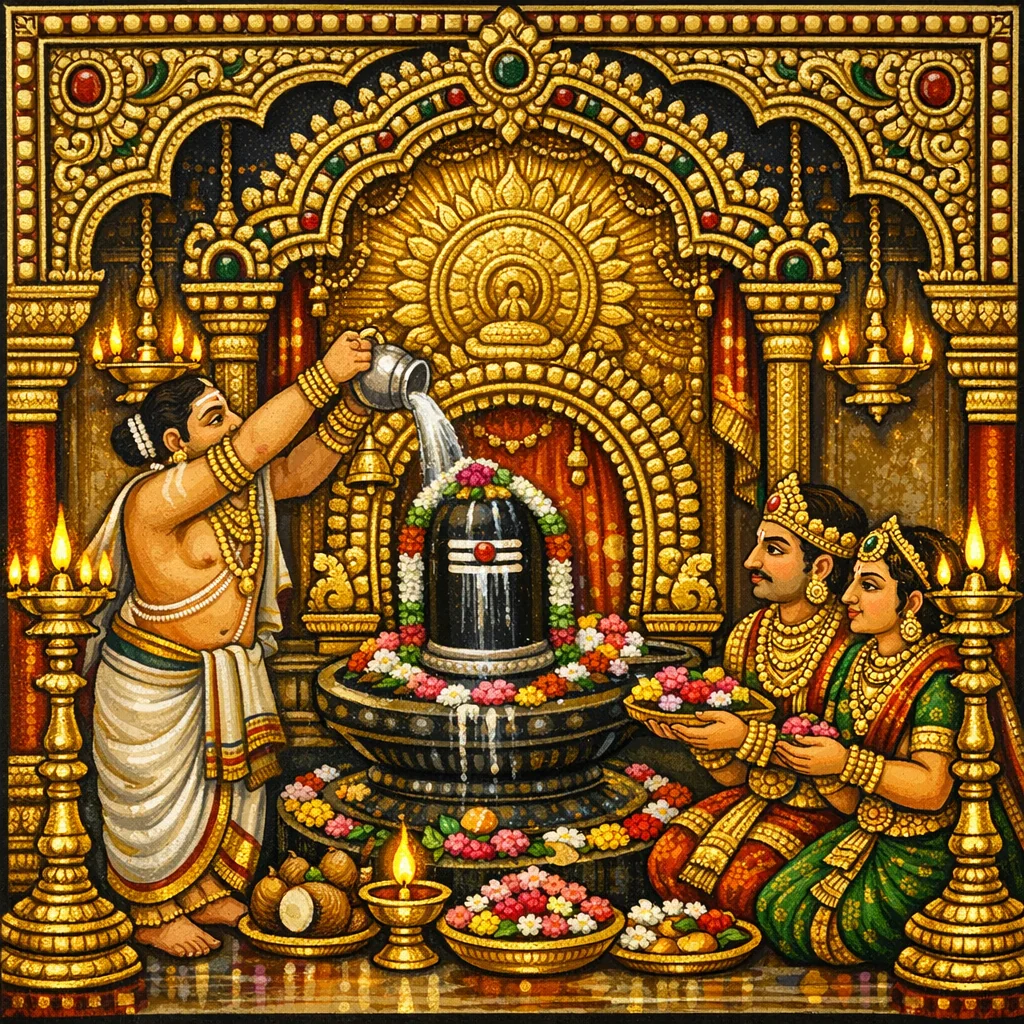
Within the Mantra-śāstra stream, this chapter shifts from vow-completion rites to the sacred economy of temple life. It describes protective and prosperity-giving ritual aids—threads, beads, and talismans—and sets rules for japa: mental recitation, the meru-bead protocol, and expiation if the rosary falls. The bell’s sound is taught as the essence of instruments, and purifying substances are prescribed for sanctifying homes, shrines, and liṅgas. The central mantra instruction exalts «Namaḥ Śivāya» in five-/six-syllable forms, culminating in «Oṃ namaḥ śivāya» as the supreme formula for liṅga worship, a compassionate source of dharma, artha, kāma, and mokṣa. The chapter then praises temple-building and liṅga installation as highest merit, multiplying the fruits of yajña, tapas, dāna, tīrtha, and Vedic study, while stressing accessibility: small or great offerings bear equal fruit when devotion is foremost. Finally, it gives a graded scale of merit for constructing devālayas with increasingly durable materials, affirming that even minimal acts of building yield great spiritual reward.
Shlokas
Verse 1
इत्य् आग्नेये महापुराणे गौर्यादिपूजा नाम पञ्चविंशत्यधिकत्रिशततमो ऽध्यायः अथ षड्विंशत्यधिकत्रिशततमो ऽध्यायः देवालयमाहात्म्यम् ईश्वर+उवाच व्रतेश्वरांश् च सत्यादीनिष्ट्वा व्रतसमर्पणम् अरिष्टशमने शस्तमरिष्टं सूत्रनायकम्
Thus, in the Agni Mahāpurāṇa ends the three-hundred-and-twenty-fifth chapter called “Worship of Gaurī and others.” Now begins the three-hundred-and-twenty-sixth chapter, “The Glory of Temples.” The Lord said: “Having duly worshipped the presiding deities of vows—such as Satya and the rest—one should perform the concluding offering of the vow (vrata-samarpaṇa). For the pacification of misfortunes (ariṣṭa), the rite connected with Ariṣṭa, guided by the Sūtranāyaka (the ritual leader who follows the sūtra), is prescribed.”
Verse 2
हेमरत्रमयं भूत्यै महाशङ्खञ्च मारणे आप्यायने शङ्खसूत्रं मौक्तिकं पुत्रवर्धनम्
A talisman made of gold and raktamaṇi is for prosperity; the great conch is for the māraṇa rite of subjugation or destruction. For nourishment and increase, a conch-thread is prescribed; a pearl-thread promotes the increase of offspring.
Verse 3
स्फाटिकं भूतिदं कौशं मुक्तिदं रुद्रनेत्रजं धाधीफलप्रमाणेन रुद्राक्षं चोत्तमन्ततः
Crystal (sphāṭika) bestows prosperity; the silk-thread (kauśa) bestows liberation; and Rudrākṣa—born of Rudra’s eye—when of the size of a dhādhī fruit, is the most excellent of all.
Verse 4
समेरुं मेरुहीनं वा सूत्रं जप्यन्तु मानसम् अनामाङ्गुष्ठमाक्रम्य जपं भाष्यन्तु कारयेत्
Whether using a rosary-string that includes a Meru-bead or one without a Meru-bead, one should perform japa mentally. Pressing the ring-finger with the thumb, one should keep count and carry out the recitation by this finger-method.
Verse 5
तर्जन्यङ्गुष्ठमाक्रम्य न मेरुं लङ्घ्येज्जपे प्रमादात् पतिते सूत्रे जप्तव्यन्तु शतद्वयम्
Pressing the forefinger with the thumb, one should not, during japa, cross over the meru-bead (the head bead) through carelessness. If the rosary-string falls down, however, two hundred repetitions should be performed.
Verse 6
सर्ववाद्यमयी घण्टा तस्या वादनमर्थकृत् गोशकृन्मूत्रवल्मीकमृत्तिकाभस्मवारिभिः
The bell embodies the essence of all musical instruments; sounding it accomplishes the intended rite. (For purification/preparation) it is treated with cow-dung, cow-urine, anthill-earth, clay, ash, and water.
Verse 7
वेस्मायतनलिङ्गादेः कार्यमेवं विशोधनम् स्कन्दो नमः शिवायेति मन्त्रः सर्वार्थसाधकः
Thus the purification rite should be performed for a house, a sanctuary/temple, a liṅga, and the like. The mantra “Skanda; namaḥ śivāya” is efficacious for accomplishing all aims.
Verse 8
गीतः पञ्चाक्षरो वेदे लोके गीतःषडक्षरः ओमित्यन्ते स्थितः शम्भुर्मुद्रार्थं वटवीजवत्
In the Veda, the (Śiva-)mantra is taught as five-syllabled; in common practice it is taught as six-syllabled. When the syllable Oṃ is placed at the end, Śambhu (Śiva) is established there—like the seed of the banyan—serving the intended purpose of the mudrā (ritual seal/gesture).
Verse 9
क्रमान्नमः शिवायेति ईशानाद्यानि वै विदुः षडक्षरस्य सूत्रस्य भाष्यद्विद्याकदम्बकं
In due sequence, they know (and apply) the “Īśāna and the rest” (divine aspects/directions) through the mantra “namaḥ śivāya”; this is a cluster of explanatory teachings (a bouquet of vidyās) serving as the commentary on the sūtra of the six-syllabled mantra.
Verse 10
यदोंनमः शिवायेति एतावत् परमं पदम् अनेन पूजयेल्लिङ्गं लिङ्गे यस्मात् स्थितः शिवः
“Oṃ namaḥ śivāya”—this alone is the supreme state (the highest formula). With this mantra one should worship the Liṅga, for Śiva is established and abides in the Liṅga.
Verse 11
अनुग्रहाय लोकानां धर्मकामार्थमुक्तिदः यो न पूजयते लिङ्गन्न स धर्मादिभाजनं
The Liṅga, out of compassion for the worlds, is the giver of dharma, kāma, artha, and liberation; one who does not worship the Liṅga is not a fit recipient of dharma and the rest.
Verse 12
लिङ्गार्चनाद्भुक्तिमुक्तिर्यावज्जीवमतो यजेत् वरं प्राणपरित्यागो भुञ्जीतापूज्य नैव तं
From worship of the Liṅga arise both worldly enjoyment and liberation; therefore one should worship for as long as one lives. Better is the surrender of the life-breath than the enjoyment of pleasures without having worshipped Him—one should not enjoy in that manner at all.
Verse 13
भक्तिदमिति ख रुद्रस्य पूजनाद्रुद्रो विष्णुः स्याद्विष्णुपूजनात् सूर्यः स्यात् सुर्यपूजातः शक्त्यादिः शक्तिपूजनात्
“This teaching is the giver of devotion (bhakti),” says the text. By worship of Rudra, Rudra becomes Viṣṇu; by worship of Viṣṇu, one attains Sūrya; by worship of Sūrya, one reaches Śakti and the rest; and by worship of Śakti, one attains the supreme goal.
Verse 14
सर्वयज्ञतपोदाने तीर्थे वेदेषु यत् फलं तत् फलं कोटिगुणितं स्थाप्य लिङ्गं लभेन्नरः
Whatever merit (phala) is gained through all sacrifices, austerities, and gifts, and whatever merit is gained from sacred pilgrimage-sites and from (study or recitation of) the Vedas—by installing a (Śiva-)Liṅga, a man attains that very merit multiplied a crore-fold.
Verse 15
त्रिसन्ध्यं योर्चयेल्लिङ्गं कृत्वा विल्वेन पार्थिवम् शतैकादशिकं यावत् कुलमुद्धृत्य नाकभाक्
Whoever worships the Śiva-Liṅga at the three daily junctions (dawn, noon, and dusk), first fashioning an earthen liṅga and offering bilva leaves, uplifts his lineage up to one hundred and eleven generations and becomes a partaker of heaven.
Verse 16
भक्त्या वित्तानुसारेण कुर्यात् प्रसादसञ्चयम् अल्पे महति वा तुल्यफलमाढ्यदरिद्रयोः
With devotion, one should accumulate offerings—acts of gracious giving—in accordance with one’s means; whether the gift is small or great, the resulting merit is the same for the wealthy and the poor.
Verse 17
भागद्वयञ्च धर्मार्थं कल्पयेज्जीवनाय च धनस्य भागमेकन्तुअनित्यं जीवितं यतः
One should allot two portions of one’s wealth to dharma (religious duty and charity), and one portion to sustaining life; for life is indeed impermanent.
Verse 18
त्रिसप्तकुलमुद्धृत्य देवागारकृदर्थभाक् मृत्काष्ठेष्टकशैलाद्यैः क्रमात् कोटिगुणं फलम्
Having redeemed three times seven generations of his lineage, the builder of a deity’s temple becomes a recipient of merit; and when the temple is built successively with clay, wood, bricks, stone, and the like, the resulting fruit increases step by step—up to a crore-fold.
Verse 19
अष्टेष्टकसुरागारकारी स्वर्गमवाप्नुयात् पांशुना क्रीडमानोपि देवागारकृदर्थभाक्
Even one who constructs a liquor-house (surāgāra) with merely eight bricks attains heaven; and even while playfully handling dust as in childish play, a person who builds a temple or shrine (devāgāra) becomes a recipient of reward—merit and prosperity.
Frequently Asked Questions
Precise japa protocol (mental repetition, meru-bead not crossing, finger-counting method, and expiation if the rosary falls), along with specified purification media for shrines and liṅgas and the mantra-structure of namaḥ śivāya / oṃ namaḥ śivāya.
It frames mantra discipline and liṅga/temple worship as direct means to all four puruṣārthas, while insisting devotion (bhakti) makes offerings efficacious regardless of wealth—thereby integrating ethical living, ritual exactness, and liberation-oriented devotion.