Adhyaya 313
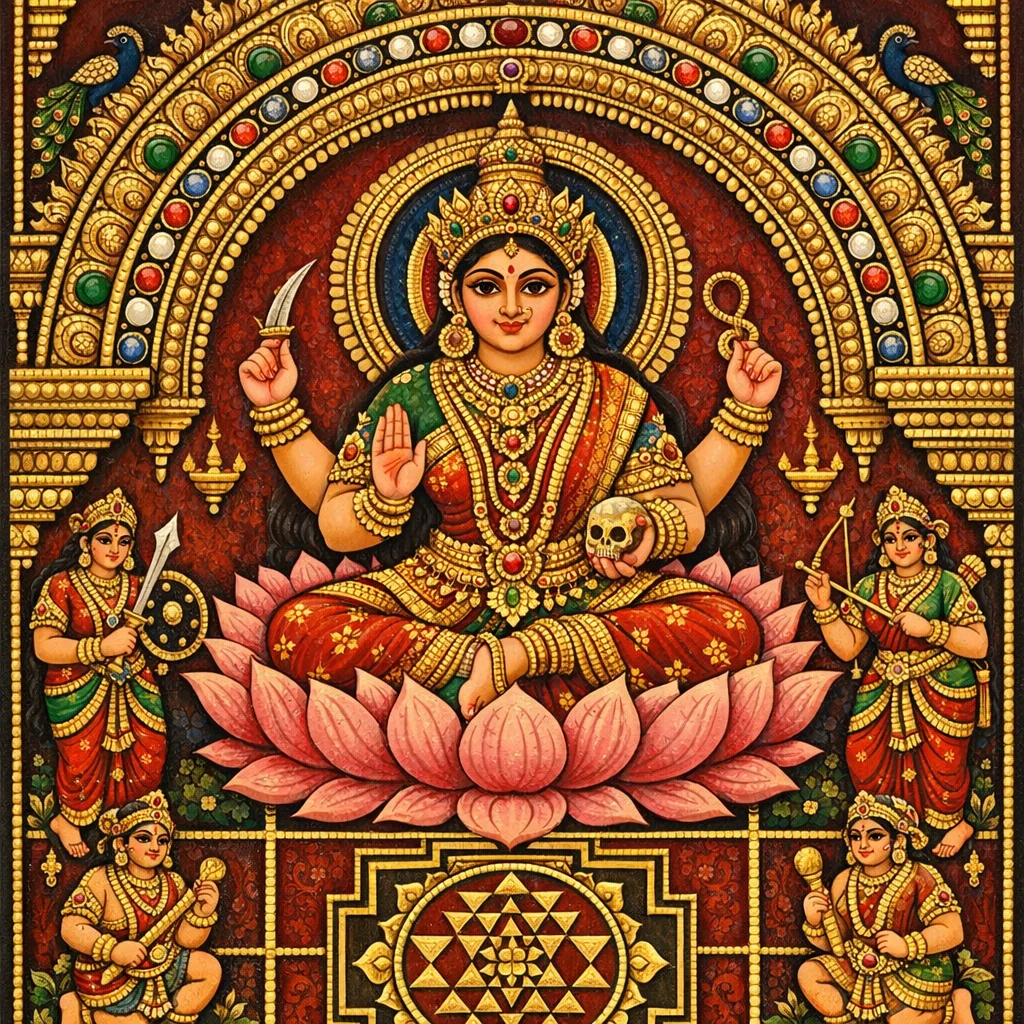
Tvaritājñānam (Knowledge of Tvaritā, the Swift Goddess) — Agni Purana, Adhyāya 314 (as introduced after 313)
Lord Agni turns from a prior catalog of mantras to a tantric ritual manual centered on Tvaritā, the Swift Goddess, and allied arts of protection and subjugation. It opens with Tvaritā’s bīja-laden mantra and worship by nyāsa, giving visualizations of her in two-armed and eight-armed forms, the establishment of ādhāra-śakti, lotus-seat, lion-mount, and limb placements (hṛd-ādi). A directional maṇḍala sequence follows: worship of Gāyatrī and feminine śaktis, then central installations and threshold guardians (Jayā, Vijayā, Kiṅkara). The text prescribes nāma-vyāhṛti offerings to the nāga-kings—Ananta, Kulikā, Vāsuki, Śaṅkhapāla, Takṣaka, Mahāpadma, Karkoṭa, and Padma/Padmā—and introduces diagrammatic practice: inscribing a Nigraha-cakra of eighty-one padas, naming suitable writing media, and where to place the sādhya’s name. The latter half expands into fierce protection and māraṇa-oriented procedures with Kālī/Kālarātrikā elements, Yama-boundary imagery, and coded protective utterances, along with ink recipes, liminal writing sites (cremation ground/crossroads), and deployment points (beneath a kumbha, an anthill, a vibhītaka tree). A complementary Anugraha-cakra is taught with auspicious materials, followed by grid-based Rudra/vidyā letter-ordering culminating in Pratyaṅgirā formulations and a combined Nigraha–Anugraha cakra of sixty-four positions. The chapter closes with an Amṛtī/Vidyā core (krīṃ saḥ hūṃ), a tri-hrīṃ encirclement, and practical modes (talismanic retention, ear-whispering) to remove enemies and despair, exemplifying the Purāṇa’s synthesis of mantra theory, yantra design, and applied ritual results under dharmic discipline.
Shlokas
Verse 1
ं फट् स्वाहा इत्य् आग्नेये महापुराणे नानामन्त्रा नाम द्वादशाधिकत्रिशततमो ऽध्यायः अथ त्रयोदशाधिकत्रिशततमो ऽध्यायः त्वरिताज्ञानम् अग्निर् उवाच ॐ ह्रीं हूं खे छे क्षः स्त्रीं ह्रूं क्षे ह्रीं फट् त्वरितायैनमः त्वरितां पूजयेन्न्यस्य द्विभुजाञ्चाष्टवाहुकां आधारशक्तिं पद्मञ्च सिंहे देवीं हृदादिकम्
“...ṃ phaṭ svāhā”—thus ends, in the Agni Mahāpurāṇa, the 313th chapter (312 plus one) entitled ‘Various Mantras’. Now begins the 314th chapter (313 plus one): ‘Knowledge of Tvaritā (the Swift Goddess)’. Agni said: “Oṃ hrīṃ hūṃ khe che kṣaḥ strīṃ hrūṃ kṣe hrīṃ phaṭ—obeisance to Tvaritā.” Having performed nyāsa, one should worship Tvaritā—visualizing her as two-armed and also as eight-armed; establishing the Ādhāra-Śakti, the lotus-seat, and the Goddess upon a lion-seat, together with the heart and other nyāsa-limbs.
Verse 2
पूर्वादौ गायत्रीं यजेन्मण्डले वै प्रणीतया हुंकारां खेचरीं चण्डां छेदनीं क्षेपणींस्त्रियाः
Beginning with the eastern quarter, one should worship Gāyatrī in the maṇḍala, duly led according to the prescribed rite; and one should also worship the feminine powers (śaktis) named Huṃkārā, Khecarī, Caṇḍā, Chedanī, and Kṣepaṇī.
Verse 3
हुंकारां क्षेमकारीञ्च फट्कारीं मध्यतो यजेत् जयाञ्च विजयां द्वारि किङ्करञ्च तदग्रतः
In the center one should worship Huṃkārā, Kṣemakārī, and Phaṭkārī; at the doorway one should place and worship Jayā and Vijayā, and in front of them, Kiṅkara.
Verse 4
लिलैहीमैश् च सर्वाप्त्यै नामव्याहृतिभिस् तथा अनन्ताय नमः स्वाहा कुलिकाय नमः स्वधा
And with gentle, pleasing utterances, together with the syllable “hīṃ” for the attainment of all aims, one should likewise employ the name-formulas (nāma-vyāhṛti): “Obeisance to Ananta—svāhā”; “Obeisance to Kulikā—svadhā.”
Verse 5
स्वाहा वासुकिराजाय शङ्खपालाय वौषट् तक्षकाय वषन्नित्यं महापद्माय वै नमः
“Svāhā” to King Vāsuki; “vauṣaṭ” to Śaṅkhapāla; “vaṣaṭ/vasan” to Takṣaka, always; and verily, salutations to Mahāpadma.
Verse 6
स्वाहा कर्कोटनागाय फट् पद्माय च वै नमः लिखेन्निग्रहचक्रन्तु एकाशीतिपदैर् नरः
“(Write the mantra:) ‘Svāhā to the serpent Karkoṭa; Phaṭ; and indeed, homage to Padmā.’” A man should inscribe the Nigraha-cakra (a restraining/protective wheel-diagram) with eighty-one syllabic units (padas).
Verse 7
वस्ते पटे तरौ भूर्जे शिलायां यष्टिकासु च मध्ये कोष्ठे साध्यनाम पूर्वादौ पट्टिकासु च
On a garment, on cloth, on a tree, on birch-bark (bhūrja), on a stone, and also on small sticks—within the central compartment (of the diagram) one should write the name of the intended target (sādhya); and likewise on the strips/labels at the beginning, starting from the eastern side.
Verse 8
ॐ ह्रीं क्षूं छन्द छन्द चतुरः कण्ठकान् कालरात्रिकां ऐशादावम्बुपादौ च यमराज्यञ्च वाह्यतः कालीनारवमाली कालीनामाक्षमालिनी
Om—together with the bījas hrīṃ and kṣūṃ—invoke, again and again, the fourfold chandas (metres); set in place/protect the throat-guards; invoke Kālarātrikā. From the Īśāna quarter onward, establish the “water-feet” as the purifying support, and outwardly establish the domain of Yama. Thus Kālī is adorned with a garland of resounding cries/roars, and Kālī bears the akṣa-mālā, a rosary of syllables.
Verse 9
मामोदेतत्तदोमोमा रक्षत स्वस्व भक्षवा यमपाटटयामय मटमो टट मोटमा
Protect me—may this incantation not fail. Guard me on every side. O devourers of your own portion, depart! Drive away the path/agents of Yama (death) and remove affliction—may the harmful forces be repelled.
Verse 10
वामो भूरिविभूमेया टट रीश्व श्वरी टट यमराजाद्वाह्यतो वं तं तोयं मारणात्मकं
“This is the leftward (vāmā) rite”: ‘bhūri-vibhū-meyā, ṭaṭ, rīśva, śvarī, ṭaṭ’—and ‘vaṃ, taṃ’. Water empowered thereby is of māraṇa (destructive) nature, as though drawn forth from Yamarāja.
Verse 11
कज्जलं निम्बनिर्यासमज्जासृग्विषसंयुतम् काकपक्षस्य लेखन्या श्मशाने वा चतुष्पथे
Soot (lampblack) mixed with neem-exudate, marrow, blood, and poison should be written with a pen made from a crow’s feather, either in a śmaśāna (cremation-ground) or at a four-way crossroads.
Verse 12
निधापयेत् कुम्भाधस्ताद्वल्मीके वाथ निक्षिपेत् विभीतद्रुमशास्वाधो यन्त्रं सर्वारिमर्दनम्
One should deposit the yantra beneath a kumbha (ritual pot), or else place it within an anthill; alternatively, beneath the branches of a vibhītaka tree. This yantra is the “crusher of all enemies”.
Verse 13
लिखेच्चानुग्रहञ्चक्रं शुक्लपत्रे ऽथ भूर्जके लाक्षया कुङ्कुमेनाथ स्फटिकाचन्दनेन वा
One should draw the Anugraha-cakra (the Wheel of Grace) on a white leaf of paper, or else on birch-bark, using lac, or saffron, or alternatively a paste of crystal-sandal (sphaṭika-candana).
Verse 14
भुवि भित्तौ पूर्वदले नाम मध्यमकोष्ठके खण्डे तु वारिमध्यस्थं ॐ हंसो वापि पट्टिशम्
On the ground or on a wall—upon the eastern petal—one should write the Name, and also in the central compartment (box). In the prescribed section, in the midst of the water-field or vessel, one should inscribe either “Oṁ haṁsaḥ” or the symbol/name of the weapon “paṭṭiśa” (battle-axe), as enjoined.
Verse 15
लक्ष्मीश्लोकं शिवादौ च राक्षसादिक्रमाल्लिखेत् श्रीःसाममोमा सा श्रीः सानौ याज्ञे ज्ञेया नौसा
One should write the Lakṣmī-verse, beginning with the word “Śiva,” following the sequence that starts with “Rākṣasa” and so forth. In this formula, “Śrīḥ” is to be understood as “Sāma”; “Omā” is that very “Śrīḥ”; and in the context of yajña it is to be known as “Sā-nau” (also read as “Nau-sā”).
Verse 16
माया लीला लाली यामा याज्ञे ज्ञेया नौसा माया यत्र ज्ञेया वहिः शीघ्रा दिक्षुरं कलसं वहिः
“Māyā, Līlā, Lālī, Yāmā”—these are to be understood within the sacrificial rite. “Nausā” (the boat) is Māyā; and wherever it is to be recognized, it is placed/uttered on the outer side. “Śīghrā” is likewise placed/uttered outwardly; and so too “Dikṣuram” and “Kalaśam” are to be taken as outward.
Verse 17
पद्मस्थं पद्मचक्रञ्च भृत्युजित् स्वर्गगन्धृतिं शान्तीनां परमा सान्तिः सौभाग्यादिप्रदायकम्
Seated upon a lotus and bearing the lotus-disc; the conqueror of servitude, the sustainer of heaven’s fragrance—this is the supreme pacification among all pacifications, the bestower of good fortune and other auspicious results.
Verse 18
रुद्रे रुद्रसमाः कार्याः कोष्ठकास्तत्र ता लिखेत् ओमाद्याह्रूंफडन्ता च आदिवर्णमथानुतः
For the worship of Rudra, one should construct Rudra-corresponding compartments (koṣṭhaka, a syllabic grid/diagram); there one should write them, beginning with “Oṃ” and ending with “hrūṃ phaḍ”; thereafter one should write the initial letters in proper sequence.
Verse 19
विद्यावर्णक्रमेनेव संज्ञाञ्च वषडन्तिकां पूर्वपदे इति ञ अधस्थात् प्रत्यङ्गिरैषा सर्वकामार्थसाधिका
In the very sequence of the syllables of the vidyā-mantra, one should also place the saṃjñā (designated name/marker) ending with the “vaṣaḍ” formula; and in the prior member (pūrvapada) one should add the syllable “ña”. Thus, in the lower placement, this is Pratyaṅgirā, capable of accomplishing all desired aims and objects.
Verse 20
एकाशीतिपदे सर्वामादिवर्णक्रमेण तु आदिमं यावदन्तं स्याद्वषडन्तञ्च नाम वै
In the eighty-first item, all (the names) are to be set forth in the sequence of initial letters; from the beginning up to the end, the name is indeed that which terminates with the exclamation “vaṣaṭ.”
Verse 21
एषा प्रत्यङ्गिरा चान्या सर्वकार्यादिसाधनी निग्रहानुग्रहञ्चक्रञ्चतुःषष्टिपदैर् लिखेत्
This is another (form of) Pratyaṅgirā, efficacious for accomplishing all undertakings and related aims. One should inscribe the Nigraha–Anugraha Cakra (“Restraint-and-Favor” ritual diagram) with sixty-four compartments/syllabic positions.
Verse 22
अमृती सा च विद्या च क्रीं सः हूं नामाथ मध्यतः फट्काराद्यां पत्रगतां त्रिह्रींकारेण वेष्टयेत्
That formula is called “Amṛtī” and also the “Vidyā”. One should place the bīja “krīṃ”, together with “saḥ” and “hūṃ”, in the middle; and the inscription beginning with “phaṭ”, written on a leaf, should be encircled (wrapped) by uttering “hrīṃ” three times.
Verse 23
कुम्भववद्धारिता सर्वशत्रुहृत् सर्वदायिका विषन्नश्येत् कर्णजपादक्षराद्यैश् च दण्डकैः
When it is held fast like a jar (that is, secured as a protective talisman or rite), it becomes the remover of all enemies and the bestower of all gifts; dejection is destroyed by whispering it into the ear, and likewise by reciting the metrical formulas beginning with the syllables (akṣara-ādi) and the daṇḍaka-verses.
Frequently Asked Questions
Precise ritual engineering: dik-krama maṇḍala placements, āvaraṇa-śakti listing, and the construction/inscription rules for multiple cakras (Nigraha 81-pada; Nigraha–Anugraha 64-pada), including substrates, central sādhya-name placement, and bīja-sequence/letter-order grids tied to vidyā-mantras.
It frames tantric efficacy as disciplined sādhana: nyāsa and mantra precision cultivate concentration and sacralize the body-mind, while protective/restraint-and-grace diagrams model dharmic control of forces—channeling worldly aims (bhukti) through regulated rites aligned to spiritual steadiness and ethical containment.