Adhyaya 314
Adhyaya 314 — Tvaritājñāna (Immediate/Quick Knowledge) (Colophon/Transition)
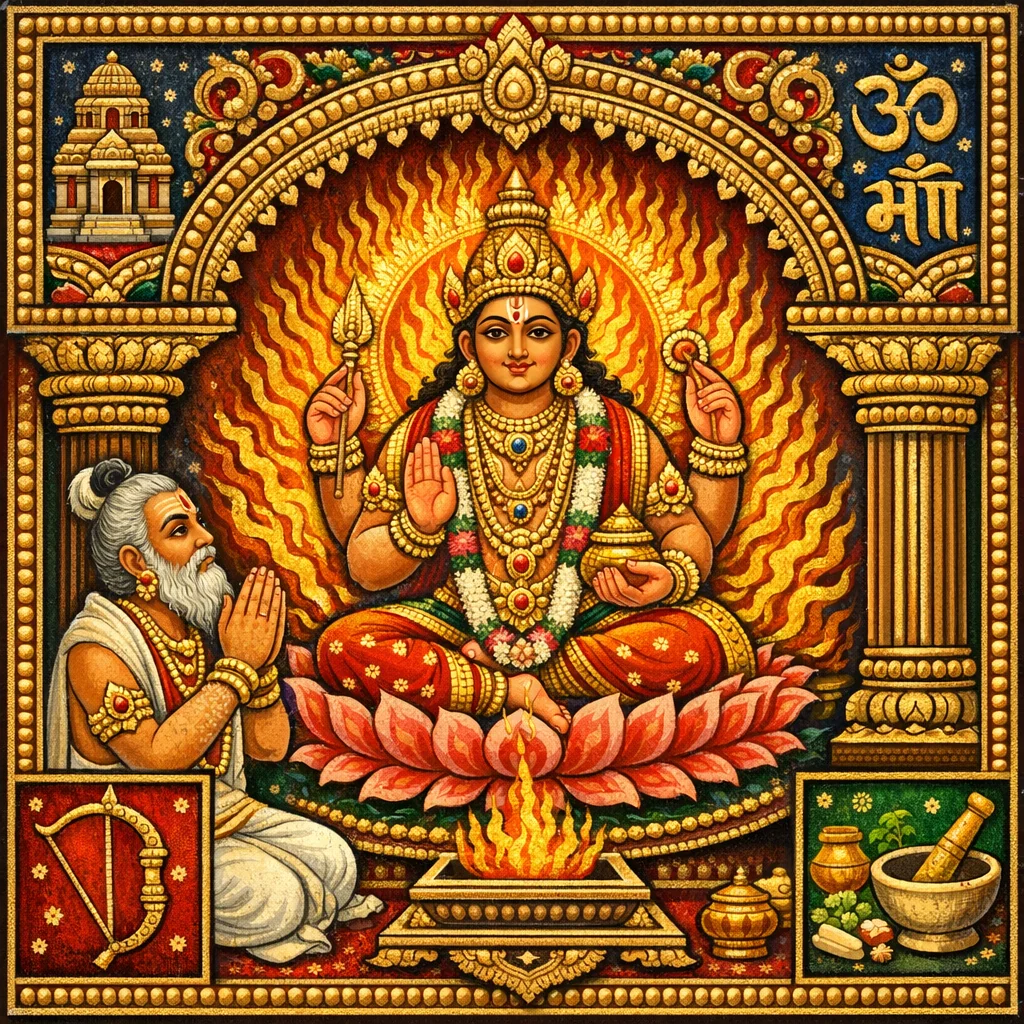
This chapter is represented by its concluding colophon, marking the completion of the unit titled Tvaritājñāna (immediate/quick knowledge). In the Agneya style of transmission, the colophon serves as a structural hinge: it closes one vidyā-module and signals an immediate shift into the next technical sequence. Within the Mantra-śāstra (Tantra) theme, such transitions indicate a curriculum order in which rapid-access knowledge (tvarita-jñāna) leads into applied mantra procedures. The narrative frame remains unchanged—Lord Agni as revealer and Vasiṣṭha as recipient—showing that even “quick methods” belong to a broader dharmic pedagogy, not standalone magical recipes.
Shlokas
Verse 1
इत्य् आग्नेये महापुराणे त्वरिताज्ञानं नाम त्रयोदशाधिकत्रिशततमो ऽध्यायः अथ चतुर्दशाधिकत्रिशततमो ऽध्यायः स्तम्भनादिमन्त्राः अग्निर् उवाच स्तम्भनं मोहनं वश्यं विद्वेषोच्चाटनं वदे विषव्याधिमरोगञ्च मारणं शमनं पुनः
Thus, in the Agni Mahāpurāṇa ends the three-hundred-and-fourteenth chapter called “Tvaritājñāna” (Immediate/Quick Knowledge). Now begins the three-hundred-and-fifteenth chapter: “Mantras beginning with Stambhana (immobilization).” Agni said: “I shall teach the rites of stambhana (checking/immobilizing), mohana (bewildering), vaśya (bringing under influence), vidveṣa and uccāṭana (causing enmity and expulsion), remedies for poison, diseases and ailments, and also māraṇa (destruction) and śamana (pacification), again in due order.”
Verse 2
भूर्जे कूर्मं समालिख्य ताडनेन षड्ङ्गुलम् मुखपादचतुर्ष्केषु ततो मन्त्रं न्यसेद्द्विजः
Having drawn a tortoise (kūrma) on birch-bark (bhūrja), and by marking/striking measured it to six finger-breadths, the twice-born (dvija) should then place the mantra (perform nyāsa) upon the fourfold set—its head and its feet.
Verse 3
चतुष्पादेषु क्रीं कारं ह्रीं कारं मुखमध्यतः गर्भे विद्यां ततो लिख्य साधकं पृष्ठतो लिखेत्
On the four feet (of the diagram/figure) one should write the syllable “krīṃ”; in the middle of the face one should write the syllable “hrīṃ”. Then, having inscribed the Vidyā (mantra) in the womb/central core, one should write the word “sādhaka” on the reverse.
Verse 4
मालामन्त्रैस्तु संवेष्ट्य इष्टकोपरि सन्न्यमेत् विधाय कूर्मपृष्ठेन करालेनाभिसम्पठेनत्
Having wrapped (the ritual item/structure) with the garland-mantras (mālā-mantra), one should place it upon the consecrated brick; and, having arranged it in the ‘tortoise-back’ formation (kūrma-pṛṣṭha, a nyāsa/placement), one should duly recite the mantra together with ‘Karāla’ (an invocatory formula/aspect).
Verse 5
महाकूर्मं पूजयित्वा पादप्रोक्षन्तु निक्षिपेत् ताडयेद्वामपादेन स्मृत्वा शत्रुञ्च सप्तधा
Having worshipped the Great Tortoise (Mahākūrma), one should place the ritual object after sprinkling it with water from the feet; then, remembering the enemy, one should strike it with the left foot seven times.
Verse 6
ततः सञ्जायते शत्रोस्तम्भनं मुखरागतः कृत्वा तु भैरवं रूपं मालामन्त्रं समालिखेत्
Thereupon, through the rite uttered by the mouth, the immobilization (stambhana) of the enemy arises; having fashioned the Bhairava-form, one should then inscribe the garland-mantra (mālā-mantra).
Verse 7
ॐ शत्रुसुखस्तम्भनी कामरूपा आलीढकरी ह्रीं फें फेत्कारिणी मम शत्रूणां देवदत्तानां मुखं स्तम्भय मम सर्वविद्वेषिणां मुखस्तम्भनं कुरु ॐ हूं फें फेत्कारिणि स्वाहा फट् हेतुञ्च समालिख्य तज्जपान्तं महाबलं वामेनैव नगं शूलं संलिखेद्दक्षिणे करे
“Oṃ. O (Goddess) who arrests the enemies’ delight, who assumes forms at will, who stands in the ālīḍha combat posture—Hrīṃ, Pheṃ—O Phetkāriṇī: paralyze the mouths (speech) of my enemies, the Devadattas; bring about the paralysis of the mouths of all who hate me. Oṃ Hūṃ Pheṃ, O Phetkāriṇī—Svāhā; Phaṭ.” Having also inscribed the ‘hetu’ (causal sign/seed), one should complete the japa of that mantra; it becomes of great power. With the left hand one should draw a mountain and a trident, and inscribe it upon the right hand.
Verse 8
लिखेन्मन्त्रमघोरस्य संग्रामे स्तम्भयेदरीन् ॐ नमो भगवत्यै भगमालिनि विस्फुर स्पन्द नित्यक्लिन्ने द्रव हूं सः क्रीं काराक्षरे स्वाहा एतेन रोचनाद्यैस्तु तिलकाम्मोहयेज्जगत्
One should write down the mantra of Aghora; in battle it is said to paralyze the enemies: “Oṃ, obeisance to the Blessed Goddess Bhagāmālinī—flash forth, throb; O Ever-Moist One, melt (them)! Hūṃ, Saḥ, Krīṃ—O syllable in the form of Kārā—Svāhā!” With this mantra, using pigments such as rocanā and the like, one should prepare a tilaka-mark that can bewilder the world.
Verse 9
ॐ फें हूं फट् फेत्कारिणि ह्रीं ज्वल त्रैलोक्यं मोहय गुह्यकालिके स्वाहा अनेन तिलकं कृत्वा राजादीनां वशीकरं गर्धभस्य रजो गृह्य कुसुमं सूतकस्य च
“Oṃ—Pheṃ, Hūṃ, Phaṭ! O Phetkāriṇī! Hrīṃ! Blaze forth; delude the three worlds, O Secret Kālikā—Svāhā.” By this mantra, having made a tilaka, one brings kings and the like under one’s control. For this rite, take dust from a donkey and also the flower of the sūtaka plant.
Verse 10
नारीरजः क्षिपेद्रात्रौ शय्यादौ द्वेषकृद्भवेत् गोखुरञ्च तथा शृङ्गमश्वस्य च खुरं तथा
If a woman’s menstrual blood is deposited at night upon a bed and the like, it is regarded as a cause of aversion and impurity. Likewise, such defiling matter is to be removed by scraping with a cow’s hoof, with a horn, and similarly with a horse’s hoof.
Verse 11
शिरः सर्पस्य संक्षिप्तं हृहेषूच्चाटनं भवेत् करवीरशिफा पीता ससिद्धार्था च मरणे
If the head of a snake is compressed (or tightly bound), it is said to bring about uccāṭana (driving away/banishing) in houses. The yellow karavīra flower-bud, together with white mustard-seed (siddhārtha), is prescribed for māraṇa (a lethal rite).
Verse 12
व्यालछुच्छुन्दरीरक्तं करवीरं तदर्थकृत् सरटं षट्पदञ्चापि तथा कर्कटवृश्चिकम्
For that very purpose (as a counter-remedy), one should employ the blood of the cucchundarī (musk-rat), karavīra (oleander), the saraṭa (a creeping, centipede-like creature), the ṣaṭpada (bee), and also remedies involving crab and scorpion.
Verse 13
चूर्णीकृत्य क्षिपेत्तैले तदभ्यङ्गश् च कुष्ठकृत् ॐ नवरहाय सर्वशत्रून् मम साधय मारय ॐ सों मं वुं चुं ॐ शं वां कें ॐ स्वहा अनेनार्कशतैर् अर्च्य श्मशाने तु निधापयेत्
Having powdered it, one should cast it into oil; massaging with that oil is said to produce kuṣṭha (a leprosy-like skin disease). (Recite:) “Oṁ, to Navarahā—subdue all my enemies for me; strike and destroy them. Oṁ soṁ maṁ vuṁ cuṁ; oṁ śaṁ vāṁ keṁ; oṁ svāhā.” Having worshipped with one hundred arka offerings by means of this mantra, one should then deposit (the prepared/charged substance) in a cremation-ground.
Verse 14
भूर्जे वा प्रतिमायां वा मारणाय रिपोर्ग्रहाः ॐ कुञ्जरी ब्रह्माणी ॐ मञ्जरी माहेश्वरी ॐ वेताली कौमारी ॐ काली वैष्णवी ॐ अघोरा वाराहि ॐ वेताली इन्त्राणी उर्वशी ॐ जयानी यक्षिणी नवमातरो हे मम शत्रुं गृह्णत भूर्जे नाम रिपोर्लिख्य श्मशाने पूजिते म्रियेत्
For the purpose of causing the enemy’s death, one should employ these seizing forces (grahas) on a bhūrja (birch-bark) leaf or on an effigy: “Oṁ Kuñjarī as Brahmāṇī; Oṁ Mañjarī as Māheśvarī; Oṁ Vetālī as Kaumārī; Oṁ Kālī as Vaiṣṇavī; Oṁ Aghorā as Vārāhī; Oṁ Vetālī as Indrāṇī; (Oṁ) Urvaśī; Oṁ Jayānī as Yakṣiṇī. O Nine Mothers, seize my enemy!” Having written the enemy’s name on bhūrja-bark and worshipped it in a cremation-ground, (the enemy) is said to die.
Frequently Asked Questions
It emphasizes textual closure and curricular continuity—ending Tvaritājñāna and preparing the reader for the next applied mantra section without breaking the Agni–Vasiṣṭha revelation frame.
By placing rapid techniques within a structured dharmic curriculum, it implies that speed or efficacy must remain accountable to right order, restraint, and the broader puruṣārtha framework.