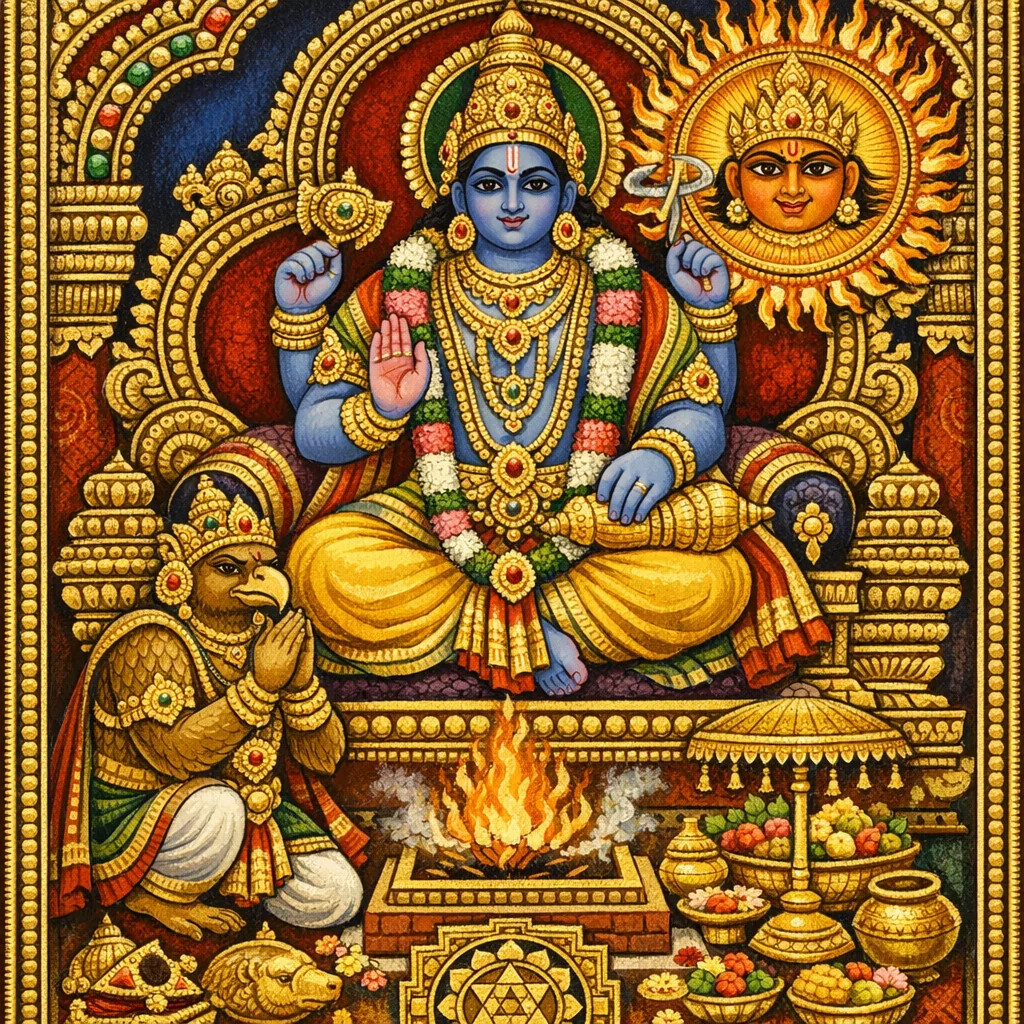
Adhyaya 306
Chapter 306 — त्रैलोक्यमोहनमन्त्राः (Mantras for Enchanting the Three Worlds)
Lord Agni introduces the Trailokya-mohana (three-world-enchanting) mantra, said to grant success in the four puruṣārthas. The chapter then lays out a structured tantric ritual sequence: preliminary worship, a fixed japa quota, abhiṣeka, and homa with prescribed substances and counts, followed by feeding brāhmaṇas and honoring the ācārya. The practitioner proceeds to bodily purification and inner ritual techniques—padmāsana, drying/disciplining the body, protective directional nyāsa (Sudarśana), bīja-meditations that expel impurity, nectar-visualization through the suṣumnā, prāṇāyāma, and śakti-nyāsa across the body. Deity-installation culminates in visualization of Viṣṇu (with Kāma/Smara motifs), Lakṣmī, Garuḍa, and weapon-worship with distinct astra-mantras. The chapter closes with the principal mantra “oṃ śrīṃ krīṃ hrīṃ hūṃ…,” tarpana protocols, higher japa/homa targets for longevity, and an appended Varāha formula aimed at sovereignty and long life—framing mantra-śāstra as both inner purification and outcome-driven rite.
Shlokas
Verse 1
इत्य् आग्नेये महापुराणे नारसिंहादिमन्त्रा नाम पञ्चाधिकत्रिशततमो ऽध्यायः अथ षष्ठाधिकत्रिशततमो ऽध्यायः त्रैलोक्यमोहनमन्त्राः अग्निर् उवाच वक्ष्ये मन्त्रं चतुर्वर्गसिद्ध्यै त्रैलिक्यमोहनम् ः ॐ पुरुषोत्तम त्रिभुवनमदोन्मादकर हूं फट् हृदयाय नमः कर्षय महाबल हूं फट् अस्त्राय त्रिभुवनेश्वर सर्वजनमनांसि हन दारय मम वशमानय हूं फट् नेत्राय त्रैलोक्यमोहन हृषीकेशाप्रतिरूप सर्वस्त्रीहृदयाकर्षण आगच्छ नमः सङ्गाक्षिण्यायकेन न्यासं मूलवदीरितं
Thus, in the Agni Mahāpurāṇa ends the three-hundred-and-fifth chapter, entitled “Nārasiṃha and other Mantras.” Now begins the three-hundred-and-sixth chapter: “Mantras for Enchanting the Three Worlds.” Agni said: “I shall proclaim the Trailokya-mohana mantra, which brings accomplishment of the four human aims (dharma, artha, kāma, mokṣa): ‘Oṃ, O Puruṣottama, you who intoxicate and madden the three worlds—hūṃ phaṭ—obeisance to the Heart. Draw (them), O Greatly Powerful One—hūṃ phaṭ—(this is) for the Weapon (astrā). O Lord of the three worlds, strike the minds of all people; split (their resolve); bring them under my control—hūṃ phaṭ—obeisance to the Eye. O Enchanter of the three worlds, O counterpart-form of Hṛṣīkeśa, attract the hearts of all women; come—obeisance.’ With “Saṅgākṣiṇī” and the rest, one should perform nyāsa as stated for the root-mantra.
Verse 2
इष्ट्वा सञ्जप्य पञ्चाशत्सहस्रमभिषिच्य च कुण्डेग्नौ देविके वह्नौ कृत्वा शतं हुनेत्
Having performed the worship and then completed the prescribed japa of fifty thousand recitations, and having performed the abhiṣeka as well, one should establish the sacred fire in the fire-pit (kuṇḍa)—O Goddess, in that fire—and then offer one hundred oblations (āhuti).
Verse 3
पृथग्दधि घृतं क्षीरं चरुं साज्यं पयः शृतं द्वादशाहुतिमूलेन सहस्रञ्चाक्षतांस्तिलान्
Separately, offer curd (dadhi), ghee, milk, caru (the rice-oblation), and cooked milk mixed with ghee; and, using the basic set of twelve oblations as the unit, offer one thousand (oblations) of unbroken rice-grains (akṣata) and sesame seeds.
Verse 4
यवं मधुत्रयं पुष्पं फलं दधि समिच्छतं हुत्वा पूर्णाहुतिं शिष्टं प्राशयेत्सघृतं चरुं
Having offered barley, the three kinds of honey, flowers, fruit, and curd (dadhi)—together with the appropriate fuel-sticks—and having performed the concluding oblation (pūrṇāhuti), one should partake of the remainder (śiṣṭa), namely the caru, the cooked oblation-food, mixed with ghee.
Verse 5
सम्भोज्य विप्रानाचार्यं तोषयेत्सिध्यते मनुः स्नात्वा यथावदाचम्य वाग्यतो यागमन्दिरं
Having fed the brāhmaṇas and satisfied the officiating teacher (ācārya), the ritual agent attains success; then, having bathed, having properly performed ācamana, and having restrained speech, he should proceed into the sacrificial hall (yāga-mandira).
Verse 6
गत्वा पद्मासनं बद्ध्वा शोषयेद्विधिना वपुः रक्षोघ्नविघ्नकृद्दिक्षु न्यसेदादौ सुदर्शनम्
Having seated oneself in the lotus posture (padmāsana), one should, according to the prescribed method, dry/discipline the body; then, for the destruction of rākṣasas and the removal of obstacles, one should first perform nyāsa, placing Sudarśana in the directions.
Verse 7
पञ्चबीजं नाभिमध्यस्थं धूम्रं चण्डानिलात्मकम् अशेषं कल्मषं देहात् विश्लेषयदनुस्मरेत्
One should meditate upon the “five-seeded” (pañcabīja) mantra, stationed in the middle of the navel—smoke-hued and of the nature of fierce wind—envisioning it as separating out and removing every impurity from the body.
Verse 8
रंवीजं हृदयाब्जस्थं स्मृत्वा ज्वालाभिरादहेत् उर्ध्वाधस्तिर्यगाभिस्तु मूर्ध्नि संप्लावयेद्वपुः
Having meditated on the seed-syllable “raṁ” abiding in the lotus of the heart, one should burn (the impurities) with flames; and with those flames—moving upward, downward, and sideways—one should flood and pervade the body up to the crown of the head.
Verse 9
ध्यात्वामृतैर् वहिश्चान्तःसुषुम्नामार्गगामिभिः एवं शुद्धवपुः प्राणानायम्य मनुना त्रिधा
Having meditated on the streams of nectar moving outward and inward along the path of the Suṣumnā, and thereby purified the body, one should regulate the vital breaths (prāṇa), performing the practice threefold with a mantra.
Verse 10
विन्यसेन्न्यस्तहस्तान्तः शक्तिं मस्तकवक्त्रयोः गुह्ये गले दिक्षु हृदि कक्षौ देहे च सर्वतः
Having performed the hand-imposition (nyāsa), one should install the Śakti upon the head and face, upon the secret part, upon the throat, in the directions, in the heart, in the armpits, and throughout the entire body.
Verse 11
आवाह्य ब्रह्मरन्ध्रेण हृत्पद्मे सूर्यमण्डलात् तारेण सम्परात्मानं स्मरेत्तं सर्वलक्षणं
Having invoked the Supreme Self through the brahmarandhra into the lotus of the heart from the solar orb, one should meditate—by means of the mystic Tāra—upon that Supreme Soul, endowed with all auspicious marks.
Verse 12
त्रैलोक्यमोहनाय विद्महे स्मराय धीमहि तन्नो विष्णुः प्रचोदयात् आत्मार्चनात् क्रतुद्रव्यं प्रोक्षयेच्छुद्धपात्रकं कृत्वात्मपूजां विधिना स्थण्डिले तं समर्चयेत्
“We know (Him) as the Enchanter of the three worlds; we meditate upon Smara (Kāma). May Viṣṇu impel and guide us.” After performing self-adoration, one should sprinkle the ritual materials (kratu-dravya) with water from a clean vessel for purification; having duly performed the self-worship according to rule, one should then worship Him properly upon the sthaṇḍila (the prepared ritual ground).
Verse 13
कर्मादिकल्पिते पीठे पद्मस्थं गरुडोपरि मर्वाङ्गसुन्दरं प्राप्तवयोलावण्ययौवनं
On a seat (pīṭha) ritually arranged according to the prescribed rites, one should visualize the deity seated upon a lotus above Garuḍa—beautiful in every limb, possessing the radiance of perfect age, charm, and youthful vigor.
Verse 14
मदाघूर्णितताम्राक्षमुदारं स्मरविह्वलिं दिव्यमाल्याम्वरलेपभूषितं सस्मिताननं
With reddish eyes rolling from intoxication, noble in bearing, tormented by Love (Kāma), adorned with a divine garland and embellished with excellent unguents, and with a gently smiling face.
Verse 15
विष्णुं नानाविधानेकपरिवारपरिच्छदम् लोकानुग्रहणं सौम्यं सहस्रादित्यतेजसं
Meditate on Vishnu—adorned with many kinds of retinues and attendants, graciously bestowing favor upon the worlds, gentle in aspect, and radiant with the splendor of a thousand suns.
Verse 16
पञ्चवाणधरं प्राप्तकामैक्षं द्विचतुर्भुजम् देवस्त्रीभिर्वृतं देवीमुखासक्तेक्षणं जपेत्
One should perform japa while meditating on the five-arrow-bearing deity, whose glance fulfills desires, who is shown as either two-armed or four-armed, surrounded by celestial women, with eyes fixed upon the Goddess’s face.
Verse 17
चक्रं शङ्खं धनुः खड्गं गदांमुषलमङ्कुशं पाशञ्च विभ्रतं चार्चेदावाहादिविसर्गतः
One should worship (the deity) who bears the discus, conch, bow, sword, mace, pestle, goad, and noose—performing worship from the rite of invocation (āvāhana) through to dismissal (visarjana).
Verse 18
श्रियं वामोरुजङ्घास्थां श्लिष्यन्तीं पाणिना पतिं साब्जचामरकरां पीनां श्रीवत्सकौस्तुभान्वितां
One should meditate upon Śrī (Lakṣmī) as seated upon His left thigh and shank, clasping her Lord with her hand; holding a lotus and a fly-whisk in her hands, full-bosomed, while He is adorned with the Śrīvatsa mark and the Kaustubha jewel.
Verse 19
मालिनं पीतवस्त्रञ्च चक्राद्याढ्यं हरिं यजेत् वाहा खड्गतीक्ष्ण छिन्द खड्गाय नमः शारङ्गाय सशराय हूं फट् भूतग्रामाय विद्महे चतुर्विधाय धीमहि तन्नो ब्रह्म प्रचोदयात् सम्बर्तक श्वसन पोथय हूं फट् स्वाहा पाश बन्ध आकर्षय हूं फट् अङ्कुशेन कट्ट हूं फट् क्रमाद्भुजेषु मन्त्रैः स्वैर् एभिरस्त्राणि पूजयेत्
One should worship Hari (Viṣṇu), garlanded and clad in yellow garments, endowed with the discus and other weapons. Reciting the weapon-mantras: “Vāhā! O sharp sword—cut! Salutation to the sword. To Śārṅga (the bow) together with the arrow—hūṃ phaṭ. We know the host of beings; we meditate on the fourfold order; may that Brahman impel us. O Sambartaka wind—strike and crush! hūṃ phaṭ svāhā. O noose—bind; draw (them) in—hūṃ phaṭ. With the goad (aṅkuśa)—strike—hūṃ phaṭ.” Thus, in due order, with these respective mantras, one should worship the astras (divine weapons) upon the deity’s arms.
Verse 20
ॐ पक्षिराजाय ह्रूं फट् तार्क्ष्यं यजेत् कर्णिकायामङ्गदेवान् यथाविधि शाक्तिरिन्द्रादियन्त्रेषु तार्क्ष्याद्या धृतचामराः
With the mantra “Oṃ, to the King of Birds—hrūṃ phaṭ,” one should worship Tārkṣya (Garuḍa) in the pericarp/central lotus (karnikā) of the yantra, and then worship the limb-deities (aṅga-devatās) in the prescribed manner. In the yantras of Indra and the other deities, Śakti (the divine Power) and the group beginning with Tārkṣya are to be depicted as holding cāmaras (fly-whisks).
Verse 21
शक्तयो ऽन्ते प्रयोज्यादौ सुरेशाद्याश् च दण्डिना पीते लक्ष्मीसरस्वत्यौ रतिप्रीतिजयाः सिताः
The Śaktis are to be placed at the end (of the rite); and at the beginning they are to be invoked along with Indra and the other gods, together with the Staff-bearer (Daṇḍin). Lakṣmī and Sarasvatī are to be visualized as yellow; Rati, Prīti, and Jayā as white.
Verse 22
कीर्तिकान्त्यौ सिते श्यामे तुष्टिपुष्ट्यौ स्मरोदिते लोकेशान्तं यजेद्देवं विष्णुमिष्टार्थसिद्धये
One should worship Lord Viṣṇu—accompanied by Kīrti and Kānti as the fair and the dark consorts, by Tuṣṭi and Puṣṭi, and by Smara and Uditi—who pacifies the Lord of the worlds, for the accomplishment of one’s desired aims.
Verse 23
ध्यायेन्मन्त्रं जपित्वैनं जुहुयात्त्वभिशेचयेत् ॐ श्रीं क्रीं ह्रीं हूं त्रैलोक्यमोहनाय विष्णवे नमः एतत्पूजादिना सर्वान् कामानाप्नोति पूर्ववत्
One should meditate upon this mantra; having recited it in japa, one should offer oblations in homa and then perform ritual ablution (abhiṣeka). “Oṃ śrīṃ krīṃ hrīṃ hūṃ—obeisance to Viṣṇu, the Enchanter of the three worlds.” By worship beginning with this (mantra), one obtains all desired aims, as stated previously.
Verse 24
तोयैः सम्मोहनी पुष्पैर् नित्यन्तेन च तर्पयेत् ब्रह्मा सशक्रश्रीदण्डी वीजं त्रैलोक्यमोहनम्
One should perform tarpaṇa (libations) with water, with ‘sammohanī’ flowers, and with the substance called nityanta. Invoking Brahmā together with Śakra (Indra), Śrī, and Daṇḍī, one should employ the bīja (seed-mantra) that enchants the three worlds.
Verse 25
जप्त्वा त्रिलक्षं हुत्वा च लक्षं बिल्वैश् च साज्यकैः तण्डुलैः फलगन्धाद्यैः दूर्वाभिस्त्वायुराप्नुयात्
Having completed three lakhs (300,000) of japa, and having offered one lakh (100,000) of homa with bilva leaves mixed with ghee—also with rice-grains, fruits, fragrant substances and the like, and with dūrvā grass—one attains longevity.
Verse 26
तयाभिषेकहोमादिक्रियातुष्टो ह्य् अभीष्टदः फलपुष्पाद्यैर् इति ट ॐ नमो भगवते वराहाय भूर्भुवः स्वःपतये भूपतिद्वं मे देहि हृदयाय स्वाह पञ्चाङ्गं नित्यमयुतं जप्त्वायूराज्यमाप्नुयात्
Pleased by those rites—such as abhiṣeka (consecratory bathing), homa (fire-offering), and the like—the Lord becomes a bestower of the desired boons, when worshipped with fruits, flowers, and so forth. “Om, obeisance to the Blessed Lord Varāha, the Lord of Bhūr, Bhuvaḥ, and Svaḥ; grant me kingship (lordship over the earth); (this oblation is) for the heart—svāhā.” Having daily recited this five-limbed (pañcāṅga) formula ten thousand times, one attains long life and sovereignty.
Frequently Asked Questions
It specifies operational ritual metrics—japa totals (e.g., 50,000; later 300,000), homa counts (e.g., 100; later 100,000), substance-lists for oblations (curd, ghee, milk, caru, sesame, akṣata, bilva, dūrvā), and stepwise internal rites (Sudarśana dik-nyāsa, bīja-dhyāna, suṣumnā nectar-visualization, prāṇāyāma, and śakti-nyāsa).
It frames tantric technique as disciplined purification (śodhana of body, breath, and mind) culminating in deity-centered contemplation of Viṣṇu; worldly aims (attraction, influence, longevity, sovereignty) are subordinated to dharma and integrated into a puruṣārtha model that includes mokṣa.
Viṣṇu is central, visualized with Lakṣmī (Śrī), Garuḍa (Tārkṣya), multiple śaktis and attendant deities (including Indra and Daṇḍin), and weapon-forms (astras) worshipped with distinct mantras.
The chapter presents a principal formula: “oṃ śrīṃ krīṃ hrīṃ hūṃ—trैलोक्यमोहनाय विष्णवे नमः,” used with dhyāna, japa, homa, and abhiṣeka to obtain desired aims.