Adhyaya 308
Chapter 308 — Worship of Tvaritā (त्वरितापूजा)
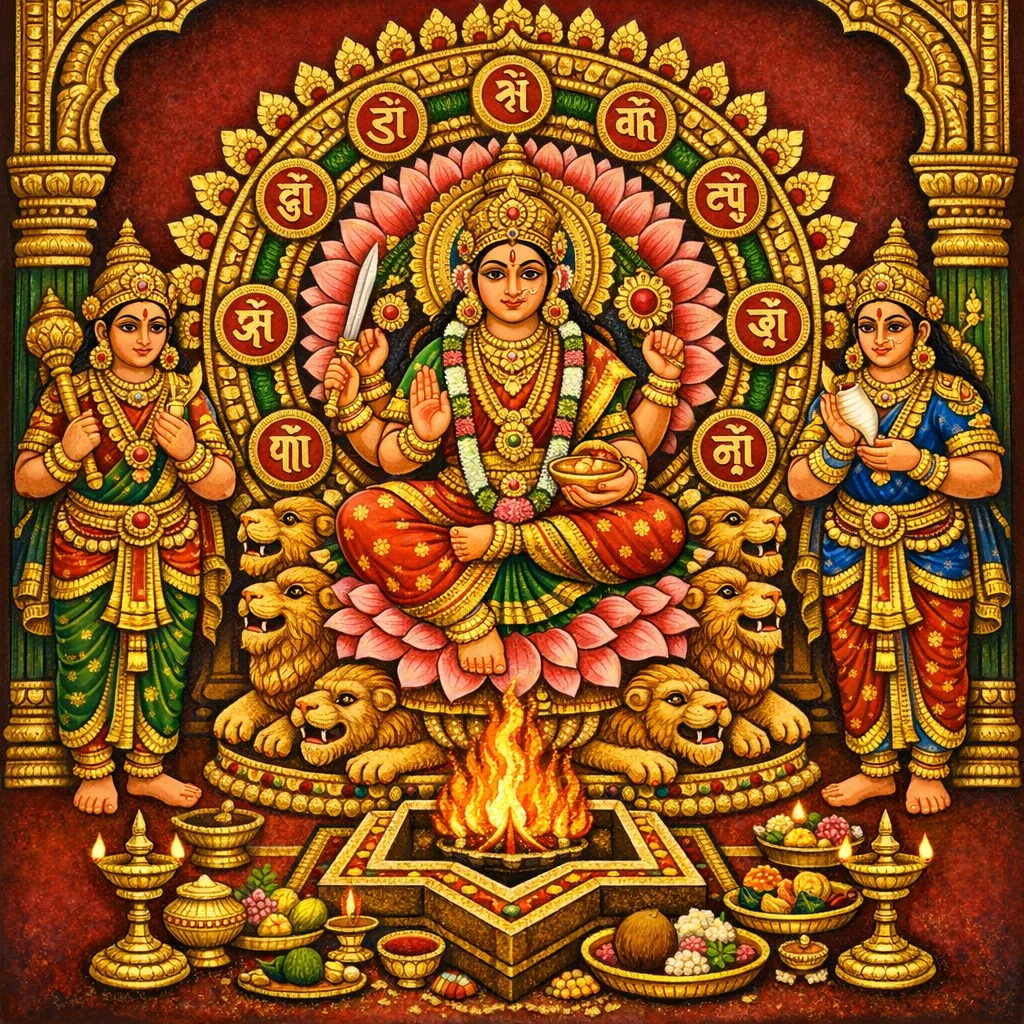
Lord Agni introduces Tvaritā-upāsanā immediately after the preceding chapter on Trailokya-mohinī Lakṣmī and allied rites. He first imparts the mantra-aṅgas and command-formulas that serve as the driving invocation for both bhukti and mukti. The rite then turns to embodied practice: aṅga-nyāsa and mantra-nyāsa are installed at prescribed bodily stations from head to feet, followed by an all-pervasive (vyāpaka) nyāsa. In dhyāna, Tvaritā is envisioned with kirāta/śabarī overtones—three-eyed, dark-hued, adorned with forest garlands and peacock-feather emblems, seated on a lion-throne, granting boons and fearlessness. Next comes an eightfold throne/lotus worship, with petal-wise placement of limb-gāyatrīs, attendant śaktis set in front and at the doorposts, and protective outer guardians. Finally, a siddhi-focused homa taxonomy is given: offerings in a yoni-shaped fire-pit with specific materials yield defined results (prosperity, protection, public favor, offspring, even hostile rites), culminating in higher japa counts, maṇḍala worship, and initiation-linked observances (dāna, pañcagavya, caru).
Shlokas
Verse 1
इत्य् आग्नेये महापुराणे त्रैलोक्यमोहनीलक्ष्म्यादिपूजा नाम सप्ताधिकत्रिशततमो ऽध्यायः अथाष्टाधिकत्रिशततमो ऽध्यायः त्वरितापूजा अग्निर् उवाच त्वरिताङ्गान्समाख्यास्ये भुक्तिमुक्तिप्रदायकान् प्रचोदयात् श्रीप्रणितायै नमः ह्रूं कारायै नमः ॐ खेच हृदयाय नमः खेचर्यै नमः ॐ चण्डायै नमः छेदन्यै नमः क्षेपण्यै नमः स्त्रियै ह्रूं कार्यै नमः क्षेमङ्कर्यै जयायै किङ्कराय रक्ष ॐ त्वरिताज्ञया स्थिरो भव वषट् तोतला त्वरिता तूर्णेत्येत्येवं विद्येयमीरिता
Thus, in the Agni Mahāpurāṇa ends the three-hundred-and-seventh chapter, “Worship of Trailokya-mohinī Lakṣmī and others.” Now begins the three-hundred-and-eighth chapter: “Worship of Tvaritā.” Agni said: “I shall declare the mantric limbs (aṅga) of Tvaritā, which bestow both worldly enjoyment and liberation; recite them as an impelling invocation: ‘Homage to Śrī-praṇitā; homage to the syllable Hrūṃ; Oṃ, homage to Kheca, the Heart; homage to Khecarī; Oṃ, homage to Caṇḍā; homage to Chedanī; homage to Kṣepaṇī; homage to Strī; homage to Hrūṃ-kārī; homage to Kṣemaṅkarī; homage to Jayā; O Kiṅkara, protect!’ ‘Oṃ—by Tvaritā’s command, become steady—vaṣaṭ!’ And the swift-accomplishing calls ‘Totala, Tvaritā, Tūrṇa’—thus this vidyā (mantra-formula) is proclaimed.
Verse 2
शिरोभ्रुमस्तके कण्ठे हृदि नाभौ च गुह्यके उर्वोश् च जानुजङ्घोरुद्वये चरणयोः क्रमात्
On the head, between the eyebrows, on the crown, at the throat, in the heart, at the navel, and in the secret region; then on the thighs, on the knees, on the shanks, on the pair of hips (or loins), and on the feet—thus, in due order, (the mantra) is to be placed.
Verse 3
न्यस्ताङ्गो न्यस्तमन्त्रस्तु समस्तं व्यापकं न्यसेत् पार्वती शवरी चेशा वरदाभयहस्तिका
Having performed the limb-placements (aṅga-nyāsa) and the placement of the mantra(s), one should then perform the complete all-pervasive nyāsa. (The Devī is to be contemplated as) Pārvatī, Śabarī, and Īśā, with her hands bestowing boons and granting fearlessness.
Verse 4
मयूरबलया पिच्छमौलिः किसलयांशुका सिंहासनस्था मायूरवर्हच्छत्रसमन्विता
She wears peacock-feather bracelets, has a crest of feathers upon her head, is clad in tender-sprout-green garments, is seated upon a lion-throne, and is attended by a parasol made of peacock plumes.
Verse 5
त्रिनेत्रा श्यामला देवी वनमालाविभूषणा विप्राहिकण्राभरणा चत्रकेयूरभूषणा
The Goddess is three-eyed and dark-hued; she is adorned with a forest-garland. Upon her neck she wears a splendid necklace, and she is ornamented with bracelets and armlets.
Verse 6
वैश्यनागकटीबन्धा वृषलाहिकृतनूपुरा एवं रूपात्मिका भूत्वा तन्मन्त्रं नियुतं जपेत्
With a waist-belt fashioned from a vaiśya nāga and anklets made from vṛṣalāhi, having assumed such a form in visualization, one should repeat that mantra one hundred thousand times.
Verse 7
ईशः किरातरूपो ऽभूत् पुरा गौरी च तादृशी जपेद्ध्यायेत् पूजयेत्तां सर्वसिद्ध्यैविषादिहृत्
In ancient times, the Lord (Īśa) assumed the form of a Kirāta, a mountain-hunter, and Gaurī too assumed a similar form. One should recite their mantra, meditate upon them, and worship that divine pair for the attainment of all siddhis; it removes dejection and the like.
Verse 8
अष्टसिंहासने पूज्या दले पूर्वादिके क्रमात् अङ्गगायत्री प्रणीता हूङ्काराद्या दलाग्रके
She is to be worshipped on the eightfold lion-throne. On the petals, beginning with the eastern one in due order, the Aṅga-gāyatrī (limb-mantras) is to be applied—beginning with the bīja “hūṃ”—at the tips of the petals.
Verse 9
फट्कारी चाग्रतो देव्याः श्रीवीजेनार्चयेदिमाः लोकेशायुधवर्णास्ताः फट्कारी तु धनुर्धरा
And in front of the Goddess, one should worship these attendant powers with the Śrī-bīja. They are to be visualized in the hues of the Lokapālas’ weapons; and Phaṭkārī is the one who bears a bow.
Verse 10
जया च विजया द्वास्थे पूज्ये सौवर्णयष्टिके किङ्करा वर्वरी मुण्डी लगुडी च तयोर्वहिः
Jaya and Vijaya are to be worshipped at the two doorposts; and likewise the venerable Sauvarṇayaṣṭikā. Outside those (doorposts), one should worship Kiṅkarā, Varvarī, Muṇḍī, and Laguḍī.
Verse 11
इष्ट्वैवं सिद्धयेद्द्रव्यैः कुण्डे योन्याकृतौ हुनेत् हेमलाभो ऽर्जुनैर् धान्यैर् गोधूमैः पुष्टिसम्पदः
Having thus performed the rite, one should accomplish the intended result by offering the prescribed substances into a yoni-shaped fire-pit (kuṇḍa). Oblations with arjuna-wood yield gain of gold; with grains and with wheat they bring nourishment and prosperity.
Verse 12
यवैर् धान्यैस्तिलैः सर्वसिद्धिरीतिविनाशनम् अक्षैर् उन्मत्तता शत्रोः शाल्मलीभिश् च मारणम्
By means of barley, grains, and sesame, one obtains complete accomplishment and the destruction of calamity or pestilence. By means of akṣa (the dice-nut seed), one brings madness upon an enemy; and by means of śālmalī substances, one effects killing.
Verse 13
जम्बुभिर्धनधान्याप्तिस्तुष्टिर्नीलोत्पलैर् अपि रक्तात्पलैर् महापुष्टिः कुन्दपुष्पैर् महोदयः
By offering jambū fruits one gains acquisition of wealth and grain; by blue lotuses, contentment; by red lotuses, great nourishment and robust well-being; and by kunda blossoms, a great rise in prosperity.
Verse 14
मल्लिकाभिः पुरक्षोभः कुमुदैर् जनवर् लभः अशोकैः पुत्रलाभः स्यात् पाटलाभिः शुभाङ्गना
With mallikā (jasmine) flowers there is disturbance in the city; with kumuda (white lotus) there is gain among the people—public favor and support. With aśoka flowers there will be the attainment of a son; and with pāṭalā flowers there comes a virtuous, auspicious woman as a gain.
Verse 15
आम्रैर् आयुस्तिलैर् लक्ष्मीर्बिल्वैः श्रीश् चम्पकैर् धनम् इष्टं मधुकपुष्पैश् च बिल्वैः सर्वज्णतां लभेत्
By offering mangoes one gains longevity; by sesame, prosperity; by bilva fruits, auspicious fortune; by campaka flowers, desired wealth. And by offering madhūka (mahua) blossoms together with bilva, one attains omniscience.
Verse 16
त्रिलक्षजप्यात्सर्वाप्तिर्होमाद्ध्यानात्तथेज्यया मण्डले ऽभ्यर्च्य गायत्र्या आहुतीः पञ्चविंशतिम्
By the japa of three lakhs (300,000 repetitions) one attains complete accomplishment; likewise by homa, by meditation (dhyāna), and by worship (ījyā). Having worshipped in a ritual maṇḍala, one should offer twenty-five oblations (āhuti) accompanied by the Gāyatrī.
Verse 17
दद्याच्छतत्रयं मूलात् पल्लवैर् दीक्षितो भवेत् पञ्चगव्यं पुरा पीत्वा चरुकं प्राशयेत्सदा
He should give three hundred (units) from his own resources; by offering tender sprouts (pallava) he becomes duly initiated (dīkṣita). Having first drunk pañcagavya, he should always partake of the sacrificial porridge (caru).
Frequently Asked Questions
It proceeds from mantra-aṅga recitation to aṅga/mantra-nyāsa across bodily loci, then vyāpaka-nyāsa, Devī dhyāna, eightfold throne-lotus worship with attendants and guardians, and finally homa in a yoni-shaped kuṇḍa with substance-specific outcomes.
The chapter emphasizes tantric ritual engineering: precise nyāsa placement (head-to-feet sequence), structured maṇḍala/throne worship with petal-wise order, and a detailed dravya–phala mapping for homa offerings.
Tvaritā’s mantra-aṅgas are explicitly said to bestow both enjoyment and liberation; the same discipline—purified body via nyāsa, concentrated dhyāna, and dharmically framed worship—supports pragmatic siddhis while orienting the practitioner to spiritual completion.
She is three-eyed and dark-hued, adorned with forest garlands and ornaments, associated with kirāta/śabarī motifs, marked by peacock-feather emblems and a peacock-plume parasol, and enthroned on a lion-seat with varada and abhaya gestures.