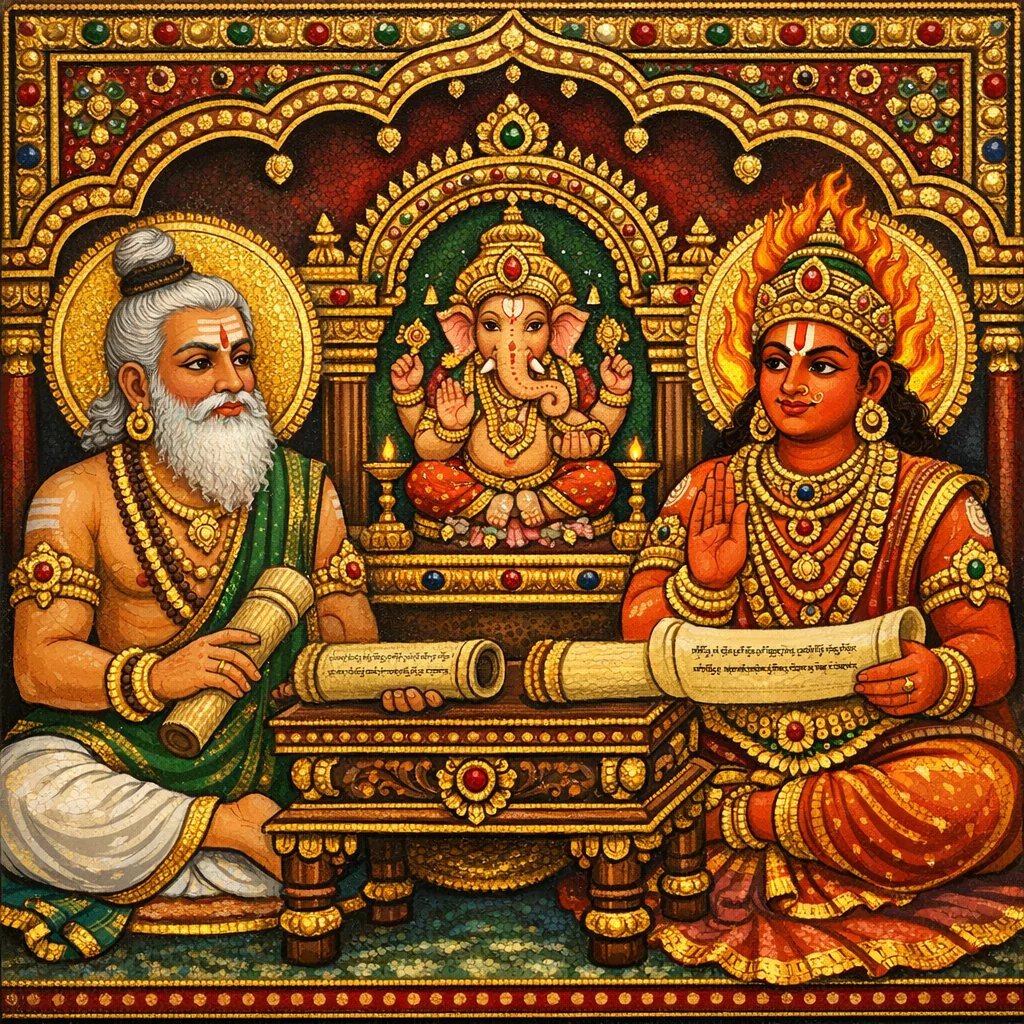
Adhyaya 317
सकलादिमन्त्रोद्धारः (Sakalādi-mantra-uddhāra) — Chapter Colophon/Transition
This unit serves chiefly as a closing colophon and transition, marking the completion of the preceding chapter, “Sakalādi Mantra-uddhāra” (the extraction/derivation of a mantra beginning with ‘sakala’). In the Agni Purana’s Mantra-śāstra sequence, such colophons function as organizational hinges, affirming mantra-derivation (uddhāra) and phonetic/ritual analysis as formal disciplines. The transition readies the reader for the next instructional layer—Gaṇa-pūjā—where mantra-technology is applied to protective worship and the removal of obstacles. The broader Purāṇic pedagogy remains intact: precise mantra-handling is required for dharmic ritual and siddhi-oriented practice, yet is ultimately subordinated to spiritual discipline and right intention.
Shlokas
Verse 1
इत्य् आग्नेये महापुराणे सकलादिमन्त्रोद्धारो नाम षोडशाधिकत्रिशततमो ऽध्यायः अथ सप्तदशाधिकत्रिशततमो ऽध्यायः गणपूजा इश्वर उवाच विश्वरूपं समुद्धृत्य तेजस्युपरि संस्थितम् नरसिंहं ततो ऽधस्तात् कृतान्तं तदधो न्यसेत्
Thus, in the Agni Mahāpurāṇa, the three-hundred-and-seventeenth chapter, called “Extraction/Derivation of the Sakalādi Mantra,” comes to an end. Now begins the three-hundred-and-eighteenth chapter: “Worship of the Gaṇas.” Īśvara said: “Having raised up (and installed) the Viśvarūpa form, place it above the region of Tejas (radiance/fire). Then, below that, place Narasiṃha; and beneath him one should place Kṛtānta (Death/Yama).”
Verse 2
प्रणवं तदधःकृत्वा ऊहकं तदधः पुनः अंशुमान् विश्वमूर्तिस्थं कण्ठोष्ठप्रणवादिकम्
Placing the syllable Oṁ (praṇava) beneath the element set down before, and again placing the ‘ūhaka’ beneath it, one should meditate on Aṁśumān—abiding as the form of the universe—together with the phonetic placements beginning with the praṇava, located in the throat and lips.
Verse 3
नमो ऽन्तः स्याच्चतुर्वर्णो विश्वरूपञ्च कारणम् सूर्यमात्राहतं ब्रह्मण्यङ्गानीह तु पूर्ववत्
The mantra should conclude with “namaḥ”. It has four syllabic units, is universal in form, and is the causal principle (kāraṇa). Marked by the Sūrya-mātrā (solar syllabic measure), one should here perform nyāsa, placing the limbs of Brahman as previously prescribed.
Verse 4
उद्धरेत् प्रणवं पूर्वं प्रस्फुरद्वयमुच्चरेत् घोरघोरतरं पश्चात् तत्र रूपमतः स्मरेत्
First, one should utter the Praṇava Oṁ. Next, one should pronounce the pair “prasphurat” (the two flashing/manifesting syllables). Thereafter, one should recite “ghora-ghoratara” (the terrible and the more terrible); then one should meditate upon the corresponding form (deity-image) there.
Verse 5
चटशब्दं द्विधा कृत्वा ततः प्रवरमुच्चरेत् दहेति च द्विधा कार्यं वमेति च द्विधा गतम्
Having split the mantric sound “caṭa” into two parts, one should then utter “pravara” (the principal/most excellent form). Likewise, “dahe” is to be treated as twofold, and “vame” too is understood as twofold in its application.
Verse 6
घातयेति द्विधाकृत्य हूंफडन्तं समुच्चरेत् अघोरास्त्रन्तु नेत्रं स्याद् गायत्री चोच्यते ऽधुना
Dividing the utterance “ghātaya” into two parts, one should recite it, ending with “hūṃ phaṭ”. This is the Aghorāstra; it functions as the protective “netra” (eye/overseer-mantra). Now the Gāyatrī is also being stated.
Verse 7
तन्महेशाय विद्महे महादेवाय धीमहि अप्_३१७*१अब्तत्रः शिवः प्रचोदयात् गायत्री सर्वसाधनी अप्_३१७*१च्द्यात्रायां विजयादौ च यजेत् पूर्वङ्गणं श्रिये तुर्यांशे तु पुरा क्षेत्रे समन्तादर्कभाजिते
We know and contemplate Mahēśa; we meditate upon Mahādeva—may Śiva impel our intellect. This Gāyatrī is an all-accomplishing mantra. At the start of a journey and at the commencement of a victory-rite, one should perform the preliminary worship for śrī (prosperity) in the first forecourt; and in the fourth quarter, in an ancient sacred kṣetra/temple precinct, illumined on all sides by the sun.
Verse 8
चतुष्पदं त्रिकोणे तु त्रिदलं कमलं लिखेत् सर्वत इति ख द्विधाकृतमिति ख तत्पृष्ठे पदिकाविथीभागि त्रिदलमश्वयुक्
Within a triangle, one should draw a four-footed (four-based) form and then inscribe a three-petalled lotus. Mark the syllable “kha” as “sarvataḥ” (on all sides) and again “kha” as “dvidhākṛta” (made into two parts). Behind that, draw a three-petalled figure divided by the pathway of small steps (padikā-vithī), joined with the aśvayuk (horse-yoke) motif.
Verse 9
वसुदेवसुतैः साब्जैस्तिदलैः पादपट्टिका तदूर्ध्वे वेदिका देया भगमात्रप्रमाणतः
The foot-plinth (pādapaṭṭikā) should be fashioned with the (Vāsudeva-)sons, together with a lotus motif of three petals. Above that, the altar-platform (vedikā) should be set in place, measured to the extent of one bhaga (a standard proportional unit/part).
Verse 10
द्वारं पद्ममितं कोष्ठादुपद्वारं विवर्णितम् द्वारोपद्वाररचितं मण्डलं विघ्नसूदनम्
The doorway is to be measured by the “padma” unit; from the chamber (koṣṭha) the sub-doorway (upadvāra) is then specified. A mandala formed by arranging the doorway and the sub-doorway in the prescribed layout is called “Vighnasūdana”—the obstacle-destroying diagram.
Verse 11
आरक्तं कमलं मध्ये वाह्यपद्मानि तद्वहिः सिता तु वीथिका कार्या द्वाराणि तु यथेच्छया
In the center, one should make a reddish lotus; outside it, the outer lotuses (petals) should be arranged. A white walkway (vīthikā) is to be constructed, and the gateways may be set according to one’s preference.
Verse 12
कर्णिका पीतवर्णा स्यात् केशराणि तथा पुनः मण्डलं विघ्नमर्दाख्यं मध्ये गणपतिं यजेत्
The central pericarp (karnikā) should be yellow in color, and likewise the filaments (keśara). This maṇḍala is called “Vighnamarda” (Destroyer of Obstacles); in its center one should worship Gaṇapati.
Verse 13
नामाद्यं सवराकं स्याद्देवाच्छक्रसमन्वितम् शिरो हतं तत्पुरुषेण ओमाद्यञ्च नमो ऽन्तकम्
The mantra should begin with the syllable “na” together with its vowel (svara). It is to be joined with the word “deva” and endowed with the prescribed “śakra” element. The ‘head’ (śiras) portion is to be set/struck with the Tatpuruṣa-mantra; and it should begin with “Oṃ” and end with “namaḥ”.
Verse 14
गजाख्यं गजशीर्षञ्च गाङ्गेयं गणनायकम् त्रिरावर्तङ्गगनगङ्गोपतिं पूर्वपङ्क्तिगम्
One should invoke him as ‘Gajākhya’ and ‘Gajaśīrṣa’, as ‘Gāṅgeya’, as the ‘Leader of the Gaṇas’; and also as ‘Trirāvarta’, as ‘Lord of the celestial Gaṅgā’, and as ‘He who stands in the foremost row’.
Verse 15
विचित्रांशं महाकायं लम्बोष्ठं लम्बकर्णकम् लम्बोदरं महाभागं विकृतं पार्वतीप्रियम्
One should meditate on him as wondrous in form, huge-bodied, with long lips and long ears; pot-bellied (Lambodara), greatly fortunate and majestic, of distinctive (unconventional) appearance, and beloved of Pārvatī.
Verse 16
भयावहञ्च भद्रञ्च भगणं भयसूदनम् द्वादशैते दशपङ्क्तौ देवत्रासञ्च पश्चिमे
‘Bhayāvaha’ and ‘Bhadra’, ‘Bhagaṇa’ and ‘Bhayasūdana’—these twelve (names) are to be arranged in a row of ten; and ‘Devatrāsa’ is to be placed on the western side.
Verse 17
महानादम्भास्वरञ्च विघ्नराजं गणाधिपम् उद्भटस्वानभश् चण्डौ महाशुण्डञ्च भीमकम्
And (I praise) Gaṇapati—whose sound is a mighty roar, the sovereign over obstacles, the lord of the Gaṇas; whose voice is thunderous and fills the sky, fierce, with a great trunk, and awe-inspiring.
Verse 18
मन्मथं मधुसूदञ्च सुन्दरं भावपुष्टकम् सौम्ये ब्रह्मेश्वरं ब्राह्मं मनोवृत्तिञ्च संलयम्
One should contemplate (and recite) these: Manmatha; Madhusūdana; the Beautiful One; the Nourisher of devotion; the Gentle One; Brahmeśvara; the Brahman-like (Supreme) One; the movements of the mind; and absorption (laya).
Verse 19
लयं दूत्यप्रियं लौल्यं विकर्णं वत्सलं तथा कृतान्तं कालदडण्च यजेत् कुम्भञ्च पूर्ववत्
One should worship (the deities) Laya, Dūtyapriya, Laulya, Vikarṇa, and Vatsala, and also Kṛtānta and Kāladaṇḍa; and one should worship the kumbha (ritual vessel) in the same manner as before.
Verse 20
श्रयुतञ्च जपेन्मन्त्रं होमयेत्तु दशांशतः शेषाणान्तु दशाहुत्या जपाद्धोमन्तु कारयेत्
One should recite the mantra up to one hundred thousand times, and then perform homa in the proportion of one-tenth of the japa. For any remainder, one should complete it by ten oblations; thus the homa is to be performed in accordance with the japa.
Verse 21
पूर्णां दत्वाभिषेकन्तु कुर्यात्सर्वन्तु सिध्यति भूगो ऽश्वगजवस्त्राद्यैर् गुरुपूजाञ्चरेन्नरः
Having given the pūrṇā (the full/due offering), one should then perform the consecration (abhiṣeka); then indeed everything succeeds. A man should practice worship of the Guru with gifts such as land, cows, horses, elephants, garments, and the like.
Frequently Asked Questions
The chapter is essentially a colophon: it emphasizes the formal closure of a mantra-derivation unit (uddhāra), highlighting that mantra parsing and extraction are treated as a codified śāstric procedure.
By framing mantra-derivation as disciplined knowledge, it reinforces that correct method (vidhi) and textual fidelity support purity of practice, preparing the practitioner for applied worship aimed at removing obstacles and stabilizing sādhana.