Adhyaya 305
Chapter 305 — Narasiṃha and Related Mantras (नारसिंहादिमन्त्राः)
Lord Agni shifts from earlier Vaiṣṇava name-litanies to a Mantra-śāstra (tantric) section aimed at forceful, protective use. He classifies hostile/kṣudra rites—stambhana (paralysis), vidveṣaṇa (enmity), uccāṭana (expulsion), utsādana (ruin/repulsion), bhrama (delusion), māraṇa (destruction), and vyādhi (disease)—and promises their “mokṣa,” a release or remedy, stressing both application and containment. He then gives operative mantras and methods: night japa in a cremation-ground to induce delusion; pratimā-vidhana (piercing an image) as a lethal rite; and powder-casting for utsādana. The teaching turns to Sudarśana/Chakra-based protection—nyāsa placements, weapon-bearing deity visualization, chakra-diagram coloration, kumbha installation, and a structured homa with prescribed materials and the count of 1008. It culminates in a fierce Narasiṃha mantra (oṃ kṣauṃ…) to destroy rākṣasa-like afflictions, fevers, graha disturbances, poisons, and disease, presenting Narasiṃha as a fiery apotropaic power within a carefully staged ritual system.
Shlokas
Verse 1
इत्य् आग्नेये महापुराणे पञ्चपञ्चाशद्विष्णुनामानि नाम चतुरधिकत्रिशततमो ऽध्यायः अथ पञ्चाधिकत्रिशततमो ऽध्यायः नारसिंहादिमन्त्राः अग्निर् उवाच स्तम्भो विद्वेषणोच्चाट उत्सादो भ्रममारणे व्याधिश्चेति स्मृतं क्षुत्रं तन्मोक्षो वक्ष्यते शृणु
Thus ends, in the Agni Mahāpurāṇa, the three-hundred-and-fourth chapter entitled “The fifty-five names of Viṣṇu.” Now begins the three-hundred-and-fifth chapter: “Narasimha and related mantras.” Agni said: “Stambha (paralysis), vidveṣaṇa (creating enmity), uccāṭa (expulsion), utsāda (ruinous affliction), bhrama (delusion), māraṇa (destruction), and vyādhi (disease)—these are remembered as ‘kṣudra’ (base/hostile) rites. Hear; I shall explain the release/remedy (mokṣa) from them.”
Verse 2
ॐ नमो भगवते उन्मत्तरुद्राय भ्रम भ्रामय अमुकं वित्रासय उद्भ्रामय रौद्रेण रूपेण हूं फठ् ठ श्मशाने निशि जप्तेन त्रिलक्षं मधुना हुनेत् चिताग्नौ धूर्तसमिदुभिर्भ्राम्यते सततं रिपुः
“Om—obeisance to the Blessed Unmattarudra! Confound—make (him) whirl; take so-and-so (amuka) and terrify (him), drive (him) into frantic delusion, in a fierce (raudra) form—hūṃ, phaṭ, ṭha!” Having recited this at night in a cremation-ground three lakhs of times, one should offer honey-oblations into the funeral pyre’s fire with dhūrta kindling; thereby the enemy is made to wander in confusion continually.
Verse 3
हेमगैरिकया कृष्णा प्रतिमा हैमसूचिभिः जप्त्वा विध्येच्च तत्कण्ठे हृदि वा मियते रिपुः
After mantra-recitation, one should pierce with golden needles a blackened image (prepared with hema-gairikā, red ochre), piercing it at the enemy’s throat or else at the heart; the foe dies.
Verse 4
खरबालचिताभस्म ब्रह्मदण्डी च मर्कटी गृहे वा मूर्ध्नि तच्चूर्णं जप्तमुत्सादकृत क्षिपेत्
One should take the ash from a donkey-hair funeral pyre, together with brahmadaṇḍī and markaṭī; having empowered that powder by mantra-recitation, one should cast it either into the target’s house or upon the target’s head, for the purpose of utsādana (driving away/repulsion).
Verse 5
भृग्वाकाशौ सदीप्ताग्निर्भृगुर्वह्निश् च वर्म फट् एवं सहस्रारे हूं फट् आचक्राय स्वाहा हृदयं विचक्राय शिवः शिखाचक्रायाथ कवचं विचक्रायाथ नेत्रकम्
‘Bhṛg’ and ‘Vyākāśa’: the blazing Fire; ‘Bhṛgu’ and ‘Vahni’—thus is the armor-mantra (kavaca): “phaṭ”. In the sahasrāra (thousand-petalled crown) utter “hūṃ phaṭ”; for the Ā-cakra say “svāhā”. For the heart, invoke the Vi-cakra with “Śiva”; then (invoke) the Śikhā-cakra; thereafter perform the protective kavaca for the Vi-cakra; and thereafter consecrate the eyes (netra).
Verse 6
सञ्चक्रायास्त्रमुदिष्टं ज्यालाचक्राय पूर्ववत् शार्ङ्गं सुदर्शनं क्षुद्रग्रहहृत् सर्वसाधनम्
The missile-weapon mantra (astra) called Sañcakrā is taught; for the Jyālācakra it is to be employed in the same manner as previously described. It is Śārṅga and Sudarśana—an implement that removes minor seizing afflictions (grahas) and serves as an all-purpose means for sādhana, for overcoming obstacles.
Verse 7
मूर्धाक्षिमुखहृद्गुह्यपादे ह्य् अस्याक्षरान्न्यसेत् चक्राब्जासनमग्न्याभं दंष्ट्रणञ्च चतुर्भुजम्
One should perform nyāsa, placing the syllables of this mantra upon the head, the eyes, the mouth, the heart, the secret region, and the feet. Then one should visualize the deity as fire-lustrous, seated upon a lotus, bearing the discus (cakra), with protruding fangs, and four-armed.
Verse 8
शङ्खचक्रगदापद्मशलाकाङ्कुशपाणिनम् चापिनं पिङ्गकेशाक्षमरव्याप्तत्रिपिष्टपं
He should meditate upon the deity whose hands bear the conch (śaṅkha), discus (cakra), mace (gadā), lotus, the rod (śalākā), and the elephant-goad (aṅkuśa); who is also armed with a bow; whose hair is tawny; and who pervades the three heavens, conquering Māra (death).
Verse 9
नाभिस्तेनाग्निना विद्धा नश्यन्ते व्याधयो ग्रहाः पीतञ्चक्रं गदा रक्ताः स्वराः श्याममवान्तरं
When the navel-region is pierced/treated with that fire (i.e., by a controlled application of heat), diseases and graha-afflictions are destroyed. In this rite/visualization, the discus and mace are yellow; the tones/syllables are red; and the inner/intermediate portion is dark (śyāma).
Verse 10
नेमिः श्वेता वहिः कृष्णवर्णरेखा च पार्थिवी मध्येतरेमरे वर्णानेवं चक्रद्वयं लिखेत्
The rim (nemi) should be white; on the outside there should be a black line, earthy in character. In the middle, in the other ring/zone, one should apply the colors accordingly—thus one should draw a pair of wheels (two concentric wheel-diagrams).
Verse 11
आदावानीय कुम्भोदं गोचरे सन्निधाय च दत्त्वा सुदर्शनं तत्र याम्ये चक्रे हुनेत् क्रमात्
First, bringing the ritual water-jar (kumbha), one should place it nearby within the ritual precinct. Then, having installed Sudarśana there, one should perform the fire-offering (homa) in due sequence into the southern (yāmya) circle of the Chakra-mandala.
Verse 12
आज्यापामार्गसमिधो ह्य् अक्षतं तिलसर्षपौ पायसं गव्यमाज्यञ्च सहस्राष्टकसंख्यया
Ghee (ājya), apāmārga fuel-sticks, unbroken rice (akṣata), sesame and mustard seeds, pāyasa (rice-pudding), and cow’s ghee as well—these are to be offered/used in the count of one thousand and eight (1008).
Verse 13
हुतशेषं क्षिप्तेत् कुम्भे प्रतिद्रव्यं विधानवित् प्रस्थानेन कृतं पिण्डं कुम्भे तस्मिन्निवेशयेत्
The ritual expert, knowing the prescribed procedure, should place into a pot (kumbha) the remainder left after the oblation (hutaśeṣa), item by item according to each substance; and he should deposit in that very pot a ball (piṇḍa) prepared in the measure of one prastha.
Verse 14
विष्णादि सर्वं तत्रैव न्यसेत् तत्रैव दक्षिणे नमो विष्णुजनेभ्यः सर्वशान्तिकरेभ्यः प्रतिगृह्णन्तु शान्तये नमः दद्यादनेन मन्त्रेण हुतशेषाम्भसा बलिं
One should perform nyāsa of everything beginning with Viṣṇu right there, and likewise on the southern side. (Recite:) “Homage to the attendants of Viṣṇu, the makers of all pacification; may they accept (this offering) for peace—homage.” With this mantra, one should present the bali offering using the water remaining after the homa.
Verse 15
फलके कल्पिते पात्रे पलाशं क्षीरशाखिनः गव्यपूर्णे निवेश्यैव दिक्ष्वेवं होमयेद्द्विजैः
Having placed palāśa (Butea monosperma) wood of the milky-branched tree into a vessel prepared on a plank and filled with cow-products, the twice-born should perform the homa in the directions in this manner.
Verse 16
सदक्षिणमिदं होमद्वयं भूतादिनाशनम् वर्णद्वयमिति ख गव्याक्तपत्रलिखितैर् निष्पर्णैः क्षुद्रमुद्धृतम्
This pair of oblations, performed together with the sacrificial fee (dakṣiṇā), destroys bhūtas and other malevolent influences. The “two syllables”—beginning with kha—are to be written on leaves smeared with cow-products; with those leaf-strips the parched grain is to be taken up and offered.
Verse 17
दूर्वाभिरायुषे पद्मैः श्रिये पुत्रा उडुग्बरैः गोसिद्ध्यै सर्पिषा गोष्ठे मेधायै सर्वशाखिना
With dūrvā grass one promotes longevity; with lotus-flowers, prosperity (śrī); with udumbara (cluster-fig) one gains sons; with ghee, success in matters of cattle; and in the cowshed (goṣṭha), with the sacred all-branching wood/tree, one attains intellect (medhā).
Verse 18
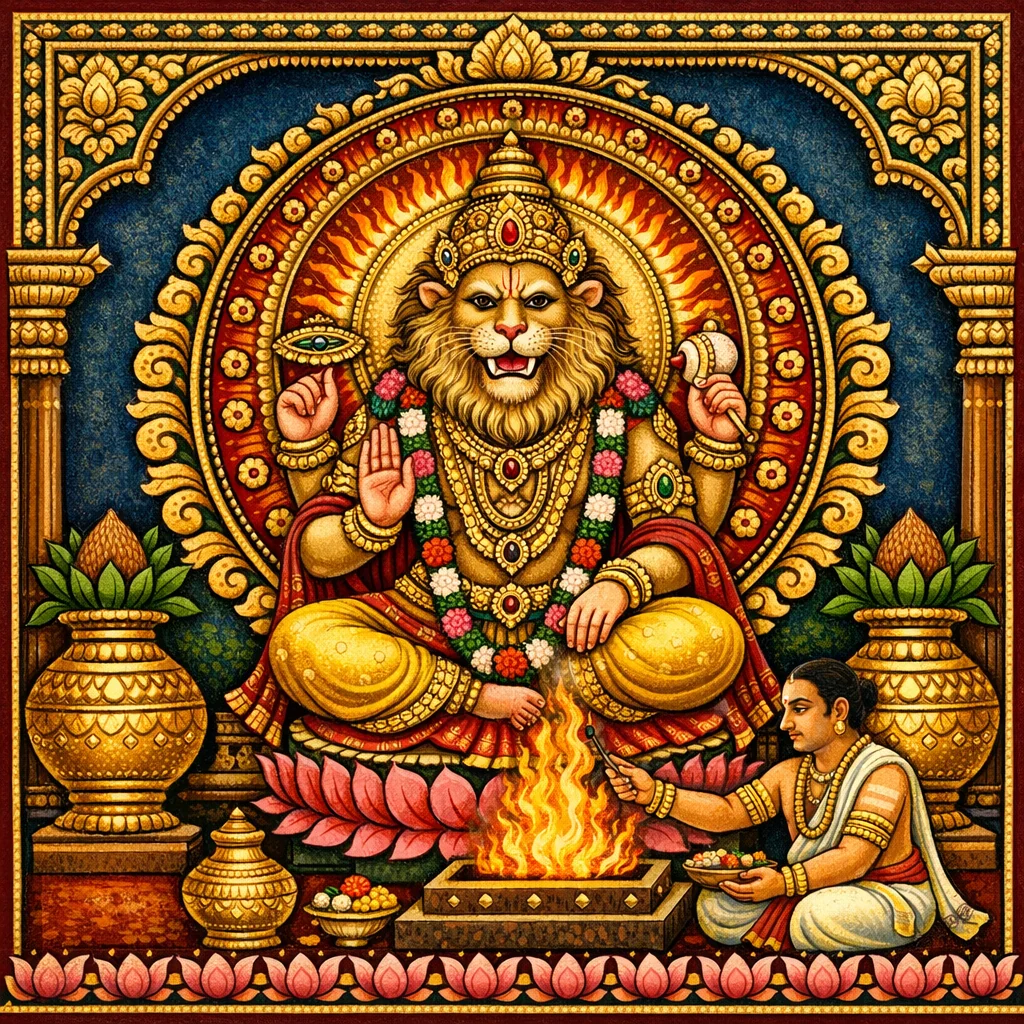
ॐ क्षौं नमो भगवते नारसिंहाय ज्वालामालिने दीप्तदंष्ट्रायाग्निनेत्राय सर्वरक्षोघ्नाय सर्वभूतविनाशाय सर्वज्वरविनाशाय दह पच रक्ष हूं फट् मन्त्रोयं नारसिंहस्य मकलाघ्निवारणः जप्यादिना हरेत् क्षुद्रग्रहमारीविषामयान् चूर्णमण्डूकवयसा जलाग्निस्तम्भकृद्भवेत्
“Oṃ kṣauṃ—homage to the Blessed Lord Narasiṃha, garlanded with flames, with blazing fangs, whose eyes are fire; slayer of all rākṣasas, destroyer of all hostile beings, remover of all fevers: ‘Burn! Cook/digest! Protect!’ hūṃ phaṭ.” This is the Narasiṃha-mantra, a warding-off of malignant afflictions. By japa and allied rites it removes minor graha-possessions, epidemic afflictions, poisonings, and diseases. With the powder called “maṇḍūka-vayasa,” it is said to effect stambhana, the arrest of water and fire.
Frequently Asked Questions
They are base/hostile operations (e.g., stambhana, vidveṣaṇa, uccāṭana, utsādana, bhrama, māraṇa, vyādhi) treated as forceful techniques that require knowledge of counter-release/pacification.
A Sudarśana/Chakra-centered system using nyāsa, dhyāna, chakra-diagrams (mandala), kumbha installation, and homa/bali procedures for graha, bhūta, and disease-removal.
It is described as removing minor graha possessions, epidemic afflictions, poisonings, fevers (jvara), and diseases, with Narasiṃha visualized as flame-wreathed and fire-eyed.