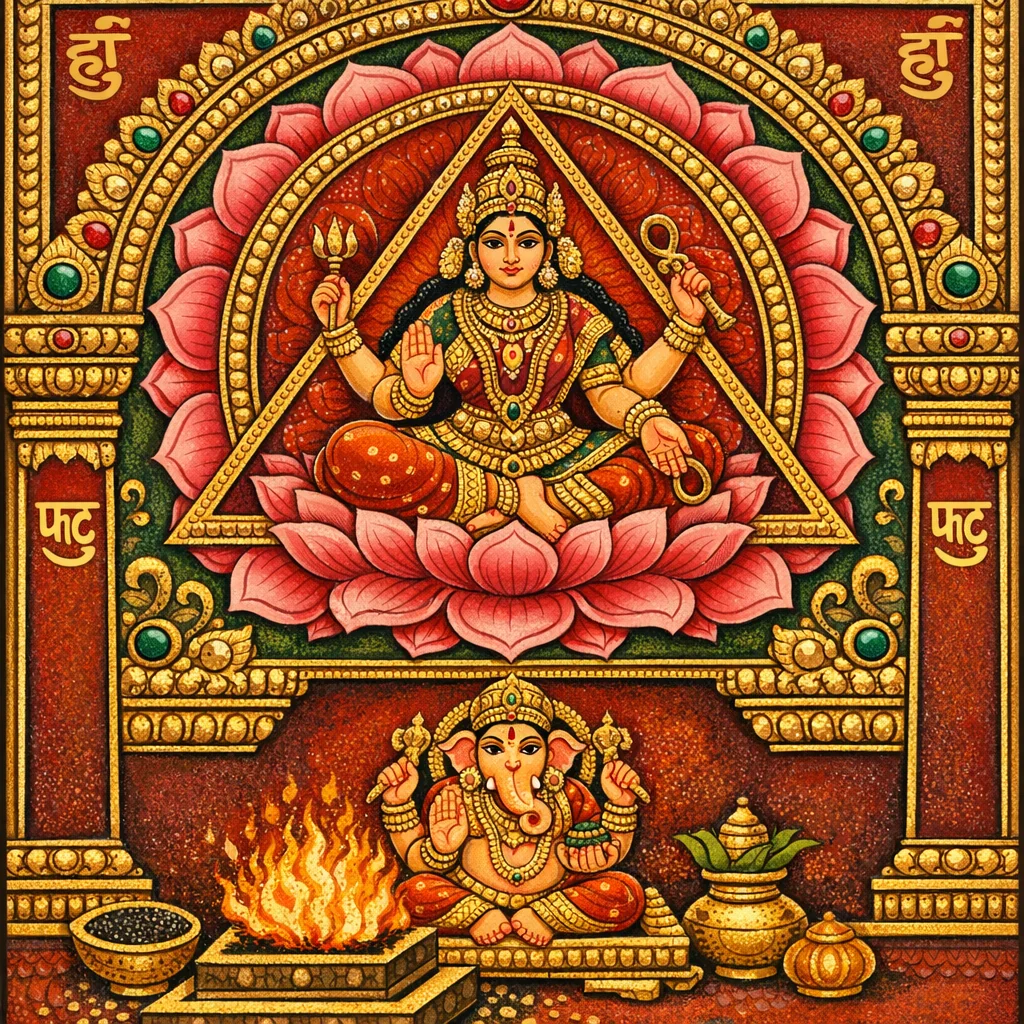
Adhyaya 312
Chapter 312 — Various Mantras (नानामन्त्राः)
Lord Agni teaches a compact Mantra-śāstra sequence beginning with Vināyaka (Gaṇeśa) worship: placing ādhāra-śakti and the lotus-structure, a kavaca with “hūṃ phaṭ,” and outer/inner invocations of Vighneśa through epithets and directional positioning. The chapter then turns to Tripurā worship, listing attendant Bhairava/Vaṭuka designations and related name-series, along with bīja markers (aiṁ, kṣeṁ, hrīṁ) and iconographic cues (abhaya, book, varada, mālā). It explains mantra-networking (jāla), hṛdayādi-nyāsa, and a kāmaka (wish-fulfilling) completion method. Applied rites follow, including uccāṭana using a named diagram, cremation-ground media, and thread-binding. Protective and victory mantras for battle are given, as well as prosperity and solar/Śrī invocations. The text further details longevity, fearlessness, pacification, and vaśīkaraṇa techniques (tilaka/añjana, touch, tila-homa, consecrated food). It culminates in Nityaklinnā’s root-mantra with ṣaḍaṅga, red-triangle visualization, directional installations, Kāma’s fivefold contemplation, and full mātrikā recitation, concluding with ādhāra-śakti/lotus/lion-seat and heart-centered installation.
Shlokas
Verse 1
इत्य् आग्नेये महापुराणे त्वरिताविद्या नामैकादशाधिकत्रिशततमो ऽध्यायः अथ द्वादशाधिकत्रिशततमो ऽध्यायः नानामन्त्राः अग्निर् उवाच ॐ विनायकार्चनं वक्ष्ये यजेदाधारशक्तिकम् धर्माद्यष्टककन्दञ्च नालं पद्मञ्च कर्णिकाम्
Thus, in the Agni Mahāpurāṇa ends the three-hundred-and-eleventh chapter called “Tvaritā-vidyā.” Now begins the three-hundred-and-twelfth chapter, “Various Mantras.” Agni said: “Oṃ. I shall teach the worship of Vināyaka. One should perform worship beginning with the Ādhāra-śakti, and then the eightfold group starting with Dharma, as well as the kanda (bulb), the nāla (stalk), the padma (lotus), and the karṇikā (pericarp).”
Verse 2
तारहेम्ना चेति ख केशरं त्रिगुनं पद्मं तीव्रञ्च ज्वलिनीं यजेत् नन्दाञ्च सुयशाञ्चोग्रां तेजोवतीं विन्ध्यवासिनीं
With the mantric utterance “tāra” and “hema”—in due sequence—one should offer saffron and lotus flowers in threefold measure, and worship the Devī forms Tīvrā and Jvalinī; likewise worship Nandā, Suyaśā, Ugrā, Tejovatī, and Vindhyavāsinī.
Verse 3
गणमूर्तिं गणपत्तिं हृदयं स्याद्गणं जयः एकदन्तोत्कटशिरःशिखायाचलकर्णिने
“Gaṇamūrti” is to be placed as the Heart (hṛdaya); “Gaṇapati” is the Lord of the gaṇas; and “Gaṇaṃ jayaḥ” is the Victory formula. (Meditate upon/offer salutations) to the One-tusked Gaṇeśa, mighty of head, with his topknot as śikhā, and with steadfast, unmoving ears.
Verse 4
गजवक्त्राय कवचं हूं फडन्तं तथाष्टकं महोदरो दण्डहस्तः पूर्वादौ मध्यतो यजेत्
For Gajavaktra (Gaṇeśa), one should apply the protective armor (kavaca) with the mantra ending in “hūṃ phaṭ”; likewise invoke the eightfold set. (Meditate on him as) Mahodara and as Daṇḍahasta; and worship, placing him first in the eastern direction and then in the middle.
Verse 5
जयो गणाधिपो गणनायको ऽथ गणेश्वरः वक्रतुण्ड एकदन्तोत्कटलम्बोदरो गज
Victory to him! He is the Lord of the Gaṇas, the leader of the Gaṇas, and indeed Gaṇeśvara: the one with the curved trunk, the single-tusked one, the formidable Utkaṭa; Lambodara with the great, pendulous belly, the elephant-faced one.
Verse 6
वक्त्रो विकटाननो ऽथ हूं पूर्वो विघ्ननाशनः धूम्रवर्णो महेन्द्राद्यो वाह्ये विघ्नेशपूजनम्
“Vaktra”, “Vikaṭānana”, then the bīja “hūṃ”; “Pūrva”, “Vighnanāśana”; “Dhūmravarṇa”; and “Mahendra” and the rest—these are the names/forms to be invoked in the outer worship of Vighneśa (Gaṇeśa).
Verse 7
त्रिपुरापूजनं वक्ष्ये असिताङ्गो रुरुस् तथा चण्डः क्रोधस्तथोन्मत्तः कपाली भीषणः क्रमात्
I shall now expound the worship of Tripurā. In due order one invokes/places Asitāṅga, Ruru, Caṇḍa, Krodha, Unmatta, Kapālī, and Bhīṣaṇa.
Verse 8
संहारो भैरवो ब्राह्मीर्मुख्या ह्रस्वास्तु भैरबाः ब्रह्माणीषण्मुखा दीर्घा अग्न्यादौ वटुकाः क्रमात्
“Saṃhāra” is the Bhairava; among the Brahmīs, the principal one is so named. The Bhairavas are the short bīja-forms. Brahmāṇī is Ṣaṇmukhā, and the long (expanded) forms are also taught. In due order, beginning with Agni, the Vaṭukas are enumerated.
Verse 9
समयपुत्रो वटुको योगिनीपुत्रकस् तथा सिद्धपुत्रश् च वटुकः कुलपुत्रश् चतुर्थकः
The Vaṭuka is also called “Samaya-putra”; likewise “Yoginī-putraka”; and also “Siddha-putra”. The fourth designation is “Kula-putra”.
Verse 10
हेतुकः क्षेत्रपालश् च त्रिपुरान्तो द्वितीयकः अग्निवेतालो ऽग्निजिह्वः कराली काललोचनः
“Hetuka”, “Kṣetrapāla” (guardian of the sacred precinct), “Tripurānta” (destroyer of Tripurā), “Dvitīyaka” (the Second/companion), “Agni-vetāla” (the fiery Vetāla), “Agni-jihva” (fire-tongued), “Karālī” (the Terrifying One), and “Kāla-locana” (time-/death-eyed)—these are the names.
Verse 11
एकपादश् च भीमाक्ष ऐं क्षें प्रेतस्तयासनं ऐं ह्रीं द्वौश् च त्रिपुरा पद्मासनसमास्थिता
“Ekapāda” and “Bhīmākṣa”; the seed-syllables aiṁ and kṣeṁ—(she is) seated upon a corpse as her seat; and aiṁ and hrīṁ—these two—designate Tripurā, firmly established in the lotus posture.
Verse 12
विभ्रत्यभयपुस्तञ्च वामे वरदमालिकाम् विवासिनीमिति ख त्रिपुरायजनमिति ख , छ , ज , ञ , ट च मूलेन हृदयादि स्याज्जालपूर्णञ्च कामकम्
She is to be visualized as bearing the fearlessness gesture (abhaya) and a book, and on her left (hand) the boon‑granting gesture (varada) and a rosary. For the syllable “kha” (and the series kha, cha, ja, ña, ṭa), worship is to be performed as “(this is) Vivāsinī” and as “worship of Tripurā”. With the root‑mantra, the placements (nyāsa) beginning with the Heart (hṛdaya‑nyāsa) are to be done; and the “kāmakam” rite (wish‑fulfilling) is said to be complete when the mantra‑network (jāla) is fully established.
Verse 13
गोमध्ये नाम संलिख्य चाष्टपत्रे च मध्यतः श्मशानादिपटे श्मशानाङ्गारेण विलेखयेत्
Having written the (person’s) name in the middle of an eight‑petalled diagram, one should inscribe it on a cloth used for funerary/cremation purposes, writing with charcoal or ash from the cremation‑ground.
Verse 14
चिताङ्गारपिष्टकेन मूर्तिं ध्यात्वा तु तस्य च क्षिप्त्वोदरे नीलसूत्रैर् वेष्ट्य चोच्चाठनं भवेत्
Having fashioned (or visualized) an effigy of that person using a paste of funeral‑pyre embers, and then placing it at (one’s) abdomen and wrapping it with blue threads, the rite of uccāṭana (driving away/banishment) is accomplished.
Verse 15
ॐ नमो भगवति ज्वालामानिनि गृध्रगणपरिवृते स्वाहा युद्धेगच्छन् जपन्मन्त्रं पुमान् साक्षाज्जयी भवेत् ॐ श्रीं ह्रीं क्लीं श्रियै नमः उत्तरादौ च घृणिनी सूर्या पुज्या चतुर्दले
“Om. Homage to the Blessed Goddess who is blazing, surrounded by hosts of vultures—svāhā.” A man who, while going to battle, recites this mantra becomes directly victorious. (Further:) “Om. Śrīṃ Hrīṃ Klīṃ—homage to Śrī (Lakṣmī).” And on a four‑petalled lotus, in the northern petal and the others, “Ghṛṇinī” and “Sūryā” are to be worshipped.
Verse 16
आदित्या प्रभावती च हेमाद्रिमधुराश्रयः ॐ ह्रीं गौर्यै नमः गौरीमन्त्रः सर्वकरः होमाद्ध्यानाज्जपार्चनात्
(She is) Ādityā, and also Prabhāvatī; the refuge of the sweetness of the Golden Mountain. “Oṃ hrīṃ, obeisance to Gaurī”—this Gaurī-mantra accomplishes all, bearing fruit through fire-offering, meditation, repetition (japa), and worship.
Verse 17
रक्ता चतुर्भुजा पाशवरदा दक्षिणे करे अङ्कुशाभययुक्तान्तां प्रार्थ्य सिद्धात्मना पुमान्
Having invoked the red-hued Goddess—four-armed, holding a noose (pāśa) and granting boons, with the right hand bearing a goad (aṅkuśa) and the gesture of fearlessness—a man, with mind disciplined to accomplishment, should supplicate her.
Verse 18
जीवेद्वर्षशतं धीमान्न चौरारिभयं भवेत् क्रुद्धः प्रसादी भवति युधि मन्त्राम्बुपानतः
By drinking water empowered with mantra, a wise man may live for a hundred years; he will have no fear of thieves or enemies. Even one who is angry becomes calm and gracious; and in battle, the drinking of mantra-charged water brings composure and favor.
Verse 19
अञ्जनं तिलकं वश्ये जिह्वाग्रे कविता भवेत् तज्जपान्मैथुनं वश्ये तज्जपाद्योनिवीक्षणम्
By applying (this mantra) as collyrium (añjana) and as a forehead mark (tilaka), one gains the power of vaśya (subjugation/attraction); and poetry arises upon the tip of the tongue. By reciting that mantra, sexual union comes under one’s control; and by reciting that mantra, the viewing of the yoni (female genital organ) is accomplished.
Verse 20
स्पर्शाद्वशी तिलहोमात्सर्वञ्चैव तु सिध्यति सप्ताभिमन्त्रितञ्चान्नं भुञ्जंस्तस्य श्रियः सदा
By ritually empowered touch, one brings (another) under control; and by a sesame-seed fire-offering (tila-homa), everything indeed is accomplished. He who eats food consecrated by sevenfold mantra-recitation enjoys śrī—prosperity—always.
Verse 21
अर्धनारीशरूपो ऽयं लक्ष्म्यादिवैष्णवादिकः अनङ्गरूपा शक्तिश् च द्वितीया मदनातुरा
This divine principle is of the Ardhanārīśvara form; it is also of the Vaiṣṇava type beginning with Lakṣmī. The second Śakti is of Anaṅga’s (Kāma’s) form, afflicted by the agitation of desire.
Verse 22
पवनवेगा भुवनपाला वै सव्वसिद्धिदा अनङ्गमदनानङ्गमेखलान्ताञ्चपेच्छ्रिये
Salutations to Śrī (the Goddess): swift as the wind; Protectress of the worlds; bestower of all accomplishments. She who enchants even Anaṅga (Kāma), the beautifully girdled One, whose end is adorned with a splendid plume-like ornament.
Verse 23
पद्ममध्यदलेषु ह्रीं स्वरान् कादींस्तितः स्त्रियाः षट्कोणे वा घटे वाथ लिखित्वा स्याद्वशीकरं
Having written, in the central petals of a lotus-diagram, the bīja “hrīṃ” together with the vowels and the consonants beginning with ka—along with the (intended) woman’s name—either within a hexagram or upon a pot (ghaṭa), one obtains a rite conducive to vaśīkaraṇa (subjugation).
Verse 24
ॐ ह्रीं छं नित्यक्लिन्ने मदद्रवे ॐ ॐ मूलमन्त्रः षडङ्गओयं रक्तवर्णे त्रिकोणके द्रवणी ह्लादकारिणी क्षोभिणी गुरुशक्तिका
“Oṁ—Hrīṁ—Chaṁ—O Nityaklinnā, O Madadravā—Oṁ, Oṁ”: this is the root-mantra. Its sixfold ancillary formula (ṣaḍaṅga) is to be applied. (She is) red-hued, abiding in a triangle; the Melting/Softening Power, the Bestower of Bliss, the Agitator (stirring desire and energy), and the mighty, weighty Śakti.
Verse 25
ईशानादौ च मध्ये तां नित्यां पाशाङ्कुशौ तथा कपालकल्पकतरुं वीणा रक्ता च तद्वती
In the Īśāna direction (northeast) and also in the center, one should contemplate that eternal Goddess, bearing the noose (pāśa) and the goad (aṅkuśa); bearing a skull (kapāla) and the wish-fulfilling tree (kalpaka-taru), and likewise a vīṇā; she is red-hued, possessing those emblems.
Verse 26
नित्याभया मङ्गला च नववीरा च मङ्गला दुर्भगा मनोन्मनी पूज्या द्रावा पूर्वादितः स्थिता
She is Nityābhayā (ever-fearless), Maṅgalā (auspicious), Navavīrā (endowed with ninefold heroism), and again Maṅgalā (the bestower of auspiciousness). She is Durbhagā (the remover of ill-fortune), Manonmanī (she who transcends the mind), Pūjyā (worthy of worship), Drāvā (she who melts and dissolves obstacles), and she stands established beginning with the eastern direction and the rest.
Verse 27
ॐ ह्रीं अनङ्गाय नमः ॐ ह्रीं ह्रीं स्मराय नमः मन्मथाय च माराय कामायैवञ्च पञ्चधा कामाः पाशाङ्कुशौ चापवाणाः ध्येयाश् च विभ्रतः
“Oṃ hrīṃ, obeisance to Anaṅga (the Bodiless One). Oṃ hrīṃ hrīṃ, obeisance to Smara (the Remembrancer).” And (obeisance) to Manmatha, to Māra, and likewise to Kāma. Kāma is to be contemplated in fivefold form, bearing the noose and goad, and also the bow and arrows.
Verse 28
रतिश् च विरतिः प्रीतिर्विप्रीतिश् च मतिर्धृतिः विधृतिः पुष्टिरेभिश् च क्रमात् कामादिकैर् युताः ॐ छं नित्यक्लिन्ने मदद्रवे ॐ ॐ अ आ इ ई उ ऊ ऋ ॠ ऌ ॡ ए ऐ ओ औ अं अः क ख ग घ ङ च छ ज झ ञ ट ठ ड ढ ण त थ द ध न प फ ब भ म य र ल व श ष स ह क्ष ॐ छं नित्यक्लिन्ने मदद्रवे स्वाहा आधारशक्तिं पद्मञ्च सिंहे देवीं हृदादिषु
Rati (delight), Virati (dispassion), Prīti (affection), Viprīti (aversion), Mati (understanding), Dhṛti (steadfastness), Vidhṛti (supporting firmness), and Puṣṭi (nourishment)—these Śaktis are to be assigned in due order, conjoined with Kāma and the other associated powers. (Then recite:) “Oṃ chaṃ, Nityaklinne, Madadrave.” Next perform the Mātrikā (alphabet) recitation: “oṃ oṃ: a ā i ī u ū ṛ ṝ ḷ ḹ e ai o au aṃ aḥ; ka kha ga gha ṅa … ha kṣa.” (Again recite:) “Oṃ chaṃ, Nityaklinne, Madadrave, svāhā.” Thereafter perform nyāsa: place the Ādhāra-Śakti, the lotus-seat (padma), the lion-seat (siṃha), and install the Goddess in the heart and the other bodily loci.
Frequently Asked Questions
A precise ritual architecture: lotus-based placements (kanda–nāla–padma–karṇikā), kavaca application with “hūṃ phaṭ,” hṛdayādi-nyāsa, jāla (mantra-network) completion, and mātrikā (alphabet) recitation integrated into deity-installation.
It frames mantra technology as disciplined sādhanā: purification through nyāsa and visualization, removal of obstacles via Vināyaka, and focused śakti-upāsanā (Tripurā/Nityaklinnā) that links protective and prosperity aims to concentrated worship under dharma.
Vināyaka/Vighneśa for obstacle-removal and protective rites; Tripurā with Bhairava/Vaṭuka retinues for śakti-centric worship; and Nityaklinnā as a red-triangle śakti with a defined root-mantra, ṣaḍaṅga, and mātrikā framework.
Victory-in-battle japa, mantra-charged water for longevity and fearlessness, vaśīkaraṇa via tilaka/añjana/touch, tila-homa for siddhi, seven-times consecrated food for prosperity, and uccāṭana using cremation-ground materials and thread-binding.