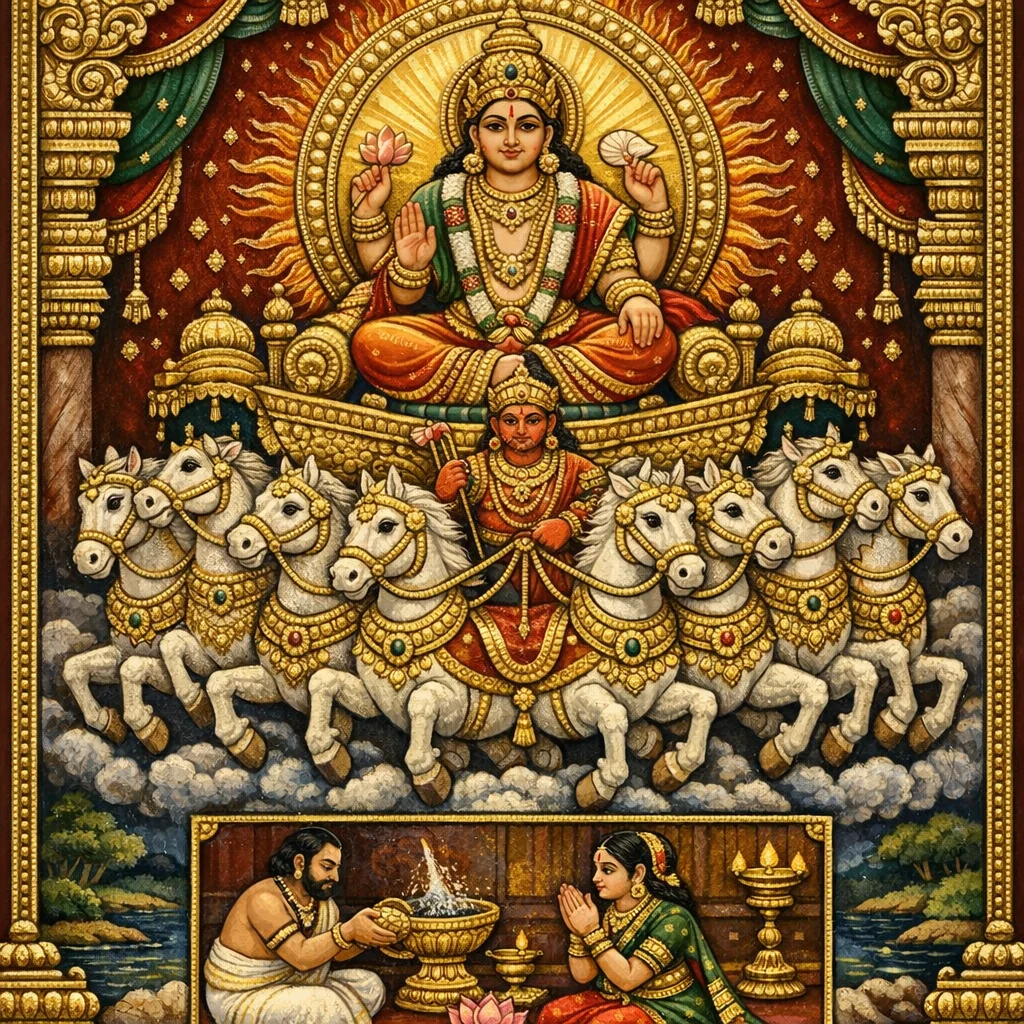
Adhyaya 301
Chapter 301 — सूर्यार्चनं (Sūryārcana) / Sun-worship (closing colophon only)
This entry preserves only the closing colophon of the prior unit, identifying Adhyaya 301 as Sūryārcana (Sun-worship). In the Agni Purana’s pedagogic flow, solar worship bridges cosmic order (ṛta/dharma) and ritual efficacy: Sūrya is invoked as regulator of time, vitality, and clarity, preparing the practitioner for the next chapter’s more technical mantra-operations. The transition highlights the Purāṇa’s method—devotional worship is not separate from applied ritual science, but establishes the purity, authority, and energetic alignment needed for specialized mantras and the homa-based procedures that follow.
Shlokas
Verse 1
इत्य् आग्नेये महापुराणे सूर्यार्चनं नाम त्रिशततमो ऽध्यायः अथैकाधिकत्रिशततमो ऽध्यायः नानामन्त्राः अग्निर् उवाच वाक्कर्मपार्श्वयुक्शुक्रतोककृते मतो प्लवः हुतान्ता देशवर्णेयं विद्या मुख्या सरस्वती
Thus, in the Agni Mahāpurāṇa ends chapter 301, called “Sun-worship (Sūryārcana).” Now begins the next chapter (302), “Various Mantras.” Agni said: “For the accomplishment of works of speech and rites—together with their subsidiary supports—and for securing progeny and vital vigor, a ‘plava’ (plava), a protective or bridging mantra-formula, is prescribed. The mantric knowledge to be described—concluding with fire-offerings (homa)—is primary; it is Sarasvatī, the supreme power of speech and learning.”
Verse 2
धार्य चेति ख विद्युत्पातविधाविति घ , ज , ञ , ट च अक्षाराशी वर्णलक्षं जपेत् समतिमान् भवेत् अत्रिः सवह्निर्वामाक्षिविन्दुरिन्द्राय हृत्परः
In the procedure for lightning-portents (vidyutpāta-vidhi), one should recite the syllable-group—kha (with the formula “dhārya”), and also gha, ja, ña, and ṭa. By repeating this “letter-collection” up to one hundred thousand times, one becomes even-minded and steady in intellect. The seer is Atri; the associated power is Agni; the sign is a dot on the left eye; the deity is Indra; and the application is centered in the heart.
Verse 3
वज्रपद्मधरं शक्रं पीतमावाह्य पूजयेत् नियुतं होमयेदाज्यतिलांस्तेनाभिषेचयेत्
Having invoked and worshipped Śakra (Indra) as the yellow-hued deity bearing the thunderbolt (vajra) and the lotus, one should perform a homa of a niyuta (a fixed large count) of offerings of ghee and sesame; with that, one should then perform abhiṣeka, the ritual bathing and consecration.
Verse 4
नृपादिर्भ्रष्टरज्यादीन्राज्यपुत्रादिमाप्नुयात् हृल्लेखा शक्तिदेवाख्या दोषाग्निर्दण्डिदण्डवान्
A king and the like who has fallen from sovereignty may regain fortunes such as a lost kingdom, royal sons, and the like. These are indicated by the signs named Hṛllekhā, Śakti, Devākhyā, Doṣāgni, and Daṇḍin/Daṇḍavān.
Verse 5
शिवमिष्ट्वा जपेच्छक्तिमष्टम्यादिचतुर्दशीं चक्रपाशाङ्कुशधरां साभयां वरदायिकां
Having first worshipped Śiva, one should perform japa of Śakti on the eighth lunar day and on the fourteenth; meditating on Her as bearing the discus (cakra), noose (pāśa), and goad (aṅkuśa), granting fearlessness and bestowing boons.
Verse 6
होमादिना च सौभाग्यं कवित्वं पुरवान् भवेत् ॐ ह्रीं ॐ नमः कामाय सर्वजनहिताय सर्वजनमोहनाय प्रज्वलिताय सर्वजनहृदयं ममात्मगतं कुरु ॐ एतज्जपादिना मन्त्रओ वशयेत् सकलं जगत्
By rites such as homa (fire-offering) and the like, one may obtain good fortune; one may become a poet and be endowed with prosperity as though possessing a city. The mantra is: “Oṃ hrīṃ. Oṃ, obeisance to Kāma—who is for the welfare of all people, who enchants all people, who is blazing in power: draw the hearts of all people into my own ātman.” By the japa (repetition) and related practice of this mantra, one may bring the entire world under control, that is, gain influence over all.
Verse 7
ॐ ह्रीं चामुण्डे अमुकन्दह पच मम वशमानय ठ वशीकरणकृन्मन्त्रश्चामुण्डायाः प्रकीर्तितः फलत्रयकषायेण वराङ्गं क्षालयेद्वशे
“Oṃ, hrīṃ—O Cāmuṇḍā! ‘So-and-so’ (the named person): burn, cook (subdue), bring (him/her) under my control—ṭha!” Thus is proclaimed the Cāmuṇḍā-mantra that accomplishes vaśīkaraṇa (subjugation). For bringing someone under control, one should wash the best limb/body with a decoction (kaṣāya) prepared from the ‘three fruits’ (triphala).
Verse 8
अश्वगन्धायवैः स्त्री तु निशाकर्पूरकादिना पिप्पलीतण्डुलान्यष्टौ मरिचानि च विंशतिः
For a woman, a preparation is made with aśvagandhā and yava (barley), together with ingredients such as niśā (turmeric) and karpūra (camphor); one should add eight grains of pippalī and twenty grains of marica (black pepper).
Verse 9
वृहतीरसलेपश् च वशे स्यान्मरणान्तिकं कटीरमूलत्रिकटुक्षौद्रलेपस् तथा भवेत्
A paste (lepa) prepared from vṛhatī (the “great nightshade”) and ‘rasa’ is said to bring a person under one’s influence, even up to the brink of death. Likewise, a paste made of kaṭīra-root, trikaṭu, and honey is also prescribed.
Verse 10
हिमं कपित्थकरभं मागधी मधुकं मधु तेषां लेपः प्रयुक्तस्तु दम्पत्योः स्वस्तिमावहेत्
A paste prepared from hima, kapittha, karabha, māgadhī, madhuka, and honey—when applied—brings well-being and auspiciousness to husband and wife.
Verse 11
सशर्करयोनिलेपात् कदम्बरसको मधु सहदेवी महालक्ष्मीः पुत्रजीवी कृताञ्जलिः
‘Sasharkara-yoni-lepa’ (a sugared paste applied to the genital region), ‘Kadamba-rasaka’ (a kadamba-juice preparation), ‘Madhu’ (honey), ‘Sahadevī’, ‘Mahālakṣmī’, ‘Putrajīvī’ (the “life-giving-to-sons” plant), and ‘Kṛtāñjalī’—these are noted as medicinal names/ingredients.
Verse 12
एतच्चूर्णं शिरःक्षिप्तं लिकस्य वशमुत्तमम् त्रिफलाचन्दनक्वाथप्रस्था द्विकुडवम् पृथक्
This powder, when sprinkled upon the head, is an excellent means of bringing the beloved under one’s influence. The decoction should be prepared from Triphalā and sandalwood: one prastha in measure, with two kuḍavas of each taken separately.
Verse 13
भृङ्गहेमरसन्दोषातावती चुञ्चुकं मधु घृतैः पक्वा निशा छाया शुष्का लिप्या तु रञ्जनी
A preparation is made with bhṛṅga, hema-rasa, and sandoṣā, together with tāvatī and cuñcuka, cooked with honey and ghee; (also) niśā and chāyā—dried—are to be applied as a paste for colouring (i.e., as a dye/tinging unguent).
Verse 14
विदारीं सोच्चटामाषचूर्णीभ्ह्तां सशर्करां गथितां यः विपेत् क्षीरैर् नित्यं स्त्रीशतकं व्रजेत्
Whoever daily drinks, with milk, a bolus made by mixing vidārī together with powdered māṣa (black gram) and sugar, will attain the capacity to approach a hundred women (i.e., great sexual vigor).
Verse 15
गुल्ममाषतिलव्रीहिचूर्णक्षीरसितान्वितं अश्वत्थवंशदर्भाणां मूलं वै वैष्णवीश्नियोः
For (treating) gulma (abdominal lump/tumor-like swelling), one should prepare a formulation of powdered black gram, sesame, and rice, combined with milk and sugar; (and also use) the roots of the aśvattha (sacred fig), bamboo, and darbha grass, along with vaiṣṇavī and śnī (medicinal herbs).
Verse 16
मूलं दूर्वाश्वगन्धोत्थं पिवेत् क्षीरैः सुतार्थिनी कौन्तीलक्ष्म्याः शिफा धात्री वज्रं लोघ्नं वटाङ्कुरम्
A woman desiring a son should drink, mixed with milk, the root of dūrvā (Bermuda grass) and aśvagandhā. (She may also take) the śiphā (tuft/crest) of Kauntī-lakṣmī, dhātrī (āmalakī), vajra, loghna, and the sprout of the banyan (vaṭa).
Verse 17
आज्यक्षीरमृतौ पेयं पुत्रार्थं त्रिदिवं स्त्रिया पुत्रार्थिनी पिवेत् क्षीरं श्रीमूलं सवटाङ्कुरम्
For the attainment of a son, a woman should drink—during the three nights of ṛtu (the fertile period)—a mixture of ghee and milk. A woman desiring a son should drink milk prepared with śrī-mūla and with banyan sprouts.
Verse 18
श्रीवडाङ्कुरदेवीनां रसं नस्ये विपेच्च सा श्रीपद्ममूलमुत्क्षीरमश्वत्थोत्तरमूलयुक्
She should instill as nasal drops (nasya) the expressed juice of the śrīvaḍāṅkura-devī plants, prepared together with the root of śrīpadma (lotus), with milk, and combined with the upper root of aśvattha (the sacred fig).
Verse 19
तरलं पयसा युक्तं कार्पासफलपल्ल्वं अपामार्गस्य पुष्पाग्रं नवं समहिषीपयः
Mix the preparation to a thin consistency with milk; add the tender shoot of the cotton-fruit plant and the fresh flower-tips of apāmārga, together with fresh buffalo’s milk.
Verse 20
पुत्रार्थञ्चार्धषट्शाकैर् योगाश् चत्वार ईरिताः शर्करोत्पलपुष्पाक्षलोध्रचन्दनसारिवाः
For the attainment of a son (progeny), four medicinal formulations are prescribed, with a dosage of half of six śāka-measures. They are prepared with sugar, blue lotus, puṣpākṣa, lodhra, sandalwood, and sārivā.
Verse 21
स्रवमाणे स्त्रिया गर्भे दातव्यास्तण्डुलाम्भसा लाजा यष्टिसिताद्राक्षाक्षौद्रसर्पींषि वा लिहेत्
When there is discharge (bleeding/oozing) during a woman’s pregnancy, she should be given lājā (parched grain) with rice-water; or she may lick a preparation of licorice, sugar, raisins, honey, and ghee.
Verse 22
अटरुषकलाङ्गुल्यः काकमाच्याः शिफा पृथक् नाभेरधः समालिप्य प्रसूते प्रमदा सुखम्
Separately prepare a paste of aṭaruṣa, kalāṅgulī, and the fruit/pod of kākamācī; when it is smeared below the navel, a woman delivers comfortably and with ease.
Verse 23
रक्तं शुक्लं जावापुष्पं रक्तशुक्लस्त्रुतौ पिवेत् केशरं वृहतीमूलं गोपीयष्टितृणोत्पलम्
For red or white discharge, one should drink an infusion (or expressed preparation) of jāvā-flowers—both red and white—together with saffron (keśara), the root of vṛhatī, gopī-yaṣṭi, tṛṇa (a medicinal grass), and utpala (blue lotus).
Verse 24
साजक्षीरं सतैलं तद्भक्षणं रोमजन्मकृत् शीर्यमाणेषु केशेषु स्थापनञ्च भवेदिदम्
Taken together with goat’s milk and oil, its ingestion promotes the growth of body-hair; and when the hair is falling out, it serves to stabilize and restore it.
Verse 25
धात्रीभृङ्गरसप्रस्थतैलञ्च क्षिरमाढकम् ॐ नमो भगवते त्र्यम्बकाय उपशमय चुलु मिलि भिद गोमानिनि चक्रिणि ह्रूं फट् अस्मिन् ग्रामे गोकुलस्य रक्षां कुरु शान्तिं कुरु घण्डाकर्णो महासेनो वीरः प्रोक्तो महाबलः
One should prepare the rite with a prastha-measure of oil mixed with the juice of dhātrī (āmalakī) and bhṛṅga (bhṛṅgarāja), and with an āḍhaka-measure of milk. (Then recite:) “Oṃ—obeisance to the Blessed Lord Tryambaka; pacify this affliction! culu mili bhida! O gomānini, O cakriṇi! hrūṃ phaṭ! In this village, protect the gokula, the cattle-settlement; establish peace!” Ghaṇḍākarṇa and Mahāsena—declared heroes of great strength—are invoked for protection.
Verse 26
मारीनिर्नाशनकरः स मां पातु जगत्पतिः श्लोकौ चैव न्यसेदेतौ मन्त्रौ गोरक्षकौ पृथक्
May the Lord of the world—who brings about the destruction of pestilence—protect me. One should also place (perform nyāsa of) these two verses separately, as two distinct mantras for the protection of cattle.
Frequently Asked Questions
Sūrya symbolizes regulated time, vitality, and clarity; Sun-worship frames the practitioner’s discipline before entering specialized mantra and homa procedures.
It reinforces devotion and alignment with cosmic order, making worldly ritual aims subordinate to dharma and supportive of inner purification.