Adhyaya 310
Tvaritā-mūla-mantra and Related Details (Dīkṣā, Maṇḍala, Nyāsa, Japa, Homa, Siddhi, Mokṣa)
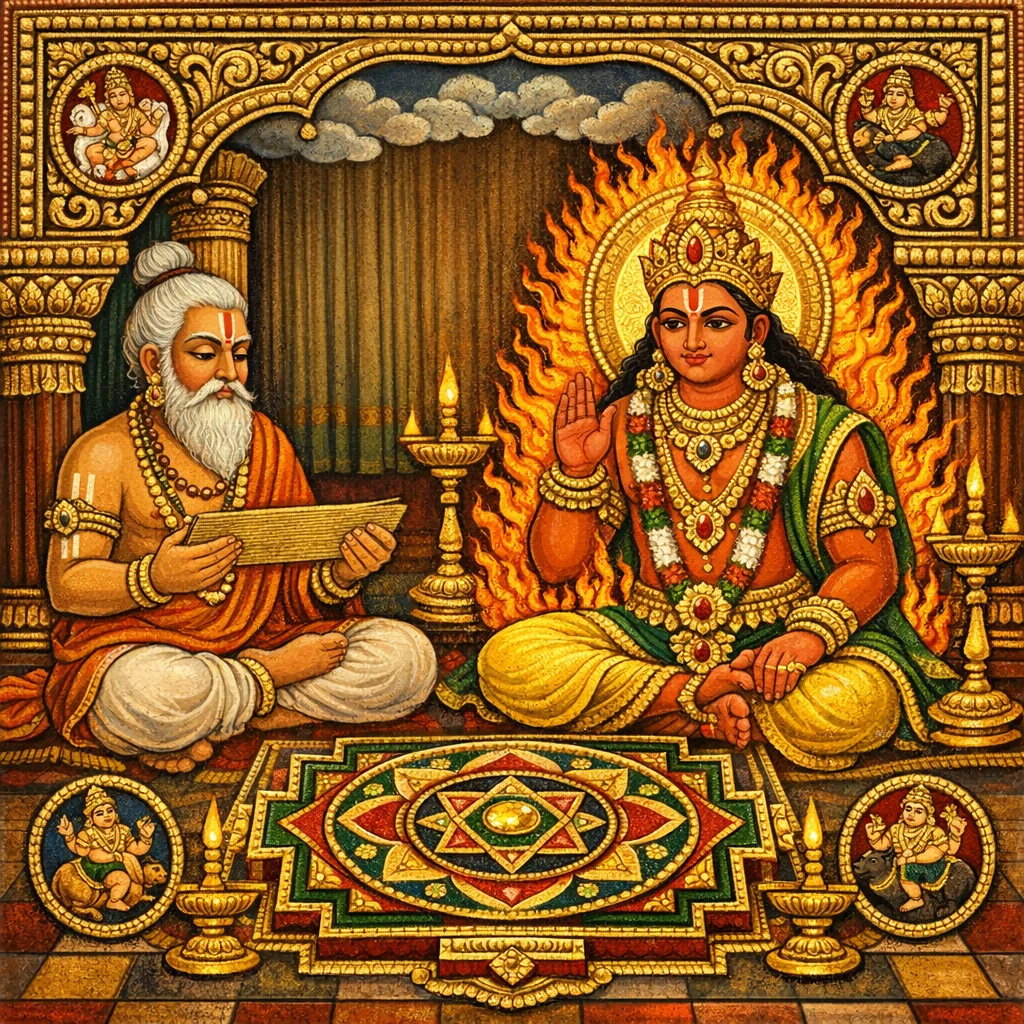
Lord Agni sets forth a Tantra-ritual sequence centered on Tvaritā: preparation by nyāsa within a Siṃha–Vajra-kula lotus-diagram, then exact maṇḍala construction (ninefold division, accepted/rejected directional cells, outer line-sets, vajra-curvature, and a radiant central lotus). The rite proceeds to installation and worship: bīja placed clockwise, vidyā-aṅgas mapped to petals and center, diśāstra protective arrays, and Lokapāla-nyāsa on the outer garbha-maṇḍala. The chapter codifies practice counts—japa totals, aṅga proportions, and homa sequences—culminating in pūrṇāhuti as the initiatory seal by which the disciple becomes dīkṣita. Alongside bhukti aims (victory, sovereignty, treasure, siddhi), Agni teaches a mokṣa trajectory: karmically non-binding homa, establishment in the Sadāśiva-state, and the “water into water” dissolution metaphor for non-returning liberation. It closes with abhiṣeka, kumārī-pūjā, dakṣiṇā, and specialized nocturnal/liminal rites (doorway, solitary tree, cremation-ground) employing the dūtī-mantra for all-purpose attainments.
Shlokas
Verse 1
इत्य् आग्नेये महापुराणे त्वरितामन्त्रादिर्नाम नवाधिकत्रिशततमो ऽध्यायः अथ दशाधिकत्रिशततमो ऽध्यायः त्वरितामूलमन्त्रादिः अग्निर् उवाच दीक्षादि वक्ष्ये विन्यस्य सिंहवज्राकुले ऽब्जके हे हुति वज्रदन्त पुरु लुलु गर्ज इह सिंहासनाय नमः तिर्यगूर्ध्वगता रेखाश् चत्वारश् चत्वारश् चतुरो भवेत्
Thus, in the Agni Mahāpurāṇa, the three-hundred-and-tenth chapter, called “The Mantras and Related Details of Tvaritā,” is concluded. Now begins the three-hundred-and-eleventh chapter, “The Root-Mantra and Related Details of Tvaritā.” Agni said: “I shall explain the dīkṣā (initiation) and the rest. Having performed nyāsa in the lotus-diagram belonging to the ‘Siṃha–Vajra’ kula, (one should recite): ‘he, huti, vajradanta, puru, lulu, garja; iha—obeisance to the lion-throne (siṃhāsana).’ The lines are to be drawn four (in number)—four going horizontally and four going upward; thus they become fourfold divisions.”}]}]}{
Verse 2
नवभागविभागेन कोष्ठकान् कारयेद्बुधः ग्राह्या दिशागताः कोष्ठा विदिशासु विनाशयेत्
A wise planner should construct the compartments (koṣṭhas) by dividing the site into nine parts. The compartments aligned with the primary directions are to be accepted, while those falling in the intermediate directions should be rejected and removed.
Verse 3
वाह्ये वै कोष्ठकोणेषु वाह्यरेखाष्टकं स्मृतम् वाह्यकोष्ठस्य वाह्ये तु मध्ये यावत् समानयेत्
In the outer ring of the diagram, at the corners of the cells, an “outer set of eight lines” is prescribed. From the exterior of the outermost cell, one should draw the lines and bring them inward up to the middle, according to the central measure.
Verse 4
वज्रस्य मध्यमं शृङ्गं वाह्यरेखा द्विधार्धतः वाह्यरेखा भवेद्वक्रा द्विभङ्गा कारयेद्बुधः
In the vajra design, the central prong is to be formed by an outer line divided into two halves. That outer line should be made curved; the skilled artisan should shape it with a double bend.
Verse 5
मध्यकोष्ठं भवेत्पद्मं पीतकर्णिकमुज्ज्वलम् कृष्णेन रजसा लिख्य कुलिशासिशितोर्धता
In the central compartment there should be a lotus, radiant with a yellow pericarp. It is to be drawn with black powder, with the lines made sharp and raised, like the edge of a vajra or a sword.
Verse 6
वाह्यतश् चतुरस्रन्तु वज्रसम्पुटलाञ्छितम् द्वारे प्रदापयेन्मन्त्री चतुरो वज्रसम्पुटान्
On the outer side, it should be made square and marked with the emblem of the Vajra-sampuṭa. At the doorway, the mantra-knowing officiant should place and install four Vajra-sampuṭas.
Verse 7
पद्मनाम भवेद्वामवीथी चैव समा भवेत् गर्भं रक्तं केशराणि मण्डले दीक्षिताः स्त्रियः
It should be designated as the “Lotus,” and the leftward course (vāmavīthī) should be made level and symmetrical. The central womb/core (garbha) is to be red; the saffron filaments (keśara) are to be depicted within the maṇḍala; and the women participants are to be duly initiated (dīkṣitāḥ).
Verse 8
जयेच्च परराष्ट्राणि क्षिप्रं राज्यमवाप्नुयात् मूर्तिं प्रणवसन्दीप्तां हूंकारेण नियोजयेत्
Thus he would conquer foreign kingdoms and swiftly attain sovereignty. He should ritually install and empower the deity-form (mūrti), blazing with the Praṇava (Oṁ), by means of the mantra-syllable Hūṁ.
Verse 9
मूलविद्यां समुच्चार्य मरुद्व्योमगतां द्विज प्रथमेन पुनश् चैव कर्णिकायां प्रपूजयेत्
O twice-born (dvija), having clearly uttered the root-mantra (mūla-vidyā), one should again worship—by the first method/recitation—that power stationed in wind and sky, in the lotus’s pericarp (karṇikā).
Verse 10
एवं प्रदक्षिणं पूज्य एकैकं वीजमादितः दलमध्ये तु विद्याङ्गा आग्नेय्यां पञ्च नैरृतम्
Thus, worshipping in a clockwise sequence (pradakṣiṇa), one should place or recite each seed-syllable (bīja) one by one, beginning from the first. In the middle of the petal are the limbs of the Vidyā (vidyāṅga); in the southeast (āgneyī) place five, and in the southwest (nairṛti) arrange the nairṛta assignment accordingly.
Verse 11
मध्ये नेत्रं दिशास्त्रञ्च गुह्यकाङ्गे तु रक्षणम् हुतयः केशरस्थास्तु वामदक्षिणपार्श्वतः
In the center one should place the Eye (netra), and the directional weapon (diśāstra) for guarding the quarters. Protection is to be set upon the secret/hidden limb (guhya-kāṅga). The oblations (hutayaḥ) are to be stationed upon the filaments (keśara), on the left and right sides.
Verse 12
पञ्च पञ्च प्रपूज्यास्तु स्वैः स्वैर् मन्त्रैः प्रपूजयेत् लोकपालान्न्यसेदष्टौ वाह्यतो गर्भमण्डले
Let the prescribed deities be duly worshipped in sets of five, each with its own respective mantra. Thereafter, by nyāsa, one should install the eight Lokapālas on the outer side of the Garbha-maṇḍala.
Verse 13
वर्णान्तमग्निमारूटं षष्ठस्वरविभेदितं पञ्चदशेन चाक्रान्तं स्वैः स्वैर् नामभि योजयेत्
One should arrange the syllables by placing Agni at the end of the varṇas, distinguishing them by the sixth vowel, and further overlaying them with the fifteenth, assigning each according to its respective name.
Verse 14
शीघ्रं सिंहे कर्णिकायां यजेद् गन्धादिभिः श्रिये आग्नेयावन्नैरृतमिति ञ ज्येष्ठस्वरविभूषितमिति ख , छ च नामभिर्योजयेदित्ययं पाठः समीचीनो भवितुमर्हति नीलेति ञ श्रियमिति ञ अष्टाभिर् वेष्टयेत् कुम्मैर् मन्त्राष्टशतमन्त्रितैः
Quickly, one should worship Śrī (Lakṣmī) in the central karṇikā set upon the lion-seat (siṃha), offering perfumes and the like. One should then connect the rite by the names, from the Agneya (southeast) direction up to Nairṛta (southwest), according to the indicated reading, and recite the mantra adorned with the proper ‘jyeṣṭha’ accent. Thereafter, one should encircle it with eight kumbhas (ritual vessels), each empowered by one hundred mantra-repetitions.
Verse 15
मन्त्रमष्टसहस्रन्तु जप्त्वाङ्गानां दशांशकम् तोमं कुर्यादग्निकुण्डे वह्निमन्त्रेण चालयेत्
Having recited the mantra eight thousand times, one should perform a homa in the fire-pit (agni-kuṇḍa) for the aṅga-mantras in an amount equal to one-tenth (of that count). One should then kindle and activate the fire by means of the Agni (Vahni) mantra.
Verse 16
निक्षिपेद् हृदयेनाग्निं शक्तिं मध्ये ऽग्निगां स्मरेत् गर्भाधानं पुंसवनं जातकर्म च होमयेत्
With the hṛdaya (the heart as the seat of intention), one should place the sacred fire; in the middle one should contemplate the Śakti that moves within Agni. Then one should perform the homa-offerings for the rites of garbhādhāna (conception), puṃsavana (begetting a male child), and jātakarma (the birth-rite) as well.
Verse 17
हृदयेन शतं ह्य् एकं गुह्येकं गुह्याङ्गे जनयेच्छिखिम् पूर्णाहुत्या तु विद्यायाः शिवाग्निर्ज्वलितो भवेत्
With the Hṛdaya-mantra one should perform a hundred (recitations/oblations); with the Guhya-mantra one more; and with the Guhyāṅga-mantra one should generate the flame. Then, by the complete oblation belonging to this Vidyā, the auspicious Śiva-fire becomes fully kindled.
Verse 18
होमयेम्मूलमन्त्रेण शतञ्चाङ्गं दशांशतः निवेदयेत्ततो देव्यास्ततः शिष्यं प्रवेशयेत्
He should perform the homa with the root-mantra—one hundred oblations—and then the aṅga-mantras in a tenth part (i.e., ten each). Thereafter he should present the offering to the Goddess; then he should cause the disciple to enter (be formally admitted/initiated).
Verse 19
अस्त्रेण ताडनं कृत्वा गुह्याङ्गानि ततो न्यसेत् विद्याङ्गैश् चैव सन्नद्धं विद्याङ्गेषु नियोजयेत्
Having performed the ritual striking (tāḍana) with the Astra-mantra, one should then place the nyāsa upon the secret parts of the body. And, having thus armed and protected oneself with the limbs of the Vidyā (vidyā-aṅga), one should apply that protection through and upon the very limbs of the Vidyā.
Verse 20
पुष्पं क्षिपाययेच्छिष्यमानयेदग्निकुण्डकम् यवैर् द्वान्यैस्तिलैर् आज्यैर् मूलविद्याशतं हुनेत्
He should have flowers scattered, and have the disciple bring the fire-pit (agni-kuṇḍa). Then, with barley, grains, sesame seeds, and ghee, he should offer one hundred oblations while reciting the root-vidyā (mūla-vidyā) a hundred times.
Verse 21
स्थावरत्वं पुरा होमं सरीसृपमतः परं पक्षिमृगपशुत्वञ्च मानुषं ब्राह्ममेव च
First comes the state of being immobile (sthāvara, as a plant or fixed being); next, the state of the creeping kind (sarisṛpa). Thereafter come the conditions of being a bird, a wild animal, or cattle; then (birth as) a human; and finally, Brahma-status, the highest condition.
Verse 22
विष्णुत्वञ्चैव रुद्रत्वमन्ते पूर्णाहुतिर्भवेत् एकया चैव ह्य् आह्त्या शिष्यः स्याद्दीक्षितो भवेत्
At the conclusion, the complete final oblation (pūrṇāhuti) should be offered, invoking both the state of Viṣṇu (viṣṇutva) and the state of Rudra (rudratva). Indeed, by a single oblation alone, the disciple becomes initiated (dīkṣita).
Verse 23
अधिकारो भवेदेवं शृणु मोक्षमतः परम् सुमेरुस्थो यदा मन्त्री सदाशिवपदे स्थितः
Thus eligibility (adhikāra) for this discipline arises; now hear the supreme teaching of liberation: when the mantra-practitioner, abiding on Mount Sumeru, becomes established in the state of Sadāśiva.
Verse 24
परे च होमयेत् स्वस्थो ऽकर्मकर्मशतान् दश पूर्णाहुत्या तु तद्योगी धर्माधर्मैर् न लिप्यते
Then, being composed and in good health, he should also perform the homa—ten times a hundred (i.e., one thousand) offerings—actions free from binding karma; and by that concluding oblation (pūrṇāhuti), that yogin is not tainted by merit or demerit (dharma or adharma).
Verse 25
मोक्षं याति परंस्थानं यद्गत्वा न निवर्तते यथा जले जलं क्षिप्तं जलं देही शिरस् तथा
He attains liberation—the supreme state—having reached which one does not return. Just as water poured into water becomes indistinguishably water, so too the embodied being, upon dissolution, becomes That (the supreme reality).
Verse 26
कुम्भैः कुर्याच्चाभिषेकं जयराज्यादिसर्वभाक् कुमारी ब्राह्मणी पूज्या गुर्वादेर्दक्षिणां ददेत्
He should perform the consecratory bathing (abhiṣeka) with ritual water-pots (kumbhas), thereby becoming a partaker of all fruits such as victory and sovereignty. A virgin Brahmin girl should be honored (worshipped), and a proper honorarium (dakṣiṇā) should be given to the guru and the rest (of the officiants/elders).
Verse 27
यजेत् सहस्रमेकन्तु पूजां कृत्वा दिने दिने तिलाज्यपुरहोमेन देवी श्रीः कामदा भवेत्
One should perform the rite a full thousand times; having offered worship day after day, by a homa fire-oblation of sesame, ghee, and pura (a sweet cake), the Goddess Śrī becomes the bestower of desired aims.
Verse 28
ददाति विपुलान् भोगान् यदन्यच्च समीहते जप्त्वा ह्य् अक्षरलक्षन्तु निधानाधिपतिर्भवेत्
It bestows abundant enjoyments—and whatever else one desires. Indeed, having completed a japa of one lakh (100,000) syllables, one becomes the lord of treasure, gaining mastery over wealth.
Verse 29
द्विगुणेन भवेद्राज्यं त्रिगुणेन च यक्षिणी चतुर्गुणेन ब्रह्मत्वं ततो विष्णुपदं भवेत्
With merit increased twofold, one attains sovereignty (royal dominion); with a threefold increase, one attains the status of a Yakṣiṇī; with a fourfold increase, one attains Brahmahood; and beyond that, one attains Viṣṇupada, Viṣṇu’s supreme abode.
Verse 30
षड्गुणेन महासिद्धिर् लक्षेणैकेन पापहा दश जप्त्वा देहशुद्ध्यै तीर्थस्नानफलं शतात्
With sixfold repetition there is great attainment (mahāsiddhi); with a single lakh (100,000 repetitions) it becomes a destroyer of sins. By reciting it ten times for bodily purification, one gains the merit of a hundred sacred-bath pilgrimages at tīrthas.
Verse 31
पटे वा प्रतिमायां वा शीघ्रां वै स्थण्डिले यजेत् शतं सहस्रमयुतं जपे होमे प्रकीर्तितम्
One should promptly perform worship either before a paṭa (painted icon) or before a pratimā (image), or else upon a prepared ritual ground (sthaṇḍila). For japa and for homa, the prescribed counts are declared as: one hundred, one thousand, and ten thousand.
Verse 32
एवं विधानतो जप्त्वा लक्षमेकन्तु होमयेत् महिषाजमेषमांसेन नरजेन पुरेण वा
Thus, having performed the prescribed japa according to rule, one should then offer a homa of one lakṣa (one hundred thousand) oblations—using the flesh of buffalo, goat, or ram; or else with a substitute material termed naraja (human-born), or with ghee.
Verse 33
तिलैर् यवैस् तथा लाजैर् व्रीहिगोधूमकाम्रकैः श्रीफलैर् आज्यसंयुक्तैर् होमयित्वा व्रतञ्चरेत्
Having offered oblations into the fire with sesame, yava (barley), lāja (parched grains), rice, wheat, and mango, together with śrīphala (coconut), all mixed with ghee, one should thereafter observe the vrata, the vowed religious rite.
Verse 34
अर्धरात्रेषु सन्नद्धः खड्गचापशरादिमान् एकवासा विचित्रेण रक्तपीतासितेन वा
At midnight, fully prepared—bearing sword, bow, arrows, and the like—one should wear a single garment, either variegated in color or else red, yellow, or black.
Verse 35
नीलेन वाथ वस्त्रेण देवीं तैर् एव चार्चयेत् व्रजेद्दक्षिणदिग्भागं द्वारे दद्याद्बलिं बुधः
With a blue cloth (or blue garments), one should worship the Goddess with those very offerings. Then the wise practitioner should proceed to the southern quarter and, at the doorway, present a bali, the ritual offering.
Verse 36
तिलाज्यप्लवहोमेनेति ख , छ च प्लवेनेति ख , छ च दूतीमन्त्रेण द्वारादौ एकवृक्षे श्मशानके एवञ्च सर्वकामाप्तिर्भुङ्क्ते सर्वां महीं नृपः
Some recensions read: “by a homa with a floating (plava) offering of sesame and ghee”; others read simply: “by a floating (offering).” By employing the Dūtī-mantra in rites performed at a doorway and the like, at a solitary tree, and in a śmaśāna (cremation-ground), one attains the fulfillment of all desires; the king comes to enjoy—i.e., to secure dominion over—the whole earth.
Frequently Asked Questions
The chapter emphasizes maṇḍala engineering and placement logic: nine-part division into koṣṭhas, acceptance of primary-direction cells, removal of intermediate-direction cells, specification of outer line sets and vajra-like double-bend curvature, and a central lotus with defined color/powder conventions and protective installations (Vajra-sampuṭas, diśāstra, Lokapālas).
It links ritual precision (nyāsa, homa, pūrṇāhuti) to inner transformation: initiation is sealed through a culminating oblation, karmically non-binding action is prescribed for the yogin, and liberation is described as establishment in Sadāśiva-state—non-returning dissolution like water merging into water.
The text associates the rite with conquest and sovereignty, wealth/treasure-lordship through large-scale japa, graded attainments via repetition multipliers (royalty, yakṣiṇī-status, brahmahood, viṣṇu-abode), sin-destruction at one lakh, and great siddhi at higher multiplication, alongside mokṣa as the ultimate end.