Adhyaya 303
Chapter 303: Mantras for Worship Beginning with the Five-syllable (Pañcākṣara) — पञ्चाक्षरादिपूजामन्त्राः
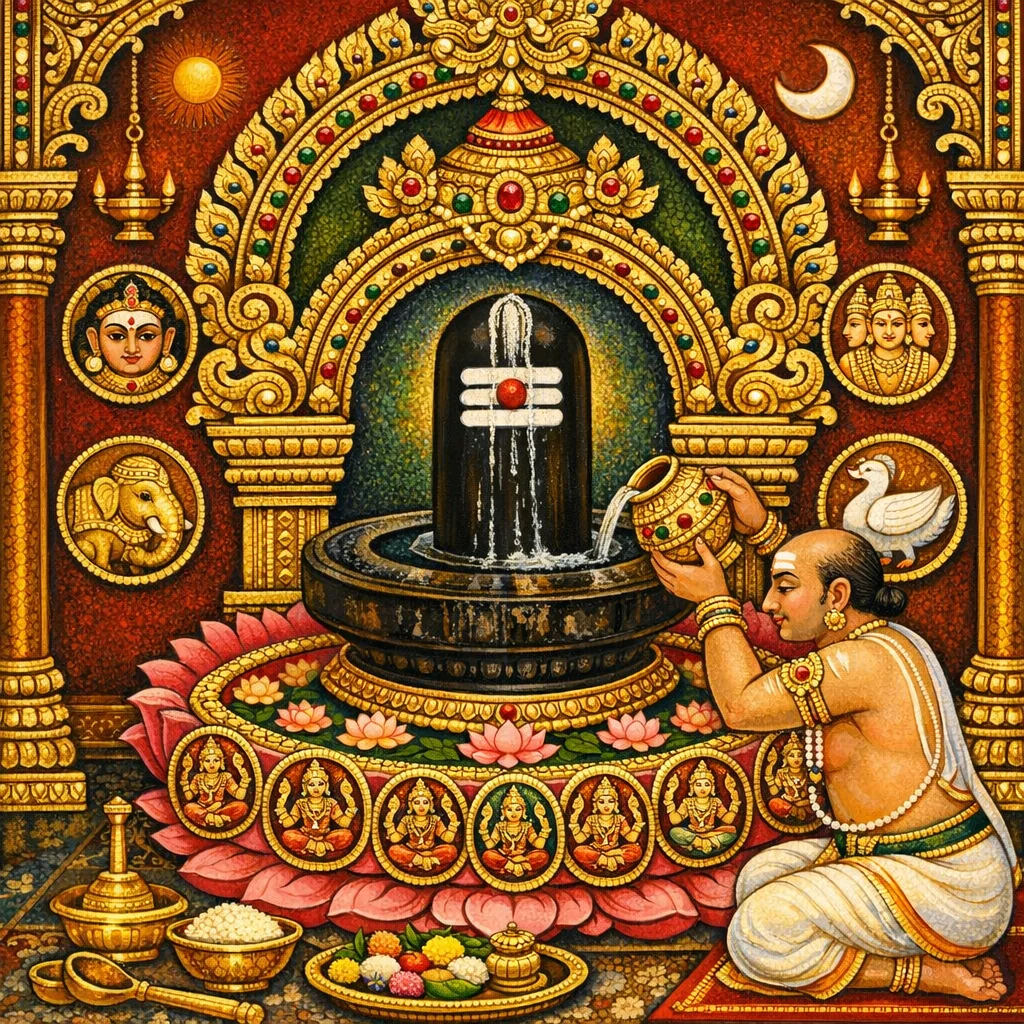
Agni teaches a Śaiva tantric protocol of worship and initiation (dīkṣā) centered on the pañcākṣara mantra, presenting mantra as both cosmology and method. Śiva is first described as the knowledge-nature of Supreme Brahman dwelling in the heart, and the mantra’s syllables are correlated with the five elements, vital airs (prāṇa), senses, and the whole embodied field, culminating also in an eight-syllable completion. The chapter then details ritual procedure: purifying the dīkṣā-site, preparing caru and dividing it threefold, observances regarding sleep and dawn-reporting, repeated maṇḍala worship, clay-smearing and tīrtha bathing with Aghamarṣaṇa, prāṇāyāma, self-purification, and nyāsa. Visualization intensifies as syllables become colored limbs; śaktis are installed on lotus petals and pericarp; Śiva is invoked as crystal-white, four-armed, five-faced, with the pañcabrahma forms (Tatpuruṣa, etc.) placed by direction. The dīkṣā sequence follows—adhivāsa, gavyapañcaka, eye-sealing, entry, tattva-saṃhāra into the Supreme and re-creation by sṛṣṭi-mārga, circumambulation, flower-casting for name/seat selection, generation of Śiva-fire, homa counts with prescribed formulas, pūrṇāhuti and astra oblations, expiation, kumbha worship, abhiṣeka, samaya vows, and honoring the guru—adding that the method applies similarly to other deities such as Viṣṇu.
Shlokas
Verse 1
इत्य् आग्नेये महापुराणे अङ्गाक्षरार्चनं नाम द्व्यधिकत्रिशततमो ऽध्यायः अथ त्र्यधिकत्रिशततमो ऽध्यायः पञ्चाक्षरादिपूजामन्त्राः अग्निर् उवाच मेषः संज्ञा विषं साद्यमस्ति दीर्घोदकं रसः एतत् पञ्चाक्षरं मन्त्रं शिवदञ्च शिवात्मकं
Thus, in the Agni Mahāpurāṇa, the chapter called “Worship by the syllables of the limbs (aṅga-akṣara-arcana)”—the three-hundred-and-second chapter—comes to an end. Now begins the three-hundred-and-third chapter: “Mantras for worship beginning with the Five-syllable (pañcākṣara).” Agni said: “Meṣa (Aries) is the designation; viṣa is the poison; sādhya is that which is to be accomplished or propitiated; dīrghodaka is the ‘long water’; rasa is the essence. This is the five-syllabled mantra—bestowing Śiva—and of the very nature of Śiva.”
Verse 2
तारकादि समभ्यर्च्य देवत्वादि समाप्नुयात् ज्ञानात्मकं परं ब्रह्म परं बुद्धिः शिवो हृदि
Having duly worshipped Tāraka and the others, one attains divinity and related excellences. The Supreme Brahman is of the nature of knowledge; the highest intellect is Śiva, present within the heart.
Verse 3
तच्छक्तिभूतः सर्वेशो भिन्नो ब्रह्मादिमूर्तिभिः मन्त्रार्णाः पञ्च भूतानि तन्मन्त्रा विषयास् तथा
The Lord of all (Sarveśa), being the very embodiment of that Power (Śakti), appears differentiated in forms beginning with Brahmā and the rest. The five great elements are constituted of mantra-syllables (phonemic seeds), and likewise their corresponding mantras are the objects of experience (the sensory domains).
Verse 4
प्राणादिवायवः पञ्च ज्ञानकर्मेन्द्रियाणि च सर्वं पञ्चाक्षरं ब्रह्म तद्वदष्टाक्षरान्तकः
The five vital airs beginning with prāṇa, and the organs of perception and action as well—everything is gathered into the five-syllabled Brahman (pañcākṣara); likewise, it culminates in the eight-syllabled (aṣṭākṣara) mantra as its final consummation.
Verse 5
गव्येन प्रक्षयेद्दीक्षास्थानं मन्त्रेण चोदितं तन्त्रसम्भूतसम्भावः शिवमिष्ट्वा विधानतः
He should sprinkle and purify the place of initiation with the cow-derived purifier, as enjoined by mantra; endowed with the sanctioned efficacy arising from the Tantra, he should worship Śiva according to the prescribed rule.
Verse 6
मध्येषु तोरणद्वहिरिति ख , ज , ञ च मूलमूर्त्यङ्गविद्याभिस्तण्डुलक्षेपणादिकम् कृत्वा चरुञ्च यत् क्षीरं पुनस्तद्विभजेत् त्रिधा
In the central positions, with the mantra “toraṇadvahir” and the seed-syllables kha, ja, and ña, having performed rites such as the casting of rice-grains together with the root-mantra, the main deity’s mantra, and the ancillary (aṅga) mantras, and having prepared the caru (sacrificial porridge), one should then divide the milk used for it again into three portions.
Verse 7
निवेद्यैकं परं हुत्वा सशिष्यो ऽन्यद्भजेद्गुरुः आचम्य सकलीकृत्य दद्याच्च्छिष्याय देशिकः
Having first offered one portion as nivedya (a presentation) and then poured the next as the principal huta-oblation into the fire, the guru—together with the disciple—should partake of the remaining portion. After performing ācamana and ritually “making it whole” (sakalī-kṛtya), the preceptor should then hand it over to the disciple.
Verse 8
दन्तकाष्ठं हृदा जप्तं क्षीरवृक्षादिसम्भवम् संशोध्य दन्तान् संक्षिप्त्वा प्रज्ञाल्यैतत् क्षिपेद्भुवि
Having mentally recited the mantra (japa), one should take a tooth-stick produced from milky trees and the like; after cleansing the teeth, one should gather it up, rinse it well, and then discard it on the ground.
Verse 9
पूर्वेण सौम्यवारीशगतं शुभमतौ शुभम् पुनस्तं शिष्यमायान्तं शिश्वाबन्धादिरक्षितं
Then, by the eastern route or quarter, that disciple came again—of auspicious intent—arriving with what was auspicious, protected against restraints such as bonds and the like.
Verse 10
कृत्वा वेद्यां सहानेन स्वपेद्दर्भास्तरे बुधः सुषुप्तं वीक्ष्य तं शिष्यः प्रभाते श्रावयेद्गुरुं
Having prepared the vedī (altar) together with the prescribed havis (offering), the wise man should sleep upon a bed of darbha grass. Seeing him asleep, the disciple should, at dawn, report to the teacher the dream or condition observed.
Verse 11
शुभैः सिद्धिपदैर् भक्तिस्तैः पुनर्मण्डलार्चनम् मण्डलं भद्रकाद्युक्तं पूजयेत्सर्वसिद्धिदं
With auspicious, siddhi-conferring formulae (mantras) and with devotion, one should again perform the worship of the maṇḍala. One should worship the maṇḍala furnished with Bhadrakā and related auspicious components, for it bestows all attainments (siddhis).
Verse 12
स्नात्वाचम्य मृदा देहं मन्त्रैर् आलिप्य कल्प्यते शिवतीर्थे नरः स्नायादघमर्षणपूर्वकम्
Having bathed and then performed ācamana, one should prepare oneself by smearing the body with cleansing earth (clay) while reciting mantras. At a Śiva-tīrtha, a person should bathe after first performing the Aghamarṣaṇa rite, the sin-dispelling recitation.
Verse 13
हस्ताभिषेकं कृत्वाथ प्रायात् पूजादिकं बुधः मूलेनाब्जासनं कुर्यात्तेन पूरककुम्भकान्
Having performed the hand-ablution, the wise practitioner should then proceed to the acts of worship and the rest. By the mūla-mantra (root-mantra) he should assume the lotus-seat; and with that same root-mantra he should perform prāṇāyāma—pūraka (inhalation) and kumbhaka (breath-retention).
Verse 14
आत्मानं योजयित्वोर्ध्वं शिखान्ते द्वादशाङ्गुले संशोष्य दग्ध्वा स्वतनुं प्लावयेदमृतेन च
Having directed the self upward and fixed it at the end of the śikhā (topknot)—twelve finger-breadths above—one should dry up and, as it were, burn one’s own body, and then flood it with amṛta, the nectar of immortality.
Verse 15
ध्मात्वा दिव्यं वपुस्तस्मिन्नात्मानञ्च पुनर्नयेत् कृत्वेवं चात्मशुद्धिः स्याद्विन्यस्यार्चनमारभेत्
Having (ritually) infused that visualized form with a divine body, one should then bring the Self (ātman) back into it again. When this is done, self-purification is accomplished; after performing nyāsa (ritual placement of mantras), one should begin the worship (arcana).
Verse 16
क्रमात् कृष्णसितश्यामरक्तपीता नगादयः मन्त्रार्णा दण्डिनाङ्गानि तेषु सर्वास्तु मूर्तयः
In due sequence, the mantra-syllables—beginning with the class ‘na’ and the rest—are to be visualized as black, white, dark-blue, red, and yellow; they constitute the limbs of the staff-bearing deity (Daṇḍin). In those syllables/limbs, all the divine forms are to be contemplated as present.
Verse 17
शिष्यमाचान्तमिति ञ अङ्गुष्ठादिकनिष्ठान्तं विन्यस्याङ्गानि सर्वतः न्यसेन्मन्त्राक्षरं पादगुह्यहृद्वक्त्रमूर्धसु
Having the disciple perform ācamana, one should arrange the nyāsa from the thumb onward up to the little finger; and, having thus placed the syllables upon all the limbs, one should install the mantra-syllable(s) upon the feet, the secret part, the heart, the mouth, and the head.
Verse 18
व्यापकं न्यस्य मूर्धादि मूलमङ्गानि विन्यसेत् रक्तपीतश्यामसितान् पीठपादान् स्वकालजान्
Having first installed the all-pervading (Vyāpaka) principle/mantra, one should then place (perform nyāsa of) the root-limbs beginning with the head; and one should install the pīṭhas and pādas—red, yellow, dark-blue/black, and white—each arising in its own prescribed time (kāla).
Verse 19
स्वाङ्गान्मन्त्रैर् न्यसेद्गात्राण्यधर्मादीनि दिक्षु च तत्र पद्मञ्च सुर्यादिमण्डले त्रितयं गुणान्
With mantras, one should perform nyāsa upon one’s own limbs; and one should also place adharma and the other negative principles in the directions. There, one should further install the lotus, and within the solar and other mandalas install the triad of the guṇas.
Verse 20
पूर्वादिपत्रे कामाद्या नवकं कर्णिकोपरि वामा ज्येष्ठा क्रमाद्रौद्रो काली कलविकारिणी
On the petals beginning with the eastern one, place the group of nine Śaktis beginning with Kāmā; and upon the pericarp (the central whorl) in proper sequence place Vāmā, Jyeṣṭhā, Raudrī, Kālī, and Kalavikāriṇī.
Verse 21
बलविकारिणी चार्थ बलप्रमथनी तथा सर्वभूतदमनी च नवमी च मनोन्मनी
Balavikāriṇī is she who transforms strength; Balapramathanī, moreover, she who crushes strength; Sarvabhūtadamanī, she who subdues all beings; Navamī, the Ninth manifestation; and Manonmanī, she who lifts the mind beyond ordinary mentation.
Verse 22
श्वेता रक्ता सिता पीता श्यामा वह्निनिभाषिता कृष्णारुणाश् च ताः शक्तीर्ज्वालारूपाः स्मरेत् क्रमात्
One should meditate in due order on those Śaktis—white, red, pale, yellow, dark (blue-black), radiant like fire, and blackish-reddish—conceiving them as having the form of flames.
Verse 23
अनन्तयोगपीठाय आवाह्याथ हृदब्जतः स्फटिकाभं चतुर्वाहुं फलशूलधरं शिवम्
Then, having invoked the Lord onto the seat of endless Yoga, one should visualize and summon from the lotus of the heart Śiva—crystal-white in radiance, four-armed, bearing the fruit (bestowing boons) and the trident.
Verse 24
साभयं वरदं पञ्चवदंनञ्च त्रिलोचनम् पत्रेषु मुर्तयः पञ्च स्थाप्यास्तत्पुरुषादयः
He (Śiva) is to be depicted as granting fearlessness and boons, five-faced and three-eyed; and on the ritual leaves, the five manifestations (mūrti)—beginning with Tatpuruṣa—should be installed in due order.
Verse 25
पूर्वे तत्पुरुषः श्वेतो अघोरो ऽष्टभुजो ऽसिताः चतुर्वाहुमुखः पीताः सद्योजातश् च पश्चिमे
In the east is Tatpuruṣa, white in hue. Aghora is dark (blackish) and eight-armed. (In the north) Vāmadeva is yellow, with four arms and the corresponding face; and in the west is Sadyojāta.
Verse 26
वामदेवः स्त्रीविलासी चतुर्वक्त्रभुजो ऽरुणः सौम्ये पञ्चास्य ईशाने ईशानः सर्वदः सितः
Vāmadeva delights in the play of the feminine power (Śakti); he is four-faced and four-armed, and reddish in hue. In the Saumya aspect he is five-faced; in the Īśāna aspect, Īśāna—white in color—bestows all attainments.
Verse 27
इष्टाङ्गानि यथान्यायमनन्तं सूक्ष्ममर्चयेत् सिद्धेश्वरं त्वेकनेत्रं पूर्वादौ दिश पूजयेत्
One should worship in the prescribed manner with the desired ritual components (aṅgas), and perform subtle worship of Ananta; and one should worship Siddheśvara, the One-Eyed, together with the directions beginning with the East.
Verse 28
एकरुद्रं त्रिनेत्रञ्च श्रीकण्ठञ्च शिखण्डिनम् ऐशान्यादिविदिक्ष्वेते विद्येशाः कमलासनाः
Ekarudra, Trinetra, Śrīkaṇṭha, and Śikhaṇḍin—these Vidyeśas, seated upon lotus-thrones, are stationed in the intermediate directions beginning with the north-east (Aiśānya).
Verse 29
श्वेतः पीतः सितो रक्तो धूम्रो रक्तो ऽरुणः शितः शूलाशनिशरेश्वासवाहवश् चतुराननाः
They are described as white, yellow, pale, red, smoke-hued, red again, tawny, and keen-bright; bearing the trident, thunderbolt (vajra), arrow, bow, and mount—these are the four-faced forms.
Verse 30
उमा वण्डेशनन्दीशौ महाकालो गणेश्वरः वृषो भृङ्गरिटिस्कन्दानुत्तरादौ प्रपूजयेत्
Then one should duly worship Umā, Vaṇḍeśa and Nandīśa, Mahākāla and Gaṇeśvara, and also the Bull (Nandin), Bhṛṅgariṭi and Skanda—beginning from the northern direction and proceeding in due order.
Verse 31
कुलिशं शक्तिदण्डौ च खड्गपाशध्वजौ गदां शूलं चक्रं यजेत् पद्मं पूव्वादौ देवमर्च्य च
One should worship the vajra (kuliśa), the spear (śakti) and staff (daṇḍa); the sword, noose (pāśa) and banner; the mace (gadā), trident (śūla) and discus (cakra); and also the lotus—placing them in the eastern direction and the other directions, and thereafter worshipping the deity as well.
Verse 32
ततो ऽधिवासितं शिष्यं पाययेद्गव्यपञ्चकम् आचान्तं प्रोक्ष्ये नेत्रान्तैर् नेत्रे नेत्रेण बन्धयेत्
Then, having kept the disciple in consecratory residence (adhivāsa), one should make him drink the gavyapañcaka, the five products of the cow. After he has performed ācāmana (purificatory sipping) and has been sprinkled with water, one should ritually seal the eyes—touching the corners of the eyes—and secure each eye by the “netra” protective rite/mantra itself.
Verse 33
द्वारं प्रवेशयेच्छिप्यं मण्डपस्याथ दक्षिणे सासनादिकुशासीनं तत्र संशोधयेद्गुरुः
He should have the disciple enter through the doorway; then, on the southern side of the maṇḍapa, seated upon a seat and on kuśa-grass, the Guru should there perform for him the prescribed saṃśodhana—rites of purification and verification.
Verse 34
आदितत्त्वानि संहृत्य परमार्थे लयः क्रमात् पुनरुत्पादयेच्छिष्यं सृष्टिमार्गेण देशिकः
Having withdrawn the primordial principles (tattvas), one should dissolve them step by step into the Supreme Reality (paramārtha); then the initiating teacher (dīkṣā-guru) should re-manifest the disciple anew by the method known as the path of creation (sṛṣṭi-mārga).
Verse 35
न्यासं शिष्ये ततः कृत्वा तं प्रदक्षिणमानयेत् पश्चिमद्वारमानीय क्षेपयेत् कुसुमाञ्जलिम्
Then, having performed the (mantra-)nyāsa upon the disciple, one should lead him in pradakṣiṇa, the circumambulation of the sacred space. Bringing him to the western doorway, one should have him cast a handful-offering of flowers (kusumāñjali).
Verse 36
यस्मिन् पतन्ति पुष्पाणि तन्नामाद्यं विनिर्दिशेत् पार्श्वेयागभुवः खाते कुण्डे सन्नभिमेखले
One should first designate and declare the name/spot where the flowers fall. (This is done) at the side-sacrificial area—at the excavated fire-pit (kuṇḍa) furnished with the central “navel” mark (nābhi) and the surrounding circular girdle (mekhalā).
Verse 37
शिवाग्निं जनयित्वेष्ट्वा पुनः शिष्येण चार्चयेत् ध्यानेनात्मनिभं शिष्यं संहृत्य प्रलयः क्रमात्
Having generated the Śiva-fire (Śivāgni) and worshipped it, he should again have it worshipped by the disciple. Then, by meditation, withdrawing (reabsorbing) the disciple—made identical with oneself—there follows dissolution (pralaya) in due sequence.
Verse 38
पुनरुत्पाद्य तत्पाणौ दद्याद्दर्भांश् च मन्त्रितान् पृथिव्यादीनि तत्त्वानि जुहुयाद्धृदयादिभिः
Having again generated (the ritual potency/mental construction), one should place into his hand darbha-grass blades empowered by mantra. Then, beginning with earth, one should offer the elemental principles (tattva) into the fire, employing the heart (hṛdaya) and the other aṅga-mantras.
Verse 39
कमलानना इति ञ सन्धादिमेखले इति ख एकैकस्य शतं हुत्वा व्योममूलेन होमयेत् हुत्वा पूर्णाहुतिं कुर्यादस्त्रेणाष्टाहुतीर्हुनेत्
With the syllabic formulas “kamalānanā” (designated as ña) and “sandhādimekhale” (designated as kha), one should offer one hundred oblations of each. Then one should perform the homa with the “Vyoma-mūla” (the root-mantra beginning with ‘vyoma’). Having offered, one should make the concluding full oblation (pūrṇāhuti), and then offer eight oblations with the Astra-mantra.
Verse 40
प्रायश्चित्तं विशुद्ध्यर्थं ततः शेषं समापयेत् कुम्भं समन्त्रितं प्रार्च्य शिशुं पीठे ऽभिषेचयेत्
For the sake of purification, one should first perform the expiatory rite (prāyaścitta); thereafter one should complete the remaining procedure. Having consecrated the kumbha (water-pot) with mantras and duly worshipped it, one should perform the abhiṣeka, the ritual bathing, of the child upon the pīṭha (ritual seat).
Verse 41
शिष्ये तु समयं दत्वा स्वर्णाद्यैः स्वगुरुं यजेत् दीक्षा पञ्चाक्षरस्योक्ता विष्ण्वादेरेवमेव हि
After giving the disciple the prescribed samaya, the vow of discipline, one should worship one’s own guru with gifts such as gold and the like. The dīkṣā, initiation into the five-syllabled mantra (pañcākṣara), has been stated; indeed, the same method applies likewise to Viṣṇu and the other (deities/mantras) as well.
Frequently Asked Questions
A full tantric workflow: site purification, maṇḍala construction and re-worship, layered nyāsa (vyāpaka and aṅga), deity/śakti directional installations, and a quantified homa sequence (including pūrṇāhuti and astra oblations) within a formal dīkṣā framework.
It converts metaphysics into practice: by mapping mantra to body, elements, and cognition, then purifying the self through prāṇāyāma, nyāsa, and tattva-saṃhāra, the rite aims at inner identification with Śiva (jñāna-svarūpa) while also conferring siddhi-oriented ritual competence.
The pañcabrahma set beginning with Tatpuruṣa—Tatpuruṣa, Aghora, Vāmadeva, Sadyojāta, and Īśāna—installed directionally with specified colors and iconographic features.
Adhivāsa, administration of gavyapañcaka, protective sealing of the eyes, entry and purification, dissolution of tattvas into the Supreme (laya/saṃhāra), re-creation by sṛṣṭi-mārga, circumambulation and flower-casting for determination, Śiva-fire worship and homa, expiation, kumbha worship, abhiṣeka, samaya vow, and guru honoring with gifts.