Adhyaya 302
Worship by Limb-Syllables (Aṅgākṣara-arcana)
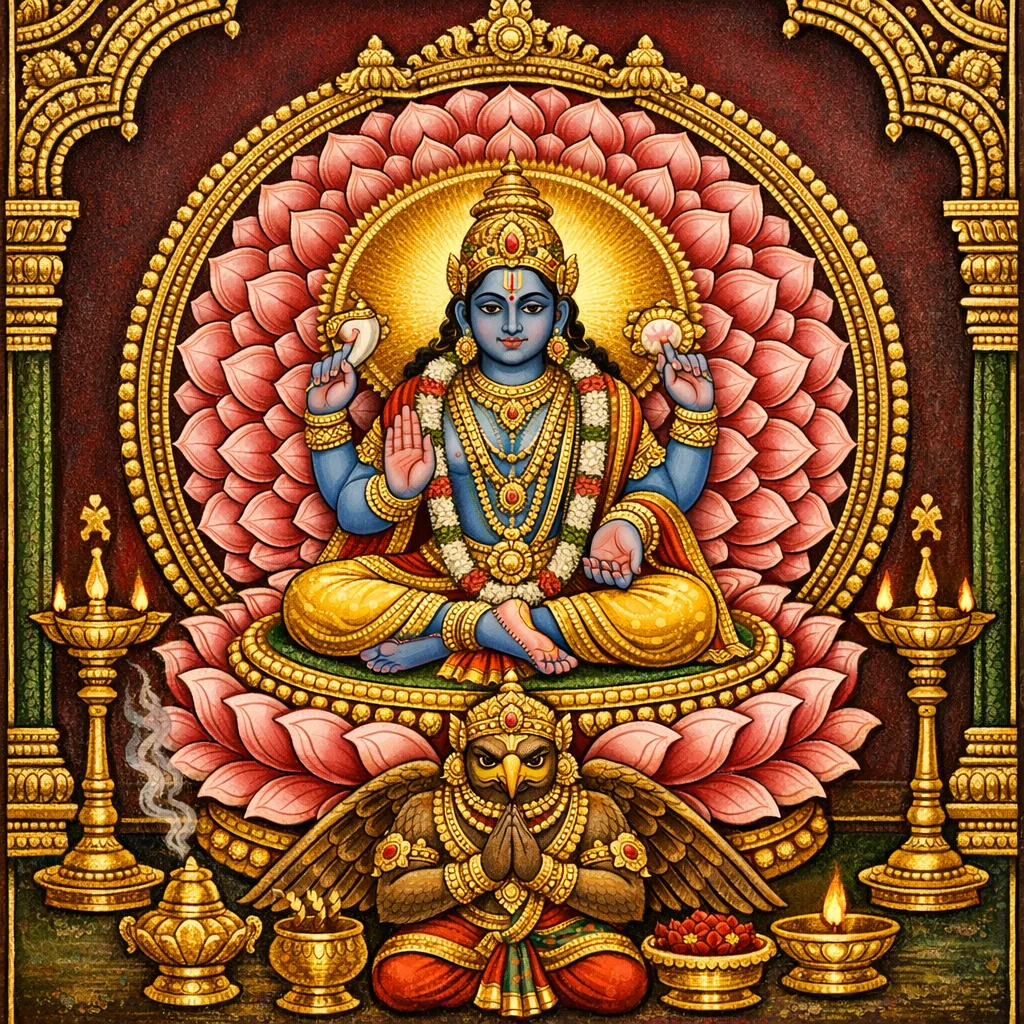
Lord Agni begins this tantra-oriented teaching by fixing an auspicious ritual window through astral signs (Moon in one’s birth asterism, Sun in the seventh sign, and Puṣan/Puṣya timing) and by urging examination of the grāsa (eclipse magnitude/phase) before proceeding. He then turns to embodied ritual technique: ominous bodily marks are noted as life-shortening portents, and protective as well as devotional uses of mantra are prescribed. A śikhā-formula is given for fierce forces (Kruddholkā, Maholkā, Vīrolkā), and the Vaiṣṇava eight-syllabled mantra is assigned across the finger joints in a structured nyāsa. The practitioner installs letters and bīja-syllables at key bodily loci (heart, mouth, eyes, head, feet, palate, guhyā, hands) and mirrors the same nyāsa upon the deity, stressing ritual identity between self and iṣṭa-devatā. The chapter expands to maṇḍala/lotus placement, installing dharma-series and guṇa/śakti sets through the lotus regions up to the triad of circles (Sun, Moon, Dāhinī). Finally, Hari is invoked on the yoga-seat and worship proceeds by pañcopacāra with the mūla-mantra, directional forms (Vāsudeva etc.), weapons/attributes in the quarters, and āvaraṇa worship including Garuḍa, Viśvaksena, Someśa, and Indra’s retinue—promising comprehensive attainment through complete liturgical order.
Shlokas
Verse 1
इत्य् आग्नेये महापुराणे नानामन्त्रा नामैकाधिकत्रिशततमो ऽध्यायः अथ द्व्यधिकत्रिशततमो ऽध्यायः अङ्गाक्षरार्चनम् अग्निर् उवाच यदा जन्मर्क्षगश् चन्द्रो भानुः सप्तसराशिगः पौष्णः कालः स विज्ञेयस्तदा ग्रासं परीक्षयेत्
Thus ends, in the Agni Mahāpurāṇa, the chapter entitled “Various Mantras.” Now begins the three-hundred-and-second chapter, “Worship by Limb-Syllables (Aṅgākṣara-arcana).” Agni said: “When the Moon is in one’s birth-asterism, the Sun is in the seventh sign, and the lunar time falls under the auspice of Puṣan (connected with Puṣya), that time is to be known as suitable; then one should examine the ‘grāsa’—the measure or phase of the eclipse—before proceeding.”
Verse 2
कण्टोष्ठौ चलतःस्थानाद्यस्य वक्रा च नासिका कृष्णा च जिह्वा सप्ताहं जीवितं तस्य वै भवेत्
For one whose throat and lips shift from their normal place, whose nose becomes crooked, and whose tongue turns black—his life indeed will last only a week.
Verse 3
तारो मेषो विषं दन्ती नरो दीर्घो वणा रसः क्रूद्धोल्काय महोल्काय वीरोल्काय शिखा भवेत्
“Tāra,” “Meṣa,” “Viṣa,” “Dantī,” “Nara,” “Dīrgha,” “Vaṇā,” “Rasa”—for the powers/deities Kruddholkā, Maholkā, and Vīrolkā, let the protective “śikhā” formula be constituted (and recited) in this manner.
Verse 4
ह्यल्काय राहसोल्काय वैष्णवोष्टाक्षरो मनुः कनिष्ठादितदष्टानामङ्गुलीनाञ्च पर्वसु
For the (nyāsa) “hyalkāya” and “rāhasolkāya,” the Vaiṣṇava eight-syllabled mantra (aṣṭākṣara) is to be placed upon the joints of the fingers, beginning with the little finger, in accordance with those eight syllables.
Verse 5
ज्येष्ठाग्रेण क्रमात्तावन् मूर्धन्यष्टाक्षरं न्यसेत् तर्जन्यान्तारमङ्गुष्ठे लग्ने मध्यमया च तत्
Then, in proper sequence, one should place (perform nyāsa of) the mūrdhanya—i.e., cranial/coronal—eight-syllabled mantra with the tip of the ring finger; and with the middle finger one should also place that (nyāsa) at the point where the thumb joins the inner space adjacent to the index finger.
Verse 6
तलेङ्गुष्ठे तदुत्तारं वीजोत्तारं ततो न्यसेत् रक्तगौरधूम्रहरिज्जातरूपाः सितास्त्रयः
On the palm at the base of the thumb, one should place by nyāsa the “raising/deliverance” of that mantra, and thereafter the “raising” of the seed-syllable (bīja). The associated forms/colors are red, pale-yellow, smoky, greenish, golden-hued, and three that are white.
Verse 7
एवं रूपानिमान् वर्णान् भावबुद्धान्न्यसेत् क्रमात् हृदास्यनेत्रमूर्धाङ्घ्रितालुगुह्यकरादिषु
Thus, in proper sequence, one should install these letters—conceived in their forms and contemplated with focused awareness—upon the heart, mouth, eyes, head, feet, palate (tālu), the secret place, the hands, and the other bodily locations.
Verse 8
अङ्गानि च न्यसेद्वीजान्न्यस्याथ करदेहयोः यथात्मनि तथा देवे न्यासः कार्यः करं विना
One should place the seed-mantras (bīja) by nyāsa upon the limbs. Having placed them upon the hands and the body, in the same manner as upon oneself, nyāsa is to be performed upon the deity as well—without omitting the hands.
Verse 9
हृदादिस्थानगान् वर्णान् गन्धपुष्पै समर्चयेत् धर्माद्यग्न्याद्यधर्मादि गात्रे पीठे ऽम्बुजे न्यसेत्
One should duly worship the syllables stationed in the heart and the other inner loci with fragrances and flowers. Then one should place by nyāsa Dharma and the rest, Agni and the rest, and Adharma and the rest—upon the body, upon the pīṭha (seat), and within the lotus (padma).
Verse 10
यत्र केशरकिञ्जल्कव्यापिसूर्येन्दुदाहिनां मण्डलन्त्रितयन्तावद् भेदैस्तत्र न्यसेत् क्रमात्
Where the lotus-filaments and pollen spread out, there one should lay down in due sequence the divisions of the maṇḍala, extending as far as the triad of circles: the Sun, the Moon, and the fiery Dāhinī.
Verse 11
गुणाश् च तन्त्रसत्वाद्याः केशरस्थाश् च शक्तयः विमलोत्कर्षणीज्ञानक्रियायोगाश् च वै क्रमात्
And the Guṇas—beginning with the (tantric) Sattva and the rest—together with the Śaktis stationed in the lotus-filaments (keśara), namely Vimalā, Utkarṣiṇī, Jñānā, Kriyā, and Yogā, are to be placed/understood in that very order.
Verse 12
प्रह्वी सत्या तथेशानानुग्रहा मध्यतस्ततः योगपीठं समभ्यर्च्य समावह्य हरिं यजेत्
Then, with Prahvī, Satyā, and likewise Īśānānugrahā placed in the middle, having duly worshipped the Yoga-seat (yogapīṭha), one should invoke Hari (Viṣṇu) and perform His worship.
Verse 13
पाद्यार्घ्याचमनीयञ्च पीतवस्त्रविभूषणं एतत् पञ्चोपचारञ्च सर्वं मूलेन दीयते
Foot-washing water (pādya), welcome-water (arghya), and sipping-water (ācamanīya), along with yellow cloth and ornaments—these, and the entire set of five ritual services (pañcopacāra), are all to be presented accompanied by the root-mantra (mūla-mantra).
Verse 14
वासुदेवादयः पूज्याश् चत्वारो दिक्षु मूर्तयः विदिक्षु श्रीसरस्वत्यै रतिशान्त्यै च पूजयेत्
The four forms beginning with Vāsudeva are to be worshipped, being stationed in the four cardinal directions; and in the intermediate directions one should also worship Śrī (Lakṣmī), Sarasvatī, Rati, and Śānti.
Verse 15
हृदास्यनेत्रमूर्धाङ्घ्रिजानुगुह्यकरादिष्विति ख शङ्खं चक्रं गदां पद्मं मुषलं खड्गशार्ङ्गिके वनमालान्वितं दिक्षु विदिक्षु च यजेत् क्रमात्
Beginning with the heart, mouth, eyes, head, feet, knees, the secret part (genitals), hands, and the other limbs—one should, in due sequence, worship the Lord as bearing the conch, discus, mace, lotus, pestle, sword, and the Śārṅga bow, adorned with the forest-garland (vanamālā), in the cardinal and intercardinal directions.
Verse 16
अभ्यर्च्य च वहिस्तार्क्ष्यं देवस्य पुरतो ऽर्चयेत् विश्वक्सेनञ्च सोमेशं मध्ये आवरणाद्वहिः इन्द्रादिपरिचारेण पूज्य सर्वमवाप्नुयात्
Having first worshipped duly, one should worship Tārkṣya (Garuḍa) outside, before the Lord. One should also worship Viśvaksena and Someśa—placing them in the middle, and then outside the surrounding retinue (āvaraṇa). Having worshipped the Lord together with Indra and the other attendant deities, one attains all that is desired.
Frequently Asked Questions
The chapter emphasizes structured nyāsa engineering: mapping the Vaiṣṇava aṣṭākṣarī across finger joints and then installing letters/bījas across bodily loci, followed by mirroring the same placements onto the deity and extending the ritual into lotus-maṇḍala (padma/keśara/kiñjalka) and āvaraṇa worship.
It links bodily discipline and liturgical precision to devotion: by aligning the practitioner’s body with mantra and then identifying the same structure in the deity (nyāsa on deva), the rite converts embodiment into sādhana, integrating protection, concentration, and bhakti toward Hari within a complete dharmic ritual order.