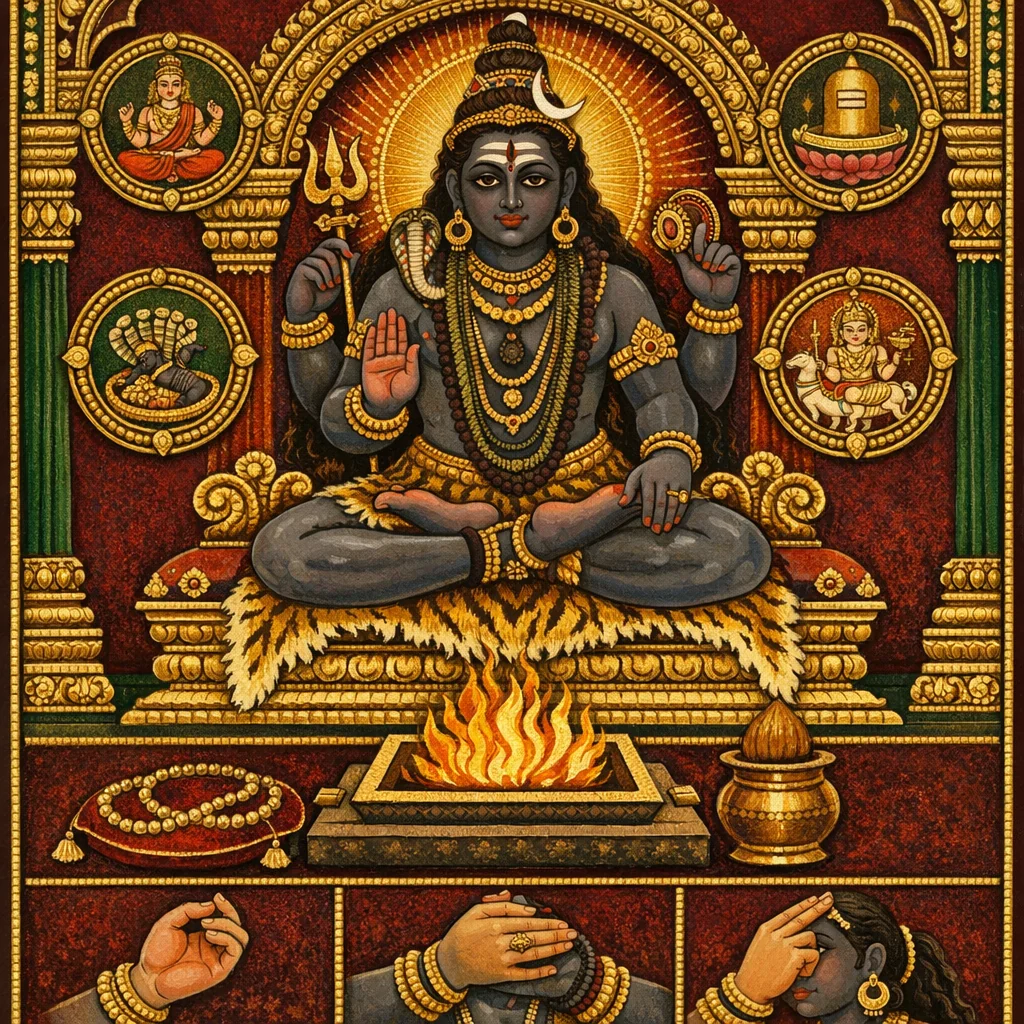
Adhyaya 322
The Six Limbs (Ṣaḍaṅga) of the Aghora-Astra (अघोरास्त्राणि षडङ्गानि)
This chapter shifts from the prior Pāśupata-Śānti discussion to a technical teaching on the Aghora-Astra’s ṣaḍaṅga—the six mantric “limbs” enacted through japa, homa, nyāsa, and kavaca. Īśvara gives a compact haṃsa-based formula to subdue death and disease, and prescribes large oblations with dūrvā grass for śānti and puṣṭi. The scope then widens to apotropaic and coercive vidyās (mohanī, jṛmbhanī, vaśīkaraṇa, antardhāna) as an ordered repertoire, including rites against thieves, enemies, and graha-afflictions, with Kṣetrapāla-bali and reversal/return motifs. Alongside ritual procedures (mantra-washing rice, threshold recitations, fumigation recipes, tilaka compounds), it incorporates practical aims—victory in disputes, attraction, fortune, and progeny remedies—showing the Purāṇa’s encyclopedic blend of mantra-technology and applied materia medica. It culminates in explicit Śaiva doctrine: Īśāna and the Pañcabrahman (Sadyojāta, Vāmadeva, Aghora, Tatpuruṣa, Īśāna) are invoked through aṅga assignments and a detailed kavaca, centering protection in Sadāśiva and promising both enjoyment and liberation.
Shlokas
Verse 1
इत्य् आग्नेये महापुराणे पाशुपतशान्तिर्नामैकविंशत्यधिकत्रिशततमो ऽध्यायः असाध्यमपीति ख अथ द्वाविंशत्यधिकत्रिशततमो ऽध्यायः षडङ्गान्यघोरास्त्राणि ईश्वर उवाच ॐ ह्रूं हंस+इति मन्त्रेण मृत्युरोगादि शास्यति लक्षाहुतिभिर्दूर्वाभिः शान्तिं पुष्टिं प्रसाधयेत्
Thus, in the Agni Mahāpurāṇa, the chapter called “Pāśupata-Śānti” is the three-hundred-and-twenty-first. Next begins the three-hundred-and-twenty-second chapter, “The Six Limbs (Ṣaḍaṅga) of the Aghora-Astra.” The Lord (Īśvara) said: “By the mantra ‘Oṃ hrūṃ haṃsa,’ one subdues death, disease, and the like. With one lakh oblations using dūrvā grass, one should accomplish śānti (peace) and puṣṭi (nourishment/prosperity).”
Verse 2
अथ वा प्रणवेनैव मायया वा षडानन दिव्यान्तरीक्षभौमानां शान्तिरुत्पातवृक्षके
Or else, O Ṣaḍānana (six-faced Lord), by the Pranava (Oṃ) alone—or by a protective Māyā (mantric formula)—there is pacification of ominous portents arising from the divine, the atmospheric (sky/space), and the terrestrial realms, as taught in the rite concerning portentous signs.
Verse 3
ॐ नमो भगवति गन्ङे कालि महाकालि मांसशोणितभोजने रक्तकृष्णमुखि वशमानय मानुषान् स्वाहा ॐ लक्षं जप्त्वा दशांशेन हुत्वा स्यात् सर्वकर्मकृत् वशं नयति शक्रादीन्मानुषेष्वेषु क कथा
“Oṃ. Homage to the Blessed Goddess—Gaṅgā, Kālī, Mahākālī—she who partakes of flesh and blood, whose face is red and black: ‘Bring human beings under (my) control—svāhā.’ Oṃ. Having repeated this mantra one lakh times, and then offering a tenth of that number into the fire as homa, one becomes capable of accomplishing all rites; one can bring even Indra (Śakra) and the like under control—what then to say of ordinary humans?”
Verse 4
अन्तर्धानकरी विद्या मोहनी जृम्भनी तथा वशन्नयति शत्रूणां शत्रुबुद्धिप्रमोहिनी
There is a Vidyā that causes disappearance, an enchanting (mohanī) Vidyā, and likewise a stupefying or paralyzing (jṛmbhanī) Vidyā; and there is a Vidyā that brings enemies under control—one that deludes and confounds the enemies’ understanding.
Verse 5
कामधेनुरियं विद्या सप्तधा परिकीर्तिता मन्त्रराजं प्रवक्ष्यामि शत्रुचौरादिमोहनम्
This Vidyā is like Kāmadhenū, the wish-fulfilling cow, and has been proclaimed in seven forms. Now I shall teach the royal mantra that bewilders enemies, thieves, and the like.
Verse 6
महाभयेषु सर्वेषु स्मर्तव्यं हरपूजितं लक्षं जप्त्वा तिलैर् होमः सिद्ध्येदुद्धरकं शृणु
In all great dangers one should remember that (mantra/rite) which is worshipped by Hara (Śiva). Having repeated it one lakh (100,000) times, an offering into the fire with sesame seeds brings accomplishment. Hear now the Uddhāraka, the deliverer and protector.
Verse 7
ॐ हले शूले एहि ब्रह्मसत्येन विष्णुसत्येन रुद्रसत्येन रक्ष मां वाचेश्वराय स्वाहा दुर्गात्तारयते यस्मात्तेन दुर्गा शिवा मता ॐ चण्डकपालिनि दन्तान् किटि क्षिटि गुह्ये फट् ह्रीं अनेन मन्त्रराजेन क्षालयित्वा तु तण्डुलान्
“Om. O (Goddess) of the plough and the trident—come! By the truth of Brahmā, by the truth of Viṣṇu, by the truth of Rudra, protect me; svāhā unto Vāceśvara, Lord of Speech.” Since she causes one to cross beyond difficulties (durgā), therefore she is held to be Durgā, the auspicious one (Śivā). “Om. O fierce one bearing a skull—(for) the teeth: kiṭi kiṣiṭi; in the secret place: phaṭ; hrīṃ.” Having washed the rice-grains with this sovereign mantra, one should use them in the rite.
Verse 8
त्रिंशद्वारानि जप्तानि तच्चौरेषु प्रदापयेत् दन्तैश्चूर्णानि शुक्लानि पतितानि हि शुद्धये
Having recited (the mantra) at the thirty doorways, one should apply it against thieves; and for purification when one has fallen into defilement, one should use the white powders (scrapings) produced by the teeth.
Verse 9
अपिलजटाभारभास्वर विद्रावण त्रैलोक्यडामर दर भ्रम आकट्ट तोटय मोटय दह पच एवं सिद्धिरुद्रो ज्ञापयति यदि ग्रहोपगतः स्वर्गलोकं देवलोकं वा आरामविहाराचलं तथापि तमावर्तयिष्यामि वलिं गृह्ण ददामि ते स्वहेति क्षेत्रपालबलिं दत्वा ग्रहो न्यासाध्रदं व्रजेत् शत्रवो नाशमायान्ति रणे वैरगणक्षयः
“O blazing one with the burden of matted locks—repeller! O dreadful Ḍāmara of the three worlds—terror! Confound! Drag (him) forth! Strike! Crush! Burn! Cook!” Thus the accomplished Rudra declares the efficacy: even if a ‘seizing spirit’ (graha) has gone to heaven-world or god-world, or to a pleasure-grove, a place of recreation, or a mountain, still I shall cause him to return. “Accept the offering (bali); I give it to you—svāhā!” Having given the bali to the Kṣetrapāla, the graha departs from the place where the nyāsa has been performed. Enemies come to destruction; in battle, hostile factions are annihilated.
Verse 10
हंसबीजन्तु विन्यस्य विषन्तु त्रिविधं हरेत् अगुरुञ्चन्दनं कुष्ठं कुङ्कुमं नागकेशरम्
Having placed (added) haṃsabīja, one should counteract the three kinds of poison, using agarwood, sandalwood, costus (kuṣṭha), saffron (kuṅkuma), and nāgakeśara.
Verse 11
नखं वै देवदारुञ्च समं कृत्वाथ दूपकः माक्षिकेन समायुक्तो देहवस्त्रादिधूपनात्
After making equal parts of nakha and deodāra (Himalayan cedar), one should prepare a dūpaka (fumigant). Combined with beeswax and used to fumigate the body, clothing, and the like, it serves as a protective incense.
Verse 12
विवादे मोहने स्त्रीणां भण्डने कलहे शुभः कन्याया वरणे भाग्येमायामन्त्रेण मन्त्रितः
Consecrated with the Māyā-mantra, it is auspicious and effective in disputes, in the bewitching/attracting of women, in quarrels and altercations, in securing a maiden in marriage, and in matters of fortune.
Verse 13
ह्रीं रोचनानागपुष्पाणि कुङ्कुमञ्च महःशिला ललाटे तिलकं कृत्वा यं पश्येत्स वशी भवेत्
Having made a tilaka on the forehead with rocanā, nāga-puṣpa, saffron (kuṅkuma), and mahaḥśilā, and uttering “Hrīṁ”, whomever one looks upon becomes submissive, brought under one’s influence.
Verse 14
शतावर्यास्तु चूर्णन्तु दुग्धपीतञ्च पुत्रकृत् नागकेशरचूर्णन्तु घृतपक्वन्तु पुत्रकृत्
Powder of śatāvarī, when taken with milk, is said to promote the begetting of a son. Likewise, powder of nāgakeśara, when cooked in ghee and consumed, is said to promote the begetting of a son.
Verse 15
पालाशवीजपानेन लमेत पुत्रकन्तथा ॐ उत्तिष्ठ चामुण्डे जम्भय मोहय अमुकं वशमानय स्वाहा निघ्नान्त्वति ख , छ च षड्विंशा सिद्धविद्या सा नदीतीरमृदा स्त्रियम्
By drinking an infusion of palāśa seeds, one makes even a child (putraka) pliant. (Recite:) “Oṃ, arise, O Cāmuṇḍā; paralyze, delude, and bring ‘amukaṃ’ under subjugation—svāhā.” Then, uttering “nighnāntu” together with the syllables “kha” and “cha,” this is the twenty-sixth perfected spell (siddha-vidyā). It is to be applied with clay taken from a riverbank, in rites concerning a woman.
Verse 16
कृत्वोन्मत्तरसेनैव नामालिख्यार्कपत्रके मूत्रोत्सर्गन्ततः कृत्वा जपेत्तामानयेत्स्त्रियम्
Having prepared an intoxicating/infatuating essence (unmatta-rasa), one should write the woman’s name upon a leaf of arka (Calotropis). Then, after urinating upon it, one should recite the prescribed mantra; by that, one brings the woman to oneself.
Verse 17
ॐ क्षुंसः वषट् महामृत्युञ्जयो मन्त्रो जप्याद्धोमाच्च पुष्टिकृत् ॐ हंसः ह्रूं हूं स ह्रः सौंः मृतसञ्जीवनी विद्यां अष्टार्णा जयकृद्रणे
The Mahāmṛtyuñjaya mantra—“Oṃ kṣuṃsaḥ, vaṣaṭ”—should be repeated in japa and also offered in fire-oblation (homa); it produces nourishment and strengthening. Likewise, “Oṃ haṃsaḥ hrūṃ hūṃ sa hraḥ sauṃḥ”: this is the eight-syllabled Mṛtasañjīvanī Vidyā, which brings victory in battle.
Verse 18
मन्त्रा ईशानमुख्याश् च धर्मकामादिदायकाः ईशानः सर्वविद्यानामीश्वरःसर्वभूतानां
These mantras—chief among them those of Īśāna—bestow dharma, kāma, and other aims. Īśāna is the Lord of all branches of knowledge and the Sovereign of all beings.
Verse 19
ब्रह्मणश्चाधिपतिर्ब्रह्म शिवो मे ऽस्तु सदाशिवः ॐ तत्पुरुषाय विद्महे महादेवाय धीमहि तन्नो रुद्रः प्रचोदयात् ॐ अघोरेभ्यो ऽथ घोरेभ्यो धोरहरेभ्यस्तु सर्वतः
May Sadāśiva—who is Brahmā, and also the Lord (adhīpati) of Brahmā—be auspicious to me as Śiva. Oṃ: We know (and contemplate) Tatpuruṣa; we meditate upon Mahādeva; may that Rudra impel (enlighten) us. Oṃ: Salutations to the non-terrific (Aghora) forms, and also to the terrific (Ghōra) forms—indeed, to those who remove terror—on all sides, from every direction.
Verse 20
सर्वेभ्यो नमस्ते रुद्ररूपेभ्यः ॐ वामदेवाय नमो ज्येष्ठाय नमः रुद्राय नमः कालाय नमः कलविकरणाय नमो बलविकरणाय नमो बलप्रमथनाय नमः सर्वभूतदमनाय नमो मनोन्मानाय नमः ॐ सद्योजातं प्रवक्ष्यामि सद्योजाताय वै नमः भवे भवे ऽनादिभवे भजस्व मां भवोद्भव
Salutations to all Your forms as Rudra. Oṁ—homage to Vāmadeva; homage to Jyeṣṭha; homage to Rudra; homage to Kāla (Time/Death); homage to the Differentiator of the parts (kalā-vikaraṇa); homage to the Differentiator of strength (bala-vikaraṇa); homage to the Crusher and Overpowerer of strength (bala-pramathana); homage to the Tamer of all beings; homage to the One who transcends and uplifts the mind. Oṁ—now I shall proclaim “Sadyojāta”; homage indeed to Sadyojāta. In every becoming—O beginningless Bhava—be gracious to me, O Bhavodbhava, Source of all becoming.
Verse 21
पञ्चब्रह्माङ्गषट्कञ्च वक्ष्ये ऽहं भुक्तिमुक्तिदं ॐ नमः परमात्मने पराय कामदाय परमेश्वराय योगाय योगसम्भवाय सर्वकराय कुरु सत्य भव भवोद्भव वामदेव सर्वकार्यकर पापप्रशमन सदाशिव प्रसन्न नमो ऽस्तु ते स्वाहा पञ्चब्रह्माङ्गफट्कारमिति ञ हृदयं सर्वार्थदन्तु सप्तत्यक्षरसंयुतं हा शिखा ॐ शिवात्मक महातेजः सर्वज्ञ प्रभुरावर्तय महाघोर कवच पिङ्गल नमः महाकवच शिवाज्ञया हृदयं बन्ध घूर्णय चूर्णय सूक्ष्मवज्रधर वज्रपाश धनुर्वज्राशनिवज्रशरीर मम शरीरमनुप्रविश्य सर्वदुष्टान् स्तम्भय हूं अक्षराणान्तु कवचं शतं पञ्चाक्षराधिकम्
I shall declare the sixfold limb-formula (aṅga-ṣaṭka) of the Pañcabrahman, which bestows both worldly enjoyment and liberation: “Oṁ—salutation to the Supreme Self, to the Transcendent One, the granter of desires, the Supreme Lord; to Yoga and the source of Yoga; to the doer of all. Make (it) true; be (present); O Bhavodbhava; O Vāmadeva, accomplisher of all works; remover of sins; O Sadāśiva, be gracious—salutation to You; svāhā.” This is called the “phaṭ-formula of the Pañcabrahman limbs.” The syllable “ña” is assigned as the Heart (hṛdaya) and grants all aims; it is joined with seventy syllables. The syllable “hā” is assigned as the Topknot (śikhā). “Oṁ—O Śiva-natured One, of great splendor, all-knowing Lord, cause (this) to revolve/return; O Mahāghora—(this is) the armor (kavaca); O Piṅgala—salutation.” By Śiva’s command: “Bind the heart; whirl (the foes); pulverize (them), O subtle Vajra-bearer; O Vajra-noose; O Vajra-bow; O thunderbolt-bodied One—enter my body and paralyze all wicked beings—hūṃ.” The protective armor is of one hundred syllables, plus five syllables more.
Frequently Asked Questions
It repeatedly uses a standard tantric workflow: lakṣa-japa (100,000 repetitions) followed by daśāṃśa-homa (one-tenth oblations), then nyāsa/kavaca for embodiment and protection, and bali offerings (notably to Kṣetrapāla) for boundary-control and removal of afflictive forces.
The practical rites culminate in Īśāna and the Pañcabrahman framework, where Sadāśiva and the five faces (Sadyojāta, Vāmadeva, Aghora, Tatpuruṣa, Īśāna) become the doctrinal ground for aṅga-nyāsa and kavaca—recasting protection and power as expressions of Śiva’s sovereignty rather than isolated technique.