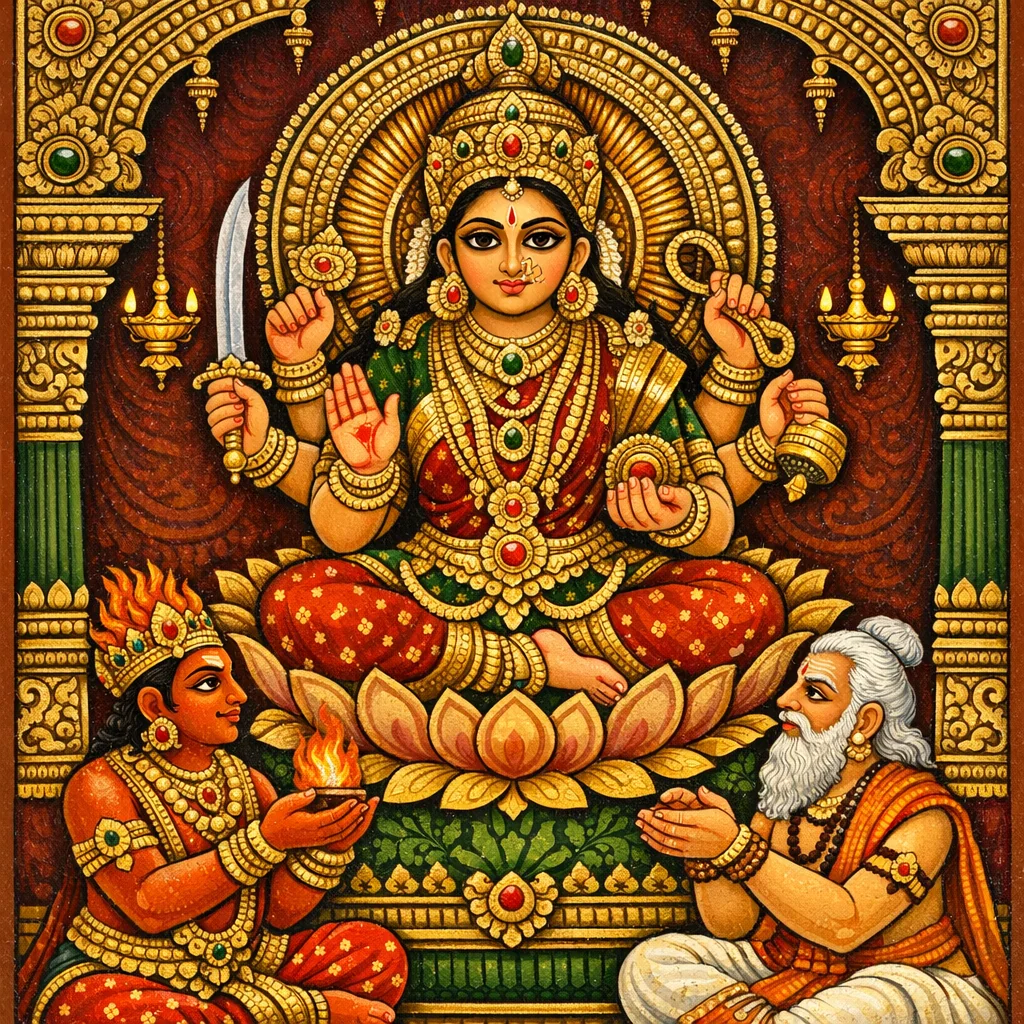
Adhyaya 311
The Root-Mantra of Tvaritā (Tvaritā-mūla-mantra)
This chapter functions as a transitional colophon and doctrinal hinge: it concludes the teaching on Tvaritā’s root-mantra (mūla-mantra) and signals a shift into a more technical exposition of Tvaritā-vidyā. In the Agneya framework, the mūla-mantra is treated as the seed-authority from which later ritual applications (prayoga) and diagrammatic deployments through yantra/cakra unfold. Placed immediately before the detailed methodology, this closure highlights a Purāṇic pedagogy: mantra is first established as a revealed nucleus, then expanded into operational branches through regulated sequences, nyāsa, and yantra/cakra construction. The chapter anchors lineage authenticity and textual continuity, preparing the practitioner-scholar to read the next chapter not as isolated spells, but as a systematic technology for dharma–kāma–artha results subordinated to scriptural order.
Shlokas
Verse 1
इत्य् आग्नेये महापुराणे त्वरितामूलमन्त्रो नाम दशाधिकत्रिशततमो ऽध्यायः अथैकादशाधिकत्रिशततमो ऽध्यायः त्वरिताविद्या अग्निर् उवाच विद्याप्रस्तावमाख्यास्ये धर्मकामादिसिद्धिदम् नवकोष्ठविभागेन विद्याभेदञ्च विन्दति
Thus, in the Agni Mahāpurāṇa ends the three-hundred-and-eleventh chapter entitled “The Root-Mantra of Tvaritā.” Now begins the three-hundred-and-twelfth chapter: “Tvaritā‑Vidyā.” Agni said: “I shall explain the introductory framework of this Vidyā, which bestows accomplishments relating to dharma, kāma, and the like; and by means of the division into nine compartments, one also understands the distinct classifications within this Vidyā.”
Verse 2
अनुलोमविलोमेन समस्तव्यस्तयोगतः कर्णाविकर्णयोगेन अत ऊर्ध्वं विभागशः
From this point onward, the divisions are to be set out systematically—by forward and reverse order (anuloma and viloma), by combined and separated arrangement (samasta and vyasta), and by the karṇa and avikarṇa modes of combination.
Verse 3
त्रित्रिकेण च योगेन देव्या सन्नद्धविग्रहः जानाति सिद्धिदान्मन्त्रान् प्रस्तावान्निर्गतान् बहून्
By the threefold (tritrika) discipline and by this yoga, the practitioner—whose form is fully armed and fortified by the Goddess—comes to know many mantras that bestow success (siddhi), together with their proper introductory applications and ritual contexts.
Verse 4
शास्त्रे शास्त्रे स्मृता मन्त्राः प्रयोगास्तत्र दुर्लभाः गुरुः स्यात् प्रथमो वर्णः पूर्वेद्युर्न च वर्ण्यते
In every treatise, mantras are indeed recorded; yet their practical applications are hard to obtain there. The first and foremost principle is the Guru; and what was taught on the previous day is not to be re-stated in full.
Verse 5
प्रस्तावे तत्र चैकार्णा द्व्यर्णास्त्र्यर्णादयो ऽभवन् तिर्यगूर्ध्वगता रेखाश् चतुरश् चतुरो भजेत्
In the opening arrangement, single-syllable, two-syllable, three-syllable, and other groupings are formed; and the lines running horizontally and vertically—four in number—should be divided into four parts.
Verse 6
नव कोष्ठा भवन्त्येवं मध्यदेशे तथा इमान् प्रदक्षिणेन संस्थाप्य प्रस्तावं भेदयेत्ततः
Thus, in the central region there are nine compartments. Having arranged them in clockwise order, one should then divide and mark the entrance or passage thereafter.
Verse 7
प्रस्तावक्रमयोगेन प्रस्तावं यस्तु विन्दति करमुष्टिस्थितास्तस्य साधकस्य हि सिद्धयः
He who, by applying the proper sequence for the prastāva (the opening section), successfully obtains—i.e., composes—the prastāva: for that practitioner, the attainments (siddhis) are as though resting in the palm of his hand.
Verse 8
त्रैलोक्यं पादमूले स्यान्नवखण्डां भुवं लभेत् कपाले तु समालिख्य शिवतत्त्वं समन्ततः
At the base of the feet one should place the three worlds, and delineate the earth as divided into nine regions. Then, upon the kapāla (skull), having carefully inscribed it, one should depict the principle (tattva) of Śiva all around.
Verse 9
श्मशानकर्पटे वाथ वाह्यं निष्क्रम्य मन्त्रवित् तस्य मध्ये लिखेन्नाम कर्णिकोपरि संस्थितम्
Or else, on a cloth taken from a cremation-ground, the knower of mantra—having gone out to the outer place—should write the name in its middle, positioned upon the karnikā, the central pericarp (hub) of the diagram.
Verse 10
तापयेत्खादिराङ्गारैर् भूर्जमाक्रम्य पादयोः सप्ताहादानयेत् सर्वं त्रेलोक्यं सचराचरम्
Placing bhūrja (birch-bark) beneath the feet and heating it with embers of khadira-wood, one should perform the heating rite. Within seven days one may draw the entire three worlds—moving and unmoving—under one’s influence.
Verse 11
वज्रसम्पुटगर्भे तु द्वादशारे तु लेखयेत् मध्ये गर्भगतं नाम सदाशिवविदर्भितम्
Within the inner chamber of the Vajra-sampuṭa (adamantine enclosure), one should inscribe it upon a twelve-spoked diagram; and in the center one should write the name set within the garbha (core), encircled and filled by the power of Sadāśiva.
Verse 12
कुड्ये फलकके वाथ शिलापट्टे हरिद्रया मुखस्तम्भं गतिस्तम्भं सैन्यस्तम्भन्तु जायते
If, on a wall, a wooden panel, or a stone slab, one makes a marking with haridrā (turmeric), then the effects called ‘mukha-stambha’, ‘gati-stambha’, and ‘sainya-stambha’ arise—obstruction of speech/face, obstruction of movement, and immobilization of troops.
Verse 13
विषरक्तेन संलिख्य श्मशाने कर्परे बुधः षट्कोणं दण्डमाक्रान्तं समन्ताच्छक्तियोजितम्
The adept should inscribe it with poison-mixed blood on a potsherd in a cremation-ground: a hexagonal figure, overrun by a staff-mark (daṇḍa), and furnished on all sides with śaktis (powers/weapon-forces).
Verse 14
मारयेदचिरादेष श्मशाने निहतं रिपुं छेदं करोति राष्ट्रस्य चक्रमध्ये न्यसेद्रिपुं
By this rite, he would cause the enemy to be slain quickly; the enemy is struck down in the cremation-ground. It brings about a ‘cutting off’ (cheda) of the enemy’s realm; one should place the enemy within the middle of the ritual wheel (cakra).
Verse 15
चक्रधाराङ्गतां शक्तिं रिपुनाम्ना रिपुं हरेत् तार्क्ष्येणैव तु वीजेन खड्गमध्ये तु लेखयेत्
Using the śakti embodied in Cakradhāra (the Lord who bears the discus), one should subdue the enemy by writing the enemy’s name; and with the Tārkṣya-bīja (Garuḍa seed-syllable) one should inscribe it in the middle of the sword.
Verse 16
विदर्भरिपुनामाथ श्मशानाङ्गारलेखितम् सप्ताहात्साधयेद्देशं ताडयेत् प्रेतभस्मना
Then, having written the enemy’s name (of Vidarbha) with charcoal from the cremation-ground, one should bring the region under control within seven days; one should strike (the target or effigy) with the ashes of a dead person.
Verse 17
भेदने छेदने चैव मारणेषु शिवो भवेत् तारकं नेत्रमुद्दिष्टं शान्तिपुष्टौ नियोजयेत्
In rites of splitting, cutting, and even lethal operations, one should employ the (form of) Śiva. The ‘Tāraka Netra’, the mantric “eye”, has been prescribed; it should be applied for pacification and for prosperity-nourishment rites.
Verse 18
दहनादिप्रयोगोयं शाकिनीञ्चैव कर्पयेत् मध्यादिवारुणीं यावद्वक्रतुण्डसमन्वितः
This is the rite beginning with incineration; one should also subdue (drive away) the Śākinī. One should proceed with the Vāruṇī operation (water/Varuṇa-related) from the middle onward, until it is accompanied by the sign or form of the ‘crooked-beaked’ one.
Verse 19
कुण्ड इति क वज्रतुण्दसमन्वित इति ट कुष्टाद्या व्याधयो ये तु नाशयेत्तान्न संशयः मध्यादिउत्तरान्तन्तु करालीबन्धनाज्जपेत्
Recite ‘kuṇḍa’ with the syllable ‘ka’, and recite ‘endowed with a vajra-like beak or tusk’ with the syllable ‘ṭa’. By this, diseases beginning with leprosy and the like are destroyed—without doubt. One should perform japa from the middle onward up to the end, according to the ‘Karālī-bandhana’ (the binding/arrangement of the mantra).
Verse 20
रक्षयेदात्मनो विद्यां प्रतिवादी यदा शिवः वारुण्यादि ततो न्यस्य ज्वरकाशविनाशनम्
One should safeguard one’s own vidyā, the mantra-knowledge. When the opponent becomes ‘śiva’—auspiciously pacified—then, having applied (nyāsa) the Varuṇa-related formula and the rest, it brings about the destruction of fever and cough.
Verse 21
सौम्यादि मध्यमान्तन्तु गुरुत्वं जायते वटे पूर्वादि मध्यमान्तन्तु लघुत्वं कुरुते क्षणात्
In the group beginning with “saumya-”, the middle and final syllables become heavy (guru) in the metrical scheme; but in the group beginning with “pūrva-”, the middle and final syllables become light (laghu) at once.
Verse 22
भूर्जे रोचनया लिख्य एतद्वज्राकुलं पुरम् क्रमस्थैर् मन्त्रवीजैस्तु रक्षां देहेषु कारयेत्
Having written this protective diagram called “Vajrākula” (the “fortress”) on birch-bark with gorocanā pigment, one should have protection performed upon the bodies (of the intended persons) by means of the mantra seed-syllables (bīja) firmly arranged in due order.
Verse 23
वेष्टिता भावहेम्ना च रक्षेयं मृत्युनाशिनी विघ्नपापारिदमनी सौभाग्यायुःप्रदा धृता
Wrapped in “bhāva-gold” (gold empowered by sacred intent), this protective amulet should be worn; it destroys death, subdues obstacles, sins, and enemies, and—when borne—bestows good fortune and long life.
Verse 24
द्यूते रेणे च जयदा शक्रसैन्ये न संशयः बन्ध्यानां पुत्रदा ह्य् एषा चिन्तामणिरिवापरा
She bestows victory in gambling and in combat, and even over Indra’s army—of this there is no doubt. For barren women she grants sons; indeed, she is another wish-fulfilling gem, like the Cintāmaṇi.
Verse 25
साधयेत् परराष्ट्राणि राज्यञ्च पृथिवीं जयेत् फट् स्त्रीं क्षें हूं लक्षजप्याद्यक्षादिर्वशगो भवेत्
By accomplishing this mantra-practice (sādhana), one may subdue foreign kingdoms and conquer sovereignty and the earth. With the seed-syllables “phaṭ”, “strīṃ”, “kṣeṃ”, and “hūṃ”, and by performing a lakṣa-japa (one hundred thousand repetitions), yakṣas and other beings come under one’s control.
Frequently Asked Questions
The chapter’s technical emphasis is structural: it establishes the Tvaritā mūla-mantra as the authoritative basis that precedes and governs later prayogas, diagrammatic layouts, and operational sequences described in the following chapter.
By grounding practice in an authorized root-mantra and textual continuity, it reinforces discipline, lineage-dependence, and right ordering—conditions presented in the Agni Purana as necessary for siddhi to remain aligned with dharma rather than mere power-seeking.