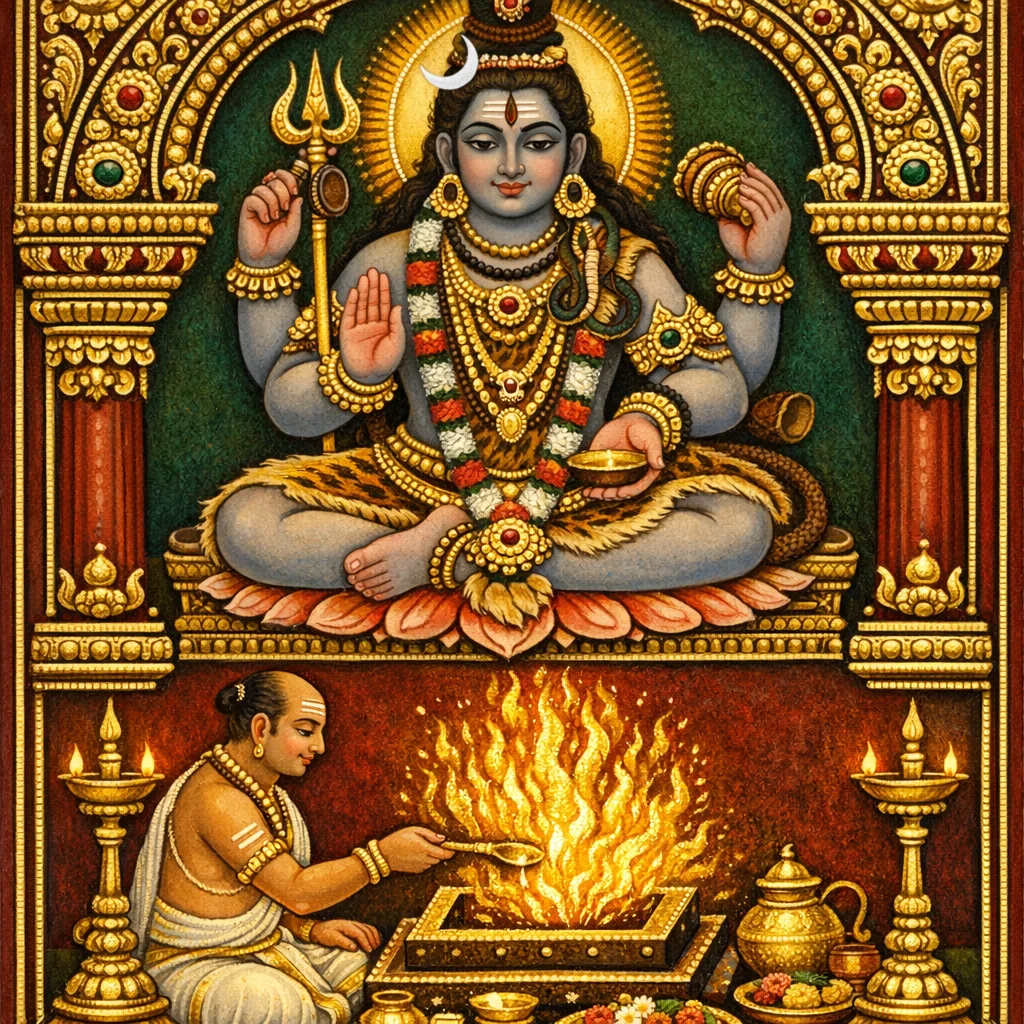
Adhyaya 324
Rudra-śānti (रुद्रशान्ति)
This chapter concludes the ritual-theological section on Rudra-śānti, a pacificatory framework that brings fearsome Rudra-power into auspicious balance. In the Agni Purana’s mantra-śāstra trajectory, śānti teachings bridge devotion and technique: the practitioner approaches Rudra not only for praise, but to harmonize a potent force through properly framed rites. Its placement marks a shift from appeasement and stabilization (śānti) toward finer tantric procedure and mantra-construction in the next adhyāya. In the encyclopedic logic of Agneya Vidyā, śānti is not isolated piety but a foundational operation preparing practitioner, ritual space, and subtle environment for later mantra-siddhi—along with timing rules, elemental correspondences, and lineage markers.
Shlokas
Verse 1
इत्य् आग्नेये महापुराणे रुद्रशान्तिर्नाम त्रयोविंशत्यधिकत्रिशततमो ऽध्यायः अथ चतुर्विंशत्यधिकत्रिशततमो ऽध्यायः अंशकादिः ईश्वर उवाच रुद्राक्षकटकं धार्यं विषमं सुसमं दृडम् एकत्रिपञ्चवदनं यथालाभन्तु धारयेत्
Thus, in the Agni Mahāpurāṇa ends the three-hundred-and-twenty-fourth chapter called “Rudra-śānti.” Now begins the three-hundred-and-twenty-fifth chapter, “Aṃśaka and related matters.” The Lord said: “One should wear a bracelet of rudrākṣa beads—whether irregular or well-formed, provided it is firm. One should wear beads having one, three, or five ‘faces’ (mukhas), according to what is obtainable.”
Verse 2
द्विचतुःषण्मुखं शस्तमव्रणं तीव्रकण्ठकं दक्षवाहौ शिखादौ च धारयेच्चतुराननं
One should visualize (or ritually install) the praised deity-form as having two, four, or six faces, unblemished and without wounds, with a fierce throat/neck; and one should place the four-faced (Brahmā) on the right arm, and at the top-knot (śikhā) and other upper points.
Verse 3
अब्रह्मचारी ब्रह्मचारी अस्नातः स्नातको भवेत् हैमी वा मुद्रिका धार्या शिवमन्त्रेण चार्च्य तु
Whether one is not observing brahmacarya or is observing brahmacarya, and even if one has not yet taken the ceremonial bath, one becomes as a snātaka (one who has completed the bath-rite). One should wear a golden ring and worship with the Śiva-mantra.
Verse 4
कार्येति ख शिवः शिखा तथा ज्योतिः सवित्रश्चेतिगोचराः गोचरन्तु कुलं ज्ञेयं तेन लक्ष्यस्तु दीक्षितः
‘Kārya’, ‘Kha’, ‘Śiva’, ‘Śikhā’, ‘Jyotis’, and ‘Savitr’—these are to be treated as the “gocaras” (operative indicators). By the set of gocaras, the kula (initiatory lineage/clan) is to be recognized; through that, the initiated person (dīkṣita) is to be correctly identified.
Verse 5
प्राजापत्यो महीपालः कपोतो ग्रन्थिकः शिवे कुटिलाश् चैव वेतालाः पद्महंसाः शिखाकुले
In Śiva’s (retinue/realm) are: the Prājāpatya, Mahīpāla (Protector of the Earth), Kapota, Granthika; likewise the Kuṭilas and the Vetālas; and the Padmahaṃsas in the Śikhākula (group).
Verse 6
धृतराष्ट्रा वकाः काका गोपाला ज्योतिसंज्ञके कुटिका साठराश् चैव गुटिका दण्डिनो ऽपरे
In the technical terminology of Jyotiṣa, these names are employed: Dhṛtarāṣṭrā, Vakāḥ (herons), Kākāḥ (crows), and Gopālāḥ (cowherds); likewise Kuṭikā and the Sāṭharas; and others are called Guṭikā and Daṇḍins.
Verse 7
सावित्री गोचरे चैवमेकैकस्तु चतुर्विधः सिद्धाद्यंशकमाख्यास्ये येन मन्त्रःसुसिद्धिदः
Thus, with regard to the gocara (sphere of application) of the Sāvitrī (Gāyatrī), each practice is fourfold. I shall explain the components beginning with “siddhi”, by which the mantra becomes a bestower of complete accomplishment.
Verse 8
भूमौ तु मातृका लेख्याः कूटषण्डाववर्जिताः मन्त्राक्षराणि विश्लिष्य अनुस्वारं नयेत् पृथक्
On the ground, the mātrikā (alphabet/seed-syllable series) should be written, omitting the kūṭa and ṣaṇḍa groupings. Having separated the mantra’s syllables, one should place the anusvāra (ṃ) separately.
Verse 9
साधकस्य तु या संज्ञा तस्या विश्लेषणं चरेत् मन्त्रस्यादौ तथा चान्ते साधकार्णानि योजयेत्
As for the designation (initiatory name) belonging to the practitioner, one should analyze it by separating it into its constituent syllables. Then, at the beginning as well as at the end of the mantra, one should append the practitioner’s syllables (letters) accordingly.
Verse 10
सिद्धः साध्यः सुशिद्धो ऽरिः संज्ञातो गणयेत् क्रमात् मन्त्रस्यादौ तथा चान्ते सिद्धिदः स्याच्छतांशतः
Having identified the mantra’s operative categories as “Siddha”, “Sādhya”, “Su-siddha”, and “Ari”, one should compute them in due order. When these are placed at the beginning and also at the end of the mantra, it becomes a bestower of success, yielding results a hundredfold.
Verse 11
सिद्धादिश्चान्तसिद्धश् च तत्क्षणादेव सिध्यति सुसिद्धादिः सुसिद्धन्तःसिद्धवत् परिकल्पयेत्
A mantra whose beginning is “siddha” and whose ending is “śānta-siddha” is accomplished at that very moment. One should also compose a mantra beginning with “su-siddha” and ending with “su-siddhānta”, treating it as a siddha-mantra, that is, as already perfected.
Verse 12
अरिमादौ तथान्ते च दूरतः परिवर्जयेत् सिद्धः सुसिद्धश् चैकार्थे अरिः साध्यस्तथैव च
One should avoid the sound/word “ari” at the beginning as well as at the end, keeping it at a distance. With respect to a single intended meaning, the expression is termed “siddha” and “susiddha”; likewise, “ari” and “sādhya” are also so designated.
Verse 13
आदौ सिद्धः स्थितो मन्त्रे तदन्ते तद्वदेव हि मध्ये रिपुसहस्राणि न दोषाय भवन्ति हि
When the perfected element “siddha” is placed at the beginning of a mantra, and likewise when it is placed at the end, then even thousands of hostile forces in the middle do not become a defect (doṣa) at all.
Verse 14
मायाप्रसादप्रणवेनांशकः ख्यातमन्त्रके ब्रह्मांशको ब्रह्मविद्या विष्ण्वङ्गो वैष्णवःस्मृतः
In the well-known class of mantras, the one constituted by the Praṇava (Oṃ) together with the “māyā” and “prasāda” seed-syllables is called an Aṃśaka-mantra. That which is a portion of Brahmā is termed Brahma-vidyā; and that which is an aṅga (limb/part) of Viṣṇu is remembered as Vaiṣṇava.
Verse 15
विष्ण्वंश इति ञ रुद्रांशको भवेद्वीर इन्द्रांशश्चेश्वरप्रियः नागांशो नागस्तब्धाक्षो यक्षांशो भूषणप्रियः
One who bears the lineage/portion of Viṣṇu is denoted by the syllable “ña”. One who bears a portion of Rudra becomes heroic; one who bears a portion of Indra is dear to the Lord (and devoted to Īśvara). One who bears a portion of the Nāgas is Nāga-like, with a steady, unblinking gaze; one who bears a portion of the Yakṣas is fond of ornaments.
Verse 16
गन्धर्वांशो ऽतिगीतादि भीमांशो राक्षसांशकः दैर्यांशः स्याद् युद्धकार्यो मानी विद्याधरांशकः
One who bears the Gandharva-element excels in song and the like. One who bears the Bhīma-element partakes of a Rākṣasa nature. One who has the Dairya-element is fit for the work of battle. One who is proud and high-spirited partakes of the Vidyādhara-element.
Verse 17
पिशाचांशो मलाक्रान्तो मन्त्रं दद्यान्निरीक्ष्य च मन्त्र एकात् फडन्तः स्यात् विद्यापञ्चाशतावधि
If a person is afflicted by a piśāca influence and overcome by impurity, one should administer (recite/apply) the mantra while observing the patient and the signs. Beginning from the first mantra, it should conclude with the exclamation “phaṭ”, up to a set of fifty vidyā-mantras.
Verse 18
बाला विंशाक्षरान्ता च रुद्रा द्वाविंशगायुधा तत ऊर्ध्वन्तु ये मन्त्रा दृद्धा यावच्छतत्रयं
The Bālā-mantra is completed in twenty syllables; the Rudrā-mantra is armed with twenty-two. Above these, the mantras that are firmly established extend up to a maximum of three hundred syllables.
Verse 19
अकारादिहकारन्ताः क्रमात् पक्षौ सितासितौ अनुस्वारविसर्गेण विना चैव स्वरा दश
Beginning with ‘a’ and ending with ‘ha’, the two series are, in order, the ‘white’ and the ‘black’ groups; and excluding anusvāra and visarga, the vowels are ten.
Verse 20
ह्रस्वाः शुक्ला दीर्घाः श्यामांस्तिथयःप्रतिपम्मुखाः उदिते शान्तिकादीनि भ्रमिते वश्यकादिकम्
The lunar days (tithis), beginning from the Pratipad, are of two kinds: the bright (śukla) are ‘short’, while the dark (śyāma/kṛṣṇa) are ‘long’. When a tithi is in its udita (rising) phase, rites such as śānti (pacification) and the like are prescribed; when it is in a bhramita (shifted/turned) condition, rites such as vaśya (attraction/subjugation) and related operations are to be performed.
Verse 21
भ्रामिते सन्धयो द्वेषोच्चाटने स्तम्भने ऽस्तकम् इहावाहे शान्तिकाद्यं पिङ्गले कर्षणादिकम्
In the (maṇḍala/deity-form) called Bhrāmita, the rite is for reconciliation (sandhi). In the form employed for hatred and expulsion (dveṣa–uccāṭana), it is for immobilization (stambhana). Here, in invocation (āvāha), it is for pacificatory rites beginning with śānti; and in the form called Piṅgala, it is for attraction and related operations (karṣaṇa, etc.).
Verse 22
मारणोच्चाटनादीनि विषुवे पञ्चधा पृथक् अधरस्य गृहे पृथ्वी ऊर्ध्वे तेजो ऽन्तरा द्रवः
Acts such as killing (māraṇa) and expulsion (uccāṭana), and the like, are to be arranged at the viṣuva (equinox) in five distinct divisions. In the lower “house” (region) is Earth; above is Fire; and in the middle is the fluid element (Water).
Verse 23
रन्ध्रपार्श्वे वहिर्वायुः सर्वं व्याप्य महेश्वरः स्तम्भनं पार्थिवे शान्तिर्जले वश्यादि तेजसे वायौ स्याद् भ्रमणं शून्ये पुण्यं कालं समभ्यसेत्
At the side of the bodily apertures (randhra), the outward-moving vital wind (vāyu) operates. Maheśvara pervades all. In the earth-element (pārthiva) is the rite of immobilization (stambhana); in the water-element (jala) is pacification (śānti); in the fire-element (tejas) are vaśyādi rites (vaśya and related operations); in the wind-element (vāyu) is the rite of bhramaṇa (bewildering, inducing errant movement). In the void/ether (śūnya) there is merit (puṇya); one should undertake the discipline of Time, kāla-sādhana.
Frequently Asked Questions
The chapter’s emphasis is the ritual function of śānti as a stabilizing operation—positioned as a prerequisite layer before advanced mantra classifications and operational rites are introduced.
By framing Rudra’s power as something to be reconciled through dharmic rite, it cultivates inner steadiness and ritual readiness—supporting both protective worldly outcomes and disciplined spiritual progress.