Adhyaya 12
Brahmā’s Creation: The Kumāras, Rudra, the Prajāpatis, and the Manifestation of Vedic Sound
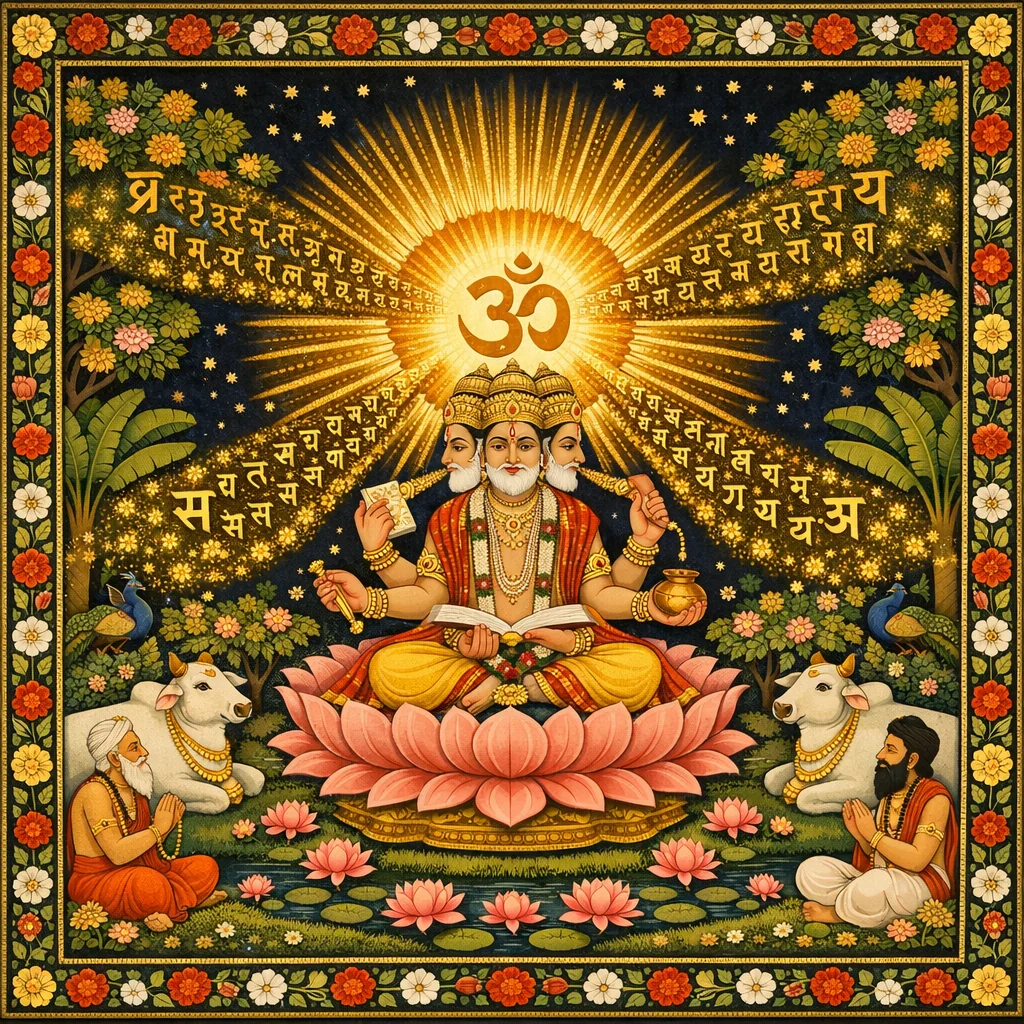
Continuing the account of cosmic unfolding under kāla, Maitreya shifts from the Lord’s time-feature to Brahmā’s visarga—how secondary creation proceeds and is regulated. Brahmā first produces misleading conditions (moha-like nescience and its derivatives), feels revulsion, and re-centers himself through meditation. He then creates the four Kumāras, who refuse progeny due to Vāsudeva-bhakti and liberation-oriented renunciation, provoking Brahmā’s restrained anger that manifests as Rudra. Brahmā assigns Rudra names, abodes, and Rudrāṇīs; Rudra’s furious progeny threaten cosmic stability, so Brahmā redirects him to tapas, establishing restraint as a cosmic necessity. Brahmā then generates the ten mind-born sons (including Nārada) and describes how dharma/adharma and various impulses arise from his body—illustrating how psychophysical tendencies enter the cosmos. A moral crisis follows with Vāk’s episode, where Brahmā is corrected by his sons and abandons that body, which becomes darkness/fog—teaching governance through shame and correction. The chapter culminates in the manifestation of the four Vedas from Brahmā’s mouths, the subsidiary sciences, sacrifices, varṇāśrama duties, meters, phonetics, and oṁkāra—presenting śabda as the organizing principle of reality. Finally, to increase population, Brahmā differentiates into Svāyambhuva Manu and Śatarūpā, whose lineage (Priyavrata, Uttānapāda, and daughters) sets the narrative bridge into subsequent genealogies and the Devahūti–Kardama–Kapila arc.
Shlokas
Verse 1
मैत्रेय उवाच इति ते वर्णित: क्षत्त: कालाख्य: परमात्मन: । महिमा वेदगर्भोऽथ यथास्राक्षीन्निबोध मे ॥ १ ॥
Śrī Maitreya said: O learned Vidura, so far I have explained to you the glories of the form of the Supreme Personality of Godhead in His feature of kāla. Now you can hear from me about the creation of Brahmā, the reservoir of all Vedic knowledge.
Verse 2
ससर्जाग्रेऽन्धतामिस्रमथ तामिस्रमादिकृत् । महामोहं च मोहं च तमश्चाज्ञानवृत्तय: ॥ २ ॥
Brahmā first created the nescient engagements like self-deception, the sense of death, anger after frustration, the sense of false ownership, and the illusory bodily conception, or forgetfulness of one’s real identity.
Verse 3
दृष्ट्वा पापीयसीं सृष्टिं नात्मानं बह्वमन्यत । भगवद्ध्यानपूतेन मनसान्यां ततोऽसृजत् ॥ ३ ॥
Seeing such a misleading creation as a sinful task, Brahmā did not feel much pleasure in his activity, and therefore he purified himself by meditation on the Personality of Godhead. Then he began another term of creation.
Verse 4
सनकं च सनन्दं च सनातनमथात्मभू: । सनत्कुमारं च मुनीन्निष्क्रियानूर्ध्वरेतस: ॥ ४ ॥
In the beginning, Brahmā created four great sages named Sanaka, Sananda, Sanātana and Sanat-kumāra. All of them were unwilling to adopt materialistic activities because they were highly elevated due to their semen’s flowing upwards.
Verse 5
तान् बभाषे स्वभू: पुत्रान् प्रजा: सृजत पुत्रका: । तन्नैच्छन्मोक्षधर्माणो वासुदेवपरायणा: ॥ ५ ॥
Brahmā spoke to his sons after generating them. “My dear sons,” he said, “now generate progeny.” But due to their being attached to Vāsudeva, the Supreme Personality of Godhead, they aimed at liberation, and therefore they expressed their unwillingness.
Verse 6
सोऽवध्यात: सुतैरेवं प्रत्याख्यातानुशासनै: । क्रोधं दुर्विषहं जातं नियन्तुमुपचक्रमे ॥ ६ ॥
On the refusal of the sons to obey the order of their father, there was much anger generated in the mind of Brahmā, which he tried to control and not express.
Verse 7
धिया निगृह्यमाणोऽपि भ्रुवोर्मध्यात्प्रजापते: । सद्योऽजायत तन्मन्यु: कुमारो नीललोहित: ॥ ७ ॥
Although he tried to curb his anger, it came out from between his eyebrows, and a child mixed blue and red was immediately generated.
Verse 8
स वै रुरोद देवानां पूर्वजो भगवान् भव: । नामानि कुरु मे धात: स्थानानि च जगद्गुरो ॥ ८ ॥
After his birth he began to cry: O destiny maker, teacher of the universe, kindly designate my name and place.
Verse 9
इति तस्य वच: पाद्मो भगवान् परिपालयन् । अभ्यधाद्भद्रया वाचा मा रोदीस्तत्करोमि ते ॥ ९ ॥
The all-powerful Brahmā, who was born from the lotus flower, pacified the boy with gentle words, accepting his request, and said: Do not cry. I shall certainly do as you desire.
Verse 10
यदरोदी: सुरश्रेष्ठ सोद्वेग इव बालक: । ततस्त्वामभिधास्यन्ति नाम्ना रुद्र इति प्रजा: ॥ १० ॥
Thereafter Brahmā said: O chief of the demigods, you shall be called by the name Rudra by all people because you have so anxiously cried.
Verse 11
हृदिन्द्रियाण्यसुर्व्योम वायुरग्निर्जलं मही । सूर्यश्चन्द्रस्तपश्चैव स्थानान्यग्रे कृतानि ते ॥ ११ ॥
My dear boy, I have already selected the following places for your residence: the heart, the senses, the air of life, the sky, the air, the fire, the water, the earth, the sun, the moon and austerity.
Verse 12
मन्युर्मनुर्महिनसो महाञ्छिव ऋतध्वज: । उग्ररेता भव: कालो वामदेवो धृतव्रत: ॥ १२ ॥
Lord Brahmā said: My dear boy Rudra, you have eleven other names: Manyu, Manu, Mahinasa, Mahān, Śiva, Ṛtadhvaja, Ugraretā, Bhava, Kāla, Vāmadeva and Dhṛtavrata.
Verse 13
धीर्धृतिरसलोमा च नियुत्सर्पिरिलाम्बिका । इरावती स्वधा दीक्षा रुद्राण्यो रुद्र ते स्त्रिय: ॥ १३ ॥
O Rudra, you also have eleven wives, called the Rudrāṇīs, and they are as follows: Dhī, Dhṛti, Rasalā, Umā, Niyut, Sarpi, Ilā, Ambikā, Irāvatī, Svadhā and Dīkṣā.
Verse 14
गृहाणैतानि नामानि स्थानानि च सयोषण: । एभि: सृज प्रजा बह्वी: प्रजानामसि यत्पति: ॥ १४ ॥
My dear boy, you may now accept all the names and places designated for you and your different wives, and since you are now one of the masters of the living entities, you may increase the population on a large scale.
Verse 15
इत्यादिष्ट: स्वगुरुणा भगवान्नीललोहित: । सत्त्वाकृतिस्वभावेन ससर्जात्मसमा: प्रजा: ॥ १५ ॥
The most powerful Rudra, whose bodily color was blue mixed with red, created many offspring exactly resembling him in features, strength and furious nature.
Verse 16
रुद्राणां रुद्रसृष्टानां समन्ताद् ग्रसतां जगत् । निशाम्यासंख्यशो यूथान् प्रजापतिरशङ्कत ॥ १६ ॥
The sons and grandsons generated by Rudra were unlimited in number, and when they assembled together they attempted to devour the entire universe. When Brahmā, the father of the living entities, saw this, he became afraid of the situation.
Verse 17
अलं प्रजाभि: सृष्टाभिरीदृशीभि: सुरोत्तम । मया सह दहन्तीभिर्दिशश्चक्षुर्भिरुल्बणै: ॥ १७ ॥
Brahmā told Rudra: O best among the demigods, there is no need for you to generate living entities of this nature. They have begun to devastate everything on all sides with the fiery flames from their eyes, and they have even attacked me.
Verse 18
तप आतिष्ठ भद्रं ते सर्वभूतसुखावहम् । तपसैव यथापूर्व स्रष्टा विश्वमिदं भवान् ॥ १८ ॥
My dear son, you had better situate yourself in penance, which is auspicious for all living entities and which will bring all benediction upon you. By penance only shall you be able to create the universe as it was before.
Verse 19
तपसैव परं ज्योतिर्भगवन्तमधोक्षजम् । सर्वभूतगुहावासमञ्जसा विन्दते पुमान् ॥ १९ ॥
By penance only can one even approach the Personality of Godhead, who is within the heart of every living entity and at the same time beyond the reach of all senses.
Verse 20
मैत्रेय उवाच एवमात्मभुवादिष्ट: परिक्रम्य गिरां पतिम् । बाढमित्यमुमामन्त्र्य विवेश तपसे वनम् ॥ २० ॥
Śrī Maitreya said: Thus Rudra, having been ordered by Brahmā, circumambulated his father, the master of the Vedas. Addressing him with words of assent, he entered the forest to perform austere penances.
Verse 21
अथाभिध्यायत: सर्गं दश पुत्रा: प्रजज्ञिरे । भगवच्छक्तियुक्तस्य लोकसन्तानहेतव: ॥ २१ ॥
Brahmā, who was empowered by the Supreme Personality of Godhead, thought of generating living entities and begot ten sons for the extension of the generations.
Verse 22
मरीचिरत्र्याङ्गिरसौ पुलस्त्य: पुलह: क्रतु: । भृगुर्वसिष्ठो दक्षश्च दशमस्तत्र नारद: ॥ २२ ॥
Marīci, Atri, Aṅgirā, Pulastya, Pulaha, Kratu, Bhṛgu, Vasiṣṭha, Dakṣa, and the tenth son, Nārada, were thus born.
Verse 23
उत्सङ्गान्नारदो जज्ञे दक्षोऽङ्गुष्ठात्स्वयम्भुव: । प्राणाद्वसिष्ठ: सञ्जातो भृगुस्त्वचि करात्क्रतु: ॥ २३ ॥
Nārada was born from the deliberation of Brahmā, which is the best part of the body. Vasiṣṭha was born from his breathing, Dakṣa from a thumb, Bhṛgu from his touch, and Kratu from his hand.
Verse 24
पुलहो नाभितो जज्ञे पुलस्त्य: कर्णयोऋर्षि: । अङ्गिरा मुखतोऽक्ष्णोऽत्रिर्मरीचिर्मनसोऽभवत् ॥ २४ ॥
Pulastya was generated from the ears, Aṅgirā from the mouth, Atri from the eyes, Marīci from the mind and Pulaha from the navel of Brahmā.
Verse 25
धर्म: स्तनाद्दक्षिणतो यत्र नारायण: स्वयम् । अधर्म पृष्ठतो यस्मान्मृत्युर्लोकभयङ्कर: ॥ २५ ॥
Religion was manifested from the breast of Brahmā, wherein is seated the Supreme Personality of Godhead Nārāyaṇa, and irreligion appeared from his back, where horrible death takes place for the living entity.
Verse 26
हृदि कामो भ्रुव: क्रोधो लोभश्चाधरदच्छदात् । आस्याद्वाक्सिन्धवो मेढ्रान्निऋर्ति: पायोरघाश्रय: ॥ २६ ॥
Lust and desire became manifested from the heart of Brahmā, anger from between his eyebrows, greed from between his lips, the power of speaking from his mouth, the ocean from his penis, and low and abominable activities from his anus, the source of all sins.
Verse 27
छायाया: कर्दमो जज्ञे देवहूत्या: पति: प्रभु: । मनसो देहतश्चेदं जज्ञे विश्वकृतो जगत् ॥ २७ ॥
Sage Kardama, husband of the great Devahūti, was manifested from the shadow of Brahmā. Thus all became manifested from either the body or the mind of Brahmā.
Verse 28
वाचं दुहितरं तन्वीं स्वयम्भूर्हरतीं मन: । अकामां चकमे क्षत्त: सकाम इति न: श्रुतम् ॥ २८ ॥
O Vidura, we have heard that Brahmā had a daughter named Vāk who was born from his body and who attracted his mind toward sex, although she was not sexually inclined towards him.
Verse 29
तमधर्मे कृतमतिं विलोक्य पितरं सुता: । मरीचिमुख्या मुनयो विश्रम्भात्प्रत्यबोधयन् ॥ २९ ॥
Thus, finding their father so deluded in an act of immorality, the sages headed by Marīci, all sons of Brahmā, spoke as follows with great respect.
Verse 30
नैतत्पूर्वै: कृतं त्वद्ये न करिष्यन्ति चापरे । यस्त्वं दुहितरं गच्छेरनिगृह्याङ्गजं प्रभु: ॥ ३० ॥
O father, this performance in which you are endeavoring to complicate yourself was never attempted by any other Brahmā, nor by anyone else, nor by you in previous kalpas, nor will anyone dare to attempt it in the future. You are the supreme being in the universe, so how is it that you want to have sex with your daughter and cannot control your desire?
Verse 31
तेजीयसामपि ह्येतन्न सुश्लोक्यं जगद्गुरो । यद्वृत्तमनुतिष्ठन् वै लोक: क्षेमाय कल्पते ॥ ३१ ॥
Even though you are the most powerful being, this act does not suit you because your character is followed for spiritual improvement by people in general.
Verse 32
तस्मै नमो भगवते य इदं स्वेन रोचिषा । आत्मस्थं व्यञ्जयामास स धर्मं पातुमर्हति ॥ ३२ ॥
Let us offer our respectful obeisances unto the Personality of Godhead, who, by His own effulgence, while situated in Himself, has manifested this cosmos. May He also protect religion for all goodness.
Verse 33
स इत्थं गृणत: पुत्रान् पुरो दृष्ट्वा प्रजापतीन् । प्रजापतिपतिस्तन्वं तत्याज व्रीडितस्तदा । तां दिशो जगृहुर्घोरां नीहारं यद्विदुस्तम: ॥ ३३ ॥
The father of all Prajāpatis, Brahmā, thus seeing all his Prajāpati sons speaking in that way, became very much ashamed and at once gave up the body he had accepted. Later that body appeared in all directions as the dangerous fog in darkness.
Verse 34
कदाचिद् ध्यायत: स्रष्टुर्वेदा आसंश्चतुर्मुखात् । कथं स्रक्ष्याम्यहं लोकान् समवेतान् यथा पुरा ॥ ३४ ॥
Once upon a time, when Brahmā was thinking of how to create the worlds as in the past millennium, the four Vedas, which contain all varieties of knowledge, became manifested from his four mouths.
Verse 35
चातुर्होत्रं कर्मतन्त्रमुपवेदनयै: सह । धर्मस्य पादाश्चत्वारस्तथैवाश्रमवृत्तय: ॥ ३५ ॥
The four kinds of paraphernalia for conducting the fire sacrifice became manifest: the performer [the chanter], the offerer, the fire, and the action performed in terms of the supplementary Vedas. Also the four principles of religiosity [truth, austerity, mercy and cleanliness] and the duties in the four social orders all became manifest.
Verse 36
विदुर उवाच स वै विश्वसृजामीशो वेदादीन् मुखतोऽसृजत् । यद् यद् येनासृजद् देवस्तन्मे ब्रूहि तपोधन ॥ ३६ ॥
Vidura said: O great sage whose only wealth is penance, kindly explain to me how and with whose help Brahmā established the Vedic knowledge which emanated from his mouth.
Verse 37
मैत्रेय उवाच ऋग्यजु:सामाथर्वाख्यान् वेदान् पूर्वादिभिर्मुखै: । शास्त्रमिज्यां स्तुतिस्तोमं प्रायश्चित्तं व्यधात्क्रमात् ॥ ३७ ॥
Maitreya said: Beginning from the front face of Brahmā, gradually the four Vedas — Ṛk, Yajur, Sāma and Atharva — became manifest. Thereafter, Vedic hymns which had not been pronounced before, priestly rituals, the subject matters of the recitation, and transcendental activities were all established, one after another.
Verse 38
आयुर्वेदं धनुर्वेदं गान्धर्वं वेदमात्मन: । स्थापत्यं चासृजद् वेदं क्रमात्पूर्वादिभिर्मुखै: ॥ ३८ ॥
He also created the medical science, military art, musical art and architectural science, all from the Vedas. They all emanated one after another, beginning from the front face.
Verse 39
इतिहासपुराणानि पञ्चमं वेदमीश्वर: । सर्वेभ्य एव वक्त्रेभ्य: ससृजे सर्वदर्शन: ॥ ३९ ॥
Then he created the fifth Veda — the Purāṇas and the histories — from all his mouths, since he could see all the past, present and future.
Verse 40
षोडश्युक्थौ पूर्ववक्त्रात्पुरीष्यग्निष्टुतावथ । आप्तोर्यामातिरात्रौ च वाजपेयं सगोसवम् ॥ ४० ॥
All the different varieties of fire sacrifices [ṣoḍaśī, uktha, purīṣi, agniṣṭoma, āptoryāma, atirātra, vājapeya and gosava] became manifested from the eastern mouth of Brahmā.
Verse 41
विद्या दानं तप: सत्यं धर्मस्येति पदानि च । आश्रमांश्च यथासंख्यमसृजत्सह वृत्तिभि: ॥ ४१ ॥
Education, charity, penance and truth are said to be the four legs of religion, and to learn this there are four orders of life with different classifications of castes according to vocation. Brahmā created all these in systematic order.
Verse 42
सावित्रं प्राजापत्यं च ब्राह्मं चाथ बृहत्तथा । वार्तासञ्चयशालीनशिलोञ्छ इति वै गृहे ॥ ४२ ॥
Then the thread ceremony for the twice-born was inaugurated, as were the rules to be followed for at least one year after acceptance of the Vedas, rules for observing complete abstinence from sex life, vocations in terms of Vedic injunctions, various professional duties in household life, and the method of maintaining a livelihood without anyone’s cooperation by picking up rejected grains.
Verse 43
वैखानसा वालखिल्यौदुम्बरा: फेनपा वने । न्यासे कुटीचक: पूर्वं बह्वोदो हंसनिष्क्रियौ ॥ ४३ ॥
The four divisions of retired life are the vaikhānasas, vālakhilyas, audumbaras and phenapas. The four divisions of the renounced order of life are the kuṭīcakas, bahvodas, haṁsas and niṣkriyas. All these were manifested from Brahmā.
Verse 44
आन्वीक्षिकी त्रयी वार्ता दण्डनीतिस्तथैव च । एवं व्याहृतयश्वासन् प्रणवो ह्यस्य दहृत: ॥ ४४ ॥
The science of logical argument, the Vedic goals of life, and also law and order, moral codes and the celebrated hymns bhūḥ, bhuvaḥ and svaḥ all became manifested from the mouths of Brahmā, and the praṇava oṁkāra was manifested from his heart.
Verse 45
तस्योष्णिगासील्लोमभ्यो गायत्री च त्वचो विभो: । त्रिष्टुम्मांसात्स्नुतोऽनुष्टुब्जगत्यस्थ्न: प्रजापते: ॥ ४५ ॥
Thereafter the art of literary expression, uṣṇik, was generated from the hairs on the body of the almighty Prajāpati. The principal Vedic hymn, gāyatrī, was generated from the skin, triṣṭup from the flesh, anuṣṭup from the veins, and jagatī from the bones of the lord of the living entities.
Verse 46
मज्जाया: पङ्क्तिरुत्पन्ना बृहती प्राणतोऽभवत् ॥ ४६ ॥
The art of writing verse, paṅkti, became manifested from the bone marrow, and that of bṛhatī, another type of verse, was generated from the life-breath of the lord of the living entities.
Verse 47
स्पर्शस्तस्याभवज्जीव: स्वरो देह उदाहृत । ऊष्माणमिन्द्रियाण्याहुरन्त:स्था बलमात्मन: । स्वरा: सप्त विहारेण भवन्ति स्म प्रजापते: ॥ ४७ ॥
Brahmā’s soul was manifested as the touch alphabets, his body as the vowels, his senses as the sibilant alphabets, his strength as the intermediate alphabets and his sensual activities as the seven notes of music.
Verse 48
शब्दब्रह्मात्मनस्तस्य व्यक्ताव्यक्तात्मन: पर: । ब्रह्मावभाति विततो नानाशक्त्युपबृंहित: ॥ ४८ ॥
Brahmā is the personal representation of the Supreme Personality of Godhead as the source of transcendental sound and is therefore above the conception of manifested and unmanifested. Brahmā is the complete form of the Absolute Truth and is invested with multifarious energies.
Verse 49
ततोऽपरामुपादाय स सर्गाय मनो दधे ॥ ४९ ॥
Thereafter Brahmā accepted another body, in which sex life was not forbidden, and thus he engaged himself in the matter of further creation.
Verse 50
ऋषीणां भूरिवीर्याणामपि सर्गमविस्तृतम् । ज्ञात्वा तद्धृदये भूयश्चिन्तयामास कौरव ॥ ५० ॥
O son of the Kurus, when Brahmā saw that in spite of the presence of sages of great potency there was no sufficient increase in population, he seriously began to consider how the population could be increased.
Verse 51
अहो अद्भुतमेतन्मे व्यापृतस्यापि नित्यदा । न ह्येधन्ते प्रजा नूनं दैवमत्र विघातकम् ॥ ५१ ॥
Brahmā thought to himself: Alas, it is wonderful that in spite of my being scattered all over, there is still insufficient population throughout the universe. There is no other cause for this misfortune but destiny.
Verse 52
एवं युक्तकृतस्तस्य दैवञ्चावेक्षतस्तदा । कस्य रूपमभूद् द्वेधा यत्कायमभिचक्षते ॥ ५२ ॥
While he was thus absorbed in contemplation and was observing the supernatural power, two other forms were generated from his body. They are still celebrated as the body of Brahmā.
Verse 53
ताभ्यां रूपविभागाभ्यां मिथुनं समपद्यत ॥ ५३ ॥
The two newly separated bodies united together in a sexual relationship.
Verse 54
यस्तु तत्र पुमान् सोऽभून्मनु: स्वायम्भुव: स्वराट् । स्त्री याऽसीच्छतरूपाख्या महिष्यस्य महात्मन: ॥ ५४ ॥
Out of them, the one who had the male form became known as the Manu named Svāyambhuva, and the woman became known as Śatarūpā, the queen of the great soul Manu.
Verse 55
तदा मिथुनधर्मेण प्रजा ह्येधाम्बभूविरे ॥ ५५ ॥
Thereafter, by sex indulgence, they gradually increased generations of population one after another.
Verse 56
स चापि शतरूपायां पञ्चापत्यान्यजीजनत् । प्रियव्रतोत्तानपादौ तिस्र: कन्याश्च भारत । आकूतिर्देवहूतिश्च प्रसूतिरिति सत्तम ॥ ५६ ॥
O son of Bharata, in due course of time he [Manu] begot in Śatarūpā five children — two sons, Priyavrata and Uttānapāda, and three daughters, Ākūti, Devahūti and Prasūti.
Verse 57
आकूतिं रुचये प्रादात्कर्दमाय तु मध्यमाम् । दक्षायादात्प्रसूतिं च यत आपूरितं जगत् ॥ ५७ ॥
The father, Manu, handed over his first daughter, Ākūti, to the sage Ruci, the middle daughter, Devahūti, to the sage Kardama, and the youngest, Prasūti, to Dakṣa. From them, all the world filled with population.
Frequently Asked Questions
Because they were niṣkāma and Vāsudeva-parāyaṇa—fixed in liberation and devotion—with their vital energy described as flowing upward (ūrdhva-retas), indicating mastery over procreative impulse and commitment to renunciation rather than world-expansion.
Rudra manifests from Brahmā’s controlled yet irrepressible anger, emerging from between Brahmā’s eyebrows. The episode teaches that even cosmic administration must manage disruptive energies; Rudra embodies transformative force that requires guidance toward tapas rather than unchecked proliferation.
Brahmā gives Rudra eleven names—Manyu, Manu, Mahinasa, Mahān, Śiva, Ṛtadhvaja, Ugraretā, Bhava, Kāla, Vāmadeva, Dhṛtavrata—indicating multiple functions: wrath/transformation (Manyu), auspiciousness (Śiva), time/destruction (Kāla), fierce potency (Ugraretā), and steadfast vows (Dhṛtavrata), among others.
Rudra’s offspring were unlimited and violently destructive, attempting to devour the universe and even attacking Brahmā. Brahmā therefore redirected Rudra to penance, showing that creation must be balanced by restraint (tapas) to preserve cosmic order (poṣaṇa/dharma).
Marīci, Atri, Aṅgirā, Pulastya, Pulaha, Kratu, Bhṛgu, Vasiṣṭha, Dakṣa, and Nārada. They function as principal Prajāpatis/ṛṣis through whom lineages, disciplines, and further creation expand in subsequent narratives.
The narrative depicts a lapse in propriety (desire toward his daughter Vāk), corrected by Brahmā’s sons. Brahmā abandons that body, which becomes fog/darkness, underscoring that even the highest administrator is accountable to dharma and that moral deviation produces obscuration in the world.
The Ṛk, Yajur, Sāma, and Atharva Vedas manifest from Brahmā’s four mouths; then rituals, hymns, and supplementary knowledge unfold sequentially. Upavedas (medicine, military, music, architecture) and the ‘fifth Veda’ (Purāṇas/Itihāsas) also emerge, presenting revelation as the structuring intelligence behind society and sacrifice.
Oṁkāra (praṇava) is portrayed as the seed of transcendental sound (śabda-brahma) and the concentrated essence of Vedic revelation, linked to the inner core (heart) where the Lord as Paramātmā is intuited—thereby grounding external ritual and language in inner realization.
They are two forms differentiated from Brahmā to enable regulated population growth when ascetic progenitors did not expand the species sufficiently. Their union establishes the human genealogical stream foundational to later histories, including the Devahūti–Kardama marriage leading to Kapila.