Adhyaya 4
Uddhava’s Departure to Badarikāśrama and Vidura’s Turn Toward Maitreya
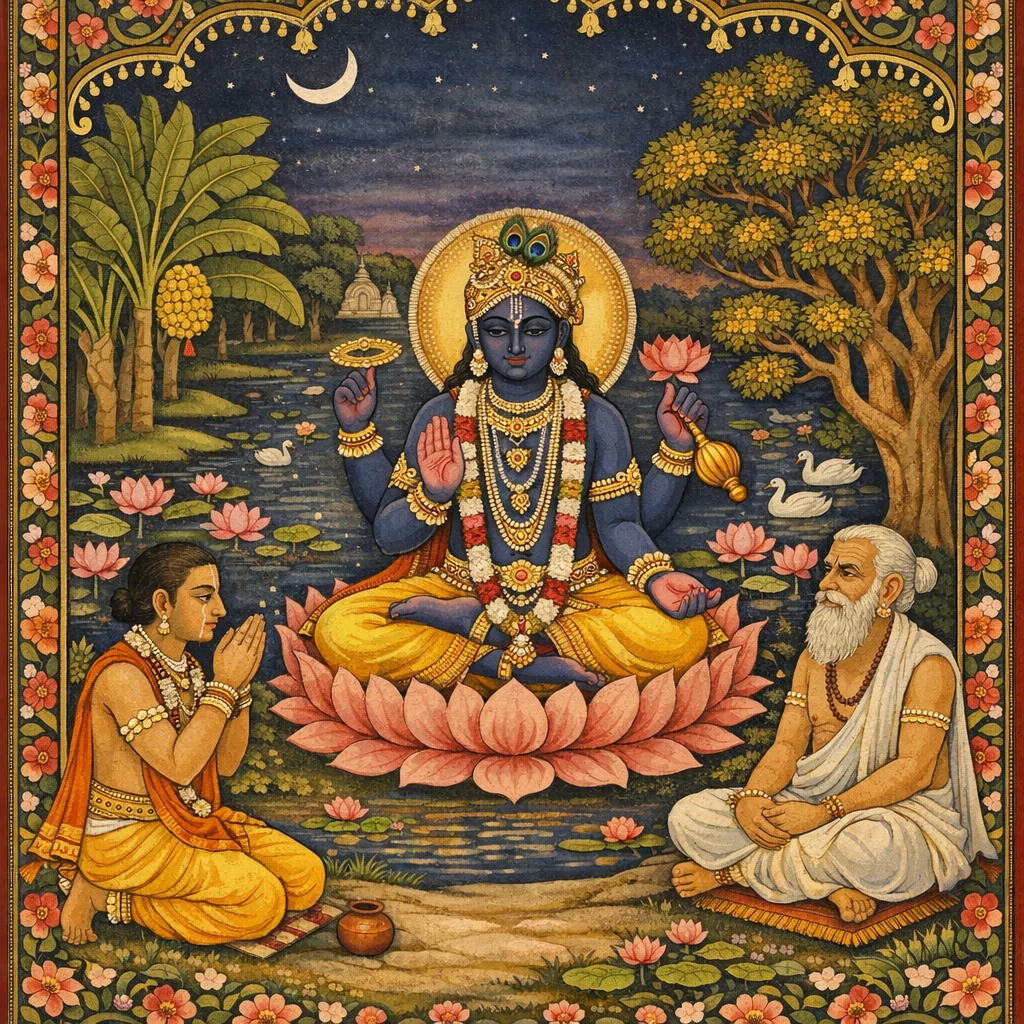
This chapter opens in the aftermath of the brāhmaṇas’ curse, as the Vṛṣṇis and Bhojas, intoxicated, quarrel violently and destroy one another—an outward pretext for the Lord’s own intent to withdraw His dynasty from the earth. Śrī Kṛṣṇa, foreseeing the end by His internal potency, sits in solitude on the Sarasvatī’s bank. Uddhava, unable to bear separation, follows and beholds the Lord’s four-armed, serene form. The sage Maitreya arrives providentially, and the Lord honors Uddhava, recalling Uddhava’s ancient desire for divine association and granting him permission to go to Vaikuṇṭha. Uddhava, however, requests the confidential knowledge earlier spoken to Brahmā; the Lord instructs him on His transcendental position (foreshadowing the Uddhava-gītā framework). Returning to Vidura, Uddhava proceeds to Badarikāśrama as ordered, while Vidura—grieving yet steadied by knowledge—asks for teachings. Uddhava directs him to Maitreya, thereby linking this chapter to the next phase: Maitreya’s extended exposition on creation, dharma, and devotion.
Shlokas
Verse 1
उद्धव उवाच अथ ते तदनुज्ञाता भुक्त्वा पीत्वा च वारुणीम् । तया विभ्रंशितज्ञाना दुरुक्तैर्मर्म पस्पृश: ॥ १ ॥
Thereafter, all of them [the descendants of Vṛṣṇi and Bhoja], being permitted by the brāhmaṇas, partook of the remnants of prasāda and also drank liquor made of rice. By drinking they all became delirious, and, bereft of knowledge, they touched the cores of each other’s hearts with harsh words.
Verse 2
तेषां मैरेयदोषेण विषमीकृतचेतसाम् । निम्लोचति रवावासीद्वेणूनामिव मर्दनम् ॥ २ ॥
As by the friction of bamboos destruction takes place, so also, at sunset, by the interaction of the faults of intoxication, all their minds became unbalanced, and destruction took place.
Verse 3
भगवान् स्वात्ममायाया गतिं तामवलोक्य स: । सरस्वतीमुपस्पृश्य वृक्षमूलमुपाविशत् ॥ ३ ॥
The Personality of Godhead, Lord Śrī Kṛṣṇa, after foreseeing the end [of His family] by His internal potency, went to the bank of the river Sarasvatī, sipped water, and sat down underneath a tree.
Verse 4
अहं चोक्तो भगवता प्रपन्नार्तिहरेण ह । बदरीं त्वं प्रयाहीति स्वकुलं संजिहीर्षुणा ॥ ४ ॥
The Lord is the vanquisher of the distresses of one who is surrendered unto Him. Thus He who desired to destroy His family told me previously to go to Badarikāśrama.
Verse 5
तथापि तदभिप्रेतं जानन्नहमरिन्दम । पृष्ठतोऽन्वगमं भर्तु: पादविश्लेषणाक्षम: ॥ ५ ॥
Yet in spite of my knowing His desire [to destroy the dynasty], O Arindama [Vidura], I followed Him because it was impossible for me to bear separation from the lotus feet of the master.
Verse 6
अद्राक्षमेकमासीनं विचिन्वन् दयितं पतिम् । श्रीनिकेतं सरस्वत्यां कृतकेतमकेतनम् ॥ ६ ॥
Thus following, I saw my patron and master [Lord Śrī Kṛṣṇa] sitting alone and deeply thinking, taking shelter on the bank of the river Sarasvatī although He is the shelter of the goddess of fortune.
Verse 7
श्यामावदातं विरजं प्रशान्तारुणलोचनम् । दोर्भिश्चतुर्भिर्विदितं पीतकौशाम्बरेण च ॥ ७ ॥
The Lord’s body is blackish, but is eternal, full of bliss and knowledge, and very, very beautiful. His eyes are always peaceful, and they are reddish like the rising morning sun. I could immediately recognize Him as the Supreme Personality of Godhead by His four hands, different symbolic representations, and yellow silk garments.
Verse 8
वाम ऊरावधिश्रित्य दक्षिणाङ्घ्रि सरोरुहम् । अपाश्रितार्भकाश्वत्थमकृशं त्यक्तपिप्पलम् ॥ ८ ॥
The Lord was sitting, taking rest against a young banyan tree, with His right lotus foot on His left thigh, and although He had left all household comforts, He looked quite cheerful in that posture.
Verse 9
तस्मिन्महाभागवतो द्वैपायनसुहृत्सखा । लोकाननुचरन् सिद्ध आससाद यदृच्छया ॥ ९ ॥
At that time, after traveling in many parts of the world, Maitreya, a great devotee of the Lord and a friend and well-wisher of the great sage Kṛṣṇa-dvaipāyana Vyāsa, reached that spot out of his own perfect accord.
Verse 10
तस्यानुरक्तस्य मुनेर्मुकुन्द: प्रमोदभावानतकन्धरस्य । आशृण्वतो मामनुरागहास- समीक्षया विश्रमयन्नुवाच ॥ १० ॥
Maitreya Muni was greatly attached to Him [the Lord], and he was listening in a pleasing attitude, with his shoulder lowered. With a smile and a particular glance upon me, having allowed me to rest, the Lord spoke as follows.
Verse 11
श्री भगवानुवाच वेदाहमन्तर्मनसीप्सितं ते ददामि यत्तद् दुरवापमन्यै: । सत्रे पुरा विश्वसृजां वसूनां मत्सिद्धिकामेन वसो त्वयेष्ट: ॥ ११ ॥
O Vasu, I know from within your mind what you desired in the days of yore when the Vasus and other demigods responsible for expanding the universal affairs performed sacrifices. You particularly desired to achieve My association. This is very difficult for others to obtain, but I award it unto you.
Verse 12
स एष साधो चरमो भवाना- मासादितस्ते मदनुग्रहो यत् । यन्मां नृलोकान् रह उत्सृजन्तं दिष्टया ददृश्वान् विशदानुवृत्त्या ॥ १२ ॥
O honest one, your present life is the last and the supermost because in this term of life you have been awarded My ultimate favor. Now you can go to My transcendental abode, Vaikuṇṭha, by leaving this universe of conditioned living entities. Your visit to Me in this lonely place because of your pure and unflinching devotional service is a great boon for you.
Verse 13
पुरा मया प्रोक्तमजाय नाभ्ये पद्मे निषण्णाय ममादिसर्गे । ज्ञानं परं मन्महिमावभासं यत्सूरयो भागवतं वदन्ति ॥ १३ ॥
O Uddhava, in the lotus millennium in the days of yore, at the beginning of the creation, I spoke unto Brahmā, who is situated on the lotus that grows out of My navel, about My transcendental glories, which the great sages describe as Śrīmad-Bhāgavatam.
Verse 14
इत्यादृतोक्त: परमस्य पुंस: प्रतिक्षणानुग्रहभाजनोऽहम् । स्नेहोत्थरोमा स्खलिताक्षरस्तं मुञ्चञ्छुच: प्राञ्जलिराबभाषे ॥ १४ ॥
Uddhava said: O Vidura, when I was thus favored at every moment by the Supreme Personality of Godhead and addressed by Him with great affection, my words failed in tears, and the hairs on my body erupted. After smearing my tears, I, with folded hands, spoke like this.
Verse 15
को न्वीश ते पादसरोजभाजां सुदुर्लभोऽर्थेषु चतुर्ष्वपीह । तथापि नाहं प्रवृणोमि भूमन् भवत्पदाम्भोजनिषेवणोत्सुक: ॥ १५ ॥
O my Lord, devotees who engage in the transcendental loving service of Your lotus feet have no difficulty in achieving anything within the realm of the four principles of religiosity, economic development, sense gratification and liberation. But, O great one, as far as I am concerned, I have preferred only to engage in the loving service of Your lotus feet.
Verse 16
कर्माण्यनीहस्य भवोऽभवस्य ते दुर्गाश्रयोऽथारिभयात्पलायनम् । कालात्मनो यत्प्रमदायुताश्रम: स्वात्मन्रते: खिद्यति धीर्विदामिह ॥ १६ ॥
My Lord, even the learned sages become disturbed in their intelligence when they see that Your Greatness engages in fruitive work although You are free from all desires, that You take birth although You are unborn, that You flee out of fear of the enemy and take shelter in a fort although You are the controller of invincible time, and that You enjoy householder life surrounded by many women although You enjoy in Your Self.
Verse 17
मन्त्रेषु मां वा उपहूय यत्त्व- मकुण्ठिताखण्डसदात्मबोध: । पृच्छे: प्रभो मुग्ध इवाप्रमत्त- स्तन्नो मनो मोहयतीव देव ॥ १७ ॥
O my Lord, Your eternal Self is never divided by the influence of time, and there is no limitation to Your perfect knowledge. Thus You were sufficiently able to consult with Yourself, yet You called upon me for consultation, as if bewildered, although You are never bewildered. And this act of Yours bewilders me.
Verse 18
ज्ञानं परं स्वात्मरह:प्रकाशं प्रोवाच कस्मै भगवान् समग्रम् । अपि क्षमं नो ग्रहणाय भर्त- र्वदाञ्जसा यद् वृजिनं तरेम ॥ १८ ॥
My Lord, kindly explain to us, if You think us competent to receive it, that transcendental knowledge which gives enlightenment about Yourself and which You explained before to Brahmājī.
Verse 19
इत्यावेदितहार्दाय मह्यं स भगवान् पर: । आदिदेशारविन्दाक्ष आत्मन: परमां स्थितिम् ॥ १९ ॥
When I thus expressed my heartfelt desires unto the Supreme Personality of Godhead, the lotus-eyed Lord instructed me about His transcendental situation.
Verse 20
स एवमाराधितपादतीर्था- दधीततत्त्वात्मविबोधमार्ग: प्रणम्य पादौ परिवृत्य देव- मिहागतोऽहं विरहातुरात्मा ॥ २० ॥
I have studied the path of understanding self-knowledge from my spiritual master, the Personality of Godhead, and thus after circumambulating Him I have come to this place, very much aggrieved due to separation.
Verse 21
सोऽहं तद्दर्शनाह्लादवियोगार्तियुत: प्रभो । गमिष्ये दयितं तस्य बदर्याश्रममण्डलम् ॥ २१ ॥
My dear Vidura, now I am mad for want of the pleasure of seeing Him, and just to mitigate this I am now proceeding to Badarikāśrama in the Himālayas for association, as I have been instructed by Him.
Verse 22
यत्र नारायणो देवो नरश्च भगवानृषि: । मृदु तीव्रं तपो दीर्घं तेपाते लोकभावनौ ॥ २२ ॥
There in Badarikāśrama the Personality of Godhead, in His incarnation as the sages Nara and Nārāyaṇa, has been undergoing great penance since time immemorial for the welfare of all amiable living entities.
Verse 23
श्री शुक उवाच इत्युद्धवादुपाकर्ण्य सुहृदां दु:सहं वधम् । ज्ञानेनाशमयत्क्षत्ता शोकमुत्पतितं बुध: ॥ २३ ॥
Śrī Śukadeva Gosvāmī said: After hearing from Uddhava all about the annihilation of his friends and relatives, the learned Vidura pacified his overwhelming bereavement by dint of his transcendental knowledge.
Verse 24
स तं महाभागवतं व्रजन्तं कौरवर्षभ: । विश्रम्भादभ्यधत्तेदं मुख्यं कृष्णपरिग्रहे ॥ २४ ॥
While Uddhava, the chief and most confidential amongst the devotees of the Lord, was going away, Vidura, in affection and confidence, questioned him.
Verse 25
विदुर उवाच ज्ञानं परं स्वात्मरह:प्रकाशं यदाह योगेश्वर ईश्वरस्ते । वक्तुं भवान्नोऽर्हति यद्धि विष्णो- र्भृत्या: स्वभृत्यार्थकृतश्चरन्ति ॥ २५ ॥
Vidura said: O Uddhava, because the servants of Viṣṇu, the Lord, wander in the interest of serving others, it is quite fit that you kindly describe the self-knowledge with which you have been enlightened by the Lord Himself.
Verse 26
उद्धव उवाच ननु ते तत्त्वसंराध्य ऋषि: कौषारवोऽन्तिके । साक्षाद्भगवतादिष्टो मर्त्यलोकं जिहासता ॥ २६ ॥
Śrī Uddhava said: You may take lessons from the great learned sage Maitreya, who is nearby and who is worshipable for reception of transcendental knowledge. He was directly instructed by the Personality of Godhead while He was about to quit this mortal world.
Verse 27
श्री शुक उवाच इति सह विदुरेण विश्वमूर्ते- र्गुणकथया सुधयाप्लावितोरुताप: । क्षणमिव पुलिने यमस्वसुस्तां समुषित औपगविर्निशां ततोऽगात् ॥ २७ ॥
Śukadeva Gosvāmī said: O King, after thus discussing with Vidura the transcendental name, fame, qualities, etc., on the bank of the Yamunā, Uddhava was overwhelmed with great affliction. He passed the night as if it were a moment, and thereafter he went away.
Verse 28
राजोवाच निधनमुपगतेषु वृष्णिभोजे- ष्वधिरथयूथपयूथपेषु मुख्य: । स तु कथमवशिष्ट उद्धवो यद्धरि- रपि तत्यज आकृतिं त्र्यधीश: ॥ २८ ॥
The King inquired: At the end of the pastimes of the Lord of the three worlds, Śrī Kṛṣṇa, and after the disappearance of the members of the Vṛṣṇi and Bhoja dynasties, who were the best of the great commanders, why did Uddhava alone remain?
Verse 29
श्री शुक उवाच ब्रह्मशापापदेशेन कालेनामोघवाञ्छित: । संहृत्य स्वकुलं स्फीतं त्यक्ष्यन्देहमचिन्तयत् ॥ २९ ॥
Śukadeva Gosvāmī replied: My dear King, the cursing of the brāhmaṇas was only a plea, but the actual fact was the supreme desire of the Lord. He wanted to disappear from the face of the earth after dispatching His excessively numerous family members. He thought to Himself as follows.
Verse 30
अस्माल्लोकादुपरते मयि ज्ञानं मदाश्रयम् । अर्हत्युद्धव एवाद्धा सम्प्रत्यात्मवतां वर: ॥ ३० ॥
Now I shall leave the vision of this mundane world, and I see that Uddhava, the foremost of My devotees, is the only one who can be directly entrusted with knowledge about Me.
Verse 31
नोद्धवोऽण्वपि मन्न्यूनो यद्गुणैर्नार्दित: प्रभु: । अतो मद्वयुनं लोकं ग्राहयन्निह तिष्ठतु ॥ ३१ ॥
Uddhava is not inferior to Me in any way because he is never affected by the modes of material nature. Therefore he may remain in this world in order to disseminate specific knowledge of the Personality of Godhead.
Verse 32
एवं त्रिलोकगुरुणा सन्दिष्ट: शब्दयोनिना । बदर्याश्रममासाद्य हरिमीजे समाधिना ॥ ३२ ॥
Śukadeva Gosvāmī informed the King that Uddhava, being thus instructed by the Supreme Personality of Godhead, who is the source of all Vedic knowledge and the spiritual master of the three worlds, reached the pilgrimage site of Badarikāśrama and engaged himself there in trance to satisfy the Lord.
Verse 33
विदुरोऽप्युद्धवाच्छ्रुत्वा कृष्णस्य परमात्मन: । क्रीडयोपात्तदेहस्य कर्माणि श्लाघितानि च ॥ ३३ ॥
Vidura also heard from Uddhava about the appearance and disappearance of Lord Kṛṣṇa, the Supersoul, in the mortal world, which is a subject matter sought after with great perseverance by the great sages.
Verse 34
देहन्यासं च तस्यैवं धीराणां धैर्यवर्धनम् । अन्येषां दुष्करतरं पशूनां विक्लवात्मनाम् ॥ ३४ ॥
The Lord’s glorious acts and His acceptance of various transcendental forms for the performance of extraordinary pastimes in the mortal world are very difficult for anyone other than His devotees to understand, and for the beasts they are simply a mental disturbance.
Verse 35
आत्मानं च कुरुश्रेष्ठ कृष्णेन मनसेक्षितम् । ध्यायन् गते भागवते रुरोद प्रेमविह्वल: ॥ ३५ ॥
Understanding that he was remembered by Lord Kṛṣṇa [while quitting this world], Vidura began to cry loudly, overwhelmed by the ecstasy of love.
Verse 36
कालिन्द्या: कतिभि: सिद्ध अहोभिर्भरतर्षभ । प्रापद्यत स्व:सरितं यत्र मित्रासुतो मुनि: ॥ ३६ ॥
After passing a few days on the bank of the river Yamunā, Vidura, the self-realized soul, reached the bank of the Ganges, where the great sage Maitreya was situated.
Frequently Asked Questions
Śāstrically, the brāhmaṇas’ curse functions as nimitta (an apparent instrument), while the Lord’s desire is the primary cause. The episode establishes that Bhagavān’s līlā includes orderly withdrawal: when His earthly mission is complete, He removes even His own associates from mundane vision to prevent misuse of power and to conclude the narrative cycle. It also warns that pramāda (negligence) and mada (intoxication) amplify latent faults, leading to collective ruin—an ethical lesson embedded within divine orchestration.
Maitreya is a mahā-bhāgavata and a close associate within Vyāsa’s circle, who arrives to witness the Lord’s final manifest moments. Uddhava explicitly identifies Maitreya as directly instructed by the Lord at the time of His departure, making him uniquely qualified to transmit tattva (creation, the Lord’s governance, and devotional conclusions). This handoff establishes an authorized knowledge-line: Vidura’s questions will be answered not by speculation but by realized śruti-sāra in paramparā.