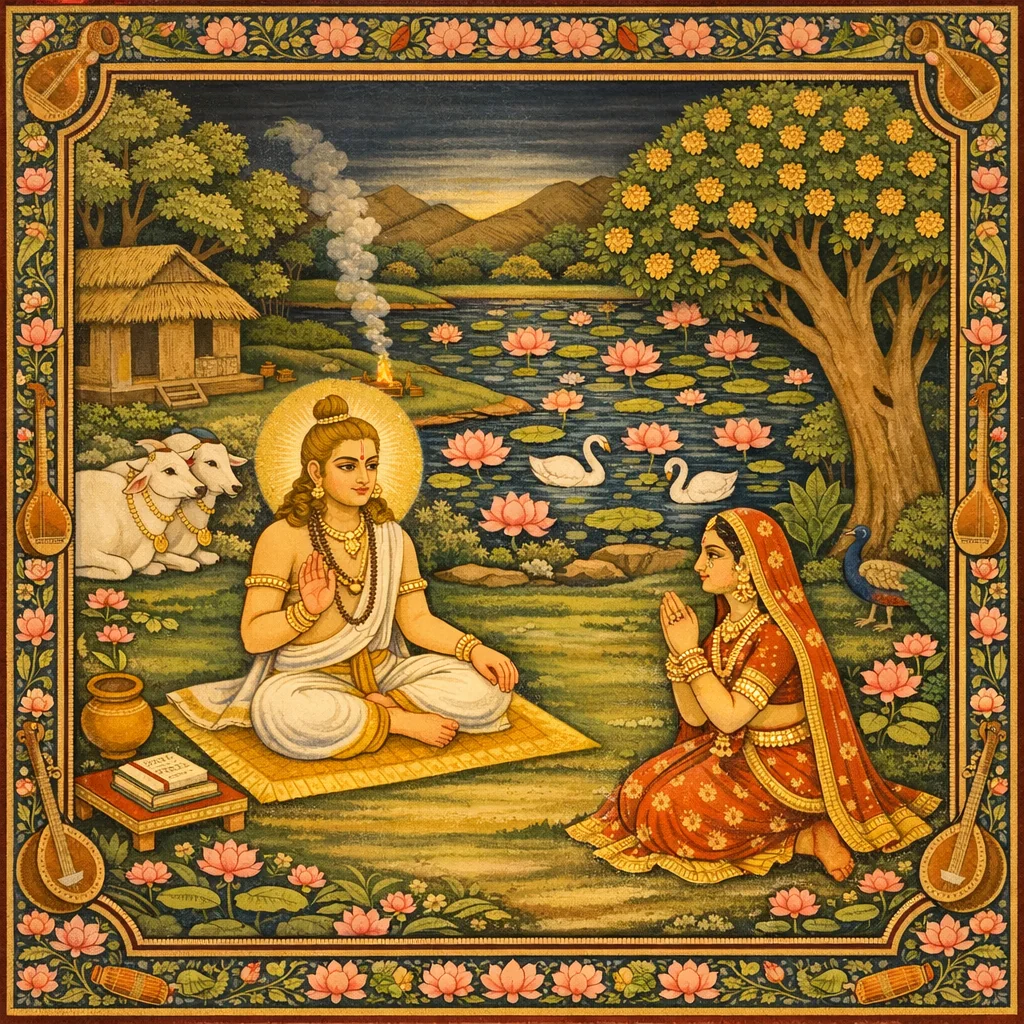
Adhyaya 25
Kapila’s Devotional Sāṅkhya: Sādhu-saṅga, Bhakti-yoga, and Fearlessness in the Supreme Shelter
Continuing the Vidura–Maitreya narration stream, Maitreya introduces the setting after Kardama Muni’s departure: Kapila remains by Bindu-sarovara to fulfill Devahūti’s spiritual need. Devahūti, recalling Brahmā’s assurance, confesses her distress under sense agitation and false ego and seeks the Lord as the sole deliverer from ignorance. Kapila responds by defining the highest yoga as that which connects jīva and Bhagavān, producing detachment from material dualities. He contrasts conditioned consciousness (guṇa-ākarṣaṇa) with liberated consciousness (Bhagavad-āśraya), emphasizing purification from lust and greed. The chapter then pivots to sādhu-lakṣaṇa and the transformative power of sādhu-saṅga: hearing and chanting about the Lord matures into fixed attraction and then genuine bhakti. Devahūti asks for the practical form of this yoga, and Kapila explains bhakti’s supremacy—dissolving the subtle body, granting liberation without separate endeavor, and making devotees desire only service. The discourse concludes with the Lord as the only fearless refuge: cosmic controllers act ‘out of fear’ of Him, and yogīs devoted to His feet attain perfection and His association even in this life—setting up deeper Sāṅkhya elaborations in subsequent chapters.
Shlokas
Verse 1
शौनक उवाच कपिलस्तत्त्वसंख्याता भगवानात्ममायया । जात: स्वयमज: साक्षादात्मप्रज्ञप्तये नृणाम् ॥ १ ॥
Śrī Śaunaka said: Although He is unborn, the Supreme Personality of Godhead took birth as Kapila Muni by His internal potency. He descended to disseminate transcendental knowledge for the benefit of the whole human race.
Verse 2
न ह्यस्य वर्ष्मण: पुंसां वरिम्ण: सर्वयोगिनाम् । विश्रुतौ श्रुतदेवस्य भूरि तृप्यन्ति मेऽसव: ॥ २ ॥
Śaunaka continued: There is no one who knows more than the Lord Himself. No one is more worshipable or more mature a yogī than He. He is therefore the master of the Vedas, and to hear about Him always is the actual pleasure of the senses.
Verse 3
यद्यद्विधत्ते भगवान् स्वच्छन्दात्मात्ममायया । तानि मे श्रद्दधानस्य कीर्तन्यान्यनुकीर्तय ॥ ३ ॥
Therefore please precisely describe all the activities and pastimes of the Personality of Godhead, who is full of self-desire and who assumes all these activities by His internal potency.
Verse 4
सूत उवाच द्वैपायनसखस्त्वेवं मैत्रेयो भगवांस्तथा । प्राहेदं विदुरं प्रीत आन्वीक्षिक्यां प्रचोदित: ॥ ४ ॥
Śrī Sūta Gosvāmī said: The most powerful sage Maitreya was a friend of Vyāsadeva. Being encouraged and pleased by Vidura’s inquiry about transcendental knowledge, Maitreya spoke as follows.
Verse 5
मैत्रेय उवाच पितरि प्रस्थितेऽरण्यं मातु: प्रियचिकीर्षया । तस्मिन् बिन्दुसरेऽवात्सीद्भगवान् कपिल: किल ॥ ५ ॥
Maitreya said: When Kardama left for the forest, Lord Kapila stayed on the strand of the Bindu-sarovara to please His mother, Devahūti.
Verse 6
तमासीनमकर्माणं तत्त्वमार्गाग्रदर्शनम् । स्वसुतं देवहूत्याह धातु: संस्मरती वच: ॥ ६ ॥
When Kapila, who could show her the ultimate goal of the Absolute Truth, was sitting leisurely before her, Devahūti remembered the words Brahmā had spoken to her, and she therefore began to question Kapila as follows.
Verse 7
देवहूतिरुवाच निर्विण्णा नितरां भूमन्नसदिन्द्रियतर्षणात् । येन सम्भाव्यमानेन प्रपन्नान्धं तम: प्रभो ॥ ७ ॥
Devahūti said: I am very sick of the disturbance caused by my material senses, for because of this sense disturbance, my Lord, I have fallen into the abyss of ignorance.
Verse 8
तस्य त्वं तमसोऽन्धस्य दुष्पारस्याद्य पारगम् । सच्चक्षुर्जन्मनामन्ते लब्धं मे त्वदनुग्रहात् ॥ ८ ॥
Your Lordship is my only means of getting out of this darkest region of ignorance because You are my transcendental eye, which, by Your mercy only, I have attained after many, many births.
Verse 9
य आद्यो भगवान् पुंसामीश्वरो वै भवान् किल । लोकस्य तमसान्धस्य चक्षु: सूर्य इवोदित: ॥ ९ ॥
You are the Supreme Personality of Godhead, the origin and Supreme Lord of all living entities. You have arisen to disseminate the rays of the sun in order to dissipate the darkness of the ignorance of the universe.
Verse 10
अथ मे देव सम्मोहमपाक्रष्टुं त्वमर्हसि । योऽवग्रहोऽहंममेतीत्येतस्मिन् योजितस्त्वया ॥ १० ॥
Now be pleased, my Lord, to dispel my great delusion. Due to my feeling of false ego, I have been engaged by Your māyā and have identified myself with the body and consequent bodily relations.
Verse 11
तं त्वा गताहं शरणं शरण्यं स्वभृत्यसंसारतरो: कुठारम् । जिज्ञासयाहं प्रकृते: पूरुषस्य नमामि सद्धर्मविदां वरिष्ठम् ॥ ११ ॥
Devahūti continued: I have taken shelter of Your lotus feet because You are the only person of whom to take shelter. You are the ax which can cut the tree of material existence. I therefore offer my obeisances unto You, who are the greatest of all transcendentalists, and I inquire from You as to the relationship between man and woman and between spirit and matter.
Verse 12
मैत्रेय उवाच इति स्वमातुर्निरवद्यमीप्सितं निशम्य पुंसामपवर्गवर्धनम् । धियाभिनन्द्यात्मवतां सतां गति- र्बभाष ईषत्स्मितशोभितानन: ॥ १२ ॥
Maitreya said: After hearing of His mother’s uncontaminated desire for transcendental realization, the Lord thanked her within Himself for her questions, and thus, His face smiling, He explained the path of the transcendentalists, who are interested in self-realization.
Verse 13
श्रीभगवानुवाच योग आध्यात्मिक: पुंसां मतो नि:श्रेयसाय मे । अत्यन्तोपरतिर्यत्र दु:खस्य च सुखस्य च ॥ १३ ॥
The Personality of Godhead answered: The yoga system which relates to the Lord and the individual soul, which is meant for the ultimate benefit of the living entity, and which causes detachment from all happiness and distress in the material world, is the highest yoga system.
Verse 14
तमिमं ते प्रवक्ष्यामि यमवोचं पुरानघे । ऋषीणां श्रोतुकामानां योगं सर्वाङ्गनैपुणम् ॥ १४ ॥
O most pious mother, I shall now explain unto you the ancient yoga system, which I explained formerly to the great sages. It is serviceable and practical in every way.
Verse 15
चेत: खल्वस्य बन्धाय मुक्तये चात्मनो मतम् । गुणेषु सक्तं बन्धाय रतं वा पुंसि मुक्तये ॥ १५ ॥
The stage in which the consciousness of the living entity is attracted by the three modes of material nature is called conditional life. But when that same consciousness is attached to the Supreme Personality of Godhead, one is situated in the consciousness of liberation.
Verse 16
अहंममाभिमानोत्थै: कामलोभादिभिर्मलै: । वीतं यदा मन: शुद्धमदु:खमसुखं समम् ॥ १६ ॥
When one is completely cleansed of the impurities of lust and greed produced from the false identification of the body as “I” and bodily possessions as “mine,” one’s mind becomes purified. In that pure state he transcends the stage of so-called material happiness and distress.
Verse 17
तदा पुरुष आत्मानं केवलं प्रकृते: परम् । निरन्तरं स्वयंज्योतिरणिमानमखण्डितम् ॥ १७ ॥
At that time the soul can see himself to be transcendental to material existence and always self-effulgent, never fragmented, although very minute in size.
Verse 18
ज्ञानवैराग्ययुक्तेन भक्तियुक्तेन चात्मना । परिपश्यत्युदासीनं प्रकृतिं च हतौजसम् ॥ १८ ॥
In that position of self-realization, by practice of knowledge and renunciation in devotional service, one sees everything in the right perspective; he becomes indifferent to material existence, and the material influence acts less powerfully upon him.
Verse 19
न युज्यमानया भक्त्या भगवत्यखिलात्मनि । सदृशोऽस्ति शिव: पन्था योगिनां ब्रह्मसिद्धये ॥ १९ ॥
Perfection in self-realization cannot be attained by any kind of yogī unless he engages in devotional service to the Supreme Personality of Godhead, for that is the only auspicious path.
Verse 20
प्रसङ्गमजरं पाशमात्मन: कवयो विदु: । स एव साधुषु कृतो मोक्षद्वारमपावृतम् ॥ २० ॥
Every learned man knows very well that attachment for the material is the greatest entanglement of the spirit soul. But that same attachment, when applied to the self-realized devotees, opens the door of liberation.
Verse 21
तितिक्षव: कारुणिका: सुहृद: सर्वदेहिनाम् । अजातशत्रव: शान्ता: साधव: साधुभूषणा: ॥ २१ ॥
The symptoms of a sādhu are that he is tolerant, merciful and friendly to all living entities. He has no enemies, he is peaceful, he abides by the scriptures, and all his characteristics are sublime.
Verse 22
मय्यनन्येन भावेन भक्तिं कुर्वन्ति ये दृढाम् । मत्कृते त्यक्तकर्माणस्त्यक्तस्वजनबान्धवा: ॥ २२ ॥
Such a sādhu engages in staunch devotional service to the Lord without deviation. For the sake of the Lord he renounces all other connections, such as family relationships and friendly acquaintances within the world.
Verse 23
मदाश्रया: कथा मृष्टा:शृण्वन्ति कथयन्ति च । तपन्ति विविधास्तापा नैतान्मद्गतचेतस: ॥ २३ ॥
Engaged constantly in chanting and hearing about Me, the Supreme Personality of Godhead, the sādhus do not suffer from material miseries because they are always filled with thoughts of My pastimes and activities.
Verse 24
त एते साधव: साध्वि सर्वसङ्गविवर्जिता: । सङ्गस्तेष्वथ ते प्रार्थ्य: सङ्गदोषहरा हि ते ॥ २४ ॥
O My mother, O virtuous lady, these are the qualities of great devotees who are free from all attachment. You must seek attachment to such holy men, for this counteracts the pernicious effects of material attachment.
Verse 25
सतां प्रसङ्गान्मम वीर्यसंविदो भवन्ति हृत्कर्णरसायना: कथा: । तज्जोषणादाश्वपवर्गवर्त्मनि श्रद्धा रतिर्भक्तिरनुक्रमिष्यति ॥ २५ ॥
In the association of pure devotees, discussion of the pastimes and activities of the Supreme Personality of Godhead is very pleasing and satisfying to the ear and the heart. By cultivating such knowledge one gradually becomes advanced on the path of liberation, and thereafter he is freed, and his attraction becomes fixed. Then real devotion and devotional service begin.
Verse 26
भक्त्या पुमाञ्जातविराग ऐन्द्रियाद् दृष्टश्रुतान्मद्रचनानुचिन्तया । चित्तस्य यत्तो ग्रहणे योगयुक्तो यतिष्यते ऋजुभिर्योगमार्गै: ॥ २६ ॥
Thus consciously engaged in devotional service in the association of devotees, a person gains distaste for sense gratification, both in this world and in the next, by constantly thinking about the activities of the Lord. This process of Kṛṣṇa consciousness is the easiest process of mystic power; when one is actually situated on that path of devotional service, he is able to control the mind.
Verse 27
असेवयायं प्रकृतेर्गुणानां ज्ञानेन वैराग्यविजृम्भितेन । योगेन मय्यर्पितया च भक्त्या मां प्रत्यगात्मानमिहावरुन्धे ॥ २७ ॥
Thus by not engaging in the service of the modes of material nature but by developing Kṛṣṇa consciousness, knowledge in renunciation, and by practicing yoga, in which the mind is always fixed in devotional service unto the Supreme Personality of Godhead, one achieves My association in this very life, for I am the Supreme Personality, the Absolute Truth.
Verse 28
देवहूतिरुवाच काचित्त्वय्युचिता भक्ति: कीदृशी मम गोचरा । यया पदं ते निर्वाणमञ्जसान्वाश्नवा अहम् ॥ २८ ॥
On hearing this statement of the Lord, Devahūti inquired: What kind of devotional service is worth developing and practicing to help me easily and immediately attain the service of Your lotus feet?
Verse 29
यो योगो भगवद्बाणो निर्वाणात्मंस्त्वयोदित: । कीदृश: कति चाङ्गानि यतस्तत्त्वावबोधनम् ॥ २९ ॥
The mystic yoga system, as You have explained, aims at the Supreme Personality of Godhead and is meant for completely ending material existence. Please let me know the nature of that yoga system. How many ways are there by which one can understand in truth that sublime yoga?
Verse 30
तदेतन्मे विजानीहि यथाहं मन्दधीर्हरे । सुखं बुद्ध्येय दुर्बोधं योषा भवदनुग्रहात् ॥ ३० ॥
My dear son, Kapila, after all, I am a woman. It is very difficult for me to understand the Absolute Truth because my intelligence is not very great. But if You will kindly explain it to me, even though I am not very intelligent, I can understand it and thereby feel transcendental happiness.
Verse 31
मैत्रेय उवाच विदित्वार्थं कपिलो मातुरित्थं जातस्नेहो यत्र तन्वाभिजात: । तत्त्वाम्नायं यत्प्रवदन्ति सांख्यं प्रोवाच वै भक्तिवितानयोगम् ॥ ३१ ॥
Śrī Maitreya said: After hearing the statement of His mother, Kapila could understand her purpose, and He became compassionate towards her because of being born of her body. He described the Sāṅkhya system of philosophy, which is a combination of devotional service and mystic realization, as received by disciplic succession.
Verse 32
श्रीभगवानुवाच देवानां गुणलिङ्गानामानुश्रविककर्मणाम् । सत्त्व एवैकमनसो वृत्ति: स्वाभाविकी तु या । अनिमित्ता भागवती भक्ति: सिद्धेर्गरीयसी ॥ ३२ ॥
Lord Kapila said: The senses are symbolic representations of the demigods, and their natural inclination is to work under the direction of the Vedic injunctions. As the senses are representatives of the demigods, so the mind is the representative of the Supreme Personality of Godhead. The mind’s natural duty is to serve. When that service spirit is engaged in devotional service to the Personality of Godhead, without any motive, that is far better even than salvation.
Verse 33
जरयत्याशु या कोशं निगीर्णमनलो यथा ॥ ३३ ॥
Bhakti, devotional service, dissolves the subtle body of the living entity without separate effort, just as fire in the stomach digests all that we eat.
Verse 34
नैकात्मतां मे स्पृहयन्ति केचिन् मत्पादसेवाभिरता मदीहा: । येऽन्योन्यतो भागवता: प्रसज्य सभाजयन्ते मम पौरुषाणि ॥ ३४ ॥
A pure devotee, who is attached to the activities of devotional service and who always engages in the service of My lotus feet, never desires to become one with Me. Such a devotee, who is unflinchingly engaged, always glorifies My pastimes and activities.
Verse 35
पश्यन्ति ते मे रुचिराण्यम्ब सन्त: प्रसन्नवक्त्रारुणलोचनानि । रूपाणि दिव्यानि वरप्रदानि साकं वाचं स्पृहणीयां वदन्ति ॥ ३५ ॥
O My mother, My devotees always see the smiling face of My form, with eyes like the rising morning sun. They like to see My various transcendental forms, which are all benevolent, and they also talk favorably with Me.
Verse 36
तैर्दर्शनीयावयवैरुदार- विलासहासेक्षितवामसूक्तै: । हृतात्मनो हृतप्राणांश्च भक्ति- रनिच्छतो मे गतिमण्वीं प्रयुङ्क्ते ॥ ३६ ॥
Upon seeing the charming forms of the Lord, smiling and attractive, and hearing His very pleasing words, the pure devotee almost loses all other consciousness. His senses are freed from all other engagements, and he becomes absorbed in devotional service. Thus in spite of his unwillingness, he attains liberation without separate endeavor.
Verse 37
अथो विभूतिं मम मायाविनस्ता- मैश्वर्यमष्टाङ्गमनुप्रवृत्तम् । श्रियं भागवतीं वास्पृहयन्ति भद्रां परस्य मे तेऽश्नुवते तु लोके ॥ ३७ ॥
Thus because he is completely absorbed in thought of Me, the devotee does not desire even the highest benediction obtainable in the upper planetary systems, including Satyaloka. He does not desire the eight material perfections obtained from mystic yoga, nor does he desire to be elevated to the kingdom of God. Yet even without desiring them, the devotee enjoys, even in this life, all the offered benedictions.
Verse 38
न कर्हिचिन्मत्परा: शान्तरूपे नङ्क्ष्यन्ति नो मेऽनिमिषो लेढि हेति: । येषामहं प्रिय आत्मा सुतश्च सखा गुरु: सुहृदो दैवमिष्टम् ॥ ३८ ॥
The Lord continued: My dear mother, devotees who receive such transcendental opulences are never bereft of them; neither weapons nor the change of time can destroy such opulences. Because the devotees accept Me as their friend, their relative, their son, preceptor, benefactor and Supreme Deity, they cannot be deprived of their possessions at any time.
Verse 39
इमं लोकं तथैवामुमात्मानमुभयायिनम् । आत्मानमनु ये चेह ये राय: पशवो गृहा: ॥ ३९ ॥ विसृज्य सर्वानन्यांश्च मामेवं विश्वतोमुखम् । भजन्त्यनन्यया भक्त्या तान्मृत्योरतिपारये ॥ ४० ॥
Thus the devotee who worships Me, the all-pervading Lord of the universe, in unflinching devotional service, gives up all aspirations to be promoted to heavenly planets or to become happy in this world with wealth, children, cattle, home or anything in relationship with the body. I take him to the other side of birth and death.
Verse 40
इमं लोकं तथैवामुमात्मानमुभयायिनम् । आत्मानमनु ये चेह ये राय: पशवो गृहा: ॥ ३९ ॥ विसृज्य सर्वानन्यांश्च मामेवं विश्वतोमुखम् । भजन्त्यनन्यया भक्त्या तान्मृत्योरतिपारये ॥ ४० ॥
Thus the devotee who worships Me, the all-pervading Lord of the universe, in unflinching devotional service, gives up all aspirations to be promoted to heavenly planets or to become happy in this world with wealth, children, cattle, home or anything in relationship with the body. I take him to the other side of birth and death.
Verse 41
नान्यत्र मद्भगवत: प्रधानपुरुषेश्वरात् । आत्मन: सर्वभूतानां भयं तीव्रं निवर्तते ॥ ४१ ॥
The terrible fear of birth and death can never be forsaken by anyone who resorts to any shelter other than Myself, for I am the almighty Lord, the Supreme Personality of Godhead, the original source of all creation, and also the Supreme Soul of all souls.
Verse 42
मद्भयाद्वाति वातोऽयं सूर्यस्तपति मद्भयात् । वर्षतीन्द्रो दहत्यग्निर्मृत्युश्चरति मद्भयात् ॥ ४२ ॥
It is because of My supremacy that the wind blows, out of fear of Me; the sun shines out of fear of Me, and the lord of the clouds, Indra, sends forth showers out of fear of Me. Fire burns out of fear of Me, and death goes about taking its toll out of fear of Me.
Verse 43
ज्ञानवैराग्ययुक्तेन भक्तियोगेन योगिन: । क्षेमाय पादमूलं मे प्रविशन्त्यकुतोभयम् ॥ ४३ ॥
The yogīs, equipped with transcendental knowledge and renunciation and engaged in devotional service for their eternal benefit, take shelter of My lotus feet, and since I am the Lord, they are thus eligible to enter into the kingdom of Godhead without fear.
Verse 44
एतावानेव लोकेऽस्मिन् पुंसां नि:श्रेयसोदय: । तीव्रेण भक्तियोगेन मनो मय्यर्पितं स्थिरम् ॥ ४४ ॥
Therefore persons whose minds are fixed on the Lord engage in the intensive practice of devotional service. That is the only means for attainment of the final perfection of life.
Frequently Asked Questions
Devahūti approaches Kapila because she recognizes sense agitation and false ego as the cause of her fall into ignorance. She seeks a direct remedy for identification with body and relations—asking for the knowledge and practice that cut the ‘tree of material existence.’ Her appeal is framed as śaraṇāgati: Kapila is her ‘transcendental eye’ attained after many births, and only His instruction can dispel the darkness of avidyā.
Kapila defines the highest yoga as the system that relates the individual soul to the Supreme Lord and yields the living entity’s ultimate benefit by generating detachment from material happiness and distress. In practice, it is yoga whose mind-fixation and renunciation are powered by devotional service (bhakti); without bhakti, self-realization remains incomplete.
A sādhu is described as tolerant, merciful, friendly to all beings, free from enmity, peaceful, scripturally grounded, and unwavering in devotional service. Sādhu-saṅga is emphasized because it redirects the jīva’s powerful attachment: material attachment binds, but attachment to self-realized devotees opens liberation. In their association, kṛṣṇa-kathā becomes pleasing, purifies the heart, fixes attraction, and matures into real bhakti.
Kapila explains that bhakti dissolves the subtle body—mind, intelligence, and ego—without separate effort, like digestion by gastric fire. As the devotee becomes absorbed in the Lord’s form, words, and pastimes, other sense engagements fade; liberation arises as a byproduct of exclusive service rather than as an independently pursued goal.
The passage asserts the Lord’s absolute supremacy (aiśvarya): cosmic forces and administrators function within His law, so the wind blows, the sun shines, Indra sends rain, fire burns, and death operates ‘out of fear’—meaning under His inviolable governance. The theological point is practical: only shelter in Him grants abhaya (fearlessness) beyond birth and death.