Adhyaya 15
The Kingdom of God (Vaikuṇṭha) and the Curse of Jaya and Vijaya
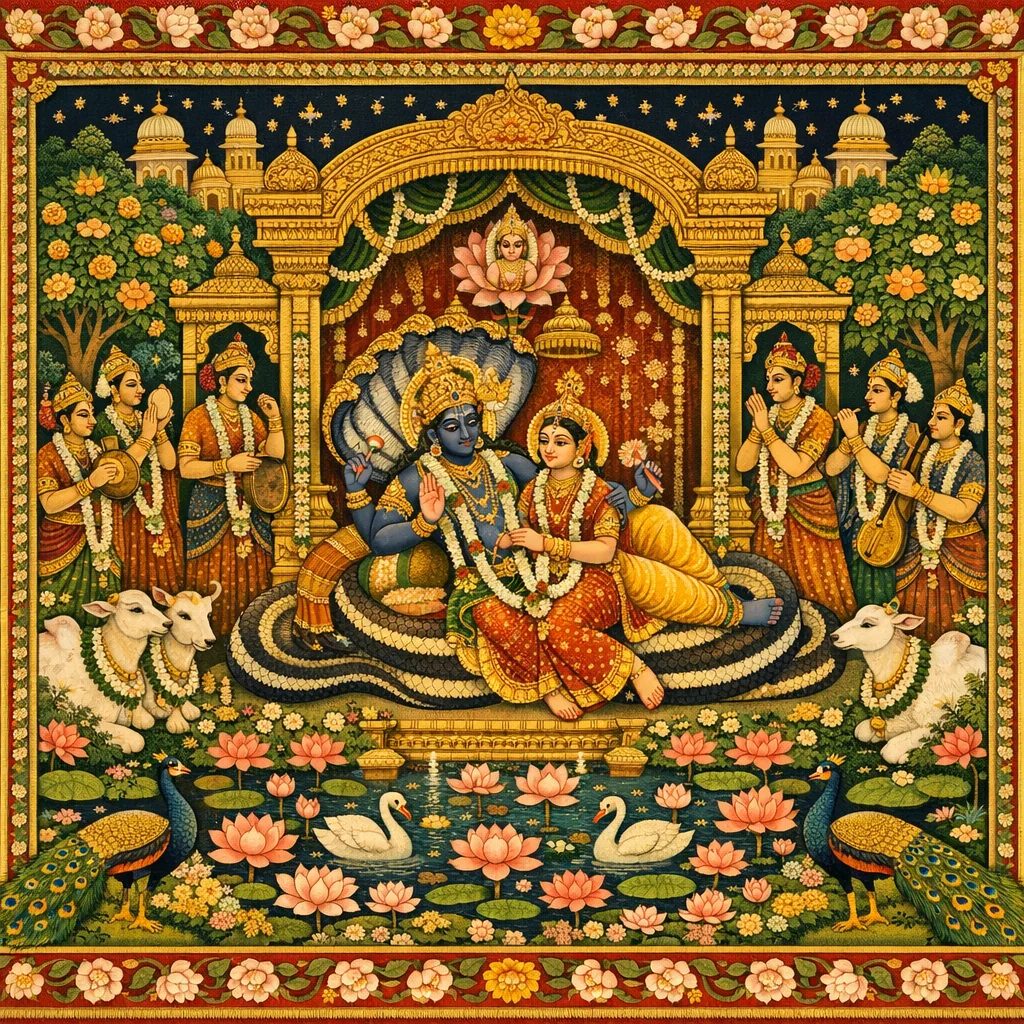
Maitreya narrates to Vidura how Diti’s prolonged pregnancy with Kaśyapa’s potent seed disturbs cosmic balance, dimming the sun and moon and alarming the devas. The demigods approach Brahmā, praising him as Veda-pravartaka and cosmic administrator, and Brahmā responds by recounting the Vaikuṇṭha-journey of his mind-born sons—the four Kumāras. Brahmā describes Vaikuṇṭha’s spiritual ecology: desire trees, fragrance-laden blossoms, tulasī’s supremacy, jewel-like vimānas, and residents absorbed in kīrtana without lust or envy. The narrative then turns sharply to a theological tension: at the seventh gate of Vaikuṇṭha, the doorkeepers Jaya and Vijaya block the Kumāras, provoking the sages’ anger and a curse to descend to the material world. The repentant gatekeepers seek protection from forgetfulness, and the Lord (Padmanābha/Nārāyaṇa), with Lakṣmī, personally arrives. His darśana transforms the Kumāras from impersonal realization toward personal devotion, as tulasī-scent and the Lord’s beauty awaken bhakti. This chapter sets up the ensuing descent of Jaya-Vijaya as a catalyst for the Lord’s līlā in the material realm (next narrative arc), while also contrasting Vaikuṇṭha’s harmony with the seed of fear that precipitates divine arrangement.
Shlokas
Verse 1
मैत्रेय उवाच प्रजापत्यं तु तत्तेज: परतेजोहनं दिति: । दधार वर्षाणि शतं शङ्कमाना सुरार्दनात् ॥ १ ॥
Śrī Maitreya said: My dear Vidura, Diti, the wife of the sage Kaśyapa, could understand that the sons within her womb would be a cause of disturbance to the demigods. As such, she continuously bore the powerful semen of Kaśyapa Muni, which was meant to give trouble to others, for one hundred years.
Verse 2
लोके तेनाहतालोके लोकपाला हतौजस: । न्यवेदयन् विश्वसृजे ध्वान्तव्यतिकरं दिशाम् ॥ २ ॥
By the force of the pregnancy of Diti, the light of the sun and moon was impaired in all the planets, and the demigods of various planets, being disturbed by that force, asked the creator of the universe, Brahmā, “What is this expansion of darkness in all directions?”
Verse 3
देवा ऊचु: तम एतद्विभो वेत्थ संविग्ना यद्वयं भृशम् । न ह्यव्यक्तं भगवत: कालेनास्पृष्टवर्त्मन: ॥ ३ ॥
The fortunate demigods said: O great one, just see this darkness, which you know very well and which is causing us anxieties. Because the influence of time cannot touch you, there is nothing unmanifest before you.
Verse 4
देवदेव जगद्धातर्लोकनाथशिखामणे । परेषामपरेषां त्वं भूतानामसि भाववित् ॥ ४ ॥
O god of the demigods, sustainer of the universe, head jewel of all the demigods in other planets, you know the intentions of all living entities, in both the spiritual and material worlds.
Verse 5
नमो विज्ञानवीर्याय माययेदमुपेयुषे । गृहीतगुणभेदाय नमस्तेऽव्यक्तयोनये ॥ ५ ॥
O original source of strength and scientific knowledge, all obeisances unto you! You have accepted the differentiated mode of passion from the Supreme Personality of Godhead. With the help of external energy you are born of the unmanifested source. All obeisances unto you!
Verse 6
ये त्वानन्येन भावेन भावयन्त्यात्मभावनम् । आत्मनि प्रोतभुवनं परं सदसदात्मकम् ॥ ६ ॥
O lord, all these planets exist within your self, and all the living entities are generated from you. Therefore you are the cause of this universe, and anyone who meditates upon you without deviation attains devotional service.
Verse 7
तेषां सुपक्वयोगानां जितश्वासेन्द्रियात्मनाम् । लब्धयुष्मत्प्रसादानां न कुतश्चित्पराभव: ॥ ७ ॥
There is no defeat in this material world for persons who control the mind and senses by controlling the breathing process and who are therefore experienced, mature mystics. This is because by such perfection in yoga they have attained your mercy.
Verse 8
यस्य वाचा प्रजा: सर्वा गावस्तन्त्येव यन्त्रिता: । हरन्ति बलिमायत्तास्तस्मै मुख्याय ते नम: ॥ ८ ॥
All the living entities within the universe are conducted by the Vedic directions, as a bull is directed by the rope attached to its nose. No one can violate the rules laid down in the Vedic literatures. To the chief person, who has contributed the Vedas, we offer our respect!
Verse 9
स त्वं विधत्स्व शं भूमंस्तमसा लुप्तकर्मणाम् । अदभ्रदयया दृष्टया आपन्नानर्हसीक्षितुम् ॥ ९ ॥
The demigods prayed to Brahmā: Please look upon us mercifully, for we have fallen into a miserable condition; because of the darkness, all our work has been suspended.
Verse 10
एष देव दितेर्गर्भ ओज: काश्यपमर्पितम् । दिशस्तिमिरयन् सर्वा वर्धतेऽग्निरिवैधसि ॥ १० ॥
As fuel overloads a fire, so the embryo created by the semen of Kaśyapa in the womb of Diti has caused complete darkness throughout the universe.
Verse 11
मैत्रेय उवाच स प्रहस्य महाबाहो भगवान् शब्दगोचर: । प्रत्याचष्टात्मभूर्देवान् प्रीणन् रुचिरया गिरा ॥ ११ ॥
Śrī Maitreya said: Thus Lord Brahmā, who is understood by transcendental vibration, tried to satisfy the demigods, being pleased with their words of prayer.
Verse 12
ब्रह्मोवाच मानसा मे सुता युष्मत्पूर्वजा: सनकादय: । चेरुर्विहायसा लोकाल्लोकेषु विगतस्पृहा: ॥ १२ ॥
Lord Brahmā said: My four sons Sanaka, Sanātana, Sanandana and Sanat-kumāra, who were born from my mind, are your predecessors. Sometimes they travel throughout the material and spiritual skies without any definite desire.
Verse 13
त एकदा भगवतो वैकुण्ठस्यामलात्मन: । ययुर्वैकुण्ठनिलयं सर्वलोकनमस्कृतम् ॥ १३ ॥
After thus traveling all over the universes, they also entered into the spiritual sky, for they were freed from all material contamination. In the spiritual sky there are spiritual planets known as Vaikuṇṭhas, which are the residence of the Supreme Personality of Godhead and His pure devotees and are worshiped by the residents of all the material planets.
Verse 14
वसन्ति यत्र पुरुषा: सर्वे वैकुण्ठमूर्तय: । येऽनिमित्तनिमित्तेन धर्मेणाराधयन् हरिम् ॥ १४ ॥
In the Vaikuṇṭha planets all the residents are similar in form to the Supreme Personality of Godhead. They all engage in devotional service to the Lord without desires for sense gratification.
Verse 15
यत्र चाद्य: पुमानास्ते भगवान् शब्दगोचर: । सत्त्वं विष्टभ्य विरजं स्वानां नो मृडयन् वृष: ॥ १५ ॥
In the Vaikuṇṭha planets is the Supreme Personality of Godhead, who is the original person and who can be understood through the Vedic literature. He is full of the uncontaminated mode of goodness, with no place for passion or ignorance. He contributes religious progress for the devotees.
Verse 16
यत्र नै:श्रेयसं नाम वनं कामदुघैर्द्रुमै: । सर्वर्तुश्रीभिर्विभ्राजत्कैवल्यमिव मूर्तिमत् ॥ १६ ॥
In those Vaikuṇṭha planets there are many forests which are very auspicious. In those forests the trees are desire trees, and in all seasons they are filled with flowers and fruits because everything in the Vaikuṇṭha planets is spiritual and personal.
Verse 17
वैमानिका: सललनाश्चरितानि शश्वद् गायन्ति यत्र शमलक्षपणानि भर्तु: । अन्तर्जलेऽनुविकसन्मधुमाधवीनां गन्धेन खण्डितधियोऽप्यनिलं क्षिपन्त: ॥ १७ ॥
In the Vaikuṇṭha planets the inhabitants fly in their airplanes, accompanied by their wives and consorts, and eternally sing of the character and activities of the Lord, which are always devoid of all inauspicious qualities. While singing the glories of the Lord, they deride even the presence of the blossoming mādhavī flowers, which are fragrant and laden with honey.
Verse 18
पारावतान्यभृतसारसचक्रवाक- दात्यूहहंसशुकतित्तिरिबर्हिणां य: । कोलाहलो विरमतेऽचिरमात्रमुच्चै र्भृङ्गाधिपे हरिकथामिव गायमाने ॥ १८ ॥
When the king of bees hums in a high pitch, singing the glories of the Lord, there is a temporary lull in the noise of the pigeon, the cuckoo, the crane, the cakravāka, the swan, the parrot, the partridge and the peacock. Such transcendental birds stop their own singing simply to hear the glories of the Lord.
Verse 19
मन्दारकुन्दकुरबोत्पलचम्पकार्ण- पुन्नागनागबकुलाम्बुजपारिजाता: । गन्धेऽर्चिते तुलसिकाभरणेन तस्या यस्मिंस्तप: सुमनसो बहु मानयन्ति ॥ १९ ॥
Although flowering plants like the mandāra, kunda, kurabaka, utpala, campaka, arṇa, punnāga, nāgakeśara, bakula, lily and pārijāta are full of transcendental fragrance, they are still conscious of the austerities performed by tulasī, for tulasī is given special preference by the Lord, who garlands Himself with tulasī leaves.
Verse 20
यत्संकुलं हरिपदानतिमात्रदृष्टै- र्वैदूर्यमारकतहेममयैर्विमानै: । येषां बृहत्कटितटा: स्मितशोभिमुख्य: कृष्णात्मनां न रज आदधुरुत्स्मयाद्यै: ॥ २० ॥
The inhabitants of Vaikuṇṭha travel in their airplanes made of lapis lazuli, emerald and gold. Although crowded by their consorts, who have large hips and beautiful smiling faces, they cannot be stimulated to passion by their mirth and beautiful charms.
Verse 21
श्री रूपिणी क्वणयती चरणारविन्दं लीलाम्बुजेन हरिसद्मनि मुक्तदोषा । संलक्ष्यते स्फटिककुड्य उपेतहेम्नि सम्मार्जतीव यदनुग्रहणेऽन्ययत्न: ॥ २१ ॥
The ladies in the Vaikuṇṭha planets are as beautiful as the goddess of fortune herself. Such transcendentally beautiful ladies, their hands playing with lotuses and their leg bangles tinkling, are sometimes seen sweeping the marble walls, which are bedecked at intervals with golden borders, in order to receive the grace of the Supreme Personality of Godhead.
Verse 22
वापीषु विद्रुमतटास्वमलामृताप्सु प्रेष्यान्विता निजवने तुलसीभिरीशम् । अभ्यर्चती स्वलकमुन्नसमीक्ष्य वक्त्र- मुच्छेषितं भगवतेत्यमताङ्ग यच्छ्री: ॥ २२ ॥
The goddesses of fortune worship the Lord in their own gardens by offering tulasī leaves on the coral-paved banks of transcendental reservoirs of water. While offering worship to the Lord, they can see on the water the reflection of their beautiful faces with raised noses, and it appears that they have become more beautiful because of the Lord’s kissing their faces.
Verse 23
यन्न व्रजन्त्यघभिदो रचनानुवादा- च्छृण्वन्ति येऽन्यविषया: कुकथा मतिघ्नी: । यास्तु श्रुता हतभगैर्नृभिरात्तसारा- स्तांस्तान् क्षिपन्त्यशरणेषु तम:सु हन्त ॥ २३ ॥
It is very much regrettable that unfortunate people do not discuss the description of the Vaikuṇṭha planets but engage in topics which are unworthy to hear and which bewilder one’s intelligence. Those who give up the topics of Vaikuṇṭha and take to talk of the material world are thrown into the darkest region of ignorance.
Verse 24
येऽभ्यर्थितामपि च तो नृगतिं प्रपन्ना ज्ञानं च तत्त्वविषयं सहधर्मं यत्र । नाराधनं भगवतो वितरन्त्यमुष्य सम्मोहिता विततया बत मायया ते ॥ २४ ॥
Lord Brahmā said: My dear demigods, the human form of life is of such importance that we also desire to have such life, for in the human form one can attain perfect religious truth and knowledge. If one in this human form of life does not understand the Supreme Personality of Godhead and His abode, it is to be understood that he is very much affected by the influence of external nature.
Verse 25
यच्च व्रजन्त्यनिमिषामृषभानुवृत्त्या दूरेयमा ह्युपरि न: स्पृहणीयशीला: । भर्तुर्मिथ: सुयशस: कथनानुराग- वैक्लव्यबाष्पकलया पुलकीकृताङ्गा: ॥ २५ ॥
Persons whose bodily features change in ecstasy and who breathe heavily and perspire due to hearing the glories of the Lord are promoted to the kingdom of God, even though they do not care for meditation and other austerities. The kingdom of God is above the material universes, and it is desired by Brahmā and other demigods.
Verse 26
तद्विश्वगुर्वधिकृतं भुवनैकवन्द्यं दिव्यं विचित्रविबुधाग्र्यविमानशोचि: । आपु: परां मुदमपूर्वमुपेत्य योग- मायाबलेन मुनयस्तदथो विकुण्ठम् ॥ २६ ॥
Thus the great sages Sanaka, Sanātana, Sanandana and Sanat-kumāra, upon reaching the above-mentioned Vaikuṇṭha in the spiritual world by dint of their mystic yoga performance, perceived unprecedented happiness. They found that the spiritual sky was illuminated by highly decorated airplanes piloted by the best devotees of Vaikuṇṭha and was predominated by the Supreme Personality of Godhead.
Verse 27
तस्मिन्नतीत्य मुनय: षडसज्जमाना: कक्षा: समानवयसावथ सप्तमायाम् । देवावचक्षत गृहीतगदौ परार्ध्य- केयूरकुण्डलकिरीटविटङ्कवेषौ ॥ २७ ॥
After passing through the six entrances of Vaikuṇṭha-purī, the Lord’s residence, without feeling astonishment at all the decorations, they saw at the seventh gate two shining beings of the same age, armed with maces and adorned with most valuable jewelry, earrings, diamonds, helmets, garments, etc.
Verse 28
मत्तद्विरेफवनमालिकया निवीतौ विन्यस्तयासितचतुष्टयबाहुमध्ये । वक्त्रं भ्रुवा कुटिलया स्फुटनिर्गमाभ्यां रक्तेक्षणेन च मनाग्रभसं दधानौ ॥ २८ ॥
The two doormen were garlanded with fresh flowers which attracted intoxicated bees and which were placed around their necks and between their four blue arms. From their arched eyebrows, discontented nostrils and reddish eyes, they appeared somewhat agitated.
Verse 29
द्वार्येतयोर्निविविशुर्मिषतोरपृष्ट्वा पूर्वा यथा पुरटवज्रकपाटिका या: । सर्वत्र तेऽविषमया मुनय: स्वदृष्टया ये सञ्चरन्त्यविहता विगताभिशङ्का: ॥ २९ ॥
The great sages, headed by Sanaka, had opened doors everywhere. They had no idea of “ours” and “theirs.” With open minds, they entered the seventh door out of their own will, just as they had passed through the six other doors, which were made of gold and diamonds.
Verse 30
तान् वीक्ष्य वातारशनांश्चतुर: कुमारान् वृद्धान्दशार्धवयसो विदितात्मतत्त्वान् । वेत्रेण चास्खलयतामतदर्हणांस्तौ तेजो विहस्य भगवत्प्रतिकूलशीलौ ॥ ३० ॥
The four boy-sages, who had nothing to cover their bodies but the atmosphere, looked only five years old, even though they were the oldest of all living creatures and had realized the truth of the self. But when the porters, who happened to possess a disposition quite unpalatable to the Lord, saw the sages, they blocked their way with their staffs, despising their glories, although the sages did not deserve such treatment at their hands.
Verse 31
ताभ्यां मिषत्स्वनिमिषेषु निषिध्यमाना: स्वर्हत्तमा ह्यपि हरे: प्रतिहारपाभ्याम् । ऊचु: सुहृत्तमदिदृक्षितभङ्ग ईष- त्कामानुजेन सहसा त उपप्लुताक्षा: ॥ ३१ ॥
When the Kumāras, although by far the fittest persons, were thus forbidden entrance by the two chief doorkeepers of Śrī Hari while other divinities looked on, their eyes suddenly turned red because of anger due to their great eagerness to see their most beloved master, Śrī Hari, the Personality of Godhead.
Verse 32
मुनय ऊचु: को वामिहैत्य भगवत्परिचर्ययोच्चै- स्तद्धर्मिणां निवसतां विषम: स्वभाव: । तस्मिन् प्रशान्तपुरुषे गतविग्रहे वां को वात्मवत्कुहकयो: परिशङ्कनीय: ॥ ३२ ॥
The sages said: Who are these two persons who have developed such a discordant mentality even though they are posted in the service of the Lord in the highest position and are expected to have developed the same qualities as the Lord? How are these two persons living in Vaikuṇṭha? Where is the possibility of an enemy’s coming into this kingdom of God? The Supreme Personality of Godhead has no enemy. Who could be envious of Him? Probably these two persons are imposters; therefore they suspect others to be like themselves.
Verse 33
न ह्यन्तरं भगवतीह समस्तकुक्षा- वात्मानमात्मनि नभो नभसीव धीरा: । पश्यन्ति यत्र युवयो: सुरलिङ्गिनो: किं व्युत्पादितं ह्युदरभेदि भयं यतोऽस्य ॥ ३३ ॥
In the Vaikuṇṭha world there is complete harmony between the residents and the Supreme Personality of Godhead, just as there is complete harmony within space between the big and the small skies. Why then is there a seed of fear in this field of harmony? These two persons are dressed like inhabitants of Vaikuṇṭha, but wherefrom can their disharmony come into existence?
Verse 34
तद्वाममुष्य परमस्य विकुण्ठभर्तु: कर्तुं प्रकृष्टमिह धीमहि मन्दधीभ्याम् । लोकानितो व्रजतमन्तरभावदृष्टया पापीयसस्त्रय इमे रिपवोऽस्य यत्र ॥ ३४ ॥
Therefore let us consider how these two contaminated persons should be punished. The punishment should be apt, for thus benefit can eventually be bestowed upon them. Since they find duality in the existence of Vaikuṇṭha life, they are contaminated and should be removed from this place to the material world, where the living entities have three kinds of enemies.
Verse 35
तेषामितीरितमुभाववधार्य घोरं तं ब्रह्मदण्डमनिवारणमस्त्रपूगै: । सद्यो हरेरनुचरावुरु बिभ्यतस्तत्- पादग्रहावपततामतिकातरेण ॥ ३५ ॥
When the doormen of Vaikuṇṭhaloka, who were certainly devotees of the Lord, found that they were going to be cursed by the brāhmaṇas, they at once became very much afraid and fell down at the feet of the brāhmaṇas in great anxiety, for a brāhmaṇa’s curse cannot be counteracted by any kind of weapon.
Verse 36
भूयादघोनि भगवद्भिरकारि दण्डो यो नौ हरेत सुरहेलनमप्यशेषम् । मा वोऽनुतापकलया भगवत्स्मृतिघ्नो मोहो भवेदिह तु नौ व्रजतोरधोऽध: ॥ ३६ ॥
After being cursed by the sages, the doormen said: It is quite apt that you have punished us for neglecting to respect sages like you. But we pray that due to your compassion at our repentance, the illusion of forgetting the Supreme Personality of Godhead will not come upon us as we go progressively downward.
Verse 37
एवं तदैव भगवानरविन्दनाभ: स्वानां विबुध्य सदतिक्रममार्यहृद्य: । तस्मिन् ययौ परमहंसमहामुनीना- मन्वेषणीयचरणौ चलयन् सहश्री: ॥ ३७ ॥
At that very moment, the Lord, who is called Padmanābha because of the lotus grown from His navel and who is the delight of the righteous, learned about the insult offered by His own servants to the saints. Accompanied by His spouse, the goddess of fortune, He went to the spot on those very feet sought for by recluses and great sages.
Verse 38
तं त्वागतं प्रतिहृतौपयिकं स्वपुम्भि- स्तेऽचक्षताक्षविषयं स्वसमाधिभाग्यम् । हंसश्रियोर्व्यजनयो: शिववायुलोल- च्छुभ्रातपत्रशशिकेसरशीकराम्बुम् ॥ ३८ ॥
The sages, headed by Sanaka Ṛṣi, saw that the Supreme Personality of Godhead, Viṣṇu, who was formerly visible only within their hearts in ecstatic trance, had now actually become visible to their eyes. As He came forward, accompanied by His own associates bearing all paraphernalia, such as an umbrella and a cāmara fan, the white bunches of hair moved very gently, like two swans, and due to their favorable breeze the pearls garlanding the umbrella also moved, like drops of nectar falling from the white full moon or ice melting due to a gust of wind.
Verse 39
कृत्स्नप्रसादसुमुखं स्पृहणीयधाम स्नेहावलोककलया हृदि संस्पृशन्तम् । श्यामे पृथावुरसि शोभितया श्रिया स्व- श्चूडामणिं सुभगयन्तमिवात्मधिष्ण्यम् ॥ ३९ ॥
The Lord is the reservoir of all pleasure. His auspicious presence is meant for everyone’s benediction, and His affectionate smiling and glancing touch the core of the heart. The Lord’s beautiful bodily color is blackish, and His broad chest is the resting place of the goddess of fortune, who glorifies the entire spiritual world, the summit of all heavenly planets. Thus it appeared that the Lord was personally spreading the beauty and good fortune of the spiritual world.
Verse 40
पीतांशुके पृथुनितम्बिनि विस्फुरन्त्या काञ्च्यालिभिर्विरुतया वनमालया च । वल्गुप्रकोष्ठवलयं विनतासुतांसे विन्यस्तहस्तमितरेण धुनानमब्जम् ॥ ४० ॥
He was adorned with a girdle that shone brightly on the yellow cloth covering His large hips, and He wore a garland of fresh flowers which was distinguished by humming bees. His lovely wrists were graced with bracelets, and He rested one of His hands on the shoulder of Garuḍa, His carrier, and twirled a lotus with another hand.
Verse 41
विद्युत्क्षिपन्मकरकुण्डलमण्डनार्ह- गण्डस्थलोन्नसमुखं मणिमत्किरीटम् । दोर्दण्डषण्डविवरे हरता परार्ध्य- हारेण कन्धरगतेन च कौस्तुभेन ॥ ४१ ॥
His countenance was distinguished by cheeks that enhanced the beauty of His alligator-shaped pendants, which outshone lightning. His nose was prominent, and His head was covered with a gem-studded crown. A charming necklace hung between His stout arms, and His neck was adorned with the gem known by the name Kaustubha.
Verse 42
अत्रोपसृष्टमिति चोत्स्मितमिन्दिराया: स्वानां धिया विरचितं बहुसौष्ठवाढ्यम् । मह्यं भवस्य भवतां च भजन्तमङ्गं नेमुर्निरीक्ष्य नवितृप्तदृशो मुदा कै: ॥ ४२ ॥
The exquisite beauty of Nārāyaṇa, being many times magnified by the intelligence of His devotees, was so attractive that it defeated the pride of the goddess of fortune in being the most beautiful. My dear demigods, the Lord who thus manifested Himself is worshipable by me, by Lord Śiva and by all of you. The sages regarded Him with unsated eyes and joyously bowed their heads at His lotus feet.
Verse 43
तस्यारविन्दनयनस्य पदारविन्द- किञ्जल्कमिश्रतुलसीमकरन्दवायु: । अन्तर्गत: स्वविवरेण चकार तेषां सङ्क्षोभमक्षरजुषामपि चित्ततन्वो: ॥ ४३ ॥
When the breeze carrying the aroma of tulasī leaves from the toes of the lotus feet of the Personality of Godhead entered the nostrils of those sages, they experienced a change both in body and in mind, even though they were attached to the impersonal Brahman understanding.
Verse 44
ते वा अमुष्य वदनासितपद्मकोश- मुद्वीक्ष्य सुन्दरतराधरकुन्दहासम् । लब्धाशिष: पुनरवेक्ष्य तदीयमङ्घ्रि- द्वन्द्वं नखारुणमणिश्रयणं निदध्यु: ॥ ४४ ॥
The Lord’s beautiful face appeared to them like the inside of a blue lotus, and the Lord’s smile appeared to be a blossoming jasmine flower. After seeing the face of the Lord, the sages were fully satisfied, and when they wanted to see Him further, they looked upon the nails of His lotus feet, which resembled rubies. Thus they viewed the Lord’s transcendental body again and again, and so they finally achieved meditation on the Lord’s personal feature.
Verse 45
पुंसां गतिं मृगयतामिह योगमार्गै- र्ध्यानास्पदं बहु मतं नयनाभिरामम् । पौंस्नं वपुर्दर्शयानमनन्यसिद्धै- रौत्पत्तिकै: समगृणन् युतमष्टभोगै: ॥ ४५ ॥
This is the form of the Lord which is meditated upon by the followers of the yoga process, and it is pleasing to the yogīs in meditation. It is not imaginary but factual, as proved by great yogīs. The Lord is full in eight kinds of achievement, but for others these achievements are not possible in full perfection.
Verse 46
कुमारा ऊचु: योऽन्तर्हितो हृदि गतोऽपि दुरात्मनां त्वं सोऽद्यैव नो नयनमूलमनन्त राद्ध: । यर्ह्येव कर्णविवरेण गुहां गतो न: पित्रानुवर्णितरहा भवदुद्भवेन ॥ ४६ ॥
The Kumāras said: Our dear Lord, You are not manifested to rascals, even though You are seated within the heart of everyone. But as far as we are concerned, we see You face to face, although You are unlimited. The statements we have heard about You from our father, Brahmā, through the ears have now been actually realized by Your kind appearance.
Verse 47
तं त्वां विदाम भगवन् परमात्मतत्त्वं सत्त्वेन सम्प्रति रतिं रचयन्तमेषाम् । यत्तेऽनुतापविदितैर्दृढभक्तियोगै- रुद्ग्रन्थयो हृदि विदुर्मुनयो विरागा: ॥ ४७ ॥
We know that You are the Supreme Absolute Truth, the Personality of Godhead, who manifests His transcendental form in the uncontaminated mode of pure goodness. This transcendental, eternal form of Your personality can be understood only by Your mercy, through unflinching devotional service, by great sages whose hearts have been purified in the devotional way.
Verse 48
नात्यन्तिकं विगणयन्त्यपि ते प्रसादं किम्वन्यदर्पितभयं भ्रुव उन्नयैस्ते । येऽङ्ग त्वदङ्घ्रि शरणा भवत: कथाया: कीर्तन्यतीर्थयशस: कुशला रसज्ञा: ॥ ४८ ॥
Persons who are very expert and most intelligent in understanding things as they are engage in hearing narrations of the auspicious activities and pastimes of the Lord, which are worth chanting and worth hearing. Such persons do not care even for the highest material benediction, namely liberation, to say nothing of other less important benedictions like the material happiness of the heavenly kingdom.
Verse 49
कामं भव: स्ववृजिनैर्निरयेषु न: स्ता- च्चेतोऽलिवद्यदि नु ते पदयो रमेत । वाचश्च नस्तुलसिवद्यदि तेऽङ्घ्रि शोभा: पूर्येत ते गुणगणैर्यदि कर्णरन्ध्र: ॥ ४९ ॥
O Lord, we pray that You let us be born in any hellish condition of life, just as long as our hearts and minds are always engaged in the service of Your lotus feet, our words are made beautiful [by speaking of Your activities] just as tulasī leaves are beautified when offered unto Your lotus feet, and as long as our ears are always filled with the chanting of Your transcendental qualities.
Verse 50
प्रादुश्चकर्थ यदिदं पुरुहूत रूपं तेनेश निर्वृतिमवापुरलं दृशो न: । तस्मा इदं भगवते नम इद्विधेम योऽनात्मनां दुरुदयो भगवान् प्रतीत: ॥ ५० ॥
O Lord, we therefore offer our respectful obeisances unto Your eternal form as the Personality of Godhead, which You have so kindly manifested before us. Your supreme, eternal form cannot be seen by unfortunate, less intelligent persons, but we are so much satisfied in our mind and vision to see it.
Frequently Asked Questions
The text frames the incident as an exceptional, divinely orchestrated tension: Vaikuṇṭha is intrinsically free from material envy, yet the doorkeepers’ momentary discord becomes the instrument for the Lord’s līlā in the material world. The sages interpret the gatekeepers’ suspicion as a trace of duality incompatible with Vaikuṇṭha’s harmony, hence the curse to descend where duality naturally operates. The Lord’s subsequent appearance confirms that the event is under His supervision and becomes spiritually fruitful—revealing His beauty, eliciting repentance, and intensifying devotional realization.
Although the Kumāras are self-realized, the sensory-spiritual impact of the Lord’s personal form—especially the tulasī aroma from His lotus feet—softens the heart and redirects attention from abstract Brahman to Bhagavān’s attributes (rūpa, guṇa, līlā). Their repeated gazing at His face and lotus feet culminates in personal meditation (saguṇa-bhajana), illustrating the Bhāgavata principle that the fullest realization of the Absolute is personal and awakened by mercy rather than by austerity alone.
Jaya and Vijaya are exalted attendants of the Lord stationed at Vaikuṇṭha’s gates, emblematic of intimate service and divine guardianship. Their temporary offense to great devotees becomes a narrative hinge: their descent (by curse) sets the stage for major incarnational conflicts in the material world, where the Lord repeatedly protects devotees and rectifies cosmic disorder. The episode also teaches that even high position demands humility toward bhāgavatas (devotees), and that repentance invokes the Lord’s direct intervention.