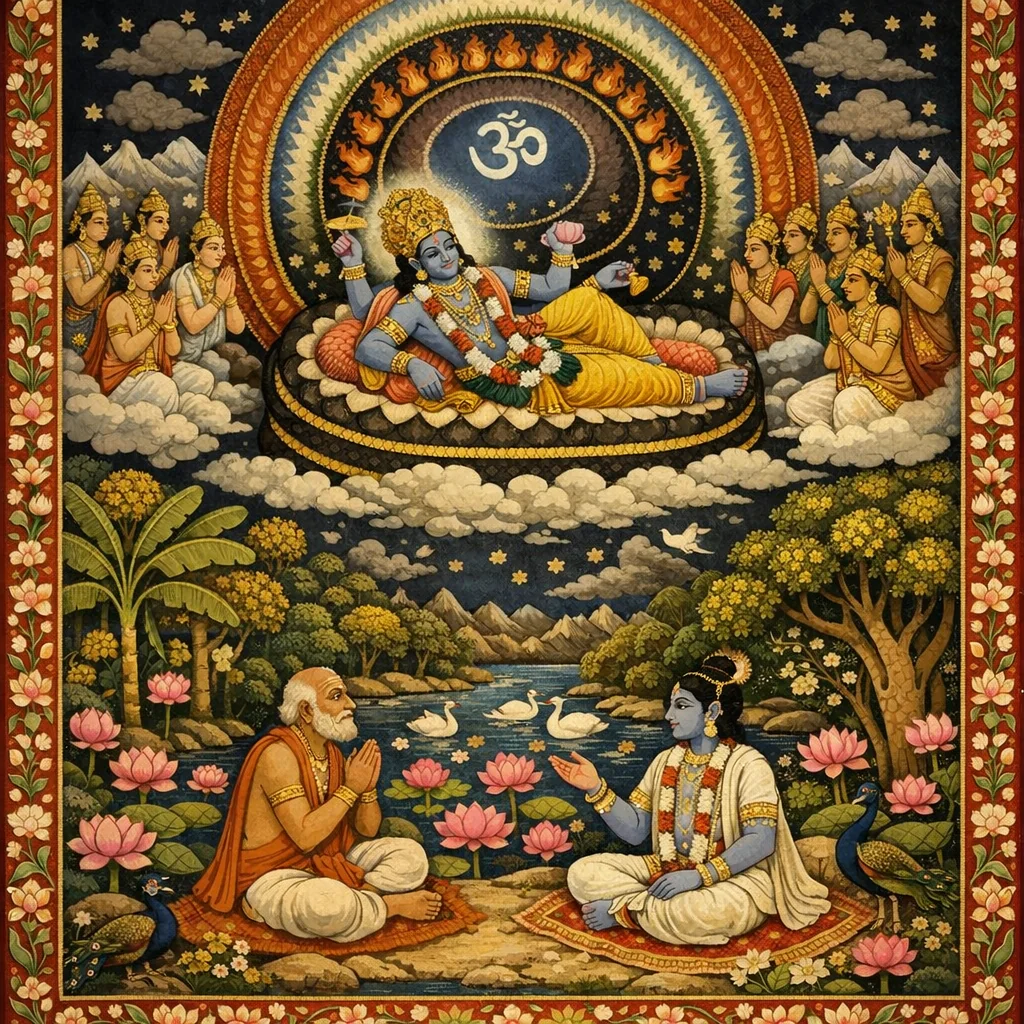
Adhyaya 5
Vidura’s Questions on Devotion and Sarga; Maitreya Begins the Account of Creation
Continuing Vidura’s pilgrimage-driven search for transcendental meaning, he reaches the source region of the Gaṅgā and approaches Maitreya. Vidura rejects the promise of happiness through fruitive work, arguing that karma intensifies distress, and requests instruction in devotional service that pleases the Lord in the heart and reveals Vedic truth. He asks for a coherent account of the Lord’s incarnations and the orderly creation and governance of the cosmos, including the diversification of species, names, forms, and social gradations. Maitreya honors Vidura, identifies his extraordinary identity and divine association, and begins the cosmological sequence: the Lord alone exists prior to creation; māyā is the seen energy; the puruṣa impregnates prakṛti under kāla; mahat-tattva manifests, evolves into ahaṅkāra in three guṇic phases, producing mind, senses, and the elements from sound to earth. Empowered deities, unable to execute their functions, offer prayers taking shelter of the Lord’s lotus feet and seek directives for service. The chapter thus bridges Vidura’s existential inquiry to the forthcoming detailed exposition of creation and divine administration in subsequent chapters.
Shlokas
Verse 1
श्री शुक उवाच द्वारि द्युनद्या ऋषभ: कुरूणां मैत्रेयमासीनमगाधबोधम् । क्षत्तोपसृत्याच्युतभावसिद्ध: पप्रच्छ सौशील्यगुणाभितृप्त: ॥ १ ॥
Śukadeva Gosvāmī said: Vidura, the best amongst the Kuru dynasty, who was perfect in devotional service to the Lord, thus reached the source of the celestial Ganges river [Hardwar], where Maitreya, the great, fathomless learned sage of the world, was seated. Vidura, who was perfect in gentleness and satisfied in transcendence, inquired from him.
Verse 2
विदुर उवाच सुखाय कर्माणि करोति लोको न तै: सुखं वान्यदुपारमं वा । विन्देत भूयस्तत एव दु:खं यदत्र युक्तं भगवान् वदेन्न: ॥ २ ॥
Vidura said: O great sage, everyone in this world engages in fruitive activities to attain happiness, but one finds neither satiation nor the mitigation of distress. On the contrary, one is only aggravated by such activities. Please, therefore, give us directions on how one should live for real happiness.
Verse 3
जनस्य कृष्णाद्विमुखस्य दैवा- दधर्मशीलस्य सुदु:खितस्य । अनुग्रहायेह चरन्ति नूनं भूतानि भव्यानि जनार्दनस्य ॥ ३ ॥
O my lord, great philanthropic souls travel on the earth on behalf of the Supreme Personality of Godhead to show compassion to the fallen souls who are averse to the sense of subordination to the Lord.
Verse 4
तत्साधुवर्यादिश वर्त्म शं न: संराधितो भगवान् येन पुंसाम् । हृदि स्थितो यच्छति भक्तिपूते ज्ञानं सतत्त्वाधिगमं पुराणम् ॥ ४ ॥
Therefore, O great sage, please give me instruction on the transcendental devotional service of the Lord, so that He who is situated in the heart of everyone can be pleased to impart, from within, knowledge of the Absolute Truth in terms of the ancient Vedic principles delivered only to those who are purified by the process of devotional service.
Verse 5
करोति कर्माणि कृतावतारो यान्यात्मतन्त्रो भगवांस्त्र्यधीश: । यथा ससर्जाग्र इदं निरीह: संस्थाप्य वृत्तिं जगतो विधत्ते ॥ ५ ॥
O great sage, kindly narrate how the Supreme Personality of Godhead, who is the independent, desireless Lord of the three worlds and the controller of all energies, accepts incarnations and creates the cosmic manifestation with perfectly arranged regulative principles for its maintenance.
Verse 6
यथा पुन: स्वे ख इदं निवेश्य शेते गुहायां स निवृत्तवृत्ति: । योगेश्वराधीश्वर एक एत- दनुप्रविष्टो बहुधा यथासीत् ॥ ६ ॥
He lies down on His own heart spread in the form of the sky, and thus placing the whole creation in that space, He expands Himself into many living entities, which are manifested as different species of life. He does not have to endeavor for His maintenance, because He is the master of all mystic powers and the proprietor of everything. Thus He is distinct from the living entities.
Verse 7
क्रीडन् विधत्ते द्विजगोसुराणां क्षेमाय कर्माण्यवतारभेदै: । मनो न तृप्यत्यपि शृण्वतां न: सुश्लोकमौलेश्चरितामृतानि ॥ ७ ॥
You may narrate also about the auspicious characteristics of the Lord in His different incarnations for the welfare of the twice-born, the cows and the demigods. Our minds are never satisfied completely, although we continuously hear of His transcendental activities.
Verse 8
यैस्तत्त्वभेदैरधिलोकनाथो लोकानलोकान् सह लोकपालान् । अचीक्लृपद्यत्र हि सर्वसत्त्व- निकायभेदोऽधिकृत: प्रतीत: ॥ ८ ॥
The Supreme King of all kings has created different planets and places of habitation where living entities are situated in terms of the modes of nature and work, and He has created their different kings and rulers.
Verse 9
येन प्रजानामुत आत्मकर्म- रूपाभिधानां य भिदां व्यधत्त । नारायणो विश्वसृगात्मयोनि- रेतच्च नो वर्णय विप्रवर्य ॥ ९ ॥
O chief amongst the brāhmaṇas, please also describe how Nārāyaṇa, the creator of the universe and the self-sufficient Lord, has differently created the natures, activities, forms, features and names of the different living creatures.
Verse 10
परावरेषां भगवन् व्रतानि श्रुतानि मे व्यासमुखादभीक्ष्णम् । अतृप्नुम क्षुल्लसुखावहानां तेषामृते कृष्णकथामृतौघात् ॥ १० ॥
O my lord, I have repeatedly heard about these higher and lower statuses of human society from the mouth of Vyāsadeva, and I am quite satiated with all these lesser subject matters and their happiness. They have not satisfied me with the nectar of topics about Kṛṣṇa.
Verse 11
कस्तृप्नुयात्तीर्थपदोऽभिधानात् सत्रेषु व: सूरिभिरीड्यमानात् । य: कर्णनाडीं पुरुषस्य यातो भवप्रदां गेहरतिं छिनत्ति ॥ ११ ॥
Who in human society can be satisfied without hearing sufficient talk of the Lord, whose lotus feet are the sum total of all places of pilgrimage and who is worshiped by great sages and devotees? Such topics can cut off one’s bondage to family affection simply by entering the holes of one’s ears.
Verse 12
मुनिर्विवक्षुर्भगवद्गुणानां सखापि ते भारतमाह कृष्ण: । यस्मिन्नृणां ग्राम्यसुखानुवादै- र्मतिर्गृहीता नु हरे: कथायाम् ॥ १२ ॥
Your friend the great sage Kṛṣṇa-dvaipāyana Vyāsa has already described the transcendental qualities of the Lord in his great work the Mahābhārata. But the whole idea is to draw the attention of the mass of people to kṛṣṇa-kathā [Bhagavad-gītā] through their strong affinity for hearing mundane topics.
Verse 13
सा श्रद्दधानस्य विवर्धमाना विरक्तिमन्यत्र करोति पुंस: । हरे: पदानुस्मृतिनिर्वृतस्य समस्तदु:खाप्ययमाशु धत्ते ॥ १३ ॥
For one who is anxious to engage constantly in hearing such topics, kṛṣṇa-kathā gradually increases his indifference towards all other things. Such constant remembrance of the lotus feet of Lord Kṛṣṇa by the devotee who has achieved transcendental bliss vanquishes all his miseries without delay.
Verse 14
ताञ्छोच्यशोच्यानविदोऽनुशोचे हरे: कथायां विमुखानघेन । क्षिणोति देवोऽनिमिषस्तु येषा- मायुर्वृथावादगतिस्मृतीनाम् ॥ १४ ॥
O sage, persons who because of their sinful activities are averse to the topics of Transcendence and thus ignorant of the purpose of the Mahābhārata [Bhagavad-gītā] are pitied by the pitiable. I also pity them because I see how their duration of life is spoiled by eternal time while they involve themselves in presentations of philosophical speculation, theoretical ultimate goals of life, and different modes of ritual.
Verse 15
तदस्य कौषारव शर्मदातु- र्हरे: कथामेव कथासु सारम् । उद्धृत्य पुष्पेभ्य इवार्तबन्धो शिवाय न: कीर्तय तीर्थकीर्ते: ॥ १५ ॥
O Maitreya, O friend of the distressed, the glories of the Supreme Lord can alone do good for people all over the world. Therefore, just as bees collect honey from flowers, kindly describe the essence of all topics — the topics of the Lord.
Verse 16
स विश्वजन्मस्थितिसंयमार्थे कृतावतार: प्रगृहीतशक्ति: । चकार कर्माण्यतिपूरुषाणि यानीश्वर: कीर्तय तानि मह्यम् ॥ १६ ॥
Kindly chant all those superhuman transcendental activities of the supreme controller, the Personality of Godhead, who accepted incarnations fully equipped with all potency for the full manifestation and maintenance of the cosmic creation.
Verse 17
श्री शुक उवाच स एवं भगवान् पृष्ट: क्षत्त्रा कौषारवो मुनि: । पुंसां नि:श्रेयसार्थेन तमाह बहुमानयन् ॥ १७ ॥
Śukadeva Gosvāmī said: The great sage Maitreya Muni, after honoring Vidura very greatly, began to speak, at Vidura’s request, for the greatest welfare of all people.
Verse 18
मैत्रेय उवाच साधु पृष्टं त्वया साधो लोकान् साध्वनुगृह्णता । कीर्तिं वितन्वता लोके आत्मनोऽधोक्षजात्मन: ॥ १८ ॥
Śrī Maitreya said: O Vidura, all glory unto you. You have inquired from me of the greatest of all goodness, and thus you have shown your mercy both to the world and to me because your mind is always absorbed in thoughts of the Transcendence.
Verse 19
नैतच्चित्रं त्वयि क्षत्तर्बादरायणवीर्यजे । गृहीतोऽनन्यभावेन यत्त्वया हरिरीश्वर: ॥ १९ ॥
O Vidura, it is not at all wonderful that you have so accepted the Lord without deviation of thought, for you were born from the semen of Vyāsadeva.
Verse 20
माण्डव्यशापाद्भगवान् प्रजासंयमनो यम: । भ्रातु: क्षेत्रे भुजिष्यायां जात: सत्यवतीसुतात् ॥ २० ॥
I know that you are now Vidura due to the cursing of Māṇḍavya Muni and that formerly you were King Yamarāja, the great controller of living entities after their death. You were begotten by the son of Satyavatī, Vyāsadeva, in the kept wife of his brother.
Verse 21
भवान् भगवतो नित्यं सम्मत: सानुगस्य ह । यस्य ज्ञानोपदेशाय मादिशद्भगवान् व्रजन् ॥ २१ ॥
Your good self is one of the eternal associates of the Supreme Personality of Godhead for whose sake the Lord, while going back to His abode, left instructions with me.
Verse 22
अथ ते भगवल्लीला योगमायोरुबृंहिता: । विश्वस्थित्युद्भवान्तार्था वर्णयाम्यनुपूर्वश: ॥ २२ ॥
I shall therefore describe to you the pastimes by which the Personality of Godhead extends His transcendental potency for the creation, maintenance and dissolution of the cosmic world as they occur one after another.
Verse 23
भगवानेक आसेदमग्र आत्मात्मनां विभु: । आत्मेच्छानुगतावात्मा नानामत्युपलक्षण: ॥ २३ ॥
The Personality of Godhead, the master of all living entities, existed prior to the creation as one without a second. It is by His will only that creation is made possible and again everything merges in Him. This Supreme Self is symptomized by different names.
Verse 24
स वा एष तदा द्रष्टा नापश्यद् दृश्यमेकराट् । मेनेऽसन्तमिवात्मानं सुप्तशक्तिरसुप्तदृक् ॥ २४ ॥
The Lord, the undisputed proprietor of everything, was the only seer. The cosmic manifestation was not present at that time, and thus He felt imperfect without His plenary and separated parts and parcels. The material energy was dormant, whereas the internal potency was manifested.
Verse 25
सा वा एतस्य संद्रष्टु: शक्ति: सदसदात्मिका । माया नाम महाभाग ययेदं निर्ममे विभु: ॥ २५ ॥
The Lord is the seer, and the external energy, which is seen, works as both cause and effect in the cosmic manifestation. O greatly fortunate Vidura, this external energy is known as māyā or illusion, and through her agency only is the entire material manifestation made possible.
Verse 26
कालवृत्त्या तु मायायां गुणमय्यामधोक्षज: । पुरुषेणात्मभूतेन वीर्यमाधत्त वीर्यवान् ॥ २६ ॥
The Supreme Living Being in His feature as the transcendental puruṣa incarnation, who is the Lord’s plenary expansion, impregnates the material nature of three modes, and thus by the influence of eternal time the living entities appear.
Verse 27
ततोऽभवन् महत्तत्त्वमव्यक्तात्कालचोदितात् । विज्ञानात्मात्मदेहस्थं विश्वं व्यञ्जंस्तमोनुद: ॥ २७ ॥
Thereafter, influenced by the interactions of eternal time, the supreme sum total of matter, called the mahat-tattva, became manifested, and in this mahat-tattva the unalloyed goodness, the Supreme Lord, sowed the seeds of universal manifestation out of His own body.
Verse 28
सोऽप्यंशगुणकालात्मा भगवद्दृष्टिगोचर: । आत्मानं व्यकरोदात्मा विश्वस्यास्य सिसृक्षया ॥ २८ ॥
Thereafter the mahat-tattva differentiated itself into many different forms as the reservoir of the would-be entities. The mahat-tattva is chiefly in the mode of ignorance, and it generates the false ego. It is a plenary expansion of the Personality of Godhead, with full consciousness of creative principles and time for fructification.
Verse 29
महत्तत्त्वाद्विकुर्वाणादहंतत्त्वं व्यजायत । कार्यकारणकर्त्रात्मा भूतेन्द्रियमनोमय: । वैकारिकस्तैजसश्च तामसश्चेत्यहं त्रिधा ॥ २९ ॥
Mahat-tattva, or the great causal truth, transforms into false ego, which is manifested in three phases — cause, effect and the doer. All such activities are on the mental plane and are based on the material elements, gross senses and mental speculation. The false ego is represented in three different modes — goodness, passion and ignorance.
Verse 30
अहंतत्त्वाद्विकुर्वाणान्मनो वैकारिकादभूत् । वैकारिकाश्च ये देवा अर्थाभिव्यञ्जनं यत: ॥ ३० ॥
The false ego is transformed into mind by interaction with the mode of goodness. All the demigods who control the phenomenal world are also products of the same principle, namely the interaction of false ego and the mode of goodness.
Verse 31
तैजसानीन्द्रियाण्येव ज्ञानकर्ममयानि च ॥ ३१ ॥
The senses are certainly products of the mode of passion in false ego, and therefore philosophical speculative knowledge and fruitive activities are predominantly products of the mode of passion.
Verse 32
तामसो भूतसूक्ष्मादिर्यत: खं लिङ्गमात्मन: ॥ ३२ ॥
The sky is a product of sound, and sound is the transformation of egoistic ignorance. In other words, the sky is the symbolic representation of the Supreme Soul.
Verse 33
कालमायांशयोगेन भगवद्वीक्षितं नभ: । नभसोऽनुसृतं स्पर्शं विकुर्वन्निर्ममेऽनिलम् ॥ ३३ ॥
Thereafter the Personality of Godhead glanced over the sky, partly mixed with eternal time and external energy, and thus developed the touch sensation, from which the air in the sky was produced.
Verse 34
अनिलोऽपि विकुर्वाणो नभसोरुबलान्वित: । ससर्ज रूपतन्मात्रं ज्योतिर्लोकस्य लोचनम् ॥ ३४ ॥
Thereafter the extremely powerful air, interacting with the sky, generated the form of sense perception, and the perception of form transformed into electricity, the light to see the world.
Verse 35
अनिलेनान्वितं ज्योतिर्विकुर्वत्परवीक्षितम् । आधत्ताम्भो रसमयं कालमायांशयोगत: ॥ ३५ ॥
When electricity was surcharged in the air and was glanced over by the Supreme, at that time, by a mixture of eternal time and external energy, there occurred the creation of water and taste.
Verse 36
ज्योतिषाम्भोऽनुसंसृष्टं विकुर्वद्ब्रह्मवीक्षितम् । महीं गन्धगुणामाधात्कालमायांशयोगत: ॥ ३६ ॥
Thereafter the water produced from electricity was glanced over by the Supreme Personality of Godhead and mixed with eternal time and external energy. Thus it was transformed into the earth, which is qualified primarily by smell.
Verse 37
भूतानां नभ आदीनां यद्यद्भव्यावरावरम् । तेषां परानुसंसर्गाद्यथासंख्यं गुणान् विदु: ॥ ३७ ॥
O gentle one, of all the physical elements, beginning from the sky down to the earth, all the inferior and superior qualities are due only to the final touch of the glance of the Supreme Personality of Godhead.
Verse 38
एते देवा: कला विष्णो: कालमायांशलिङ्गिन: । नानात्वात्स्वक्रियानीशा: प्रोचु: प्राञ्जलयो विभुम् ॥ ३८ ॥
The controlling deities of all the above-mentioned physical elements are empowered expansions of Lord Viṣṇu. They are embodied by eternal time under the external energy, and they are His parts and parcels. Because they were entrusted with different functions of universal duties and were unable to perform them, they offered fascinating prayers to the Lord as follows.
Verse 39
देवा ऊचु: नमाम ते देव पदारविन्दं प्रपन्नतापोपशमातपत्रम् । यन्मूलकेता यतयोऽञ्जसोरु- संसारदु:खं बहिरुत्क्षिपन्ति ॥ ३९ ॥
The demigods said: O Lord, Your lotus feet are like an umbrella for the surrendered souls, protecting them from all the miseries of material existence. All the sages under that shelter throw off all material miseries. We therefore offer our respectful obeisances unto Your lotus feet.
Verse 40
धातर्यदस्मिन् भव ईश जीवा- स्तापत्रयेणाभिहता न शर्म । आत्मन्लभन्ते भगवंस्तवाङ्घ्रि- च्छायां सविद्यामत आश्रयेम ॥ ४० ॥
O Father, O Lord, O Personality of Godhead, the living entities in the material world can never have any happiness because they are overwhelmed by the three kinds of miseries. Therefore they take shelter of the shade of Your lotus feet, which are full of knowledge, and we also thus take shelter of them.
Verse 41
मार्गन्ति यत्ते मुखपद्मनीडै- श्छन्द:सुपर्णैऋर्षयो विविक्ते । यस्याघमर्षोदसरिद्वराया: पदं पदं तीर्थपद: प्रपन्ना: ॥ ४१ ॥
The lotus feet of the Lord are by themselves the shelter of all places of pilgrimage. The great clear-minded sages, carried by the wings of the Vedas, always search after the nest of Your lotuslike face. Some of them surrender to Your lotus feet at every step by taking shelter of the best of rivers [the Ganges], which can deliver one from all sinful reactions.
Verse 42
यच्छ्रद्धया श्रुतवत्या य भक्त्या संमृज्यमाने हृदयेऽवधाय । ज्ञानेन वैराग्यबलेन धीरा व्रजेम तत्तेऽङ्घ्रिसरोजपीठम् ॥ ४२ ॥
Simply by hearing about Your lotus feet with eagerness and devotion and by meditating upon them within the heart, one at once becomes enlightened with knowledge, and on the strength of detachment one becomes pacified. We must therefore take shelter of the sanctuary of Your lotus feet.
Verse 43
विश्वस्य जन्मस्थितिसंयमार्थे कृतावतारस्य पदाम्बुजं ते । व्रजेम सर्वे शरणं यदीश स्मृतं प्रयच्छत्यभयं स्वपुंसाम् ॥ ४३ ॥
O Lord, You assume incarnations for the creation, maintenance and dissolution of the cosmic manifestation, and therefore we all take shelter of Your lotus feet because they always award remembrance and courage to Your devotees.
Verse 44
यत्सानुबन्धेऽसति देहगेहे ममाहमित्यूढदुराग्रहाणाम् । पुंसां सुदूरं वसतोऽपि पुर्यां भजेम तत्ते भगवन् पदाब्जम् ॥ ४४ ॥
O Lord, persons who are entangled by undesirable eagerness for the temporary body and kinsmen, and who are bound by thoughts of “mine” and “I,” are unable to see Your lotus feet, although Your lotus feet are situated within their own bodies. But let us take shelter of Your lotus feet.
Verse 45
तान् वै ह्यसद्वृत्तिभिरक्षिभिर्ये पराहृतान्तर्मनस: परेश । अथो न पश्यन्त्युरुगाय नूनं ये ते पदन्यासविलासलक्ष्या: ॥ ४५ ॥
O great Supreme Lord, offensive persons whose internal vision has been too affected by external materialistic activities cannot see Your lotus feet, but they are seen by Your pure devotees, whose one and only aim is to transcendentally enjoy Your activities.
Verse 46
पानेन ते देव कथासुधाया: प्रवृद्धभक्त्या विशदाशया ये । वैराग्यसारं प्रतिलभ्य बोधं यथाञ्जसान्वीयुरकुण्ठधिष्ण्यम् ॥ ४६ ॥
O Lord, persons who, because of their serious attitude, attain the stage of enlightened devotional service achieve the complete meaning of renunciation and knowledge and attain the Vaikuṇṭhaloka in the spiritual sky simply by drinking the nectar of Your topics.
Verse 47
तथापरे चात्मसमाधियोग- बलेन जित्वा प्रकृतिं बलिष्ठाम् । त्वामेव धीरा: पुरुषं विशन्ति तेषां श्रम: स्यान्न तु सेवया ते ॥ ४७ ॥
Others, who are pacified by means of transcendental self-realization and have conquered over the modes of nature by dint of strong power and knowledge, also enter into You, but for them there is much pain, whereas the devotee simply discharges devotional service and thus feels no such pain.
Verse 48
तत्ते वयं लोकसिसृक्षयाद्य त्वयानुसृष्टास्त्रिभिरात्मभि: स्म । सर्वे वियुक्ता: स्वविहारतन्त्रं न शक्नुमस्तत्प्रतिहर्तवे ते ॥ ४८ ॥
O Original Person, we are therefore but Yours only. Although we are Your creatures, we are born one after another under the influence of the three modes of nature, and for this reason we are separated in action. Therefore, after the creation we could not act concertedly for Your transcendental pleasure.
Verse 49
यावद्बलिं तेऽज हराम काले यथा वयं चान्नमदाम यत्र । यथोभयेषां त इमे हि लोका बलिं हरन्तोऽन्नमदन्त्यनूहा: ॥ ४९ ॥
O unborn one, please enlighten us regarding the ways and means by which we can offer You all enjoyable grains and commodities so that both we and all other living entities in this world can maintain ourselves without disturbance and can easily accumulate the necessities of life both for You and for ourselves.
Verse 50
त्वं न: सुराणामसि सान्वयानां कूटस्थ आद्य: पुरुष: पुराण: । त्वं देव शक्त्यां गुणकर्मयोनौ रेतस्त्वजायां कविमादधेऽज: ॥ ५० ॥
You are the original personal founder of all the demigods and the orders of different gradations, yet You are the oldest and are unchanged. O Lord, You have no source or superior. You have impregnated the external energy with the semen of the total living entities, yet You are unborn.
Verse 51
ततो वयं मत्प्रमुखा यदर्थे बभूविमात्मन् करवाम किं ते । त्वं न: स्वचक्षु: परिदेहि शक्त्या देव क्रियार्थे यदनुग्रहाणाम् ॥ ५१ ॥
O Supreme Self, please give us, who are created in the beginning from the mahat-tattva, the total cosmic energy, Your kind directions on how we shall act. Kindly award us Your perfect knowledge and potency so that we can render You service in the different departments of subsequent creation.
Frequently Asked Questions
Vidura observes that karma pursued for enjoyment does not yield lasting satisfaction and instead aggravates distress because it binds one to repeated desire, reaction, and the threefold miseries. Therefore he seeks a higher path—bhakti—by which the Lord in the heart becomes pleased and grants knowledge of the Absolute beyond temporary gains.
Maitreya outlines that by the Lord’s will, under kāla, mahat-tattva manifests and differentiates, producing ahaṅkāra in three guṇic phases. From goodness arise mind and devatās; from passion arise the senses and karma/jñāna tendencies; from ignorance arise the tanmātras leading to the gross elements—beginning with sound and sky, then touch and air, form and fire/light, taste and water, and finally smell and earth—each activated by the Lord’s glance.