Adhyaya 10
Brahmā’s Secondary Creation, Kāla (Eternal Time), and the Taxonomy of Species
Vidura presses Maitreya to explain how Brahmā generated embodied forms after the Lord’s disappearance from direct view, requesting a complete resolution of his doubts. Maitreya begins by describing Brahmā’s long tapas and devotion, by which his knowledge becomes mature and effective. When a violent wind agitates the cosmic waters and lotus, Brahmā—empowered by realized knowledge—stabilizes the situation and proceeds to organize the cosmic lotus into the three worlds and then fourteen planetary divisions, establishing habitats for varied beings. Vidura then shifts the inquiry toward kāla, the Lord’s impersonal, unmanifest feature that activates the interactions of the guṇas and regulates creation, maintenance, and dissolution. Maitreya outlines the nine creations (including mahat-tattva, ahaṅkāra, senses, elements, capacities, and presiding deities) and then details Brahmā’s vaikṛta creations: immovable life, lower species, humans, and the eightfold classes of demigods and related beings. The chapter closes by pointing forward to genealogies—especially the descendants of the Manus—linking cosmology to historical unfolding in subsequent chapters.
Shlokas
Verse 1
विदुर उवाच अन्तर्हिते भगवति ब्रह्मा लोकपितामह: । प्रजा: ससर्ज कतिधा दैहिकीर्मानसीर्विभु: ॥ १ ॥
Śrī Vidura said: O great sage, please let me know how Brahmā, the grandfather of the planetary inhabitants, created the bodies of the living entities from his own body and mind after the disappearance of the Supreme Personality of Godhead.
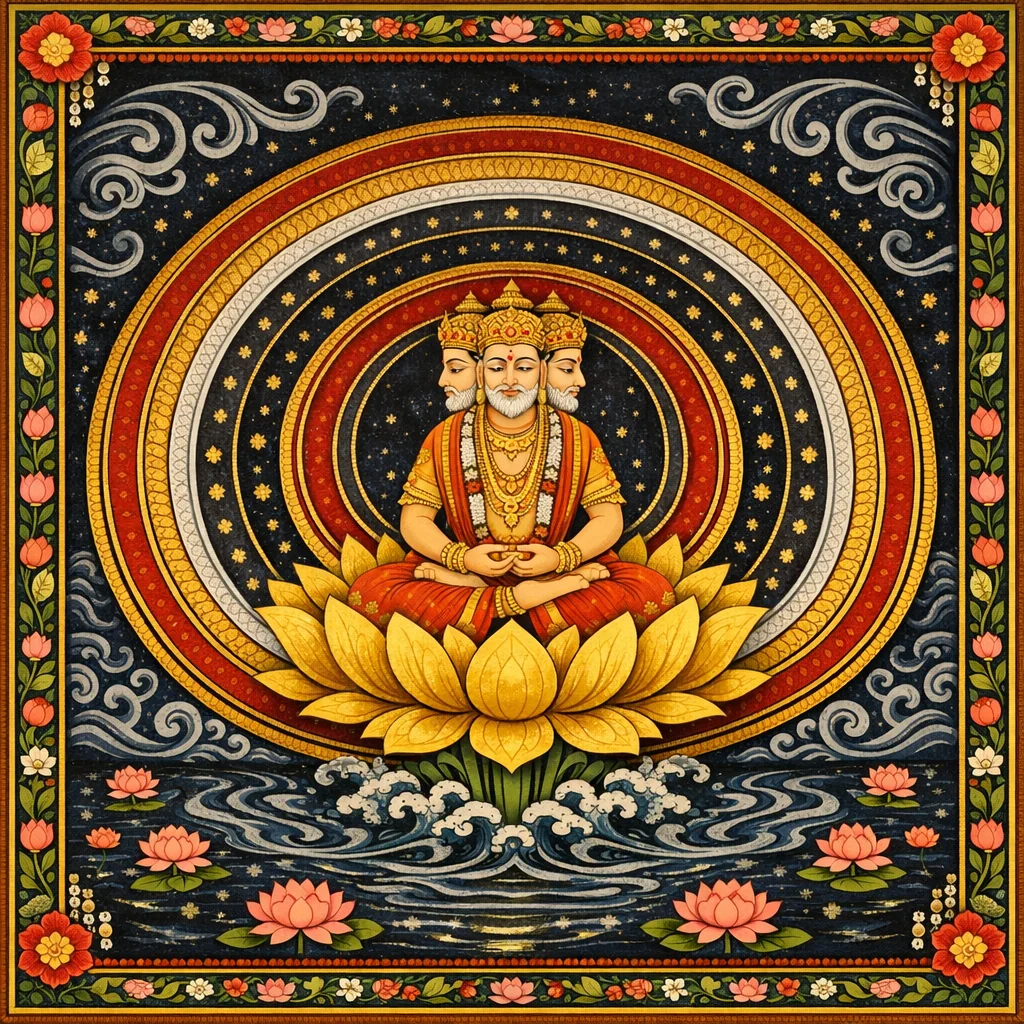
Verse 2
ये च मे भगवन् पृष्टास्त्वय्यर्था बहुवित्तम । तान् वदस्वानुपूर्व्येण छिन्धि न: सर्वसंशयान् ॥ २ ॥
O greatly learned one, kindly eradicate all my doubts, and let me know of all that I have inquired from you from the beginning to the end.
Verse 3
सूत उवाच एवं सञ्चोदितस्तेन क्षत्त्रा कौषारविर्मुनि: । प्रीत: प्रत्याह तान् प्रश्नान् हृदिस्थानथ भार्गव ॥ ३ ॥
Sūta Gosvāmī said: O son of Bhṛgu, the great sage Maitreya Muni, thus hearing from Vidura, felt very much enlivened. Everything was in his heart, and thus he began to reply to the questions one after another.
Verse 4
मैत्रेय उवाच विरिञ्चोऽपि तथा चक्रे दिव्यं वर्षशतं तप: । आत्मन्यात्मानमावेश्य यथाह भगवानज: ॥ ४ ॥
The greatly learned sage Maitreya said: O Vidura, Brahmā thus engaged himself in penances for one hundred celestial years, as advised by the Personality of Godhead, and applied himself in devotional service to the Lord.
Verse 5
तद्विलोक्याब्जसम्भूतो वायुना यदधिष्ठित: । पद्ममम्भश्च तत्कालकृतवीर्येण कम्पितम् ॥ ५ ॥
Thereafter Brahmā saw that both the lotus on which he was situated and the water on which the lotus was growing were trembling due to a strong, violent wind.
Verse 6
तपसा ह्येधमानेन विद्यया चात्मसंस्थया । विवृद्धविज्ञानबलो न्यपाद् वायुं सहाम्भसा ॥ ६ ॥
Long penance and transcendental knowledge of self-realization had matured Brahmā in practical knowledge, and thus he drank the wind completely, along with the water.
Verse 7
तद्विलोक्य वियद्व्यापि पुष्करं यदधिष्ठितम् । अनेन लोकान् प्राग्लीनान् कल्पितास्मीत्यचिन्तयत् ॥ ७ ॥
Thereafter he saw that the lotus on which he was situated was spread throughout the universe, and he contemplated how to create all the planets, which were previously merged in that very same lotus.
Verse 8
पद्मकोशं तदाविश्य भगवत्कर्मचोदित: । एकं व्यभाङ्क्षीदुरुधा त्रिधा भाव्यं द्विसप्तधा ॥ ८ ॥
Thus engaged in the service of the Supreme Personality of Godhead, Lord Brahmā entered into the whorl of the lotus, and as it spread all over the universe he divided it into three divisions of worlds and later into fourteen divisions.
Verse 9
एतावाञ्जीवलोकस्य संस्थाभेद: समाहृत: । धर्मस्य ह्यनिमित्तस्य विपाक: परमेष्ठ्यसौ ॥ ९ ॥
Lord Brahmā is the most exalted personality in the universe because of his causeless devotional service unto the Lord in mature transcendental knowledge. He therefore created all the fourteen planetary divisions for inhabitation by the different types of living entities.
Verse 10
विदुर उवाच यथात्थ बहुरूपस्य हरेरद्भुतकर्मण: । कालाख्यं लक्षणं ब्रह्मन् यथा वर्णय न: प्रभो ॥ १० ॥
Vidura inquired from Maitreya: O my lord, O greatly learned sage, kindly describe eternal time, which is another form of the Supreme Lord, the wonderful actor. What are the symptoms of that eternal time? Please describe them to us in detail.
Verse 11
मैत्रेय उवाच गुणव्यतिकराकारो निर्विशेषोऽप्रतिष्ठित: । पुरुषस्तदुपादानमात्मानं लीलयासृजत् ॥ ११ ॥
Maitreya said: Eternal time is the primeval source of the interactions of the three modes of material nature. It is unchangeable and limitless, and it works as the instrument of the Supreme Personality of Godhead for His pastimes in the material creation.
Verse 12
विश्वं वै ब्रह्मतन्मात्रं संस्थितं विष्णुमायया । ईश्वरेण परिच्छिन्नं कालेनाव्यक्तमूर्तिना ॥ १२ ॥
This cosmic manifestation is separated from the Supreme Lord as material energy by means of kāla, which is the unmanifested, impersonal feature of the Lord. It is situated as the objective manifestation of the Lord under the influence of the same material energy of Viṣṇu.
Verse 13
यथेदानीं तथाग्रे च पश्चादप्येतदीदृशम् ॥ १३ ॥
This cosmic manifestation is as it is now, it was the same in the past, and it will continue in the same way in the future.
Verse 14
सर्गो नवविधस्तस्य प्राकृतो वैकृतस्तु य: । कालद्रव्यगुणैरस्य त्रिविध: प्रतिसंक्रम: ॥ १४ ॥
There are nine different kinds of creations besides the one which naturally occurs due to the interactions of the modes. There are three kinds of annihilations due to eternal time, the material elements and the quality of one’s work.
Verse 15
आद्यस्तु महत: सर्गो गुणवैषम्यमात्मन: । द्वितीयस्त्वहमो यत्र द्रव्यज्ञानक्रियोदय: ॥ १५ ॥
Of the nine creations, the first one is the creation of the mahat-tattva, or the sum total of the material ingredients, wherein the modes interact due to the presence of the Supreme Lord. In the second, the false ego is generated, in which the material ingredients, material knowledge and material activities arise.
Verse 16
भूतसर्गस्तृतीयस्तु तन्मात्रो द्रव्यशक्तिमान् । चतुर्थ ऐन्द्रिय: सर्गो यस्तु ज्ञानक्रियात्मक: ॥ १६ ॥
The sense perceptions are created in the third creation, and from these the elements are generated. The fourth creation is the creation of knowledge and of working capacity.
Verse 17
वैकारिको देवसर्ग: पञ्चमो यन्मयं मन: । पष्ठस्तु तमस: सर्गो यस्त्वबुद्धिकृत: प्रभो: ॥ १७ ॥
The fifth creation is that of the controlling deities by the interaction of the mode of goodness, of which the mind is the sum total. The sixth creation is the ignorant darkness of the living entity, by which the master acts as a fool.
Verse 18
षडिमे प्राकृता: सर्गा वैकृतानपि मे शृणु । रजोभाजो भगवतो लीलेयं हरिमेधस: ॥ १८ ॥
All the above are natural creations by the external energy of the Lord. Now hear from me about the creations by Brahmā, who is an incarnation of the mode of passion and who, in the matter of creation, has a brain like that of the Personality of Godhead.
Verse 19
सप्तमो मुख्यसर्गस्तु षङ्विधस्तस्थुषां च य: । वनस्पत्योषधिलतात्वक्सारा वीरुधो द्रुमा: ॥ १९ ॥
The seventh creation is that of the immovable entities, which are of six kinds: the fruit trees without flowers, trees and plants which exist until the fruit is ripe, creepers, pipe plants, creepers which have no support, and trees with flowers and fruits.
Verse 20
उत्स्रोतसस्तम:प्राया अन्त:स्पर्शा विशेषिण: ॥ २० ॥
All the immovable trees and plants seek their subsistence upwards. They are almost unconscious but have feelings of pain within. They are manifested in variegatedness.
Verse 21
तिरश्चामष्टम: सर्ग: सोऽष्टाविंशद्विधो मत: । अविदो भूरितमसो घ्राणज्ञा ह्यद्यवेदिन: ॥ २१ ॥
The eighth creation is that of the lower species of life, and they are of different varieties, numbering twenty-eight. They are all extensively foolish and ignorant. They know their desirables by smell, but are unable to remember anything within the heart.
Verse 22
गौरजो महिष: कृष्ण: सूकरो गवयो रुरु: । द्विशफा: पशवश्चेमे अविरुष्ट्रश्च सत्तम ॥ २२ ॥
O purest Vidura, of the lower animals the cow, goat, buffalo, kṛṣṇa stag, hog, gavaya animal, deer, lamb and camel all have cloven hooves.
Verse 23
खरोऽश्वोऽश्वतरो गौर: शरभश्चमरी तथा । एते चैकशफा: क्षत्त: शृणु पञ्चनखान् पशून् ॥ २३ ॥
The horse, mule, ass, gaura, śarabha bison and wild cow all have only one hoof. Now you may hear from me about the animals who have five nails.
Verse 24
श्वा सृगालो वृको व्याघ्रो मार्जार: शशशल्लकौ । सिंह: कपिर्गज: कूर्मो गोधा च मकरादय: ॥ २४ ॥
The dog, jackal, tiger, fox, cat, rabbit, sajāru, lion, monkey, elephant, tortoise, alligator, gosāpa, etc., all have five nails in their claws. They are known as pañca-nakhas, or animals having five nails.
Verse 25
कङ्कगृधबकश्येनभासभल्लूकबर्हिण: । हंससारसचक्राह्वकाकोलूकादय: खगा: ॥ २५ ॥
The heron, vulture, crane, hawk, bhāsa, bhallūka, peacock, swan, sārasa, cakravāka, crow, owl and others are the birds.
Verse 26
अर्वाक्स्रोतस्तु नवम: क्षत्तरेकविधो नृणाम् । रजोऽधिका: कर्मपरा दु:खे च सुखमानिन: ॥ २६ ॥
The creation of the human beings, who are of one species only and who stock their eatables in the belly, is the ninth in the rotation. In the human race, the mode of passion is very prominent. Humans are always busy in the midst of miserable life, but they think themselves happy in all respects.
Verse 27
वैकृतास्रय एवैते देवसर्गश्च सत्तम । वैकारिकस्तु य: प्रोक्त: कौमारस्तूभयात्मक: ॥ २७ ॥
O good Vidura, these last three creations and the creation of demigods (the tenth creation) are vaikṛta creations, which are different from the previously described prākṛta (natural) creations. The appearance of the Kumāras is both.
Verse 28
देवसर्गश्चाष्टविधो विबुधा: पितरोऽसुरा: । गन्धर्वाप्सरस: सिद्धा यक्षरक्षांसि चारणा: ॥ २८ ॥ भूतप्रेतपिशाचाश्च विद्याध्रा: किन्नरादय: । दशैते विदुराख्याता: सर्गास्ते विश्वसृक्कृता: ॥ २९ ॥
The creation of the demigods is of eight varieties: (1) the demigods, (2) the forefathers, (3) the asuras, or demons, (4) the Gandharvas and Apsarās, or angels, (5) the Yakṣas and Rākṣasas, (6) the Siddhas, Cāraṇas and Vidyādharas, (7) the Bhūtas, Pretas and Piśācas, and (8) the superhuman beings, celestial singers, etc. All are created by Brahmā, the creator of the universe.
Verse 29
देवसर्गश्चाष्टविधो विबुधा: पितरोऽसुरा: । गन्धर्वाप्सरस: सिद्धा यक्षरक्षांसि चारणा: ॥ २८ ॥ भूतप्रेतपिशाचाश्च विद्याध्रा: किन्नरादय: । दशैते विदुराख्याता: सर्गास्ते विश्वसृक्कृता: ॥ २९ ॥
The creation of the demigods is of eight varieties: (1) the demigods, (2) the forefathers, (3) the asuras, or demons, (4) the Gandharvas and Apsarās, or angels, (5) the Yakṣas and Rākṣasas, (6) the Siddhas, Cāraṇas and Vidyādharas, (7) the Bhūtas, Pretas and Piśācas, and (8) the superhuman beings, celestial singers, etc. All are created by Brahmā, the creator of the universe.
Verse 30
अत: परं प्रवक्ष्यामि वंशान्मन्वन्तराणि च । एवं रज:प्लुत: स्रष्टा कल्पादिष्वात्मभूर्हरि: । सृजत्यमोघसङ्कल्प आत्मैवात्मानमात्मना ॥ ३० ॥
Now I shall describe the descendants of the Manus. The creator, Brahmā, as the incarnation of the passion mode of the Personality of Godhead, creates the universal affairs with unfailing desires in every millennium by the force of the Lord’s energy.
Frequently Asked Questions
Kāla is described as beginningless, unchangeable, and limitless, functioning as the Supreme Lord’s instrument for material pastimes. It catalyzes the interaction of the three guṇas and thereby enables manifestation, transformation, and dissolution within material nature. Although impersonal as an unmanifest feature, it operates under the Lord’s supremacy, not independently.
Because the primary ingredients (mahat-tattva, guṇas, and the causal framework) arise under the Supreme Lord’s presence and kāla. Brahmā then organizes and populates—dividing cosmic space into planetary systems and producing species categories—using intelligence and potency received through devotion and the Lord’s energy.
The chapter enumerates a sequence beginning with mahat-tattva and then ahaṅkāra, followed by the development of sense perception and the elements, the creation of knowledge and working capacity, and the presiding deities (with mind as the sum total in sattva), alongside the ignorance/delusion aspect affecting the jīva. These are described as prākṛta (natural) creations of the Lord’s external energy, prior to Brahmā’s more specific vaikṛta productions of species and administrators.
It presents Brahmā’s seventh to tenth creations as categories: immovable life (six kinds), lower species (twenty-eight varieties), birds, humans, and the eightfold classes of demigods and related beings (including pitṛs, asuras, gandharvas/apsarās, yakṣas/rākṣasas, siddhas/cāraṇas/vidyādharas, bhūtas/pretas/piśācas, and other celestial beings). The taxonomy highlights gradations of consciousness and guṇa influence, with humans marked by prominent rajas.