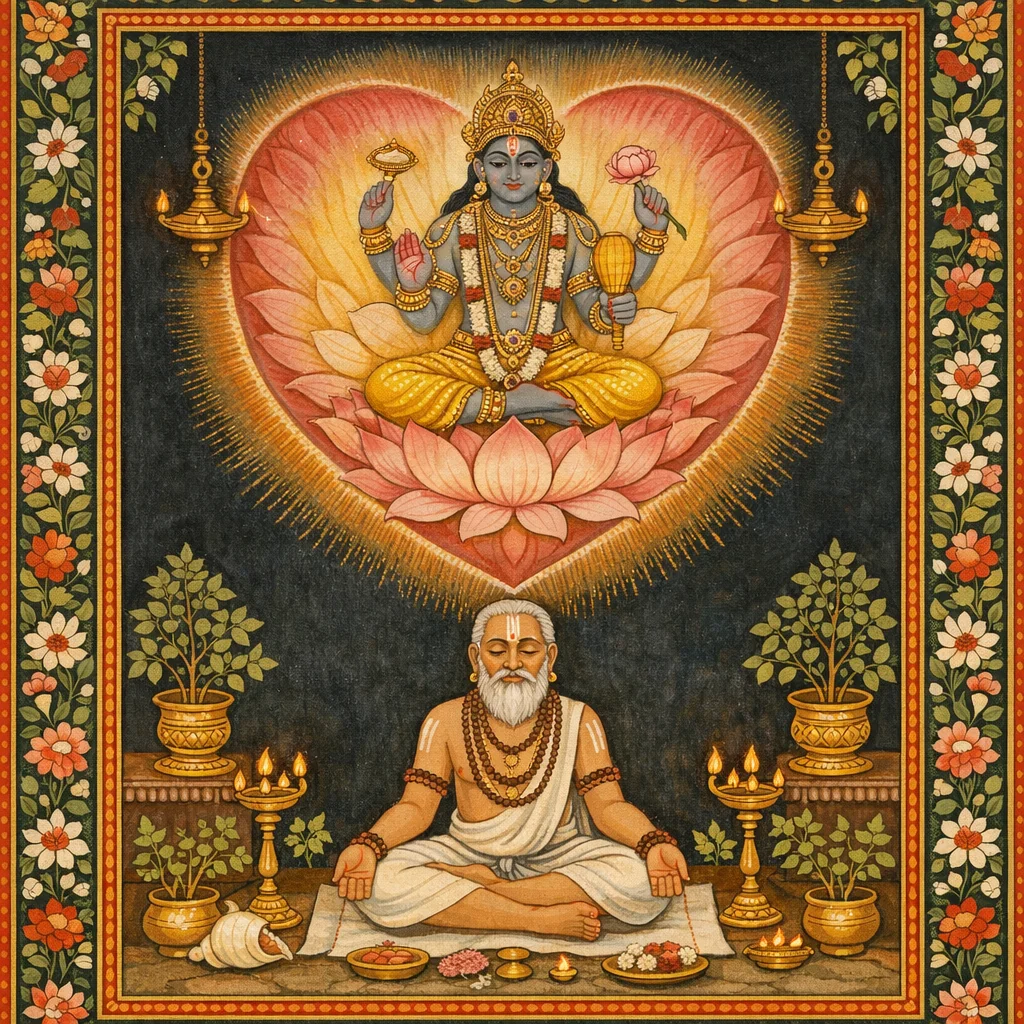
Adhyaya 28
Kapila Describes Bhakti-Saturated Aṣṭāṅga-Yoga and Meditation on the Lord’s Form
Continuing Kapila’s liberating instructions to Devahūti, this chapter shifts from foundational sāṅkhya discernment to a practical sādhana-map for inner absorption (samādhi). Kapila begins with preparatory dharma: performing one’s allotted duty, contentment by the Lord’s grace, and surrender to the spiritual master. He then outlines yama-niyama-like virtues—nonviolence, truthfulness, austerity, cleanliness, Vedic study—followed by posture, breath regulation, sense-withdrawal, and concentration within the heart. The yogī is guided to meditate on Viṣṇu’s personal form in a deliberate limb-by-limb progression (from lotus feet upward), transforming attention into devotion and culminating in prema-bhakti symptoms. The result is a mind freed from guṇic reactions, realizing the difference between self, body, and false ego, and perceiving the same soul in all beings as energies of the Supreme. This chapter thus bridges earlier analytical teaching to the next stages of realized detachment and God-centered vision, showing yoga’s perfection as bhakti-driven samādhi beyond māyā.
Shlokas
Verse 1
श्रीभगवानुवाच योगस्य लक्षणं वक्ष्ये सबीजस्य नृपात्मजे । मनो येनैव विधिना प्रसन्नं याति सत्पथम् ॥ १ ॥
The Personality of Godhead said: My dear mother, O daughter of the King, now I shall explain to you the system of yoga, the object of which is to concentrate the mind. By practicing this system one can become joyful and progressively advance towards the path of the Absolute Truth.
Verse 2
स्वधर्माचरणं शक्त्या विधर्माच्च निवर्तनम् । दैवाल्लब्धेन सन्तोष आत्मविच्चरणार्चनम् ॥ २ ॥
One should execute his prescribed duties to the best of his ability and avoid performing duties not allotted to him. One should be satisfied with as much gain as he achieves by the grace of the Lord, and one should worship the lotus feet of a spiritual master.
Verse 3
ग्राम्यधर्मनिवृत्तिश्च मोक्षधर्मरतिस्तथा । मितमेध्यादनं शश्वद्विविक्तक्षेमसेवनम् ॥ ३ ॥
One should cease performing conventional religious practices and should be attracted to those which lead to salvation. One should eat very frugally and should always remain secluded so that he can achieve the highest perfection of life.
Verse 4
अहिंसा सत्यमस्तेयं यावदर्थपरिग्रह: । ब्रह्मचर्यं तप: शौचं स्वाध्याय: पुरुषार्चनम् ॥ ४ ॥
One should practice nonviolence and truthfulness, should avoid thieving and be satisfied with possessing as much as he needs for his maintenance. He should abstain from sex life, perform austerity, be clean, study the Vedas and worship the supreme form of the Supreme Personality of Godhead.
Verse 5
मौनं सदासनजय: स्थैर्यं प्राणजय: शनै: । प्रत्याहारश्चेन्द्रियाणां विषयान्मनसा हृदि ॥ ५ ॥
One must observe silence, acquire steadiness by practicing different yogic postures, control the breathing of the vital air, withdraw the senses from sense objects and thus concentrate the mind on the heart.
Verse 6
स्वधिष्ण्यानामेकदेशे मनसा प्राणधारणम् । वैकुण्ठलीलाभिध्यानं समाधानं तथात्मन: ॥ ६ ॥
Fixing the vital air and the mind in one of the six circles of vital air circulation within the body, thus concentrating one’s mind on the transcendental pastimes of the Supreme Personality of Godhead, is called samādhi, or samādhāna, of the mind.
Verse 7
एतैरन्यैश्च पथिभिर्मनो दुष्टमसत्पथम् । बुद्ध्या युञ्जीत शनकैर्जितप्राणो ह्यतन्द्रित: ॥ ७ ॥
By these processes, or any other true process, one must control the contaminated, unbridled mind, which is always attracted by material enjoyment, and thus fix himself in thought of the Supreme Personality of Godhead.
Verse 8
शुचौ देशे प्रतिष्ठाप्य विजितासन आसनम् । तस्मिन्स्वस्ति समासीन ऋजुकाय: समभ्यसेत् ॥ ८ ॥
After controlling one’s mind and sitting postures, one should spread a seat in a secluded and sanctified place, sit there in an easy posture, keeping the body erect, and practice breath control.
Verse 9
प्राणस्य शोधयेन्मार्गं पूरकुम्भकरेचकै: । प्रतिकूलेन वा चित्तं यथा स्थिरमचञ्चलम् ॥ ९ ॥
The yogī should clear the passage of vital air by breathing in the following manner: first he should inhale very deeply, then hold the breath in, and finally exhale. Or, reversing the process, the yogi can first exhale, then hold the breath outside, and finally inhale. This is done so that the mind may become steady and free from external disturbances.
Verse 10
मनोऽचिरात्स्याद्विरजं जितश्वासस्य योगिन: । वाय्वग्निभ्यां यथा लोहं ध्मातं त्यजति वै मलम् ॥ १० ॥
The yogīs who practice such breathing exercises are very soon freed from all mental disturbances, just as gold, when put into fire and fanned with air, becomes free from all impurities.
Verse 11
प्राणायामैर्दहेद्दोषान्धारणाभिश्च किल्बिषान् । प्रत्याहारेण संसर्गान्ध्यानेनानीश्वरान्गुणान् ॥ ११ ॥
By practicing the process of prāṇāyāma, one can eradicate the contamination of his physiological condition, and by concentrating the mind one can become free from all sinful activities. By restraining the senses one can free himself from material association, and by meditating on the Supreme Personality of Godhead one can become free from the three modes of material attachment.
Verse 12
यदा मन: स्वं विरजं योगेन सुसमाहितम् । काष्ठां भगवतो ध्यायेत्स्वनासाग्रावलोकन: ॥ १२ ॥
When the mind is perfectly purified by this practice of yoga, one should concentrate on the tip of the nose with half-closed eyes and see the form of the Supreme Personality of Godhead.
Verse 13
प्रसन्नवदनाम्भोजं पद्मगर्भारुणेक्षणम् । नीलोत्पलदलश्यामं शङ्खचक्रगदाधरम् ॥ १३ ॥
The Supreme Personality of Godhead has a cheerful, lotuslike countenance with ruddy eyes like the interior of a lotus, and a swarthy body like the petals of a blue lotus. He bears a conch, discus and mace in three of His hands.
Verse 14
लसत्पङ्कजकिञ्जल्कपीतकौशेयवाससम् । श्रीवत्सवक्षसं भ्राजत्कौस्तुभामुक्तकन्धरम् ॥ १४ ॥
His loins are covered by a shining cloth, yellowish like the filaments of a lotus. On His breast He bears the mark of Śrīvatsa, a curl of white hair. The brilliant Kaustubha gem is suspended from His neck.
Verse 15
मत्तद्विरेफकलया परीतं वनमालया । परार्ध्यहारवलयकिरीटाङ्गदनूपुरम् ॥ १५ ॥
He also wears around His neck a garland of attractive sylvan flowers, and a swarm of bees, intoxicated by its delicious fragrance, hums about the garland. He is further superbly adorned with a pearl necklace, a crown and pairs of armlets, bracelets and anklets.
Verse 16
काञ्चीगुणोल्लसच्छ्रोणिं हृदयाम्भोजविष्टरम् । दर्शनीयतमं शान्तं मनोनयनवर्धनम् ॥ १६ ॥
His loins and hips encircled by a girdle, He stands on the lotus of His devotee’s heart. He is most charming to look at, and His serene aspect gladdens the eyes and souls of the devotees who behold Him.
Verse 17
अपीच्यदर्शनं शश्वत्सर्वलोकनमस्कृतम् । सन्तं वयसि कैशोरे भृत्यानुग्रहकातरम् ॥ १७ ॥
The Lord is eternally very beautiful, and He is worshipable by all the inhabitants of every planet. He is ever youthful and always eager to bestow His blessing upon His devotees.
Verse 18
कीर्तन्यतीर्थयशसं पुण्यश्लोकयशस्करम् । ध्यायेद्देवं समग्राङ्गं यावन्न च्यवते मन: ॥ १८ ॥
The glory of the Lord is always worth singing, for His glories enhance the glories of His devotees. One should therefore meditate upon the Supreme Personality of Godhead and upon His devotees. One should meditate on the eternal form of the Lord until the mind becomes fixed.
Verse 19
स्थितं व्रजन्तमासीनं शयानं वा गुहाशयम् । प्रेक्षणीयेहितं ध्यायेच्छुद्धभावेन चेतसा ॥ १९ ॥
Thus always merged in devotional service, the yogī visualizes the Lord standing, moving, lying down or sitting within him, for the pastimes of the Supreme Lord are always beautiful and attractive.
Verse 20
तस्मिँल्लब्धपदं चित्तं सर्वावयवसंस्थितम् । विलक्ष्यैकत्र संयुज्यादङ्गे भगवतो मुनि: ॥ २० ॥
In fixing his mind on the eternal form of the Lord, the yogī should not take a collective view of all His limbs, but should fix the mind on each individual limb of the Lord.
Verse 21
सञ्चिन्तयेद्भगवतश्चरणारविन्दं वज्राङ्कुशध्वजसरोरुहलाञ्छनाढ्यम् । उत्तुङ्गरक्तविलसन्नखचक्रवाल- ज्योत्स्नाभिराहतमहद्धृदयान्धकारम् ॥ २१ ॥
The devotee should first concentrate his mind on the Lord’s lotus feet, which are adorned with the marks of a thunderbolt, a goad, a banner and a lotus. The splendor of their beautiful ruby nails resembles the orb of the moon and dispels the thick gloom of one’s heart.
Verse 22
यच्छौचनि:सृतसरित्प्रवरोदकेन तीर्थेन मूर्ध्न्यधिकृतेन शिव: शिवोऽभूत् । ध्यातुर्मन:शमलशैलनिसृष्टवज्रं ध्यायेच्चिरं भगवतश्चरणारविन्दम् ॥ २२ ॥
The blessed Lord Śiva becomes all the more blessed by bearing on his head the holy waters of the Ganges, which has its source in the water that washed the Lord’s lotus feet. The Lord’s feet act like thunderbolts hurled to shatter the mountain of sin stored in the mind of the meditating devotee. One should therefore meditate on the lotus feet of the Lord for a long time.
Verse 23
जानुद्वयं जलजलोचनया जनन्या लक्ष्म्याखिलस्य सुरवन्दितया विधातु: । ऊर्वोर्निधाय करपल्लवरोचिषा यत् संलालितं हृदि विभोरभवस्य कुर्यात् ॥ २३ ॥
The yogī should fix in his heart the activities of Lakṣmī, the goddess of fortune, who is worshiped by all demigods and is the mother of the supreme person, Brahmā. She can always be found massaging the legs and thighs of the transcendental Lord, very carefully serving Him in this way.
Verse 24
ऊरू सुपर्णभुजयोरधिशोभमानाव्- ओजोनिधी अतसिकाकुसुमावभासौ । व्यालम्बिपीतवरवाससि वर्तमान काञ्चीकलापपरिरम्भि नितम्बबिम्बम् ॥ २४ ॥
Next, the yogi should fix his mind in meditation on the Personality of Godhead’s thighs, the storehouse of all energy. The Lord’s thighs are whitish blue, like the luster of the linseed flower, and appear most graceful when the Lord is carried on the shoulders of Garuḍa. Also the yogī should contemplate His rounded hips, which are encircled by a girdle that rests on the exquisite yellow silk cloth that extends down to His ankles.
Verse 25
नाभिह्रदं भुवनकोशगुहोदरस्थं यत्रात्मयोनिधिषणाखिललोकपद्मम् । व्यूढं हरिन्मणिवृषस्तनयोरमुष्य ध्यायेद्द्वयं विशदहारमयूखगौरम् ॥ २५ ॥
The yogī should then meditate on His moonlike navel in the center of His abdomen. From His navel, which is the foundation of the entire universe, sprang the lotus stem containing all the different planetary systems. The lotus is the residence of Brahmā, the first created being. In the same way, the yogī should concentrate his mind on the Lord’s nipples, which resemble a pair of most exquisite emeralds and which appear whitish because of the rays of the milk-white pearl necklaces adorning His chest.
Verse 26
वक्षोऽधिवासमृषभस्य महाविभूते: पुंसां मनोनयननिर्वृतिमादधानम् । कण्ठं च कौस्तुभमणेरधिभूषणार्थं कुर्यान्मनस्यखिललोकनमस्कृतस्य ॥ २६ ॥
The yogī should then meditate on the chest of the Supreme Personality of Godhead, the abode of goddess Mahā-Lakṣmī. The Lord’s chest is the source of all transcendental pleasure for the mind and full satisfaction for the eyes. The yogī should then imprint on his mind the neck of the Personality of Godhead, who is adored by the entire universe. The neck of the Lord serves to enhance the beauty of the Kaustubha gem, which hangs on His chest.
Verse 27
बाहूंश्च मन्दरगिरे: परिवर्तनेन निर्णिक्तबाहुवलयानधिलोकपालान् । सञ्चिन्तयेद्दशशतारमसह्यतेज: शङ्खं च तत्करसरोरुहराजहंसम् ॥ २७ ॥
The yogī should further meditate upon the Lord’s four arms, which are the source of all the powers of the demigods who control the various functions of material nature. Then the yogi should concentrate on the polished ornaments, which were burnished by Mount Mandara as it revolved. He should also duly contemplate the Lord’s discus, the Sudarśana cakra, which contains one thousand spokes and a dazzling luster, as well as the conch, which looks like a swan in His lotuslike palm.
Verse 28
कौमोदकीं भगवतो दयितां स्मरेत दिग्धामरातिभटशोणितकर्दमेन । मालां मधुव्रतवरूथगिरोपघुष्टां चैत्यस्य तत्त्वममलं मणिमस्य कण्ठे ॥ २८ ॥
The yogī should meditate upon His club, which is named Kaumodakī and is very dear to Him. This club smashes the demons, who are always inimical soldiers, and is smeared with their blood. One should also concentrate on the nice garland on the neck of the Lord, which is always surrounded by bumblebees, with their nice buzzing sound, and one should meditate upon the pearl necklace on the Lord’s neck, which is considered to represent the pure living entities who are always engaged in His service.
Verse 29
भृत्यानुकम्पितधियेह गृहीतमूर्ते: सञ्चिन्तयेद्भगवतो वदनारविन्दम् । यद्विस्फुरन्मकरकुण्डलवल्गितेन विद्योतितामलकपोलमुदारनासम् ॥ २९ ॥
The yogī should then meditate on the lotuslike countenance of the Lord, who presents His different forms in this world out of compassion for the anxious devotees. His nose is prominent, and His crystal-clear cheeks are illuminated by the oscillation of His glittering alligator-shaped earrings.
Verse 30
यच्छ्रीनिकेतमलिभि: परिसेव्यमानं भूत्या स्वया कुटिलकुन्तलवृन्दजुष्टम् । मीनद्वयाश्रयमधिक्षिपदब्जनेत्रं ध्यायेन्मनोमयमतन्द्रित उल्लसद्भ्रु ॥ ३० ॥
The yogi then meditates upon the beautiful face of the Lord, which is adorned with curly hair and decorated by lotuslike eyes and dancing eyebrows. A lotus surrounded by swarming bees and a pair of swimming fish would be put to shame by its elegance.
Verse 31
तस्यावलोकमधिकं कृपयातिघोर- तापत्रयोपशमनाय निसृष्टमक्ष्णो: । स्निग्धस्मितानुगुणितं विपुलप्रसादं ध्यायेच्चिरं विपुलभावनया गुहायाम् ॥ ३१ ॥
The yogīs should contemplate with full devotion the compassionate glances frequently cast by the Lord’s eyes, for they soothe the most fearful threefold agonies of His devotees. His glances, accompanied by loving smiles, are full of abundant grace.
Verse 32
हासं हरेरवनताखिललोकतीव्र- शोकाश्रुसागरविशोषणमत्युदारम् । सम्मोहनाय रचितं निजमाययास्य भ्रूमण्डलं मुनिकृते मकरध्वजस्य ॥ ३२ ॥
A yogī should similarly meditate on the most benevolent smile of Lord Śrī Hari, a smile which, for all those who bow to Him, dries away the ocean of tears caused by intense grief. The yogī should also meditate on the Lord’s arched eyebrows, which are manifested by His internal potency in order to charm the sex-god for the good of the sages.
Verse 33
ध्यानायनं प्रहसितं बहुलाधरोष्ठ- भासारुणायिततनुद्विजकुन्दपङ्क्ति । ध्यायेत्स्वदेहकुहरेऽवसितस्य विष्णोर् भक्त्यार्द्रयार्पितमना न पृथग्दिदृक्षेत् ॥ ३३ ॥
With devotion steeped in love and affection, the yogī should meditate within the core of his heart upon the laughter of Lord Viṣṇu. The laughter of Viṣṇu is so captivating that it can be easily meditated upon. When the Supreme Lord is laughing, one can see His small teeth, which resemble jasmine buds rendered rosy by the splendor of His lips. Once devoting his mind to this, the yogī should no longer desire to see anything else.
Verse 34
एवं हरौ भगवति प्रतिलब्धभावो भक्त्या द्रवद्धृदय उत्पुलक: प्रमोदात् । औत्कण्ठ्यबाष्पकलया मुहुरर्द्यमानस् तच्चापि चित्तबडिशं शनकैर्वियुङ्क्ते ॥ ३४ ॥
By following this course, the yogī gradually develops pure love for the Supreme Personality of Godhead, Hari. In the course of his progress in devotional service, the hairs on his body stand erect through excessive joy, and he is constantly bathed in a stream of tears occasioned by intense love. Gradually, even the mind, which he used as a means to attract the Lord, as one attracts a fish to a hook, withdraws from material activity.
Verse 35
मुक्ताश्रयं यर्हि निर्विषयं विरक्तं निर्वाणमृच्छति मन: सहसा यथार्चि: । आत्मानमत्र पुरुषोऽव्यवधानमेकम् अन्वीक्षते प्रतिनिवृत्तगुणप्रवाह: ॥ ३५ ॥
When the mind is thus completely freed from all material contamination and detached from material objectives, it is just like the flame of a lamp. At that time the mind is actually dovetailed with that of the Supreme Lord and is experienced as one with Him because it is freed from the interactive flow of the material qualities.
Verse 36
सोऽप्येतया चरमया मनसो निवृत्त्या तस्मिन्महिम्न्यवसित: सुखदु:खबाह्ये । हेतुत्वमप्यसति कर्तरि दु:खयोर्यत् स्वात्मन्विधत्त उपलब्धपरात्मकाष्ठ: ॥ ३६ ॥
Thus situated in the highest transcendental stage, the mind ceases from all material reaction and becomes situated in its own glory, transcendental to all material conceptions of happiness and distress. At that time the yogī realizes the truth of his relationship with the Supreme Personality of Godhead. He discovers that pleasure and pain as well as their interactions, which he attributed to his own self, are actually due to the false ego, which is a product of ignorance.
Verse 37
देहं च तं न चरम: स्थितमुत्थितं वा सिद्धो विपश्यति यतोऽध्यगमत्स्वरूपम् । दैवादुपेतमथ दैववशादपेतं वासो यथा परिकृतं मदिरामदान्ध: ॥ ३७ ॥
Because he has achieved his real identity, the perfectly realized soul has no conception of how the material body is moving or acting, just as an intoxicated person cannot understand whether or not he has clothing on his body.
Verse 38
देहोऽपि दैववशग: खलु कर्म यावत् स्वारम्भकं प्रतिसमीक्षत एव सासु: । तं सप्रपञ्चमधिरूढसमाधियोग: स्वाप्नं पुनर्न भजते प्रतिबुद्धवस्तु: ॥ ३८ ॥
The body of such a liberated yogī, along with the senses, is taken charge of by the Supreme Personality of Godhead, and it functions until its destined activities are finished. The liberated devotee, being awake to his constitutional position and thus situated in samādhi, the highest perfectional stage of yoga, does not accept the by-products of the material body as his own. Thus he considers his bodily activities to be like the activities of a body in a dream.
Verse 39
यथा पुत्राच्च वित्ताच्च पृथङ्मर्त्य: प्रतीयते । अप्यात्मत्वेनाभिमताद्देहादे: पुरुषस्तथा ॥ ३९ ॥
Because of great affection for family and wealth, one accepts a son and some money as his own, and due to affection for the material body, one thinks that it is his. But actually, as one can understand that his family and wealth are different from him, the liberated soul can understand that he and his body are not the same.
Verse 40
यथोल्मुकाद्विस्फुलिङ्गाद्धूमाद्वापि स्वसम्भवात् । अप्यात्मत्वेनाभिमताद्यथाग्नि: पृथगुल्मुकात् ॥ ४० ॥
The blazing fire is different from the flames, from the sparks and from the smoke, although all are intimately connected because they are born from the same blazing wood.
Verse 41
भूतेन्द्रियान्त:करणात्प्रधानाज्जीवसंज्ञितात् । आत्मा तथा पृथग्द्रष्टा भगवान्ब्रह्मसंज्ञित: ॥ ४१ ॥
The Supreme Personality of Godhead, who is known as Parambrahma, is the seer. He is different from the jīva soul, or individual living entity, who is combined with the senses, the five elements and consciousness.
Verse 42
सर्वभूतेषु चात्मानं सर्वभूतानि चात्मनि । ईक्षेतानन्यभावेन भूतेष्विव तदात्मताम् ॥ ४२ ॥
A yogi should see the same soul in all manifestations, for all that exists is a manifestation of different energies of the Supreme. In this way the devotee should see all living entities without distinction. That is realization of the Supreme Soul.
Verse 43
स्वयोनिषु यथा ज्योतिरेकं नाना प्रतीयते । योनीनां गुणवैषम्यात्तथात्मा प्रकृतौ स्थित: ॥ ४३ ॥
As fire is exhibited in different forms of wood, so, under different conditions of the modes of material nature, the pure spirit soul manifests itself in different bodies.
Verse 44
तस्मादिमां स्वां प्रकृतिं दैवीं सदसदात्मिकाम् । दुर्विभाव्यां पराभाव्य स्वरूपेणावतिष्ठते ॥ ४४ ॥
Thus the yogī can be in the self-realized position after conquering the insurmountable spell of māyā, who presents herself as both the cause and effect of this material manifestation and is therefore very difficult to understand.
Frequently Asked Questions
Kapila’s method culminates in personalist absorption: the purified mind beholds and serves the Supreme Lord’s eternal form (Viṣṇu/Hari) within the heart. The meditation is not on a formless absolute but on Bhagavān’s features, ornaments, weapons, and compassionate glances, and it matures into bhakti marked by love (prema), tears, and complete detachment from material desire.
Limb-by-limb meditation (aṅgaśaḥ dhyāna) stabilizes attention and prevents the mind from scattering. Each limb becomes a devotional anchor, drawing the mind from gross distraction to subtle absorption, until remembrance becomes continuous and affectionate—culminating in samādhi where the mind is fixed in Hari rather than in sense objects.
Prāṇāyāma is presented as a purificatory aid: it steadies the mind, clears disturbances, and supports sense-withdrawal and concentration. Kapila explains that regulated breath helps remove mental agitation and supports deeper meditation, but the chapter’s telos is devotion—meditating on the Lord until the heart is transformed.
Parambrahma, the Supreme Personality of Godhead, is the ultimate seer, distinct from the individual jīva who is associated with senses, elements, and conditioned consciousness. Realization means discerning that bodily pleasure and pain belong to false ego and guṇas, while the self is a dependent conscious being meant to be aligned with the Supreme.
The yogī recognizes all manifestations as energies (śakti) of the Supreme and thus sees living entities without material distinction. Like fire appearing differently according to wood and conditions, the same pure spirit is expressed through bodies shaped by the guṇas—leading to compassion and non-envious, spiritual equality.