Adhyaya 29
Bhakti Yoga: The Three Modes of Devotion, Non-Envy, and Time as the Lord
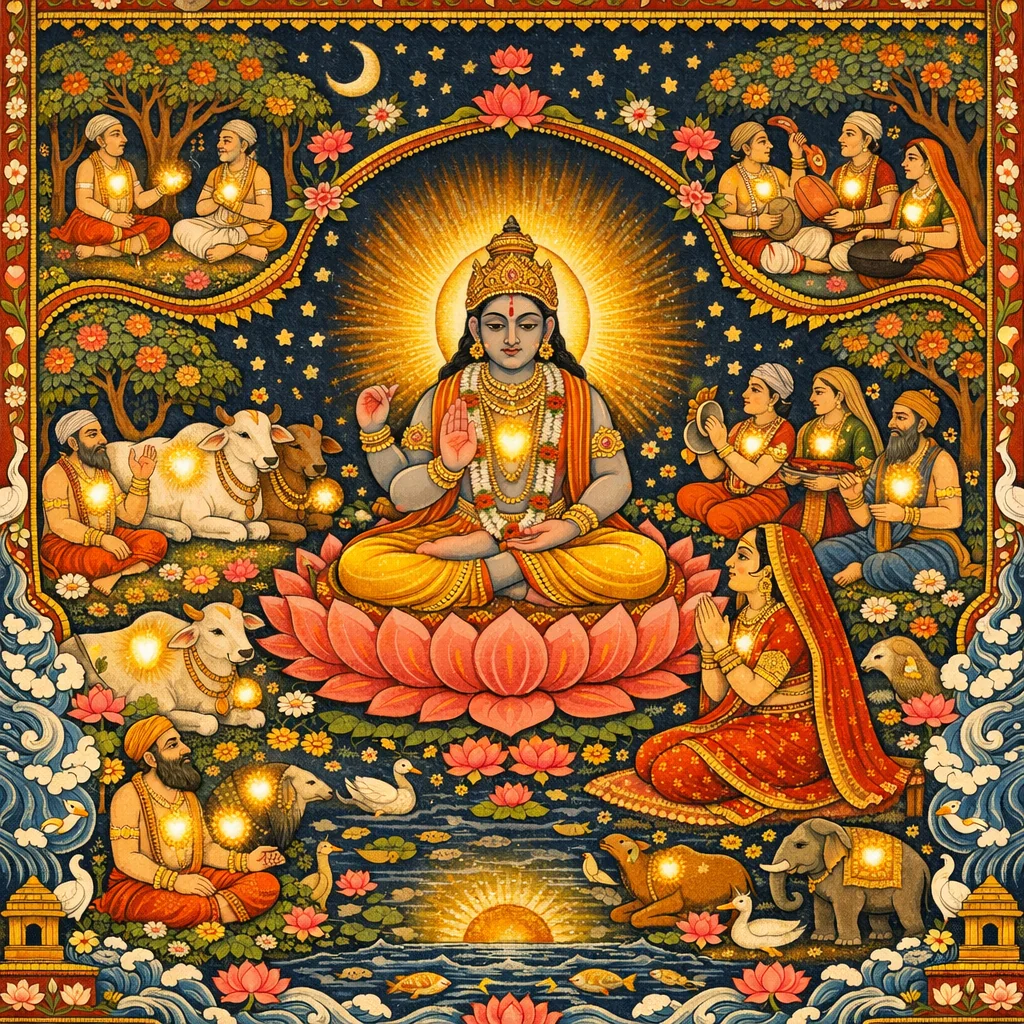
Continuing from Kapila’s Sāṅkhya exposition of matter and spirit, Devahūti requests the definitive path—devotional service—as well as teachings on saṁsāra (birth and death) and kāla (eternal time). Maitreya narrates Kapila’s compassionate reply: bhakti appears in gradations shaped by the guṇas—tāmasika devotion marked by envy and violence, rājasika devotion driven by enjoyment and prestige, and sāttvika devotion offered to cleanse fruitive intoxication. Kapila then defines śuddha-bhakti as spontaneous, uninterrupted attraction to hearing the Lord’s names and qualities, flowing naturally like Gaṅgā toward the ocean, and he notes that a pure devotee rejects even the five kinds of liberation. The chapter advances from temple worship to universal God-vision: Deity worship divorced from recognizing Paramātmā in all beings is condemned as imitation; true worship expresses non-envious respect and equal vision. Kapila ranks beings and human excellence to culminate in the pure devotee as सर्वोत्तम. The discourse then widens to cosmology: time is the Lord’s feature, feared by the ignorant, and all cosmic order operates ‘out of fear’ of Him, leading into deeper reflections on kāla and dissolution in subsequent teachings.
Shlokas
Verse 1
देवहूतिरुवाच लक्षणं महदादीनां प्रकृते: पुरुषस्य च । स्वरूपं लक्ष्यतेऽमीषां येन तत्पारमार्थिकम् ॥ १ ॥ यथा साङ्ख्येषु कथितं यन्मूलं तत्प्रचक्षते । भक्तियोगस्य मे मार्गं ब्रूहि विस्तरश: प्रभो ॥ २ ॥
Devahūti inquired: My dear Lord, You have already very scientifically described the symptoms of the total material nature and the characteristics of the spirit according to the Sāṅkhya system of philosophy. Now I shall request You to explain the path of devotional service, which is the ultimate end of all philosophical systems.
Verse 2
देवहूतिरुवाच लक्षणं महदादीनां प्रकृते: पुरुषस्य च । स्वरूपं लक्ष्यतेऽमीषां येन तत्पारमार्थिकम् ॥ १ ॥ यथा साङ्ख्येषु कथितं यन्मूलं तत्प्रचक्षते । भक्तियोगस्य मे मार्गं ब्रूहि विस्तरश: प्रभो ॥ २ ॥
Devahūti inquired: My dear Lord, You have already very scientifically described the symptoms of the total material nature and the characteristics of the spirit according to the Sāṅkhya system of philosophy. Now I shall request You to explain the path of devotional service, which is the ultimate end of all philosophical systems.
Verse 3
विरागो येन पुरुषो भगवन्सर्वतो भवेत् । आचक्ष्व जीवलोकस्य विविधा मम संसृती: ॥ ३ ॥
Devahūti continued: My dear Lord, please also describe in detail, both for me and for people in general, the continual process of birth and death, for by hearing of such calamities we may become detached from the activities of this material world.
Verse 4
कालस्येश्वररूपस्य परेषां च परस्य ते । स्वरूपं बत कुर्वन्ति यद्धेतो: कुशलं जना: ॥ ४ ॥
Please also describe eternal time, which is a representation of Your form and by whose influence people in general engage in the performance of pious activities.
Verse 5
लोकस्य मिथ्याभिमतेरचक्षुष- श्चिरं प्रसुप्तस्य तमस्यनाश्रये । श्रान्तस्य कर्मस्वनुविद्धया धिया त्वमाविरासी: किल योगभास्कर: ॥ ५ ॥
My dear Lord, You are just like the sun, for You illuminate the darkness of the conditional life of the living entities. Because their eyes of knowledge are not open, they are sleeping eternally in that darkness without Your shelter, and therefore they are falsely engaged by the actions and reactions of their material activities, and they appear to be very fatigued.
Verse 6
मैत्रेय उवाच इति मातुर्वच: श्लक्ष्णं प्रतिनन्द्य महामुनि: । आबभाषे कुरुश्रेष्ठ प्रीतस्तां करुणार्दित: ॥ ६ ॥
Śrī Maitreya said: O best amongst the Kurus, the great sage Kapila, moved by great compassion and pleased by the words of His glorious mother, spoke as follows.
Verse 7
श्रीभगवानुवाच भक्तियोगो बहुविधो मार्गैर्भामिनि भाव्यते । स्वभावगुणमार्गेण पुंसां भावो विभिद्यते ॥ ७ ॥
Lord Kapila, the Personality of Godhead, replied: O noble lady, there are multifarious paths of devotional service in terms of the different qualities of the executor.
Verse 8
अभिसन्धाय यो हिंसां दम्भं मात्सर्यमेव वा । संरम्भी भिन्नदृग्भावं मयि कुर्यात्स तामस: ॥ ८ ॥
Devotional service executed by a person who is envious, proud, violent and angry, and who is a separatist, is considered to be in the mode of darkness.
Verse 9
विषयानभिसन्धाय यश ऐश्वर्यमेव वा । अर्चादावर्चयेद्यो मां पृथग्भाव: स राजस: ॥ ९ ॥
The worship of Deities in the temple by a separatist, with a motive for material enjoyment, fame and opulence, is devotion in the mode of passion.
Verse 10
कर्मनिर्हारमुद्दिश्य परस्मिन्वा तदर्पणम् । यजेद्यष्टव्यमिति वा पृथग्भाव: स सात्त्विक: ॥ १० ॥
When a devotee worships the Supreme Personality of Godhead and offers the results of his activities in order to free himself from the inebrieties of fruitive activities, his devotion is in the mode of goodness.
Verse 11
मद्गुणश्रुतिमात्रेण मयि सर्वगुहाशये । मनोगतिरविच्छिन्ना यथा गङ्गाम्भसोऽम्बुधौ ॥ ११ ॥ लक्षणं भक्तियोगस्य निर्गुणस्य ह्युदाहृतम् । अहैतुक्यव्यवहिता या भक्ति: पुरुषोत्तमे ॥ १२ ॥
The manifestation of unadulterated devotional service is exhibited when one’s mind is at once attracted to hearing the transcendental name and qualities of the Supreme Personality of Godhead, who is residing in everyone’s heart. Just as the water of the Ganges flows naturally down towards the ocean, such devotional ecstasy, uninterrupted by any material condition, flows towards the Supreme Lord.
Verse 12
मद्गुणश्रुतिमात्रेण मयि सर्वगुहाशये । मनोगतिरविच्छिन्ना यथा गङ्गाम्भसोऽम्बुधौ ॥ ११ ॥ लक्षणं भक्तियोगस्य निर्गुणस्य ह्युदाहृतम् । अहैतुक्यव्यवहिता या भक्ति: पुरुषोत्तमे ॥ १२ ॥
The manifestation of unadulterated devotional service is exhibited when one’s mind is at once attracted to hearing the transcendental name and qualities of the Supreme Personality of Godhead, who is residing in everyone’s heart. Just as the water of the Ganges flows naturally down towards the ocean, such devotional ecstasy, uninterrupted by any material condition, flows towards the Supreme Lord.
Verse 13
सालोक्यसार्ष्टिसामीप्यसारूप्यैकत्वमप्युत । दीयमानं न गृह्णन्ति विना मत्सेवनं जना: ॥ १३ ॥
A pure devotee does not accept any kind of liberation — sālokya, sārṣṭi, sāmīpya, sārūpya or ekatva — even though they are offered by the Supreme Personality of Godhead.
Verse 14
स एव भक्तियोगाख्य आत्यन्तिक उदाहृत: । येनातिव्रज्य त्रिगुणं मद्भावायोपपद्यते ॥ १४ ॥
By attaining the highest platform of devotional service, as I have explained, one can overcome the influence of the three modes of material nature and be situated in the transcendental stage, as is the Lord.
Verse 15
निषेवितेनानिमित्तेन स्वधर्मेण महीयसा । क्रियायोगेन शस्तेन नातिहिंस्रेण नित्यश: ॥ १५ ॥
A devotee must execute his prescribed duties, which are glorious, without material profit. Without excessive violence, one should regularly perform one’s devotional activities.
Verse 16
मद्धिष्ण्यदर्शनस्पर्शपूजास्तुत्यभिवन्दनै: । भूतेषु मद्भावनया सत्त्वेनासङ्गमेन च ॥ १६ ॥
The devotee should regularly see My statues in the temple, touch My lotus feet and offer worshipable paraphernalia and prayer. He should see in the spirit of renunciation, from the mode of goodness, and see every living entity as spiritual.
Verse 17
महतां बहुमानेन दीनानामनुकम्पया । मैत्र्या चैवात्मतुल्येषु यमेन नियमेन च ॥ १७ ॥
The pure devotee should execute devotional service by giving the greatest respect to the spiritual master and the ācāryas. He should be compassionate to the poor and make friendship with persons who are his equals, but all his activities should be executed under regulation and with control of the senses.
Verse 18
आध्यात्मिकानुश्रवणान्नामसङ्कीर्तनाच्च मे । आर्जवेनार्यसङ्गेन निरहङ्क्रियया तथा ॥ १८ ॥
A devotee should always try to hear about spiritual matters and should always utilize his time in chanting the holy name of the Lord. His behavior should always be straightforward and simple, and although he is not envious but friendly to everyone, he should avoid the company of persons who are not spiritually advanced.
Verse 19
मद्धर्मणो गुणैरेतै: परिसंशुद्ध आशय: । पुरुषस्याञ्जसाभ्येति श्रुतमात्रगुणं हि माम् ॥ १९ ॥
When one is fully qualified with all these transcendental attributes and his consciousness is thus completely purified, he is immediately attracted simply by hearing My name or hearing of My transcendental quality.
Verse 20
यथा वातरथो घ्राणमावृङ्क्ते गन्ध आशयात् । एवं योगरतं चेत आत्मानमविकारि यत् ॥ २० ॥
As the chariot of air carries an aroma from its source and immediately catches the sense of smell, similarly, one who constantly engages in devotional service, in Kṛṣṇa consciousness, can catch the Supreme Soul, who is equally present everywhere.
Verse 21
अहं सर्वेषु भूतेषु भूतात्मावस्थित: सदा । तमवज्ञाय मां मर्त्य: कुरुतेऽर्चाविडम्बनम् ॥ २१ ॥
I am present in every living entity as the Supersoul. If someone neglects or disregards that Supersoul everywhere and engages himself in the worship of the Deity in the temple, that is simply imitation.
Verse 22
यो मां सर्वेषु भूतेषु सन्तमात्मानमीश्वरम् । हित्वार्चां भजते मौढ्याद्भस्मन्येव जुहोति स: ॥ २२ ॥
One who worships the Deity of Godhead in the temples but does not know that the Supreme Lord, as Paramātmā, is situated in every living entity’s heart, must be in ignorance and is compared to one who offers oblations into ashes.
Verse 23
द्विषत: परकाये मां मानिनो भिन्नदर्शिन: । भूतेषु बद्धवैरस्य न मन: शान्तिमृच्छति ॥ २३ ॥
One who offers Me respect but is envious of the bodies of others and is therefore a separatist never attains peace of mind, because of his inimical behavior towards other living entities.
Verse 24
अहमुच्चावचैर्द्रव्यै: क्रिययोत्पन्नयानघे । नैव तुष्येऽर्चितोऽर्चायां भूतग्रामावमानिन: ॥ २४ ॥
My dear mother, even if he worships with proper rituals and paraphernalia, a person who is ignorant of My presence in all living entities never pleases Me by the worship of My Deities in the temple.
Verse 25
अर्चादावर्चयेत्तावदीश्वरं मां स्वकर्मकृत् । यावन्न वेद स्वहृदि सर्वभूतेष्ववस्थितम् ॥ २५ ॥
Performing his prescribed duties, one should worship the Deity of the Supreme Personality of Godhead until one realizes My presence in his own heart and in the hearts of other living entities as well.
Verse 26
आत्मनश्च परस्यापि य: करोत्यन्तरोदरम् । तस्य भिन्नदृशो मृत्युर्विदधे भयमुल्बणम् ॥ २६ ॥
As the blazing fire of death, I cause great fear to whoever makes the least discrimination between himself and other living entities because of a differential outlook.
Verse 27
अथ मां सर्वभूतेषु भूतात्मानं कृतालयम् । अर्हयेद्दानमानाभ्यां मैत्र्याभिन्नेन चक्षुषा ॥ २७ ॥
Therefore, through charitable gifts and attention, as well as through friendly behavior and by viewing all to be alike, one should propitiate Me, who abide in all creatures as their very Self.
Verse 28
जीवा: श्रेष्ठा ह्यजीवानां तत: प्राणभृत: शुभे । त: सचित्ता: प्रवरास्ततश्चेन्द्रियवृत्तय: ॥ २८ ॥
Living entities are superior to inanimate objects, O blessed mother, and among them, living entities who display life symptoms are better. Animals with developed consciousness are better than them, and better still are those who have developed sense perception.
Verse 29
तत्रापि स्पर्शवेदिभ्य: प्रवरा रसवेदिन: । तेभ्यो गन्धविद: श्रेष्ठास्तत: शब्दविदो वरा: ॥ २९ ॥
Among the living entities who have developed sense perception, those who have developed the sense of taste are better than those who have developed only the sense of touch. Better than them are those who have developed the sense of smell, and better still are those who have developed the sense of hearing.
Verse 30
रूपभेदविदस्तत्र ततश्चोभयतोदत: । तेषां बहुपदा: श्रेष्ठाश्चतुष्पादस्ततो द्विपात् ॥ ३० ॥
Better than those living entities who can perceive sound are those who can distinguish between one form and another. Better than them are those who have developed upper and lower sets of teeth, and better still are those who have many legs. Better than them are the quadrupeds, and better still are the human beings.
Verse 31
ततो वर्णाश्च चत्वारस्तेषां ब्राह्मण उत्तम: । ब्राह्मणेष्वपि वेदज्ञो ह्यर्थज्ञोऽभ्यधिकस्तत: ॥ ३१ ॥
Among human beings, the society which is divided according to quality and work is best, and in that society, the intelligent men, who are designated as brāhmaṇas, are best. Among the brāhmaṇas, one who has studied the Vedas is the best, and among the brāhmaṇas who have studied the Vedas, one who knows the actual purport of Veda is the best.
Verse 32
अर्थज्ञात्संशयच्छेत्ता तत: श्रेयान्स्वकर्मकृत् । मुक्तसङ्गस्ततो भूयानदोग्धा धर्ममात्मन: ॥ ३२ ॥
Better than the brāhmaṇa who knows the purpose of the Vedas is he who can dissipate all doubts, and better than him is one who strictly follows the brahminical principles. Better than him is one who is liberated from all material contamination, and better than him is a pure devotee, who executes devotional service without expectation of reward.
Verse 33
तस्मान्मय्यर्पिताशेषक्रियार्थात्मा निरन्तर: । मय्यर्पितात्मन: पुंसो मयि संन्यस्तकर्मण: । न पश्यामि परं भूतमकर्तु: समदर्शनात् ॥ ३३ ॥
Therefore I do not find a greater person than he who has no interest outside of Mine and who therefore engages and dedicates all his activities and all his life — everything — unto Me without cessation.
Verse 34
मनसैतानि भूतानि प्रणमेद्बहुमानयन् । ईश्वरो जीवकलया प्रविष्टो भगवानिति ॥ ३४ ॥
Such a perfect devotee offers respects to every living entity because he is under the firm conviction that the Supreme Personality of Godhead has entered the body of every living entity as the Supersoul, or controller.
Verse 35
भक्तियोगश्च योगश्च मया मानव्युदीरित: । ययोरेकतरेणैव पुरुष: पुरुषं व्रजेत् ॥ ३५ ॥
My dear mother, O daughter of Manu, a devotee who applies the science of devotional service and mystic yoga in this way can achieve the abode of the Supreme Person simply by that devotional service.
Verse 36
एतद्भगवतो रूपं ब्रह्मण: परमात्मन: । परं प्रधानं पुरुषं दैवं कर्मविचेष्टितम् ॥ ३६ ॥
This puruṣa whom the individual soul must approach is the eternal form of the Supreme Personality of Godhead, who is known as Brahman and Paramātmā. He is the transcendental chief personality, and His activities are all spiritual.
Verse 37
रूपभेदास्पदं दिव्यं काल इत्यभिधीयते । भूतानां महदादीनां यतो भिन्नदृशां भयम् ॥ ३७ ॥
The time factor, who causes the transformation of the various material manifestations, is another feature of the Supreme Personality of Godhead. Anyone who does not know that time is the same Supreme Personality is afraid of the time factor.
Verse 38
योऽन्त: प्रविश्य भूतानि भूतैरत्त्यखिलाश्रय: । स विष्ण्वाख्योऽधियज्ञोऽसौ काल: कलयतां प्रभु: ॥ ३८ ॥
Lord Viṣṇu, the Supreme Personality of Godhead, who is the enjoyer of all sacrifices, is the time factor and the master of all masters. He enters everyone’s heart, He is the support of everyone, and He causes every being to be annihilated by another.
Verse 39
न चास्य कश्चिद्दयितो न द्वेष्यो न च बान्धव: । आविशत्यप्रमत्तोऽसौ प्रमत्तं जनमन्तकृत् ॥ ३९ ॥
No one is dear to the Supreme Personality of Godhead, nor is anyone His enemy or friend. But He gives inspiration to those who have not forgotten Him and destroys those who have.
Verse 40
यद्भयाद्वाति वातोऽयं सूर्यस्तपति यद्भयात् । यद्भयाद्वर्षते देवो भगणो भाति यद्भयात् ॥ ४० ॥
Out of fear of the Supreme Personality of Godhead the wind blows, out of fear of Him the sun shines, out of fear of Him the rain pours forth showers, and out of fear of Him the host of heavenly bodies shed their luster.
Verse 41
यद्वनस्पतयो भीता लताश्चौषधिभि: सह । स्वे स्वे कालेऽभिगृह्णन्ति पुष्पाणि च फलानि च ॥ ४१ ॥
Out of fear of the Supreme Personality of Godhead the trees, creepers, herbs and seasonal plants and flowers blossom and fructify, each in its own season.
Verse 42
स्रवन्ति सरितो भीता नोत्सर्पत्युदधिर्यत: । अग्निरिन्धे सगिरिभिर्भूर्न मज्जति यद्भयात् ॥ ४२ ॥
Out of fear of the Supreme Personality of Godhead the rivers flow, and the ocean never overflows. Out of fear of Him only does fire burn and does the earth, with its mountains, not sink in the water of the universe.
Verse 43
नभो ददाति श्वसतां पदं यन्नियमादद: । लोकं स्वदेहं तनुते महान् सप्तभिरावृतम् ॥ ४३ ॥
Subject to the control of the Supreme Personality of Godhead, the sky allows outer space to accommodate all the various planets, which hold innumerable living entities. The total universal body expands with its seven coverings under His supreme control.
Verse 44
गुणाभिमानिनो देवा: सर्गादिष्वस्य यद्भयात् । वर्तन्तेऽनुयुगं येषां वश एतच्चराचरम् ॥ ४४ ॥
Out of fear of the Supreme Personality of Godhead, the directing demigods in charge of the modes of material nature carry out the functions of creation, maintenance and destruction; everything animate and inanimate within this material world is under their control.
Verse 45
सोऽनन्तोऽन्तकर: कालोऽनादिरादिकृदव्यय: । जनं जनेन जनयन्मारयन्मृत्युनान्तकम् ॥ ४५ ॥
The eternal time factor has no beginning and no end. It is the representative of the Supreme Personality of Godhead, the maker of the criminal world. It brings about the end of the phenomenal world, it carries on the work of creation by bringing one individual into existence from another, and likewise it dissolves the universe by destroying even the lord of death, Yamarāja.
Frequently Asked Questions
Kapila describes (1) tāmasika bhakti as worship colored by envy, pride, violence and anger; (2) rājasika bhakti as Deity worship pursued for enjoyment, fame, and opulence; and (3) sāttvika bhakti as worship where one offers results to the Lord to become free from fruitive intoxication. Beyond all three is śuddha-bhakti—unmotivated, uninterrupted attraction to hearing and glorifying the Lord.
Because worship that honors the Deity while disregarding the Lord’s presence as Paramātmā in every living being is incomplete and rooted in ignorance. Such a practitioner retains a separatist, inimical outlook; therefore the ritual does not truly please the Lord, who is equally situated in all hearts.
It illustrates natural, uninterrupted movement: as the Gaṅgā flows effortlessly toward the ocean, the purified mind flows toward hearing and glorifying the Lord without obstruction from material conditions, motives, or guṇa-based interruptions.
They are sālokya (same planet), sārṣṭi (same opulence), sāmīpya (proximity), sārūpya (similar form), and ekatva (oneness/merging). A pure devotee values loving service itself over any liberated status, accepting only what supports bhakti and refusing liberation as an end in itself.
Kāla is presented as a feature/representation of the Supreme Personality of Godhead that drives transformation, creation, and dissolution. Those who do not recognize time as the Lord’s potency fear it, whereas the wise see it as divine governance under Viṣṇu’s supreme control.