Adhyaya 23
Kardama Muni’s Mystic Opulence, Devahūti’s Rejuvenation, and the Turning Toward Fearlessness
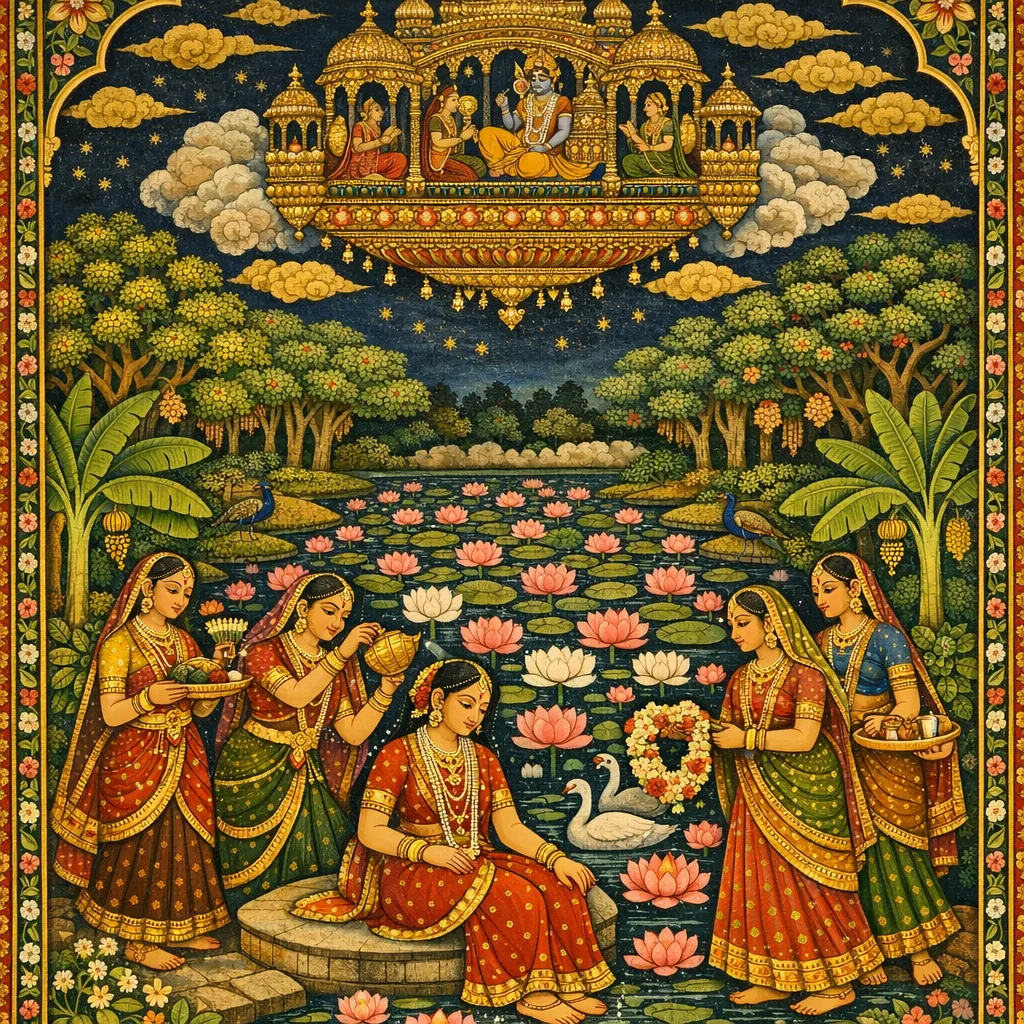
Continuing from the prior household establishment and devotional service mood, Devahūti serves Kardama with chaste dedication (pati-vratā-dharma), becoming physically emaciated through austerity and self-neglect. Kardama, pleased and compassionate, reveals that all achievements are fragile without Viṣṇu’s grace, yet grants Devahūti rare boons and divine vision. Devahūti requests fulfillment of Kardama’s earlier promise of progeny; Kardama manifests a jewel-like aerial palace (vimāna), then directs her to bathe in Bindu-sarovara—Viṣṇu’s sacred lake—where celestial maidens cleanse, adorn, and restore her beauty. The couple travels through celestial pleasure-grounds (Meru, Nandana and others), illustrating yogic mastery and the intoxicating power of refined enjoyment. Kardama then divides into nine forms to satisfy Devahūti; a hundred years pass like a moment, and nine daughters are born in one day. As Kardama prepares for renunciation, Devahūti’s heart turns from enjoyment to existential fear and spiritual urgency: she laments wasted time, recognizes sense-association as bondage, and begs for fearlessness—setting the narrative bridge to the next phase where true liberation will be taught and secured through higher knowledge and bhakti (ultimately via Kapila).
Shlokas
Verse 1
मैत्रेय उवाच पितृभ्यां प्रस्थिते साध्वी पतिमिङ्गितकोविदा । नित्यं पर्यचरत्प्रीत्या भवानीव भवं प्रभुम् ॥ १ ॥
Maitreya continued: After the departure of her parents, the chaste woman Devahūti, who could understand the desires of her husband, served him constantly with great love, as Bhavānī, the wife of Lord Śiva, serves her husband.
Verse 2
विश्रम्भेणात्मशौचेन गौरवेण दमेन च । शुश्रूषया सौहृदेन वाचा मधुरया च भो: ॥ २ ॥
O Vidura, Devahūti served her husband with intimacy and great respect, with control of the senses, with love and with sweet words.
Verse 3
विसृज्य कामं दम्भं च द्वेषं लोभमघं मदम् । अप्रमत्तोद्यता नित्यं तेजीयांसमतोषयत् ॥ ३ ॥
Working sanely and diligently, she pleased her very powerful husband, giving up all lust, pride, envy, greed, sinful activities and vanity.
Verse 4
स वै देवर्षिवर्यस्तां मानवीं समनुव्रताम् । दैवाद्गरीयस: पत्युराशासानां महाशिष: ॥ ४ ॥ कालेन भूयसा क्षामां कर्शितां व्रतचर्यया । प्रेमगद्गदया वाचा पीडित: कृपयाब्रवीत् ॥ ५ ॥
The daughter of Manu, who was fully devoted to her husband, looked upon him as greater even than providence. Thus she expected great blessings from him. Having served him for a long time, she grew weak and emaciated due to her religious observances. Seeing her condition, Kardama, the foremost of celestial sages, was overcome with compassion and spoke to her in a voice choked with great love.
Verse 5
स वै देवर्षिवर्यस्तां मानवीं समनुव्रताम् । दैवाद्गरीयस: पत्युराशासानां महाशिष: ॥ ४ ॥ कालेन भूयसा क्षामां कर्शितां व्रतचर्यया । प्रेमगद्गदया वाचा पीडित: कृपयाब्रवीत् ॥ ५ ॥
The daughter of Manu, who was fully devoted to her husband, looked upon him as greater even than providence. Thus she expected great blessings from him. Having served him for a long time, she grew weak and emaciated due to her religious observances. Seeing her condition, Kardama, the foremost of celestial sages, was overcome with compassion and spoke to her in a voice choked with great love.
Verse 6
कर्दम उवाच तुष्टोऽहमद्य तव मानवि मानदाया: शुश्रूषया परमया परया च भक्त्या । यो देहिनामयमतीव सुहृत्स देहो नावेक्षित: समुचित: क्षपितुं मदर्थे ॥ ६ ॥
Kardama Muni said: O respectful daughter of Svāyambhuva Manu, today I am very much pleased with you for your great devotion and most excellent loving service. Since the body is so dear to embodied beings, I am astonished that you have neglected your own body to use it on my behalf.
Verse 7
ये मे स्वधर्मनिरतस्य तप:समाधि- विद्यात्मयोगविजिता भगवत्प्रसादा: । तानेव ते मदनुसेवनयावरुद्धान् दृष्टिं प्रपश्य वितराम्यभयानशोकान् ॥ ७ ॥
Kardama Muni continued: I have achieved the blessings of the Lord in discharging my own religious life of austerity, meditation and Kṛṣṇa consciousness. Although you have not yet experienced these achievements, which are free from fear and lamentation, I shall offer them all to you because you are engaged in my service. Now just look at them. I am giving you the transcendental vision to see how nice they are.
Verse 8
अन्ये पुनर्भगवतो भ्रुव उद्विजृम्भ- विभ्रंशितार्थरचना: किमुरुक्रमस्य । सिद्धासि भुङ्क्ष्व विभवान्निजधर्मदोहान् दिव्यान्नरैर्दुरधिगान्नृपविक्रियाभि: ॥ ८ ॥
Kardama Muni continued: What is the use of enjoyments other than the Lord’s grace? All material achievements are subject to be annihilated simply by a movement of the eyebrows of Lord Viṣṇu, the Supreme Personality of Godhead. By your principles of devotion to your husband, you have achieved and can enjoy transcendental gifts very rarely obtained by persons proud of aristocracy and material possessions.
Verse 9
एवं ब्रुवाणमबलाखिलयोगमाया- विद्याविचक्षणमवेक्ष्य गताधिरासीत् । सम्प्रश्रयप्रणयविह्वलया गिरेषद्- व्रीडावलोकविलसद्धसिताननाह ॥ ९ ॥
Upon hearing the speaking of her husband, who excelled in knowledge of all kinds of transcendental science, innocent Devahūti was very satisfied. Her smiling face shining with a slightly bashful glance, she spoke in a choked voice because of great humility and love.
Verse 10
देवहूतिरुवाच राद्धं बत द्विजवृषैतदमोघयोग- मायाधिपे त्वयि विभो तदवैमि भर्त: । यस्तेऽभ्यधायि समय: सकृदङ्गसङ्गो भूयाद्गरीयसि गुण: प्रसव: सतीनाम् ॥ १० ॥
Śrī Devahūti said: My dear husband, O best of brāhmaṇas, I know that you have achieved perfection and are the master of all the infallible mystic powers because you are under the protection of yoga-māyā, the transcendental nature. But you once made a promise that our bodily union should now fulfill, since children are a great quality for a chaste woman who has a glorious husband.
Verse 11
तत्रेतिकृत्यमुपशिक्ष यथोपदेशं येनैष मे कर्शितोऽतिरिरंसयात्मा । सिद्ध्येत ते कृतमनोभवधर्षिताया दीनस्तदीश भवनं सदृशं विचक्ष्व ॥ ११ ॥
Devahūti continued: My dear lord, I am struck by excited emotion for you. Therefore kindly make what arrangements must be made according to the scriptures so that my skinny body, emaciated through unsatisfied passion, may be rendered fit for you. Also, my lord, please think of a suitable house for this purpose.
Verse 12
मैत्रेय उवाच प्रियाया: प्रियमन्विच्छन् कर्दमो योगमास्थित: । विमानं कामगं क्षत्तस्तर्ह्येवाविरचीकरत् ॥ १२ ॥
Maitreya continued: O Vidura, seeking to please his beloved wife, the sage Kardama exercised his yogic power and instantly produced an aerial mansion that could travel at his will.
Verse 13
सर्वकामदुघं दिव्यं सर्वरत्नसमन्वितम् । सर्वर्द्ध्युपचयोदर्कं मणिस्तम्भैरुपस्कृतम् ॥ १३ ॥
It was a wonderful structure, bedecked with all sorts of jewels, adorned with pillars of precious stones, and capable of yielding whatever one desired. It was equipped with every form of furniture and wealth, which tended to increase in the course of time.
Verse 14
दिव्योपकरणोपेतं सर्वकालसुखावहम् । पट्टिकाभि: पताकाभिर्विचित्राभिरलंकृतम् ॥ १४ ॥ स्रग्भिर्विचित्रमाल्याभिर्मञ्जुशिञ्जत्षडङ्घ्रिभि: । दुकूलक्षौमकौशेयैर्नानावस्रैर्विराजितम् ॥ १५ ॥
The castle was fully equipped with all necessary paraphernalia, and it was pleasing in all seasons. It was decorated all around with flags, festoons and artistic work of variegated colors. It was further embellished with wreaths of charming flowers that attracted sweetly humming bees and with tapestries of linen, silk and various other fabrics.
Verse 15
दिव्योपकरणोपेतं सर्वकालसुखावहम् । पट्टिकाभि: पताकाभिर्विचित्राभिरलंकृतम् ॥ १४ ॥ स्रग्भिर्विचित्रमाल्याभिर्मञ्जुशिञ्जत्षडङ्घ्रिभि: । दुकूलक्षौमकौशेयैर्नानावस्रैर्विराजितम् ॥ १५ ॥
The castle was fully equipped with all necessary paraphernalia, and it was pleasing in all seasons. It was decorated all around with flags, festoons and artistic work of variegated colors. It was further embellished with wreaths of charming flowers that attracted sweetly humming bees and with tapestries of linen, silk and various other fabrics.
Verse 16
उपर्युपरि विन्यस्तनिलयेषु पृथक्पृथक् । क्षिप्तै: कशिपुभि: कान्तं पर्यङ्कव्यजनासनै: ॥ १६ ॥
The palace looked charming, with beds, couches, fans and seats, all separately arranged in seven stories.
Verse 17
तत्र तत्र विनिक्षिप्तनानाशिल्पोपशोभितम् । महामरकतस्थल्या जुष्टं विद्रुमवेदिभि: ॥ १७ ॥
Its beauty was enhanced by artistic engravings here and there on the walls. The floor was of emerald, with coral daises.
Verse 18
द्वा:सु विद्रुमदेहल्या भातं वज्रकपाटवत् । शिखरेष्विन्द्रनीलेषु हेमकुम्भैरधिश्रितम् ॥ १८ ॥
The palace was very beautiful, with its coral thresholds at the entrances and its doors bedecked with diamonds. Gold pinnacles crowned its domes of sapphire.
Verse 19
चक्षुष्मत्पद्मरागाग्र्यैर्वज्रभित्तिषु निर्मितै: । जुष्टं विचित्रवैतानैर्महार्हैर्हेमतोरणै: ॥ १९ ॥
With the choicest rubies set in its diamond walls, it appeared as though possessed of eyes. It was furnished with wonderful canopies and greatly valuable gates of gold.
Verse 20
हंसपारावतव्रातैस्तत्र तत्र निकूजितम् । कृत्रिमान् मन्यमानै: स्वानधिरुह्याधिरुह्य च ॥ २० ॥
Here and there in that palace were multitudes of live swans and pigeons, as well as artificial swans and pigeons so lifelike that the real swans rose above them again and again, thinking them live birds like themselves. Thus the palace vibrated with the sounds of these birds.
Verse 21
विहारस्थानविश्रामसंवेशप्राङ्गणाजिरै: । यथोपजोषं रचितैर्विस्मापनमिवात्मन: ॥ २१ ॥
The castle had pleasure grounds, resting chambers, bedrooms and inner and outer yards designed with an eye to comfort. All this caused astonishment to the sage himself.
Verse 22
ईदृग्गृहं तत्पश्यन्तीं नातिप्रीतेन चेतसा । सर्वभूताशयाभिज्ञ: प्रावोचत्कर्दम: स्वयम् ॥ २२ ॥
When he saw Devahūti looking at the gigantic opulent palace with a displeased heart, Kardama Muni could understand her feelings because he could study the heart of anyone. Thus he personally addressed his wife as follows.
Verse 23
निमज्ज्यास्मिन् हृदे भीरु विमानमिदमारुह । इदं शुक्लकृतं तीर्थमाशिषां यापकं नृणाम् ॥ २३ ॥
My dear Devahūti, you look very much afraid. First bathe in Lake Bindu-sarovara, created by Lord Viṣṇu Himself, which can grant all the desires of a human being, and then mount this airplane.
Verse 24
सा तद्भर्तु: समादाय वच: कुवलयेक्षणा । सरजं बिभ्रती वासो वेणीभूतांश्च मूर्धजान् ॥ २४ ॥
The lotus-eyed Devahūti accepted the order of her husband. Because of her dirty dress and the locks of matted hair on her head, she did not look very attractive.
Verse 25
अङ्गं च मलपङ्केन संछन्नं शबलस्तनम् । आविवेश सरस्वत्या: सर: शिवजलाशयम् ॥ २५ ॥
Her body was coated with a thick layer of dirt, and her breasts were discolored. She dove, however, into the lake, which contained the sacred waters of the Sarasvatī.
Verse 26
सान्त:सरसि वेश्मस्था: शतानि दश कन्यका: । सर्वा: किशोरवयसो ददर्शोत्पलगन्धय: ॥ २६ ॥
In a house inside the lake she saw one thousand girls, all in the prime of youth and fragrant like lotuses.
Verse 27
तां दृष्ट्वा सहसोत्थाय प्रोचु: प्राञ्जलय: स्त्रिय: । वयं कर्मकरीस्तुभ्यं शाधि न: करवाम किम् ॥ २७ ॥
Seeing her, the damsels suddenly rose and said with folded hands, “We are your maidservants. Tell us what we can do for you.”
Verse 28
स्नानेन तां महार्हेण स्नापयित्वा मनस्विनीम् । दुकूले निर्मले नूत्ने ददुरस्यै च मानदा: ॥ २८ ॥
The girls, being very respectful to Devahūti, brought her forth, and after bathing her with valuable oils and ointments, they gave her fine, new, spotless cloth to cover her body.
Verse 29
भूषणानि परार्ध्यानि वरीयांसि द्युमन्ति च । अन्नं सर्वगुणोपेतं पानं चैवामृतासवम् ॥ २९ ॥
They then decorated her with very excellent and valuable jewels, which shone brightly. Next they offered her food containing all good qualities, and a sweet inebriating drink called āsavam.
Verse 30
अथादर्शे स्वमात्मानं स्रग्विणं विरजाम्बरम् । विरजं कृतस्वस्त्ययनं कन्याभिर्बहुमानितम् ॥ ३० ॥
Then in a mirror she beheld her own reflection. Her body was completely freed from all dirt, and she was adorned with a garland. Dressed in unsullied robes and decorated with auspicious marks of tilaka, she was served very respectfully by the maids.
Verse 31
स्नातं कृतशिर:स्नानं सर्वाभरणभूषितम् । निष्कग्रीवं वलयिनं कूजत्काञ्चननूपुरम् ॥ ३१ ॥
Her entire body, including her head, was completely bathed, and she was decorated all over with ornaments. She wore a special necklace with a locket. There were bangles on her wrists and tinkling anklets of gold about her ankles.
Verse 32
श्रोण्योरध्यस्तया काञ्च्या काञ्चन्या बहुरत्नया । हारेण च महार्हेण रुचकेन च भूषितम् ॥ ३२ ॥
About her hips she wore a girdle of gold, set with numerous jewels, and she was further adorned with a precious pearl necklace and auspicious substances.
Verse 33
सुदता सुभ्रुवा श्लक्ष्णस्निग्धापाङ्गेन चक्षुषा । पद्मकोशस्पृधा नीलैरलकैश्च लसन्मुखम् ॥ ३३ ॥
Her countenance shone, with beautiful teeth and charming eyebrows. Her eyes, distinguished by lovely moist corners, defeated the beauty of lotus buds. Her face was surrounded by dark curling tresses.
Verse 34
यदा सस्मार ऋषभमृषीणां दयितं पतिम् । तत्र चास्ते सह स्त्रीभिर्यत्रास्ते स प्रजापति: ॥ ३४ ॥
When she thought of her great husband, the best of the sages, Kardama Muni, who was very dear to her, she, along with all the maidservants, at once appeared where he was.
Verse 35
भर्तु: पुरस्तादात्मानं स्त्रीसहस्रवृतं तदा । निशाम्य तद्योगगतिं संशयं प्रत्यपद्यत ॥ ३५ ॥
She was amazed to find herself surrounded by a thousand maids in the presence of her husband and to witness his yogic power.
Verse 36
स तां कृतमलस्नानां विभ्राजन्तीमपूर्ववत् । आत्मनो बिभ्रतीं रूपं संवीतरुचिरस्तनीम् ॥ ३६ ॥ विद्याधरीसहस्रेण सेव्यमानां सुवाससम् । जातभावो विमानं तदारोहयदमित्रहन् ॥ ३७ ॥
The sage could see that Devahūti had washed herself clean and was shining forth as though no longer his former wife. She had regained her own original beauty as the daughter of a prince. Dressed in excellent robes, her charming breasts duly girded, she was waited upon by a thousand Gandharva girls. O destroyer of the enemy, his fondness for her grew, and he placed her on the aerial mansion.
Verse 37
स तां कृतमलस्नानां विभ्राजन्तीमपूर्ववत् । आत्मनो बिभ्रतीं रूपं संवीतरुचिरस्तनीम् ॥ ३६ ॥ विद्याधरीसहस्रेण सेव्यमानां सुवाससम् । जातभावो विमानं तदारोहयदमित्रहन् ॥ ३७ ॥
The sage could see that Devahūti had washed herself clean and was shining forth as though no longer his former wife. She had regained her own original beauty as the daughter of a prince. Dressed in excellent robes, her charming breasts duly girded, she was waited upon by a thousand Gandharva girls. O destroyer of the enemy, his fondness for her grew, and he placed her on the aerial mansion.
Verse 38
तस्मिन्नलुप्तमहिमा प्रिययानुरक्तो विद्याधरीभिरुपचीर्णवपुर्विमाने । बभ्राज उत्कचकुमुद्गणवानपीच्य- स्ताराभिरावृत इवोडुपतिर्नभ:स्थ: ॥ ३८ ॥
Though seemingly attached to his beloved consort while served by the Gandharva girls, the sage did not lose his glory, which was mastery over his self. In the aerial mansion, Kardama Muni with his consort shone as charmingly as the moon in the midst of the stars in the sky, which causes rows of lilies to open in ponds at night.
Verse 39
तेनाष्टलोकपविहारकुलाचलेन्द्र- द्रोणीस्वनङ्गसखमारुतसौभगासु । सिद्धैर्नुतो द्युधुनिपातशिवस्वनासु रेमे चिरं धनदवल्ललनावरूथी ॥ ३९ ॥
In that aerial mansion he traveled to the pleasure valleys of Mount Meru, which were rendered all the more beautiful by cool, gentle, fragrant breezes that stimulated passion. In these valleys, the treasurer of the gods, Kuvera, surrounded by beautiful women and praised by the Siddhas, generally enjoys pleasure. Kardama Muni also, surrounded by the beautiful damsels and his wife, went there and enjoyed for many, many years.
Verse 40
वैश्रम्भके सुरसने नन्दने पुष्पभद्रके । मानसे चैत्ररथ्ये च स रेमे रामया रत: ॥ ४० ॥
Satisfied by his wife, he enjoyed in that aerial mansion not only on Mount Meru but in different gardens known as Vaiśrambhaka, Surasana, Nandana, Puṣpabhadraka and Caitrarathya, and by the Mānasa-sarovara Lake.
Verse 41
भ्राजिष्णुना विमानेन कामगेन महीयसा । वैमानिकानत्यशेत चरँल्लोकान् यथानिल: ॥ ४१ ॥
He traveled in that way through the various planets, as the air passes uncontrolled in every direction. Coursing through the air in that great and splendid aerial mansion, which could fly at his will, he surpassed even the demigods.
Verse 42
किं दुरापादनं तेषां पुंसामुद्दामचेतसाम् । यैराश्रितस्तीर्थपदश्चरणो व्यसनात्यय: ॥ ४२ ॥
What is difficult to achieve for determined men who have taken refuge of the Supreme Personality of Godhead’s lotus feet? His feet are the source of sacred rivers like the Ganges, which put an end to the dangers of mundane life.
Verse 43
प्रेक्षयित्वा भुवो गोलं पत्न्यै यावान् स्वसंस्थया । बह्वाश्चर्यं महायोगी स्वाश्रमाय न्यवर्तत ॥ ४३ ॥
After showing his wife the globe of the universe and its different arrangements, full of many wonders, the great yogī Kardama Muni returned to his own hermitage.
Verse 44
विभज्य नवधात्मानं मानवीं सुरतोत्सुकाम् । रामां निरमयन् रेमे वर्षपूगान्मुहूर्तवत् ॥ ४४ ॥
After coming back to his hermitage, he divided himself into nine personalities just to give pleasure to Devahūti, the daughter of Manu, who was eager for sex life. In that way he enjoyed with her for many, many years, which passed just like a moment.
Verse 45
तस्मिन् विमान उत्कृष्टां शय्यां रतिकरीं श्रिता । न चाबुध्यत तं कालं पत्यापीच्येन सङ्गता ॥ ४५ ॥
In that aerial mansion, Devahūti, in the company of her handsome husband, situated on an excellent bed that increased sexual desires, could not realize how much time was passing.
Verse 46
एवं योगानुभावेन दम्पत्यो रममाणयो: । शतं व्यतीयु: शरद: कामलालसयोर्मनाक् ॥ ४६ ॥
While the couple, who eagerly longed for sexual pleasure, were thus enjoying themselves by virtue of mystic powers, a hundred autumns passed like a brief span of time.
Verse 47
तस्यामाधत्त रेतस्तां भावयन्नात्मनात्मवित् । नोधा विधाय रूपं स्वं सर्वसङ्कल्पविद्विभु: ॥ ४७ ॥
The powerful Kardama Muni was the knower of everyone’s heart, and he could grant whatever one desired. Knowing the spiritual soul, he regarded her as half of his body. Dividing himself into nine forms, he impregnated Devahūti with nine discharges of semen.
Verse 48
अत: सा सुषुवे सद्यो देवहूति: स्त्रिय: प्रजा: । सर्वास्ताश्चारुसर्वाङ्ग्यो लोहितोत्पलगन्धय: ॥ ४८ ॥
Immediately afterward, on the same day, Devahūti gave birth to nine female children, all charming in every limb and fragrant with the scent of the red lotus flower.
Verse 49
पतिं सा प्रव्रजिष्यन्तं तदालक्ष्योशतीबहि: । स्मयमाना विक्लवेन हृदयेन विदूयता ॥ ४९ ॥
When she saw her husband about to leave home, she smiled externally, but at heart she was agitated and distressed.
Verse 50
लिखन्त्यधोमुखी भूमिं पदा नखमणिश्रिया । उवाच ललितां वाचं निरुध्याश्रुकलां शनै: ॥ ५० ॥
She stood and scratched the ground with her foot, which was radiant with the luster of her gemlike nails. Her head bent down, she spoke in slow yet charming accents, suppressing her tears.
Verse 51
देवहूतिरुवाच सर्वं तद्भगवान्मह्यमुपोवाह प्रतिश्रुतम् । अथापि मे प्रपन्नाया अभयं दातुमर्हसि ॥ ५१ ॥
Śrī Devahūti said: My lord, you have fulfilled all the promises you gave me, yet because I am your surrendered soul, you should give me fearlessness too.
Verse 52
ब्रह्मन्दुहितृभिस्तुभ्यं विमृग्या: पतय: समा: । कश्चित्स्यान्मे विशोकाय त्वयि प्रव्रजिते वनम् ॥ ५२ ॥
My dear brāhmaṇa, as far as your daughters are concerned, they will find their own suitable husbands and go away to their respective homes. But who will give me solace after your departure as a sannyāsī?
Verse 53
एतावतालं कालेन व्यतिक्रान्तेन मे प्रभो । इन्द्रियार्थप्रसङ्गेन परित्यक्तपरात्मन: ॥ ५३ ॥
Until now we have simply wasted so much of our time in sense gratification, neglecting to cultivate knowledge of the Supreme Lord.
Verse 54
इन्द्रियार्थेषु सज्जन्त्या प्रसङ्गस्त्वयि मे कृत: । अजानन्त्या परं भावं तथाप्यस्त्वभयाय मे ॥ ५४ ॥
Not knowing your transcendental situation, I have loved you while remaining attached to the objects of the senses. Nonetheless, let the affinity I have developed for you rid me of all fear.
Verse 55
सङ्गो य: संसृतेर्हेतुरसत्सु विहितोऽधिया । स एव साधुषु कृतो नि:सङ्गत्वाय कल्पते ॥ ५५ ॥
Association for sense gratification is certainly the path of bondage. But the same type of association, performed with a saintly person, leads to the path of liberation, even if performed without knowledge.
Verse 56
नेह यत्कर्म धर्माय न विरागाय कल्पते । न तीर्थपदसेवायै जीवन्नपि मृतो हि स: ॥ ५६ ॥
Anyone whose work is not meant to elevate him to religious life, anyone whose religious ritualistic performances do not raise him to renunciation, and anyone situated in renunciation that does not lead him to devotional service to the Supreme Personality of Godhead, must be considered dead, although he is breathing.
Verse 57
साहं भगवतो नूनं वञ्चिता मायया दृढम् । यत्त्वां विमुक्तिदं प्राप्य न मुमुक्षेय बन्धनात् ॥ ५७ ॥
My lord, surely I have been solidly cheated by the insurmountable illusory energy of the Supreme Personality of Godhead, for in spite of having obtained your association, which gives liberation from material bondage, I did not seek such liberation.
Frequently Asked Questions
Kardama’s vimāna demonstrates yoga-siddhi under divine sanction, but the chapter frames it as subordinate to Viṣṇu’s grace. The opulence is used to honor Devahūti’s service and fulfill gṛhastha obligations (including progeny), while simultaneously teaching that material and celestial enjoyments remain perishable—thus preparing Devahūti’s mind for renunciation and liberation-centered inquiry.
Bindu-sarovara, described as created by Lord Viṣṇu and infused with sacred waters, functions as a tīrtha of purification and renewal. Devahūti’s bathing and re-adornment by celestial maidens symbolize śuddhi (cleansing of exhaustion and impurity) and the restoration of auspiciousness, enabling the next stage of household duty while also hinting that true beauty and fulfillment ultimately depend on divine grace rather than bodily condition.
They are celestial maidens (often understood as Gandharva-associated attendants) who serve under Kardama’s mystic arrangement. Narratively, they display the reach of yogic power; symbolically, they underscore that even the finest services and pleasures of higher realms are still within the created order and thus cannot replace the ‘fearlessness’ (abhaya) that comes only from spiritual realization and devotion.
The Bhāgavatam distinguishes saṅga by intention and consciousness: when association is driven by kāma (enjoyment), it strengthens ahaṅkāra and karma, binding one to repeated birth and death. The same social proximity, when centered on a sādhu and oriented to the Supreme Lord, plants śraddhā, awakens vairāgya, and redirects life toward bhakti—thus becoming a cause of liberation even if one begins without full philosophical clarity.
The nine daughters extend Svāyambhuva Manu’s manvantara genealogy and enable further dharmic propagation through their future marriages. At the same time, their birth marks the completion of Kardama’s household responsibilities, creating the narrative condition for his renunciation and for Devahūti’s intensified quest for mukti—culminating in the forthcoming teachings connected to Lord Kapila.