Adhyaya 26
Sāṅkhya: Categories of the Absolute Truth and the Unfolding of Creation (Tattva-vicāra)
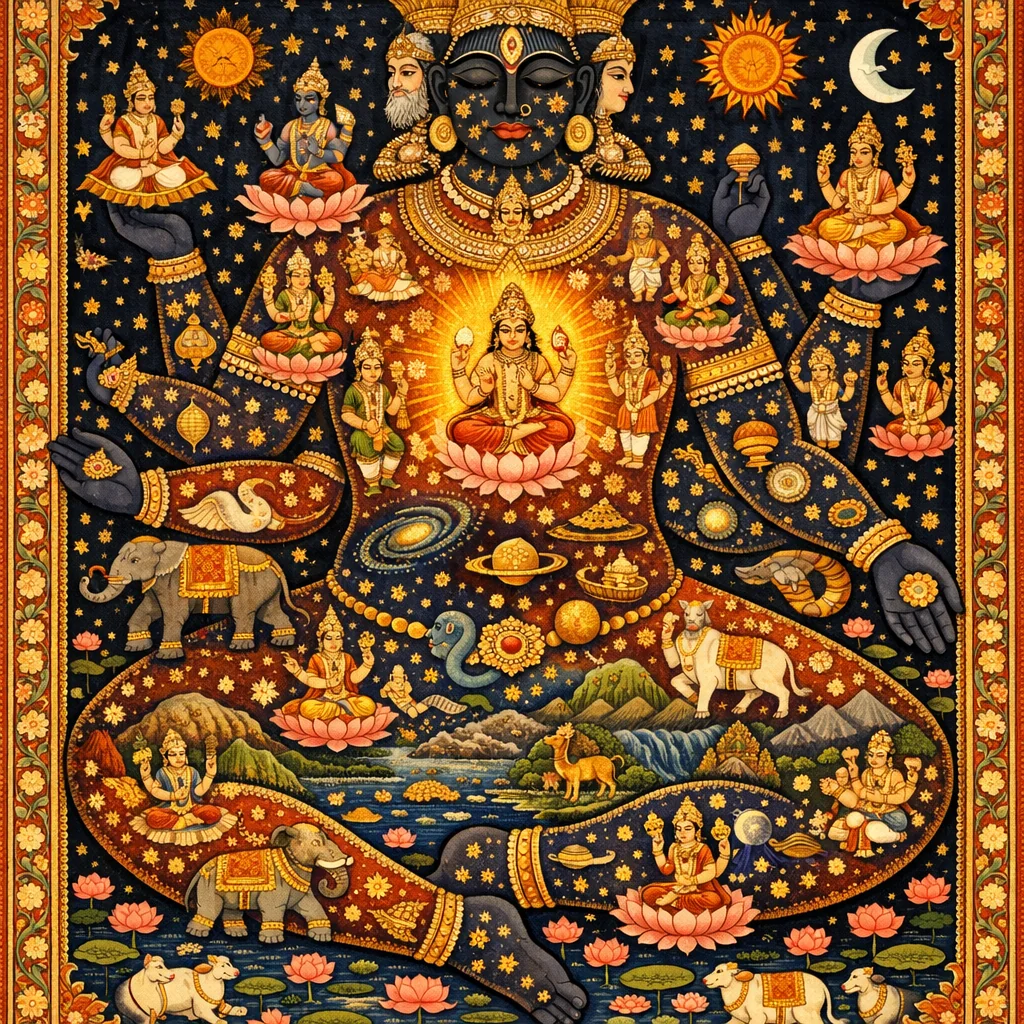
Continuing Kapila’s instruction to Devahūti, this chapter shifts from the diagnosis of bondage to a structured map of tattvas whose right understanding severs material attachment. Kapila defines pradhāna/prakṛti as the equilibrium and manifestation of the three guṇas, enumerates the aggregate of elements and senses, and identifies kāla (time) as the integrating principle and a potency through which the Lord governs transformation and fear of death. From the Lord’s impregnation of material nature arises mahat-tattva (cosmic intelligence), within which pure vāsudeva-like clarity appears; then ahaṅkāra manifests in three guṇic divisions, generating mind (from sattva), intelligence and senses (from rajas), and the tanmātras and mahābhūtas (from tamas) in a stepwise sequence: sound→ether→touch→air→form→fire→taste→water→odor→earth. The narrative then turns cosmological: the Lord enters the universal egg, the virāṭ-puruṣa’s organs and presiding deities appear, yet the cosmic body remains inert until the inner controller (Supersoul/consciousness) enters—teaching that mere mechanics cannot animate existence without Paramātmā. The chapter prepares the next movement of Kapila’s yoga by grounding devotion, detachment, and knowledge in a precise ontology of creation and embodiment.
Shlokas
Verse 1
श्रीभगवानुवाच अथ ते सम्प्रवक्ष्यामि तत्त्वानां लक्षणं पृथक् । यद्विदित्वा विमुच्येत पुरुष: प्राकृतैर्गुणै: ॥ १ ॥
The Personality of Godhead, Kapila, continued: My dear mother, now I shall describe unto you the different categories of the Absolute Truth, knowing which any person can be released from the influence of the modes of material nature.
Verse 2
ज्ञानं नि:श्रेयसार्थाय पुरुषस्यात्मदर्शनम् । यदाहुर्वर्णये तत्ते हृदयग्रन्थिभेदनम् ॥ २ ॥
Knowledge is the ultimate perfection of self-realization. I shall explain that knowledge unto you by which the knots of attachment to the material world are cut.
Verse 3
अनादिरात्मा पुरुषो निर्गुण: प्रकृते: पर: । प्रत्यग्धामा स्वयंज्योतिर्विश्वं येन समन्वितम् ॥ ३ ॥
The Supreme Personality of Godhead is the Supreme Soul, and He has no beginning. He is transcendental to the material modes of nature and beyond the existence of this material world. He is perceivable everywhere because He is self-effulgent, and by His self-effulgent luster the entire creation is maintained.
Verse 4
स एष प्रकृतिं सूक्ष्मां दैवीं गुणमयीं विभु: । यदृच्छयैवोपगतामभ्यपद्यत लीलया ॥ ४ ॥
As His pastime, that Supreme Personality of Godhead, the greatest of the great, accepted the subtle material energy, which is invested with three material modes of nature and which is related with Viṣṇu.
Verse 5
गुणैर्विचित्रा: सृजतीं सरूपा: प्रकृतिं प्रजा: । विलोक्य मुमुहे सद्य: स इह ज्ञानगूहया ॥ ५ ॥
Divided into varieties by her threefold modes, material nature creates the forms of the living entities, and the living entities, seeing this, are illusioned by the knowledge-covering feature of the illusory energy.
Verse 6
एवं पराभिध्यानेन कर्तृत्वं प्रकृते: पुमान् । कर्मसु क्रियमाणेषु गुणैरात्मनि मन्यते ॥ ६ ॥
Because of his forgetfulness, the transcendental living entity accepts the influence of material energy as his field of activities, and thus actuated, he wrongly applies the activities to himself.
Verse 7
तदस्य संसृतिर्बन्ध: पारतन्त्र्यं च तत्कृतम् । भवत्यकर्तुरीशस्य साक्षिणो निर्वृतात्मन: ॥ ७ ॥
Material consciousness is the cause of one’s conditional life, in which conditions are enforced upon the living entity by the material energy. Although the spirit soul does not do anything and is transcendental to such activities, he is thus affected by conditional life.
Verse 8
कार्यकारणकर्तृत्वे कारणं प्रकृतिं विदु: । भोक्तृत्वे सुखदु:खानां पुरुषं प्रकृते: परम् ॥ ८ ॥
The cause of the conditioned soul’s material body and senses, and the senses’ presiding deities, the demigods, is the material nature. This is understood by learned men. The feelings of happiness and distress of the soul, who is transcendental by nature, are caused by the spirit soul himself.
Verse 9
देवहूतिरुवाच प्रकृते: पुरुषस्यापि लक्षणं पुरुषोत्तम । ब्रूहि कारणयोरस्य सदसच्च यदात्मकम् ॥ ९ ॥
Devahūti said: O Supreme Personality of Godhead, kindly explain the characteristics of the Supreme Person and His energies, for both of these are the causes of this manifest and unmanifest creation.
Verse 10
श्रीभगवानुवाच यत्तत्त्रिगुणमव्यक्तं नित्यं सदसदात्मकम् । प्रधानं प्रकृतिं प्राहुरविशेषं विशेषवत् ॥ १० ॥
The Supreme Personality of Godhead said: The unmanifested eternal combination of the three modes is the cause of the manifest state and is called pradhāna. It is called prakṛti when in the manifested stage of existence.
Verse 11
पञ्चभि: पञ्चभिर्ब्रह्म चतुर्भिर्दशभिस्तथा । एतच्चतुर्विंशतिकं गणं प्राधानिकं विदु: ॥ ११ ॥
The aggregate elements, namely the five gross elements, the five subtle elements, the four internal senses, the five senses for gathering knowledge and the five outward organs of action, are known as the pradhāna.
Verse 12
महाभूतानि पञ्चैव भूरापोऽग्निर्मरुन्नभ: । तन्मात्राणि च तावन्ति गन्धादीनि मतानि मे ॥ १२ ॥
There are five gross elements, namely earth, water, fire, air and ether. There are also five subtle elements: smell, taste, color, touch and sound.
Verse 13
इन्द्रियाणि दश श्रोत्रं त्वग्दृग्रसननासिका: । वाक्करौ चरणौ मेढ्रं पायुर्दशम उच्यते ॥ १३ ॥
The senses for acquiring knowledge and the organs for action number ten, namely the auditory sense, the sense of taste, the tactile sense, the sense of sight, the sense of smell, and the active organs for speaking, working, traveling, generating and evacuating.
Verse 14
मनो बुद्धिरहङ्कारश्चित्तमित्यन्तरात्मकम् । चतुर्धा लक्ष्यते भेदो वृत्त्या लक्षणरूपया ॥ १४ ॥
The internal, subtle senses are experienced as having four aspects, in the shape of mind, intelligence, ego and contaminated consciousness. Distinctions between them can be made only by different functions, since they represent different characteristics.
Verse 15
एतावानेव सङ्ख्यातो ब्रह्मण: सगुणस्य ह । सन्निवेशो मया प्रोक्तो य: काल: पञ्चविंशक: ॥ १५ ॥
All these are considered the qualified Brahman. The mixing element, which is known as time, is counted as the twenty-fifth element.
Verse 16
प्रभावं पौरुषं प्राहु: कालमेके यतो भयम् । अहङ्कारविमूढस्य कर्तु: प्रकृतिमीयुष: ॥ १६ ॥
The influence of the Supreme Personality of Godhead is felt in the time factor, which causes fear of death due to the false ego of the deluded soul who has contacted material nature.
Verse 17
प्रकृतेर्गुणसाम्यस्य निर्विशेषस्य मानवि । चेष्टा यत: स भगवान्काल इत्युपलक्षित: ॥ १७ ॥
My dear mother, O daughter of Svāyambhuva Manu, the time factor, as I have explained, is the Supreme Personality of Godhead, from whom the creation begins as a result of the agitation of the neutral, unmanifested nature.
Verse 18
अन्त: पुरुषरूपेण कालरूपेण यो बहि: । समन्वेत्येष सत्त्वानां भगवानात्ममायया ॥ १८ ॥
By exhibiting His potencies, the Supreme Personality of Godhead adjusts all these different elements, keeping Himself within as the Supersoul and without as time.
Verse 19
दैवात्क्षुभितधर्मिण्यां स्वस्यां योनौ पर: पुमान् । आधत्त वीर्यं सासूत महत्तत्त्वं हिरण्मयम् ॥ १९ ॥
After the Supreme Personality of Godhead impregnates material nature with His internal potency, material nature delivers the sum total of the cosmic intelligence, which is known as Hiraṇmaya. This takes place in material nature when she is agitated by the destinations of the conditioned souls.
Verse 20
विश्वमात्मगतं व्यञ्जन्कूटस्थो जगदङ्कुर: । स्वतेजसापिबत्तीव्रमात्मप्रस्वापनं तम: ॥ २० ॥
Thus, after manifesting variegatedness, the effulgent mahat-tattva, which contains all the universes within itself, which is the root of all cosmic manifestations and which is not destroyed at the time of annihilation, swallows the darkness that covered the effulgence at the time of dissolution.
Verse 21
यत्तत्सत्त्वगुणं स्वच्छं शान्तं भगवत: पदम् । यदाहुर्वासुदेवाख्यं चित्तं तन्महदात्मकम् ॥ २१ ॥
The mode of goodness, which is the clear, sober status of understanding the Personality of Godhead and which is generally called vāsudeva, or consciousness, becomes manifest in the mahat-tattva.
Verse 22
स्वच्छत्वमविकारित्वं शान्तत्वमिति चेतस: । वृत्तिभिर्लक्षणं प्रोक्तं यथापां प्रकृति: परा ॥ २२ ॥
After the manifestation of the mahat-tattva, these features appear simultaneously. As water in its natural state, before coming in contact with earth, is clear, sweet and unruffled, so the characteristic traits of pure consciousness are complete serenity, clarity, and freedom from distraction.
Verse 23
महत्तत्त्वाद्विकुर्वाणाद्भगवद्वीर्यसम्भवात् । क्रियाशक्तिरहङ्कारस्त्रिविध: समपद्यत ॥ २३ ॥ वैकारिकस्तैजसश्च तामसश्च यतो भव: । मनसश्चेन्द्रियाणां च भूतानां महतामपि ॥ २४ ॥
The material ego springs up from the mahat-tattva, which evolved from the Lord’s own energy. The material ego is endowed predominantly with active power of three kinds: good, passionate and ignorant. It is from these three types of material ego that the mind, the senses of perception, the organs of action, and the gross elements evolve.
Verse 24
महत्तत्त्वाद्विकुर्वाणाद्भगवद्वीर्यसम्भवात् । क्रियाशक्तिरहङ्कारस्त्रिविध: समपद्यत ॥ २३ ॥ वैकारिकस्तैजसश्च तामसश्च यतो भव: । मनसश्चेन्द्रियाणां च भूतानां महतामपि ॥ २४ ॥
The material ego springs up from the mahat-tattva, which evolved from the Lord’s own energy. The material ego is endowed predominantly with active power of three kinds: good, passionate and ignorant. It is from these three types of material ego that the mind, the senses of perception, the organs of action, and the gross elements evolve.
Verse 25
सहस्रशिरसं साक्षाद्यमनन्तं प्रचक्षते । सङ्कर्षणाख्यं पुरुषं भूतेन्द्रियमनोमयम् ॥ २५ ॥
The threefold ahaṅkāra, the source of the gross elements, the senses and the mind, is identical with them because it is their cause. It is known by the name of Saṅkarṣaṇa, who is directly Lord Ananta with a thousand heads.
Verse 26
कर्तृत्वं करणत्वं च कार्यत्वं चेति लक्षणम् । शान्तघोरविमूढत्वमिति वा स्यादहङ्कृते: ॥ २६ ॥
This false ego is characterized as the doer, as an instrument and as an effect. It is further characterized as serene, active or dull according to how it is influenced by the modes of goodness, passion and ignorance.
Verse 27
वैकारिकाद्विकुर्वाणान्मनस्तत्त्वमजायत । यत्सङ्कल्पविकल्पाभ्यां वर्तते कामसम्भव: ॥ २७ ॥
From the false ego of goodness, another transformation takes place. From this evolves the mind, whose thoughts and reflections give rise to desire.
Verse 28
यद्विदुर्ह्यनिरुद्धाख्यं हृषीकाणामधीश्वरम् । शारदेन्दीवरश्यामं संराध्यं योगिभि: शनै: ॥ २८ ॥
The mind of the living entity is known by the name of Lord Aniruddha, the supreme ruler of the senses. He possesses a bluish-black form resembling a lotus flower growing in the autumn. He is found slowly by the yogīs.
Verse 29
तैजसात्तु विकुर्वाणाद् बुद्धितत्त्वमभूत्सति । द्रव्यस्फुरणविज्ञानमिन्द्रियाणामनुग्रह: ॥ २९ ॥
By transformation of the false ego in passion, intelligence takes birth, O virtuous lady. The functions of intelligence are to help in ascertaining the nature of objects when they come into view, and to help the senses.
Verse 30
संशयोऽथ विपर्यासो निश्चय: स्मृतिरेव च । स्वाप इत्युच्यते बुद्धेर्लक्षणं वृत्तित: पृथक् ॥ ३० ॥
Doubt, misapprehension, correct apprehension, memory and sleep, as determined by their different functions, are said to be the distinct characteristics of intelligence.
Verse 31
तैजसानीन्द्रियाण्येव क्रियाज्ञानविभागश: । प्राणस्य हि क्रियाशक्तिर्बुद्धेर्विज्ञानशक्तिता ॥ ३१ ॥
Egoism in the mode of passion produces two kinds of senses: the senses for acquiring knowledge and the senses of action. The senses of action depend on the vital energy, and the senses for acquiring knowledge depend on intelligence.
Verse 32
तामसाच्च विकुर्वाणाद्भगवद्वीर्यचोदितात् । शब्दमात्रमभूत्तस्मान्नभ: श्रोत्रं तु शब्दगम् ॥ ३२ ॥
When egoism in ignorance is agitated by the sex energy of the Supreme Personality of Godhead, the subtle element sound is manifested, and from sound come the ethereal sky and the sense of hearing.
Verse 33
अर्थाश्रयत्वं शब्दस्य द्रष्टुर्लिङ्गत्वमेव च । तन्मात्रत्वं च नभसो लक्षणं कवयो विदु: ॥ ३३ ॥
Persons who are learned and who have true knowledge define sound as that which conveys the idea of an object, indicates the presence of a speaker screened from our view and constitutes the subtle form of ether.
Verse 34
भूतानां छिद्रदातृत्वं बहिरन्तरमेव च । प्राणेन्द्रियात्मधिष्ण्यत्वं नभसो वृत्तिलक्षणम् ॥ ३४ ॥
The activities and characteristics of the ethereal element can be observed as the accommodation of room for the external and internal existences of all living entities, namely the field of activities of the vital air, the senses and the mind.
Verse 35
नभस: शब्दतन्मात्रात्कालगत्या विकुर्वत: । स्पर्शोऽभवत्ततो वायुस्त्वक्स्पर्शस्य च संग्रह: ॥ ३५ ॥
From ethereal existence, which evolves from sound, the next transformation takes place under the impulse of time, and thus the subtle element touch and thence the air and sense of touch become prominent.
Verse 36
मृदुत्वं कठिनत्वं च शैत्यमुष्णत्वमेव च । एतत्स्पर्शस्य स्पर्शत्वं तन्मात्रत्वं नभस्वत: ॥ ३६ ॥
Softness and hardness and cold and heat are the distinguishing attributes of touch, which is characterized as the subtle form of air.
Verse 37
चालनं व्यूहनं प्राप्तिर्नेतृत्वं द्रव्यशब्दयो: । सर्वेन्द्रियाणामात्मत्वं वायो: कर्माभिलक्षणम् ॥ ३७ ॥
The action of the air is exhibited in movements, mixing, allowing approach to the objects of sound and other sense perceptions, and providing for the proper functioning of all other senses.
Verse 38
वायोश्च स्पर्शतन्मात्राद्रूपं दैवेरितादभूत् । समुत्थितं ततस्तेजश्चक्षू रूपोपलम्भनम् ॥ ३८ ॥
By interactions of the air and the sensations of touch, one receives different forms according to destiny. By evolution of such forms, there is fire, and the eye sees different forms in color.
Verse 39
द्रव्याकृतित्वं गुणता व्यक्तिसंस्थात्वमेव च । तेजस्त्वं तेजस: साध्वि रूपमात्रस्य वृत्तय: ॥ ३९ ॥
My dear mother, the characteristics of form are understood by dimension, quality and individuality. The form of fire is appreciated by its effulgence.
Verse 40
द्योतनं पचनं पानमदनं हिममर्दनम् । तेजसो वृत्तयस्त्वेता: शोषणं क्षुत्तृडेव च ॥ ४० ॥
Fire is appreciated by its light and by its ability to cook, to digest, to destroy cold, to evaporate, and to give rise to hunger, thirst, eating and drinking.
Verse 41
रूपमात्राद्विकुर्वाणात्तेजसो दैवचोदितात् । रसमात्रमभूत्तस्मादम्भो जिह्वा रसग्रह: ॥ ४१ ॥
By the interaction of fire and the visual sensation, the subtle element taste evolves under a superior arrangement. From taste, water is produced, and the tongue, which perceives taste, is also manifested.
Verse 42
कषायो मधुरस्तिक्त: कट्वम्ल इति नैकधा । भौतिकानां विकारेण रस एको विभिद्यते ॥ ४२ ॥
Although originally one, taste becomes manifold as astringent, sweet, bitter, pungent, sour and salty due to contact with other substances.
Verse 43
क्लेदनं पिण्डनं तृप्ति: प्राणनाप्यायनोन्दनम् । तापापनोदो भूयस्त्वमम्भसो वृत्तयस्त्विमा: ॥ ४३ ॥
The characteristics of water are exhibited by its moistening other substances, coagulating various mixtures, causing satisfaction, maintaining life, softening things, driving away heat, incessantly supplying itself to reservoirs of water, and refreshing by slaking thirst.
Verse 44
रसमात्राद्विकुर्वाणादम्भसो दैवचोदितात् । गन्धमात्रमभूत्तस्मात्पृथ्वी घ्राणस्तु गन्धग: ॥ ४४ ॥
Due to the interaction of water with the taste perception, the subtle element odor evolves under superior arrangement. Thence the earth and the olfactory sense, by which we can variously experience the aroma of the earth, become manifest.
Verse 45
करम्भपूतिसौरभ्यशान्तोग्राम्लादिभि: पृथक् । द्रव्यावयववैषम्याद्गन्ध एको विभिद्यते ॥ ४५ ॥
Odor, although one, becomes many — as mixed, offensive, fragrant, mild, strong, acidic and so on — according to the proportions of associated substances.
Verse 46
भावनं ब्रह्मण: स्थानं धारणं सद्विशेषणम् । सर्वसत्त्वगुणोद्भेद: पृथिवीवृत्तिलक्षणम् ॥ ४६ ॥
The characteristics of the functions of earth can be perceived by modeling forms of the Supreme Brahman, by constructing places of residence, by preparing pots to contain water, etc. In other words, the earth is the place of sustenance for all elements.
Verse 47
नभोगुणविशेषोऽर्थो यस्य तच्छ्रोत्रमुच्यते । वायोर्गुणविशेषोऽर्थो यस्य तत्स्पर्शनं विदु: ॥ ४७ ॥
The sense whose object of perception is sound is called the auditory sense, and that whose object of perception is touch is called the tactile sense.
Verse 48
तेजोगुणविशेषोऽर्थो यस्य तच्चक्षुरुच्यते । अम्भोगुणविशेषोऽर्थो यस्य तद्रसनं विदु: । भूमेर्गुणविशेषोऽर्थो यस्य स घ्राण उच्यते ॥ ४८ ॥
The sense whose object of perception is form, the distinctive characteristic of fire, is the sense of sight. The sense whose object of perception is taste, the distinctive characteristic of water, is known as the sense of taste. Finally, the sense whose object of perception is odor, the distinctive characteristic of earth, is called the sense of smell.
Verse 49
परस्य दृश्यते धर्मो ह्यपरस्मिन्समन्वयात् । अतो विशेषो भावानां भूमावेवोपलक्ष्यते ॥ ४९ ॥
Since the cause exists in its effect as well, the characteristics of the former are observed in the latter. That is why the peculiarities of all the elements exist in the earth alone.
Verse 50
एतान्यसंहत्य यदा महदादीनि सप्त वै । कालकर्मगुणोपेतो जगदादिरुपाविशत् ॥ ५० ॥
When all these elements were unmixed, the Supreme Personality of Godhead, the origin of creation, along with time, work, and the qualities of the modes of material nature, entered into the universe with the total material energy in seven divisions.
Verse 51
ततस्तेनानुविद्धेभ्यो युक्तेभ्योऽण्डमचेतनम् । उत्थितं पुरुषो यस्मादुदतिष्ठदसौ विराट् ॥ ५१ ॥
From these seven principles, roused into activity and united by the presence of the Lord, an unintelligent egg arose, from which appeared the celebrated Cosmic Being.
Verse 52
एतदण्डं विशेषाख्यं क्रमवृद्धैर्दशोत्तरै: । तोयादिभि: परिवृतं प्रधानेनावृतैर्बहि: । यत्र लोकवितानोऽयं रूपं भगवतो हरे: ॥ ५२ ॥
This universal egg, or the universe in the shape of an egg, is called the manifestation of material energy. Its layers of water, air, fire, sky, ego and mahat-tattva increase in thickness one after another. Each layer is ten times bigger than the previous one, and the final outside layer is covered by pradhāna. Within this egg is the universal form of Lord Hari, of whose body the fourteen planetary systems are parts.
Verse 53
हिरण्मयादण्डकोशादुत्थाय सलिलेशयात् । तमाविश्य महादेवो बहुधा निर्बिभेद खम् ॥ ५३ ॥
The Supreme Personality of Godhead, the virāṭ-puruṣa, situated Himself in that golden egg, which was lying on the water, and He divided it into many departments.
Verse 54
निरभिद्यतास्य प्रथमं मुखं वाणी ततोऽभवत् । वाण्या वह्निरथो नासे प्राणोतो घ्राण एतयो: ॥ ५४ ॥
First of all a mouth appeared in Him, and then came forth the organ of speech, and with it the god of fire, the deity who presides over that organ. Then a pair of nostrils appeared, and in them appeared the olfactory sense, as well as prāṇa, the vital air.
Verse 55
घ्राणाद्वायुरभिद्येतामक्षिणी चक्षुरेतयो: । तस्मात्सूर्यो न्यभिद्येतां कर्णौ श्रोत्रं ततो दिश: ॥ ५५ ॥
In the wake of the olfactory sense came the wind-god, who presides over that sense. Thereafter a pair of eyes appeared in the universal form, and in them the sense of sight. In the wake of this sense came the sun-god, who presides over it. Next there appeared in Him a pair of ears, and in them the auditory sense and in its wake the Dig-devatās, or the deities who preside over the directions.
Verse 56
निर्बिभेद विराजस्त्वग्रोमश्मश्रवादयस्तत: । तत ओषधयश्चासन् शिश्नं निर्बिभिदे तत: ॥ ५६ ॥
Then the universal form of the Lord, the virāṭ-puruṣa, manifested His skin, and thereupon the hair, mustache and beard appeared. After this all the herbs and drugs became manifested, and then His genitals also appeared.
Verse 57
रेतस्तस्मादाप आसन्निरभिद्यत वै गुदम् । गुदादपानोऽपानाच्च मृत्युर्लोकभयङ्कर: ॥ ५७ ॥
After this, semen (the faculty of procreation) and the god who presides over the waters appeared. Next appeared an anus and then the organs of defecation and thereupon the god of death, who is feared throughout the universe.
Verse 58
हस्तौ च निरभिद्येतां बलं ताभ्यां तत: स्वराट् । पादौ च निरभिद्येतां गतिस्ताभ्यां ततो हरि: ॥ ५८ ॥
Thereafter the two hands of the universal form of the Lord became manifested, and with them the power of grasping and dropping things, and after that Lord Indra appeared. Next the legs became manifested, and with them the process of movement, and after that Lord Viṣṇu appeared.
Verse 59
नाड्योऽस्य निरभिद्यन्त ताभ्यो लोहितमाभृतम् । नद्यस्तत: समभवन्नुदरं निरभिद्यत ॥ ५९ ॥
The veins of the universal body became manifested and thereafter the red corpuscles, or blood. In their wake came the rivers (the deities presiding over the veins), and then appeared an abdomen.
Verse 60
क्षुत्पिपासे तत: स्यातां समुद्रस्त्वेतयोरभूत् । अथास्य हृदयं भिन्नं हृदयान्मन उत्थितम् ॥ ६० ॥
Next grew feelings of hunger and thirst, and in their wake came the manifestation of the oceans. Then a heart became manifest, and in the wake of the heart the mind appeared.
Verse 61
मनसश्चन्द्रमा जातो बुद्धिर्बुद्धेर्गिरां पति: । अहङ्कारस्ततो रुद्रश्चित्तं चैत्यस्ततोऽभवत् ॥ ६१ ॥
After the mind, the moon appeared. Intelligence appeared next, and after intelligence, Lord Brahmā appeared. Then the false ego appeared and then Lord Śiva, and after the appearance of Lord Śiva came consciousness and the deity presiding over consciousness.
Verse 62
एते ह्यभ्युत्थिता देवा नैवास्योत्थापनेऽशकन् । पुनराविविशु: खानि तमुत्थापयितुं क्रमात् ॥ ६२ ॥
When the demigods and presiding deities of the various senses were thus manifested, they wanted to wake their origin of appearance. But upon failing to do so, they reentered the body of the virāṭ-puruṣa one after another in order to wake Him.
Verse 63
वह्निर्वाचा मुखं भेजे नोदतिष्ठत्तदा विराट् । घ्राणेन नासिके वायुर्नोदतिष्ठत्तदा विराट् ॥ ६३ ॥
The god of fire entered His mouth with the organ of speech, but the virāṭ-puruṣa could not be aroused. Then the god of wind entered His nostrils with the sense of smell, but still the virāṭ-puruṣa refused to be awakened.
Verse 64
अक्षिणी चक्षुषादित्यो नोदतिष्ठत्तदा विराट् । श्रोत्रेण कर्णौ च दिशो नोदतिष्ठत्तदा विराट् ॥ ६४ ॥
The sun-god entered the eyes of the virāṭ-puruṣa with the sense of sight, but still the virāṭ-puruṣa did not get up. Similarly, the predominating deities of the directions entered through His ears with the sense of hearing, but still He did not get up.
Verse 65
त्वचं रोमभिरोषध्यो नोदतिष्ठत्तदा विराट् । रेतसा शिश्नमापस्तु नोदतिष्ठत्तदा विराट् ॥ ६५ ॥
The predominating deities of the skin, herbs and seasoning plants entered the skin of the virāṭ-puruṣa with the hair of the body, but the Cosmic Being refused to get up even then. The god predominating over water entered His organ of generation with the faculty of procreation, but the virāṭ-puruṣa still would not rise.
Verse 66
गुदं मृत्युरपानेन नोदतिष्ठत्तदा विराट् । हस्ताविन्द्रो बलेनैव नोदतिष्ठत्तदा विराट् ॥ ६६ ॥
The god of death entered His anus with the organ of defecation, but the virāṭ-puruṣa could not be spurred to activity. The god Indra entered the hands with their power of grasping and dropping things, but the virāṭ-puruṣa would not get up even then.
Verse 67
विष्णुर्गत्यैव चरणौ नोदतिष्ठत्तदा विराट् । नाडीर्नद्यो लोहितेन नोदतिष्ठत्तदा विराट् ॥ ६७ ॥
Lord Viṣṇu entered His feet with the faculty of locomotion, but the virāṭ-puruṣa refused to stand up even then. The rivers entered His blood vessels with the blood and the power of circulation, but still the Cosmic Being could not be made to stir.
Verse 68
क्षुत्तृड्भ्यामुदरं सिन्धुर्नोदतिष्ठत्तदा विराट् । हृदयं मनसा चन्द्रो नोदतिष्ठत्तदा विराट् ॥ ६८ ॥
The ocean entered His abdomen with hunger and thirst, but the Cosmic Being refused to rise even then. The moon-god entered His heart with the mind, but the Cosmic Being would not be roused.
Verse 69
बुद्ध्या ब्रह्मापि हृदयं नोदतिष्ठत्तदा विराट् । रुद्रोऽभिमत्या हृदयं नोदतिष्ठत्तदा विराट् ॥ ६९ ॥
Brahmā also entered His heart with intelligence, but even then the Cosmic Being could not be prevailed upon to get up. Lord Rudra also entered His heart with the ego, but even then the Cosmic Being did not stir.
Verse 70
चित्तेन हृदयं चैत्य: क्षेत्रज्ञ: प्राविशद्यदा । विराट् तदैव पुरुष: सलिलादुदतिष्ठत ॥ ७० ॥
However, when the inner controller, the deity presiding over consciousness, entered the heart with reason, at that very moment the Cosmic Being arose from the causal waters.
Verse 71
यथा प्रसुप्तं पुरुषं प्राणेन्द्रियमनोधिय: । प्रभवन्ति विना येन नोत्थापयितुमोजसा ॥ ७१ ॥
When a man is sleeping, all his material assets — namely the vital energy, the senses for recording knowledge, the senses for working, the mind and the intelligence — cannot arouse him. He can be aroused only when the Supersoul helps him.
Verse 72
तमस्मिन्प्रत्यगात्मानं धिया योगप्रवृत्तया । भक्त्या विरक्त्या ज्ञानेन विविच्यात्मनि चिन्तयेत् ॥ ७२ ॥
Therefore, through devotion, detachment and advancement in spiritual knowledge acquired through concentrated devotional service, one should contemplate that Supersoul as present in this very body although simultaneously apart from it.
Frequently Asked Questions
Kāla is presented as the mixing/activating factor that coordinates transformation among the elements and triggers the agitation of neutral pradhāna into manifest creation. It also becomes the experiential basis of fear of death when the soul identifies with false ego. In Bhāgavata theism, time is not merely physical duration; it is a potency through which the Supreme governs change while remaining transcendent.
Ahaṅkāra emerges from mahat-tattva and divides by the guṇas: from sattvic ego comes manas (mind, associated with Aniruddha); from rajasic ego arise buddhi (intelligence) and the ten senses (jñānendriyas and karmendriyas); from tamasic ego arise the tanmātras and then the gross elements in sequence—sound→ether, touch→air, form→fire, taste→water, odor→earth—along with their corresponding sense capacities.
The episode teaches that presiding deities and functional organs can exist as a complete system yet remain inert without the presence of Paramātmā, the ultimate animator. This reinforces the Bhāgavata’s hierarchy: material and cosmic mechanisms operate only when empowered by the Lord within, so liberation likewise depends on turning toward that Supersoul through bhakti, detachment, and realized knowledge.
Kapila links cosmic functions to Viṣṇu-tattva expansions: the threefold ahaṅkāra is identified with Saṅkarṣaṇa (connected with Ananta), and the mind is identified with Aniruddha, the ruler of the senses. The intent is theological integration—showing that even the categories of Sāṅkhya ultimately rest on and are governed by the Supreme Person’s expansions.