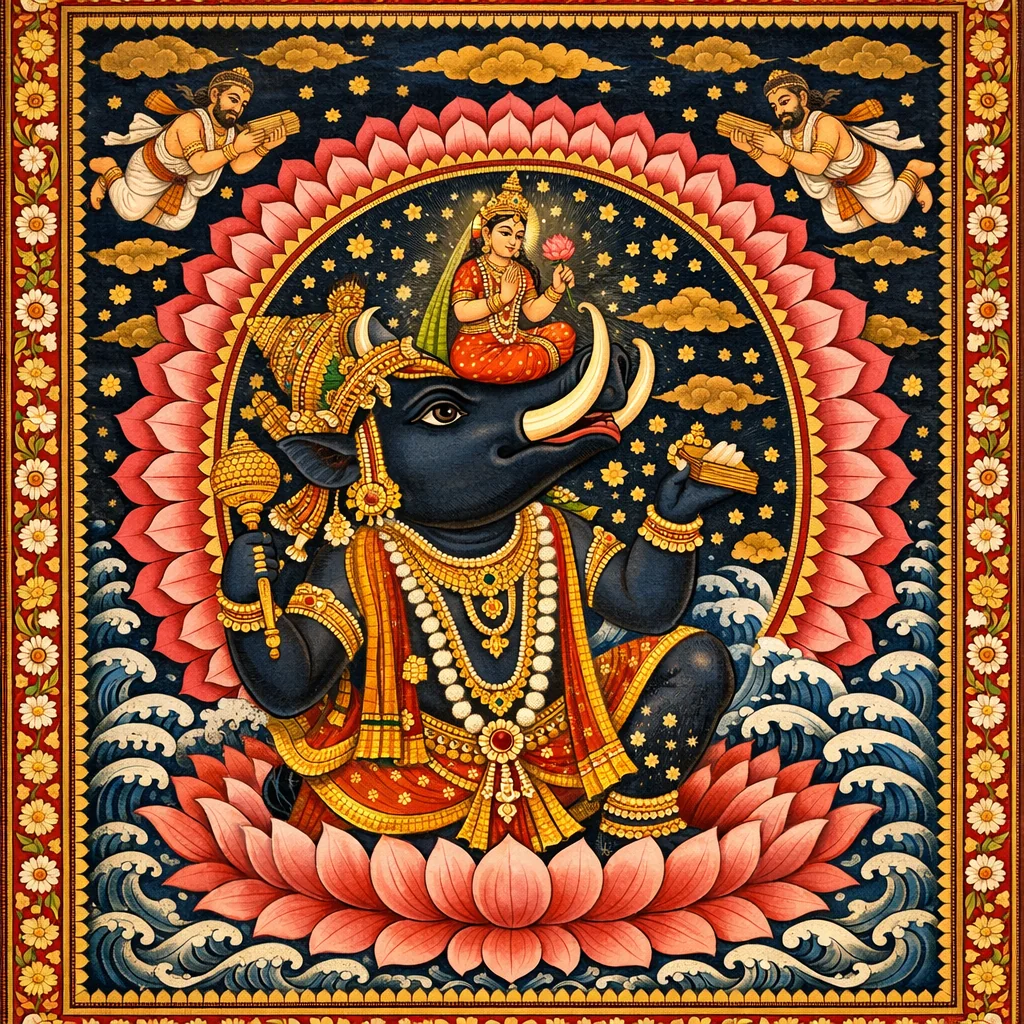
Adhyaya 13
Varāha-avatāra: The Boar Incarnation Lifts the Earth and Slays Hiraṇyākṣa
Following earlier teachings from Maitreya, Vidura’s eagerness intensifies as he requests the exemplary conduct of Svāyambhuva Manu after receiving his wife—linking cosmic history to ideal devotional kingship. Maitreya narrates Manu’s surrender to Brahmā and Brahmā’s instruction: populate the world, protect beings, and worship Hari through yajña, because all effort is futile if Janārdana is not pleased. A crisis emerges: the earth has sunk into the cosmic waters. As Brahmā deliberates, a minute boar manifests from his nostril, rapidly expanding into a wondrous form—revealed as Viṣṇu. The Lord’s roar awakens the sages across higher lokas, who respond with Vedic hymns. Varāha plunges into the ocean, finds the earth, lifts it effortlessly upon His tusks, and kills Hiraṇyākṣa. The sages then offer a profound stuti identifying Varāha as the personified Vedas and the very structure of sacrifice. The chapter closes with the phala-śruti: hearing and speaking this narration in bhakti pleases the Lord within the heart and elevates the devotee. The narrative naturally leads into further avatāra-centered protections and the unfolding manvantara history.
Shlokas
Verse 1
श्रीशुक उवाच निशम्य वाचं वदतो मुने: पुण्यतमां नृप । भूय: पप्रच्छ कौरव्यो वासुदेवकथादृत: ॥ १ ॥
Śrī Śukadeva Gosvāmī said: O King, after hearing all these most virtuous topics from the sage Maitreya, Vidura inquired further on the topics of the Supreme Personality of Godhead, which he adored to hear.
Verse 2
विदुर उवाच स वै स्वायम्भुव: सम्राट् प्रिय: पुत्र: स्वयम्भुव: । प्रतिलभ्य प्रियां पत्नीं किं चकार ततो मुने ॥ २ ॥
Vidura said: O great sage, what did Svāyambhuva, the dear son of Brahmā, do after obtaining his very loving wife?
Verse 3
चरितं तस्य राजर्षेरादिराजस्य सत्तम । ब्रूहि मे श्रद्दधानाय विष्वक्सेनाश्रयो ह्यसौ ॥ ३ ॥
O best of the virtuous, the original king of kings [Manu] was a great devotee of the Personality of Godhead Hari, and thus it is worth hearing of his sublime character and activities. Please describe them. I am very eager to hear.
Verse 4
श्रुतस्य पुंसां सुचिरश्रमस्य नन्वञ्जसा सूरिभिरीडितोऽर्थ: । तत्तद्गुणानुश्रवणं मुकुन्द- पादारविन्द हृदयेषु येषाम् ॥ ४ ॥
Persons who hear from a spiritual master with great labor and for a long time must hear from the mouths of pure devotees about the character and activities of pure devotees. Pure devotees always think within their hearts of the lotus feet of the Personality of Godhead, who awards His devotees liberation.
Verse 5
श्रीशुक उवाच इति ब्रुवाणं विदुरं विनीतं सहस्रशीर्ष्णश्चरणोपधानम् । प्रहृष्टरोमा भगवत्कथायां प्रणीयमानो मुनिरभ्यचष्ट ॥ ५ ॥
Śrī Śukadeva Gosvāmī said: The Personality of Godhead, Śrī Kṛṣṇa, was pleased to place His lotus feet on the lap of Vidura because Vidura was very meek and gentle. The sage Maitreya was very pleased with Vidura’s words, and, being influenced by his spirit, he attempted to speak.
Verse 6
मैत्रेय उवाच यदा स्वभार्यया सार्धं जात: स्वायम्भुवो मनु: । प्राञ्जलि: प्रणतश्चेदं वेदगर्भमभाषत ॥ ६ ॥
The sage Maitreya said to Vidura: After his appearance, Manu, the father of mankind, along with his wife, thus addressed the reservoir of Vedic wisdom, Brahmā, with obeisances and folded hands.
Verse 7
त्वमेक: सर्वभूतानां जन्मकृद् वृत्तिद: पिता । तथापि न: प्रजानां ते शुश्रूषा केन वा भवेत् ॥ ७ ॥
You are the father of all living entities and the source of their subsistence because they are all born of you. Please order us how we may be able to render service unto you.
Verse 8
तद्विधेहि नमस्तुभ्यं कर्मस्वीड्यात्मशक्तिषु । यत्कृत्वेह यशो विष्वगमुत्र च भवेद्गति: ॥ ८ ॥
O worshipful one, please give us your direction for the execution of duty within our working capacity so that we can follow it for fame in this life and progress in the next.
Verse 9
ब्रह्मोवाच प्रीतस्तुभ्यमहं तात स्वस्ति स्ताद्वां क्षितीश्वर । यन्निर्व्यलीकेन हृदा शाधि मेत्यात्मनार्पितम् ॥ ९ ॥
Lord Brahmā said: My dear son, O lord of the world, I am very pleased with you, and I desire all blessings for both you and your wife. You have without reservation surrendered yourself unto me with your heart for my instructions.
Verse 10
एतावत्यात्मजैर्वीर कार्या ह्यपचितिर्गुरौ । शक्त्याप्रमत्तैर्गृह्येत सादरं गतमत्सरै: ॥ १० ॥
O hero, your example is quite befitting a son in relationship with his father. This sort of adoration for the superior is required. One who is beyond the limit of envy and who is sane accepts the order of his father with great delight and executes it to his full capacity.
Verse 11
स त्वमस्यामपत्यानि सदृशान्यात्मनो गुणै: । उत्पाद्य शास धर्मेण गां यज्ञै: पुरुषं यज ॥ ११ ॥
Since you are my very obedient son, I ask you to beget children qualified like yourself in the womb of your wife. Rule the world in pursuance of the principles of devotional service unto the Supreme Personality of Godhead, and thus worship the Lord by performances of yajña.
Verse 12
स त्वमस्यामपत्यानि सदृशान्यात्मनो गुणै: । उत्पाद्य शास धर्मेण गां यज्ञै: पुरुषं यज ॥ ११ ॥
O King, if you can give proper protection to the living beings in the material world, that will be the best service for me. When the Supreme Lord sees you to be a good protector of the conditioned souls, certainly the master of the senses will be very pleased with you.
Verse 13
येषां न तुष्टो भगवान् यज्ञलिङ्गो जनार्दन: । तेषां श्रमो ह्यपार्थाय यदात्मा नादृत: स्वयम् ॥ १३ ॥
The Supreme Personality of Godhead, Janārdana [Lord Kṛṣṇa], is the form to accept all the results of sacrifice. If He is not satisfied, then one’s labor for advancement is futile. He is the ultimate Self, and therefore one who does not satisfy Him certainly neglects his own interests.
Verse 14
मनुरुवाच आदेशेऽहं भगवतो वर्तेयामीवसूदन । स्थानं त्विहानुजानीहि प्रजानां मम च प्रभो ॥ १४ ॥
Śrī Manu said: O all-powerful lord, O killer of all sins, I shall abide by your order. Now please let me know my place and that of the living entities born of me.
Verse 15
यदोक: सर्वभूतानां मही मग्ना महाम्भसि । अस्या उद्धरणे यत्नो देव देव्या विधीयताम् ॥ १५ ॥
O master of the demigods, please attempt to lift the earth, which is merged in the great water, because it is the dwelling place for all the living entities. It can be done by your endeavor and by the mercy of the Lord.
Verse 16
मैत्रेय उवाच परमेष्ठी त्वपां मध्ये तथा सन्नामवेक्ष्य गाम् । कथमेनां समुन्नेष्य इति दध्यौ धिया चिरम् ॥ १६ ॥
Śrī Maitreya said: Thus, seeing the earth merged in the water, Brahmā gave his attention for a long time to how it could be lifted.
Verse 17
सृजतो मे क्षितिर्वार्भि:प्लाव्यमाना रसां गता । अथात्र किमनुष्ठेयमस्माभि: सर्गयोजितै: । यस्याहं हृदयादासं स ईशो विदधातु मे ॥ १७ ॥
Brahmā thought: While I have been engaged in the process of creation, the earth has been inundated by a deluge and has gone down into the depths of the ocean. What can we do who are engaged in this matter of creation? It is best to let the Almighty Lord direct us.
Verse 18
इत्यभिध्यायतो नासाविवरात्सहसानघ । वराहतोको निरगादङ्गुष्ठपरिमाणक: ॥ १८ ॥
O sinless Vidura, all of a sudden, while Brahmā was engaged in thinking, a small form of a boar came out of his nostril. The measurement of the creature was not more than the upper portion of a thumb.
Verse 19
तस्याभिपश्यत: खस्थ: क्षणेन किल भारत । गजमात्र: प्रववृधे तदद्भुतमभून्महत् ॥ १९ ॥
O descendant of Bharata, while Brahmā was observing Him, that boar became situated in the sky in a wonderful manifestation as gigantic as a great elephant.
Verse 20
मरीचिप्रमुखैर्विप्रै: कुमारैर्मनुना सह । हृष्ट्वा तत्सौकरं रूपं तर्कयामास चित्रधा ॥ २० ॥
Struck with wonder at observing the wonderful boarlike form in the sky, Brahmā, with great brāhmaṇas like Marīci, as well as the Kumāras and Manu, began to argue in various ways.
Verse 21
किमेतत्सूकरव्याजं सत्त्वं दिव्यमवस्थितम् । अहो बताश्चर्यमिदं नासाया मे विनि:सृतम् ॥ २१ ॥
Is this some extraordinary entity come in the pretense of a boar? It is very wonderful that He has come from my nose.
Verse 22
दृष्टोऽङ्गुष्ठशिरोमात्र: क्षणाद्गण्डशिलासम: । अपि स्विद्भगवानेष यज्ञो मे खेदयन्मन: ॥ २२ ॥
First of all this boar was seen no bigger than the tip of a thumb, and within a moment He was as large as a stone. My mind is perturbed. Is He the Supreme Personality of Godhead, Viṣṇu?
Verse 23
इति मीमांसतस्तस्य ब्रह्मण: सह सूनुभि: । भगवान् यज्ञपुरुषो जगर्जागेन्द्रसन्निभ: ॥ २३ ॥
While Brahmā was deliberating with his sons, the Supreme Personality of Godhead, Viṣṇu, roared tumultuously like a great mountain.
Verse 24
ब्रह्माणं हर्षयामास हरिस्तांश्च द्विजोत्तमान् । स्वगर्जितेन ककुभ: प्रतिस्वनयता विभु: ॥ २४ ॥
The omnipotent Supreme Personality of Godhead enlivened Brahmā and the other highly elevated brāhmaṇas by again roaring with His uncommon voice, which echoed in all directions.
Verse 25
निशम्य ते घर्घरितं स्वखेद- क्षयिष्णु मायामयसूकरस्य । जनस्तप:सत्यनिवासिनस्ते त्रिभि: पवित्रैर्मुनयोऽगृणन् स्म ॥ २५ ॥
When the great sages and thinkers who are residents of Janaloka, Tapoloka and Satyaloka heard the tumultuous voice of Lord Boar, which was the all-auspicious sound of the all-merciful Lord, they chanted auspicious chants from the three Vedas.
Verse 26
तेषां सतां वेदवितानमूर्ति- र्ब्रह्मावधार्यात्मगुणानुवादम् । विनद्य भूयो विबुधोदयाय गजेन्द्रलीलो जलमाविवेश ॥ २६ ॥
Playing like an elephant, He entered into the water after roaring again in reply to the Vedic prayers by the great devotees. The Lord is the object of the Vedic prayers, and thus He understood that the devotees’ prayers were meant for Him.
Verse 27
उत्क्षिप्तवाल: खचर: कठोर: सटा विधुन्वन् खररोमशत्वक् । खुराहताभ्र: सितदंष्ट्र ईक्षा- ज्योतिर्बभासे भगवान्महीध्र: ॥ २७ ॥
Before entering the water to rescue the earth, Lord Boar flew in the sky, slashing His tail, His hard hairs quivering. His very glance was luminous, and He scattered the clouds in the sky with His hooves and His glittering white tusks.
Verse 28
घ्राणेन पृथ्व्या: पदवीं विजिघ्रन् क्रोडापदेश: स्वयमध्वराङ्ग: । करालदंष्ट्रोऽप्यकरालदृग्भ्या- मुद्वीक्ष्य विप्रान् गृणतोऽविशत्कम् ॥ २८ ॥
He was personally the Supreme Lord Viṣṇu and was therefore transcendental, yet because He had the body of a hog, He searched after the earth by smell. His tusks were fearful, and He glanced over the devotee-brāhmaṇas engaged in offering prayers. Thus He entered the water.
Verse 29
स वज्रकूटाङ्गनिपातवेग- विशीर्णकुक्षि: स्तनयन्नुदन्वान् । उत्सृष्टदीर्घोर्मिभुजैरिवार्त- श्चुक्रोश यज्ञेश्वर पाहि मेति ॥ २९ ॥
Diving into the water like a giant mountain, Lord Boar divided the middle of the ocean, and two high waves appeared as the arms of the ocean, which cried loudly as if praying to the Lord, “O Lord of all sacrifices, please do not cut me in two! Kindly give me protection!”
Verse 30
खुरै: क्षुरप्रैर्दरयंस्तदाप उत्पारपारं त्रिपरू रसायाम् । ददर्श गां तत्र सुषुप्सुरग्रे यां जीवधानीं स्वयमभ्यधत्त ॥ ३० ॥
Lord Boar penetrated the water with His hooves, which were like sharp arrows, and found the limits of the ocean, although it was unlimited. He saw the earth, the resting place for all living beings, lying as it was in the beginning of creation, and He personally lifted it.
Verse 31
स्वदंष्ट्रयोद्धृत्य महीं निमग्नां स उत्थित: संरुरुचे रसाया: । तत्रापि दैत्यं गदयापतन्तं सुनाभसन्दीपिततीव्रमन्यु: ॥ ३१ ॥
Lord Boar very easily took the earth on His tusks and got it out of the water. Thus He appeared very splendid. Then, His anger glowing like the Sudarśana wheel, He immediately killed the demon [Hiraṇyākṣa], although he tried to fight with the Lord.
Verse 32
जघान रुन्धानमसह्यविक्रमं स लीलयेभं मृगराडिवाम्भसि । तद्रक्तपङ्काङ्कितगण्डतुण्डो यथा गजेन्द्रो जगतीं विभिन्दन् ॥ ३२ ॥
Thereupon Lord Boar killed the demon within the water, just as a lion kills an elephant. The cheeks and tongue of the Lord became smeared with the blood of the demon, just as an elephant becomes reddish from digging in the purple earth.
Verse 33
तमालनीलं सितदन्तकोट्या क्ष्मामुत्क्षिपन्तं गजलीलयाङ्ग । प्रज्ञाय बद्धाञ्जलयोऽनुवाकै- र्विरिञ्चिमुख्या उपतस्थुरीशम् ॥ ३३ ॥
Then the Lord, playing like an elephant, suspended the earth on the edge of His curved white tusks. He assumed a bluish complexion like that of a tamāla tree, and thus the sages, headed by Brahmā, could understand Him to be the Supreme Personality of Godhead and offered respectful obeisances unto the Lord.
Verse 34
ऋषय ऊचु: जितं जितं तेऽजित यज्ञभावन त्रयीं तनुं स्वां परिधुन्वते नम: । यद्रोमगर्ेषु निलिल्युरद्धय- स्तस्मै नम: कारणसूकराय ते ॥ ३४ ॥
All the sages uttered with great respect: O unconquerable enjoyer of all sacrifices, all glories and all victories unto You! You are moving in Your form of the personified Vedas, and in the hair holes of Your body the oceans are submerged. For certain reasons [to uplift the earth] You have now assumed the form of a boar.
Verse 35
रूपं तवैतन्ननु दुष्कृतात्मनां दुर्दर्शनं देव यदध्वरात्मकम् । छन्दांसि यस्य त्वचि बर्हिरोम- स्वाज्यं दृशि त्वङ्घ्रि षु चातुर्होत्रम् ॥ ३५ ॥
O Lord, Your form is worshipable by performances of sacrifice, but souls who are simply miscreants are unable to see it. All the Vedic hymns, Gāyatrī and others, are in the touch of Your skin. In Your bodily hairs is the kuśa grass, in Your eyes is the clarified butter, and in Your four legs are the four kinds of fruitive activities.
Verse 36
स्रक्तुण्ड आसीत्स्रुव ईश नासयो- रिडोदरे चमसा: कर्णरन्ध्रे । प्राशित्रमास्ये ग्रसने ग्रहास्तु ते यच्चर्वणं ते भगवन्नग्निहोत्रम् ॥ ३६ ॥
O Lord, Your tongue is a plate of sacrifice, Your nostril is another plate of sacrifice, in Your belly is the eating plate of sacrifice, and another plate of sacrifice is the holes of Your ears. In Your mouth is the Brahmā plate of sacrifice, Your throat is the plate of sacrifice known as soma, and whatever You chew is known as agni-hotra.
Verse 37
दीक्षानुजन्मोपसद: शिरोधरं त्वं प्रायणीयोदयनीयदंष्ट्र: । जिह्वा प्रवर्ग्यस्तव शीर्षकं क्रतो: सत्यावसथ्यं चितयोऽसवो हि ते ॥ ३७ ॥
Moreover, O Lord, the repetition of Your appearance is the desire for all kinds of initiation. Your neck is the place for three desires, and Your tusks are the result of initiation and the end of all desires. Your tongue is the prior activities of initiation, Your head is the fire without sacrifice as well as the fire of worship, and Your living forces are the aggregate of all desires.
Verse 38
सोमस्तु रेत: सवनान्यवस्थिति: संस्थाविभेदास्तव देव धातव: । सत्राणि सर्वाणि शरीरसन्धि- स्त्वं सर्वयज्ञक्रतुरिष्टिबन्धन: ॥ ३८ ॥
O Lord, Your semen is the sacrifice called soma-yajña. Your growth is the ritualistic performances of the morning. Your skin and touch sensations are the seven elements of the agniṣṭoma sacrifice. Your bodily joints are symbols of various other sacrifices performed in twelve days. Therefore You are the object of all sacrifices called soma and asoma, and You are bound by yajñas only.
Verse 39
नमो नमस्तेऽखिलमन्त्रदेवता- द्रव्याय सर्वक्रतवे क्रियात्मने । वैराग्यभक्त्यात्मजयानुभावित- ज्ञानाय विद्यागुरवे नमो नम: ॥ ३९ ॥
O Lord, You are the Supreme Personality of Godhead and are worshipable by universal prayers, Vedic hymns and sacrificial ingredients. We offer our obeisances unto You. You can be realized by the pure mind freed from all visible and invisible material contamination. We offer our respectful obeisances to You as the supreme spiritual master of knowledge in devotional service.
Verse 40
दंष्ट्राग्रकोट्या भगवंस्त्वया धृता विराजते भूधर भू: सभूधरा । यथा वनान्नि:सरतो दता धृता मतङ्गजेन्द्रस्य सपत्रपद्मिनी ॥ ४० ॥
O lifter of the earth, the earth with its mountains, which You have lifted with Your tusks, is situated as beautifully as a lotus flower with leaves sustained by an infuriated elephant just coming out of the water.
Verse 41
त्रयीमयं रूपमिदं च सौकरं भूमण्डलेनाथ दता धृतेन ते । चकास्ति शृङ्गोढघनेन भूयसा कुलाचलेन्द्रस्य यथैव विभ्रम: ॥ ४१ ॥
O Lord, as the peaks of great mountains become beautiful when decorated with clouds, Your transcendental body has become beautiful because of Your lifting the earth on the edge of Your tusks.
Verse 42
संस्थापयैनां जगतां सतस्थुषां लोकाय पत्नीमसि मातरं पिता । विधेम चास्यै नमसा सह त्वया यस्यां स्वतेजोऽग्निमिवारणावधा: ॥ ४२ ॥
O Lord, for the residential purposes of all inhabitants, both moving and nonmoving, this earth is Your wife, and You are the supreme father. We offer our respectful obeisances unto You, along with mother earth, in whom You have invested Your own potency, just as an expert sacrificer puts fire in the araṇi wood.
Verse 43
क: श्रद्दधीतान्यतमस्तव प्रभो रसां गताया भुव उद्विबर्हणम् । न विस्मयोऽसौ त्वयि विश्वविस्मये यो माययेदं ससृजेऽतिविस्मयम् ॥ ४३ ॥
Who else but You, the Supreme Personality of Godhead, could deliver the earth from within the water? It is not very wonderful for You, however, because You acted most wonderfully in the creation of the universe. By Your energy You have created this wonderful cosmic manifestation.
Verse 44
विधुन्वता वेदमयं निजं वपु- र्जनस्तप:सत्यनिवासिनो वयम् । सटाशिखोद्धूतशिवाम्बुबिन्दुभि- र्विमृज्यमाना भृशमीश पाविता: ॥ ४४ ॥
O Supreme Lord, undoubtedly we are inhabitants of the most pious planets — the Jana, Tapas and Satya lokas — but still we have been purified by the drops of water sprinkled from Your shoulder hairs by the shaking of Your body.
Verse 45
स वै बत भ्रष्टमतिस्तवैषते य: कर्मणां पारमपारकर्मण: । यद्योगमायागुणयोगमोहितं विश्वं समस्तं भगवन् विधेहि शम् ॥ ४५ ॥
O Lord, there is no limit to Your wonderful activities. Anyone who desires to know the limit of Your activities is certainly nonsensical. Everyone in this world is conditioned by the powerful mystic potencies. Please bestow Your causeless mercy upon these conditioned souls.
Verse 46
मैत्रेय उवाच इत्युपस्थीयमानोऽसौ मुनिभिर्ब्रह्मवादिभि: । सलिले स्वखुराक्रान्त उपाधत्तावितावनिम् ॥ ४६ ॥
The sage Maitreya said: The Lord, being thus worshiped by all the great sages and transcendentalists, touched the earth with His hooves and placed it on the water.
Verse 47
स इत्थं भगवानुर्वीं विष्वक्सेन: प्रजापति: । रसाया लीलयोन्नीतामप्सु न्यस्य ययौ हरि: ॥ ४७ ॥
In this manner the Personality of Godhead, Lord Viṣṇu, the maintainer of all living entities, raised the earth from within the water, and having placed it afloat on the water, He returned to His own abode.
Verse 48
य एवमेतां हरिमेधसो हरे: । कथां सुभद्रां कथनीयमायिन: । शृण्वीत भक्त्या श्रवयेत वोशतीं जनार्दनोऽस्याशु हृदि प्रसीदति ॥ ४८ ॥
If one hears and describes in a devotional service attitude this auspicious narration of Lord Boar, which is worthy of description, the Lord, who is within the heart of everyone, is very pleased.
Verse 49
तस्मिन् प्रसन्ने सकलाशिषां प्रभौ किं दुर्लभं ताभिरलं लवात्मभि: । अनन्यदृष्टया भजतां गुहाशय: स्वयं विधत्ते स्वगतिं पर: पराम् ॥ ४९ ॥
Nothing remains unachieved when the Supreme Personality of Godhead is pleased with someone. By transcendental achievement one understands everything else to be insignificant. One who engages in transcendental loving service is elevated to the highest perfectional stage by the Lord Himself, who is seated in everyone’s heart.
Verse 50
को नाम लोके पुरुषार्थसारवित् पुराकथानां भगवत्कथासुधाम् । आपीय कर्णाञ्जलिभिर्भवापहा- महो विरज्येत विना नरेतरम् ॥ ५० ॥
Who, other than one who is not a human being, can exist in this world and not be interested in the ultimate goal of life? Who can refuse the nectar of narrations about the Personality of Godhead’s activities, which by itself can deliver one from all material pangs?
Frequently Asked Questions
The episode emphasizes that secondary creation (visarga) under Brahmā ultimately depends on the Supreme Lord. The startling emergence from Brahmā’s body signals divine sovereignty over cosmic administration: when the earth is lost and Brahmā reaches the limit of his capacity, Viṣṇu manifests and directs the outcome, illustrating poṣaṇa—protection that transcends the creator’s power.
The stuti maps sacrificial components onto Varāha’s limbs—skin as Vedic meters, hairs as kuśa, eyes as ghee, mouth and tongue as offering-plates—teaching that yajña is ultimately personal and culminates in Viṣṇu. This is a theological claim: the Lord is both the meaning of the Vedas and the recipient of sacrifice; ritual becomes fruitful only when it satisfies Him (Janārdana).
Hiraṇyākṣa is the demonic force opposing cosmic order, associated here with the submergence and destabilization of the earth. His slaying demonstrates that the Lord’s protection is not only restorative (lifting the earth) but also corrective (removing the obstructive adharma). The victory frames avatāra-kathā as both cosmological rescue and moral-theological restoration.
The text states that hearing and describing Varāha-kathā with a devotional attitude pleases the Lord situated in everyone’s heart. When He is pleased, nothing essential remains unachieved: devotion matures into the highest perfection, and other attainments are seen as secondary to loving service.