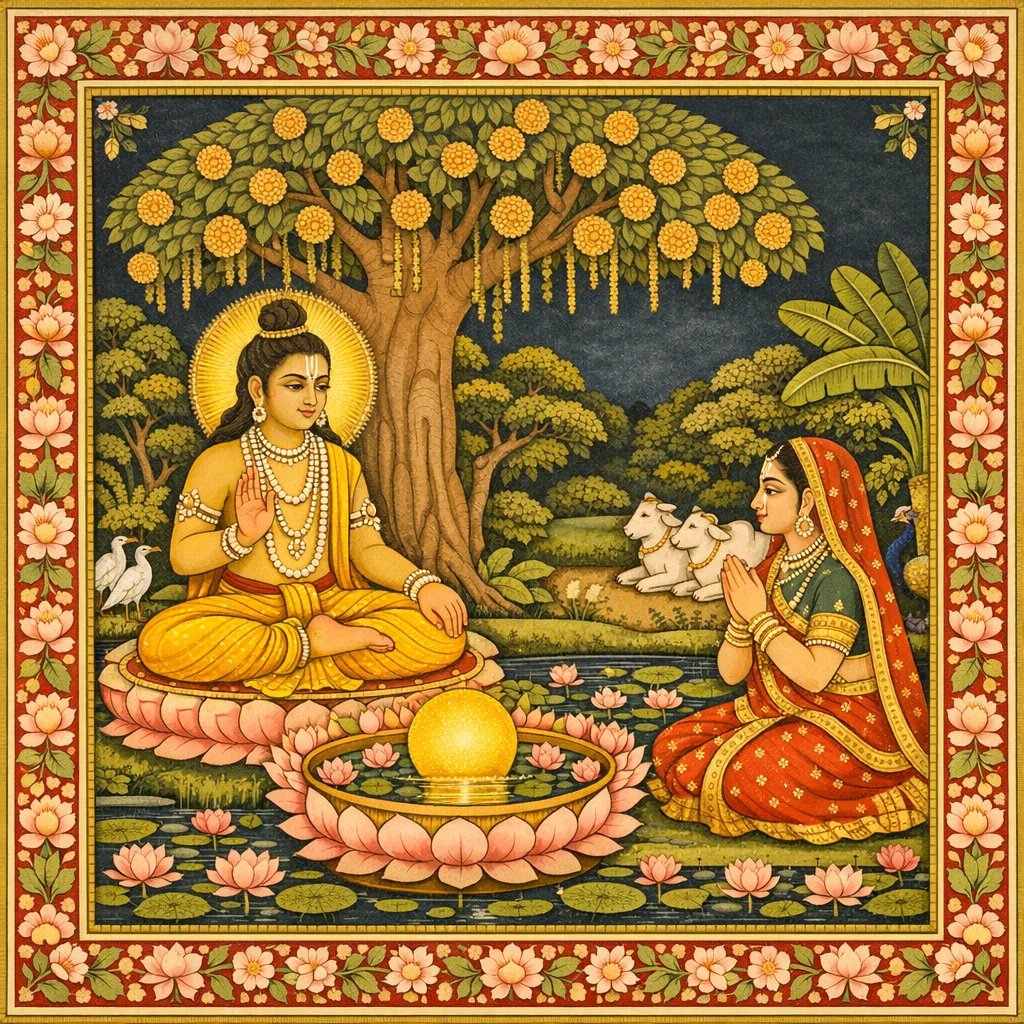
Adhyaya 27
Kapila on Liberation: Detachment, Devotional Discipline, and the Soul’s Aloofness from the Guṇas
Continuing Kapila’s Sāṅkhya-bhakti instruction to Devahūti from the preceding chapter, this adhyāya clarifies the jīva’s transcendence to prakṛti while diagnosing how false ego (ahaṅkāra) and proprietorship bind the soul to guṇa-driven action and transmigration. Kapila uses recurring sun-reflection analogies and sleep/dream imagery to show how consciousness appears entangled though the self remains the seer. He then outlines the sādhaka’s regimen—equanimity toward all beings, regulated living, celibacy, simplicity, seclusion, and offering results to Bhagavān—culminating in hearing and chanting as the elevating force from yoga discipline to unalloyed bhakti. Devahūti’s philosophical doubt about whether prakṛti ever releases the soul is answered: liberation arises by sustained devotional service that burns its own causes of bondage, removing contamination like fire consuming its fuel. The chapter points forward to deeper consolidation of bhakti as the final shelter beyond mystic by-products, culminating in the devotee’s assured return to the Lord’s protected spiritual abode.
Shlokas
Verse 1
श्रीभगवानुवाच प्रकृतिस्थोऽपि पुरुषो नाज्यते प्राकृतैर्गुणै: । अविकारादकर्तृत्वान्निर्गुणत्वाज्जलार्कवत् ॥ १ ॥
The Personality of Godhead Kapila continued: When the living entity is thus unaffected by the modes of material nature, because he is unchanging and does not claim proprietorship, he remains apart from the reactions of the modes, although abiding in a material body, just as the sun remains aloof from its reflection on water.
Verse 2
स एष यर्हि प्रकृतेर्गुणेष्वभिविषज्जते । अहंक्रियाविमूढात्मा कर्तास्मीत्यभिमन्यते ॥ २ ॥
When the soul is under the spell of material nature and false ego, identifying his body as the self, he becomes absorbed in material activities, and by the influence of false ego he thinks that he is the proprietor of everything.
Verse 3
तेन संसारपदवीमवशोऽभ्येत्यनिर्वृत: । प्रासङ्गिकै: कर्मदोषै: सदसन्मिश्रयोनिषु ॥ ३ ॥
The conditioned soul therefore transmigrates into different species of life, higher and lower, because of his association with the modes of material nature. Unless he is relieved of material activities, he has to accept this position because of his faulty work.
Verse 4
अर्थे ह्यविद्यमानेऽपि संसृतिर्न निवर्तते । ध्यायतो विषयानस्य स्वप्नेऽनर्थागमो यथा ॥ ४ ॥
Actually a living entity is transcendental to material existence, but because of his mentality of lording it over material nature, his material existential condition does not cease, and just as in a dream, he is affected by all sorts of disadvantages.
Verse 5
अत एव शनैश्चित्तं प्रसक्तमसतां पथि । भक्तियोगेन तीव्रेण विरक्त्या च नयेद्वशम् ॥ ५ ॥
It is the duty of every conditioned soul to engage his polluted consciousness, which is now attached to material enjoyment, in very serious devotional service with detachment. Thus his mind and consciousness will be under full control.
Verse 6
यमादिभिर्योगपथैरभ्यसन्श्रद्धयान्वित: । मयि भावेन सत्येन मत्कथाश्रवणेन च ॥ ६ ॥
One has to become faithful by practicing the controlling process of the yoga system and must elevate himself to the platform of unalloyed devotional service by chanting and hearing about Me.
Verse 7
सर्वभूतसमत्वेन निर्वैरेणाप्रसङ्गत: । ब्रह्मचर्येण मौनेन स्वधर्मेण बलीयसा ॥ ७ ॥
In executing devotional service, one has to see every living entity equally, without enmity towards anyone yet without intimate connections with anyone. One has to observe celibacy, be grave and execute his eternal activities, offering the results to the Supreme Personality of Godhead.
Verse 8
यदृच्छयोपलब्धेन सन्तुष्टो मितभुङ्मुनि: । विविक्तशरण: शान्तो मैत्र: करुण आत्मवान् ॥ ८ ॥
For his income a devotee should be satisfied with what he earns without great difficulty. He should not eat more than what is necessary. He should live in a secluded place and always be thoughtful, peaceful, friendly, compassionate and self-realized.
Verse 9
सानुबन्धे च देहेऽस्मिन्नकुर्वन्नसदाग्रहम् । ज्ञानेन दृष्टतत्त्वेन प्रकृते: पुरुषस्य च ॥ ९ ॥
One’s seeing power should be increased through knowledge of spirit and matter, and one should not unnecessarily identify himself with the body and thus become attracted by bodily relationships.
Verse 10
निवृत्तबुद्ध्यवस्थानो दूरीभूतान्यदर्शन: । उपलभ्यात्मनात्मानं चक्षुषेवार्कमात्मदृक् ॥ १० ॥
One should be situated in the transcendental position, beyond the stages of material consciousness, and should be aloof from all other conceptions of life. Thus realizing freedom from false ego, one should see his own self just as he sees the sun in the sky.
Verse 11
मुक्तलिङ्गं सदाभासमसति प्रतिपद्यते । सतो बन्धुमसच्चक्षु: सर्वानुस्यूतमद्वयम् ॥ ११ ॥
A liberated soul realizes the Absolute Personality of Godhead, who is transcendental and who is manifest as a reflection even in the false ego. He is the support of the material cause and He enters into everything. He is absolute, one without a second, and He is the eyes of the illusory energy.
Verse 12
यथा जलस्थ आभास: स्थलस्थेनावदृश्यते । स्वाभासेन तथा सूर्यो जलस्थेन दिवि स्थित: ॥ १२ ॥
The presence of the Supreme Lord can be realized just as the sun is realized first as a reflection on water, and again as a second reflection on the wall of a room, although the sun itself is situated in the sky.
Verse 13
एवं त्रिवृदहङ्कारो भूतेन्द्रियमनोमयै: । स्वाभासैर्लक्षितोऽनेन सदाभासेन सत्यदृक् ॥ १३ ॥
The self-realized soul is thus reflected first in the threefold ego and then in the body, senses and mind.
Verse 14
भूतसूक्ष्मेन्द्रियमनोबुद्ध्यादिष्विह निद्रया । लीनेष्वसति यस्तत्र विनिद्रो निरहंक्रिय: ॥ १४ ॥
Although a devotee appears to be merged in the five material elements, the objects of material enjoyment, the material senses and material mind and intelligence, he is understood to be awake and to be freed from the false ego.
Verse 15
मन्यमानस्तदात्मानमनष्टो नष्टवन्मृषा । नष्टेऽहङ्करणे द्रष्टा नष्टवित्त इवातुर: ॥ १५ ॥
The living entity can vividly feel his existence as the seer, but because of the disappearance of the ego during the state of deep sleep, he falsely takes himself to be lost, like a man who has lost his fortune and feels distressed, thinking himself to be lost.
Verse 16
एवं प्रत्यवमृश्यासावात्मानं प्रतिपद्यते । साहङ्कारस्य द्रव्यस्य योऽवस्थानमनुग्रह: ॥ १६ ॥
When, by mature understanding, one can realize his individuality, then the situation he accepts under false ego becomes manifest to him.
Verse 17
देवहूतिरुवाच पुरुषं प्रकृतिर्ब्रह्मन्न विमुञ्चति कर्हिचित् । अन्योन्यापाश्रयत्वाच्च नित्यत्वादनयो: प्रभो ॥ १७ ॥
Śrī Devahūti inquired: My dear brāhmaṇa, does material nature ever give release to the spirit soul? Since one is attracted to the other eternally, how is their separation possible?
Verse 18
यथा गन्धस्य भूमेश्च न भावो व्यतिरेकत: । अपां रसस्य च यथा तथा बुद्धे: परस्य च ॥ १८ ॥
As there is no separate existence of the earth and its aroma or of water and its taste, there cannot be any separate existence of intelligence and consciousness.
Verse 19
अकर्तु: कर्मबन्धोऽयं पुरुषस्य यदाश्रय: । गुणेषु सत्सु प्रकृते: कैवल्यं तेष्वत: कथम् ॥ १९ ॥
Hence even though he is the passive performer of all activities, how can there be freedom for the soul as long as material nature acts on him and binds him?
Verse 20
क्वचित्तत्त्वावमर्शेन निवृत्तं भयमुल्बणम् । अनिवृत्तनिमित्तत्वात्पुन: प्रत्यवतिष्ठते ॥ २० ॥
Even if the great fear of bondage is avoided by mental speculation and inquiry into the fundamental principles, it may still appear again, since its cause has not ceased.
Verse 21
श्रीभगवानुवाच अनिमित्तनिमित्तेन स्वधर्मेणामलात्मना । तीव्रया मयि भक्त्या च श्रुतसम्भृतया चिरम् ॥ २१ ॥
The Supreme Personality of Godhead said: One can get liberation by seriously discharging devotional service unto Me and thereby hearing for a long time about Me or from Me. By thus executing one’s prescribed duties, there will be no reaction, and one will be freed from the contamination of matter.
Verse 22
ज्ञानेन दृष्टतत्त्वेन वैराग्येण बलीयसा । तपोयुक्तेन योगेन तीव्रेणात्मसमाधिना ॥ २२ ॥
This devotional service has to be performed strongly in perfect knowledge and with transcendental vision. One must be strongly renounced and must engage in austerity and perform mystic yoga in order to be firmly fixed in self-absorption.
Verse 23
प्रकृति: पुरुषस्येह दह्यमाना त्वहर्निशम् । तिरोभवित्री शनकैरग्नेर्योनिरिवारणि: ॥ २३ ॥
The influence of material nature has covered the living entity, and thus it is as if the living entity were always in a blazing fire. But by the process of seriously discharging devotional service, this influence can be removed, just as wooden sticks which cause a fire are themselves consumed by it.
Verse 24
भुक्तभोगा परित्यक्ता दृष्टदोषा च नित्यश: । नेश्वरस्याशुभं धत्ते स्वे महिम्नि स्थितस्य च ॥ २४ ॥
By discovering the faultiness of his desiring to lord it over material nature and by therefore giving it up, the living entity becomes independent and stands in his own glory.
Verse 25
यथा ह्यप्रतिबुद्धस्य प्रस्वापो बह्वनर्थभृत् । स एव प्रतिबुद्धस्य न वै मोहाय कल्पते ॥ २५ ॥
In the dreaming state one’s consciousness is almost covered, and one sees many inauspicious things, but when he is awakened and fully conscious, such inauspicious things cannot bewilder him.
Verse 26
एवं विदिततत्त्वस्य प्रकृतिर्मयि मानसम् । युञ्जतो नापकुरुत आत्मारामस्य कर्हिचित् ॥ २६ ॥
The influence of material nature cannot harm an enlightened soul, even though he engages in material activities, because he knows the truth of the Absolute, and his mind is fixed on the Supreme Personality of Godhead.
Verse 27
यदैवमध्यात्मरत: कालेन बहुजन्मना । सर्वत्र जातवैराग्य आब्रह्मभुवनान्मुनि: ॥ २७ ॥
When a person thus engages in devotional service and self-realization for many, many years and births, he becomes completely reluctant to enjoy any one of the material planets, even up to the highest planet, which is known as Brahmaloka; he becomes fully developed in consciousness.
Verse 28
मद्भक्त: प्रतिबुद्धार्थो मत्प्रसादेन भूयसा । नि:श्रेयसं स्वसंस्थानं कैवल्याख्यं मदाश्रयम् ॥ २८ ॥ प्राप्नोतीहाञ्जसा धीर: स्वदृशाच्छिन्नसंशय: । यद्गत्वा न निवर्तेत योगी लिङ्गाद्विनिर्गमे ॥ २९ ॥
My devotee actually becomes self-realized by My unlimited causeless mercy, and thus, when freed from all doubts, he steadily progresses towards his destined abode, which is directly under the protection of My spiritual energy of unadulterated bliss. That is the ultimate perfectional goal of the living entity. After giving up the present material body, the mystic devotee goes to that transcendental abode and never comes back.
Verse 29
मद्भक्त: प्रतिबुद्धार्थो मत्प्रसादेन भूयसा । नि:श्रेयसं स्वसंस्थानं कैवल्याख्यं मदाश्रयम् ॥ २८ ॥ प्राप्नोतीहाञ्जसा धीर: स्वदृशाच्छिन्नसंशय: । यद्गत्वा न निवर्तेत योगी लिङ्गाद्विनिर्गमे ॥ २९ ॥
My devotee actually becomes self-realized by My unlimited causeless mercy, and thus, when freed from all doubts, he steadily progresses towards his destined abode, which is directly under the protection of My spiritual energy of unadulterated bliss. That is the ultimate perfectional goal of the living entity. After giving up the present material body, the mystic devotee goes to that transcendental abode and never comes back.
Verse 30
यदा न योगोपचितासु चेतो मायासु सिद्धस्य विषज्जतेऽङ्ग । अनन्यहेतुष्वथ मे गति: स्याद् आत्यन्तिकी यत्र न मृत्युहास: ॥ ३० ॥
When a perfect yogī’s attention is no longer attracted to the by-products of mystic powers, which are manifestations of the external energy, his progress towards Me becomes unlimited, and thus the power of death cannot overcome him.
Frequently Asked Questions
The analogy teaches that the ātmā remains unchanged and aloof, even when consciousness appears reflected through ego, mind, senses, and body. Just as the sun is not affected by distortions in its reflection, the self is not intrinsically touched by the guṇas; bondage is due to identification (ahaṅkāra) and proprietorship, not the soul’s true nature.
Kapila answers Devahūti that liberation occurs when devotional service is performed steadily—especially hearing and chanting—so that the root causes of bondage (desire to lord over prakṛti, karmic reaction, and false ego) are removed. Bhakti is described as self-purifying: like fire consuming the wood that fuels it, devotion consumes the contaminations that sustain conditioned life.
A liberated soul is one who realizes Bhagavān as the Absolute support of all causes, perceives the self beyond bodily identification, and remains unharmed by material engagement because the mind is fixed on the Supreme. Such a person is awake within the elements—externally functioning, internally free from false ego.
Kapila prescribes equal vision, non-enmity, avoidance of intimate entanglements, celibacy, gravity, simplicity, satisfaction with modest income, moderation in eating, seclusion, thoughtfulness, peace, friendliness, compassion, and self-realization—along with offering all results to Bhagavān and advancing through chanting and hearing.
Mystic siddhis and higher planetary attainments remain within the jurisdiction of external energy and can re-attract attention to subtle enjoyment and prestige. Kapila emphasizes that mature devotion makes one reluctant to enjoy any material planet, even Brahmaloka, because the devotee’s aim is the Lord’s protected spiritual abode beyond return.