Adhyaya 18
Varāha Confronts Hiraṇyākṣa: The Challenge, the Rescue of Earth, and the Opening of the Mace-Duel
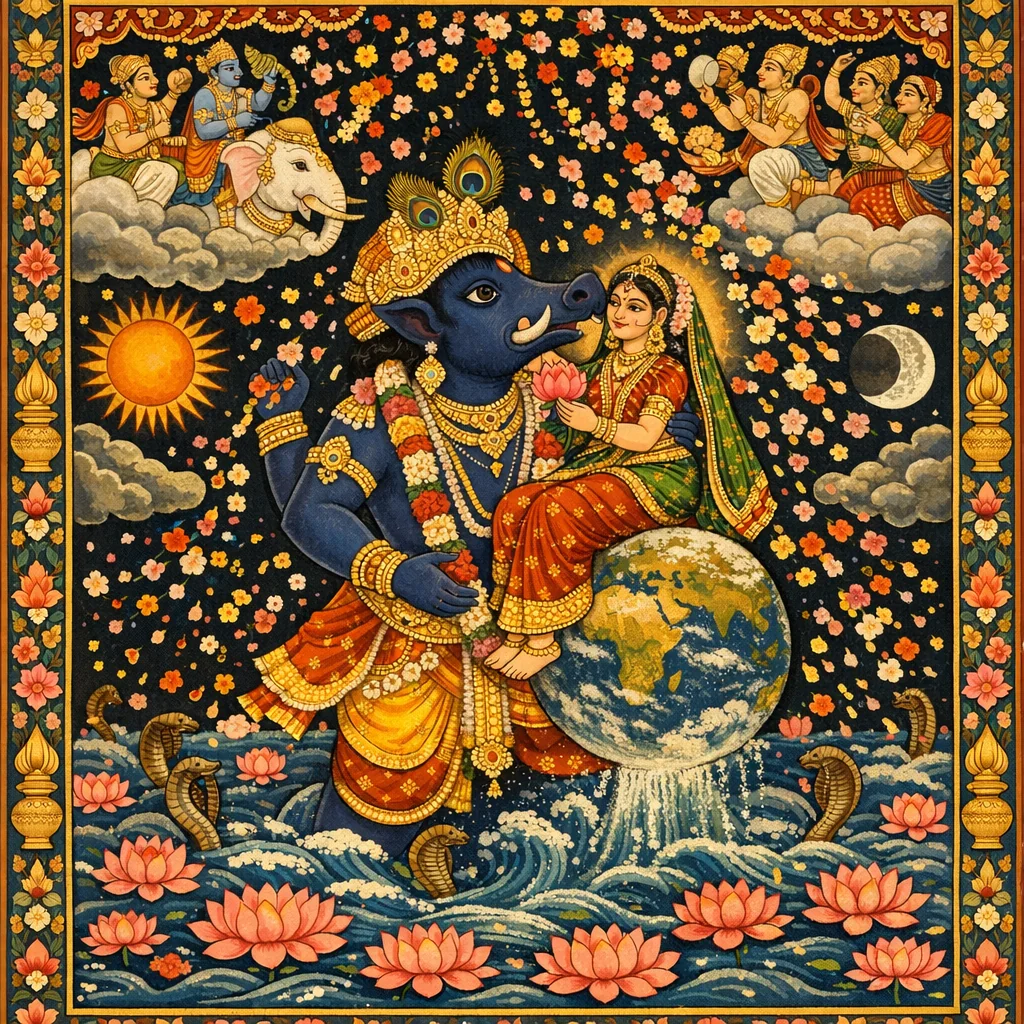
Continuing from the prior tension of Hiraṇyākṣa’s defiance and the Lord’s descent to restore the displaced Earth, this chapter begins as the Daitya—having learned from Nārada where the Supreme Lord is—rushes into the oceanic depths and beholds Varāha lifting Bhū-devī upon His tusks. Mocking the Lord as a mere beast, the demon issues threats against the devas and sacrificial order, claiming dominion over the Earth. Varāha, though pained by abusive speech, prioritizes Bhū-devī’s safety: He rises from the waters, places Earth upon the surface, and empowers her to float, while Brahmā and the devas praise and shower flowers. The Lord then answers the demon’s taunts with fearless, dharma-restoring challenge, exposing Hiraṇyākṣa as bound by death. The combat formally begins: the demon strikes; the Lord deftly evades; both exchange heavy mace blows with escalating fury. The chapter concludes with Brahmā arriving to witness the duel and urging the Lord to end the fight swiftly before inauspicious time passes—setting up the decisive continuation in the next chapter.
Shlokas
Verse 1
मैत्रेय उवाच तदेवमाकर्ण्य जलेशभाषितं महामनास्तद्विगणय्य दुर्मद: । हरेर्विदित्वा गतिमङ्ग नारदाद् रसातलं निर्विविशे त्वरान्वित: ॥ १ ॥
Maitreya continued: The proud and falsely glorious Daitya paid little heed to the words of Varuṇa. O dear Vidura, he learned from Nārada the whereabouts of the Supreme Personality of Godhead and hurriedly betook himself to the depths of the ocean.
Verse 2
ददर्श तत्राभिजितं धराधरं प्रोन्नीयमानावनिमग्रदंष्ट्रया । मुष्णन्तमक्ष्णा स्वरुचोऽरुणश्रिया जहास चाहो वनगोचरो मृग: ॥ २ ॥
He saw there the all-powerful Personality of Godhead in His boar incarnation, bearing the earth upward on the ends of His tusks and robbing him of his splendor with His reddish eyes. The demon laughed: Oh, an amphibious beast!
Verse 3
आहैनमेह्यज्ञ महीं विमुञ्च नो रसौकसां विश्वसृजेयमर्पिता । न स्वस्ति यास्यस्यनया ममेक्षत: सुराधमासादितसूकराकृते ॥ ३ ॥
The demon addressed the Lord: O best of the demigods, dressed in the form of a boar, just hear me. This earth is entrusted to us, the inhabitants of the lower regions, and You cannot take it from my presence and not be hurt by me.
Verse 4
त्वं न: सपत्नैरभवाय किं भृतो यो मायया हन्त्यसुरान् परोक्षजित् । त्वां योगमायाबलमल्पपौरुषं संस्थाप्य मूढ प्रमृजे सुहृच्छुच: ॥ ४ ॥
You rascal, You have been nourished by our enemies to kill us, and You have killed some demons by remaining invisible. O fool, Your power is only mystic, so today I shall enliven my kinsmen by killing You.
Verse 5
त्वयि संस्थिते गदया शीर्णशीर्ष- ण्यस्मद्भुजच्युतया ये च तुभ्यम् । बलिं हरन्त्यृषयो ये च देवा: स्वयं सर्वे न भविष्यन्त्यमूला: ॥ ५ ॥
The demon continued: When You fall dead with Your skull smashed by the mace hurled by my arms, the demigods and sages who offer You oblations and sacrifice in devotional service will also automatically cease to exist, like trees without roots.
Verse 6
स तुद्यमानोऽरिदुरुक्ततोमरै- र्दंष्ट्राग्रगां गामुपलक्ष्य भीताम् । तोदं मृषन्निरगादम्बुमध्याद् ग्राहाहत: सकरेणुर्यथेभ: ॥ ६ ॥
Although the Lord was pained by the shaftlike abusive words of the demon, He bore the pain. But seeing that the earth on the ends of His tusks was frightened, He rose out of the water just as an elephant emerges with its female companion when assailed by an alligator.
Verse 7
तं नि:सरन्तं सलिलादनुद्रुतो हिरण्यकेशो द्विरदं यथा झष: । करालदंष्ट्रोऽशनिनिस्वनोऽब्रवीद् गतह्रियां किं त्वसतां विगर्हितम् ॥ ७ ॥
The demon, who had golden hair on his head and fearful tusks, gave chase to the Lord while He was rising from the water, even as an alligator would chase an elephant. Roaring like thunder, he said: Are You not ashamed of running away before a challenging adversary? There is nothing reproachable for shameless creatures!
Verse 8
स गामुदस्तात्सलिलस्य गोचरे विन्यस्य तस्यामदधात्स्वसत्त्वम् । अभिष्टुतो विश्वसृजा प्रसूनै- रापूर्यमाणो विबुधै: पश्यतोऽरे: ॥ ८ ॥
The Lord placed the earth within His sight on the surface of the water and transferred to her His own energy in the form of the ability to float on the water. While the enemy stood looking on, Brahmā, the creator of the universe, extolled the Lord, and the other demigods rained flowers on Him.
Verse 9
परानुषक्तं तपनीयोपकल्पं महागदं काञ्चनचित्रदंशम् । मर्माण्यभीक्ष्णं प्रतुदन्तं दुरुक्तै: प्रचण्डमन्यु: प्रहसंस्तं बभाषे ॥ ९ ॥
The demon, who had a wealth of ornaments, bangles and beautiful golden armor on his body, chased the Lord from behind with a great mace. The Lord tolerated his piercing ill words, but in order to reply to him, He expressed His terrible anger.
Verse 10
श्रीभगवानुवाच सत्यं वयं भो वनगोचरा मृगा युष्मद्विधान्मृगये ग्रामसिंहान् । न मृत्युपाशै: प्रतिमुक्तस्य वीरा विकत्थनं तव गृह्णन्त्यभद्र ॥ १० ॥
The Personality of Godhead said: Indeed, We are creatures of the jungle, and We are searching after hunting dogs like you. One who is freed from the entanglement of death has no fear from the loose talk in which you are indulging, for you are bound up by the laws of death.
Verse 11
एते वयं न्यासहरा रसौकसां गतह्रियो गदया द्रावितास्ते । तिष्ठामहेऽथापि कथञ्चिदाजौ स्थेयं क्व यामो बलिनोत्पाद्य वैरम् ॥ ११ ॥
Certainly We have stolen the charge of the inhabitants of Rasātala and have lost all shame. Although bitten by your powerful mace, I shall stay here in the water for some time because, having created enmity with a powerful enemy, I now have no place to go.
Verse 12
त्वं पद्रथानां किल यूथपाधिपो घटस्व नोऽस्वस्तय आश्वनूह: । संस्थाप्य चास्मान् प्रमृजाश्रुस्वकानां य: स्वां प्रतिज्ञां नातिपिपर्त्यसभ्य: ॥ १२ ॥
You are supposed to be the commander of many foot soldiers, and now you may take prompt steps to overthrow Us. Give up all your foolish talk and wipe out the cares of your kith and kin by slaying Us. One may be proud, yet he does not deserve a seat in an assembly if he fails to fulfill his promised word.
Verse 13
मैत्रेय उवाचसोऽधिक्षिप्तो भगवता प्रलब्धश्च रुषा भृशम् । आजहारोल्बणं क्रोधं क्रीड्यमानोऽहिराडिव ॥ १३ ॥
Śrī Maitreya said: The demon, being thus challenged by the Personality of Godhead, became angry and agitated, and he trembled in anger like a challenged cobra.
Verse 14
सृजन्नमर्षित: श्वासान्मन्युप्रचलितेन्द्रिय: । आसाद्य तरसा दैत्यो गदयान्यहनद्धरिम् ॥ १४ ॥
Hissing indignantly, all his senses shaken by wrath, the demon quickly sprang upon the Lord and dealt Him a blow with his powerful mace.
Verse 15
भगवांस्तु गदावेगं विसृष्टं रिपुणोरसि । अवञ्चयत्तिरश्चीनो योगारूढ इवान्तकम् ॥ १५ ॥
The Lord, however, by moving slightly aside, dodged the violent mace-blow aimed at His breast by the enemy, just as an accomplished yogī would elude death.
Verse 16
पुनर्गदां स्वामादाय भ्रामयन्तमभीक्ष्णश: । अभ्यधावद्धरि: क्रुद्ध: संरम्भाद्दष्टदच्छदम् ॥ १६ ॥
The Personality of Godhead now exhibited His anger and rushed to meet the demon, who bit his lip in rage, took up his mace again and began to repeatedly brandish it about.
Verse 17
ततश्च गदयारातिं दक्षिणस्यां भ्रुवि प्रभु: । आजघ्ने स तु तां सौम्य गदया कोविदोऽहनत् ॥ १७ ॥
Then with His mace the Lord struck the enemy on the right of his brow, but since the demon was expert in fighting, O gentle Vidura, he protected himself by a maneuver of his own mace.
Verse 18
एवं गदाभ्यां गुर्वीभ्यां हर्यक्षो हरिरेव च । जिगीषया सुसंरब्धावन्योन्यमभिजघ्नतु: ॥ १८ ॥
In this way, the demon Haryakṣa and the Lord, the Personality of Godhead, struck each other with their huge maces, each enraged and seeking his own victory.
Verse 19
तयो: स्पृधोस्तिग्मगदाहताङ्गयो: क्षतास्रवघ्राणविवृद्धमन्य्वो: । विचित्रमार्गांश्चरतोर्जिगीषया व्यभादिलायामिव शुष्मिणोर्मृध: ॥ १९ ॥
There was keen rivalry between the two combatants; both had sustained injuries on their bodies from the blows of each other’s pointed maces, and each grew more and more enraged at the smell of blood on his person. In their eagerness to win, they performed maneuvers of various kinds, and their contest looked like an encounter between two forceful bulls for the sake of a cow.
Verse 20
दैत्यस्य यज्ञावयवस्य माया- गृहीतवाराहतनोर्महात्मन: । कौरव्य मह्यां द्विषतोर्विमर्दनं दिदृक्षुरागादृषिभिर्वृत: स्वराट् ॥ २० ॥
O descendant of Kuru, Brahmā, the most independent demigod of the universe, accompanied by his followers, came to see the terrible fight for the sake of the world between the demon and the Personality of Godhead, who appeared in the form of a boar.
Verse 21
आसन्नशौण्डीरमपेतसाध्वसं कृतप्रतीकारमहार्यविक्रमम् । विलक्ष्य दैत्यं भगवान् सहस्रणी- र्जगाद नारायणमादिसूकरम् ॥ २१ ॥
After arriving at the place of combat, Brahmā, the leader of thousands of sages and transcendentalists, saw the demon, who had attained such unprecedented power that no one could fight with him. Brahmā then addressed Nārāyaṇa, who was assuming the form of a boar for the first time.
Verse 22
ब्रह्मोवाच एष ते देव देवानामङ्घ्रिमूलमुपेयुषाम् । विप्राणां सौरभेयीणां भूतानामप्यनागसाम् ॥ २२ ॥ आगस्कृद्भयकृद्दुष्कृदस्मद्राद्धवरोऽसुर: । अन्वेषन्नप्रतिरथो लोकानटति कण्टक: ॥ २३ ॥
Lord Brahmā said: My dear Lord, this demon has proved to be a constant pinprick to the demigods, the brāhmaṇas, the cows and innocent persons who are spotless and always dependent upon worshiping Your lotus feet. He has become a source of fear by unnecessarily harassing them. Since he has attained a boon from me, he has become a demon, always searching for a proper combatant, wandering all over the universe for this infamous purpose.
Verse 23
ब्रह्मोवाच एष ते देव देवानामङ्घ्रिमूलमुपेयुषाम् । विप्राणां सौरभेयीणां भूतानामप्यनागसाम् ॥ २२ ॥ आगस्कृद्भयकृद्दुष्कृदस्मद्राद्धवरोऽसुर: । अन्वेषन्नप्रतिरथो लोकानटति कण्टक: ॥ २३ ॥
Lord Brahmā said: My dear Lord, this demon has proved to be a constant pinprick to the demigods, the brāhmaṇas, the cows and innocent persons who are spotless and always dependent upon worshiping Your lotus feet. He has become a source of fear by unnecessarily harassing them. Since he has attained a boon from me, he has become a demon, always searching for a proper combatant, wandering all over the universe for this infamous purpose.
Verse 24
मैनं मायाविनं दृप्तं निरङ्कुशमसत्तमम् । आक्रीड बालवद्देव यथाशीविषमुत्थितम् ॥ २४ ॥
Lord Brahmā continued: My dear Lord, there is no need to play with this serpentine demon, who is always very skilled in conjuring tricks and is arrogant, self-sufficient and most wicked.
Verse 25
न यावदेष वर्धेत स्वां वेलां प्राप्य दारुण: । स्वां देव मायामास्थाय तावज्जह्यघमच्युत ॥ २५ ॥
Brahmā continued: My dear Lord, You are infallible. Please kill this sinful demon before the demoniac hour arrives and he presents another formidable approach favorable to him. You can kill him by Your internal potency without doubt.
Verse 26
एषा घोरतमा सन्ध्या लोकच्छम्बट्करी प्रभो । उपसर्पति सर्वात्मन् सुराणां जयमावह ॥ २६ ॥
My Lord, the darkest evening, which covers the world, is fast approaching. Since You are the Soul of all souls, kindly kill him and win victory for the demigods.
Verse 27
अधुनैषोऽभिजिन्नाम योगो मौहूर्तिको ह्यगात् । शिवाय नस्त्वं सुहृदामाशु निस्तर दुस्तरम् ॥ २७ ॥
The auspicious period known as abhijit, which is most opportune for victory, commenced at midday and has all but passed; therefore, in the interest of Your friends, please dispose of this formidable foe quickly.
Verse 28
दिष्टया त्वां विहितं मृत्युसमयमासादित: स्वयम् । विक्रम्यैनं मृधे हत्वा लोकानाधेहि शर्मणि ॥ २८ ॥
This demon, luckily for us, has come of his own accord to You, his death ordained by You; therefore, exhibiting Your ways, kill him in the duel and establish the worlds in peace.
Frequently Asked Questions
Varāha’s first act is poṣaṇa: safeguarding Bhū-devī and stabilizing cosmic order. The text highlights that the Lord transfers His potency so Earth can float, demonstrating that restoring dharma is not impulsive heroism but deliberate protection of the vulnerable and re-establishment of the world’s foundations before the final removal of adharma.
Hiraṇyākṣa’s insults are described as “shaftlike,” acknowledging speech as a weapon that wounds. Yet Varāha tolerates them until Earth’s fear is addressed, showing divine forbearance. When He replies, it is not egoic retaliation but a dharmic rebuke: He frames the demon as bound by death (kāla) and Himself as fearless, thereby re-centering the conflict on spiritual reality rather than verbal provocation.
Hiraṇyākṣa is a Daitya empowered by a boon (received via Brahmā), which fuels arrogance and a compulsion to find an equal combatant. He seeks notoriety through conquest and terrorizes devas, brāhmaṇas, cows, and innocents—those aligned with worship of the Lord—making his challenge a direct assault on sacrificial order and divine sovereignty.
Brahmā’s counsel frames the duel within kāla (time), a governing principle even in cosmic events. Abhijit is traditionally an auspicious midday period associated with victory; Brahmā urges swift completion to prevent the demon from gaining advantage in an inauspicious hour and to restore peace promptly. The episode underscores that the Lord’s līlā accommodates worldly timing while remaining fully capable of victory by internal potency.