Adhyaya 21
Kardama Muni’s Penance, Viṣṇu’s Darśana, and the Arrangement of Devahūti’s Marriage
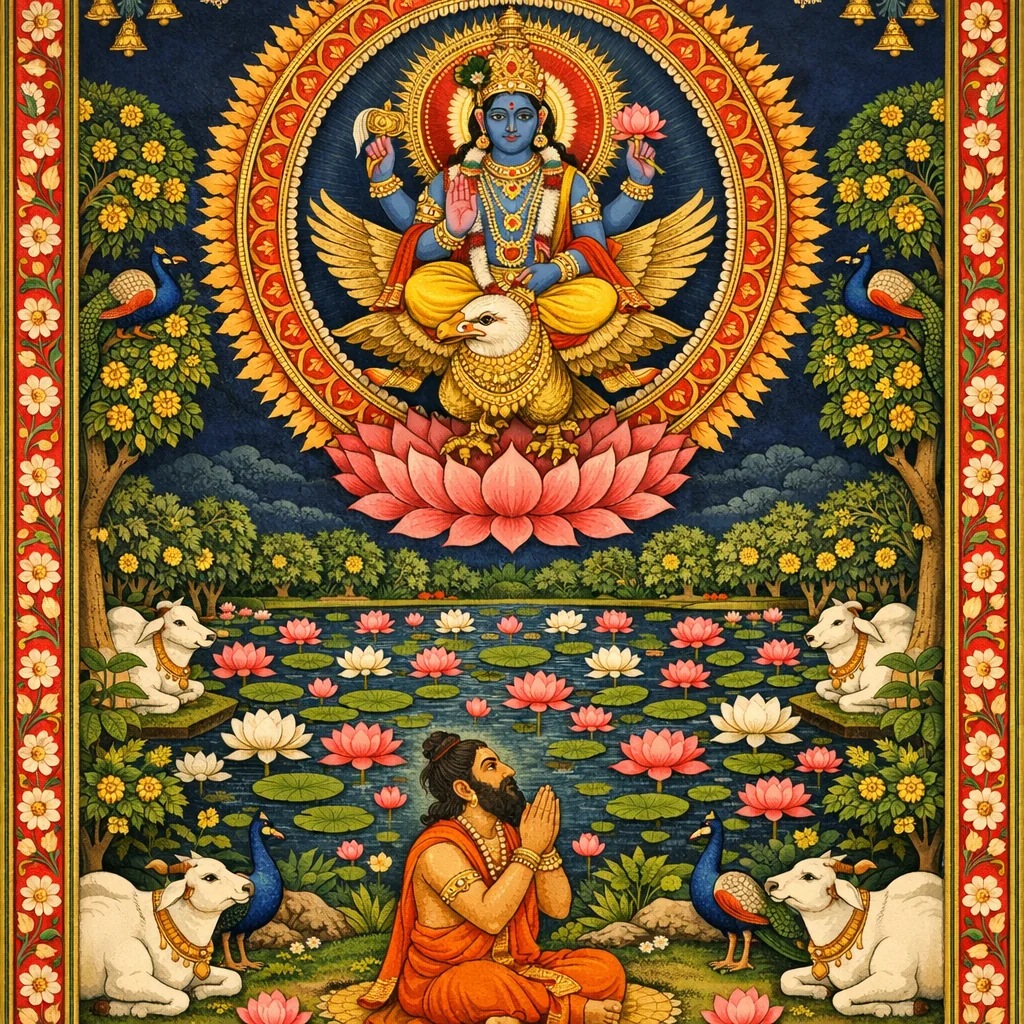
Vidura presses Maitreya for specifics of Svāyambhuva Manu’s dynasty—especially Devahūti’s marriage to Kardama and the progeny of Manu’s daughters, linking earlier genealogical mentions to concrete historical unfolding. Maitreya then narrates Kardama’s ten-thousand-year tapas on the Sarasvatī at Bindu-sarovara, culminating in Viṣṇu’s personal appearance on Garuḍa. Kardama’s prayers blend devotional awe with candid admission of material desire for a suitable wife, and he praises the Lord’s role as time, creator, and liberator whose wheel governs the cosmos yet cannot diminish devotees. Viṣṇu responds by validating Kardama’s disciplined worship, foretelling Manu and Śatarūpā’s arrival with Devahūti, promising nine daughters, and announcing His own partial descent as Kapila to teach tattva (Sāṅkhya). After the Lord departs toward Vaikuṇṭha, Manu arrives at the foretold time; the chapter lingers on the sanctity and beauty of Bindu-sarovara and then turns to Kardama’s reception of Manu, setting up the forthcoming marriage negotiations and household-stage developments that lead to Kapila’s teachings.
Shlokas
Verse 1
विदुर उवाच स्वायम्भुवस्य च मनोर्वंश: परमसम्मत: । कथ्यतां भगवन् यत्र मैथुनेनैधिरे प्रजा: ॥ १ ॥
Vidura said: The line of Svāyambhuva Manu was most esteemed. O worshipful sage, I beg you: Give me an account of this race, whose progeny multiplied through sexual intercourse.
Verse 2
प्रियव्रतोत्तानपादौ सुतौ स्वायम्भुवस्य वै । यथाधर्मं जुगुपतु: सप्तद्वीपवतीं महीम् ॥ २ ॥
The two great sons of Svāyambhuva Manu — Priyavrata and Uttānapāda — ruled the world, consisting of seven islands, just according to religious principles.
Verse 3
तस्य वै दुहिता ब्रह्मन्देवहूतीति विश्रुता । पत्नी प्रजापतेरुक्ता कर्दमस्य त्वयानघ ॥ ३ ॥
O holy brāhmaṇa, O sinless one, you have spoken of his daughter, known by the name Devahūti, as the wife of the sage Kardama, the lord of created beings.
Verse 4
तस्यां स वै महायोगी युक्तायां योगलक्षणै: । ससर्ज कतिधा वीर्यं तन्मे शुश्रूषवे वद ॥ ४ ॥
How many offspring did that great yogī beget through the princess, who was endowed with eightfold perfection in the yoga principles? Oh, pray tell me this, for I am eager to hear it.
Verse 5
रुचिर्यो भगवान् ब्रह्मन्दक्षो वा ब्रह्मण: सुत: । यथा ससर्ज भूतानि लब्ध्वा भार्यां च मानवीम् ॥ ५ ॥
O holy sage, tell me how the worshipful Ruci and Dakṣa, the son of Brahmā, generated children after securing as their wives the other two daughters of Svāyambhuva Manu.
Verse 6
मैत्रेय उवाच प्रजा: सृजेति भगवान् कर्दमो ब्रह्मणोदित: । सरस्वत्यां तपस्तेपे सहस्राणां समा दश ॥ ६ ॥
The great sage Maitreya replied: Commanded by Lord Brahmā to beget children in the worlds, the worshipful Kardama Muni practiced penance on the bank of the river Sarasvatī for a period of ten thousand years.
Verse 7
तत: समाधियुक्तेन क्रियायोगेन कर्दम: । सम्प्रपेदे हरिं भक्त्या प्रपन्नवरदाशुषम् ॥ ७ ॥
During that period of penance, the sage Kardama, by worship through devotional service in trance, propitiated the Personality of Godhead, who is the quick bestower of all blessings upon those who flee to Him for protection.
Verse 8
तावत्प्रसन्नो भगवान् पुष्कराक्ष: कृते युगे । दर्शयामास तं क्षत्त: शाब्दं ब्रह्म दधद्वपु: ॥ ८ ॥
Then, in the Satya-yuga, the lotus-eyed Supreme Personality of Godhead, being pleased, showed Himself to that Kardama Muni and displayed His transcendental form, which can be understood only through the Vedas.
Verse 9
स तं विरजमर्काभं सितपद्मोत्पलस्रजम् । स्निग्धनीलालकव्रातवक्त्राब्जं विरजोऽम्बरम् ॥ ९ ॥
Kardama Muni saw the Supreme Personality of Godhead, who is free from material contamination, in His eternal form, effulgent like the sun, wearing a garland of white lotuses and water lilies. The Lord was clad in spotless yellow silk, and His lotus face was fringed with slick dark locks of curly hair.
Verse 10
किरीटिनं कुण्डलिनं शङ्खचक्रगदाधरम् । श्वेतोत्पलक्रीडनकं मन:स्पर्शस्मितेक्षणम् ॥ १० ॥
Adorned with a crown and earrings, He held His characteristic conch, disc and mace in three of His hands and a white lily in the fourth. He glanced about in a happy, smiling mood whose sight captivates the hearts of all devotees.
Verse 11
विन्यस्तचरणाम्भोजमंसदेशे गरुत्मत: । दृष्ट्वा खेऽवस्थितं वक्ष:श्रियं कौस्तुभकन्धरम् ॥ ११ ॥
A golden streak on His chest, the famous Kaustubha gem suspended from His neck, He stood in the air with His lotus feet placed on the shoulders of Garuḍa.
Verse 12
जातहर्षोऽपतन्मूर्ध्ना क्षितौ लब्धमनोरथ: । गीर्भिस्त्वभ्यगृणात्प्रीतिस्वभावात्मा कृताञ्जलि: ॥ १२ ॥
When Kardama Muni actually realized the Supreme Personality of Godhead in person, he was greatly satisfied because his transcendental desire was fulfilled. He fell on the ground with his head bowed to offer obeisances unto the lotus feet of the Lord. His heart naturally full of love of God, with folded hands he satisfied the Lord with prayers.
Verse 13
ऋषिरुवाच जुष्टं बताद्याखिलसत्त्वराशे: सांसिद्ध्यमक्ष्णोस्तव दर्शनान्न: । यद्दर्शनं जन्मभिरीड्य सद्भि- राशासते योगिनो रूढयोगा: ॥ १३ ॥
The great sage Kardama said: O supreme worshipful Lord, my power of sight is now fulfilled, having attained the greatest perfection of the sight of You, who are the reservoir of all existences. Through many successive births of deep meditation, advanced yogīs aspire to see Your transcendental form.
Verse 14
ये मायया ते हतमेधसस्त्वत्- पादारविन्दं भवसिन्धुपोतम् । उपासते कामलवाय तेषां रासीश कामान्निरयेऽपि ये स्यु: ॥ १४ ॥
Your lotus feet are the true vessel to take one across the ocean of mundane nescience. Only persons deprived of their intelligence by the spell of the deluding energy will worship those feet with a view to attain the trivial and momentary pleasures of the senses, which even persons rotting in hell can attain. However, O my Lord, You are so kind that You bestow mercy even upon them.
Verse 15
तथा स चाहं परिवोढुकाम: समानशीलां गृहमेधधेनुम् । उपेयिवान्मूलमशेषमूलं दुराशय: कामदुघाङ्घ्रिपस्य ॥ १५ ॥
Therefore, desiring to marry a girl of like disposition who may prove to be a veritable cow of plenty in my married life, to satisfy my lustful desire I too have sought the shelter of Your lotus feet, which are the source of everything, for You are like a desire tree.
Verse 16
प्रजापतेस्ते वचसाधीश तन्त्या लोक: किलायं कामहतोऽनुबद्ध: । अहं च लोकानुगतो वहामि बलिं च शुक्लानिमिषाय तुभ्यम् ॥ १६ ॥
O my Lord, You are the master and leader of all living entities. Under Your direction, all conditioned souls, as if bound by rope, are constantly engaged in satisfying their desires. Following them, O embodiment of religion, I also bear oblations for You, who are eternal time.
Verse 17
लोकांश्च लोकानुगतान् पशूंश्च हित्वा श्रितास्ते चरणातपत्रम् । परस्परं त्वद्गुणवादसीधु- पीयूषनिर्यापितदेहधर्मा: ॥ १७ ॥
However, persons who have given up stereotyped worldly affairs and the beastly followers of these affairs, and who have taken shelter of the umbrella of Your lotus feet by drinking the intoxicating nectar of Your qualities and activities in discussions with one another, can be freed from the primary necessities of the material body.
Verse 18
न तेऽजराक्षभ्रमिरायुरेषां त्रयोदशारं त्रिशतं षष्टिपर्व । षण्नेम्यनन्तच्छदि यत्त्रिणाभि करालस्रोतो जगदाच्छिद्य धावत् ॥ १८ ॥
Your wheel, which has three naves, rotates around the axis of the imperishable Brahman. It has thirteen spokes, 360 joints, six rims and numberless leaves carved upon it. Though its revolution cuts short the life span of the entire creation, this wheel of tremendous velocity cannot touch the life span of the devotees of the Lord.
Verse 19
एक: स्वयं सञ्जगत: सिसृक्षया- द्वितीययात्मन्नधियोगमायया । सृजस्यद: पासि पुनर्ग्रसिष्यसे यथोर्णनाभिर्भगवन् स्वशक्तिभि: ॥ १९ ॥
My dear Lord, You alone create the universes. O Personality of Godhead, desiring to create these universes, You create them, maintain them and again wind them up by Your own energies, which are under the control of Your second energy, called yoga-māyā, just as a spider creates a cobweb by its own energy and again winds it up.
Verse 20
नैतद्बताधीश पदं तवेप्सितं यन्मायया नस्तनुषे भूतसूक्ष्मम् । अनुग्रहायास्त्वपि यर्ही मायया लसत्तुलस्या भगवान् विलक्षित: ॥ २० ॥
My dear Lord, although it is not Your desire, You manifest this creation of gross and subtle elements just for our sensual satisfaction. Let Your causeless mercy be upon us, for You have appeared before us in Your eternal form, adorned with a splendid wreath of tulasī leaves.
Verse 21
तं त्वानुभूत्योपरतक्रियार्थं स्वमायया वर्तितलोकतन्त्रम् । नमाम्यभीक्ष्णं नमनीयपाद- सरोजमल्पीयसि कामवर्षम् ॥ २१ ॥
I continuously offer my respectful obeisances unto Your lotus feet, of which it is worthy to take shelter, because You shower all benedictions on the insignificant. To give all living entities detachment from fruitive activity by realizing You, You have expanded these material worlds by Your own energy.
Verse 22
ऋषिरुवाच इत्यव्यलीकं प्रणुतोऽब्जनाभ- स्तमाबभाषे वचसामृतेन । सुपर्णपक्षोपरि रोचमान: प्रेमस्मितोद्वीक्षणविभ्रमद्भ्रू: ॥ २२ ॥
Maitreya resumed: Sincerely extolled in these words, Lord Viṣṇu, shining very beautifully on the shoulders of Garuḍa, replied with words as sweet as nectar. His eyebrows moved gracefully as He looked at the sage with a smile full of affection.
Verse 23
श्रीभगवानुवाच विदित्वा तव चैत्यं मे पुरैव समयोजि तत् । यदर्थमात्मनियमैस्त्वयैवाहं समर्चित: ॥ २३ ॥
The Supreme Lord said: Having come to know what was in your mind, I have already arranged for that for which you have worshiped Me well through your mental and sensory discipline.
Verse 24
न वै जातु मृषैव स्यात्प्रजाध्यक्ष मदर्हणम् । भवद्विधेष्वतितरां मयि संगृभितात्मनाम् ॥ २४ ॥
The Lord continued: My dear ṛṣi, O leader of the living entities, for those who serve Me in devotion by worshiping Me, especially persons like you who have given up everything unto Me, there is never any question of frustration.
Verse 25
प्रजापतिसुत: सम्राण्मनुर्विख्यातमङ्गल: । ब्रह्मावर्तं योऽधिवसन् शास्ति सप्तार्णवां महीम् ॥ २५ ॥
The Emperor Svāyambhuva Manu, the son of Lord Brahmā, who is well known for his righteous acts, has his seat in Brahmāvarta and rules over the earth with its seven oceans.
Verse 26
स चेह विप्र राजर्षिर्महिष्या शतरूपया । आयास्यति दिदृक्षुस्त्वां परश्वो धर्मकोविद: ॥ २६ ॥
The day after tomorrow, O brāhmaṇa, that celebrated emperor, who is expert in religious activities, will come here with his queen, Śatarūpā, wishing to see you.
Verse 27
आत्मजामसितापाङ्गीं वय:शीलगुणान्विताम् । मृगयन्तीं पतिं दास्यत्यनुरूपाय ते प्रभो ॥ २७ ॥
He has a grown-up daughter whose eyes are black. She is ready for marriage, and she has good character and all good qualities. She is also searching for a good husband. My dear sir, her parents will come to see you, who are exactly suitable for her, just to deliver their daughter as your wife.
Verse 28
समाहितं ते हृदयं यत्रेमान् परिवत्सरान् । सा त्वां ब्रह्मन्नृपवधू: काममाशु भजिष्यति ॥ २८ ॥
That princess, O holy sage, will be just the type you have been thinking of in your heart for all these long years. She will soon be yours and will serve you to your heart’s content.
Verse 29
या त आत्मभृतं वीर्यं नवधा प्रसविष्यति । वीर्ये त्वदीये ऋषय आधास्यन्त्यञ्जसात्मन: ॥ २९ ॥
She will bring forth nine daughters from the seed sown in her by you, and through the daughters you beget, the sages will duly beget children.
Verse 30
त्वं च सम्यगनुष्ठाय निदेशं म उशत्तम: । मयि तीर्थीकृताशेषक्रियार्थो मां प्रपत्स्यसे ॥ ३० ॥
With your heart cleansed by properly carrying out My command, resigning to Me the fruits of all your acts, you will finally attain to Me.
Verse 31
कृत्वा दयां च जीवेषु दत्त्वा चाभयमात्मवान् । मय्यात्मानं सह जगद् द्रक्ष्यस्यात्मनि चापि माम् ॥ ३१ ॥
Showing compassion to all living entities, you will attain self-realization. Giving assurance of safety to all, you will perceive your own self as well as all the universes in Me, and Myself in you.
Verse 32
सहाहं स्वांशकलया त्वद्वीर्येण महामुने । तव क्षेत्रे देवहूत्यां प्रणेष्ये तत्त्वसंहिताम् ॥ ३२ ॥
O great sage, I shall manifest My own plenary portion through your wife, Devahūti, along with your nine daughters, and I shall instruct her in the system of philosophy that deals with the ultimate principles or categories.
Verse 33
मैत्रेय उवाच एवं तमनुभाष्याथ भगवान् प्रत्यगक्षज: । जगाम बिन्दुसरस: सरस्वत्या परिश्रितात् ॥ ३३ ॥
Maitreya went on: Thus having spoken to Kardama Muni, the Lord, who reveals Himself only when the senses are in Kṛṣṇa consciousness, departed from that lake called Bindu-sarovara, which was encircled by the river Sarasvatī.
Verse 34
निरीक्षतस्तस्य ययावशेष- सिद्धेश्वराभिष्टुतसिद्धमार्ग: । आकर्णयन् पत्ररथेन्द्रपक्षै- रुच्चारितं स्तोममुदीर्णसाम ॥ ३४ ॥
While the sage stood looking on, the Lord left by the pathway leading to Vaikuṇṭha, a path extolled by all great liberated souls. The sage stood listening as the hymns forming the basis of the Sāma Veda were vibrated by the flapping wings of the Lord’s carrier, Garuḍa.
Verse 35
अथ सम्प्रस्थिते शुक्ले कर्दमो भगवानृषि: । आस्ते स्म बिन्दुसरसि तं कालं प्रतिपालयन् ॥ ३५ ॥
Then, after the departure of the Lord, the worshipful sage Kardama stayed on the bank of Bindu-sarovara, awaiting the time of which the Lord had spoken.
Verse 36
मनु: स्यन्दनमास्थाय शातकौम्भपरिच्छदम् । आरोप्य स्वां दुहितरं सभार्य: पर्यटन्महीम् ॥ ३६ ॥
Svāyambhuva Manu, with his wife, mounted his chariot, which was decorated with golden ornaments. Placing his daughter on it with them, he began traveling all over the earth.
Verse 37
तस्मिन् सुधन्वन्नहनि भगवान् यत्समादिशत् । उपायादाश्रमपदं मुने: शान्तव्रतस्य तत् ॥ ३७ ॥
O Vidura, they reached the hermitage of the sage, who had just completed his vows of austerity on the very day foretold by the Lord.
Verse 38
यस्मिन् भगवतो नेत्रान्न्यपतन्नश्रुबिन्दव: । कृपया सम्परीतस्य प्रपन्नेऽर्पितया भृशम् ॥ ३८ ॥ तद्वै बिन्दुसरो नाम सरस्वत्या परिप्लुतम् । पुण्यं शिवामृतजलं महर्षिगणसेवितम् ॥ ३९ ॥
The holy Lake Bindu-sarovara, flooded by the waters of the river Sarasvatī, was resorted to by hosts of eminent sages. Its holy water was not only auspicious but as sweet as nectar. It was called Bindu-sarovara because drops of tears had fallen there from the eyes of the Lord, who was overwhelmed by extreme compassion for the sage who had sought His protection.
Verse 39
यस्मिन् भगवतो नेत्रान्न्यपतन्नश्रुबिन्दव: । कृपया सम्परीतस्य प्रपन्नेऽर्पितया भृशम् ॥ ३८ ॥ तद्वै बिन्दुसरो नाम सरस्वत्या परिप्लुतम् । पुण्यं शिवामृतजलं महर्षिगणसेवितम् ॥ ३९ ॥
The holy Lake Bindu-sarovara, flooded by the waters of the river Sarasvatī, was resorted to by hosts of eminent sages. Its holy water was not only auspicious but as sweet as nectar. It was called Bindu-sarovara because drops of tears had fallen there from the eyes of the Lord, who was overwhelmed by extreme compassion for the sage who had sought His protection.
Verse 40
पुण्यद्रुमलताजालै: कूजत्पुण्यमृगद्विजै: । सर्वर्तुफलपुष्पाढ्यं वनराजिश्रियान्वितम् ॥ ४० ॥
The shore of the lake was surrounded by clusters of pious trees and creepers, rich in fruits and flowers of all seasons, that afforded shelter to pious animals and birds, which uttered various cries. It was adorned by the beauty of groves of forest trees.
Verse 41
मत्तद्विजगणैर्घुष्टं मत्तभ्रमरविभ्रमम् । मत्तबर्हिनटाटोपमाह्वयन्मत्तकोकिलम् ॥ ४१ ॥
The area resounded with the notes of overjoyed birds. Intoxicated bees wandered there, intoxicated peacocks proudly danced, and merry cuckoos called one another.
Verse 42
कदम्बचम्पकाशोककरञ्जबकुलासनै: । कुन्दमन्दारकुटजैश्चूतपोतैरलङ्कृतम् ॥ ४२ ॥ कारण्डवै: प्लवैर्हंसै: कुररैर्जलकुक्कुटै: । सारसैश्चक्रवाकैश्च चकोरैर्वल्गु कूजितम् ॥ ४३ ॥
Lake Bindu-sarovara was adorned by flowering trees such as kadamba, campaka, aśoka, karañja, bakula, āsana, kunda, mandāra, kuṭaja and young mango trees. The air was filled with the pleasing notes of kāraṇḍava ducks, plavas, swans, ospreys, waterfowl, cranes, cakravākas and cakoras.
Verse 43
कदम्बचम्पकाशोककरञ्जबकुलासनै: । कुन्दमन्दारकुटजैश्चूतपोतैरलङ्कृतम् ॥ ४२ ॥ कारण्डवै: प्लवैर्हंसै: कुररैर्जलकुक्कुटै: । सारसैश्चक्रवाकैश्च चकोरैर्वल्गु कूजितम् ॥ ४३ ॥
Lake Bindu-sarovara was adorned by flowering trees such as kadamba, campaka, aśoka, karañja, bakula, āsana, kunda, mandāra, kuṭaja and young mango trees. The air was filled with the pleasing notes of kāraṇḍava ducks, plavas, swans, ospreys, waterfowl, cranes, cakravākas and cakoras.
Verse 44
तथैव हरिणै: क्रोडै: श्वाविद्गवयकुञ्जरै: । गोपुच्छैर्हरिभिर्मर्कैर्नकुलैर्नाभिभिर्वृतम् ॥ ४४ ॥
Its shores abounded with deer, boars, porcupines, gavayas, elephants, baboons, lions, monkeys, mongooses and musk deer.
Verse 45
प्रविश्य तत्तीर्थवरमादिराज: सहात्मज: । ददर्श मुनिमासीनं तस्मिन् हुतहुताशनम् ॥ ४५ ॥ विद्योतमानं वपुषा तपस्युग्रयुजा चिरम् । नातिक्षामं भगवत: स्निग्धापाङ्गावलोकनात् । त द्वयहृतामृतकलापीयूषश्रवणेन च ॥ ४६ ॥ प्रांशुं पद्मपलाशाक्षं जटिलं चीरवाससम् । उपसंश्रित्य मलिनं यथार्हणमसंस्कृतम् ॥ ४७ ॥
Entering that most sacred spot with his daughter and going near the sage, the first monarch, Svāyambhuva Manu, saw the sage sitting in his hermitage, having just propitiated the sacred fire by pouring oblations into it. His body shone most brilliantly; though he had engaged in austere penance for a long time, he was not emaciated, for the Lord had cast His affectionate sidelong glance upon him and he had also heard the nectar flowing from the moonlike words of the Lord. The sage was tall, his eyes were large, like the petals of a lotus, and he had matted locks on his head. He was clad in rags. Svāyambhuva Manu approached and saw him to be somewhat soiled, like an unpolished gem.
Verse 46
प्रविश्य तत्तीर्थवरमादिराज: सहात्मज: । ददर्श मुनिमासीनं तस्मिन् हुतहुताशनम् ॥ ४५ ॥ विद्योतमानं वपुषा तपस्युग्रयुजा चिरम् । नातिक्षामं भगवत: स्निग्धापाङ्गावलोकनात् । त द्वयहृतामृतकलापीयूषश्रवणेन च ॥ ४६ ॥ प्रांशुं पद्मपलाशाक्षं जटिलं चीरवाससम् । उपसंश्रित्य मलिनं यथार्हणमसंस्कृतम् ॥ ४७ ॥
Entering that most sacred spot with his daughter and going near the sage, the first monarch, Svāyambhuva Manu, saw the sage sitting in his hermitage, having just propitiated the sacred fire by pouring oblations into it. His body shone most brilliantly; though he had engaged in austere penance for a long time, he was not emaciated, for the Lord had cast His affectionate sidelong glance upon him and he had also heard the nectar flowing from the moonlike words of the Lord. The sage was tall, his eyes were large, like the petals of a lotus, and he had matted locks on his head. He was clad in rags. Svāyambhuva Manu approached and saw him to be somewhat soiled, like an unpolished gem.
Verse 47
प्रविश्य तत्तीर्थवरमादिराज: सहात्मज: । ददर्श मुनिमासीनं तस्मिन् हुतहुताशनम् ॥ ४५ ॥ विद्योतमानं वपुषा तपस्युग्रयुजा चिरम् । नातिक्षामं भगवत: स्निग्धापाङ्गावलोकनात् । त द्वयहृतामृतकलापीयूषश्रवणेन च ॥ ४६ ॥ प्रांशुं पद्मपलाशाक्षं जटिलं चीरवाससम् । उपसंश्रित्य मलिनं यथार्हणमसंस्कृतम् ॥ ४७ ॥
Entering that most sacred spot with his daughter and going near the sage, the first monarch, Svāyambhuva Manu, saw the sage sitting in his hermitage, having just propitiated the sacred fire by pouring oblations into it. His body shone most brilliantly; though he had engaged in austere penance for a long time, he was not emaciated, for the Lord had cast His affectionate sidelong glance upon him and he had also heard the nectar flowing from the moonlike words of the Lord. The sage was tall, his eyes were large, like the petals of a lotus, and he had matted locks on his head. He was clad in rags. Svāyambhuva Manu approached and saw him to be somewhat soiled, like an unpolished gem.
Verse 48
अथोटजमुपायातं नृदेवं प्रणतं पुर: । सपर्यया पर्यगृह्णात्प्रतिनन्द्यानुरूपया ॥ ४८ ॥
Seeing that the monarch had come to his hermitage and was bowing before him, the sage greeted him with benediction and received him with due honor.
Verse 49
गृहीतार्हणमासीनं संयतं प्रीणयन्मुनि: । स्मरन् भगवदादेशमित्याह श्लक्ष्णया गिरा ॥ ४९ ॥
After receiving the sage’s attention, the King sat down and was silent. Recalling the instructions of the Lord, Kardama then spoke to the King as follows, delighting him with his sweet accents.
Verse 50
नूनं चङ्क्रमणं देव सतां संरक्षणाय ते । वधाय चासतां यस्त्वं हरे: शक्तिर्हि पालिनी ॥ ५० ॥
The tour you have undertaken, O lord, is surely intended to protect the virtuous and kill the demons, since you embody the protecting energy of Śrī Hari.
Verse 51
योऽर्केन्द्वग्नीन्द्रवायूनां यमधर्मप्रचेतसाम् । रूपाणि स्थान आधत्से तस्मै शुक्लाय ते नम: ॥ ५१ ॥
When necessary, You assume the part of the sun-god; the moon-god; Agni, the god of fire; Indra, the lord of paradise; Vāyu, the wind-god; Yama, the god of punishment; Dharma, the god of piety; and Varuṇa, the god presiding over the waters. All obeisances to you, who are none other than Lord Viṣṇu!
Verse 52
न यदा रथमास्थाय जैत्रं मणिगणार्पितम् । विस्फूर्जच्चण्डकोदण्डो रथेन त्रासयन्नघान् ॥ ५२ ॥ स्वसैन्यचरणक्षुण्णं वेपयन्मण्डलं भुव: । विकर्षन् बृहतीं सेनां पर्यटस्यंशुमानिव ॥ ५३ ॥ तदैव सेतव: सर्वे वर्णाश्रमनिबन्धना: । भगवद्रचिता राजन् भिद्येरन् बत दस्युभि: ॥ ५४ ॥
If you did not mount your victorious jeweled chariot, whose mere presence threatens culprits, if you did not produce fierce sounds by the twanging of your bow, and if you did not roam about the world like the brilliant sun, leading a huge army whose trampling feet cause the globe of the earth to tremble, then all the moral laws governing the varṇas and āśramas created by the Lord Himself would be broken by the rogues and rascals.
Verse 53
न यदा रथमास्थाय जैत्रं मणिगणार्पितम् । विस्फूर्जच्चण्डकोदण्डो रथेन त्रासयन्नघान् ॥ ५२ ॥ स्वसैन्यचरणक्षुण्णं वेपयन्मण्डलं भुव: । विकर्षन् बृहतीं सेनां पर्यटस्यंशुमानिव ॥ ५३ ॥ तदैव सेतव: सर्वे वर्णाश्रमनिबन्धना: । भगवद्रचिता राजन् भिद्येरन् बत दस्युभि: ॥ ५४ ॥
If you did not mount your victorious jeweled chariot, whose mere presence threatens culprits, if you did not produce fierce sounds by the twanging of your bow, and if you did not roam about the world like the brilliant sun, leading a huge army whose trampling feet cause the globe of the earth to tremble, then all the moral laws governing the varṇas and āśramas created by the Lord Himself would be broken by the rogues and rascals.
Verse 54
न यदा रथमास्थाय जैत्रं मणिगणार्पितम् । विस्फूर्जच्चण्डकोदण्डो रथेन त्रासयन्नघान् ॥ ५२ ॥ स्वसैन्यचरणक्षुण्णं वेपयन्मण्डलं भुव: । विकर्षन् बृहतीं सेनां पर्यटस्यंशुमानिव ॥ ५३ ॥ तदैव सेतव: सर्वे वर्णाश्रमनिबन्धना: । भगवद्रचिता राजन् भिद्येरन् बत दस्युभि: ॥ ५४ ॥
If you did not mount your victorious jeweled chariot, whose mere presence threatens culprits, if you did not produce fierce sounds by the twanging of your bow, and if you did not roam about the world like the brilliant sun, leading a huge army whose trampling feet cause the globe of the earth to tremble, then all the moral laws governing the varṇas and āśramas created by the Lord Himself would be broken by the rogues and rascals.
Verse 55
अधर्मश्च समेधेत लोलुपैर्व्यङ्कुशैर्नृभि: । शयाने त्वयि लोकोऽयं दस्युग्रस्तो विनङ्क्ष्यति ॥ ५५ ॥
If you gave up all thought of the world’s situation, unrighteousness would flourish, for men who hanker only after money would be unopposed. Such miscreants would attack, and the world would perish.
Verse 56
अथापि पृच्छे त्वां वीर यदर्थं त्वमिहागत: । तद्वयं निर्व्यलीकेन प्रतिपद्यामहे हृदा ॥ ५६ ॥
In spite of all this, I ask you, O valiant King, the purpose for which you have come here. Whatever it may be, we shall carry it out without reservation.
Frequently Asked Questions
The chapter presents Viṣṇu’s darśana as the fruit of sustained tapas performed in devotional trance—discipline of mind and senses offered as bhakti, not mere yogic exhibition. In Bhāgavata theology, Bhagavān becomes visible when He is pleased by surrendered service; the appearance confirms that sincere spiritual practice is met by divine reciprocation and that the Lord can redirect mixed motives (including desire for marriage) toward dharma and eventual liberation.
Kardama’s honesty illustrates a key Bhāgavata principle: approaching the Lord, even with mixed desires, is superior to pursuing desires independently. By taking shelter of the Lord’s lotus feet, his personal motive is placed under divine purification. The Lord does not endorse lust as an ideal; He grants a dharmic arrangement (marriage to Devahūti) and simultaneously sets Kardama on a trajectory of detachment, culminating in self-realization and the advent of Kapila’s liberating instruction.
Devahūti is Svāyambhuva Manu’s daughter, given to Kardama as part of the manvantara’s dharmic social order. Their union is crucial because it becomes the locus for the Lord’s promised descent as Kapila, who will teach tattva-jñāna (Sāṅkhya) to Devahūti. The narrative thus links household life (gṛhastha-dharma), lineage expansion (nine daughters), and the highest aim (mokṣa) through Bhagavān-centered instruction.
The kāla-cakra imagery depicts time as the Lord’s irresistible governance over the cosmos—measuring creation through cyclic divisions (days, months, seasons, years) and diminishing embodied lifespan. Kardama emphasizes that while time consumes the world’s duration, it cannot ‘touch’ the devotee in the same way, because devotion aligns one with the eternal Lord and grants transcendence over fear and mortality.
The detailed tīrtha description establishes sacred geography as a theological witness: Bindu-sarovara is portrayed as sanctified by the Lord’s compassion (tears) and by the presence of sages, making it an ideal setting for revelation and dharmic transition. In Purāṇic narrative strategy, such descriptions also signal a shift from cosmic discourse to embodied history—where divine encounters occur within the sanctified natural world.