Adhyaya 4
नैमित्तिक-प्राकृत-प्रलयवर्णनम् (Periodic and Elemental Dissolution; Reabsorption into Paramātman)
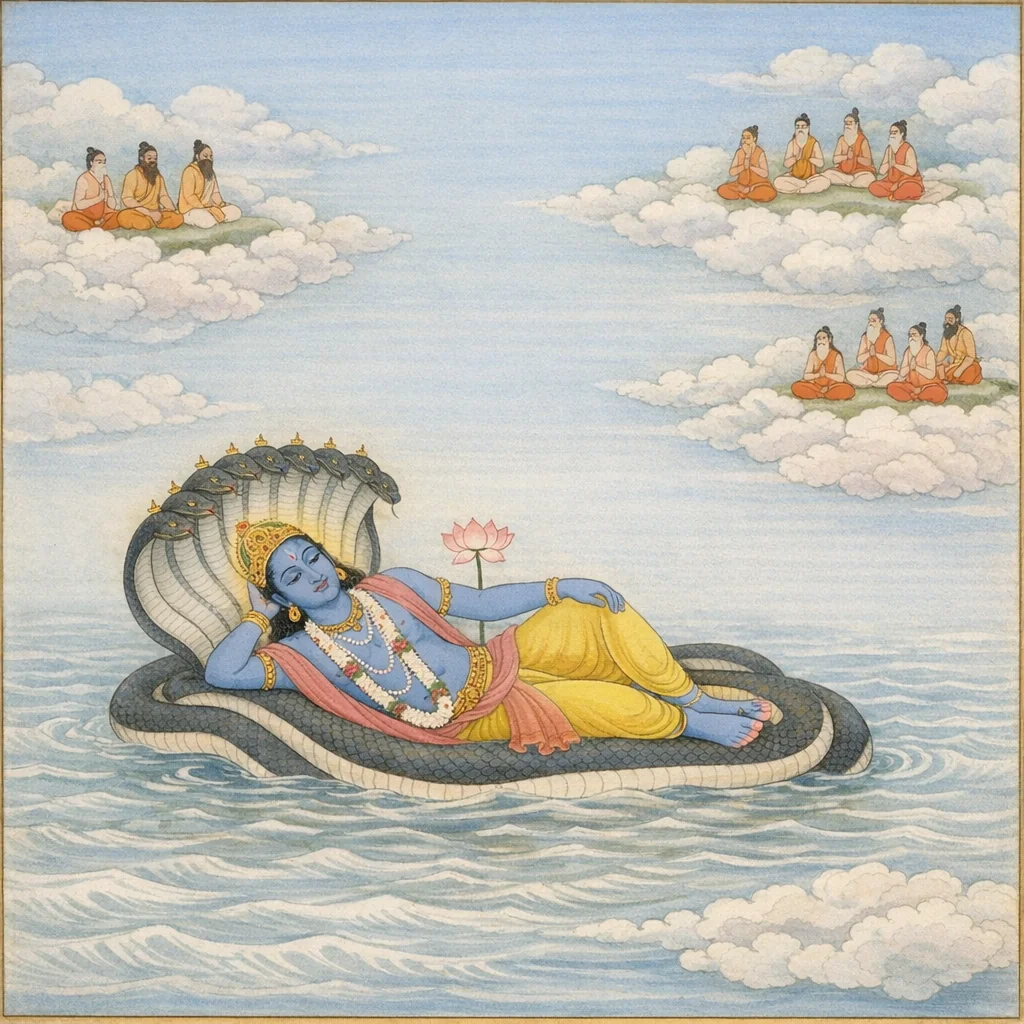
Parāśara answers Maitreya by first describing the naimittika pralaya: the waters rise until even the Saptarṣi region is submerged; the wind of Viṣṇu’s breath destroys the clouds, and then the Lord withdraws even that wind. In the single cosmic ocean, Hari reclines on Śeṣa and enters yoganidrā; when He “closes His eyes,” the universe becomes still. Brahmā’s day and night are each a thousand caturyugas. He then explains the prākṛta pralaya: the tattvas withdraw in order—earth loses gandha and becomes water; water’s rasa is consumed by fire; fire dissolves into wind; wind’s sparśa is absorbed into ākāśa; sound and ākāśa merge into bhūtādi (ahaṃkāra), then into mahān (buddhi), then into Prakṛti (guṇa-sāmya). Finally Prakṛti and the cosmic Puruṣa dissolve into the Paramātman, Viṣṇu, praised in Veda and Vedānta as the all-in-all and worshipped by both the pravṛtti and nivṛtti paths.
Shlokas
Verse 1
सप्तर्षिस्थानम् आक्रम्य स्थिते ऽम्भसि महामुने एकार्णवं भवत्य् एतत् त्रैलोक्यम् अखिलं ततः
O great sage, when the waters rise and reach even the realm of the Seven Ṛṣis, from that moment the whole threefold world becomes a single, boundless ocean.
Verse 2
मुखनिश्वासजो विष्णोर् वायुस् ताञ् जलदांस् ततः नाशयन् वाति मैत्रेय वर्षाणाम् अपरं शतम्
Then the wind born of Viṣṇu’s very breath blows forth; O Maitreya, raging on, it destroys the rain-bearing clouds for yet another hundred years.
Verse 3
सर्वभूतमयो ऽचिन्त्यो भगवान् भूतभावनः अनादिर् आदिर् विश्वस्य पीत्वा वायुम् अशेषतः
The Blessed Lord—pervading all beings, inconceivable, the sustainer of life, without beginning yet the first cause of the universe—drank in the wind entirely, without remainder.
Verse 4
एकार्णवे ततस् तस्मिञ् शेषशय्यास्थितः प्रभुः ब्रह्मरूपधरः शेते भगवान् आदिकृद् धरिः
Then, in that single all-encompassing ocean, the Sovereign Lord—Hari, the Blessed One, the primal Maker—reclines upon Śeṣa’s couch, assuming the form of Brahmā to bring forth creation anew.
Verse 5
जनलोकगतैः सिद्धैः सनकाद्यैर् अभिष्टुतः ब्रह्मलोकगतैश् चैव चिन्त्यमानो मुमुक्षुभिः
He is hymned by the perfected beings in Janaloka—Sanaka and the primordial sages—and contemplated in Brahmaloka by seekers of liberation who keep their minds fixed upon Him.
Verse 6
आत्ममायामयीं दिव्यां योगनिद्रां समास्थितः आत्मानं वासुदेवाख्यं चिन्तयन् परमेश्वरः
The Supreme Lord entered the divine Yogic Sleep born of His own Māyā, and remained absorbed, contemplating His very Self known as Vāsudeva.
Verse 7
एष नैमित्तिको नाम मैत्रेय प्रतिसंचरः निमित्तं तत्र यच् छेते ब्रह्मरूपधरो हरिः
O Maitreya, this is called the naimittika dissolution, the periodic reabsorption of the cosmos; for then Hari, bearing the form of Brahmā, lies in yogic repose, and His withdrawal itself becomes the cause that draws the worlds back into Him.
Verse 8
यदा जागर्ति सर्वात्मा स तदा चेष्टते जगत् निमीलत्य् एतद् अखिलं मायाशय्याशये ऽच्युते
When the All-Self awakens, the universe moves and acts; but when Acyuta, resting upon the couch of Māyā, closes His eyes, the entire cosmos grows still, as though withdrawn into Him.
Verse 9
पद्मयोनेर् दिनं यत् तु चतुर्युगसहस्रवत् एकार्णवे कृते लोके तावती रात्रिर् इष्यते
The day of the Lotus-born (Brahmā) is said to equal a thousand cycles of the four yugas; and when the world becomes a single ocean, an equal span is declared to be his night.
Verse 10
ततः प्रबुद्धो रात्र्यन्ते पुनः सृष्टिं करोत्य् अजः ब्रह्मस्वरूपधृग् विष्णुर् यथा ते कथितं पुरा
Then, when the cosmic night comes to its end, the Unborn One awakens and creates again—Vishnu who assumes the form of Brahmā—just as I told you before.
Verse 11
इत्य् एष कल्पसंहाराद् अन्तरप्रलयो द्विज नैमित्तिकस् ते कथितः प्राकृतं शृण्वतः परम्
O twice-born one, the intermediate dissolution at the end of a kalpa—the naimittika pralaya—has been explained to you. Now hear the supreme account of the prākṛta (elemental) dissolution.
Verse 12
अनावृष्ट्यग्निसंपर्कात् कृते संक्षालने मुने समस्तेष्व् एव लोकेषु पातालेष्व् अखिलेषु च
O sage, when the great cleansing is wrought—through the absence of rain and the contact of fire—it spreads through all the worlds, and through every pātāla as well.
Verse 13
महदादेर् विकारस्य विशेषान्तस्य संक्षये कृष्णेच्छाकारिते तस्मिन् प्रवृत्ते प्रतिसंचरे
When the entire chain of evolutes—from Mahat to the particularized elements—reaches dissolution, the reverse-withdrawal (pratisaṃcara) begins by the will of Kṛṣṇa (Vishnu), who impels and governs the process.
Verse 14
आपो ग्रसन्ति वै पूर्वं भूमेर् गन्धात्मकं गुणम् आत्तगन्धा ततो भूमिः प्रलयत्वाय कल्पते
First, the waters swallow up the earth’s fragrance-essence—its defining quality. When that scent is withdrawn, the earth, bereft of its own nature, becomes fit to pass into dissolution.
Verse 15
प्रणष्टे गन्धतन्मात्रे भवत्य् उर्वी जलात्मिका आपस् तदा प्रवृद्धास् तु वेगवत्यो महास्वनाः
When the subtle principle of smell has perished, the earth becomes of the nature of water. Then the waters, swollen in their might, rush forth with irresistible force, resounding with a great roar.
Verse 16
सर्वम् आपूरयन्तीदं तिष्ठन्ति विचरन्ति च सलिलेनैवोर्मिमता लोकांस् तांस् तान् समन्ततः
Filling this entire expanse, they abide and they also move about—just as water itself, bearing waves, encompasses those many worlds on every side.
Verse 17
अपाम् अपि गुणो यस् तु ज्योतिषा पीयते तु सः नश्यन्त्य् आपस् ततस् ताश् च रसतन्मात्रसंक्षयात्
Then even the very quality of water—its savor and liquidity—is drawn up and consumed by fire. When that essence is withdrawn, the waters vanish, for they depend upon the subtle principle of taste (rasa-tanmātra).
Verse 18
ततश् चापो हृतरसा ज्योतिषं प्राप्नुवन्ति वै अग्न्यवस्थे तु सलिले तेजसा सर्वतो वृते
Thereafter, the waters—having had their essence drawn away—attain the state of radiance. For when water is brought into the condition of fire, it becomes enveloped on every side by blazing energy.
Verse 19
स चाग्निः सर्वतो व्याप्य आदत्ते तज् जलं तथा सर्वम् आपूर्यते ऽर्चिभिस् तदा जगद् इदं शनैः
And that Fire, spreading everywhere, draws in that very water; then, little by little, this entire world is filled on every side with its flames.
Verse 20
अर्चिर्भिः संवृते तस्मिंस् तिर्यग् ऊर्ध्वम् अधस् तथा ज्योतिषो ऽपि परं रूपं वायुर् अत्ति प्रभाकरम्
Enveloped there by tongues of flame—spreading sideways, rising upward, and flowing downward—wind itself consumes even the higher, subtler form of light: the radiance of the Sun.
Verse 21
प्रलीने च ततस् तस्मिन् वायुभूते ऽखिलात्मनि प्रणष्टे रूपतन्मात्रे हृतरूपो विभावसुः
When the all-pervading Self became the principle of Wind and the former state dissolved, and when the subtle essence of form (rūpa-tanmātra) perished, then Vibhāvasu—Fire—bereft of form, was withdrawn into its source.
Verse 22
प्रशाम्यति तदा ज्योतिर् वायुर् दोधूयते महान् निरालोके तदा लोके वाय्ववस्थे च तेजसि
Then radiance is quenched, and the mighty Wind is violently stirred. When the world is left without light—when Fire has entered its withdrawn condition—the cosmos abides in a state ruled by Wind alone, as the elements retreat in dissolution.
Verse 23
ततस् तु मूलम् आसाद्य वायुः संभवम् आत्मनः ऊर्ध्वं चाधश् च तिर्यक् च दोधवीति दिशो दश
Then, reaching its own root, the Wind—born of itself—set all things in motion: upward and downward, and sideways too, stirring agitation through the ten directions.
Verse 24
वायोर् अपि गुणं स्पर्शम् आकाशं ग्रसते ततः प्रशाम्यति ततो वायुः खं तु तिष्ठत्य् अनावृतम्
Thereafter, ether (ākāśa) swallows up even the quality of air—touch. Then air itself subsides into stillness; but space remains, unobstructed and unshrouded.
Verse 25
अरूपम् अरसस्पर्शम् अगन्धं न च मूर्तिमत् सर्वम् आपूरयच् चैव सुमहत् तत् प्रकाशते
That Supreme Reality is formless—beyond taste and touch, without scent, and not confined to any embodied shape; yet filling all things completely, that immeasurable Greatness shines forth.
Verse 26
परिमण्डलं तत् सुषिरम् आकाशं शब्दलक्षणम् शब्दमात्रं तदाकाशं सर्वम् आवृत्य तिष्ठति
That element is spherical and hollow—ākāśa (ether), whose defining mark is sound. Being of the nature of sound alone, that ether stands pervading and enveloping all things.
Verse 27
ततः शब्दगुणं तस्य भूतादिर् ग्रसते पुनः भूतेन्द्रियेषु युगपद् भूतादौ संस्थितेषु वै अभिमानात्मको ह्य् एष भूतादिस् तामसः स्मृतः
Thereafter, the principle called Bhūtādi again absorbs that (subtle element) together with its specific quality—sound. And when the elements and the senses are simultaneously resolved back into Bhūtādi, this Bhūtādi—whose very nature is egoic identification (abhimāna)—is remembered as tāmasa (born of tamas).
Verse 28
भूतादिं ग्रसते चापि महान् वै बुद्धिलक्षणः
And Mahān—the Great Principle, whose very mark is Buddhi (cosmic intelligence)—also absorbs Bhūtādi, drawing the primordial elements back into itself.
Verse 29
उर्वी महांश् च जगतः प्रान्ते ऽन्तर् बाह्यतस् तथा
At the very extremity of the cosmos lies the vast Earth—spreading in every direction—both within and without, as the boundary and support of the world-system.
Verse 30
एवं सप्त महाबुद्धेः क्रमात् प्रकृतयस् तु वै प्रत्याहारे तु ताः सर्वाः प्रविशन्ति परस्परम्
Thus, O great-minded one, these seven fundamental natures proceed in due sequence; and at the time of re-absorption, all of them enter into one another—each merging back into its prior source—until the whole returns to its causal ground under the sovereign order of the Supreme.
Verse 31
येनेदम् आवृतं सर्वम् अण्डम् अप्सु प्रलीयते सप्तद्वीपसमुद्रान्तं सप्तलोकं सपर्वतम्
He by whom this entire cosmic Egg is encompassed—at the end it dissolves into the Waters: the whole expanse bounded by the seven continents and their oceans, the seven worlds, and all the mountains as well.
Verse 32
उदकावरणं यत् तु ज्योतिषा पीयते तु तत् ज्योतिर् वायौ लयं याति यात्य् आकाशे समीरणः
That watery sheath is then drunk up by Fire; and that very Fire is absorbed into Wind. Thereafter the Wind dissolves into Space—thus the grosser coverings return, step by step, into subtler being.
Verse 33
आकाशं चैव भूतादिर् ग्रसते तं तथा महान् महान्तम् एभिः सहितं प्रकृतिर् ग्रसते द्विज
Then the primal source of the elements withdraws space itself; thereafter Mahān (the Great Principle) absorbs that source. And Prakṛti, O twice-born one, draws Mahān—together with all these principles—back into her own undifferentiated state.
Verse 34
गुणसाम्यम् अनुद्रिक्तम् अन्यूनं च महामुने प्रोच्यते प्रकृतिर् हेतुः प्रधानं कारणं परम्
O great sage, that state in which the qualities (gunas) are in perfect equilibrium—neither excessive nor deficient—is declared to be Prakṛti: the causal ground, called Pradhāna, the supreme material cause.
Verse 35
इत्य् एषा प्रकृतिः सर्वा व्यक्ताव्यक्तस्वरूपिणी व्यक्तस्वरूपम् अव्यक्ते तस्मिन् मैत्रेय लीयते
Thus, this entire Prakṛti—whose nature is both the manifest and the unmanifest—has its manifest condition dissolved back into that very Unmanifest; and there, O Maitreya, it is reabsorbed.
Verse 36
एकः शुद्धो ऽक्षरो नित्यः सर्वव्यापी तथा पुमान् सो ऽप्य् अंशः सर्वभूतस्य मैत्रेय परमात्मनः
He is One—pure, imperishable, eternal, and all-pervading—the conscious Puruṣa. Yet, O Maitreya, even this cosmic Puruṣa is but a portion of the Paramātman, the inner Self of all beings.
Verse 37
न सन्ति यत्र सर्वेशे नामजात्यादिकल्पनाः सत्तामात्रात्मके ज्ञेये ज्ञानात्मन्य् आत्मनः परे
In the Supreme Lord, the Lord of all, there are no fabrications of name, caste, and the like. He is to be known as pure Being alone, the very essence of Consciousness—beyond the individual self, the transcendent Self.
Verse 38
तद् ब्रह्म तत् परं धाम परमात्मा स चेश्वरः स विष्णुः सर्वम् एवेदं यतो नावर्तते यतिः
He is that Brahman; He is the supreme abode. He is the Paramātman, and indeed He is Īśvara. He is Viṣṇu—this entire universe is truly He. Having reached Him, the ascetic does not return again.
Verse 39
प्रकृतिर् या मया ख्याता व्यक्ताव्यक्तस्वरूपिणी पुरुषश् चाप्य् उभाव् एतौ लीयेते परमात्मनि
That Prakṛti which I have described—whose nature is both the manifest and the unmanifest—and the Puruṣa as well: these two, together, ultimately dissolve into the Paramātman, the Supreme Self.
Verse 40
परमात्मा च सर्वेषाम् आधारः परमेश्वरः विष्णुर् नाम्ना स वेदेषु वेदान्तेषु च गीयते
He is the Paramātman of all beings, the universal ground and support, the Highest Lord; and in the Vedas and the Vedānta He is sung of by the name “Viṣṇu”.
Verse 41
प्रवृत्तं च निवृत्तं च द्विविधं कर्म वैदिकम् ताभ्याम् उभाभ्यां पुरुषैः सर्वमूर्तिः स इज्यते
Vedic action is declared twofold: pravṛtti, engagement in prescribed duty, and nivṛtti, withdrawal in renunciation. By both, people worship Viṣṇu, He whose form is the whole of all existence.
Verse 42
ऋग्यजुःसामभिर् मार्गैः प्रवृत्तैर् इज्यते ह्य् असौ यज्ञेश्वरो यज्ञपुमान् पुरुषैः पुरुषोत्तमः
He is worshipped through the established paths of Ṛg, Yajus, and Sāman—Lord of sacrifice, the very Person within sacrifice; by all beings He is adored as Puruṣottama, the Supreme Person.
Verse 43
ज्ञानात्मा ज्ञानयोगेन ज्ञानमूर्तिः स चेज्यते निवृत्ते योगिभिर् मार्गे विष्णुर् मुक्तिफलप्रदः
Viṣṇu is the very Self of pure knowledge; His worship is the yoga of knowledge, and His form is knowledge itself. Yogins on the path of nivṛtti adore Him, for He alone bestows the fruit of liberation.
Verse 44
ह्रस्वदीर्घप्लुतैर् यत् तु किंचिद् वस्त्व् अभिधीयते यच् च वाचाम् अविषये तत् सर्वं विष्णुर् अव्ययः
Whatever is denoted by speech through measures of sound—short, long, or protracted—and whatever lies beyond the reach of words: all of that, entirely, is the imperishable Viṣṇu.
Verse 45
व्यक्तं स एव चाव्यक्तं स एव पुरुषो ऽव्ययः परमात्मा च विश्वात्मा विश्वरूपधरो हरिः
He alone is the manifest, and He alone the unmanifest; He alone is the imperishable Puruṣa—the Supreme Self and the Soul of the universe. Hari bears the cosmos as His all-encompassing form.
Verse 46
व्यक्ताव्यक्तात्मिका तस्मिन् प्रकृतिः संप्रलीयते पुरुषश् चापि मैत्रेय व्यापिन्य् अव्याहतात्मनि
In Him—whose nature embraces both the manifest and the unmanifest—Prakṛti is wholly reabsorbed; and the Puruṣa too, O Maitreya, merges into that all-pervading Reality whose Self is never obstructed or diminished.
Verse 47
द्विपरार्धात्मकः कालः कथितो यो मया तव तद् अहस् तस्य मैत्रेय विष्णोर् ईशस्य कथ्यते
The span of time consisting of two parārdhas has been explained by me to you; and that very measure, O Maitreya, is declared to be the Day of the sovereign Lord Viṣṇu.
Verse 48
व्यक्ते च प्रकृतौ लीने प्रकृत्यां पुरुषे तथा तत्र स्थिते निशा चान्या तत्प्रमाणा महामुने
When the manifest world is dissolved into Prakṛti, and Prakṛti in turn is resolved into the Puruṣa, then—while that Supreme Principle abides in its own state—there occurs another Night, O great sage, of the same measure.
Verse 49
नैवाहस् तस्य न निशा नित्यस्य परमात्मनः उपचारस् तथाप्य् एष तस्येशस्य द्विजोच्यते
For that Eternal Supreme Self there is truly neither “day” nor “night.” Yet this manner of speaking is employed, O twice-born, as a conventional expression with reference to that Sovereign Lord.
Verse 50
इत्य् एष तव मैत्रेय कथितः प्राकृतो लयः आत्यन्तिकम् अथो ब्रह्मन् निबोध प्रतिसंचरम्
Thus, O Maitreya, I have explained to you the primordial (prākṛta) dissolution. Now, O Brahman, understand the ultimate (ātyantika) dissolution, and the return-course of emanation (pratisaṃcara).
Frequently Asked Questions
Naimittika pralaya is the periodic dissolution at the end of Brahmā’s day (kalpānta), where the worlds are submerged and the Lord rests in yoganidrā. Prākṛta pralaya is the elemental dissolution where the tattvas themselves (elements, tanmātras, ahaṃkāra, mahat, and Prakṛti) withdraw step-by-step into subtler causes and finally into Paramātman.
It indicates that the same Supreme Lord functions as the cosmic creator through Brahmā’s role; creation and re-creation proceed from Viṣṇu’s sovereignty, even while He remains transcendent and the final ground of dissolution.
It identifies the final terminus of all tattvas—Prakṛti and Puruṣa included—as the Paramātman called Viṣṇu, beyond conceptual constructs (nāma-jāti), praised in Veda/Vedānta, and worshipped through both action and renunciation.