Adhyaya 14
प्रचेतसां तपः तथा विष्णु-स्तुतिः (The Pracetases’ Ocean Tapas and Hymn to Vishnu)
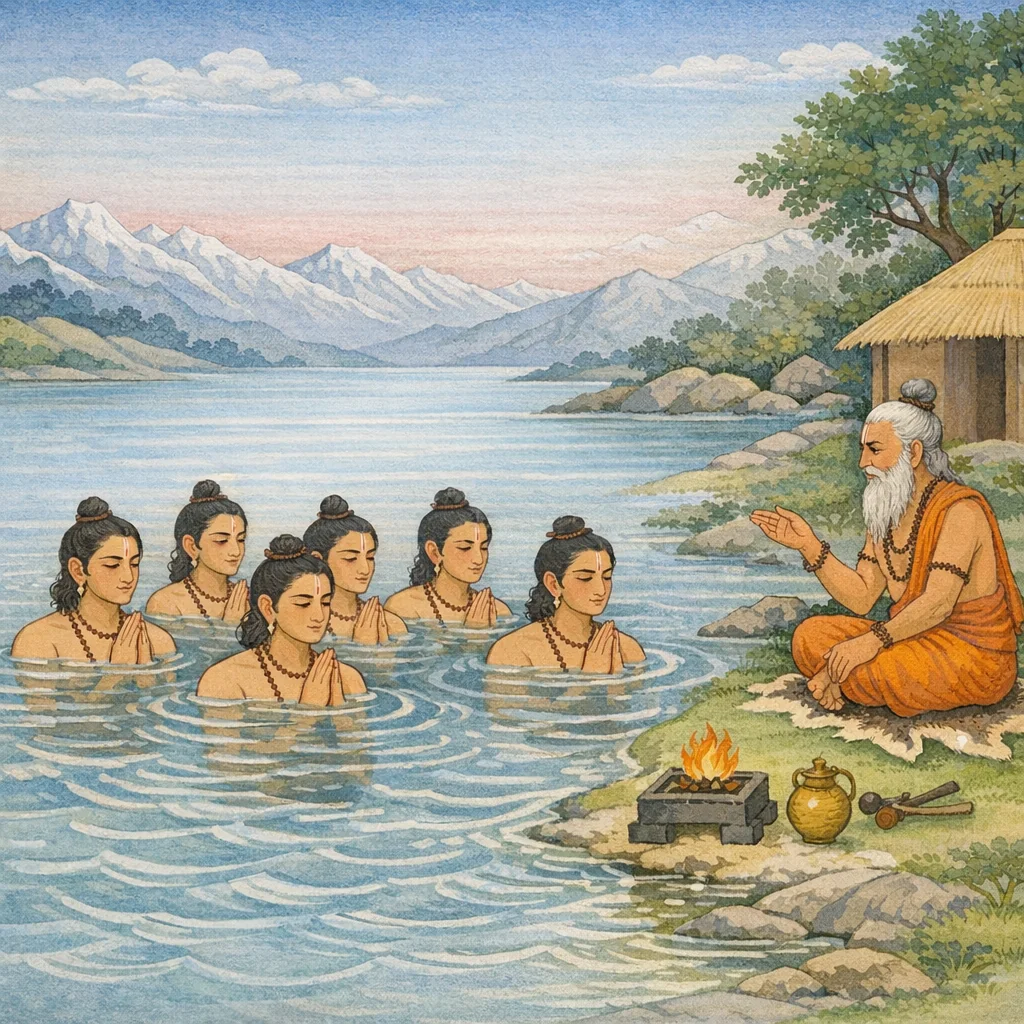
Parāśara traces Pṛthu’s line: Antardhāna begets Havirdhāna; Havirdhāna and Dhiṣaṇā beget Prācīnabarhis, who fathers ten Pracetases. Maitreyā asks why they undertook austerity in the ocean. Parāśara explains that, under Prajāpati/Brahmā’s command, their father charged them to increase progeny, and the explicit means is worship of Govinda—the beginningless Puruṣottama—who alone bestows dharma, artha, kāma, and mokṣa. The Pracetases enter the sea and perform tapas for ten thousand years with minds fixed on Nārāyaṇa, composing a profound hymn. The stuti praises Viṣṇu as the ground of Vedic speech, as time (day, night, twilight), as Soma, Sun, Earth, Water, Fire, Wind, and Space, and as the inner self of senses and mind; it culminates in apophatic, nirguṇa descriptions of His supreme padam beyond name, form, and temporal sequence. Pleased, Hari appears upon Garuḍa, grants boons, fulfills their request for prajā-vṛddhi, and then vanishes as they rise from the waters.
Shlokas
Verse 1
पृथोः पुत्रौ महावीर्यौ जज्ञाते ऽन्तर्धिवादिनौ शिखण्डिनी हविर्धानम् अन्तर्धानाद् व्यजायत
To Pṛthu were born two sons of great prowess, Antardhi and Vādin. And from Antardhāna, Śikhaṇḍinī gave birth to Havirdhāna.
Verse 2
हविर्धानात् षड् आग्नेयी धिषणाजनयत् सुतान् प्राचीनबर्हिषं शुक्रं गयं कृष्णं वृजाजिनौ
From Havirdhāna, Āgneyī Dhiṣaṇā bore six sons: Prācīnabarhis, Śukra, Gaya, Kṛṣṇa, and the pair Vṛja and Ajina—lineages that, by the ordinance of Viṣṇu, the supreme ordainer, would extend the ordered sovereignty of creation.
Verse 3
प्राचीनबर्हिर् भगवान् महान् आसीत् प्रजापतिः हविर्धानिर् महाराजो येन संवर्धिताः प्रजाः
Prācīnabarhis was exalted and mighty, becoming a Prajāpati. And there was the great king Havirdhāni, by whom the subjects were nourished and brought to prosperity.
Verse 4
प्राचीनाग्राः कुशास् तस्य पृथिव्यां विश्रुता मुने प्राचीनबर्हिर् अभवत् ख्यातो भुवि महाबलः
O sage, the kuśa-grass used in his rites became famed across the earth for its ancient, time-honoured tips. By that very mark he was known as Prācīnabarhi, celebrated in the world as a king of great might.
Verse 5
समुद्रतनयायां तु कृतदारो महीपतिः महतस् तपसः पारे सवर्णायां महीपतेः
Then the lord of the earth took the Ocean’s daughter as his wedded queen; and, O king, beyond the reach of arduous austerities, he was born of Savarṇā in that royal line.
Verse 6
सवर्णाधत्त सामुद्री दश प्राचीनबर्हिषः सर्वे प्रचेतसो नाम धनुर्वेदस्य पारगाः
From Savarṇā and the ocean-born maiden Sāmudrī, Prācīnabarhis begot ten sons; all were known as the Pracetases, each perfected in the sacred science of the bow.
Verse 7
अपृथग्धर्मचरणास् ते ऽतप्यन्त महत् तपः दश वर्षसहस्राणि समुद्रसलिलेशयाः
United in a single observance of dharma, they undertook a great austerity—lying within the waters of the ocean for ten thousand years.
Verse 8
यदर्थं ते महात्मानस् तपस् तेपुर् महामुने प्रचेतसः समुद्राम्भस्य् एतद् आख्यातुम् अर्हसि
O great sage, please tell: for what purpose did those great-souled Pracetases perform austerities within the waters of the ocean?
Verse 9
पित्रा प्रचेतसः प्रोक्ताः प्रजार्थम् अमितात्मना प्रजापतिनियुक्तेन बहुमानपुरःसरम्
Commissioned by the Prajāpati, their father—boundless in spirit—instructed the Pracetases for the sake of bringing forth progeny; and with honor and reverence before them, they undertook their appointed duty.
Verse 10
ब्रह्मणा देवदेवेन समादिष्टो ऽस्म्य् अहं सुताः प्रजाः संवर्धनीयास् ते मया चोक्तं तथेति तत्
By Brahmā, the God of gods, I was commanded: “My sons, these beings are to be increased and sustained.” I replied, “So be it”; thus I accepted that charge.
Verse 11
तन् मम प्रीतये पुत्राः प्रजावृद्धिम् अतन्द्रिताः कुरुध्वं माननीया च सम्यग् आज्ञा प्रजापतेः
Therefore, for my satisfaction, O sons, strive without negligence to foster the increase of beings; for Prajāpati’s command is truly proper and is to be honored in full.
Verse 12
ततस् ते तत् पितुः श्रुत्वा वचनं नृपनन्दनाः तथेत्य् उक्त्वा च तं भूयः पप्रच्छुः पितरं मुने
Then those princely sons, having heard their father’s words, assented—“So be it”—and, O sage, once again questioned their father.
Verse 13
येन तात प्रजावृद्धौ समर्थाः कर्मणा वयम् भवेम तत् समस्तं नः कर्म व्याख्यातुम् अर्हसि
By what course of action, dear sir, might we become capable—through righteous activity—of increasing our progeny and prosperity? Deign to explain to us, in full, that entire discipline of action.
Verse 14
आराध्य वरदं विष्णुम् इष्टप्राप्तिम् असंशयम् समेति नान्यथा मर्त्यः किम् अन्यत् कथयामि वः
By worshipping Viṣṇu, the bestower of boons, a mortal attains—without the slightest doubt—the fulfillment of what is truly desired; it cannot be otherwise. What more need I say to you?
Verse 15
तस्मात् प्रजाविवृद्ध्यर्थं सर्वभूतप्रभुं हरिम् आराधयत गोविन्दं यदि सिद्धिम् अभीप्सथ
Therefore, if you desire true accomplishment, worship Govinda—Hari, the Lord of all beings—for the increase and flourishing of progeny.
Verse 16
धर्मम् अर्थं च कामं च मोक्षं चान्विच्छता सदा आराधनीयो भगवान् अनादिः पुरुषोत्तमः
For one who ever seeks dharma, artha, kāma, and even mokṣa, the Lord—Bhagavān, beginningless and the Supreme Person—alone is to be worshipped.
Verse 17
यस्मिन्न् आराधिते सर्गं चकारादौ प्रजापतिः तम् आराध्याच्युतं वृद्धिः प्रजानां वो भविष्यति
When He is worshipped—the Imperishable Lord—Prajāpati, in the beginning, brought forth creation itself. Therefore worship that Acyuta; by His grace, the increase of your progeny shall surely come to pass.
Verse 18
इत्य् एवम् उक्तास् ते पित्रा पुत्राः प्रचेतसो दश मग्नाः पयोधिसलिले तपस् तेपुः समाहिताः
Thus instructed by their father, the ten sons known as the Pracetas—sinking into the waters of the ocean—performed austerity there, with minds gathered in steady concentration.
Verse 19
दश वर्षसहस्राणि न्यस्तचित्ता जगत्पतौ नारायणे मुनिश्रेष्ठ सर्वलोकपरायणे
For ten thousand years, their minds wholly surrendered and absorbed in Nārāyaṇa—the Lord of the universe, the supreme refuge and final goal of all worlds.
Verse 20
तत्रैव ते स्थिता देवम् एकाग्रमनसो हरिम् तुष्टुवुर् यः स्तुतः कामान् स्तोतुर् इष्टान् प्रयच्छति
There they remained, their minds fixed in one-pointed concentration, and they praised Hari, the Divine Lord—He who, when hymned, grants the worshipper the heart’s desired aims.
Verse 21
स्तवं प्रचेतसो विष्णोः समुद्राम्भसि संस्थिताः चक्रुस् तं मे मुनिश्रेष्ठ सुपुण्यं वक्तुम् अर्हसि
O best of sages, while dwelling within the ocean’s waters, the Pracetas composed a hymn of praise to Lord Viṣṇu. It is supremely meritorious—be pleased to recite that sacred stotra to me.
Verse 22
शृणु मैत्रेय गोविन्दं यथापूर्वं प्रचेतसः तुष्टुवुस् तन्मयीभूताः समुद्रसलिलेशयाः
Listen, Maitreya: just as before, the Pracetas praised Govinda; dwelling in the ocean’s waters, they had become wholly absorbed in Him.
Verse 23
नताः स्म सर्ववचसां प्रतिष्ठा यत्र शाश्वती तम् आद्यन्तम् अशेषस्य जगतः परमं प्रभुम्
We bow to Him in whom abides the eternal foundation of all sacred utterance; to that Supreme Lord—Himself the beginning and the end—who is the highest Master of the entire, limitless universe.
Verse 24
ज्योतिर् आद्यम् अनौपम्यम् अण्व् अनन्तम् अपारवत् योनिभूतम् अशेषस्य स्थावरस्य चरस्य च
He is the primal Light—matchless and beyond comparison: subtler than the subtlest, yet infinite and without limit. He becomes the womb and originating source of all that exists, of every immovable being and every moving creature.
Verse 25
यस्याहः प्रथमं रूपम् अरूपस्य ततो निशा संध्या च परमेशस्य तस्मै कालात्मने नमः
Salutations to the Supreme Lord, the very Soul of Time: formless in essence, yet first manifest as “day,” then as “night,” and as the sacred junctions of twilight; to that Paramēśvara I bow.
Verse 26
भुज्यते ऽनुदिनं देवैः पितृभिश् च सुधात्मकः जीवभूतः समस्तस्य तस्मै सोमात्मने नमः
Salutations to Him whose essence is Soma: day by day the gods and the ancestors partake of Him, for His nature is nectar; as the life-principle of all beings, He sustains the whole.
Verse 27
यस् तमो हन्ति तीव्रात्मा स्वभाभिर् भासयन् नभः घर्मशीताम्भसां योनिस् तस्मै सूर्यात्मने नमः
Salutations to the Lord ensouled as the Sun—fierce in essence—who destroys darkness, illumines the sky with His own radiance, and is the womb from which heat, cold, and the waters arise.
Verse 28
काठिन्यवान् यो बिभर्ति जगद् एतद् अशेषतः शब्दादिसंश्रयो व्यापी तस्मै भूम्यात्मने नमः
Salutations to Him whose form is Earth—firm and enduring—who upholds this entire universe without remainder; the all-pervading support in which sound and all the objects of the senses find their refuge.
Verse 29
यद् योनिभूतं जगतो बीजं यत् सर्वदेहिनाम् तत् तोयरूपम् ईशस्य नमामो हरिमेधसः
We bow to the Lord—Hari of unfailing wisdom—whose watery form becomes the womb of the universe, the seed of the cosmos, and the generative principle of all embodied beings.
Verse 30
यो मुखं सर्वदेवानां हव्यभुक् कव्यभुक् तथा पितॄणां च नमस् तस्मै विष्णवे पावकात्मने
Salutations to Vishnu, whose very essence is the purifying Fire—mouth of all the gods, enjoyer of havis, receiver of kavya, and the sustaining refuge of the Pitṛs.
Verse 31
पञ्चधावस्थितो देहे यश् चेष्टां कुरुते ऽनिशम् आकाशयोनिर् भगवांस् तस्मै वाय्वात्मने नमः
Salutations to the blessed Lord whose essence is Vāyu—born of ākāśa, abiding fivefold within the body, and ceaselessly setting all living activity in motion.
Verse 32
अवकाशम् अशेषाणां भूतानां यः प्रयच्छति अनन्तमूर्तिमाञ् छुद्धस् तस्मै व्योमात्मने नमः
Salutations to Him who is the very Self of space—pure, of infinite forms—who grants room and abiding to all beings without exception.
Verse 33
समस्तेन्द्रियवर्गस्य यः सदा स्थानम् उत्तमम् तस्मै शब्दादिरूपाय नमः कृष्णाय वेधसे
Salutations to Kṛṣṇa, the all-ordaining Creator—ever the highest abode of the entire host of senses, and, as the very form of sound and the rest, their underlying reality.
Verse 34
गृह्णाति विषयान् नित्यम् इन्द्रियात्मा क्षराक्षरः यस् तस्मै ज्ञानमूलाय नताः स्म हरिमेधसे
He who ever apprehends the objects of sense—the Self within the senses, Lord of both the perishable and the imperishable—unto that Hari, root of true knowledge and all-wise, we bow in reverence.
Verse 35
गृहीतान् इन्द्रियैर् अर्थान् आत्मने यः प्रयच्छति अन्तःकरणभूताय तस्मै विश्वात्मने नमः
Salutations to the Universal Self, who offers back to the Self the very objects grasped by the senses, abiding within as the inner instrument—mind and heart, the inmost ruler.
Verse 36
यस्मिन्न् अनन्ते सकलं विश्वं यस्मात् तथोद्गतम् लयस्थानं च यस् तस्मै नमः प्रकृतिधर्मिणे
Salutations to the Infinite One in whom the whole universe abides, from whom it arises, and in whom it rests at dissolution—to Him whose very nature is the law of Prakṛti.
Verse 37
शुद्धः संल्लक्ष्यते भ्रान्त्या गुणवान् इव यो ऽगुणः तम् आत्मरूपिणं देवं नताः स्म पुरुषोत्तमम्
Though He is utterly pure and without attributes, through delusion He is perceived as if endowed with qualities. To that God who is the Self in all, to the Supreme Person, Puruṣottama, we bow.
Verse 38
अविकारम् अजं शुद्धं निर्गुणं यन् निरञ्जनम् नताः स्म तत् परं ब्रह्म विष्णोर् यत् परमं पदम्
We bow to the Supreme Brahman—Vishnu’s highest state—changeless, unborn, pure, beyond the guṇas, and stainless.
Verse 39
अदीर्घह्रस्वम् अस्थूलम् अनण्व् अग्र्यम् अलोहितम् अस्नेहच्छायम् अतनुम् असक्तम् असमीरणम्
He is neither long nor short; neither gross nor minute; without any foremost limit or measurable extremity; without color. He casts no shadow born of material contact; is not tenuous as a formed thing; is unattached to all; and untouched by the movements of air—beyond all physical conditions.
Verse 40
अनाकाशम् असंस्पर्शम् अगन्धम् अरसं च यत् अचक्षुःश्रोत्रम् अचलम् अवाक्पाणिम् अमानसम्
That Supreme Reality is not of the nature of space; it is beyond touch, without scent and without taste—without eyes and ears, unmoving; without speech and hands, and beyond the mind itself.
Verse 41
अनामगोत्रम् असुखम् अतेजस्कम् अहेतुकम् अभयं भ्रान्तिरहितम् अनिद्रम् अजरामरम्
He is without name or lineage, untouched by pleasure and pain; not limited by any material brilliance, and not produced by any cause. Fearless, free from delusion, never subject to sleep—He is without aging and without death.
Verse 42
अरजो ऽशब्दम् अमृतम् अप्लुतं यद् असंवृतम् पूर्वापरे न वै यस्मिंस् तद् विष्णोः परमं पदम्
That supreme station of Viṣṇu is the Reality that is dustless and stainless, beyond sound, deathless, unmoistened and untouched, and never veiled. In it there is no ‘before’ or ‘after’—for there, time’s divisions do not obtain.
Verse 43
परम् ईशित्वगुणवत् सर्वभूतम् असंश्रयम् नताः स्म तत् पदं विष्णोर् जिह्वादृग्गोचरं न यत्
We bow to that supreme station of Vishnu—endowed with the power of sovereign lordship, the very being within all beings, yet dependent on nothing—whose reality is not an object for the tongue to describe nor for the eye to behold.
Verse 44
एवं प्रचेतसो विष्णुं स्तुवन्तस् तत्समाधयः दश वर्षसहस्राणि तपश् चेरुर् महार्णवे
Thus, the Pracetas—absorbed in that very contemplation—praised Lord Viṣṇu and performed austerities for ten thousand years in the great ocean, their minds fixed on the Supreme Reality.
Verse 45
ततः प्रसन्नो भगवांस् तेषाम् अन्तर्जले हरिः ददौ दर्शनम् उन्निद्रनीलोत्पलदलच्छविः
Then the Blessed Lord Hari, pleased with them, revealed Himself within the waters—His radiance like the freshly opened petals of the dark-blue lotus—granting them direct vision of the Supreme.
Verse 46
पतत्रिराजम् आरूढम् अवलोक्य प्रचेतसः प्रणिपेतुः शिरोभिस् तं भक्तिभारावनामितैः
Beholding Him mounted upon the king of birds, Garuḍa, the Pracetases—heads bowed under the very weight of bhakti—fell down in full prostration.
Verse 47
ततस् तान् आह भगवान् व्रियताम् ईप्सितो वरः प्रसादसुमुखो ऽहं वो वरदः समुपस्थितः
Then the Blessed Lord addressed them: “Choose the boon you desire. With a gracious countenance, I—your giver of boons—stand here before you.”
Verse 48
ततस् तम् ऊचुर् वरदं प्रणिपत्य प्रचेतसः यथा पित्रा समादिष्टं प्रजानां वृद्धिकारणम्
Then the Pracetases, bowing down before the boon-bestowing Lord, said: “As our father commanded, grant us that cause by which living beings may increase and flourish.”
Verse 49
स चापि देवस् तं दत्त्वा यथाभिलषितं वरम् अन्तर्धानं जगामाशु ते च निश्चक्रमुर् जलात्
And that Deity, having granted the boon they desired, swiftly vanished from sight; and they, in turn, emerged from the waters.
Frequently Asked Questions
They are commissioned to increase progeny (prajā-vṛddhi) under Prajāpati’s mandate; Parāśara presents Viṣṇu-ārādhana as the efficacious means, so their long ocean-tapas is framed as concentrated worship leading to divine darśana and boon.
It combines cosmic identification (Viṣṇu as time, Soma, Sun, elements, senses, inner organ) with nirguṇa/apophatic descriptions of Viṣṇu’s supreme padam beyond sensory grasp—integrating devotional address with metaphysical universality.
By presenting Viṣṇu as the immanent ground of all functions (sense-perception, mind, elements) and the transcendent, changeless supreme station into which all resolves—affirming unity of source and reality while retaining bhakti language and personal theophany.