Kedara Khanda
Kedara Khanda
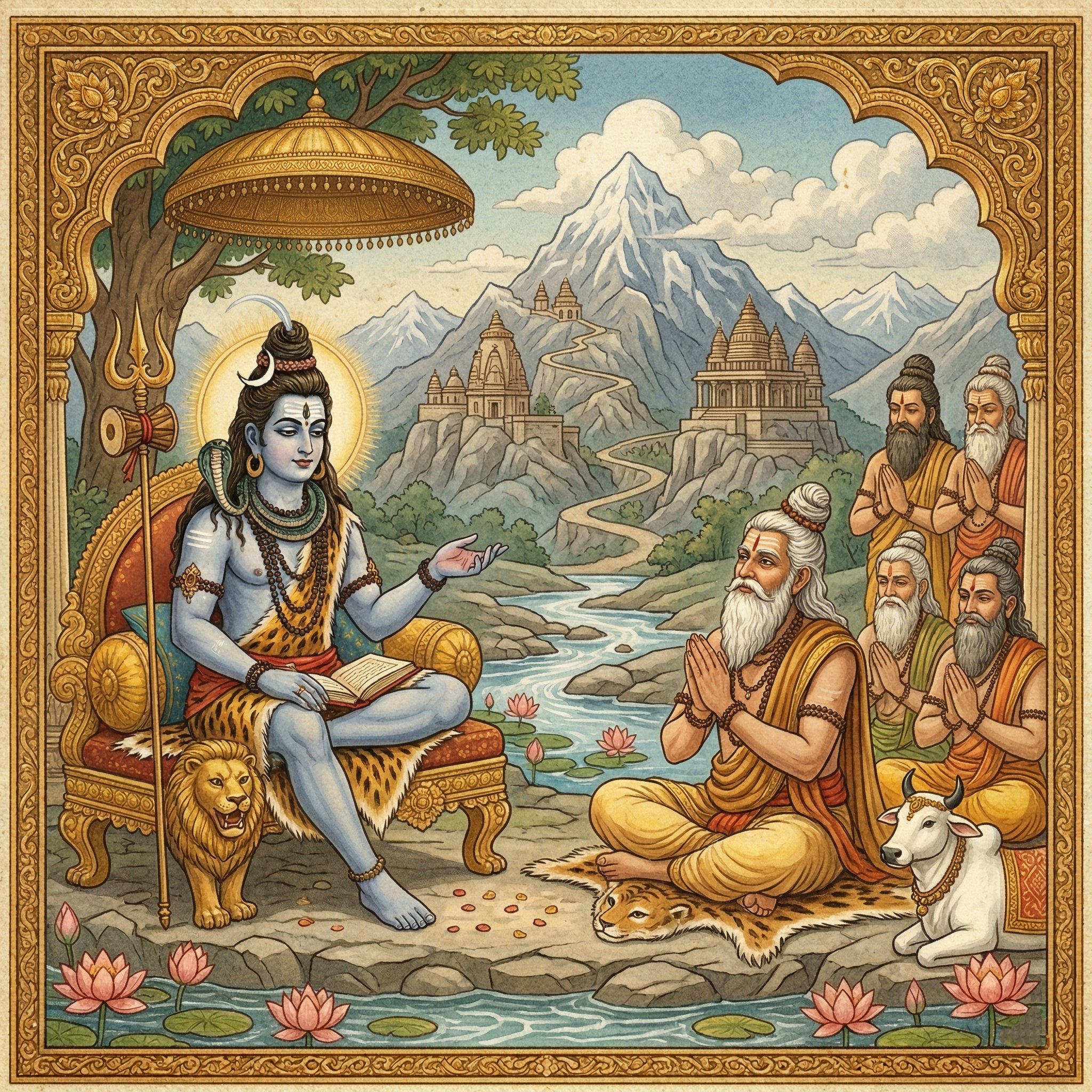
A Himalayan sacred-geography unit focused on Kedāra/Kedārnāth and its surrounding tīrthas, reflecting North Indian pilgrimage networks (uttarāpatha) where mountain landscapes, rivers, and shrines are interpreted as embodied theology and ethical space.
Adhyayas in Kedara Khanda
35 chapters to explore.
Adhyaya 1
Śiva-māhātmya Praśnaḥ — The Sages’ Inquiry into Śiva’s Greatness and the Dakṣa Episode (Part 1)
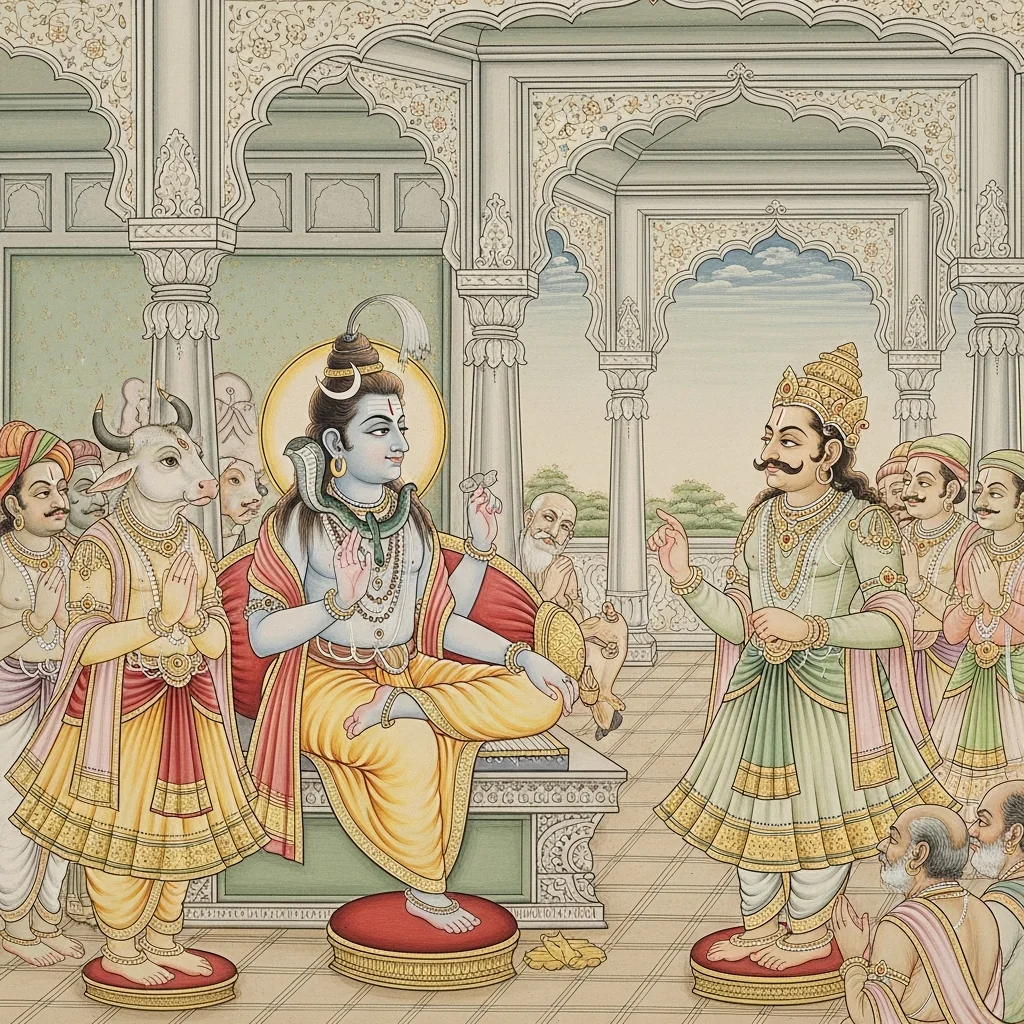
The chapter begins with customary Purāṇic invocations and sets the scene in Naimiṣāraṇya, where ascetic sages led by Śaunaka are engaged in a long sacrificial session. Lomasha, a learned ascetic in the Vyāsa lineage, arrives and is ritually welcomed. The sages request a systematic teaching of Śiva-dharma, asking about the merits of worship and devotional gifts—such as cleaning the shrine, making decorative designs, offering mirrors, fans, canopies, halls, and lamps—and about the fruits of sponsoring Purāṇa/Itihāsa recitation and Vedic study before Śiva. Lomasha replies that Śiva’s greatness is hard to describe in full; that the two-syllabled name “Śiva” bears powerful saving grace; and that crossing saṃsāra without Sadāśiva is futile. The narrative then turns to the Dakṣa episode: by Brahmā’s directive Satī is given to Śaṅkara; Dakṣa, offended when Śiva does not rise to greet him, reviles Śiva and his attendants and pronounces a curse. Nandin answers with a counter-curse against Dakṣa-aligned ritualism and social corruption. Śiva intervenes with ethical and theological instruction: anger toward Brahmins is improper; the Veda is mantra-formed and foundational; and true wisdom requires relinquishing conceptual proliferation and cultivating equanimity. The chapter ends with Dakṣa departing still hostile, persisting in criticism of Śiva and Śiva’s devotees.
Adhyaya 2
Dakṣayajña-prasaṅgaḥ — The Dakṣa Sacrifice Episode (Sati’s Departure)
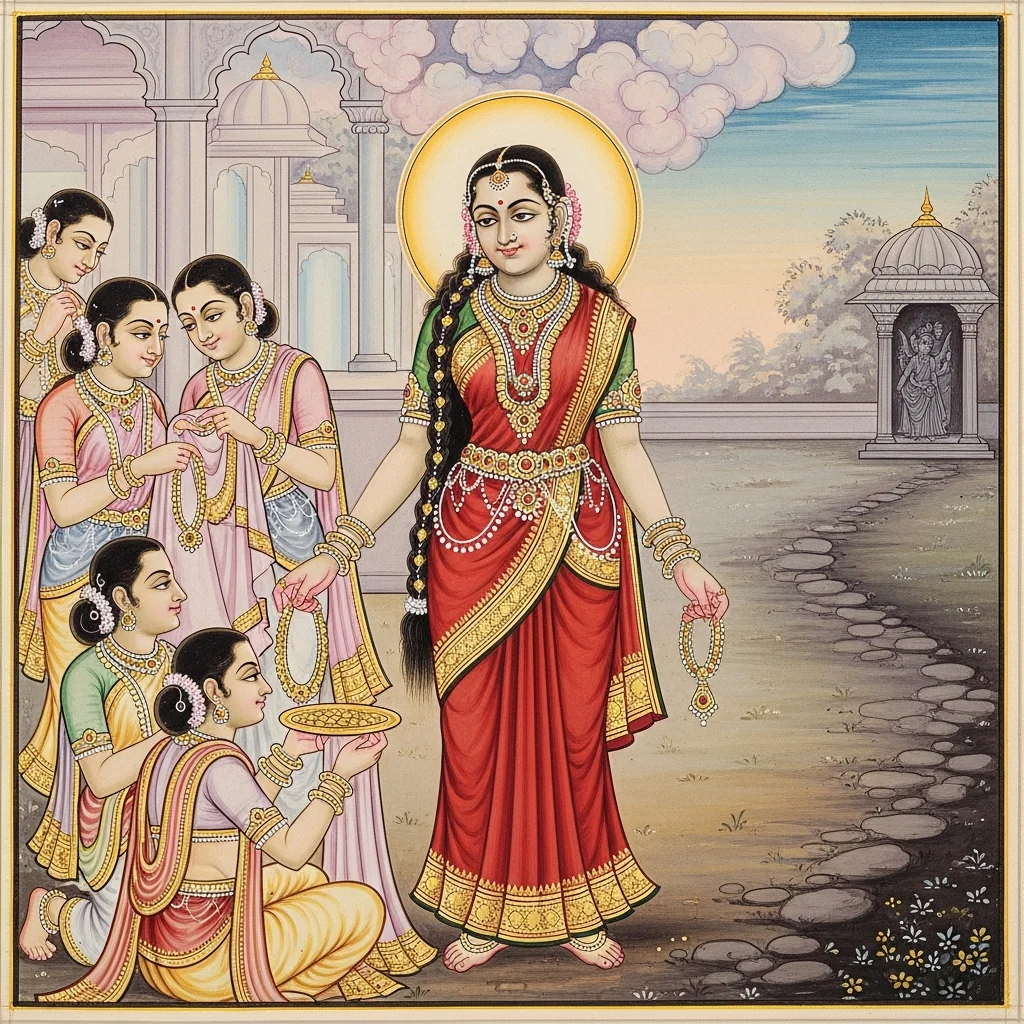
This chapter portrays a ritual and social conflict within a grand yajña. Lomaśa relates how Dakṣa begins a great sacrifice at Kanakhala, inviting many ṛṣis (Vasiṣṭha, Agastya, Kaśyapa, Atri, Vāmadeva, Bhṛgu, and others) and deities (Brahmā, Viṣṇu, Indra, Soma, Varuṇa, Kubera, the Maruts, Agni, Nirṛti), all honored with splendid quarters fashioned by Tvaṣṭṛ. As the rite proceeds, the sage Dadhīci declares publicly that the sacrifice lacks true splendor without Pinākin/Śiva: what is auspicious becomes inauspicious when severed from Tryambaka. He urges that Śiva be invited along with Dākṣāyaṇī. Dakṣa rejects the counsel, asserting Viṣṇu as the ritual root and disparaging Rudra as unfit, thereby revealing pride and exclusion as faults in worship. Dadhīci departs, warning of impending ruin. The narrative then turns to Satī (Dākṣāyaṇī) in a celestial realm. Learning that Soma is going to Dakṣa’s yajña, she asks why she and Śiva were not invited. She approaches Śiva amid his gaṇas (Nandin, Bhṛṅgi, Mahākāla, and others) and seeks permission to go despite the lack of invitation. Śiva advises against it for reasons of social-ritual propriety and the harm of uninvited attendance; Satī insists. Śiva permits her to go with a vast gaṇa retinue, while inwardly sensing she will not return—marking the tension between familial obligation, ritual honor, and divine dignity.
Adhyaya 3
Dakṣa-Yajña: Satī’s Protest, Self-Immolation, and the Dispatch of Vīrabhadra
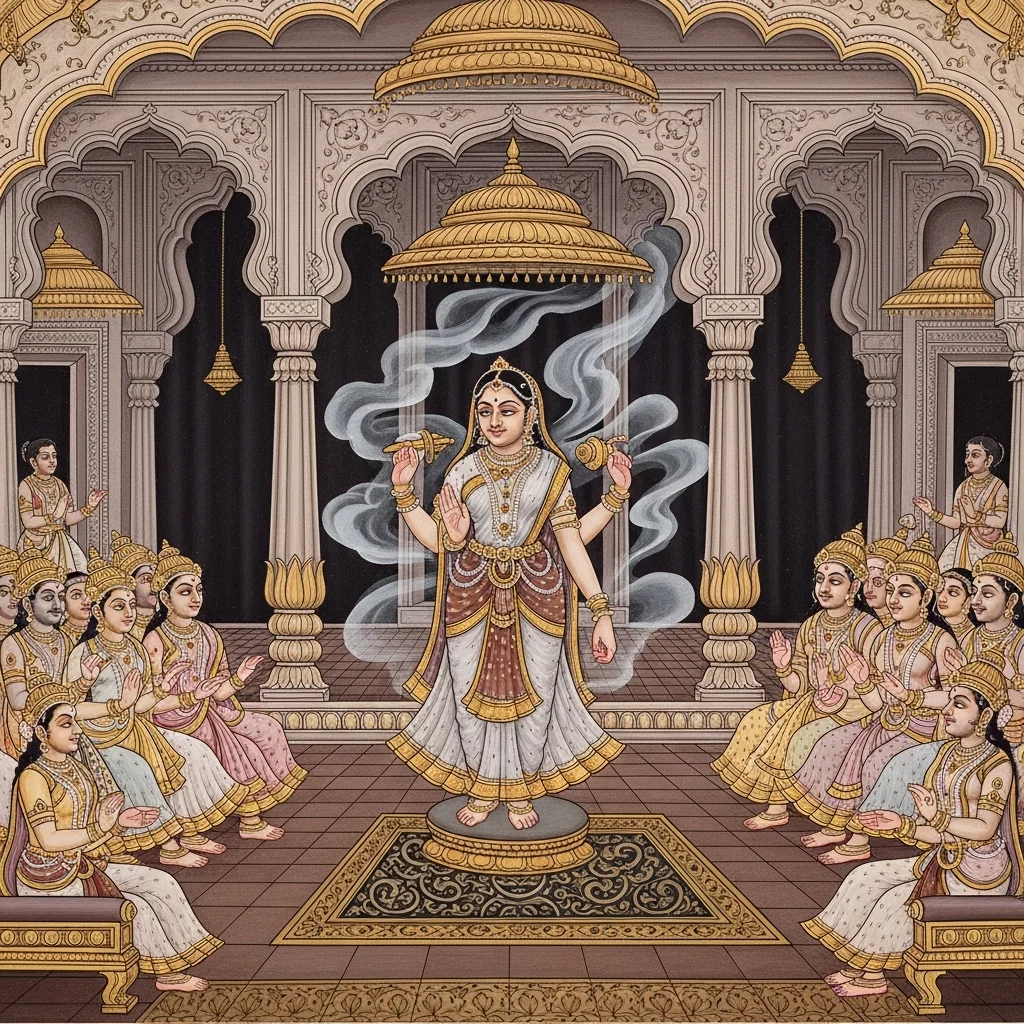
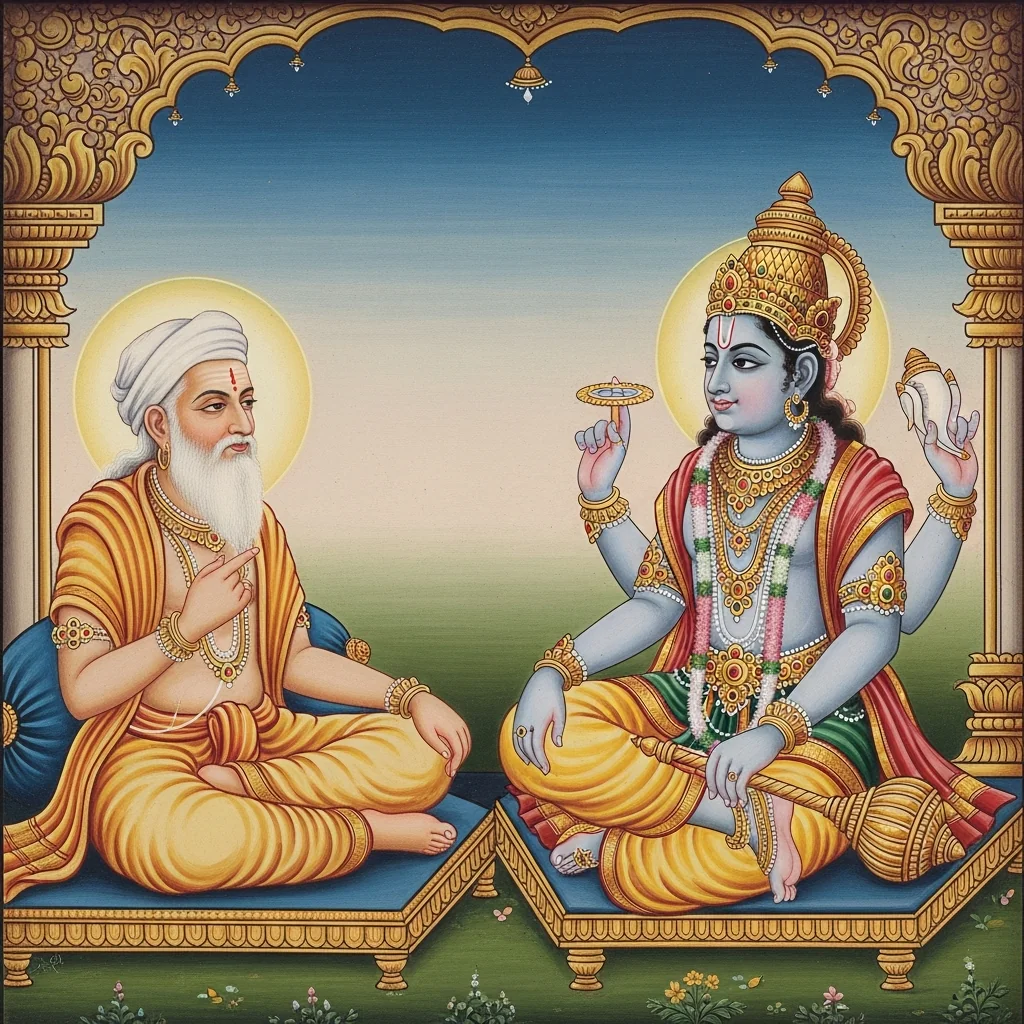
In this adhyāya, narrated by Lomāśa, the episode of Dakṣa’s yajña becomes a theological critique of sacrificial authority. Satī (Dākṣāyaṇī) arrives at her father Dakṣa’s great sacrifice and challenges the omission of Śambhu (Śiva), declaring that ritual substances, mantras, and offerings turn impure when the supreme divine Reality is dishonored. Addressing deva and ṛṣi authorities, she affirms Śiva’s cosmic pervasiveness and prior manifestations, insisting that the yajña is structurally incomplete without reverence to Īśvara. Dakṣa answers with anger and insults, branding Śiva inauspicious and outside Vedic norms. Unable to bear the denigration of Mahādeva, Satī states an ethical principle: both the slanderer and the complicit listener incur grave consequence; then she enters the fire and self-immolates. The assembly collapses into panic, violence, and self-harm. Nārada reports to Rudra, and Śiva’s wrath externalizes as the emergence of Vīrabhadra and Kālikā, accompanied by formidable gaṇas and ominous portents. Dakṣa seeks refuge in Viṣṇu, and Viṣṇu articulates a governing law of worship: where the unworthy are honored and the worthy neglected, famine, death, and fear arise; disrespect to Īśvara renders actions futile. The chapter closes with the doctrine that “kevala-karma”—ritual/action without Īśvara—secures neither protection nor fruit; only action joined to devotion and recognition of divine sovereignty yields results.
Adhyaya 4
ईश्वराधीनकर्मफलप्रकरणम् (Karma’s Fruit as Dependent on Īśvara) — Vīrabhadra–Viṣṇu–Deva Saṅgrāma Episode
This chapter weaves a layered theological teaching into a battle narrative. Lomāśa recounts Dakṣa’s reply to Viṣṇu, questioning how Vedic action can be valid without Īśvara. Viṣṇu explains that the Veda functions within the three guṇas, and that rites bear fruit only through dependence on Īśvara; therefore one should take refuge in God. War then escalates: the devas, emboldened by Bhṛgu’s mantra-power (uccaṭana), initially rout Śiva’s gaṇas. Vīrabhadra counterattacks with fierce auxiliaries and overwhelms the devas, who seek counsel from Bṛhaspati. Bṛhaspati confirms the doctrine: mantras, medicines, sorcery, worldly means, and even Veda/Mīmāṃsā cannot fully know Īśvara; Śiva is known through exclusive devotion and inner peace. Vīrabhadra confronts the devas and then Viṣṇu; a conciliatory exchange affirms the functional equivalence of Śiva and Viṣṇu while sustaining narrative tension. Combat resumes with reversals, including the rise of burning afflictions (jvaras) from Rudra’s wrath and their containment by the Aśvins. The episode culminates when Viṣṇu’s cakra is swallowed and returned; Viṣṇu withdraws, revealing the limits of force and the primacy of Īśvara-centered devotion over mere ritual or power.
Adhyaya 5
Dakṣayajñabhaṅga–Prasāda Upadeśa (Disruption of Dakṣa’s Sacrifice and Śiva’s Instruction)
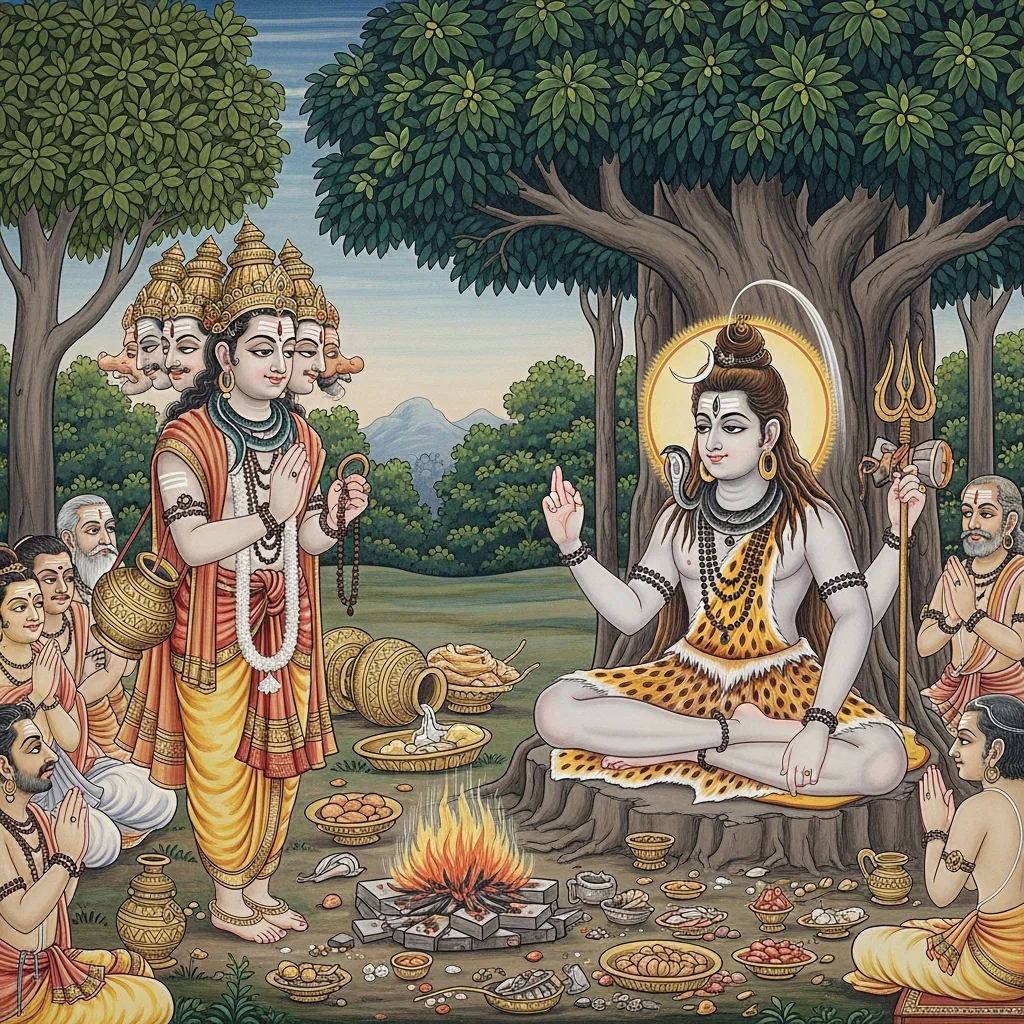
After Viṣṇu departs from Dakṣa’s sacrificial arena, Śiva’s gaṇas overrun the ritual assembly, humiliating many participants and throwing gods, sages, and even celestial bodies into turmoil. Distressed, Brahmā journeys to Kailāsa and offers a formal stuti to Śiva, acknowledging him as the transcendent source of cosmic order and the true efficacy of sacrifice. Śiva explains that the breaking of Dakṣa’s yajña is not arbitrary divine malice but the karmic consequence of Dakṣa’s own deeds, and that conduct causing others’ suffering is condemned by dharma. Śiva then goes to Kanakhala, reviews Vīrabhadra’s actions, and restores Dakṣa to life by reconstituting him with a substitute animal head—an emblem of reconciliation and the reordering of ritual under higher dharma. Dakṣa praises Śiva, after which Śiva teaches a graded typology of devotees (ārta, jijñāsu, arthārthī, jñānī), exalting jñāna-oriented devotion above mere ritual works. The chapter also lists the merits and fruits of temple service and offerings, and illustrates them through narratives: King Indrasena is saved through inadvertent utterance of Śiva’s name; the power of vibhūti and the pañcākṣara is affirmed; and a longer exemplum contrasts wealth-based formal worship (Nandī the merchant) with the intense, unconventional devotion of a hunter (Kirāta), culminating in Śiva’s grace and his appointment as a divine attendant and gatekeeper (pārṣada/dvārapāla).
Adhyaya 6
Liṅga-Manifestation in Dāruvana: Sage-Conflict, Cosmic Expansion, and the Question of Verification
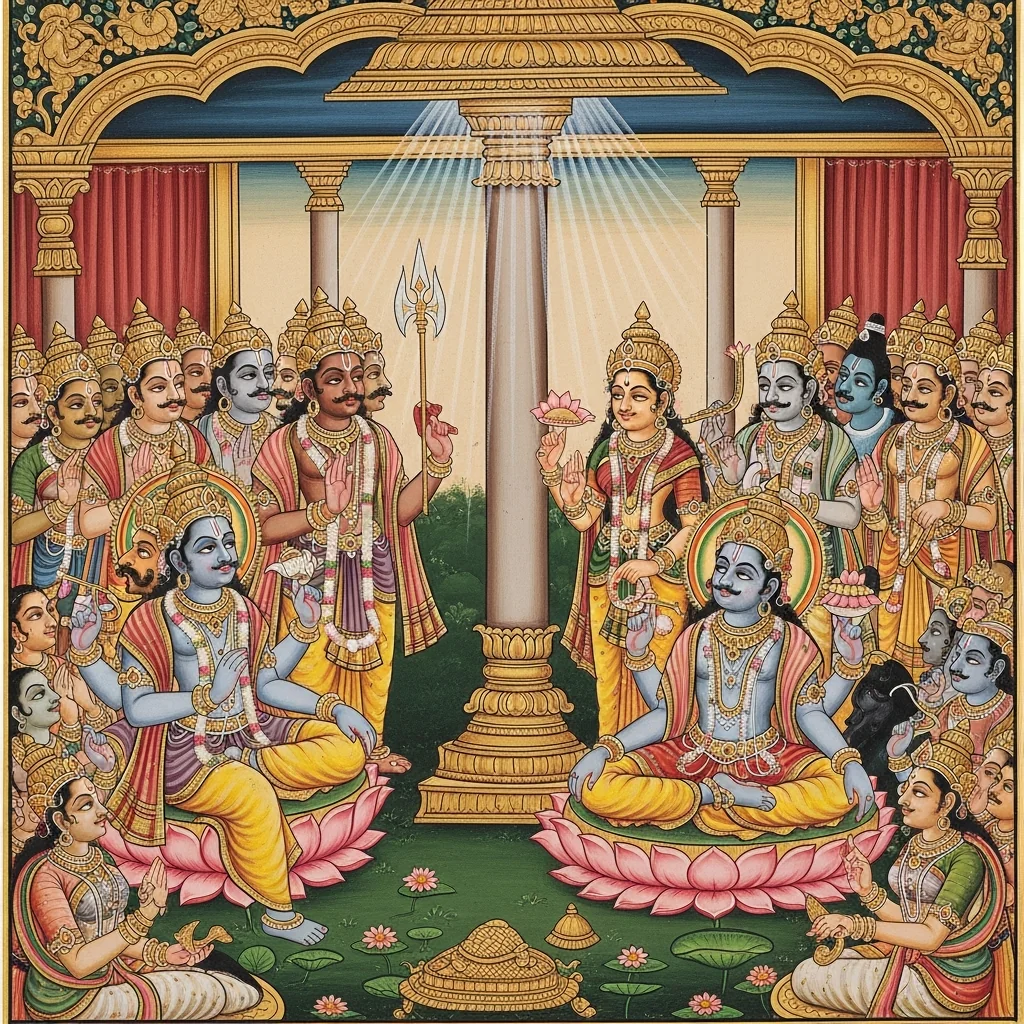
Chapter 6 begins with the sages asking how liṅga-pratiṣṭhā—the establishing of liṅga worship—can proceed when Śiva seems set aside. Lomasha answers by recounting an instructive incident in Dāruvana: Śiva appears as a digambara mendicant, receives alms from the sages’ wives, and draws their attention; when the sages return, they deem it a breach of ascetic order and accuse Śiva of wrongdoing. In response to their curse, Śiva’s liṅga falls to the earth and expands into a cosmic, world-encompassing form, dissolving ordinary divisions of direction, element, and duality. The liṅga is revealed as a theological sign of the Absolute that upholds the cosmos. The gods seek its limits—Viṣṇu downward and Brahmā upward—yet neither finds an end. Brahmā then falsely claims to have seen the summit, with Ketakī and Surabhī offered as witnesses; a bodiless voice exposes the deceit and issues censures that serve as an ethical lesson on misrepresentation and authority. The chapter closes with afflicted gods and sages taking refuge in the liṅga, affirming it as the stabilizing center of devotion and metaphysical meaning.
Adhyaya 7
Mahāliṅga-stuti, Liṅga-saṃvaraṇa, and the Spread of Liṅga-Sthāpanā (महालिङ्गस्तुति–लिङ्गसंवरण–लिङ्गप्रतिष्ठा)
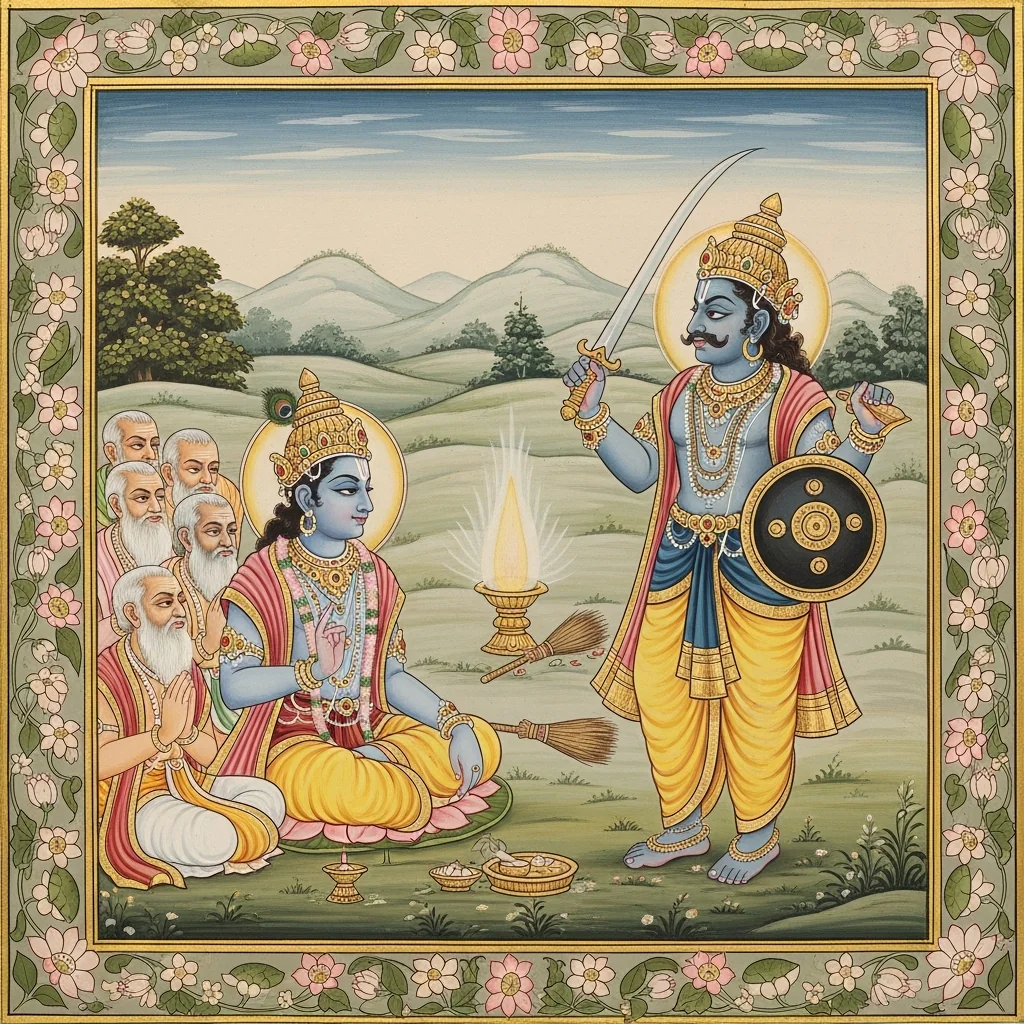
Chapter 7 unfolds as a layered theological dialogue. Lomasha recounts a crisis in which gods and Ṛṣis, overwhelmed by fear and uncertainty of understanding, praise the Īśa-liṅga. Brahmā’s hymn proclaims the liṅga as knowable through Vedānta, the cosmic cause, and an eternal ground of bliss; the sages add that Śiva is mother, father, friend, and the single light within all beings, linking the name “Śambhu” with the arising of existence. Mahādeva then gives a procedural command: the assembly should appeal to Viṣṇu. Viṣṇu admits he once protected them from the daityas, yet declares he cannot shield them from the dread stirred by the ancient liṅga. A celestial voice prescribes a protective rite: Viṣṇu should “cover/contain” the liṅga for worship, becoming compact (piṇḍibhūta) to safeguard the moving and unmoving world; Vīrabhadra is then shown performing worship in the manner ordained by Śiva. The chapter shifts into doctrinal indexing: the liṅga is defined by its role in dissolution (laya), and a catalog-like expansion describes the establishment of many liṅgas across realms and directions (including Kedāra in the human world), forming a networked sacred geography. It also sketches transmitted śivadharma and practice markers—mantra-vidyā such as pañcākṣarī and ṣaḍakṣarī, guru motifs, and Pāśupata dharma—and concludes with an illustrative devotion ethic: a patangī (moth) accidentally cleans a shrine and gains a heavenly result, later reborn as the princess Sundarī devoted to daily temple cleaning; Uddālaka recognizes the power of Śiva-bhakti and attains quieted insight.
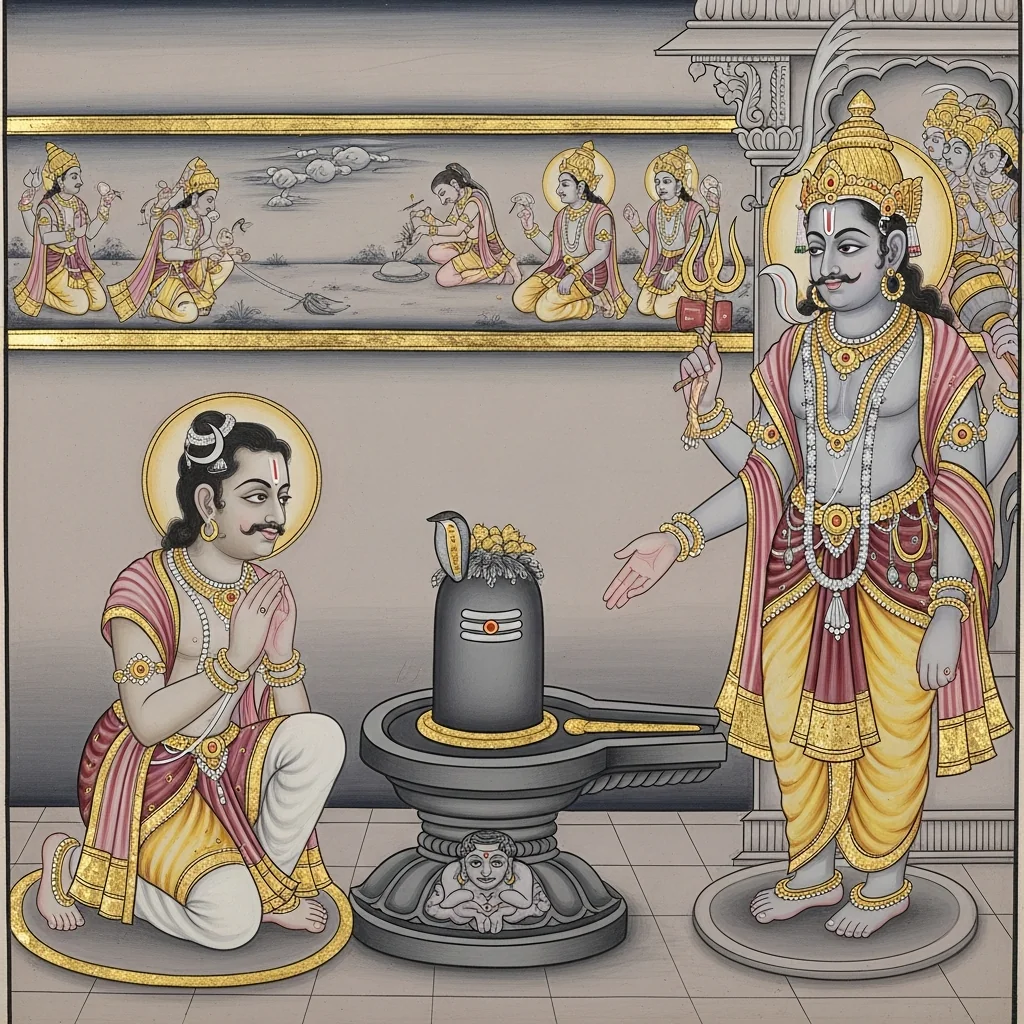
Adhyaya 8
Liṅgārcana-prādhānya: Taskaroddhāra, Rāvaṇa-tapas, and Deva-sammati (Liṅga Worship as Salvific Priority)
The chapter begins with Lomasha portraying an archetypal sinner—a thief burdened with grave faults—who tries to steal a temple bell. That very attempt becomes the occasion for Śiva’s startling praise: Śiva declares him foremost among devotees and dear to Him. Śiva’s gaṇas, led by figures such as Vīrabhadra, carry the thief to Kailāsa and transform him into a divine attendant. The teaching then broadens: devotion to Śiva, especially worship of the liṅga, surpasses mere dialectical disputation, and even animals are said to gain worth through proximity to such worship. The chapter affirms Śiva–Viṣṇu identity and interprets the liṅga with its pīṭhikā as a symbolic unity—liṅga as Maheśvara, pīṭhikā as Viṣṇu-form—thereby proclaiming liṅgārcana as superior. A long exemplum lists cosmic beings (lokapālas, devas, daityas, rākṣasas) as liṅga worshippers, culminating in Rāvaṇa’s extreme tapas: he repeatedly offers his own heads in worship and receives boons and knowledge from Śiva. When the devas cannot defeat Rāvaṇa, Nandin directs them to Viṣṇu; Viṣṇu outlines an avatāra strategy culminating in Rāma and allied incarnations (including Hanumān as an ekādaśa-rudra manifestation). The chapter closes with a soteriological frame: sacrificial merit is finite, whereas liṅga devotion leads toward māyā-dissolution, guṇa-transcendence, and liberation, and it transitions to the next topic—Śiva’s consumption of poison (garabhakṣaṇa)—to be explained later.
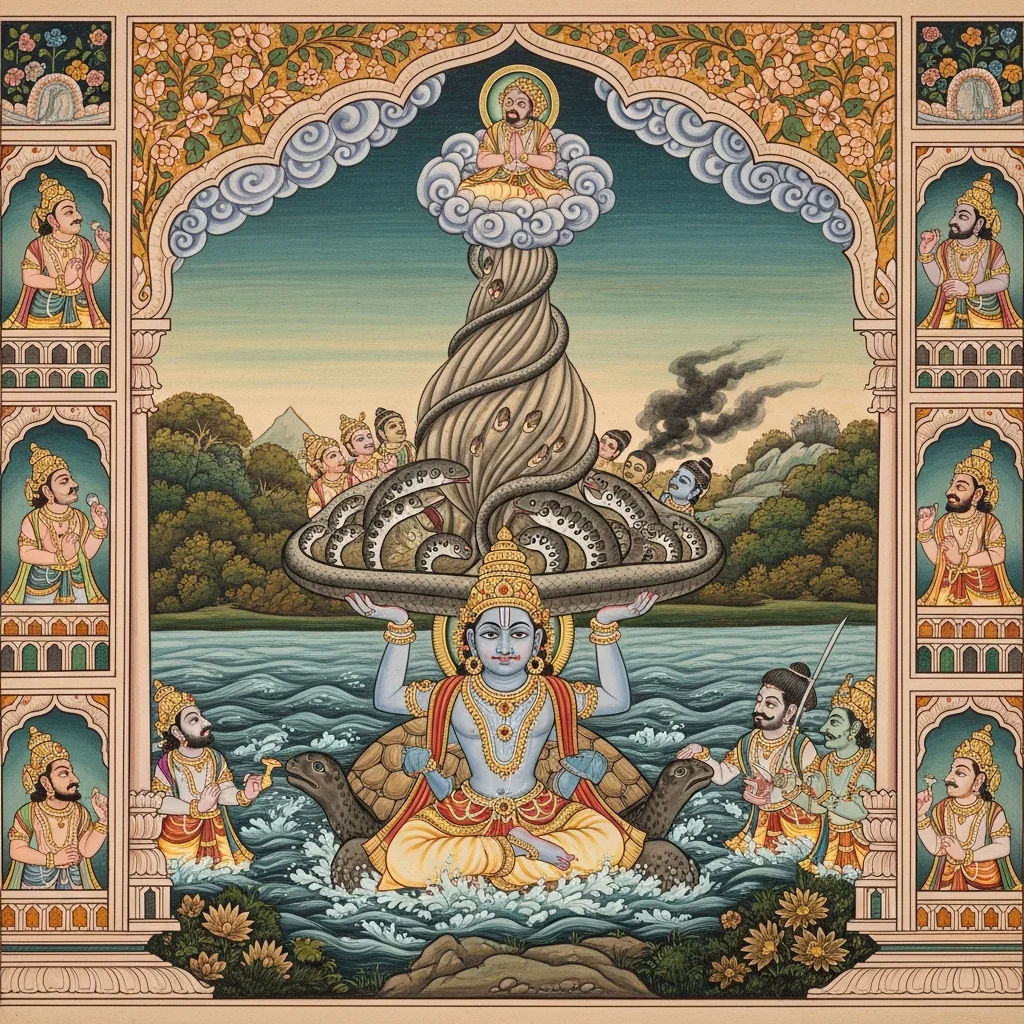
Adhyaya 9
Bṛhaspati-Avajñā, Bali-Śaraṇāgati, and the Initiation of Kṣīrasāgara-Manthana (Guru-Reverence and Cosmic Crisis)
This adhyāya opens with Lomasha portraying Indra in a celestial assembly, surrounded by the lokapālas, devas, ṛṣis, apsarases, and gandharvas. When Bṛhaspati, the deva-guru, arrives, Indra—clouded by pride and royal intoxication—fails to render proper honor by invitation, seat, and respectful dismissal. Taking this as avajñā (disrespect), Bṛhaspati withdraws in concealment (tirodhāna), and the devas fall into dejection. Nārada identifies the moral breach: by slighting the guru, Indra’s sovereignty collapses and he must seek forgiveness. Indra searches for Bṛhaspati and consults Tārā, who cannot disclose his whereabouts. He returns amid ominous portents as Bali advances from Pātāla with the daityas; the devas are defeated, and many key treasures are lost, falling into the ocean. Bali consults Śukra, who teaches that sura-sovereignty requires extensive yajña discipline, especially the aśvamedha. Indra, now vulnerable, appeals to Brahmā; the devas then approach Viṣṇu on the shore of the Kṣīrārṇava (Milk Ocean). Viṣṇu declares the crisis to be the immediate karmic fruit of Indra’s misconduct and instructs a strategic reconciliation with the daityas. Indra approaches Bali in Sutala as a supplicant; Nārada extols śaraṇāgata-pālana (protecting one who seeks refuge) as a supreme dharma, and Bali honors Indra, establishing a pact. Together they plan to recover the ocean-fallen treasures by churning the Milk Ocean, choosing Mandara as the churning-rod and Vāsuki as the rope. The first attempt fails; the mountain collapses, causing injury and despair. Viṣṇu intervenes—lifting and setting Mandara, then becoming Kūrma (the tortoise) as the stabilizing base, and sustaining the work. As the churning intensifies, the destructive poison Hālāhala/Kālakūṭa arises, threatening the three worlds. Nārada urges immediate recourse to Śiva as the highest refuge, yet the sura–asura host persists in misguided effort. The poison spreads catastrophically, described in hyperbolic crisis-register as reaching even Brahmā’s realm and Vaikuṇṭha, evoking dissolution-like conditions attributed to Śiva’s dread power—thereby preparing the theological necessity for Śiva’s salvific intervention in what follows.
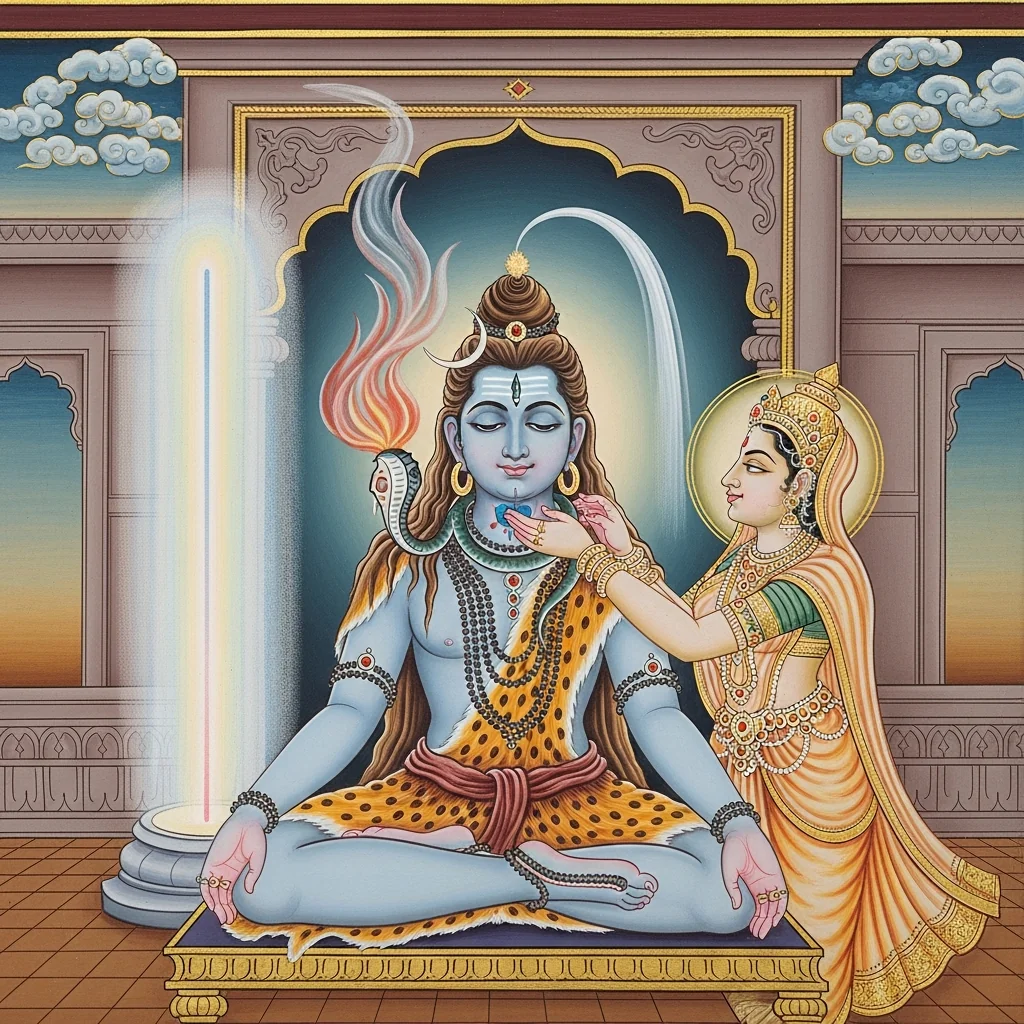
Adhyaya 10
कालकूट-शमनं लिङ्ग-तत्त्वोपदेशश्च (Kālakūṭa Pacification and Instruction on Liṅga-Tattva)
This chapter presents a layered theological dialogue. The sages ask how creation could resume after a cosmic conflagration in which the brahmāṇḍa and its beings seem reduced to ash by Rudra’s wrath and the fire-like poison of kālakūṭa. Through Lomāśa, the narrator depicts the devas—Brahmā and Viṣṇu among them—overwhelmed by fear and delusion; Heramba (Gaṇeśa) petitions Śiva, explaining that such confusion disrupts proper worship and thereby multiplies obstacles. Śiva replies in Liṅga-form, teaching liṅga-tattva: the manifest world is tied to ahaṃkāra and the play of the guṇas under kāla-śakti, while the supreme principle is calm, māyā-free, beyond both duality and non-duality—pure awareness and bliss. Pressed by Gaṇeśa on plurality, conflicting doctrines, and the origin of beings, the narrative introduces Śakti as the world-womb and recounts Gaṇeśa’s emergence through prakṛti, conflict, transformation into Gajānana, and appointment as lord of the gaṇas and remover of obstacles. In the culmination, Gaṇeśa hymns the Liṅga united with Śakti; Śiva, as Liṅga, absorbs/neutralizes the kālakūṭa threat, revives the worlds, and admonishes the devas for neglecting Gaṇeśa and Durgā. An explicit ritual-ethical rule is established: worship of Vighneśa at the beginning of undertakings is necessary for siddhi (successful attainment).
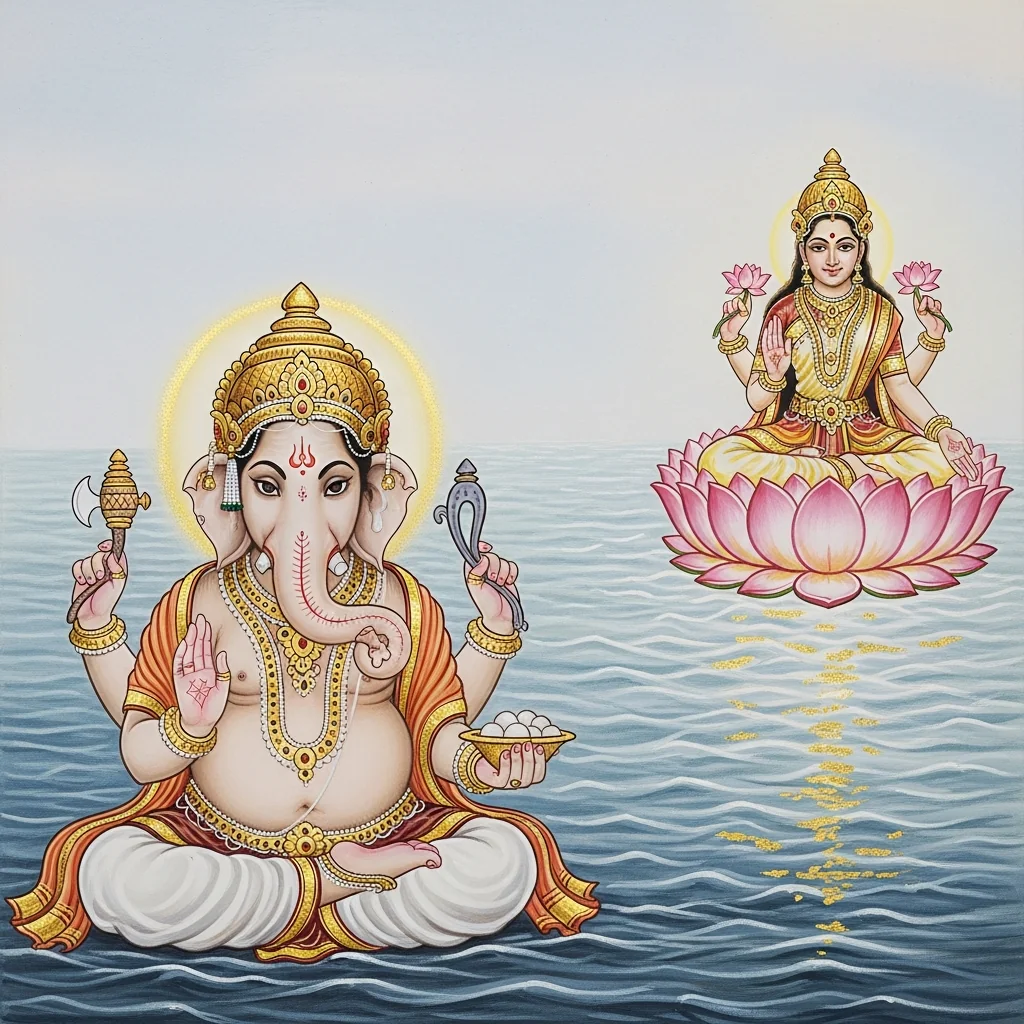
Adhyaya 11
Gaṇeśa-pūjā-vidhi, Dhyāna-traya, and Samudra-manthana Prasaṅga (Gaṇādhipa Worship and Churning-of-the-Ocean Episode)
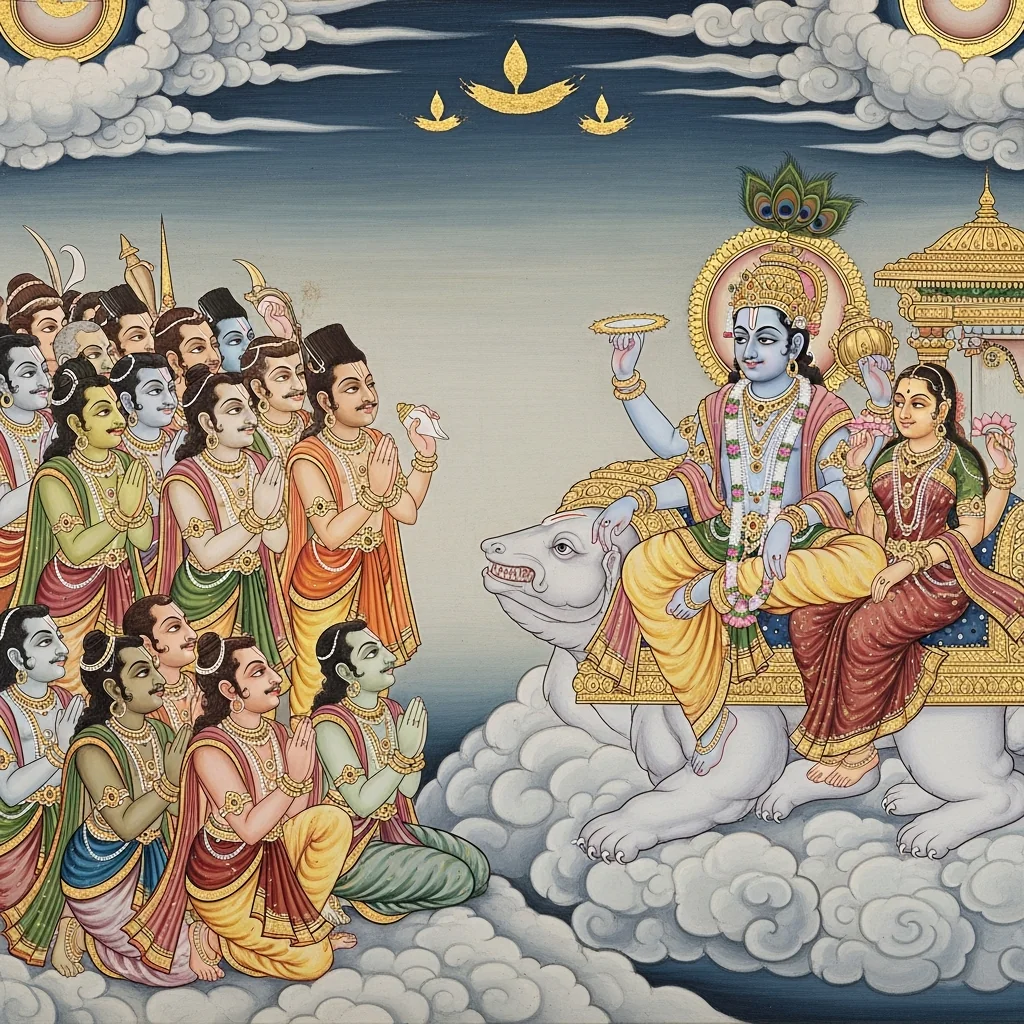
Chapter 11 begins with Maheśvara laying down a disciplined rite of worship for Gaṇādhipa (Gaṇeśa), especially for caturthī observance: preliminary purification by snāna (bathing), offerings of gandha (fragrance), mālya (garlands), and akṣata (consecrated grains), and a mandated sequence of dhyāna. It then presents an iconographic-meditational form: a five-faced, ten-armed, three-eyed Gaṇeśa with specified facial colors and held attributes, followed by a threefold typology of meditation—sāttvika, rājasa, and tāmasa—each with distinct visual features. The chapter further fixes offering counts, notably twenty-one dūrvā and twenty-one modakas, and supplies praise-names to be used in worship. The narrative then turns to the cosmic episode of samudra-manthana: after the gods’ worship, they go to the Kṣīrārṇava (Milk Ocean) and churn it, from which arise Candra, Surabhī (Kāmadhenū), wish-fulfilling trees, the Kaustubha jewel, Uccaiḥśravā, Airāvata, and other treasures. At last Mahālakṣmī appears; her universal gaze bestows prosperity, and amid celestial rejoicing she chooses Viṣṇu. Thus the chapter interweaves vidhi (ritual order), dhyāna-lakṣaṇa (contemplative form), and cosmological myth to show how devotional order upholds cosmic order.
Adhyaya 12
मोहिन्याः सुधाविभागः, राहुच्छेदः, पीडन-महालाय-स्थलनिर्देशश्च (Mohinī’s Distribution of Amṛta; Rāhu’s Decapitation; Site-Etymologies of Pīḍana and Mahālaya)
Lomasha recounts the renewed churning of the ocean for amṛta: Dhanvantari arises bearing the nectar-pot, but the asuras seize it by force. The bewildered devas seek refuge in Nārāyaṇa, who consoles them and assumes the form of Mohinī to regain command over the distribution. Discord breaks out among the asuras, and Bali respectfully asks Mohinī to apportion the amṛta. With socially framed persuasion—including a caution offered as worldly counsel—Mohinī imposes a ritual delay of fasting, an overnight vigil, and a morning bath; the asuras then sit in orderly rows. Mohinī arranges the serving so that the devas receive the nectar. Rāhu and Ketu disguise themselves among the devas; when Rāhu attempts to drink, the Sun and Moon expose him, and Viṣṇu beheads him, with cosmic disturbance attributed to the severed body. The tale then anchors its effects in sacred geography, explaining Mahādeva’s stance and the origins of place-names such as Pīḍana and Mahālaya; Ketu vanishes after returning the amṛta. The chapter closes with an explicit teaching that daiva (divine ordering/fate) surpasses mere human exertion, followed by the asuras’ furious reaction.
Adhyaya 13
Adhyāya 13: Devāsura-saṅgrāma, Śiva-āśrayatva, and Śaiva Ācāra (Rudrākṣa–Vibhūti–Dīpadāna)
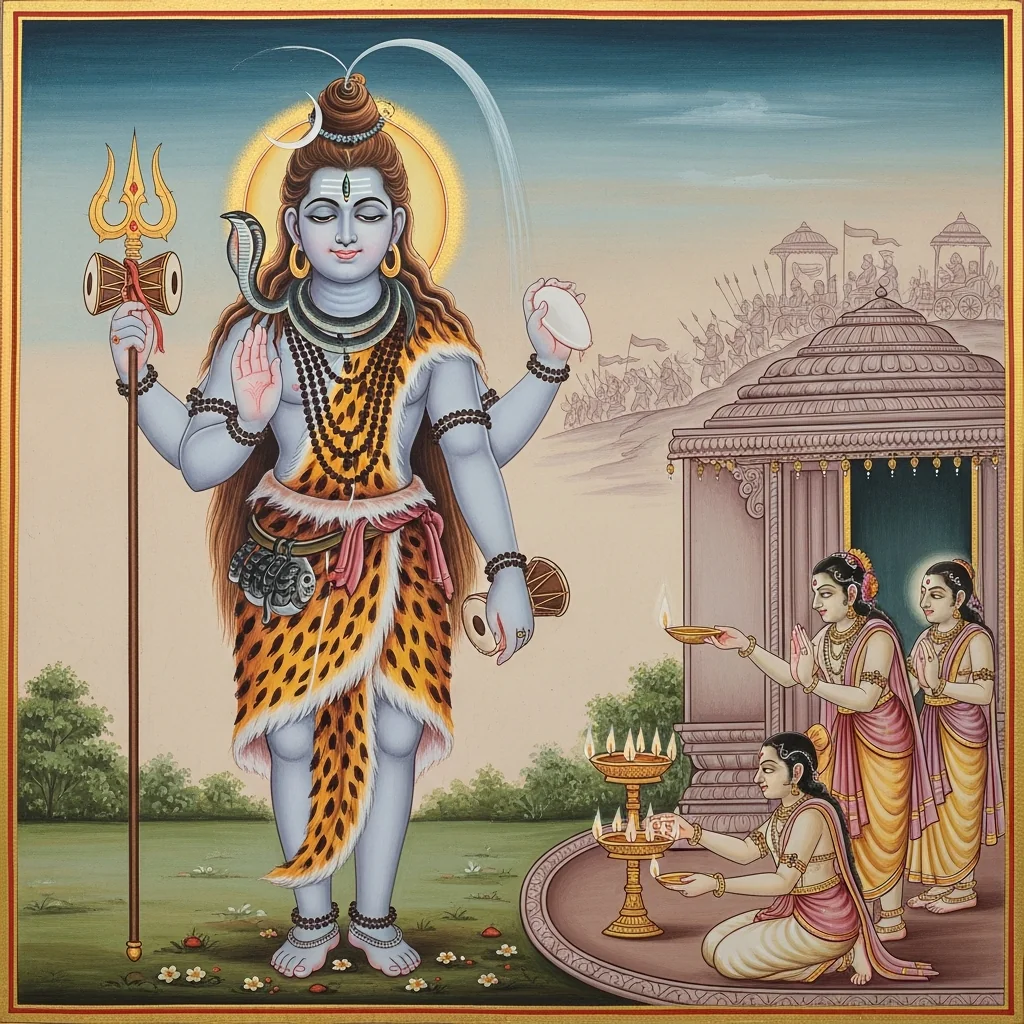
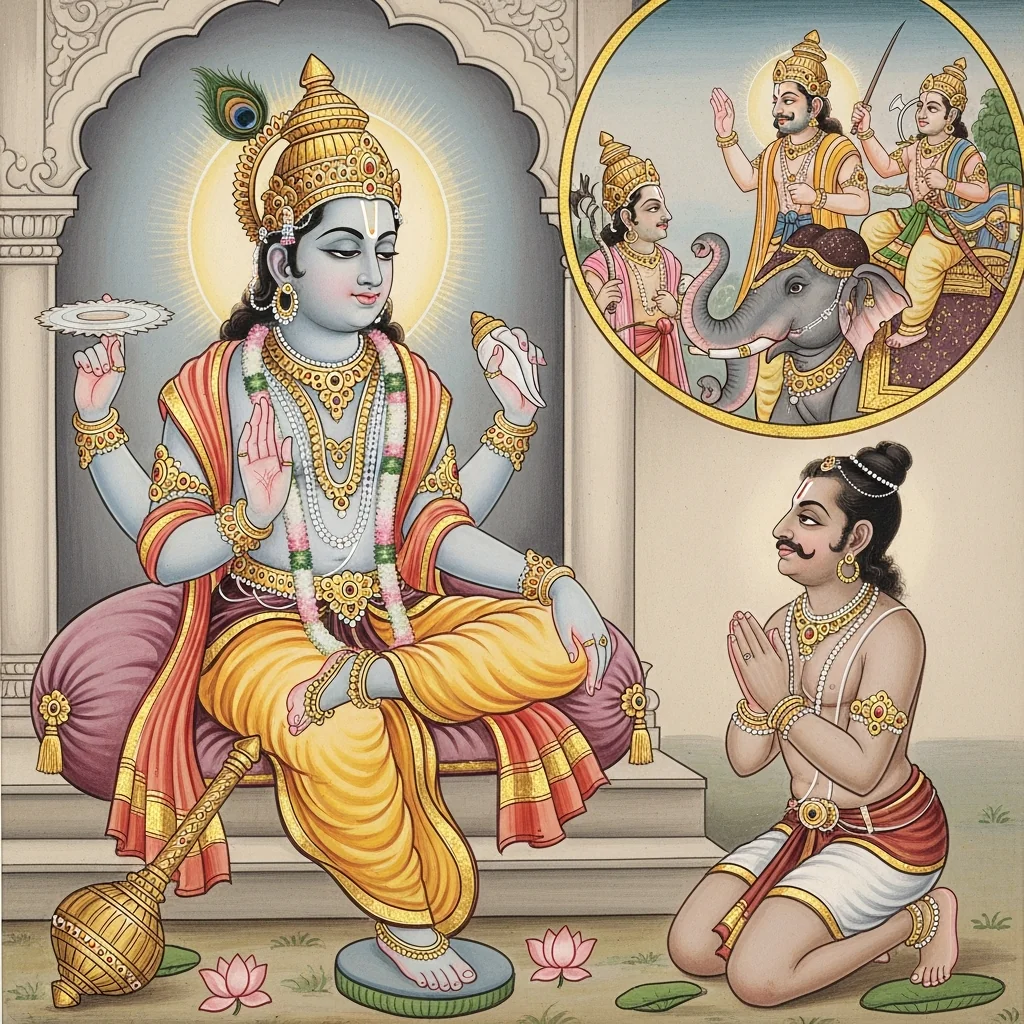
Lomāśa begins by recounting a renewed war between devas and asuras. The daityas gather in vast numbers with varied mounts, weapons, and aerial vehicles, while the devas—strengthened by amṛta—prepare under Indra and pray for auspicious victory. A fierce battle follows, vividly marked by arrows, tomara and nārāca, shattered standards, and severed bodies, until the devas gain the upper hand. The narrative then turns to doctrine in the setting of the Rahu–Candra episode, declaring Śiva the universal support and beloved of both suras and asuras. Śiva’s sacred motifs are recalled: his becoming Nīlakaṇṭha through the Kālakūṭa event and the origin of the muṇḍamālā, along with the teaching that Śiva-bhakti equalizes all, beyond social rank. The latter half is strongly prescriptive: it extols Kārttika dīpadāna before the liṅga, specifies oils/ghṛta and their fruits, praises daily ārātrika with camphor and incense, and codifies Śaiva conduct—rudrākṣa types (notably ekamukha and pañcamukha), their power to amplify rites, and methods of applying vibhūti and tripuṇḍra. The chapter closes by returning to the war: Indra duels Bali, Kālanemi arises with boon-backed invincibility, and Nārada urges remembrance of Viṣṇu; the devas hymn him, and Viṣṇu appears on Garuḍa to challenge Kālanemi to battle.
Adhyaya 14
Kālanemi’s Renunciation of Combat, Nārada’s Ethical Injunction, and the Restoration of the Daityas (Kedārakhaṇḍa Adhyāya 14)
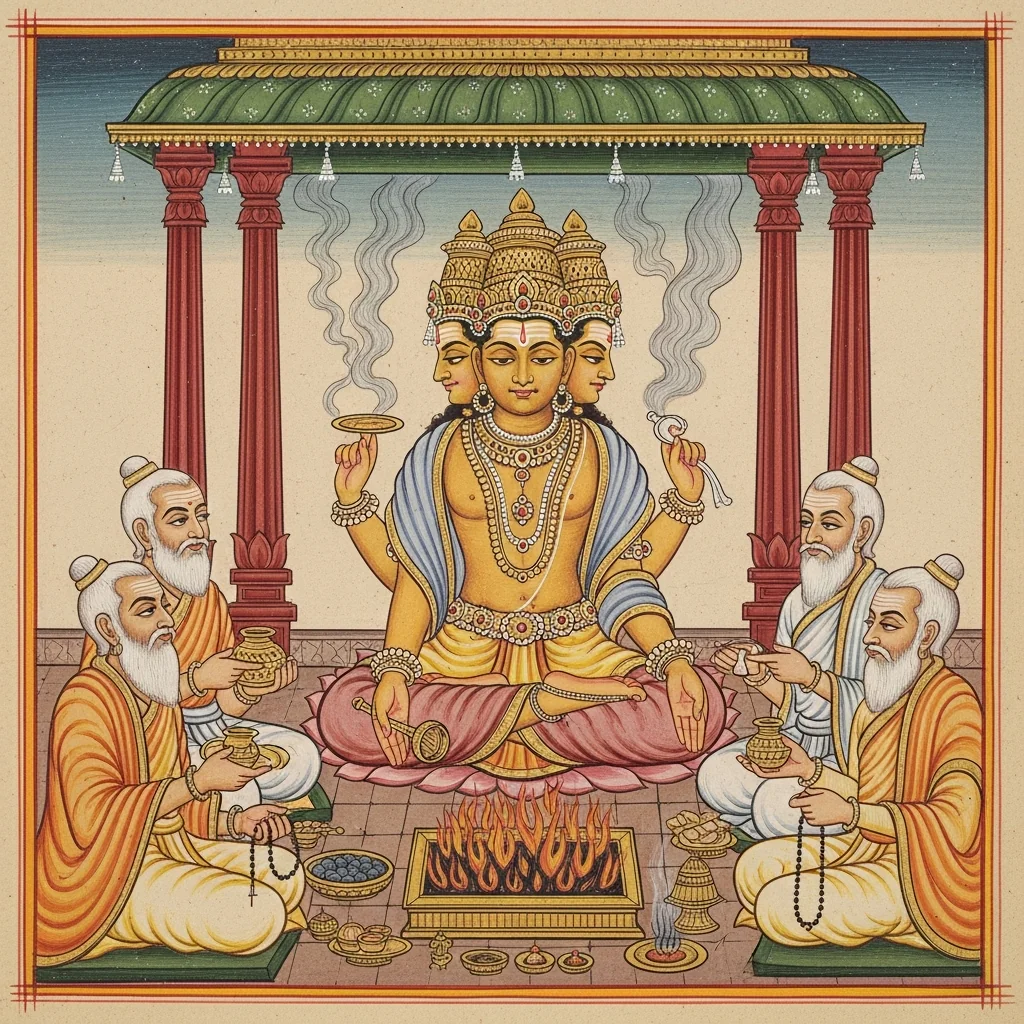
This chapter recounts the climax of the deva–asura war: Viṣṇu routs the daityas and, after a failed trident-strike, subdues Kālanemi. When he regains consciousness, Kālanemi refuses further combat, reflecting that death in battle is but momentary and that slain asuras, by Brahmā’s ordinance, reach an imperishable realm, enjoy deva-like pleasures, and later return to saṃsāra. Thus he asks Viṣṇu not for victory, but for the supreme isolation/liberation—kaivalya. The narrative then turns to Indra, who continues violence against the defeated and terrified remnants. Nārada intervenes, declaring that harming the fearful or those who have surrendered is a grievous sin and ethically forbidden, even in thought. Indra desists and returns to heaven, where a victory festival with ritual music and celestial rejoicing is described as arising from Śaṅkara’s favor. Afterward the surviving daityas approach Śukra, son of Bhṛgu, who revives the fallen through life-restoring knowledge. He consoles Bali with the teaching that those slain by weapons attain heaven. The chapter ends with the daityas relocating to Pātāla under Śukra’s direction, stabilizing cosmic order through martial resolve, ethical restraint, and restorative counsel.
Adhyaya 15
Indra’s Brahmahatyā, Interregnum in Heaven, and the Rise and Fall of Nahūṣa (इन्द्रस्य ब्रह्महत्यादोषः—नहुषाभिषेकः—शापः)
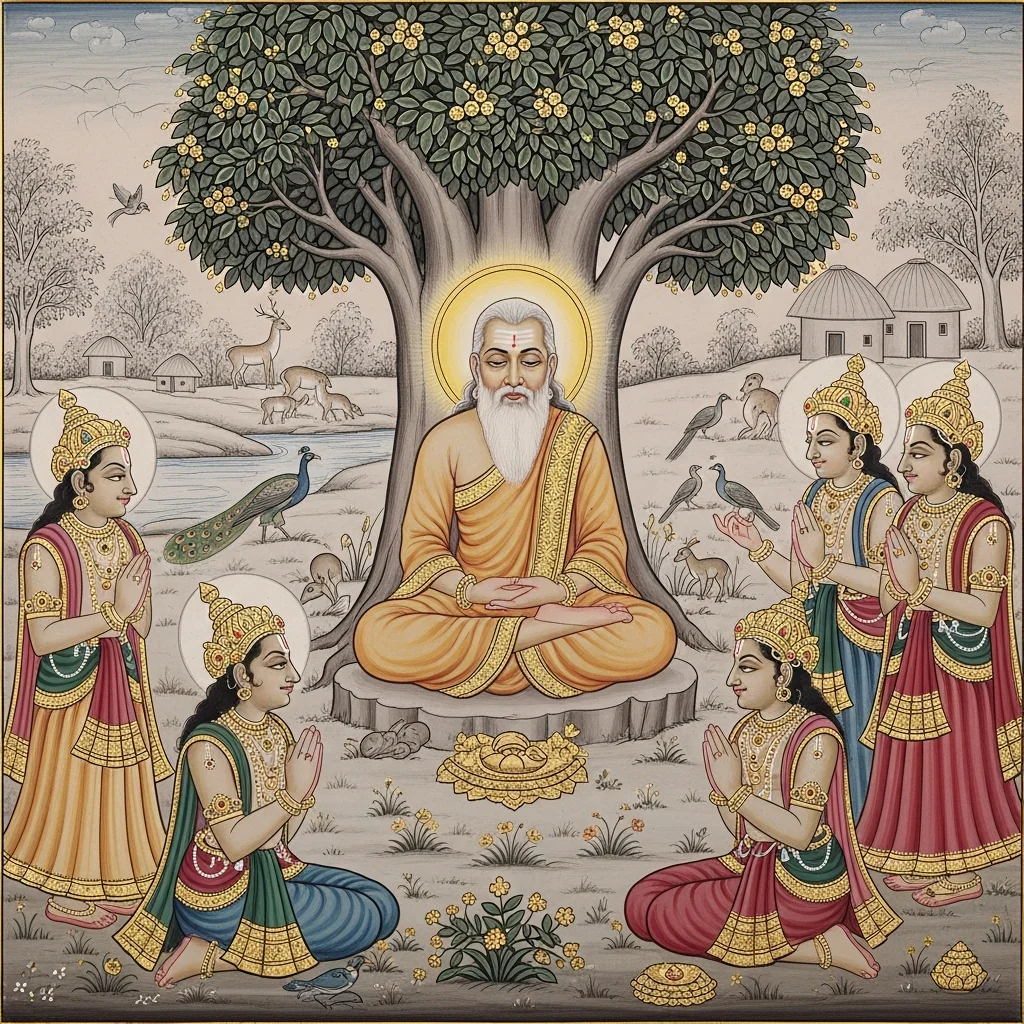
This adhyāya presents a layered ethical tale of authority, transgression, and social order. The sages ask how Indra, though restored to sovereignty, again fell into distress; Lomaśa recounts that Indra relied on Viśvarūpa (Triśiras), a priest of extraordinary ritual power who distributed offerings with partiality—audibly for the devas, silently for the daityas—thereby stirring Indra’s suspicion. In disregard of his guru and in impulsive violence, Indra kills Viśvarūpa, and the sin of Brahmahatyā becomes personified and pursues him relentlessly. Indra hides in the waters for a long time, creating an interregnum (arājaka) in heaven. The text states a political-ethical principle: a sinful ruler, or an unexpiated brahmahatyā, brings famine, calamity, and untimely death. The devas consult Bṛhaspati, who stresses the gravity of intentionally killing a learned priest and the collapse of prior merit—even that of a hundred aśvamedhas. To restore governance, Nārada proposes Nahūṣa; enthroned, he is driven by desire, insults the sages by forcing them to bear his palanquin, and is cursed by Agastya into a serpent, returning disorder. A further attempt with Yayāti also fails when he publicly proclaims his merits and immediately falls, leaving the devas once more without a worthy ritual-king.
Adhyaya 16
Brahmahatyā-vimocana, Pāpa-vibhāga, and Dadhīci’s Self-Sacrifice (Indra–Vṛtra Prelude)
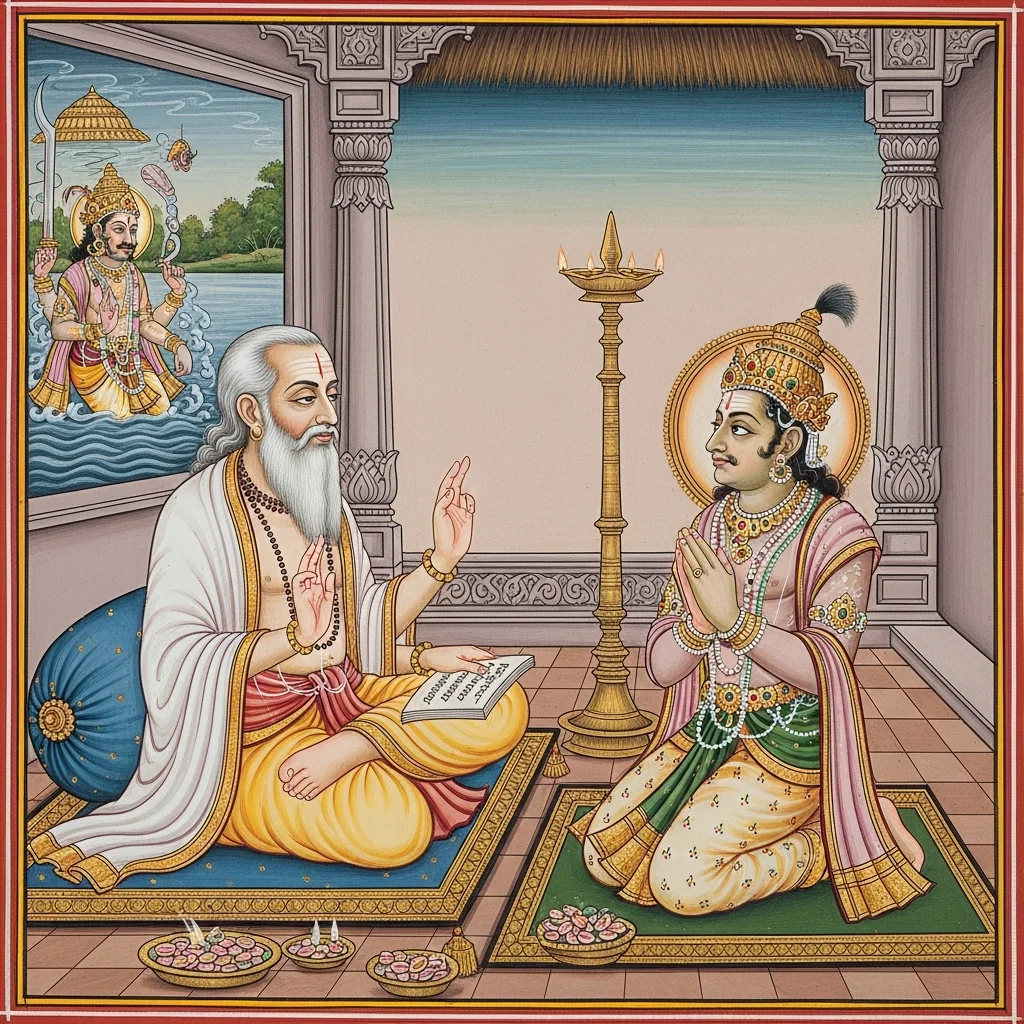
This chapter unfolds in three closely linked movements. (1) Śacī urges the gods to approach Indra, who is stricken with brahmahatyā after killing Viśvarūpa; the devas find him hidden in the waters, practicing austerity in solitary penance. (2) A theological and ethical settlement follows: brahmahatyā is personified and, under Bṛhaspati’s guidance, its burden is pragmatically divided into four shares and assigned to earth (kṣamā/pṛthivī), trees, waters, and women. Indra is thereby restored in ritual and royal authority, and cosmic balance returns, bringing auspiciousness to the elements, crops, and minds. (3) The narrative then turns to Tvāṣṭṛ’s grief and tapas; Brahmā grants a boon, and Vṛtra is born as a world‑threatening foe. Lacking weapons, the devas are directed to seek the bones of the sage Dadhīci for weapon‑making; concern about harming a brāhmaṇa is resolved through dharma reasoning (the ātātāyin principle), and Dadhīci willingly enters samādhi and relinquishes his body for the welfare of all worlds.
Adhyaya 17
प्रदोषव्रत-विधानम् तथा वृत्र-नमुचि-संग्रामः (Pradoṣa Vrata Procedure and the Vṛtra–Namuci War Narrative)
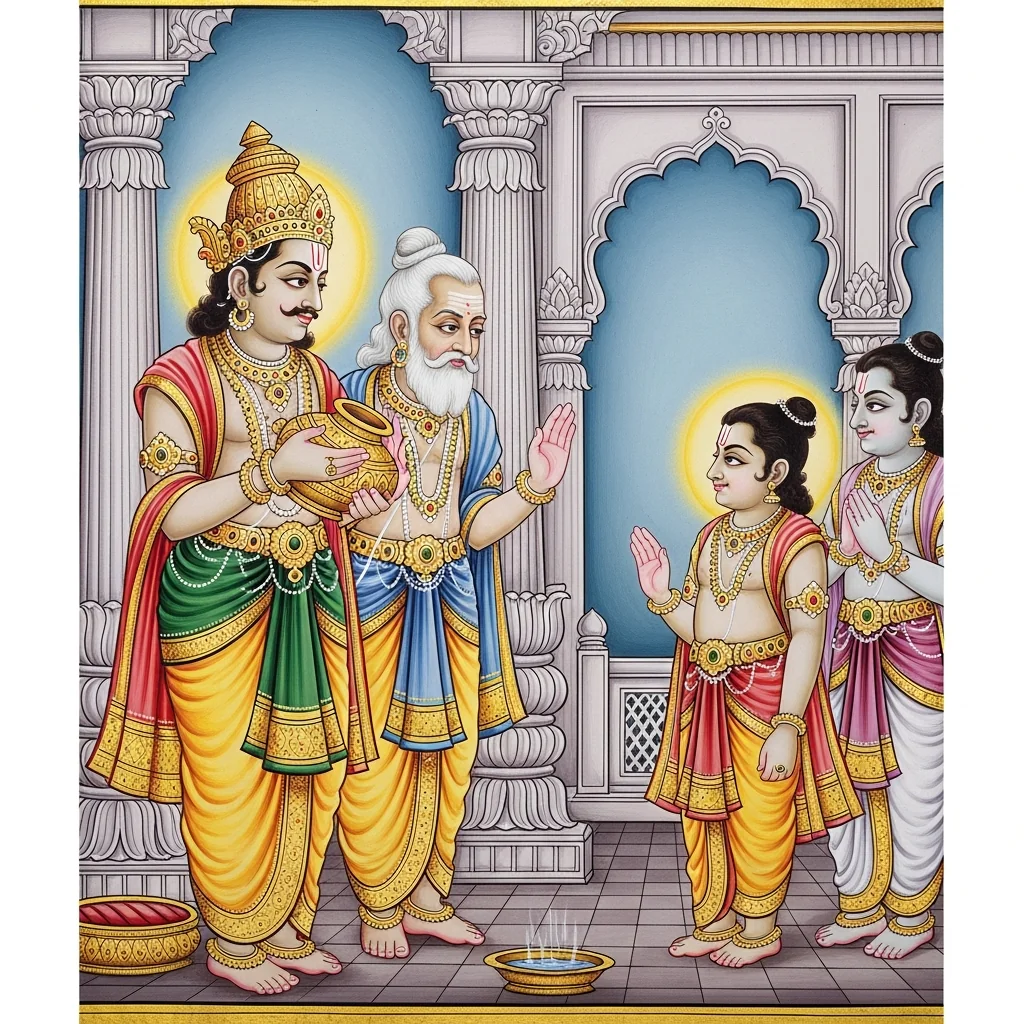
The chapter begins with the devas’ response to Dadhīci’s passing. At Indra’s command, Surabhi, the divine cow, removes the flesh from Dadhīci’s body so that the gods may fashion weapons from his bones, including the vajra. Dadhīci’s wife Suvarcā, discovering this, flares with ascetic wrath and curses the devas to be without progeny; she then brings forth Pippalāda—known as a Rudra-avatāra—beneath an aśvattha tree, and departs into samādhi with her husband. The narrative turns to the vast deva–asura war. Namuci, protected by a boon, cannot be slain by ordinary weapons until a heavenly voice instructs Indra to kill him with foam (phena) near water, thus fulfilling and overcoming the boon’s condition. As the struggle escalates, Vṛtra’s might is repeatedly linked to tapas and prior karmic causality, including an origin connected with a curse narrative involving Citraratha. Bṛhaspati then prescribes a detailed Pradoṣa-vrata and liṅga-worship discipline: the proper time (Kārtika, śukla pakṣa, trayodaśī—especially a Monday), ritual bathing, offerings, lamp rites, circumambulation and prostrations, and the recitation of a hundred names of Rudra, presenting ritual correctness as the strategic means to victory. Later Indra is swallowed by Vṛtra; Brahmā and the gods appeal to Śiva. A heavenly instruction condemns improper circumambulation (including stepping over the pīṭhikā) and reiterates correct liṅga-arcana, even specifying flowers by time of day. Through Rudra-sūkta and Ekādaśa Rudra worship, Indra is released and Vṛtra falls; the text notes the appearance or settling of the imagery of grave sin (brahmahatyā), and the shifting of power as Bali prepares a counter-campaign through a great sacrifice.
Adhyaya 18
Aditi’s Annual Viṣṇu-Vrata (Bhādrapada Daśamī–Dvādaśī) and the Ethics of Dāna in the Bali Narrative
The chapter unfolds as a layered dialogue. Lomāśa recounts that the devas, defeated by the asuras, abandon Amarāvatī by taking animal forms and seek refuge in Kaśyapa’s holy āśrama, where they report their distress to Aditi. Kaśyapa explains that the asuras’ strength rests on tapas (austerity) and prescribes for Aditi a structured annual Viṣṇu-vrata: beginning in Bhādrapada, keeping purity and a regulated diet, fasting on Ekādaśī, keeping night vigil, and performing proper pāraṇa on Dvādaśī while feeding eminent dvijas; this is repeated for twelve months and culminates in special worship of Viṣṇu upon a kalaśa. Pleased, Janārdana manifests in bāṭa form and is petitioned to protect the devas. The narrative then turns to the ethics of dāna, contrasting Indra’s acquisitiveness with Bali’s generosity, and includes a sub-legend of a sinful gambler whose accidental offering to Śiva becomes karmically effective, granting him temporary Indra-status and illustrating Purāṇic teaching on intention, offering, and divine grace. The chapter moves toward the Bali–Vāmana sequence—Bali’s aśvamedha setting, Vāmana’s arrival, Bali’s pledge of three steps, and Śukra’s warning—setting up the tension between vow-bound giving and cosmic rebalancing.
Adhyaya 19
Adhyāya 19 — Bali, Vāmana-Trivikrama, Gaṅgā-utpatti, and Śiva as Guṇātīta (Bali–Vāmana–Trivikrama-prasaṅgaḥ)
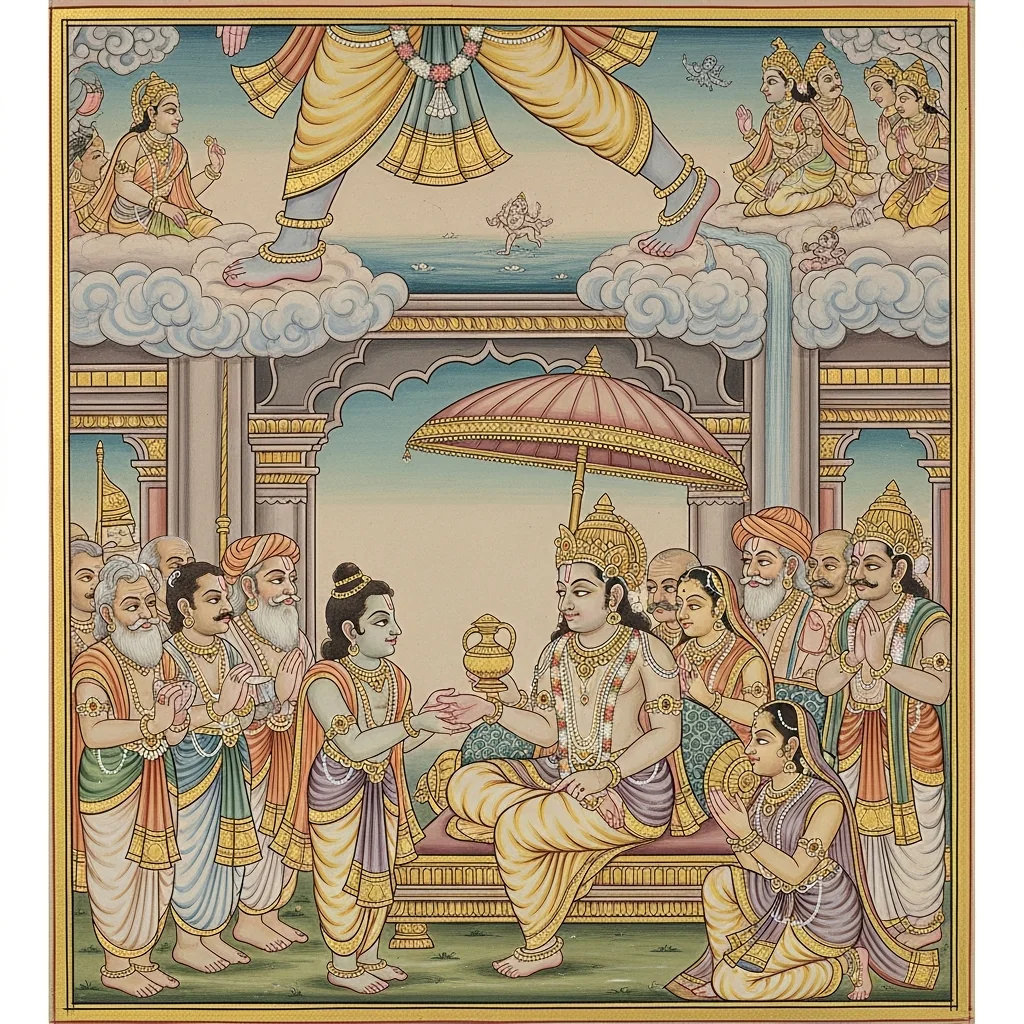
This chapter segment (told by Lomāśa) weaves a daitya king’s moral trial together with cosmological and theological teaching. Bali, though warned by his guru Śukra (Bhārgava), upholds the dharma of dāna and resolves to give alms to the brahmacārin Vāmana (Viṣṇu in disguise). Śukra, angered by Bali’s firmness, utters a curse of inauspicious consequence; yet Bali proceeds with the gift, with Vindhyāvalī’s reverent ritual participation. Viṣṇu then expands as Trivikrama and with two strides covers earth and heaven. The third step becomes a crisis of vow and obligation; Garuḍa binds Bali for withholding what was promised. Vindhyāvalī intervenes, offering her own head and her child’s head as the locus for the remaining steps, turning the pledge into self-surrender and household devotion. Pleased, Viṣṇu releases Bali, grants him Sutala, and promises perpetual nearness as guardian at Bali’s gate, making the daitya an exemplar of generosity and bhakti. The discourse then turns to a Śaiva conclusion: Gaṅgā arises from the water that touched Viṣṇu’s foot, yet Śiva is proclaimed unsurpassed. Worship of Sadāśiva is open to all, even the marginalized; Śiva is the indwelling reality. Mahādeva is guṇātīta, beyond the three guṇas, while Brahmā, Viṣṇu, and Rudra function through rajas, sattva, and tamas respectively, pointing toward liberation.
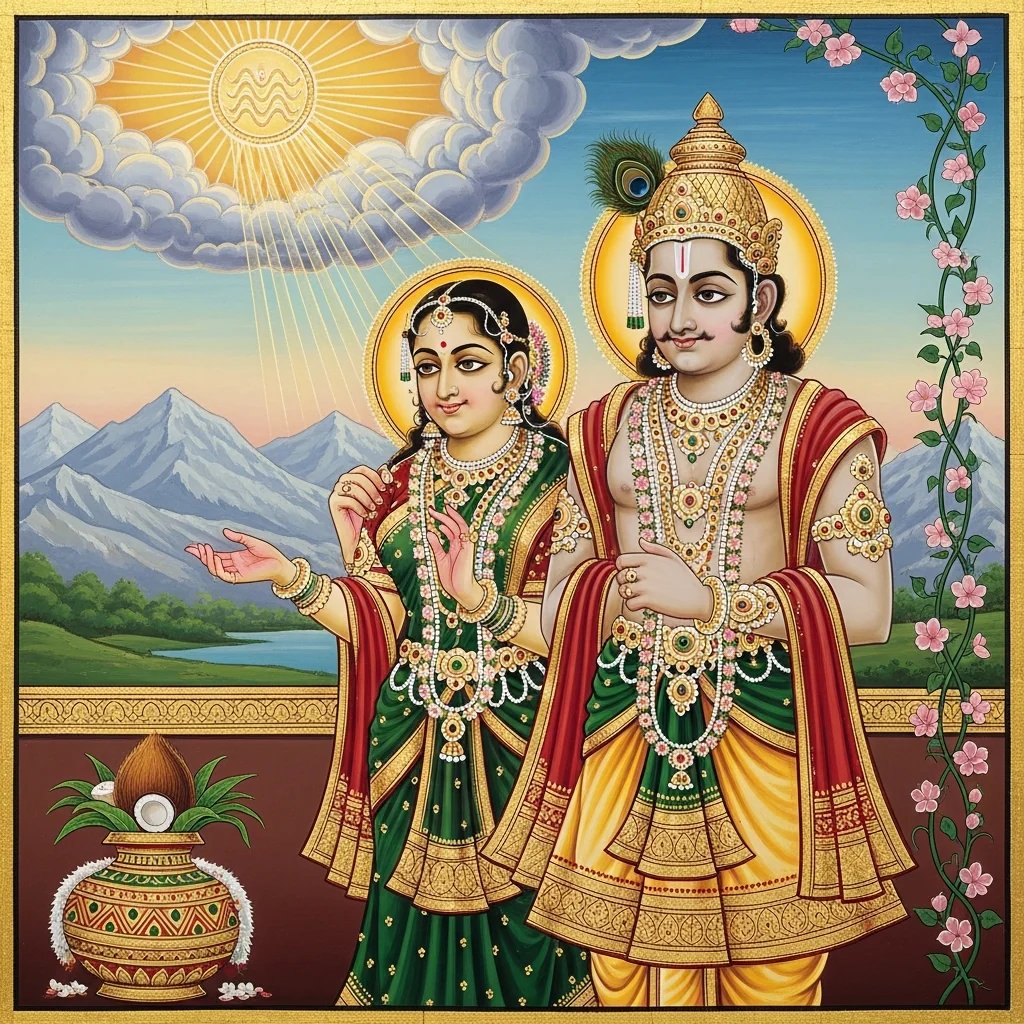
Adhyaya 20
Liṅga as Nirguṇa Reality; Śakti’s Re-emergence and the Taraka Narrative (लिङ्गनिर्गुणतत्त्वं तथा गिरिजाप्रादुर्भावः)
Chapter 20 begins with a question from an assembly of sages: if Brahmā, Viṣṇu, and Rudra are spoken of as possessing attributes (saguṇa), how can Īśa be both liṅga-formed and yet nirguṇa? The reply, conveyed by Sūta as Vyāsa’s teaching, draws a doctrinal line: the liṅga is the emblematic form of the nirguṇa Paramātman, whereas the manifest world is māyā-conditioned and pervaded by the three guṇas, and is therefore ultimately impermanent and perishable. The narrative then turns to sacred history. After Satī (Dākṣāyaṇī) departs through the episode of the sacrificial fire, Śiva performs intense tapas in the Himalayas, surrounded by gaṇas and attendants. In that interval asuric powers rise; Tāraka receives a boon from Brahmā with a fixed limitation—defeat only by a child—and becomes a grave threat. The devas seek guidance, and a celestial voice declares that only Śiva’s son can slay Tāraka. They approach Himavat; after deliberation with Menā, he agrees to bring forth a daughter fit for Śiva, culminating in the birth of Girijā—the re-manifestation of the supreme Śakti—amid cosmic rejoicing and renewed confidence among gods and sages.
Adhyaya 21
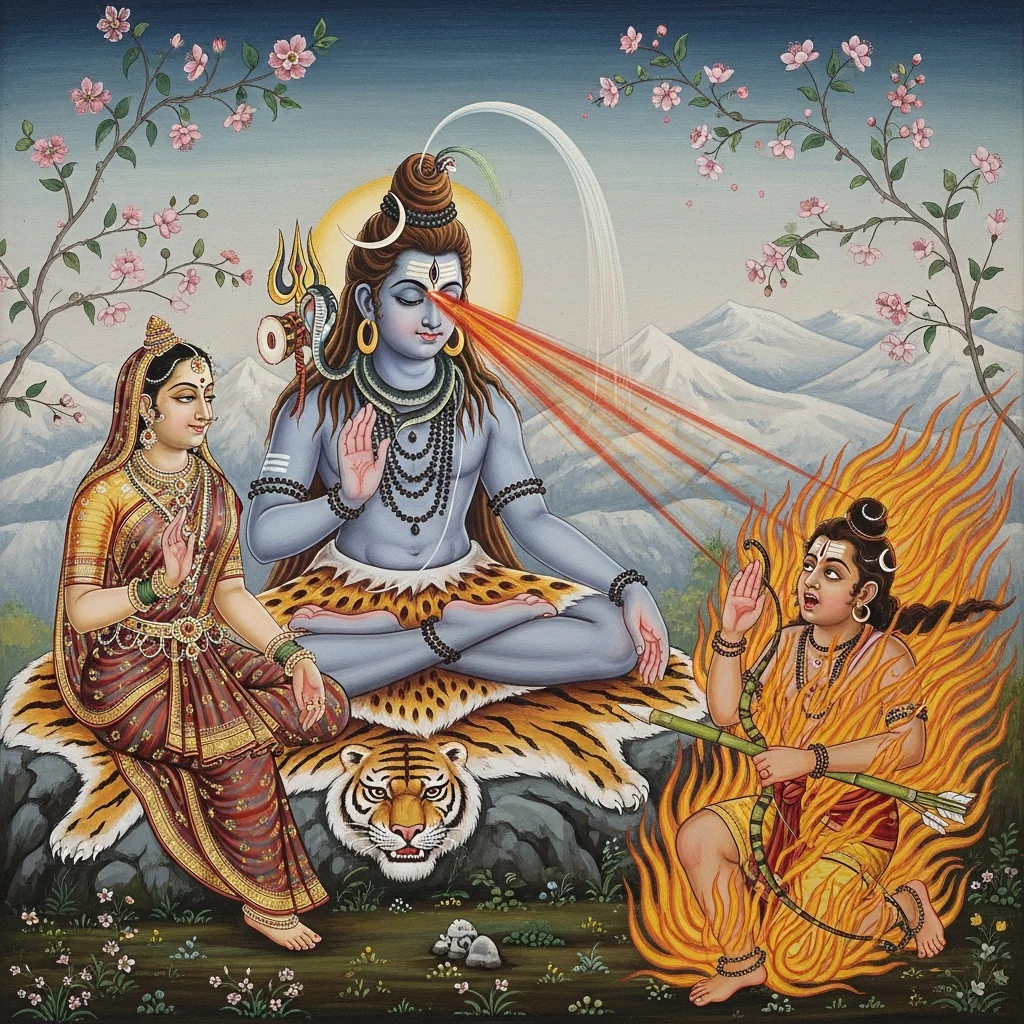
Himavān’s Darśana of Śiva, Kāma’s Burning, and Pārvatī’s Intensified Tapas (Apārṇā Episode)
The chapter begins with Lomāśa describing Pārvatī’s growth and Śiva’s fierce tapas in a Himalayan valley, guarded by gaṇas. Himavān comes with Pārvatī to seek Śiva’s darśana, but Nandin controls access, stressing that nearness to the ascetic Lord must follow disciplined, ritual propriety. Śiva grants Himavān regular darśana yet forbids bringing the maiden close, leading to a philosophical exchange in which Pārvatī tests Śiva’s claim of transcending prakṛti and probes the logic of perception and speech. Meanwhile the devas, distressed by their cosmic danger—especially Tāraka—decide that only Madana (Kāma) can disturb Śiva’s austerity. Madana arrives with apsarases; nature turns unseasonably erotic, and even the gaṇas are affected, revealing desire’s cosmological force. Madana releases the mohana-arrow; Śiva briefly beholds Pārvatī and is stirred, then recognizes Madana and burns him to ashes with the third eye. Devas and sages debate: Śiva condemns kāma as the root of suffering, while the sages argue that kāma is woven into worldly creation and cannot be simply negated. Śiva then withdraws in concealment (tiraḥdhāna). Pārvatī vows to restore the situation through intensified tapas; renouncing even leaves, she becomes “Apārṇā” and advances to extreme bodily restraint. The chapter ends with the gods seeking Brahmā’s aid; Brahmā approaches Viṣṇu, and Viṣṇu proposes going to Śiva to secure the marriage outcome, framing the tale as a sacred and ethical necessity rather than mere romance.
Adhyaya 22
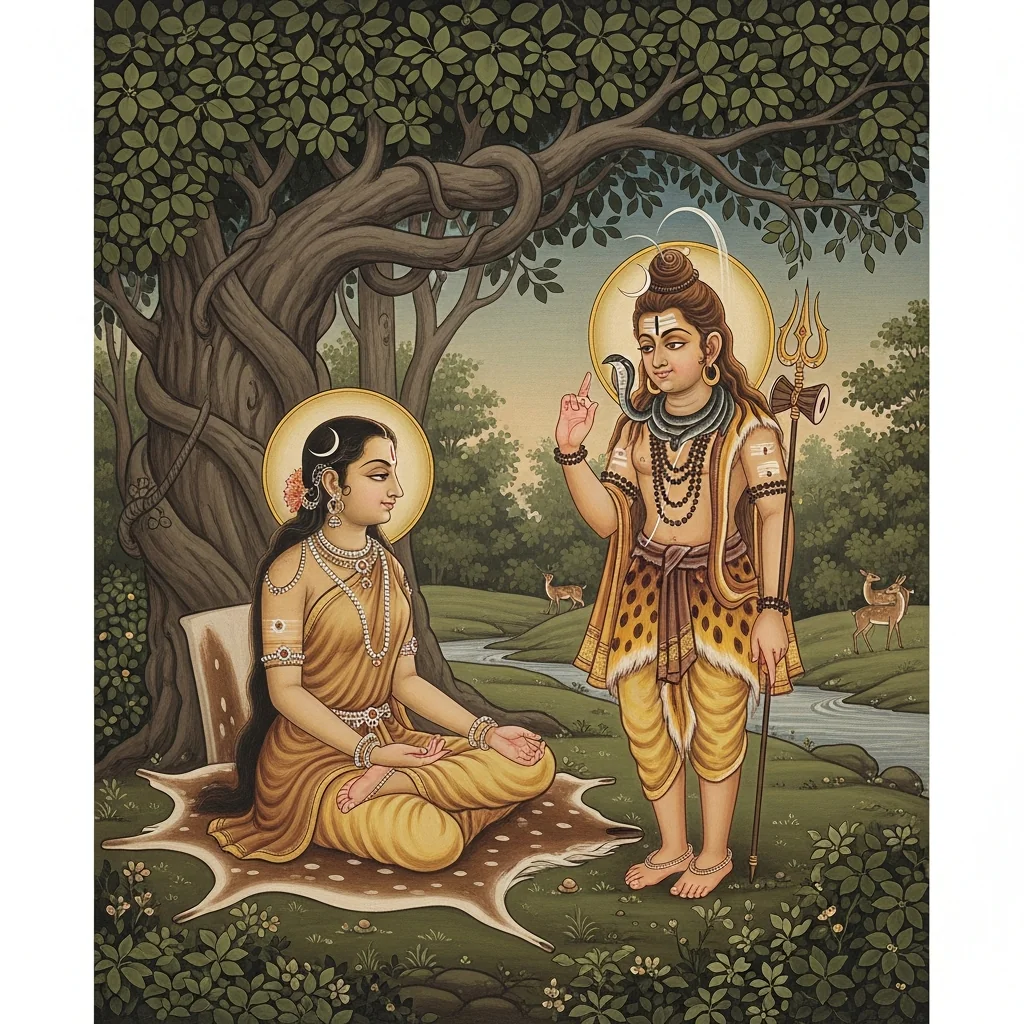
देवस्तुति–समाधिवर्णन–पार्वतीतपः–बटुरूपशिवोपदेशः (Deva-stuti, Samādhi Description, Pārvatī’s Tapas, and Śiva’s Instruction in Disguise)
Chapter 22 begins with Sūta describing the devas—led by Brahmā and Viṣṇu—approaching Śiva, who sits in profound samādhi amid his gaṇas, adorned with serpent-ornaments and ascetic emblems. The devas praise him with Veda-toned hymns; when Nandī asks their purpose, they petition deliverance from the asura Tāraka, declaring that only Śiva’s son can defeat him. Śiva answers by turning their plea into ethical and contemplative instruction: abandon kāma (desire) and krodha (anger), beware delusion born of passion, and then he returns to meditation. The narrative shifts to Pārvatī’s tapas, which draws Śiva forth; he tests her resolve by appearing as a brahmacārin (baṭu) who disparages Śiva as inauspicious and socially marginal. Pārvatī (through her companions) rejects the slander, whereupon Śiva reveals his true form and offers a boon. Pārvatī asks for a formal marriage, to be arranged through Himālaya, so divine aims may be fulfilled—including the birth of Kumāra for Tāraka’s downfall. Śiva gives a cosmological-philosophical discourse on the guṇas, prakṛti–puruṣa, and the māyā-conditioned nature of the manifest world, yet agrees—“by worldly convention”—to proceed. The chapter ends with Himālaya’s arrival, familial rejoicing, and a movement toward domestic life as Pārvatī remains inwardly fixed on Śiva.
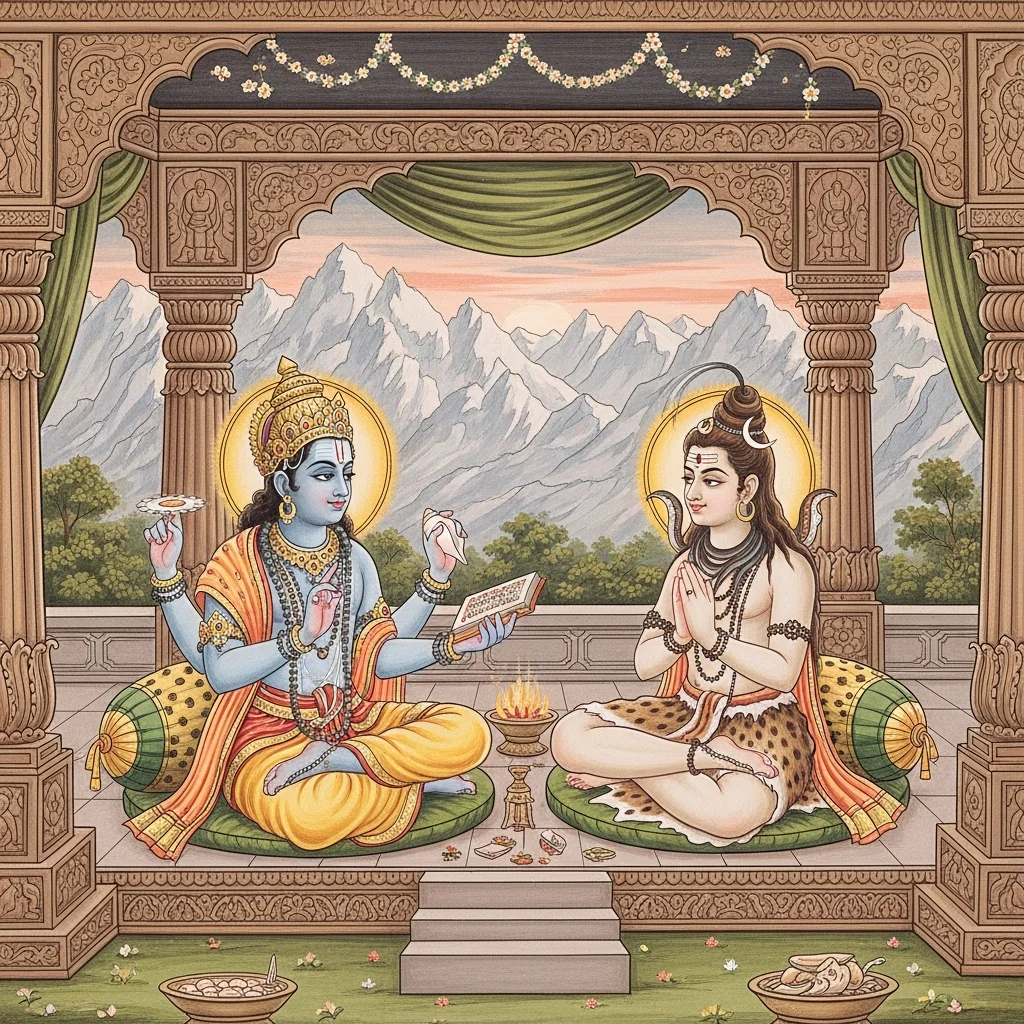
Adhyaya 23
पार्वती-विवाह-प्रस्तावः (Proposal and Preparations toward Pārvatī’s Marriage)
This chapter marks a formal shift from divine intention forged through tapas to a socially recognized ritual process. At Mahesha’s prompting, sages arrive at Himālaya and ask to see the mountain-king’s daughter. Himavān presents Pārvatī and sets out deliberative norms for kanyādāna, naming disqualifying traits—imprudence, instability, lack of livelihood, or improper detachment—to affirm marriage as an ethical institution rather than mere desire. The sages reply by praising Pārvatī’s tapas and Śiva’s satisfaction, urging that she be given to Śiva. With Menā’s assent—declaring Pārvatī’s birth to be for a divine purpose—consent is secured. The narrative then turns to preparations: Śiva is instructed to invite Viṣṇu, Brahmā, Indra, and many orders of beings. Nārada serves as envoy to Viṣṇu; Viṣṇu and Śiva confer on proper wedding rites, including the maṇḍapa and auspicious preliminaries. A great assembly of ṛṣis performs Vedic protections and auspicious acts; Śiva is adorned, and the procession with Caṇḍī, attendant gaṇas, devas, and cosmic beings advances to Himālaya for the pāṇigrahaṇa (hand-taking) ceremony.
Adhyaya 24
Viśvakarmā’s Wonder-Pavilion and the Devas’ Approach to the Wedding (विश्वकर्मकृतमण्डप-विवाहोपक्रमः)
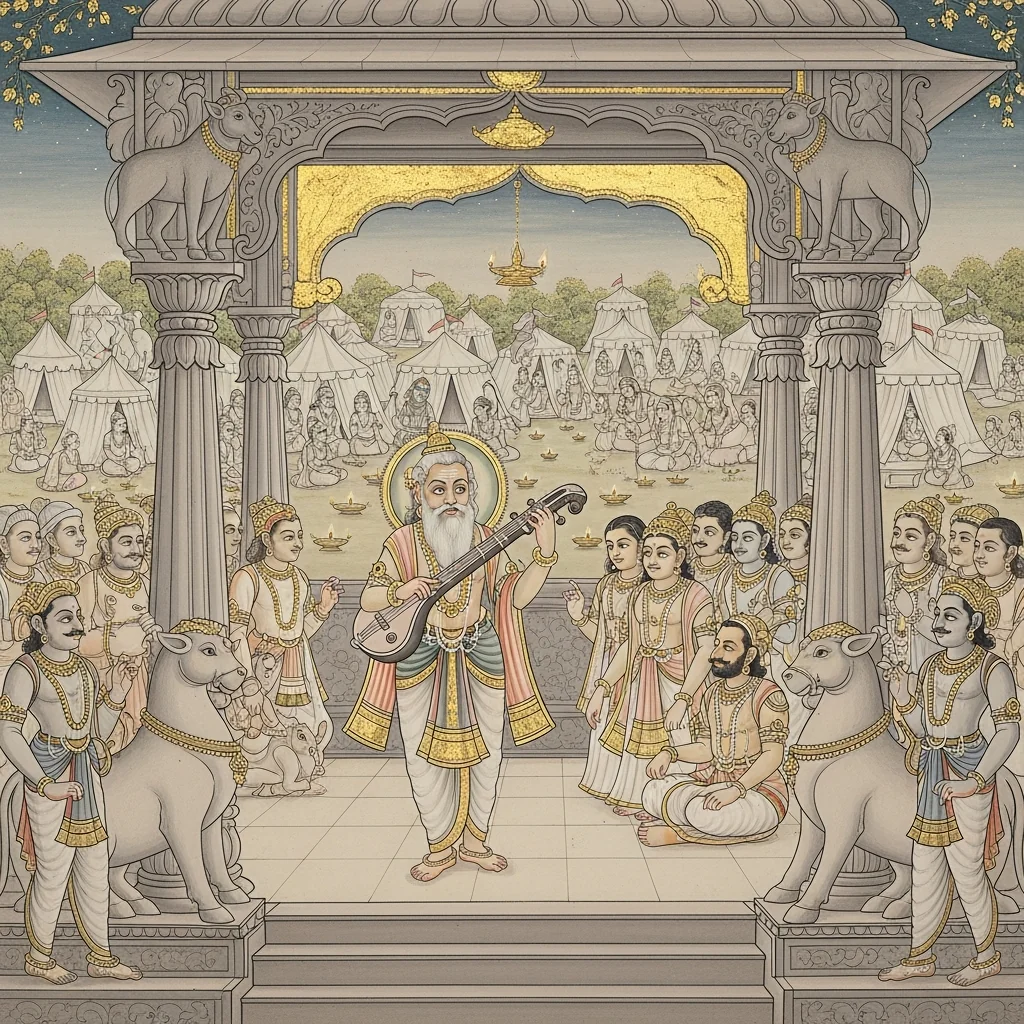
Lomāśa recounts that Himavān, seeking an auspicious place for his daughter’s marriage, summons Viśvakarmā to raise a vast, richly adorned maṇḍapa and a yajña precinct. The pavilion becomes a wonder of lifelike craft, māyā-like in its power: fashioned beings and creatures—lions, swans, sārasas, peacocks—along with nāgas, horses, elephants, chariots, banners, doorkeepers, and courtly assemblies appear so real that onlookers cannot tell water from land, or the moving from the still. Iconic figures are set in place—Nandī at the great gate and Lakṣmī at the doorway—while jeweled canopies heighten the splendor. Prompted by Brahmā, Nārada arrives, is briefly bewildered by the illusion-like workmanship, and reports to the gathered devas and ṛṣis that a grand structure has been made that can delude perception. Indra, Viṣṇu, and Śiva then speak of the situation and the wedding’s purpose, and the devas, led by Nārada, proceed toward Himavān’s extraordinary residence and the prepared yajña-vāṭa. The chapter ends with diverse beings—devas, siddhas, gandharvas, yakṣas, and others—being accommodated in specially built dwellings across the land.
Adhyaya 25
Śiva’s Procession and the Initiation of Kanyādāna (शिवस्य आगमन-नीराजन-कन्यादानारम्भः)
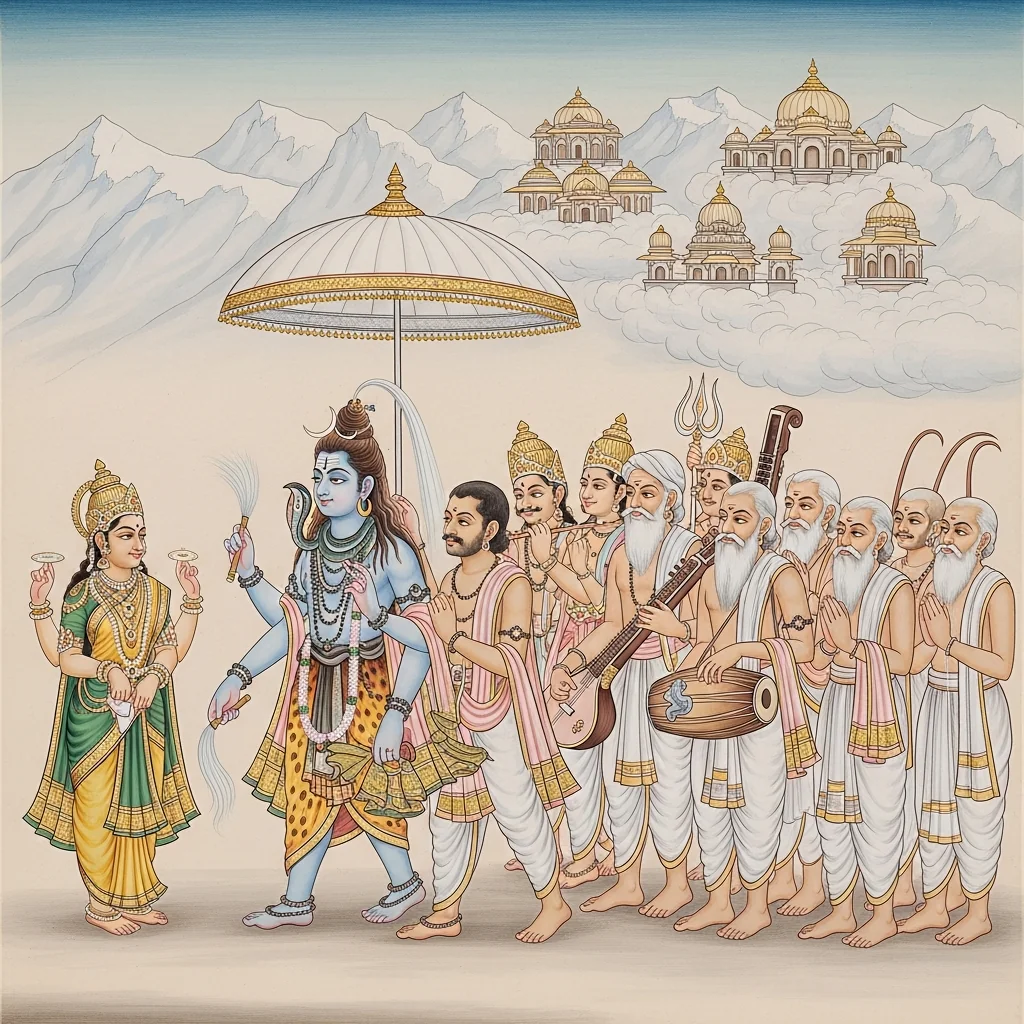
Lomaśa depicts a Himalayan ceremonial splendor: Viśvakarman, Tvaṣṭṛ, and other divine artisans fashion celestial residences, and Śiva is installed in radiant majesty. Menā arrives with her companions and performs nīrājana (auspicious waving of light) to Mahādeva, marveling that his beauty surpasses all that Pārvatī had described. Garga commands that Śiva be brought for the marriage rites; mountains, ministers, and gathered hosts prepare gifts as music and Vedic recitation swell. Śiva advances surrounded by gaṇas, yoginī-cakra forces, and fierce protective retinues—Caṇḍī, Bhairavas, and pretas/bhūtas. Viṣṇu requests that Caṇḍī remain nearby for the world’s protection, and Śiva, with a conciliatory word, temporarily restrains the martial entourage. A grand procession follows with Brahmā, Viṣṇu, the luminaries, lokapālas, sages, and revered women such as Arundhatī, Anasūyā, Sāvitrī, and Lakṣmī; Śiva is bathed, praised, and led into the ritual pavilion. Within the inner altar-space Pārvatī sits adorned and prepared; the auspicious moment is observed as Garga recites praṇava (oṃ) formulae. Pārvatī and Śiva worship one another with arghya, akṣata, and ritual offerings. The narrative then opens the formal kanyādāna: Himavat seeks guidance on procedure, and tension arises when Śiva’s gotra and kula are questioned. Nārada intervenes, declaring Śiva transcendent beyond lineage, grounded in nāda (sacred sound), and the assembly responds in astonishment, affirming Śiva’s incomprehensibility and cosmic sovereignty.
Adhyaya 26
Śiva–Pārvatī Udvāha (The Divine Marriage Ceremony and Yajña Assembly)
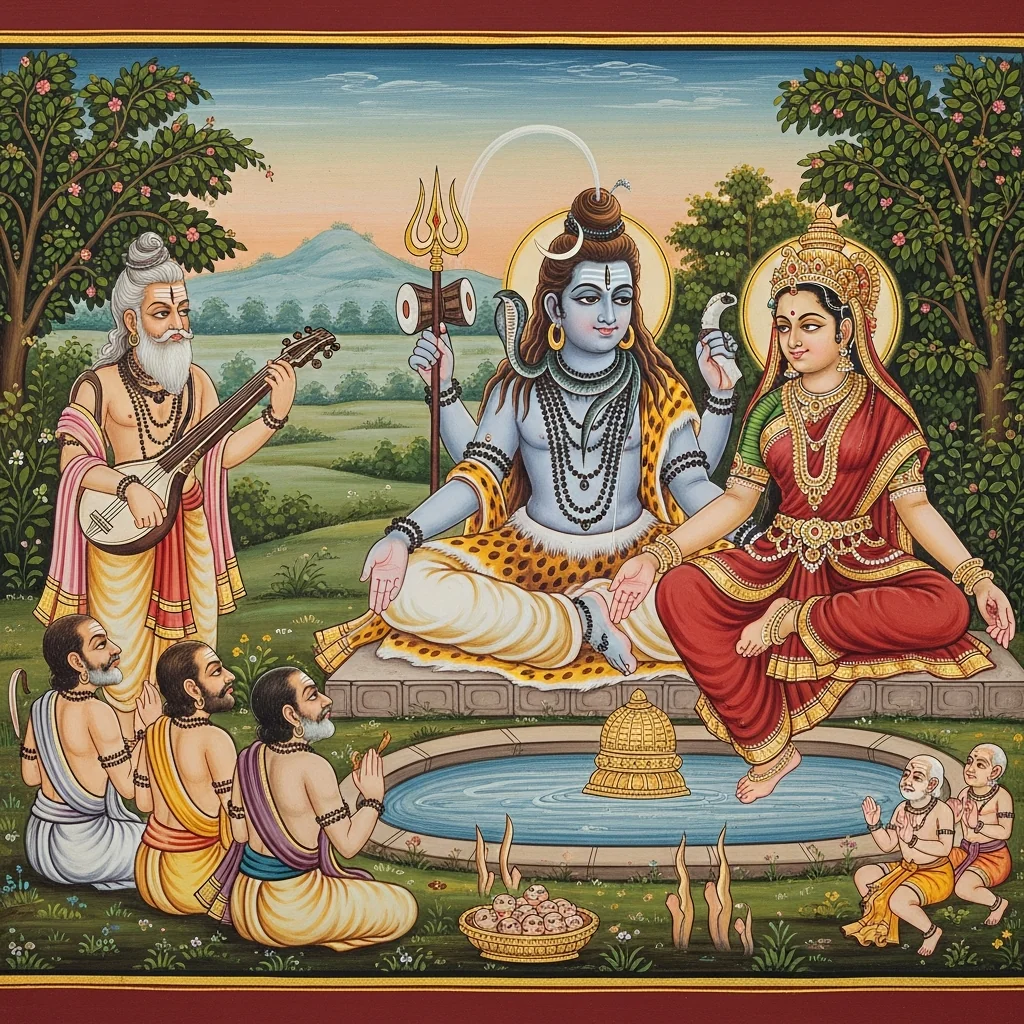
Chapter 26, as reported by Lomasha, recounts the ceremonial sequence that culminates in Himālaya’s formal kanyādāna—giving Pārvatī in marriage to Maheśvara (Śiva). Urged by the lords of the mountains to hesitate no longer, Himālaya resolves to offer his daughter to Śiva with a dedicatory mantra. The divine couple is led into the ritual arena and seated; Kaśyapa serves as officiant, invoking Agni and conducting the havan. Brahmā arrives, and the yajña proceeds amid a learned assembly of ṛṣis who dispute with opposing Vedic interpretations. Nārada counsels silence, inward recollection, and recognition of Sadāśiva as the inner ground of all. Another episode tells of Brahmā’s momentary disturbance on seeing the Devī’s feet, from which the Vālakhilya sages emerge; at Nārada’s direction they depart for Gandhamādana. The rite concludes with extensive śānti recitations, nīrājana, and shared honoring: devas, ṛṣis, and their consorts worship Śiva; Himālaya distributes gifts; and gaṇas, yoginīs, bhūtas, vetālas, and protective beings join the festivities. Viṣṇu asks that the intoxicated gaṇas be restrained; Śiva commands Vīrabhadra, who restores order. The chapter closes by stressing the auspicious grandeur of the udvāha and the four-day cycle of worship in which Himālaya honors Śiva, Viṣṇu with Lakṣmī, Brahmā, Indra, the lokapālas, Caṇḍī, and all assembled beings.
Adhyaya 27
गिरिपूजा, वरयात्रा, रेतोवमनं च—कार्त्तिकेयजन्मप्रसङ्गः (Mountain Worship, Divine Procession, and the Karttikeya Birth Episode)
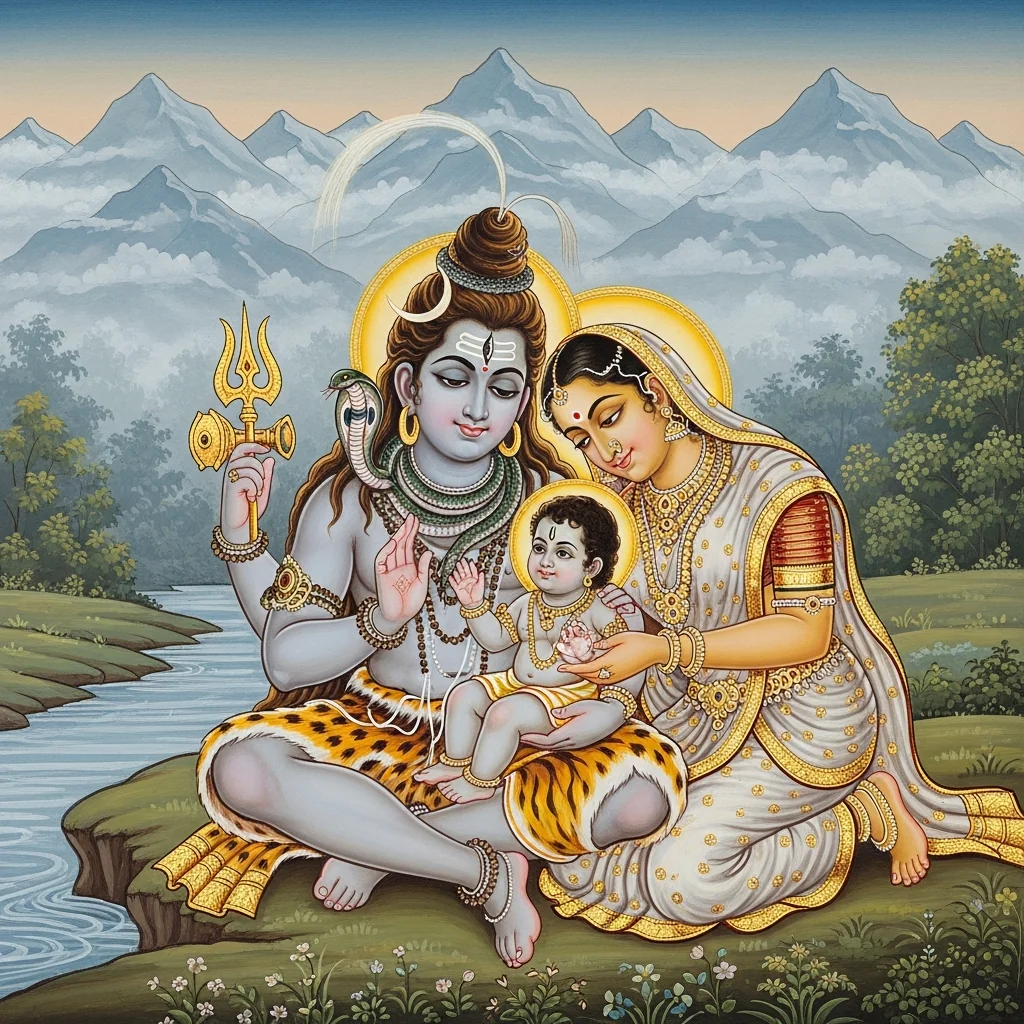
Lomāśa recounts a ritual honoring of the great mountains performed by Viṣṇu with Brahmā’s participation, naming renowned peaks as sacred recipients of worship. The scene then shifts into a “varayātrā” (processional journey) where devas, gaṇas, and mountain-personifications assemble, and Śiva and Pārvatī are portrayed as an inseparable pair through closely linked metaphors—fragrance and flower, speech and meaning. A crisis follows: the overwhelming potency of Śiva’s generative energy (retas) brings cosmic distress to the gods. Brahmā and Viṣṇu enlist Agni, who enters Śiva’s abode to contain or consume that power, yet further complications arise and the devas grow anxious. Viṣṇu urges that Mahādeva be praised; after hymns, Śiva appears and instructs the gods to expel (vamanam) the burden. The expelled energy manifests as a vast radiant mass, is managed through Agni and the Kṛttikās, and becomes linked to the advent of the mighty child Kārttikeya (Ṣaṇmukha), born on the bank of the Gaṅgā. In the closing celebration, devas, sages, and attendants gather as Śiva and Pārvatī approach, embrace the child, and all conclude with auspicious rites and festival-like acclamation.
Adhyaya 28
Kumāra Appointed as Senāpati; Deva–Tāraka Mobilization in Antarvedī (कुमारसेनापत्याभिषेकः तारकसंग्रामोद्योगश्च)
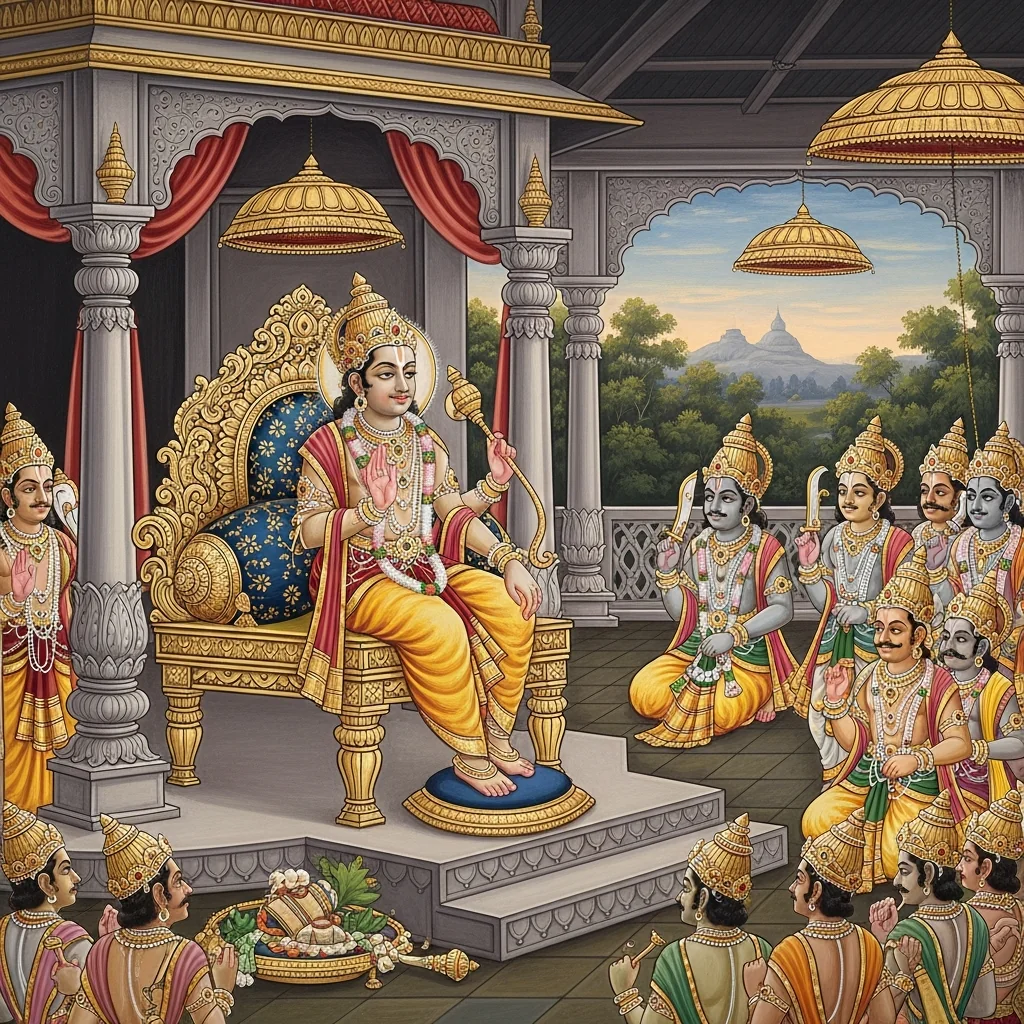
Lomāśa recounts a moment of crisis: the Devas, distressed by Tāraka’s threat, petition Rudra/Śiva for protection. Śiva declares that Kumāra (Kārttikeya) will be the means of deliverance, and the Devas set out with him at their head. A celestial voice reassures them that victory is assured when they uphold Śaiva (Śāṅkarī) leadership. As war draws near, at Brahmā’s prompting Death’s daughter Senā—of singular beauty—arrives and is accepted in relation to Kumāra; thereafter Kumāra is installed as senāpati (commander). Conches, drums, and battle instruments resound through the sky. A brief maternal dispute among Gaurī, Gaṅgā, and the Kṛttikās is settled by Nārada, reaffirming Kumāra’s Śaiva origin and his purpose “for the gods’ work.” Kumāra instructs Indra to return to heaven and rule without interruption, consoling the displaced Devas. Tāraka arrives with a vast host; Nārada confronts him, declaring the inevitability of the Devas’ effort and Kumāra’s destined role. Tāraka answers with derision, challenging Indra and scorning supports tied to the human realm. Nārada reports back; the Devas rally, invest Kumāra with royal insignia (elephant, then a jewel-like aerial conveyance), and assemble the lokapālas with their retinues. Both sides form battle arrays in Antarvedī—between the Gaṅgā and Yamunā—amid detailed musters of troops, vehicles, weapons, and a ceremonial display of power before engagement.
Adhyaya 29
Tāraka–Vīrabhadra Saṅgrāmaḥ and the Appointment of Kumāra as Slayer (तारकवीरभद्रसंग्रामः कुमारनियुक्तिश्च)
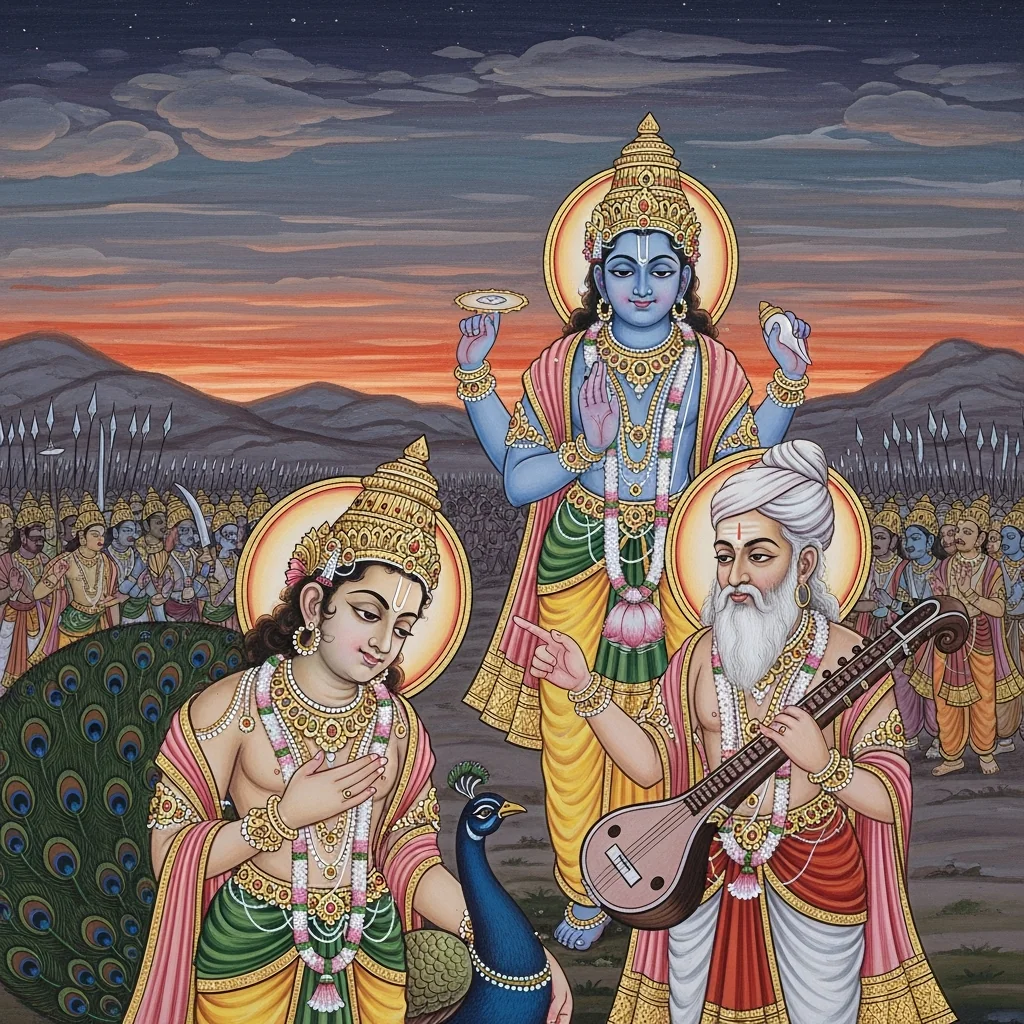
This chapter unfolds a vast caturaṅga war between devas and asuras, rendered in swift battlefield images of severed limbs and fallen heroes. Mucukunda, son of Māndhātṛ, confronts the asura chief Tāraka and presses toward a decisive, escalating violence, even nearing the use of the Brahmāstra. Nārada intervenes with a dharmic constraint: Tāraka is not to be slain by a human, and the power to end him must be redirected to the divinely appointed Kumāra, Śiva’s son. As the struggle intensifies, Vīrabhadra and Śiva’s gaṇas engage Tāraka in a fierce duel, while Nārada repeatedly urges restraint, setting martial fervor against cosmic ordinance. The narrative then turns as Viṣṇu explicitly designates Kṛttikā-suta/Kumāra as the only possible slayer. Kumāra first appears as an observer, uncertain in distinguishing friend from foe, and Nārada supplies the account of Tāraka’s austerities and conquests. The chapter closes with Tāraka’s boastful challenge and his mobilization to fight Kumāra, preparing the sanctioned resolution of adharma through the proper divine instrument.
Adhyaya 30
Kumāra’s Victory over Tāraka (Tārakavadha) — Śakti-Yuddha and Phalāśruti
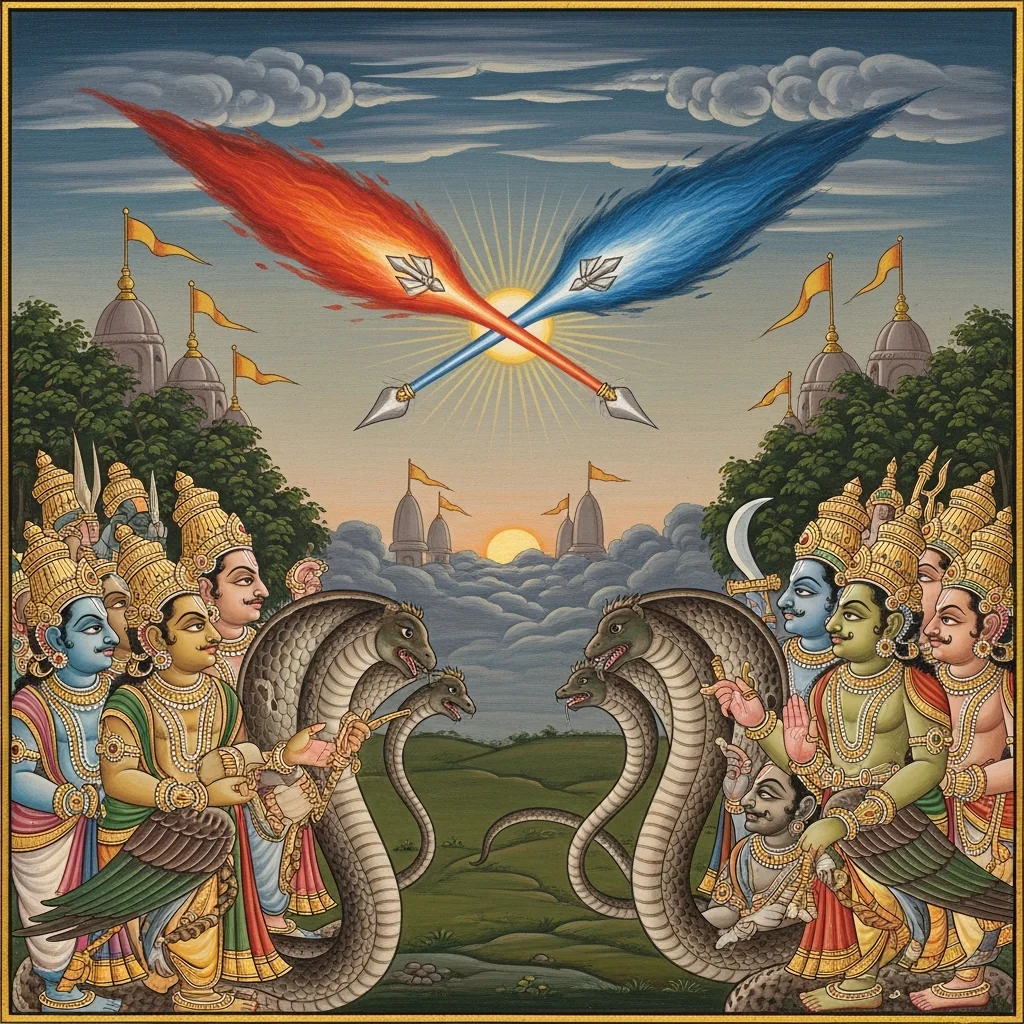
Chapter 30 depicts a deliberate escalation of the war as Tāraka confronts the devas, until Śiva’s martial lineage intervenes decisively. Lomasha recounts Indra striking Tāraka with the vajra and Tāraka’s fierce counterattack, which throws the celestial onlookers into panic. Vīrabhadra then enters, wounds Tāraka with a blazing triśūla, yet is himself felled by Tāraka’s śakti; devas, gandharvas, nāgas, and other beings cry out repeatedly, marking the battle’s cosmic scope. The focus shifts as Kārttikeya (Kumāra) restrains Vīrabhadra from a final blow and engages Tāraka in an intense śakti-duel of feints, aerial maneuvers, and mutual wounding. Mountains and ranges, named as fearful witnesses, converge, and Kumāra reassures them that the end is near. The climax comes when Kumāra severs Tāraka’s head, followed by universal celebration—praise, music, dance, flower-rain, and Pārvatī’s embrace of her son—while Śiva is honored among the sages. The chapter closes with a clear phalāśruti: reciting or hearing this “Kumāra-vijaya” and the Tāraka narrative is said to remove sins and fulfill desires.
Adhyaya 31
Kārttikeya’s Post-Tāraka Triumph: Darśana-Merit, Liṅga-Mountains, and Śiva’s Nondual Instruction (कुमारमहिमा–लिङ्गरूपगिरिवरदान–ज्ञानोपदेश)
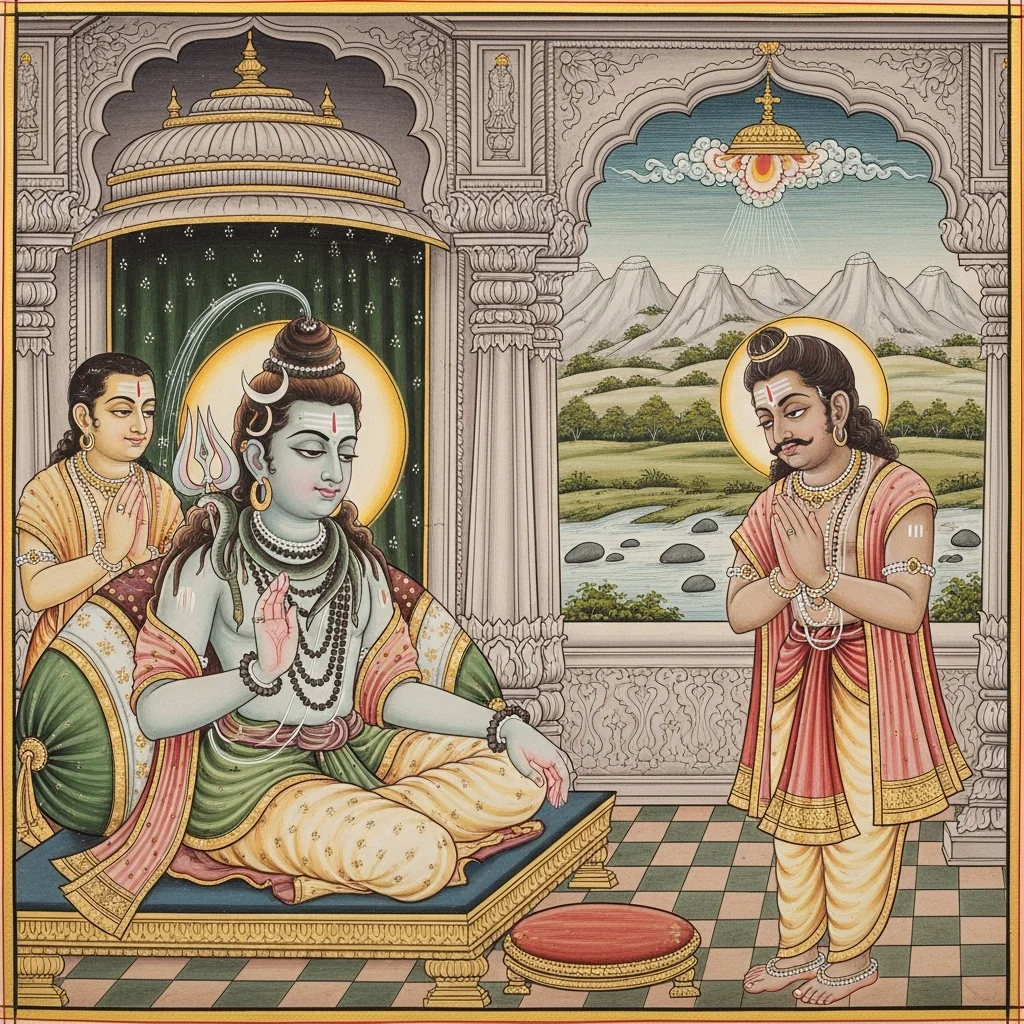
This chapter begins with Śaunaka asking what followed Kārttikeya’s slaying of Tāraka. Lomaśa replies by glorifying the “Kumāra” principle, declaring that Kumāra’s darśana itself purifies at once—even those scorned by society—thus placing merit beyond mere social standing. Yama, as Dharmarāja, then approaches Śaṅkara with Brahmā and Viṣṇu, praising him as Mṛtyuñjaya and voicing a concern: Kārttikeya’s darśana seems to open svarga’s gate widely, even to sinners. Śiva explains this through karmic continuity and inner disposition—sudden purity arises from long-formed saṃskāras and prior practice—while reaffirming tīrthas, yajñas, and dānas as means to cleanse the mind. He delivers a concentrated nondual teaching: the Self beyond guṇas and dualities; māyā as misapprehension (shell-silver, rope-snake); and liberation through relinquishing mamatā (possessiveness) and passions, concluding with the method of hearing, reflection, and discernment. After Tāraka’s fall, the mountains hymn Kārttikeya; he grants them the boon to become liṅga-forms and future abodes of Śiva, naming prominent ranges. Asked by Nandin about liṅga worship, Kārttikeya classifies gem and metal liṅgas, extols certain locales, and explains the Narmadā (Revā) bāṇa-liṅgas with careful rules for installation and worship. The chapter ends by linking the pañcākṣarī, inward withdrawal, equality toward all beings, and ethical restraint as marks of true practice.
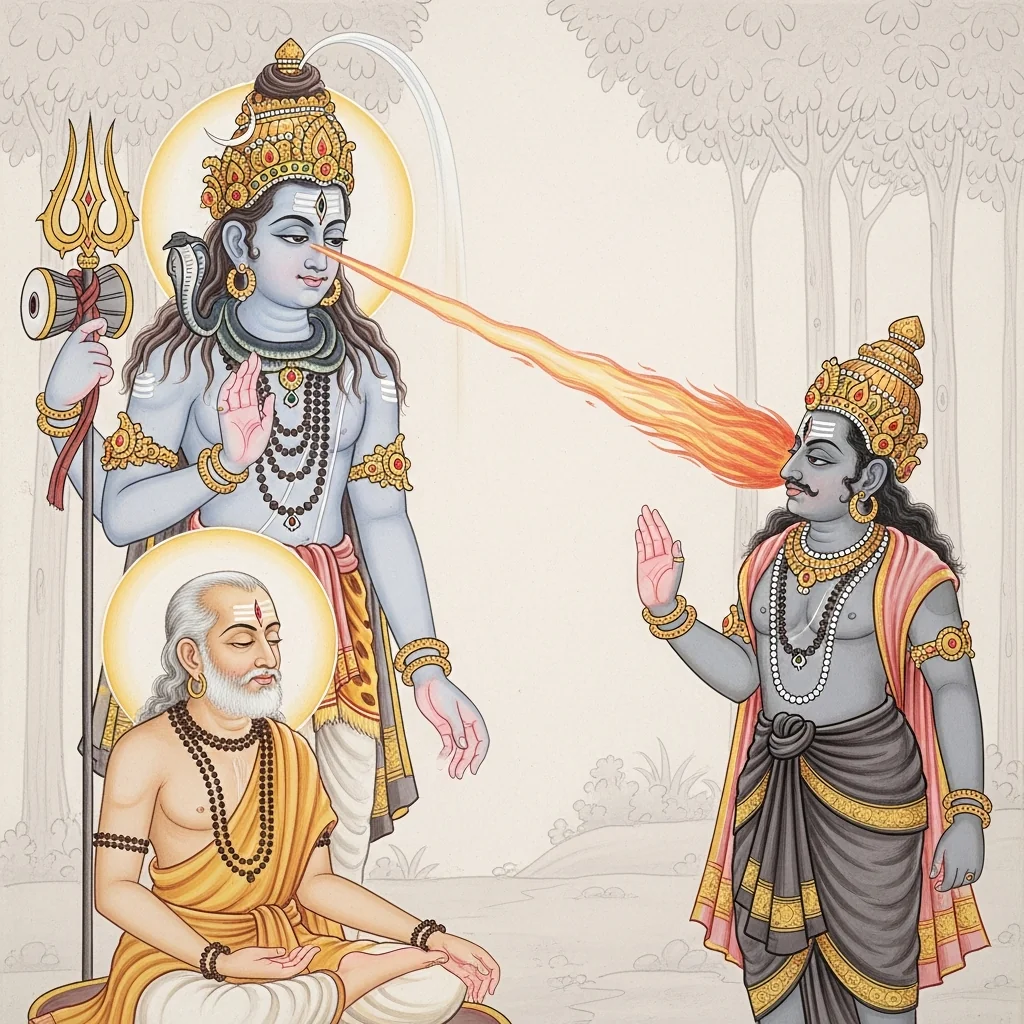
Adhyaya 32
Śvetarāja-carita: Śiva’s Protection of the Devotee and the Restraint of Kāla
Framed as a dialogue, the sages ask Lomāśa to recount the wondrous story of King Śveta (also called rājasimha), famed for unbroken Śiva-bhakti and dhārmic rule. His kingdom is first portrayed as ideal—stable, free from disease and calamity, and prosperous—arising from constant worship of Śaṅkara. When his lifespan ends, Yama, acting on Citragupta’s directive, sends messengers to seize the king. Finding him absorbed in Śiva-dhyāna within the temple precinct, they hesitate; Yama comes himself. Then Kāla appears, insisting that the law of time is inescapable, and attempts to kill the king in the sacred space. Śiva (Pinākin), hailed as Kālântaka, intervenes and with the ‘third eye’ burns Kāla to ashes to protect his devotee. Questioned by the king, Śiva explains that Kāla is the universal devourer of beings. Yet Śveta argues that Kāla is also a necessary cosmic regulator for the world’s moral order, and requests his restoration. Śiva revives Kāla; Kāla praises Śiva’s cosmic deeds and acknowledges the king’s exceptional devotional power. The chapter ends with an injunction to Yama’s agents: those bearing Śaiva marks (tripuṇḍra, jaṭā, rudrākṣa, affiliation with Śiva’s name) are not to be taken to Yama’s realm; true worshippers are to be regarded as Rudra-like. King Śveta finally attains Śiva-sāyujya, affirming that devotion grants both protection and liberation-oriented fulfillment.
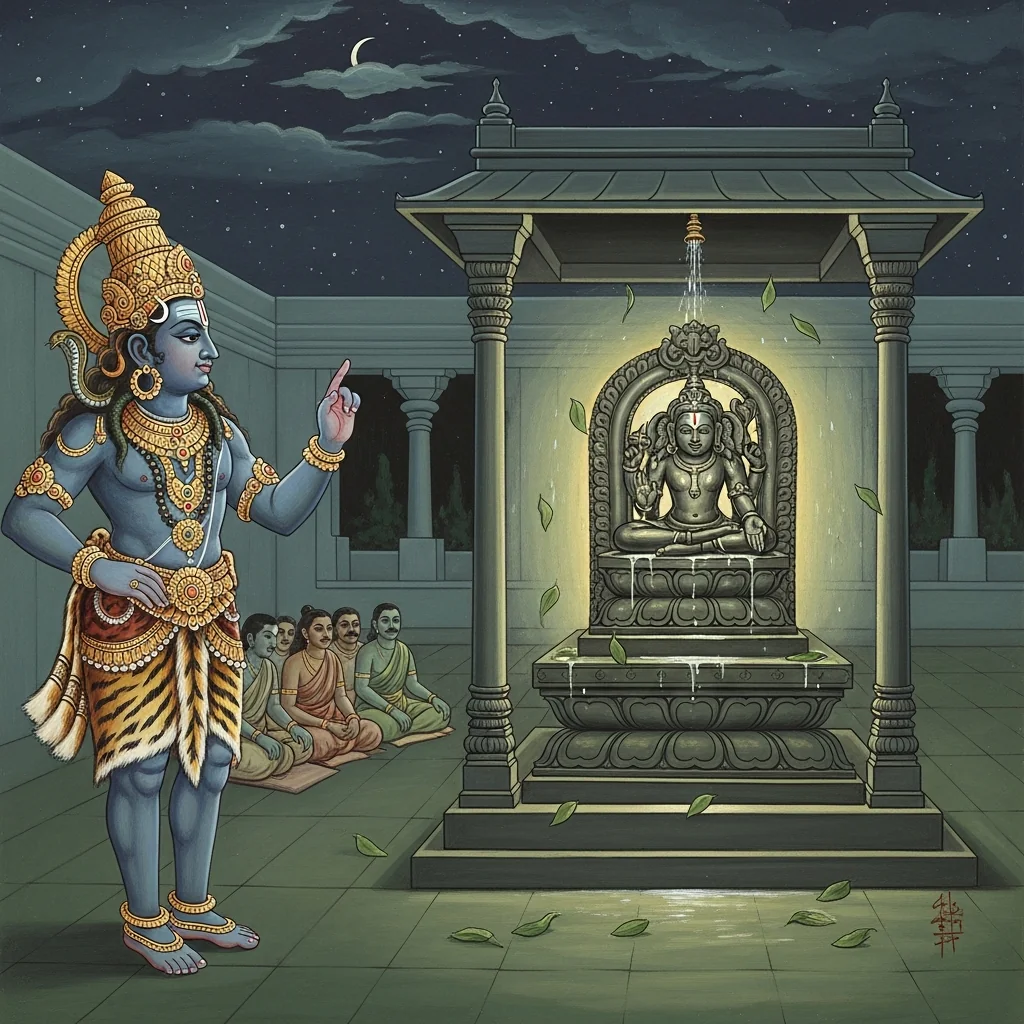
Adhyaya 33
Puṣkasena’s Accidental Śivarātri Worship and the Doctrine of Kāla (Time) and Tithi
The chapter begins with sages asking Lomāśa to identify a kirāta (hunter) and explain his vow. Lomāśa tells of Caṇḍa, also called Puṣkasena—violent and morally wayward, living by hunting and harming beings. In Māgha, on the kṛṣṇapakṣa-caturdaśī night, he waits in a tree to kill a boar; yet he accidentally cuts and drops bilva leaves, and water from his mouth falls upon a liṅga beneath. Unintentionally, this becomes liṅga-snapana and bilva-arcana, and his wakefulness becomes a Śivarātri vigil. A domestic scene follows: his wife Ghanodarī/Caṇḍī worries through the night, later finds him by a river, and brings food; a dog eats it, stirring anger. Puṣkasena calms himself and teaches about impermanence, relinquishing pride and wrath, so that the night’s fasting and vigil are strengthened by ethical counsel. As amāvasyā approaches, Śiva’s gaṇas arrive in vimānas, declaring that the karmic fruit of this incidental Śivarātri worship grants him nearness to Śiva. When Puṣkasena doubts how a sinful hunter could deserve it, Vīrabhadra explains that bilva offerings, vigil, and upavāsa on Śivarātri uniquely please Śiva. The chapter then unfolds a calendrical-cosmological doctrine—Brahmā’s kālacakra, the structure of tithis, and why the dark-fortnight caturdaśī with niśītha is Śivarātri—praised as sin-destroying and bestowing Śiva-sāyujya. A second example shows another fallen person attaining a higher birth and ultimately liberation through keeping Śivarātri awake near a Śiva shrine and sustaining Shaiva devotion; the chapter closes with Śiva and Pārvatī seen in divine play.
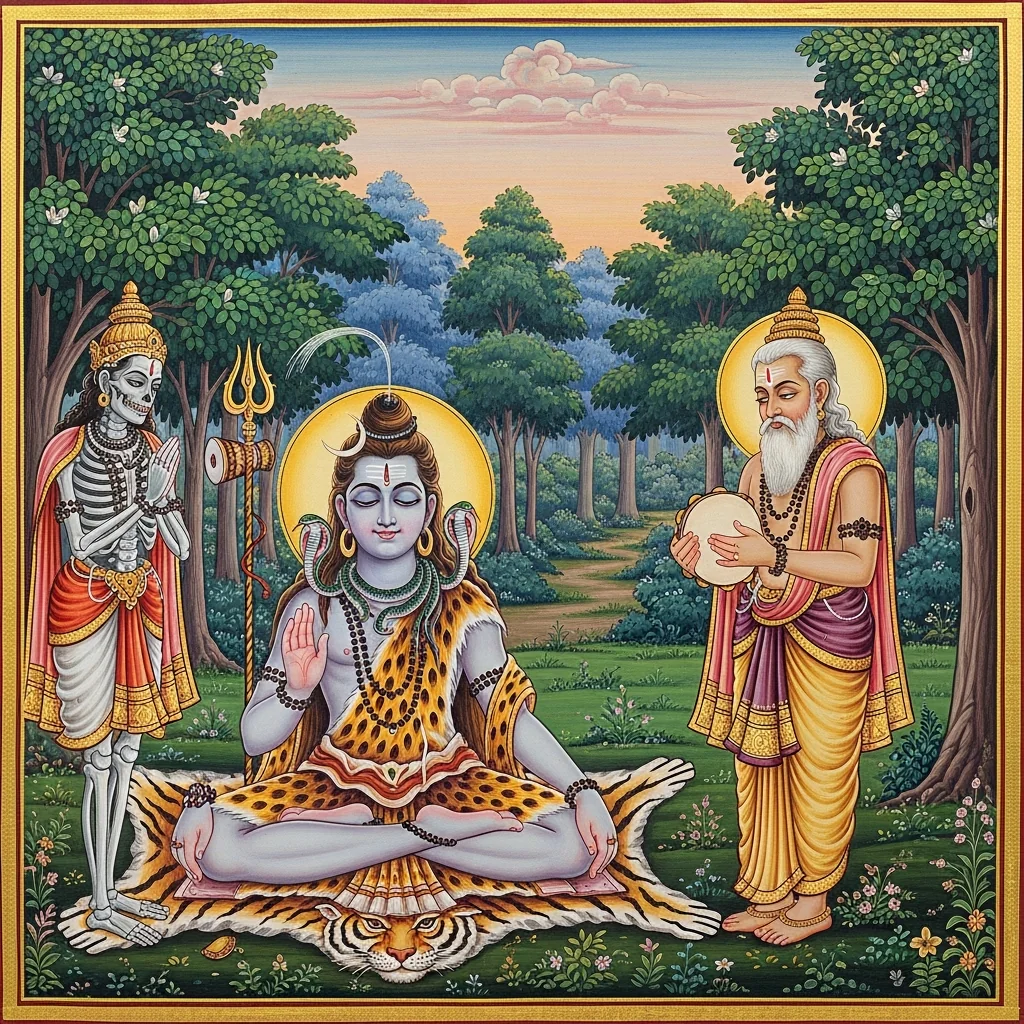
Adhyaya 34
कैलासे नारददर्शनं द्यूतक्रीडा-विवादः (Nārada’s Vision of Kailāsa and the Dice-Play Dispute)
Lomāśa portrays Śiva’s royal splendor on Kailāsa: devas and ṛṣis attend Him, celestial musicians perform, and His victories over mighty adversaries are recalled. Nārada journeys to moon-bright Kailāsa and beholds its marvels—wish-fulfilling trees, birds and animals, and the wondrous descent of the Gaṅgā—along with crafted gatekeepers and wonders within the sacred precinct. He then sees Śiva with Pārvatī, with iconographic detail highlighting Śiva’s serpent-ornaments and His multiform majesty. A playful episode follows: Nārada proposes dice-play as “sport,” Pārvatī challenges, and Śiva and Pārvatī contest amid teasing, claims of victory, and escalating speech. Bhṛṅgī intervenes with doctrinal admonition about Śiva’s invincibility and supremacy; Pārvatī replies sharply, even cursing Bhṛṅgī, and in anger removes Śiva’s ornaments as though claiming the stakes. Śiva, offended and reflecting on detachment, withdraws alone to a forest-like hermitage, assumes yogic posture, and enters contemplative absorption—recasting the incident as an ethical-theological lesson on ego, speech, and renunciation.
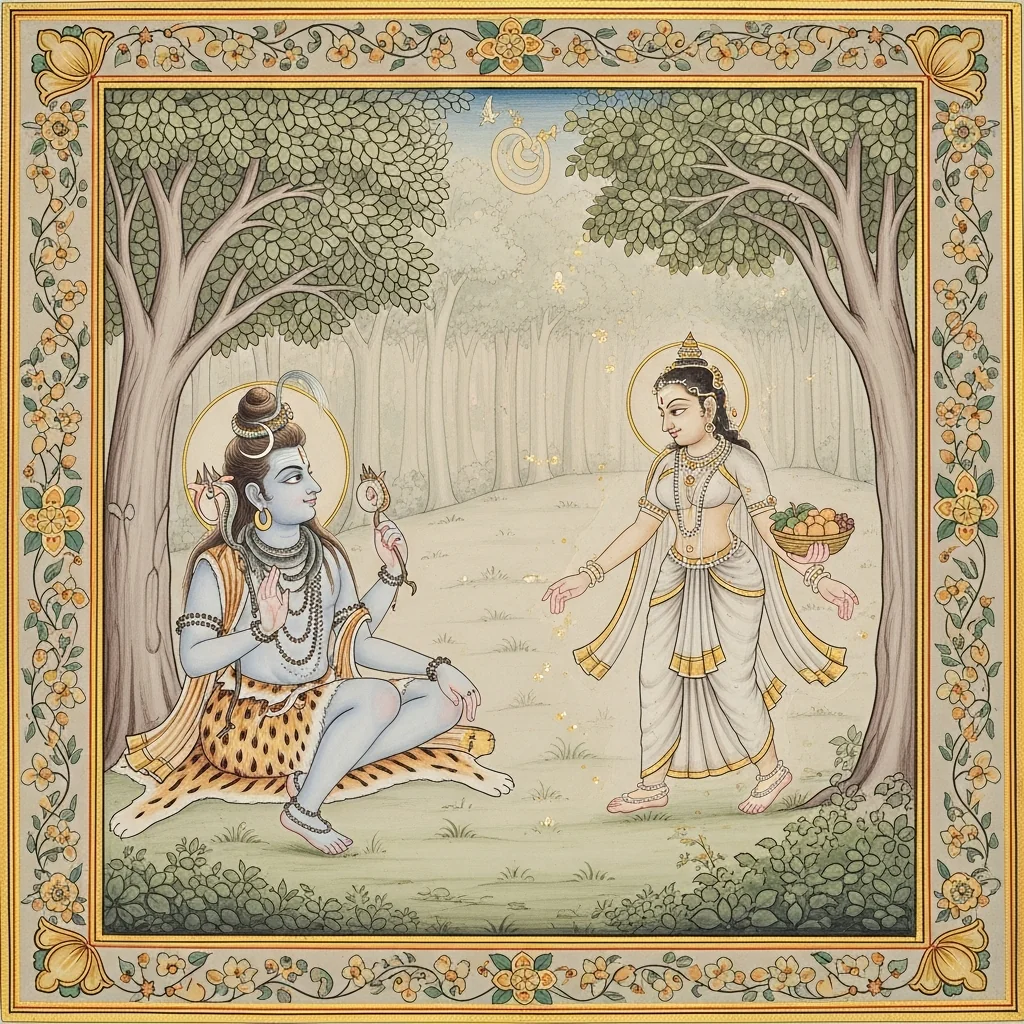
Adhyaya 35
गिरिजायाः शबरीरूपधारणं शंकरस्य मोहो नारदोपदेशश्च (Girijā’s Śabarī Disguise, Śaṅkara’s Bewilderment, and Nārada’s Counsel)
The chapter begins with Lomaśa describing Girijā’s anguish when Mahādeva departs for the forest; neither palace life nor secluded retreats bring her peace. Her companion Vijayā urges swift reconciliation, warning of the faults of gambling and the harm that comes from delay. Girijā replies with a theologically charged self-understanding, affirming her sovereignty over form and cosmos: Maheśa’s saguṇa/nirguṇa manifestation and even the universe’s līlā, she says, lie within her creative power. Girijā then assumes a richly described Śabarī (forest-woman/ascetic) guise and approaches Śiva as he sits in samādhi. By sound and presence she breaks his absorption, producing a momentary bewilderment and desire. Śiva questions the unknown woman; the dialogue turns ironic as he offers to find her a suitable husband, then declares himself the proper spouse. As Śabarī, Girijā critiques the tension between yogic detachment and sudden attachment; when Śiva grasps her hand, she rebukes the impropriety and directs him to seek her properly from her father, Himālaya. The scene shifts to Kailāsa, where Himālaya praises Śiva’s cosmic sovereignty. Nārada arrives and admonishes Śiva about the ethical and reputational danger of association driven by desire. Śiva concedes, calls his conduct astonishing and improper, and withdraws by yogic means onto an inaccessible path. Nārada then urges Girijā, Himālaya, and the attendants to seek forgiveness and venerate Śiva; the chapter closes with collective prostration and praise, celestial celebration, and the assurance that hearing Śiva’s wondrous deeds is purifying and spiritually fruitful.
FAQs about Kedara Khanda
Kedāra is framed as an eminent Shaiva power-center where landscape and shrine are treated as a locus of intensified merit, devotion, and purification through worship and disciplined conduct.
The section’s thematic arc links pilgrimage to merit through pūjā, dāna, and reverent behavior—especially honoring sacred beings and avoiding insult—so that tīrtha-sevā becomes both ritual practice and ethical training.
Kedāra’s narrative environment commonly hosts Shaiva legends of divine presence and moral consequence; in this opening chapter, the discourse pivots to the Dakṣa–Śiva conflict as a foundational cautionary narrative about disrespect and anger.