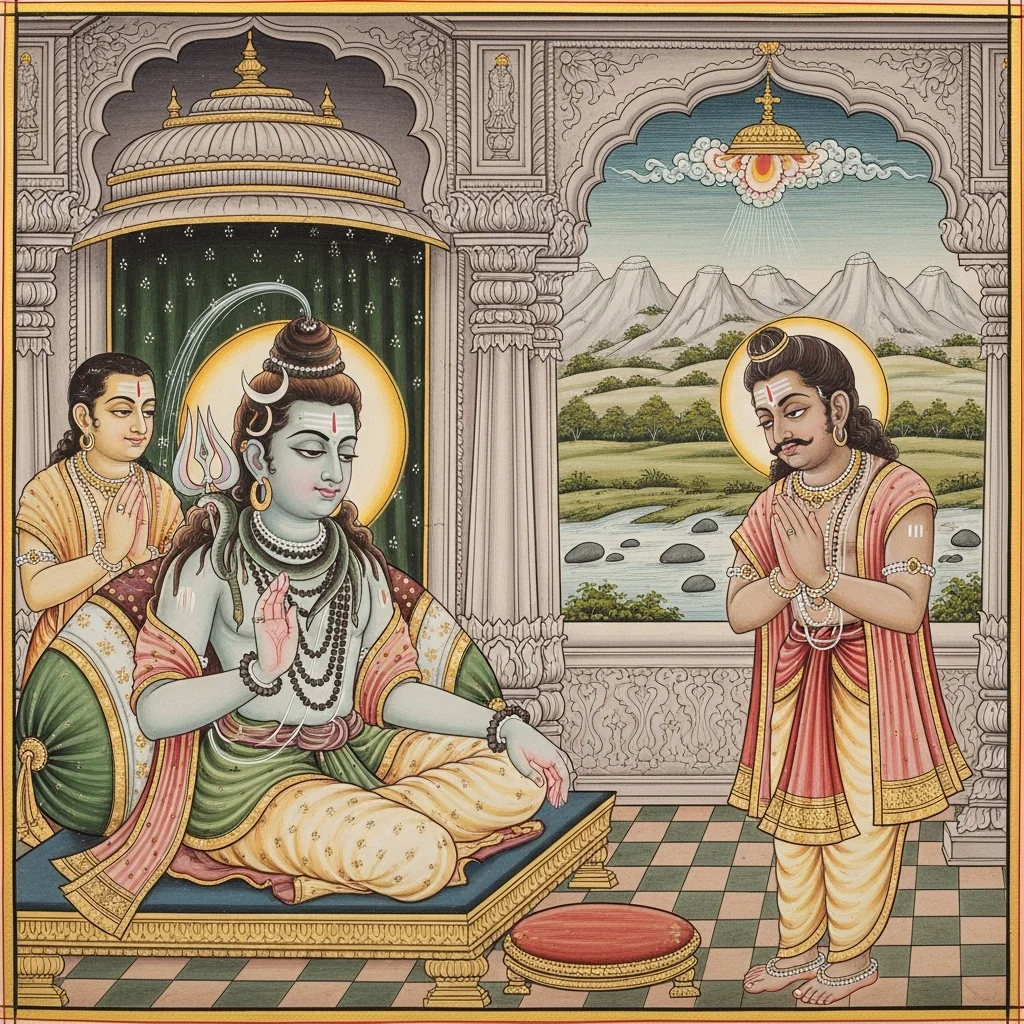
Adhyaya 31
This chapter begins with Śaunaka asking what followed Kārttikeya’s slaying of Tāraka. Lomaśa replies by glorifying the “Kumāra” principle, declaring that Kumāra’s darśana itself purifies at once—even those scorned by society—thus placing merit beyond mere social standing. Yama, as Dharmarāja, then approaches Śaṅkara with Brahmā and Viṣṇu, praising him as Mṛtyuñjaya and voicing a concern: Kārttikeya’s darśana seems to open svarga’s gate widely, even to sinners. Śiva explains this through karmic continuity and inner disposition—sudden purity arises from long-formed saṃskāras and prior practice—while reaffirming tīrthas, yajñas, and dānas as means to cleanse the mind. He delivers a concentrated nondual teaching: the Self beyond guṇas and dualities; māyā as misapprehension (shell-silver, rope-snake); and liberation through relinquishing mamatā (possessiveness) and passions, concluding with the method of hearing, reflection, and discernment. After Tāraka’s fall, the mountains hymn Kārttikeya; he grants them the boon to become liṅga-forms and future abodes of Śiva, naming prominent ranges. Asked by Nandin about liṅga worship, Kārttikeya classifies gem and metal liṅgas, extols certain locales, and explains the Narmadā (Revā) bāṇa-liṅgas with careful rules for installation and worship. The chapter ends by linking the pañcākṣarī, inward withdrawal, equality toward all beings, and ethical restraint as marks of true practice.
Shlokas
Verse 1
शोनक उवाच । हत्वा तं तारकं संख्ये कुमारेण महात्मना । किं कृतं सुमहद्विप्र तत्सर्वं वक्तुमर्हसि
Śaunaka said: “After the great-souled Kumāra slew Tāraka in battle, what mighty events followed, O brāhmaṇa? You should recount all of it.”
Verse 2
कुमारो ह्यपरः शंभुर्येन सर्वमिदं ततम् । तपसा तोषितः शंभुर्ददाति परमं पदम्
For Kumāra is indeed another form of Śambhu (Śiva), by whom this entire universe is pervaded. When Śambhu is pleased by austerity, he bestows the supreme state.
Verse 3
कुमारो दर्शनात्सद्यः सफलो हि नृणां सदा । ये पापिनो ह्यधर्म्मिष्ठाः श्वपचा अपि लोमश । दर्शनाद्धूतपापास्ते भवंत्येव न संशयः
By merely beholding Kumāra, people at once attain spiritual fruit. Even those who are sinful and devoted to adharma—even dog-cookers, O Lomaśa—are cleansed of sin by that vision; of this there is no doubt.
Verse 4
शौनकस्य वचः श्रुत्वा उवाच चरितं तदा । व्यास शिष्यो महाप्रज्ञः कुमारस्य महात्मनः
Having heard Śaunaka’s words, the highly wise disciple of Vyāsa then began to recount the sacred deeds of the great-souled Kumāra.
Verse 5
लोमश उवाच । ह्ताव तं तारकं संख्ये देवानामजयं ततः । अवध्यं च द्विजश्रेष्ठाः कुमारो जयमाप्तवान्
Lomaśa said: Having slain Tāraka in battle—he whom the gods could not conquer and who was deemed invincible—Kumāra (Skanda) attained victory, O best of the twice-born.
Verse 6
महिमा हि कुमारस्य सर्वशास्त्रेषु कथ्यते । वेदैश्च स्वागमैश्चापि पुराणैश्च तथैव च
Indeed, the greatness of Kumāra is proclaimed in all the śāstras—by the Vedas, by the (Śaiva) Āgamas, and likewise by the Purāṇas as well.
Verse 7
तथोपनिषदैश्चैव मीमांसाद्वितयेन तु । एवंभूतः कुमारोयमशक्यो वर्णितुं द्विजाः
So too by the Upaniṣads, and by the two Mīmāṃsās as well—such is this Kumāra that he is impossible to describe fully, O twice-born.
Verse 8
यो हि दर्शनमात्रेण पुनाति सकलं जगत् । त्रातारं भुवनस्यास्य निशम्य पितृराट्स्वयम्
For he who, by mere sight, purifies the entire world—having heard of him as the savior of this universe, Pitṛrāṭ (Yama) himself (was moved to act).
Verse 9
ब्रह्माणं च पुरस्कृत्य विष्णुं चैव सवासवम् । स ययौ त्वरितेनैव शंकरं लोकशंकरम् । तृष्टाव प्रयतो भूत्वा दक्षिणाशापतिः स्वयम्
Placing Brahmā at the fore, and also taking along Viṣṇu together with Vāsava (Indra), he hastened to Śaṅkara—the benefactor of the worlds—and, becoming reverent, Dakṣiṇāśāpati (Yama) himself praised him.
Verse 10
नमो भर्गाय देवाय देवानां पतये नमः । मृत्युंजयाय रुद्राय ईशानाय कपर्द्दिने
Homage to Bharga, the radiant Lord; homage to the ruler of the gods. Homage to Mṛtyuṃjaya, the Conqueror of Death—to Rudra, to Īśāna, to the matted-haired One (Kapardin).
Verse 11
नीलकंठाय शर्वाय व्योमावयवरूपिणे । कालाय कालनाथाय कालरूपाय वै नमः
Homage to Nīlakaṇṭha, to Śarva, to Him whose form is fashioned from the very vastness of space. Homage to Kāla, to the Lord of Time, and to Him whose own nature is Time.
Verse 12
यमेन स्तूयमानो हि उवाच प्रभुरीश्वरः । किमर्थमागतोऽसि त्वं तत्सर्वं कथयस्व नः
Thus praised by Yama, the Lord Īśvara spoke: “For what purpose have you come? Tell me all of it.”
Verse 13
यम उवाच । श्रूयतां देवदेवेश वाक्य वाक्यविशारद । तपसा परमेणैव तुष्टिं प्राप्तोसि शंकर
Yama said: “Hear, O God of gods, O masterful speaker. By supreme austerity you have attained perfect satisfaction, O Śaṅkara.”
Verse 14
कर्मणा परमेणैव ब्रह्मा लोकपितामहः । तुष्टिमेति न संदेहो वराणां हि सदा प्रभुः
By supreme action—right performance of duty—Brahmā, the grandsire of the worlds, attains satisfaction; there is no doubt, for the Lord is ever the bestower of boons.
Verse 15
तथा विष्णुर्हि भगवान्वेदवेद्यः सनातनः । यज्ञैरनेकैः संतुष्ट उपवासव्रतैस्तथा
Likewise, Lord Viṣṇu—eternal and knowable through the Vedas—is pleased by many kinds of sacrifices, and also by fasts and vowed observances.
Verse 16
ददाति केवलं भावं येन कैवल्यमाप्नुयुः । नराः सर्वे मम मतं नान्यता हि वचो मम
He grants only that single-pointed inner bhāva by which people attain Kaivalya (liberating aloneness). Let all accept my view—my words bear no other meaning.
Verse 17
ददाति तुष्टो वै भोगं तथा स्वर्गादिसंपदः । सूर्यो नमस्ययाऽरोग्यं ददातीह न चान्यथा
When pleased, he bestows enjoyments and prosperity, beginning with the riches of heaven. The Sun, when worshipped with reverence, grants health here—indeed, not otherwise.
Verse 18
गणेशो हि महादेव अर्घ्यपाद्यादिचंदनैः । मंत्रावृत्त्या तथा शंभो निर्विघ्नं च करिष्यति
O Mahādeva, Gaṇeśa—when honoured with arghya, pādya, sandal-paste and the like, and with mantra-recitation—O Śambhu, will make one’s undertaking free of obstacles.
Verse 19
तथान्ये लोकपाः सर्वे यथाशक्त्या फलप्रदाः । यज्ञाध्ययनदानाद्यैः परितुष्टाश्च शंकर
So too, all the other Lokapālas, according to their power, bestow results; and they are pleased, O Śaṅkara, by sacrifices, Vedic study, charity, and the like.
Verse 20
महदाश्चर्य संभूतं सर्वेषां प्राणिनामिह । कृतं च तव पुत्रेण स्वर्गद्वारमपावृताम्
A great wonder has arisen here for all living beings: by your son, the gate of heaven has been thrown open.
Verse 21
दर्शनाच्च कुमारस्य सर्वे स्वर्गैकसो नराः । पापिनोऽपि महादेव जाता नास्त्यत्र संशयः
By the mere darśana of Kumāra, all men attain heaven at once; even sinners, O Mahādeva, become so—of this there is no doubt.
Verse 22
मया किं क्रियतां देव कार्याकार्यव्यवस्थितौ । ये सत्यशीलाः शांताश्च वदान्या निरवग्रहाः
O Deva, what should I do in deciding what is to be done and what is not? For there are those devoted to truth, peaceful, generous, and free from obstruction or contentiousness.
Verse 23
जितेंद्रिया अलुब्धाश्च कामरागविवर्जिताः । याज्ञिका धर्मनिष्ठाश्च वेदवेदांगपारगाः
Self-controlled, free from greed, and devoid of lust and attachment—they are sacrificers, steadfast in dharma, and proficient in the Vedas and the Vedāṅgas.
Verse 24
यां गतिं यांति वै शंभो सर्वे सुकृतिनोपि हि । तां गतिं दर्शनात्सर्वे श्वपचा अधमा अपि
O Śambhu, the very state that even all the meritorious attain—by mere darśana, all attain that same state, even dog-cookers and the lowly as well.
Verse 25
कुमारस्य च देवेश महदाश्चर्यकर्मणः । कार्त्तिक्यां कृत्तिकायोगसहितायां शिवस्य च
O Lord of the gods, the deeds of Kumāra are supremely wondrous—especially in the month of Kārttika, when the sacred conjunction with the Kṛttikā asterism is present, and likewise in matters pertaining to Śiva.
Verse 26
शिवस्य तनयं दृष्ट्वा ते यांति स्वकुलैः सह । कोटिभिर्बहुभिश्चैव मत्स्थानं परिमुच्य वै
Having beheld Śiva’s son, they depart with their own families—indeed in many crores—utterly leaving behind my realm, the domain of Yama.
Verse 27
कुमारदर्शनात्सर्वे श्वपचा अपि यांति वै । सद्गतिं त्वरितेनैव किं क्रियेत मयाधुना
By the mere sight of Kumāra, all—even the lowest-born (śvapacas)—swiftly attain a good destiny. What, then, am I to do now?
Verse 28
यमस्य वचनं श्रुत्वा शंकरो वाक्यमब्रवीत्
Having heard Yama’s words, Śaṅkara (Śiva) spoke in reply.
Verse 29
शंकर उवाच । येषां त्वंतगतं पापं जनानां पुण्यकर्मणाम् । विशुद्धभावो भो धर्म्म तेषां मनसि वर्त्तते
Śaṅkara said: “O Dharma (Yama), in those people of meritorious conduct whose sin has come to an end, a purified disposition abides within the mind.”
Verse 30
सत्तीर्थगमनायैव दर्शनार्थं सतामिह । वांछा च महती तेषां जायते पूर्वकारिता
In such people a great longing arises—born of deeds done before—for going to the true sacred fords (sat-tīrthas) and for the holy darśana of the virtuous here.
Verse 31
बहूनां जन्मनामंते मयि भावोऽनुवर्त्तते । प्राणिनां सर्वभावेन जन्माभ्यासेनभो यम
O Yama, at the end of many births, devotion toward Me continues to arise in living beings—through the force of repeated birth and the deep habit of their inner dispositions.
Verse 32
तस्मात्सुकृतिनः सर्वे येषां भावोऽनुवर्त्ते । जन्मजन्मानुवृत्तानां विस्मयं नैव कारयेत्
Therefore, all who are virtuous and meritorious—whose devotional disposition continues—should not be regarded with wonder, for such continuity is carried along from birth to birth.
Verse 33
स्त्रीबालशूद्राः श्वपचाधमाश्च प्राग्जन्मसंस्कारवशाद्धि धर्म्म । योनिं पापिषु वर्त्तमानास्तथापि शुद्धा मनुजा भवंति
O Dharma, women, children, Śūdras, and even those deemed most fallen among śvapacas—by the force of impressions from former births—though presently dwelling in ‘sinful’ circumstances or wombs, still become purified human beings.
Verse 34
तथा सितेन मनसा च भवंति सर्वे सर्वेषु चैव विषयेषु भवंति तज्ज्ञाः । दैवेन पूर्वचरितेन भवंति सर्वे सुराश्चेंद्रादयो लोकपालाः प्राक्तनेन
So too, all become possessed of a bright and pure mind, and they become discerning in every matter. By destiny shaped from former conduct, all this comes to be—just as the gods, Indra and the other world-guardians, attained their stations through their prior deeds.
Verse 35
जाता ह्यमी भूतगणाश्च सर्वे ह्यमी ऋषयो ह्यमी देवताश्च
Indeed, all these hosts of beings are born; so too are these sages, and so too are these deities.
Verse 36
विस्मयो नैव कर्त्तव्यस्त्वया वापि कुमारके । कुमारदर्शने चैव धर्मराज निबोध मे
Do not be astonished—neither because of this boy nor even upon seeing him. O Dharmarāja, understand what I say.
Verse 37
वचनं कर्मसंयुक्तं सर्वेषां फलदायकम् । सर्वतीर्थानि यज्ञाश्च दानानि विविधानि च । कार्याणि मनःशुद्ध्यर्थं नात्र कार्या विचारणा
Words, when joined with right action, become fruit-giving for all. All tīrthas, sacrifices, and the many forms of charity are to be performed for the purification of the mind—there is no need for doubt about this.
Verse 38
मनसा भावितो ह्यात्मा आत्मनात्मानमेव च । आत्मा अहं च सर्वेषआं प्राणिनां हि व्यवस्थितः
The Self is shaped by the mind, and the self fashions itself. I—the Ātman—abide established within all living beings.
Verse 39
अहं सदा भावयुक्त आत्मसंस्थो निरंतरः । जंगमाजंगमानां च सत्यं प्रति वदामि ते
I am ever united with pure being, continually established in the Self. To you I speak the truth concerning both the moving and the unmoving.
Verse 40
द्वंद्वातीतो निर्विकल्पो हि साक्षात्स्वस्थो नित्यो नित्ययुक्तो निरीहः । कूटस्थो वै कल्पभेदप्रवादैर्बहिष्कृतो बोधबोध्यो ह्यनन्तः
Transcending all pairs of opposites, free of mental constructions, directly self-abiding—eternal, ever-united, and desireless—He stands unchanging. Beyond the disputations about differences of ages and cycles, He is the infinite: pure consciousness, and knowable only through awakening.
Verse 41
विस्मृत्य चैनं स्वात्मानं केवलं बोधलक्षणम् । संसारिणो हि दृश्यंते समस्ता जीवराशयः
Forgetting one’s own Self—whose very mark is pure consciousness—all multitudes of living beings are seen to wander in saṃsāra.
Verse 42
अहं ब्रह्मा च विष्णुश्च त्रयोऽमी गुणकारिणः । सृष्टिपालनसंहारकारका नान्यथा भवेत्
I, Brahmā, and Viṣṇu—these three operate through the guṇas. We are the agents of creation, preservation, and dissolution; it cannot be otherwise.
Verse 43
अहंकारवृतेनैव कर्मणा कारितावयम् । यूयं च सर्वे विबुधा मनुष्याश्च खगादयः
By action (karma) veiled by ego (ahaṃkāra) alone, we are made to act; and so are you all—gods, humans, and birds and the rest.
Verse 44
पश्वादयः पृथग्भूतास्तथान्ये बहवो ह्यमी । पृथक्पृथक्समीचीना गुणवतश्च संसृतौ
Animals and the rest exist as separate kinds, and many others too. In saṃsāra, each is fitted to its own distinct condition, according to the guṇas.
Verse 45
पतिता मृगतृष्णायां मायया च वशीकृताः । वयं सर्वे च विबुधाः प्राज्ञाः पंडितमानिनः
Fallen into the mirage (mṛgatṛṣṇā) and brought under the spell of Māyā, we all—even though learned and intelligent—only imagine ourselves to be true scholars.
Verse 46
परस्परं दूषयंतो मिथ्यावादरताः खलाः
They slander one another, delighting in false speech—people of base mind.
Verse 47
त्रैगुणा भवसंपन्ना अतत्तवज्ञाश्च रागिणः । कामक्रोधभयद्वेषमदमात्सर्यसंयुताः
Bound by the three guṇas and equipped only for worldly becoming, they do not know the Real; they are passionate, filled with desire, anger, fear, hatred, arrogance, and envy.
Verse 48
परस्परं दूषयंतो ह्यतत्त्वज्ञा बहिर्मुखाः । तस्मादेवं विदित्वाथ असत्यं गुणभेदतः
Indeed, not knowing the Truth and turned outward, they censure one another. Therefore, understanding it thus, know that what appears as ‘truth’—by the divisions of the guṇas—is not the Supreme Truth.
Verse 49
गुणातीते च वस्त्वर्थे परमार्थैकदर्शनम्
In the Reality that transcends the guṇas, there is a single vision: the seeing of the Supreme Truth alone.
Verse 50
यस्मिन्भेदो ह्यभेदं च यस्मिन्रागो विरागताम् । क्रोधो ह्यक्रोधतां याति तद्वाम परमं श्रृणु
Therein, even difference is known as non-difference; therein, attachment turns into dispassion; therein, anger becomes angerlessness—listen, O beloved, to that Supreme state and teaching.
Verse 51
न तद्भासयते शब्दः कृतकत्वाद्यथा घटः । शब्दो हि जायते धर्म्मः प्रवृत्तिपरमो यतः
Word—mere verbal expression—does not illumine That Supreme Reality, for it is a produced thing, like a pot. Sound/word arises within dharma as a principle oriented toward activity in the world.
Verse 52
प्रवृत्तिश्च निवृत्तिश्च तथा द्वंद्वानि सर्वशः । विलयं यांति यत्रैव तत्स्थानं शाश्वतं मतम्
Where activity and withdrawal, and all dualities whatsoever, dissolve completely—That abode is held to be eternal.
Verse 53
निरंतरं निर्गुणं ज्ञप्तिमात्रं निरंजनं निर्विकाशं निरीहम् । सत्तामात्रं ज्ञानगम्यं स्वसिद्धं स्वयंप्रभं सुप्रभं बोधगम्यम्
Unbroken and beyond the guṇas; pure awareness alone; stainless, without expansion or modification, and actionless—mere Being, attainable through knowledge; self-established, self-luminous, brilliantly luminous, and reachable by awakening.
Verse 54
एतज्ज्ञानं ज्ञानविदो वदंति सर्वात्मभावेन निरीक्षयंति । सर्वातीतं ज्ञानगम्यं विदित्वा येन स्वस्थाः समबुद्ध्या चरंति
This is the knowledge, say the knowers of knowledge: they behold Reality as the Self of all. Having known That which transcends everything and is reached by knowledge, they remain inwardly steady and move through life with equal-mindedness.
Verse 55
अतीत्य संसारमनादिमूलं मायामयं मायया दुर्विचार्यम् । मायां त्यक्त्वा निर्ममा वीतरागा गच्छंति ते प्रेतराणिनर्विकल्पम्
Having transcended saṃsāra—whose root is beginningless and whose nature is Māyā, hard to fathom by Māyā itself—those who abandon Māyā, free from possessiveness and attachment, go beyond the path of the departed and attain the changeless, thought-free (nirvikalpa) state.
Verse 56
संसृतिः कल्पनामूलं कल्पना ह्यमृतोपमा । यैः कल्पना परित्यक्ता ते यांति परमां गतिम्
Transmigration is rooted in mental fabrication; imagination indeed is like amṛta—sweet and enticing. Yet those who abandon this fabrication attain the supreme goal.
Verse 57
शुक्त्यां रजतबुद्धिश्च रज्जुबुद्धिर्यर्थोरणे । मरीचौ जलबुद्धिश्च मिथ्या मिथ्यैव नान्यथा
The notion of silver in mother-of-pearl, of a snake in a rope, and of water in a mirage—these are false: false alone, and nothing else.
Verse 58
सिद्धिः स्वच्छंदवर्त्तित्वं पारतंत्र्यं हि वै मृषा । बद्धो हि परतंत्राख्यो मुक्तः स्वातंत्र्यभावनः
True attainment (siddhi) is to abide in one’s own freedom; dependence is indeed delusion. The bound are called ‘dependent,’ while the liberated are established in inner autonomy.
Verse 59
एको ह्यात्मा विदित्वाथ निर्ममो निरवग्रहः । कुतस्तेषां बंधनं च यथाखे पुष्पमेव च
Knowing the Self (Ātman) to be one, one becomes free of ‘mine-ness’ and without grasping. How could bondage exist for such—like a flower in the sky?
Verse 60
शशविषाणमेवैतज्त्रानं संसार एव च । किं कार्यं बहुनोक्तेन वचसा निष्फलेन हि
This ‘knowledge’ is like a hare’s horn—and so too is saṃsāra (as an ultimate reality). What is the use of speaking much with words that are, in truth, fruitless?
Verse 61
ममतां च निराकृत्य प्राप्तुकामाः परं पदम् । ज्ञानिनस्ते हि विद्वांसो वीतरागा जितेंद्रियाः
Casting off possessiveness and longing to reach the supreme station—those are the true knowers: wise, free from attachment, and masters of the senses.
Verse 62
यैस्त्यक्तो ममताभावो लोभकोपौ निराकृतौ । ते यांति परमं स्थानं कामक्रोधविवर्जिताः
Those who have abandoned possessiveness and cast away greed and anger go to the highest station—free from desire and wrath.
Verse 63
यावत्कामश्च लोभश्च रागद्वेषौ व्यवस्थितौ । नाप्नुवंति च तां सिद्धिं शब्दमात्रैकबोधकाः
So long as desire and greed, attachment and aversion remain established, they do not attain that perfection—those whose understanding is only of words.
Verse 64
यम उवाच । शब्दाच्छब्दः प्रवर्त्तेत निःशब्दं ज्ञानमेव च । अनित्यत्वं हि शब्दस्य कथं प्रोक्तं त्वया प्रभो
Yama said: “From words, more words proceed; but knowledge itself is wordless. Since sound and speech are impermanent, O Lord, how have you taught this through speech?”
Verse 65
अक्षरं ब्रह्मपरमं शब्दो वै ह्यरात्मकः । तस्माच्छब्दस्त्वया प्रोक्तो निरीक्षक इति श्रुतम्
The Imperishable (Akṣara) is the supreme Brahman; and sound (śabda) is indeed of that very essence. Therefore it is heard that you have declared sound to be the ‘Examiner’—that which reveals and tests reality.
Verse 66
प्रतिपाद्यं हि यत्किंचिच्छब्देनैव विना कथम् । तत्सर्वं कथ्यतां शंभो कार्याकार्यव्यवस्थितौ
Whatever is to be explained—how could it be conveyed without words? Therefore, O Śambhu, please expound it all: the proper discernment of what should be done and what should not be done.
Verse 67
शंकर उवाच । श्रृणुष्वावहितो भूत्वा परमार्धयुतं वचः । यस्य श्रवणमात्रेण ज्ञातव्यं नावशिष्यते
Śaṃkara said: Listen with full attention to these words filled with the highest purport—by merely hearing them, nothing that ought to be known will remain unknown.
Verse 68
ज्ञानप्रवादिनः सर्व ऋषयो वीतकल्मषाः । ज्ञानाभ्यासेन वर्त्तंते ज्ञानं ज्ञानविदो विदुः
All the sages, proclaimers of wisdom and freed from impurity, live by the practice of knowledge; and the knowers of knowledge recognize what true knowledge is.
Verse 69
ज्ञानं ज्ञेयं ज्ञानगम्यं ज्ञात्वा च परिगीयते । कथं केन च ज्ञातव्यं किं तद्वक्तुं विवक्षितम्
Knowledge, the knowable, and that which is reached through knowledge are all praised after being realized. But how, by what means, is it to be known—what exactly is intended to be taught about that?
Verse 70
एतत्सर्वं समासेन कथयामि निबोध मे । एको ह्यनेकधा चैव दृश्यते भेदभावनः
All this I shall explain to you in brief—understand my words. The One alone is seen as many, because of the imagination of difference.
Verse 71
यथा भ्रमरिकादृष्टा भ्रम्यते च मही यम । तथात्मा भेदबुद्ध्या च प्रतिभाति ह्यनेकधा
Just as the earth seems to whirl when the eyes are confused (as in dizziness), so the Self (Ātman) appears manifold through the intellect’s sense of difference.
Verse 72
तस्माद्विमृश्य तेनैव ज्ञातव्यः श्रवणेन च । मंतव्यः सुप्रयोगेण मननेन विशेषतः
Therefore, after due reflection, That alone should be known—through hearing (śravaṇa); and it should be firmly contemplated through proper practice, especially by deep reasoning and reflection (manana).
Verse 73
निर्द्धार्य चात्मनात्मानं सुखं बंधात्प्रमुच्यते । मायाजालमिदं सर्वं जगदेतच्चाराचरम्
Having ascertained the Self by the Self, one is happily released from bondage. This entire world, moving and unmoving, is a net of Māyā.
Verse 74
मायामयोऽयं संसारो ममतालक्षणो महान् । ममतां च बहिः कृत्वा सुखं बंधात्प्रमुच्यते
This vast saṃsāra is made of Māyā and is marked by possessiveness, the sense of “mine.” Casting out this “mine-ness,” one is happily freed from bondage.
Verse 75
कोऽहं कस्त्वं कुतश्चान्ये महामायावलंबिनः । अजागलस्तनस्येव प्रपंचोऽयं निरर्थकः
“Who am I? Who are you? And whence are all these others—clinging to the Great Illusion (Mahāmāyā)?” This worldly display is as meaningless as milk from the teat of a she-goat.
Verse 76
निष्फलोऽयं निराभासो निःसारो धूमडंबरः । तस्मात्सर्वप्रयत्नेन आत्मानं स्मर वै यम
This is fruitless, without true radiance, hollow—only a smoky display. Therefore, with every effort, O Yama, remember the Self, the Ātman.
Verse 77
लोमश उवाच । एवं प्रचोदितस्तेन शंभुना प्रेतराट्स्वयम् । बुद्धो भूत्वा यमः साक्षादात्मभूतोऽभवत्तदा
Lomaśa said: “Thus urged by Śaṃbhu, Yama himself—the lord of the departed—awakened, and then truly became established in the Self, the Ātman.”
Verse 78
कर्म्मणां हि च सर्वेषां शास्ता कर्मानुसारतः । बभूव डंबरो नॄणां भूतानां च समाहितः
For all deeds, he became the true governor in accordance with karma—becoming a steady, composed regulator for men and for beings.
Verse 79
ऋषय ऊचुः । हत्वा तु तारकं युद्धे कुमारेण महात्मना । अत ऊर्ध्वं कथ्यतां भोः किं कृतं महदद्भुतम्
The sages said: “After the great-souled Kumāra slew Tāraka in battle, tell us, sir—what great marvel happened thereafter?”
Verse 80
सूत उवाच । हते तु तारके दैत्ये हिमवन्प्रमुखाद्रयः । कार्त्तिकेयं समागत्य गीर्भी रम्याभिरैडयन्
Sūta said: “When the demon Tāraka had been slain, the mountains—led by Himavat—came to Kārttikeya and praised him with delightful words.”
Verse 81
गिरय ऊचुः । नमः कल्याणरूपाय नमस्ते विश्वमंगल । विश्वबंधो नमस्तेऽस्तु नमस्ते विश्वभावन
The mountains said: “Salutations to you whose very form is auspiciousness; salutations, O blessing of the universe. O friend of the world, may salutations be to you; salutations, O sustainer of the universe.”
Verse 82
वरीष्ठाः श्वपचा येन कृता वै दर्शनात्त्वया । त्वां नमामो जगद्बंधुं त्वां वयं शरणागताः
“By your mere sight even those deemed ‘dog-cookers’ were made most excellent. We bow to you, O kinsman of the world; we have come to you for refuge.”
Verse 83
नमस्ते पार्वतीपुत्र शंकरात्मज ते नमः । नमस्ते कृत्तिकासूनो अग्निभूत नमोस्तु ते
“Salutations to you, son of Pārvatī; salutations to you, offspring of Śaṅkara. Salutations to you, son of the Kṛttikās; O one born of Agni, salutations to you.”
Verse 84
नमोस्तु ते देववरैः सुपूज्य नमोऽस्तु ते ज्ञानविदां वरिष्ठ । नमोऽस्तु ते देववर प्रसीद शरण्य सर्वार्तिविनाशदक्ष
“Salutations to you, worshipped even by the best of gods; salutations to you, foremost among the knowers of wisdom. Salutations to you, O best of gods—be gracious: O refuge of all, skilled in destroying every affliction.”
Verse 85
एवं स्तुतो गिरिभिः कार्त्तिकेयो ह्युमासुतः । तान्गिरीन्सुप्रसन्नात्मा वरं दातुं समुत्सुकः
Thus praised by the mountains, Kārttikeya, the son of Umā, became greatly pleased at heart and, eager to grant a boon, turned toward those mountains.
Verse 86
कार्त्तिकेय उवाच । भोभो गिरिवरा यूयं श्रृणुध्वं मद्वचोऽधुना । कर्मिभिर्ज्ञानिभिश्चैव सेव्यमाना भविष्यथ
Kārttikeya said: “O most excellent mountains, hear my words now. You shall become holy places, revered and visited alike by performers of rites and by knowers of Truth.”
Verse 87
भवत्स्वेव हि वर्त्तते दृषदो यत्नसेविताः । पुनंतु विश्चं वचनान्मम ता नात्र संशयः
“Indeed, within you are those sacred stones, diligently tended and honored; by my word they shall purify the world—of this there is no doubt.”
Verse 88
पर्वतीयानि तीर्थानि भविष्यंति न चान्यथा । शिवालयानि दिव्यानि दिव्यान्यायतनानि च
“Mountain tīrthas shall come into being—certainly, and not otherwise; and there shall be divine shrines of Śiva, and other splendid sanctuaries as well.”
Verse 89
अयनानि विचित्राणि शोभनानि महांति च । भविष्यंति न संदेहः पर्वता वचनान्मम
“There will arise wondrous sacred abodes—beautiful and great. O mountains, there is no doubt: it shall be so by my decree.”
Verse 90
योऽयं मातामहो मेऽद्य हिमवान्पर्वतोत्तमः । तपस्विनां महाभागः फलदो हि भविष्यति
“This Himavān—best of mountains—who is today my maternal grandsire, shall indeed become a great and auspicious giver of spiritual fruits to ascetics.”
Verse 91
मेरुश्च गिरिराजोऽयमाश्रयो हि भविष्यति । लोकालोको गिरिवर उदयाद्रिर्महायशः
This Meru, king of mountains, shall indeed become a mighty refuge; so too Lokāloka, O best of peaks, and the renowned Udayādri.
Verse 92
लिंगरूपो हि भगवान्भविष्यति न चान्यथा । श्रीशैलो हि महेंद्रश्च तथा सह्याचलोगिरिः
The Blessed Lord shall indeed manifest in the form of the Liṅga—certainly, and not otherwise—at Śrīśaila, at Mahendra, and likewise upon the Sahya range.
Verse 93
माल्यवान्मलयो विन्ध्यस्तथासौ गंधमादनः । श्वेतकूटस्त्रिकूटो हि तथा दर्दुरपर्वतः
So too Mālyavān, Malaya, Vindhya, and that Gandhamādana; likewise Śvetakūṭa, Trikūṭa, and also Dardura mountain.
Verse 94
एते चान्ये च बहवः पर्वता लिंगरूपिणः । मम वाक्याद्भविष्यंति पापक्षयकरा ह्यमी
These and many other mountains shall, by my word, become Liṅga-formed; indeed, they shall be destroyers of sin.
Verse 95
एवं वरं ददौ तेभ्यः पर्वतेभ्यश्च शांकरिः । ततो नंदीह्युवाचाथ सर्वागमपुरस्कृतम्
Thus Śaṅkara granted that boon to them—and to the mountains as well. Thereafter Nandī spoke, setting forth a teaching grounded in the authority of all the Āgamas.
Verse 96
नंद्युवाच । त्वया कृता हि गिरयो लिंगरूपिण एव ते । शिवालयाः कथं नाथ पूज्याः स्युःसर्वदैवतैः
Nandī said: “Since these mountains have truly been fashioned by You in the very form of the liṅga, how, O Lord, could these abodes of Śiva not be worshipped by all the gods?”
Verse 97
कुमार उवाच । लिंगं शिवालयं ज्ञेयं देवदेवस्य शूलिनः । सर्वैर्नृभिर्दैवतैश्च ब्रह्मादिभिरतांद्रितैः
Kumāra said: “Know the liṅga to be the very abode of Śiva, the God of gods, the Trident-bearer. It is to be worshipped by all humans and deities—by Brahmā and the others—without negligence.”
Verse 98
नीलं मुक्ता प्रवालं च वैडूर्यं चंद्रमेव च । गोमेदं पद्मरागं च मारतं कांचनं तथा
Blue sapphire, pearl, coral, cat’s-eye, and moonstone; and also hessonite, ruby, emerald, and gold—
Verse 99
राजतं ताम्रमारं च तथा नागमयं परम् । रत्नधातुमयान्येव लिंगानि कथितानि ते
—silver, copper, iron, and excellent lead as well. Thus have liṅgas made of gems and metals been described to you.”
Verse 100
पवित्राण्येव पूज्यानि सर्वकामप्रदानि च । एतेषामपि सर्वेषां काश्मीरं हि विशिष्यते
They are indeed pure and worthy of worship, and they bestow all desired aims. Yet among all of these, the Kāśmīra stone is especially distinguished.
Verse 101
ऐहिकामुष्मिकं सर्वं पूजाकर्तुः प्रयच्छति
It bestows upon the worshipper everything—both worldly prosperity and otherworldly good.
Verse 102
नंद्युवाच । लिंगानामपि पूज्यं स्याद्बाणलिंगं त्वया कथम् । कथितं चोत्तमत्वेन तत्सर्वं वदसुव्रत
Nandī said: “Even among liṅgas, how is the Bāṇa-liṅga declared by you to be worthy of worship—and even described as the best? Tell me all of that, O you of excellent vows.”
Verse 103
कुमार उवाच । रेवायां तोयमध्ये च दृश्यंते दृषदो हि याः । शिवप्रसादात्तास्तु स्युर्लिंगरूपा न चान्यथा
Kumāra said: “The stones that are seen in the midst of the waters of the Revā—by Śiva’s grace—become liṅga-formed indeed, and not otherwise.”
Verse 104
श्लक्ष्णमूलाश्च कर्तव्याः पिंडिकोपरि संस्थिताः । पूजनीयाः प्रयत्नेन शिवदीक्षायुतेन हि
They should be prepared with a smooth base and placed upon the piṇḍikā (yoni-base). Indeed, they are to be worshipped with care—by one who is endowed with Śiva’s initiation.
Verse 105
पिंडीयुक्तं च शास्त्रेण विधिना च यजेच्छिवम् । वरदो हि जगन्नाथः पूजकस्य न चान्यथा
One should worship Śiva in the scripturally prescribed manner, with the proper rite and with the piṇḍī (the sacred pedestal/base of the liṅga). For the Lord of the universe is a giver of boons to the worshipper—never otherwise.
Verse 106
पंचाक्षरी यस्य मुखे स्थिता सदा चेतोनिवृत्तिः शिवचिंतने च । भूतेषुः साम्यं परिवादमूकता षंढत्वमेव परयोषितासु
For one in whose mouth the five-syllabled mantra «Namaḥ Śivāya» ever abides, whose mind is withdrawn and absorbed in contemplation of Śiva—there arises equality toward all beings, silence toward slander, and complete indifference toward other men’s women.