Adhyaya 8
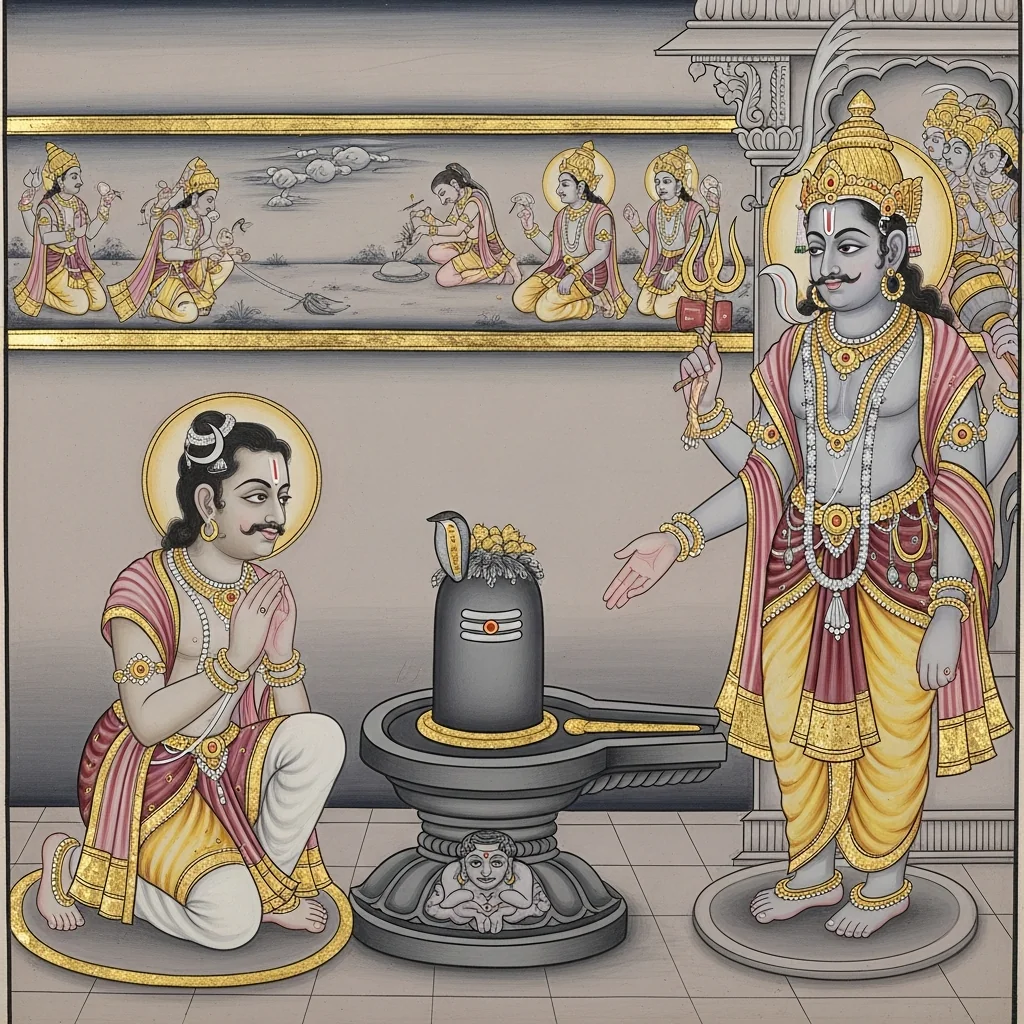
The chapter begins with Lomasha portraying an archetypal sinner—a thief burdened with grave faults—who tries to steal a temple bell. That very attempt becomes the occasion for Śiva’s startling praise: Śiva declares him foremost among devotees and dear to Him. Śiva’s gaṇas, led by figures such as Vīrabhadra, carry the thief to Kailāsa and transform him into a divine attendant. The teaching then broadens: devotion to Śiva, especially worship of the liṅga, surpasses mere dialectical disputation, and even animals are said to gain worth through proximity to such worship. The chapter affirms Śiva–Viṣṇu identity and interprets the liṅga with its pīṭhikā as a symbolic unity—liṅga as Maheśvara, pīṭhikā as Viṣṇu-form—thereby proclaiming liṅgārcana as superior. A long exemplum lists cosmic beings (lokapālas, devas, daityas, rākṣasas) as liṅga worshippers, culminating in Rāvaṇa’s extreme tapas: he repeatedly offers his own heads in worship and receives boons and knowledge from Śiva. When the devas cannot defeat Rāvaṇa, Nandin directs them to Viṣṇu; Viṣṇu outlines an avatāra strategy culminating in Rāma and allied incarnations (including Hanumān as an ekādaśa-rudra manifestation). The chapter closes with a soteriological frame: sacrificial merit is finite, whereas liṅga devotion leads toward māyā-dissolution, guṇa-transcendence, and liberation, and it transitions to the next topic—Śiva’s consumption of poison (garabhakṣaṇa)—to be explained later.
Shlokas
Verse 1
। लोमश उवाच । तस्करोऽपि पुरा ब्रह्मन्सर्वधर्मबाहिष्कृतः । ब्रह्मघ्नोऽसौ सुरापश्च सुवर्णस्य च तस्करः
Lomaśa said: “O Brāhmaṇa, long ago there was a thief, cast out from all dharma. He was a slayer of a brāhmaṇa, a drunkard, and a stealer of gold as well.”
Verse 2
लंपटोहि महापाप उत्तमस्त्रीषु सर्वदा । द्यूतकारी सदा मंदः कितवैः सह संगतः
He was indeed lustful and greatly sinful, always pursuing other men’s noble women. Ever a gambler and dull-witted, he kept company with cheats.
Verse 3
एकदा क्रीडता तेन हारितं द्यूतमद्भुतम् । कितवैर्मर्द्यमानो हि तदा नोवाच किञ्चन
Once, while he was playing, he lost grievously in a wondrous game of dice. Though beaten by the gamblers, he spoke not a word at that time.
Verse 4
पीडितोऽप्यभवत्तूष्णीं तैरुक्तः पापकृत्तमः । द्यूते त्वया च तद्द्रव्यं हारितं किं प्रयच्छसि
Though tormented, he remained silent. Then those men said to that worst of sinners: “In gambling you have lost that property—so what will you pay?”
Verse 5
नो वा तत्कथ्यतां शीघ्रं याथातथ्येन दुर्मते । यद्धारितं प्रयच्छामि रात्रावित्यब्रवीच्च सः
“If not, then tell it quickly and truthfully, you fool!” He replied, “What I have lost, I will repay at night.”
Verse 6
तैर्मुक्तस्तेन वाक्येन गतास्ते कितवादयः । तदा निशीथसमये गतोऽसौ शिवमंदिरम्
Released by them on the strength of those words, the gamblers and the rest went away. Then, at the dead of night, he went to Śiva’s temple.
Verse 7
शिरोधिरुह्य शम्भोश्च घण्टामादातुमुद्यतः । तावत्कैलासशिखरे शंभुः प्रोवाच किंकरान्
Having climbed onto Śambhu’s (liṅga) head and intent on taking the bell, at that very moment, on the peak of Kailāsa, Śambhu spoke to His attendants.
Verse 8
अनेन यत्कृतं चाद्य सर्वेषामधिकं भुवि । सर्वेषामेव भक्तानां वरिष्ठोऽयं च मत्प्रियः
What this one has done today surpasses all others on earth. Truly, among all devotees, this one is the foremost and dear to Me.
Verse 9
इति प्रोक्त्वान यामास वीरभद्रादिभिर्गणैः । ते सर्वे त्वरिता जग्मुः कैलासाच्छिववल्लभात्
Having spoken thus, Śiva dispatched the gaṇas led by Vīrabhadra. All of them swiftly set out from Kailāsa, Śiva’s beloved abode.
Verse 10
सर्वैर्डमरुनादेन नादितं भुवनत्रयम् । तान्दृष्ट्वा सहसोत्तीर्य तस्करोसौ दुरात्मवान् । लिंगस्य मस्तकात्सद्यः पलायनपरोऽभवत्
With the sound of their ḍamarus, the three worlds resounded. Seeing them, that wicked thief at once leapt down from the liṅga’s head and became wholly intent on fleeing.
Verse 11
पलायमानं तं दृष्ट्वा वीरभद्रः समाह्वयत्
Seeing him fleeing, Vīrabhadra called out to him.
Verse 12
कस्माद्विभेपि रे मन्द देवदेवो महेस्वरः । प्रसन्नस्तव जातोद्य उदारचरितो ह्यसौ
“Why are you afraid, you foolish one? Maheśvara, the God of gods, has become pleased with you today—for He is truly noble in conduct.”
Verse 13
इत्युक्त्वा तं विमाने च कृत्वा कैलासमाययौ । पार्षदो हि कृतस्तेन तस्करो हि महात्मना
Having spoken thus, He placed him in a celestial car (vimāna) and returned to Kailāsa. That thief was indeed made a pārṣada, an intimate attendant, by the great-souled Lord Śiva.
Verse 14
तस्माद्भाव्या शिवे भक्तिः सर्वेषामपि देहिनाम् । पशवोऽपि हि पूज्याः स्युः किं पुनर्मानवाभुवि
Therefore, devotion (bhakti) to Śiva should be cultivated by all embodied beings. If even animals, through their connection with Śiva, become worthy of reverence, how much more so human beings upon the earth!
Verse 15
ये तार्किकास्तर्कपरास्तथ मीमांसकाश्च ये । अन्योन्यवादिनश्चान्ये चान्ये वात्मवितर्ककाः
Those who are logicians devoted to disputation, and those who are Mīmāṃsakas; others who argue against one another, and still others who indulge in self-speculation—
Verse 16
एकवाक्यं न कुर्वंति शिवार्चनबहिष्कृताः । तर्को हि क्रियते यैश्च तेसर्वे किं शिवं विना
Those who exclude the worship of Śiva do not arrive at a single, harmonious conclusion. Those who pursue mere disputation—what are all of them without Śiva?
Verse 17
तथा किं बहुनोक्तेन सर्वेऽपि स्थिरजंगमाः । प्राणिनोऽपि हि जायंते केवलं लिंगधारिणः
And what is the use of saying much more? All beings—immovable and moving, indeed every living creature—are born only as bearers of the liṅga, the mark of generative identity.
Verse 18
पिण्डीयुक्तं यता लिंगं स्थापितं च यथाऽभवत् । तथा नरा लिंगयुक्ताः पिण्डीभूतास्तता स्त्रियः
Just as the liṅga was established together with its base (piṇḍī/pīṭhikā), so too men are endowed with the liṅga, and women, correspondingly, are endowed with the piṇḍī—the supporting base.
Verse 19
शिवशक्तियुतं सर्वं जगदेतच्चराचरम् । तं शिवं मौढ्यतस्त्यक्त्वा मूढाश्चान्यं भजंति ये
This entire universe—moving and unmoving—is pervaded by Śiva together with Śakti. Those who, out of delusion, abandon that Śiva and worship another are truly misguided.
Verse 20
धर्ममात्यंतिकं तुच्छं नश्वरं क्षणभंगुरम् । यो विष्णुः स शिवो ज्ञेयो यः शिवो विष्णुरेव सः
Worldly religiosity that is ‘ultimate’ only in name is petty, perishable, and momentary. Know that the one who is Viṣṇu is Śiva, and the one who is Śiva is indeed Viṣṇu.
Verse 21
पीठिका विष्णुरूपं स्याल्लिंगरूपी महेश्वरः । तस्माल्लिंगार्चनं श्रेष्ठं सर्वेषामपि वै द्विजाः
The pedestal (pīṭhikā) is of the form of Viṣṇu, and Maheśvara is of the form of the liṅga. Therefore, worship of the liṅga is the best for all—indeed, O twice-born.
Verse 22
ब्रह्मा मणिमयं लिंगं पूजयत्यनिशं शुभम् । इन्द्रो रत्नमयं लिंगं चन्द्रो मुक्तामयं तथा
Brahmā continually worships an auspicious liṅga made of gems; Indra worships a jewel-made liṅga; and Candra likewise worships a pearl-made liṅga.
Verse 23
भानुस्ताम्रमयं लिंगं पूजयत्यनिशं शुभम् । रौक्मं लिंगं कुबेरश्च पाशी चारक्तमेव च
Bhānu (the Sun) continually worships an auspicious copper liṅga. Kubera worships a golden liṅga, and Pāśī (Varuṇa) also worships a red-hued liṅga.
Verse 24
यमो नीलमयं लिंगं राजतं नैरृतस्तथा । काश्मीरं पवनो लिंगमर्चयत्यनिशं विभोः
Yama worships a blue liṅga; Nairṛta likewise worships a silver liṅga. And Pavana (the Wind) continually adores the Lord’s liṅga, saffron-tinted in the kāśmīra hue.
Verse 25
एवं ते लिंगिताः सर्वे लोकपालाः सवासवाः । तथा सर्वेऽपि पाताले गंधर्वाः किंनरैः सह
Thus all the guardians of the worlds, together with the Vasus, are marked by devotion to the liṅga; and likewise, in Pātāla, all the Gandharvas along with the Kinnaras are devoted in the same way.
Verse 26
दैत्यानां वैष्णवाः केचित्प्रह्लादप्रमुखा द्विजाः । तथाहि राक्षसानां च विभीषणपुरोगमाः
Among the Daityas, some are Vaiṣṇavas, devoted to Viṣṇu—chief among them Prahlāda, O twice-born. Likewise, among the Rākṣasas too, there are devotees led by Vibhīṣaṇa.
Verse 27
बलिश्च नमुचिश्चैव हिरण्यकशिपुस्तथा । वृषपर्वा वृषश्चैव संह्रादो बाण एव च
Bali and Namuci, as well as Hiraṇyakaśipu; Vṛṣaparvā and Vṛṣ too; Saṃhrāda and Bāṇa likewise—these are the famed beings spoken of here.
Verse 28
एते चान्ये च बहवः शिष्याः शुक्रस्य धीमतः । एवं शिवार्चनरताः सर्वे ते दैत्यदानवाः
These—and many others besides—were disciples of the wise Śukra. Thus, all those Daityas and Dānavas were ever intent on the worship of Śiva.
Verse 29
राक्षसा एव ते सर्वे शिवपूजान्विताः सदा । हेतिः प्रहेतिः संयातिर्विघसः प्रघसस्तथा
Indeed, all of them were Rākṣasas, always engaged in the worship of Śiva—Heti, Praheti, Saṃyāti, Vighasa, and likewise Praghasa.
Verse 30
विद्युज्जिह्वस्तीक्ष्णदंष्ट्रो धूम्राक्षो भीमविक्रमः । माली चैव सुमाली च माल्यवानतिभीषमः
Vidyujjihva, Tīkṣṇadaṃṣṭra, Dhūmrākṣa of dreadful might; and Mālī, Sumālī, and Mālyavān—exceedingly fearsome (were they).
Verse 31
विद्युत्कैशस्तडिज्जिह्वो रावणश्च महाबलः । कुंभकर्णो दुराधर्षो वेगदर्शी प्रतापवान्
Vidyutkaiśa, Taḍijjihva, and Rāvaṇa of great strength; and Kumbhakarṇa, hard to overpower; Vegadarśī, possessed of splendor and prowess.
Verse 32
एते हि राक्षसाः श्रेष्ठा शिवार्चनरताः सदा । लिंगमभ्यर्च्य च सदा सिद्धिं प्राप्ताः पुरा तु ते
For these were the foremost among the Rākṣasas, ever devoted to the worship of Śiva. Having continually adored the Liṅga, they attained spiritual accomplishment in former times.
Verse 33
रावणेन तपस्तप्तं सर्वेषामपि दुःखहम् । तपोधिपो महादेवस्तुतोष च तदा भृशम्
The austerity performed by Rāvaṇa brought anguish to all. Yet Mahādeva, lord of ascetic power, was then greatly pleased.
Verse 34
वरान्प्रायच्छत तदा सर्वेषामपि दुर्लभान् । ज्ञानं विज्ञानसहितं लब्धं तेन सदाशिवात्
Then (Mahādeva) granted boons that are difficult for anyone to obtain. From Sadāśiva, Rāvaṇa received knowledge together with realized, applied wisdom.
Verse 35
अजेयत्वं च संग्रामे द्वैगुण्यं शिरसामपि । पंचवक्त्रो महा देवो दशवक्त्रोऽथ रावणः
And (he obtained) invincibility in battle, and even a doubling of heads. Mahādeva is five-faced; and then Rāvaṇa became ten-faced.
Verse 36
देवानृषीन्पितॄंश्चैव निर्जित्य तपसा विभुः । महेशस्य प्रसादाच्च सर्वेषामधिकोऽभवत्
By the force of austerity, that mighty one overcame even the Devas, the Ṛṣis, and the Pitṛs. Through the grace of Maheśa, he became superior to all.
Verse 37
राजा त्रिकूटाधिपतिर्महेशेन कृतो महान् । सर्वेषां राक्षसानां च परमासनमास्तितः
That king—the lord of Trikūṭa—was made exceedingly great by Maheśa, and he occupied the supreme throne among all the Rākṣasas.
Verse 38
तपस्विनां परीक्षायै यदृषीणां विहिंसनम् । कृतं तेन तदा विप्रा रावणेन तपस्विना
O brāhmaṇas, whatever harm he then inflicted upon the ṛṣis was done by the ascetic Rāvaṇa as a “test” of the austerity of holy men.
Verse 39
अजेयो हि महाञ्जातो रावणो लोकरावणः । सृष्ट्यंतरं कृतं येन प्रसादाच्छंकरस्य च
Indeed, Rāvaṇa—“the terror of the worlds”—was born mighty and unconquerable; by Śaṅkara’s favor he even brought about an alteration in the established order of the world.
Verse 40
लोकपाला जितास्तेन प्रतापेन तपस्विना । ब्रह्मापि विजितो येन तपसा परमेण हि
By that ascetic’s splendor and might, the guardians of the worlds were conquered; indeed, even Brahmā was overcome by his supreme austerity.
Verse 41
अमृतांशुकरो भूत्वा जितो येन शशी द्विजाः । दाहकत्वाज्जितो वह्निरीशः कैलासतोलनात्
O twice-born ones, by him even the Moon—become the maker of nectar-like rays—was subdued; Fire was subdued in its power to burn; and the Lord was challenged by the lifting of Kailāsa.
Verse 42
ऐश्वर्येण जितश्चेन्द्रो विष्णुः सर्वगतस्तथा । लिंगार्चनप्रसादेन त्रैलोक्यं च वशीकृतम्
By sheer sovereignty Indra was overcome, and likewise Viṣṇu the all-pervading; and by the grace gained from worship of the Liṅga, the three worlds were brought under control.
Verse 43
तदा सर्वे सुरगणा ब्रह्मविष्णुपुरोगमाः । मेरुपृष्ठं समासाद्य सुमंत्रं चक्रिरे तदा
Then all the hosts of the gods, led by Brahmā and Viṣṇu, reached the summit-back of Mount Meru and there performed a sacred and auspicious rite of mantra.
Verse 44
पीडिताः स्मो रावणेन तपसा दुष्करेण वै । गोकर्णाख्ये गिरौ देवाः श्रूयतां परमाद्भुतम्
“We are afflicted by Rāvaṇa through his truly difficult austerity. O gods, on the mountain called Gokarṇa—listen to what is supremely wondrous.”
Verse 45
साक्षाल्लिंगार्चनं येन कृतमस्ति महात्मना । ज्ञानज्ञेयं ज्ञानगम्यं यद्यत्परममद्भुतम् । तत्कृतं रावणेनैव सर्वेषां दुरतिक्रमम्
That great-souled one performed direct worship of the Liṅga itself. Whatever is knowledge, whatever is to be known, whatever is reached through knowledge—whatever is supremely wondrous—Rāvaṇa alone accomplished it, beyond the reach of all others.
Verse 46
वैराग्यं परमास्थाय औदार्यं च ततोऽधिकम् । तेनैव ममता त्यक्ता रावणेन महात्मना
Establishing himself in supreme dispassion, and in generosity even beyond that, that great-souled Rāvaṇa abandoned possessiveness, the sense of “mine.”
Verse 47
संवत्सरसहस्राच्च स्वशिरो हि महाभुजः । कृत्त्वा करेण लिंगस्य पूजनार्थं समर्पयत्
After a thousand years, that mighty-armed one cut off his own head with his hand and offered it as an oblation for the worship of the Liṅga.
Verse 48
रावणस्य कबंधं च तदग्रे च समीपतः । योगधारणया युक्तं परमेण समाधिना
And there, near the front, stood Rāvaṇa’s headless trunk—steadfast, upheld by yogic concentration and absorbed in the highest samādhi.
Verse 49
लिंगे लयं समाधाय कयापि कलया स्थितम् । अन्यच्छिरोविवृश्च्यैवं तेनापि शिवपूजनम् । कृतं नैवान्यमुनिना तथा चैवापरेणहि
Having merged his awareness into the Liṅga, he remained established there by a certain power. Then, in the same manner, cutting off yet another head, he again performed Śiva’s worship—an act done by no other sage, nor by anyone at all.
Verse 50
एवं शिरांस्येव बहूनि तेन समर्पितान्येव शिवार्चनार्थे । भूत्वा कबंधो हि पुनः पुनश्च शिवोऽसौ वरदो बभूव
Thus he offered many heads for the sake of Śiva’s worship; and though becoming headless again and again, that Śiva became the giver of boons to him.
Verse 51
मया विनासुरस्तत्र पिंडीभूतेन वै पुरा । वरान्वरय पौलस्त्य यथेष्टं तान्ददाम्यहम्
Formerly, in that place, when I was manifested in condensed form, no asura could stand before me. Choose your boons, O Paulastya; as you desire, I shall grant them.
Verse 52
रावणेन तदा चोक्तः शिवः परममंगलः । यदि प्रसन्नो भगवन्देयो मे वर उत्तमः
Then Rāvaṇa spoke to Śiva, the supremely auspicious: “If you are pleased, O Lord, grant me the highest boon.”
Verse 53
न कामयेऽन्यं च वरमाश्रये त्वत्पदांबुजम् । यथा तथा प्रदातव्यं यद्यस्ति च कृपा मयि
I desire no other boon; I take refuge in your lotus-feet. In whatever way you deem fit, grant your gift, if indeed you have compassion toward me.
Verse 54
तदा सदाशिवेनोक्तो रावणो लोकरावणः । मत्प्रसादाच्च सर्वं त्वं प्राप्स्यसे मनसेप्सितम्
Then Sadāśiva said to Rāvaṇa, the terror of the worlds: “By my grace, you shall obtain everything your mind desires.”
Verse 55
एवं प्राप्तं शिवात्सर्वं रावणेन सुरेश्वराः । तस्मात्सर्वैर्भवद्भिश्च तपसा परमेण हि
Thus, O lords of the gods, Rāvaṇa obtained everything from Śiva. Therefore, all of you too must indeed undertake supreme austerity (tapas).
Verse 56
विजेतव्यो रावणोयमिति मे मनसि स्थितम् । ्च्युतस्य वचः श्रुत्वा ब्रह्माद्या देवतागणाः
“This Rāvaṇa must be conquered”—so it became settled in my mind. Hearing the words of Cyuta, Brahmā and the hosts of gods gathered to take counsel.
Verse 57
चिंतामापेदिरे सर्वे चिरं ते विषयान्विताः । ब्रह्मापि चेंद्रियग्रस्तः सुता रमितुमुद्यतः
Long bound to the objects of the senses, all of them fell into prolonged anxiety; even Brahmā—overpowered by the senses—became intent on amorous sport with his own daughter.
Verse 58
इंद्रो हि जारभावाच्च चंद्रो हि गुरुतल्पगः । यमः कदर्यभावाच्च चंचलत्वात्सदागतिः
Indra, by the mind of a seducer; the Moon, as one who violated the teacher’s bed; Yama, by miserly nature—thus, through fickleness, they are ever prone to downfall.
Verse 59
पावकः सर्वभक्षित्वात्तथान्ये देवतागणाः । अशक्ता रावणं जेतुं तपसा च विजृंभितम्
Pāvaka (Fire), because he consumes everything, and likewise the other hosts of gods, were unable to conquer Rāvaṇa, who had grown mighty and expansive through austerity.
Verse 60
शैलादो हि महातेजा गणश्रेष्ठः पुरातनः । बुद्धि मान्नीतिनिपुणो महाबलपराक्रमी
Śailāda was of great splendor—ancient, the foremost among the gaṇas—intelligent, skilled in policy, and possessed of immense strength and valor.
Verse 61
शिवप्रियो रुद्ररूपी महात्मा ह्युवाच सर्वानथ चेंद्रमुख्यान् । कस्माद्यूयं संभ्रमादागताश्च एतत्सर्वं कथ्यतां विस्तरेण
That great soul—dear to Śiva and bearing Rudra’s form—then addressed them all, especially Indra and the rest: “Why have you come in such haste and agitation? Tell me everything in detail.”
Verse 62
नंदिना च तदा सर्वे पृष्टाः प्रोचुस्त्वरान्विताः
Then, questioned by Nandī, they all replied at once, filled with urgency.
Verse 63
देवा ऊचुः । रावणेन वयं सर्वे निर्जिता मुनिभिः सह । प्रसादयितुमायाताः शिवं लोकेश्वरेश्वरम्
The gods said: “All of us, together with the sages, have been defeated by Rāvaṇa. We have come to seek the grace of Śiva, the Lord of the lords of the worlds.”
Verse 64
प्रहस्य भगवान्नंदी ब्रह्माणं वै ह्युवाच ह । क्व यूयं क्व शिवः शंभुस्तपसा परमेण हि । द्रष्टव्यो हृदि मध्यस्थः सोऽद्य द्रष्टुं न पार्यते
Smiling, the blessed Nandī said to Brahmā: “What are you—and what is Śiva, Śambhu! He is beheld only through supreme austerity, abiding in the very center of the heart; yet today you are unable to see Him.”
Verse 65
यावद्भावा ह्यनेकाश्च इंद्रियार्थास्तथैव च । यावच्च ममताभावस्तावदीशो हि दुर्लभः
So long as the mind runs in many directions, so long as the objects of the senses remain, and so long as the feeling of “mine” persists—so long is the Lord truly difficult to attain.
Verse 66
जितेंद्रियाणां शांतानां तन्निष्ठानां महात्मनाम् । सुलभो लिंगरूपी स्याद्भवतां हि सुदुर्लभः
For great souls who have conquered the senses, who are tranquil and steadfast in That, the Lord—manifest as the Liṅga—is easily attained; but for you, He is indeed very difficult to obtain.
Verse 67
तदा ब्रह्मादयो देवा ऋषयश्च विपश्चितः । प्रणम्य नंदिनं प्राहुः कस्मात्त्वं वानराननः । तत्सर्वं कथयान्यं च रावणस्य तपोबलम्
Then Brahmā and the other gods, along with the wise seers, bowed to Nandin and said: “Why do you bear a monkey-like face? Tell us all of that—and also relate the power of Rāvaṇa’s austerities.”
Verse 68
नंदीश्वर उवाच । कुबेरोऽधिकृतस्तेन शंकरेण महात्मना । धनानामादिपत्ये च तं द्रष्टुं रावणोऽत्र वै
Nandīśvara said: “The great-souled Śaṅkara appointed Kubera to the lordship over wealth. And here indeed, Rāvaṇa came to see him.”
Verse 69
आगच्छत्त्वरया युक्तः समारुह्य स्ववाहनम् । मां दृष्ट्वा चाब्रवीत्क्रुद्धः कुबेरो ह्यत्र आगतः
Hurrying, he came mounted on his own vehicle. On seeing me, he spoke in anger: “Kubera has come here!”
Verse 70
त्वया दृष्टोऽथ वात्रासौ कथ्यतामविलंबितम् । किं कार्यं धनदेनाद्य इति पृष्टो मया हि सः
“Have you seen him here or not? Tell me at once, without delay.” Thus he spoke; and I asked him: “What business do you have today with Dhanada (Kubera)?”
Verse 71
तदोवाच महातेजा रावणो लोकरावणः । मय्यश्रद्धान्वितो भूत्वा विषयात्मा सुदुर्मदः
Then the mighty Rāvaṇa—terrifier of the worlds—spoke, having become faithless toward me, driven by sensuality and fiercely arrogant.
Verse 72
शिक्षापयितुमारब्धो मैवं कार्यमिति प्रभो । यथाहं च श्रिया युक्त आढ्योऽहं बलवानहम् । तथा त्वं भव रे मूढ मा मूढत्वमुपार्जय
Beginning to ‘instruct’ me, he said, “O lord, do not act like this. As I am endowed with fortune—rich and strong—so should you be, you fool. Do not heap up foolishness!”
Verse 73
अहं मूढः कृतस्तेन कुबेरेण महात्मना । मया निराकृतो रोषात्तपस्तेपे स गुह्यकः
I was made a fool by that great-souled Kubera. Rejected by me in anger, that lord of the Guhyakas undertook austerities.
Verse 74
कुबेरः स हि नंदिन्किमागतस्तव मंदिरम् । दीयतां च कुबेरोद्य नात्र कार्या विचारणा
Nandin, why has that Kubera come to your abode? Hand him over today—there is no need for deliberation here.
Verse 75
रावणस्य वचः श्रुत्वा ह्यवोचं त्वरितोऽप्यहम् । लिंगकोसि महाभाग त्वमहं च तथाविधः
Hearing Rāvaṇa’s words, I replied at once: “O fortunate one, you are a ‘liṅgaka’, and I too am of the same kind.”
Verse 76
उभयोः समनां ज्ञात्वा वृथा जल्पसि दुर्मते । यथोक्तः स त्ववादीन्मां वदनार्थे बलोद्धतः
Knowing us both to be equal, you speak in vain, you wicked-minded one.” Thus addressed, that one—puffed up with strength—spoke to me, intent on mere argument.
Verse 77
यथा भवद्भिः पृष्टोऽहं वदनार्थे महात्मभिः । पुरावृत्तं मया प्रोक्तं शिवार्चनविधेः फलम् । शिवेन दत्तं सालूप्यं न गृहीतं मया तदा
As you great-souled ones have asked me to speak, I have related an ancient account—the fruit of the proper method of worship of Śiva. Though Śiva granted me sālūpya (sharing His divine form and proximity), I did not accept it at that time.
Verse 78
याचितं च मया शंभोर्वदनं वानरस्य च । शिवेन कृपया दत्तं मम कारुण्यशालिना
I entreated Śambhu for a monkey’s face; and Śiva, overflowing with mercy, granted it to me out of compassion.
Verse 79
निराभिमानिनो ये च निर्दभा निष्परिग्रहाः । शंभोः प्रियास्ते विज्ञेया ह्यन्ये शिववबहिष्कृताः
Those free from pride, free from deceit, and without possessiveness—know them to be dear to Śambhu; all others are cast out from Śiva’s favor.
Verse 80
तथावदन्मया सार्द्धं रावणस्तपसो बलात् । मया च याचितान्येव दश वक्त्राणि धीमता
As I spoke thus, Rāvaṇa, by the power of his austerities, appeared; and that wise one asked of me ten faces.
Verse 81
उपहासकरं वाक्यं पौलस्त्यस्य तदा सुराः । मया तदा हि शप्तोऽसौ रावणो लोकरावणः
O gods, because of a mocking word spoken then by that Paulastya (Rāvaṇa), I cursed him at that very time—Rāvaṇa, the tormentor of the worlds.
Verse 82
ईदृशान्येव वक्त्राणि येषां वै संभवंति हि । तैः समेतो यदा कोऽपि नरवर्यो महातपाः । मां पुरस्कृत्य सहसा हनिष्यति न संशयः
“Whoever comes to possess such faces—when some foremost man, a great ascetic, confronts him, placing me in front, he will swiftly slay him; of this there is no doubt.”
Verse 83
एवं शप्तो मया ब्रह्मन्रावणो लोकरावणः । अर्चितं केवलं लिंगं विना तेन महात्मना
Thus, O Brahman, Rāvaṇa—the afflicter of the worlds—was cursed by me. Yet that great one worshipped only the liṅga, without the pīṭhikā, the proper base that should accompany it.
Verse 84
पीठिकारूपसंस्थेन विना तेन सुरोत्तमाः । विष्णुना हि महाभागास्तस्मात्सर्वं विधास्यति
O best of gods, since that worship was performed without establishing the liṅga upon the pīṭhikā-form, therefore Viṣṇu—O fortunate ones—will set everything in proper order.
Verse 85
देवदेवो महादेवो विष्णुरूपी महेश्वरः । सर्वे यूयं प्रार्थयंतु विष्णुं सर्वगुहाशयम्
Mahādeva, the God of gods—Maheśvara appearing in the form of Viṣṇu—may all of you pray to Viṣṇu, the indweller of every hidden recess, of every heart.
Verse 86
अहं हि सर्वदेवानां पुरोवर्ती भवाम्यतः । ते सर्वे नंदिनो वाक्यं श्रुत्वा मुदितमानसाः । वैकुंठमागता गीर्भिर्विष्णुं स्तोतुं प्रचक्रिरे
“Therefore I shall go before all the gods.” Hearing Nandin’s words, all of them, their minds delighted, went to Vaikuṇṭha and began to hymn Viṣṇu with sacred utterances.
Verse 87
देवा ऊचुः । नमो भगवते तुभ्यं देवदेव जगत्पते । त्वदाधारमिदं सर्वं जगदेतच्चराचरम्
The Devas said: “Salutations to You, O Blessed Lord—God of gods, Lord of the universe. This entire world, moving and unmoving, rests upon You as its support.”
Verse 88
एतल्लिंगं त्वया विष्णो धृतं वै पिण्डिरूपिणा । महाविष्णुस्वरूपेण घातितौ मधुकैटभौ
O Viṣṇu, this Liṅga was indeed borne by you in a compact, embodied form; and in your form as Mahāviṣṇu you slew Madhu and Kaiṭabha.
Verse 89
तथा कमठरूपेण धृतो वै मंदराचलः । वराहरूपमास्थाय हिरण्याक्षो हतस्त्वया
Likewise, in the form of the Tortoise you bore Mount Mandara; and assuming the form of the Boar you slew Hiraṇyākṣa.
Verse 90
हिरण्यकशिपुर्दैत्यो हतो नृहरिरूपिणा । त्वया चैव बलिर्बद्धो दैत्यो वामनरूपिणा
The demon Hiraṇyakaśipu was slain by you in the Man-Lion form; and Bali, the daitya, was bound by you in the Dwarf (Vāmana) form.
Verse 91
भृगूणामन्वये भूत्वा कृतवीर्यात्मजो हतः । इतोप्यस्मान्महाविष्णो तथैव परिपालय
Born in the lineage of Bhṛgu, you slew the son of Kṛtavīrya (Kārtavīryārjuna). Even now, O Mahāviṣṇu, protect us in the same way.
Verse 92
रावमस्य भयादस्मात्त्रातुं भूयोर्हसि त्वरम्
From the fear of this Rāvaṇa, you should once again swiftly deliver us.
Verse 93
एवं संप्रार्थितो देवैर्भगवान्भूतभावनः । उवाच च सुरान्सर्वान्वासुदेवो जगन्मयः
Thus entreated by the Devas, the Blessed Lord—nurturer of all beings—Vāsudeva, who pervades the universe, spoke to all the gods.
Verse 94
हे देवाः श्रूयतां वाक्यं प्रस्तावसदृशं महत् । शैलादिं च पुरस्कृत्य सर्वे यूयं त्वरान्विताः । अवतारान्प्रकुर्वन्तु वानरीं तनुमाश्रिताः
“O Devas, hear a great instruction fitting the occasion. Taking Śaila and the others as leaders, all of you—acting with urgency—should manifest incarnations, assuming bodies of the monkey-kind.”
Verse 95
अहं हि मानुषो भूत्वा ह्यज्ञानेन समावृतः । संभविष्याम्ययोध्यायं गृहे दशरथस्य च । ब्रह्मविद्यासहायोस्मि भवतां कार्यसिद्धये
“I, becoming human and veiled by ignorance (as part of the divine play), shall be born in Ayodhyā, in the house of Daśaratha. Together with Brahmavidyā as my aid, I shall bring about the accomplishment of your purpose.”
Verse 96
जनकस्य गृहे साक्षाद्ब्रह्मविद्या जनिष्यति । भक्तो हि रावणः साक्षाच्छिवध्यानपरायणः
“In the house of Janaka, Brahmavidyā herself will be born manifest. For Rāvaṇa is indeed a devotee—openly devoted to meditation upon Śiva.”
Verse 97
तपसा महता युक्तो ब्रह्मविद्यां यदेच्छति । तदा सुसाध्यो भवति पुरुषो धर्मनिर्जितः
When a person, endowed with great austerity, longs for the knowledge of Brahman, then that person becomes truly capable of attainment—one who is mastered and guided by Dharma.
Verse 98
एवं संभाष्य भगवान्विष्णुः परममङ्गलः । वाली चेन्द्रांशसंभूतः सुग्रीवों शुमतः सुतः
Thus having spoken, the Blessed Viṣṇu—supremely auspicious—ordained that Vālī was born from a portion of the Moon, and Sugrīva as the son of Śumata.
Verse 99
तथा ब्रह्मांशसंभूतो जाम्बवान्नृक्षकुञ्जरः । शिलादतनयो नंदी शिवस्यानुचरः प्रियः
Likewise Jāmbavān, the mighty lord among bears, was born from a portion of Brahmā; and Nandī, the son of Śilādata, the beloved attendant of Śiva, also manifested.
Verse 100
यो वै चैकादशो रुद्रो हनूमान्स महाकपिः । अवतीर्णः सहायार्थं विष्णोरमिततेजसः
That great monkey Hanūmān is indeed the eleventh Rudra; he descended to earth for the sake of assisting Viṣṇu of immeasurable splendor.
Verse 101
मैंदादयोऽथ कपयस्ते सर्वे सुरसत्तमाः । एवं सर्वे सुरगणा अवतेरुर्यथा तथम्
So too Mainda and the other monkeys—all of them the best among the gods—thus the hosts of divine beings descended, each in the manner destined for them.
Verse 102
तथैव विष्णुरुत्पन्नः कौशल्यानंदवर्द्धनः । विश्वस्य रमणाच्चैव राम इत्युच्यते बुधैः
In the same way Viṣṇu was born as the increaser of Kauśalyā’s joy; and because he delights the whole world, the wise call him ‘Rāma.’
Verse 103
शेषोपि भक्त्या विष्णोश्च तपसाऽवातरद्भुवि
Śeṣa too, through devotion to Viṣṇu and by austerity, descended upon the earth.
Verse 104
दोर्दण्डावपि विष्णोश्च अवतीर्णौ प्रतापिनौ । शत्रुघ्नभरताख्यौ च विख्यातौ भुवनत्रये
And the two mighty arms of Viṣṇu also descended—powerful and renowned in the three worlds—as Bharata and Śatrughna.
Verse 105
मिथिलाधिपतेः कन्या या उक्ता ब्रह्मवादिभिः । सा ब्रह्मविद्यावतरत्सुराणां कार्य्यसिद्धये । सीता जाता लांगलस्य इयं भूमिविकर्षणात्
The daughter of the ruler of Mithilā—so declared by the knowers of Brahman—was an incarnation of Brahman-knowledge, descending to accomplish the gods’ purpose. She was born as Sītā, brought forth by the plough when the earth was furrowed.
Verse 106
तस्मात्सीतेति विख्याता विद्या सान्वीक्षिकी तदा । मिथिलायां समुत्पन्ना मैथितीत्यभिधीयते
Therefore that inquiry-based wisdom (ānvīkṣikī) became famed as ‘Sītā’; and since it arose in Mithilā, it is also called ‘Maithitī.’
Verse 107
जनकस्य कुले जाता विश्रुता जनकात्मजा । ख्याता वेदवती पूर्वं ब्रह्मविद्याघनाशिनी
In King Janaka’s lineage was born the famed daughter of Janaka. Formerly she was renowned as Vedavatī, the one who destroys the dense darkness of ignorance through the wisdom of Brahman.
Verse 108
सा दत्ता जनकेनैव विष्णवे परमात्मने
She was indeed given by Janaka to Viṣṇu, the Supreme Self (Paramātman).
Verse 109
तयाथ विद्यया सार्द्धं देवदेवो जगत्पतिः । उग्रे तपसि लीनोऽसौ विष्णुः परमदुष्करम्
Then, together with her and with that sacred knowledge, Viṣṇu—the Lord of gods, the Master of the world—became absorbed in fierce austerity, exceedingly hard to perform.
Verse 110
रावणं जेतुकामो वै रामो राजीवलोचनः । अरण्यवासमकरोद्देवानां कार्यसिद्धये
Wishing to conquer Rāvaṇa, Rāma of lotus-like eyes undertook forest-dwelling, to accomplish the gods’ purpose.
Verse 111
शेषावतारोऽपि महांस्तपः परमदुष्करम् । तताप परया शक्त्या देवानां कार्यसिद्धये
Even the great incarnation of Śeṣa performed exceedingly difficult austerity, with supreme power, for the fulfillment of the gods’ work.
Verse 112
शत्रुघ्नो भरतश्चैव तेपतुः परमं तपः
Śatrughna and Bharata too performed supreme austerity.
Verse 113
ततोऽसौ तपसा युक्तः सार्द्धं तैर्देवतागणैः । सगणं रावणं रामः षड्भिर्मासैरजीहनत् । विष्णुना घातितः शस्त्रैः शिवसारूप्यमाप्तवान्
Then, strengthened by austerity and accompanied by those hosts of deities, Rāma slew Rāvaṇa together with his forces within six months. Struck down by Viṣṇu’s weapons, he attained likeness to Śiva (Śiva-sārūpya).
Verse 114
सगमः स पुनः सद्यो बंधुभिः सह सुव्रताः
He went again at once, together with his kinsmen—those of good vows and disciplined conduct.
Verse 115
शिवप्रसादात्सकलं द्वैताद्वैतमवाप ह । द्वैताद्वैतविवेकार्थमृपयोप्यत्र मोहिताः । तत्सर्वं प्राप्नुवंतीह शिवार्चनरता नराः
By Śiva’s grace, one attains the complete vision of duality and non-duality. For discerning duality and non-duality, even sages are here bewildered. Yet all of that is attained here by people devoted to the worship of Śiva.
Verse 116
येऽर्चयंति शिवं नित्यं लिंगरूपिणमेव च । स्त्रियो वाप्यथ वा शूद्राः श्वपचा ह्यंत्यवासिनः । तं शिवं प्राप्नुवंत्येव सर्वदुःखोपनाशनम्
Those who worship Śiva daily—Śiva who is present in the form of the Liṅga—whether women, or Śūdras, or even dog-cookers and those dwelling at the margins, they indeed attain that Śiva who destroys all sorrow.
Verse 117
पशवोऽपि परं याताः किं पुनर्मानुषादयः
Even animals have attained the Supreme state; how much more, then, human beings and others.
Verse 118
ये द्विजा ब्रह्मचर्येण तपः परममास्थिताः । वर्षैरनेकैर्यज्ञानां तेऽपि स्वर्गपरा भवन्
Those twice-born who, through brahmacarya, embraced the highest austerity and for many years performed sacrifices—even they gained only heaven as their fruit.
Verse 119
ज्योतिष्टोमो वाजपेयो ह्यतिरात्रादयो ह्यमी । यज्ञाः स्वर्गं प्रयच्छंति सत्त्रीणां नात्र संशयः
Sacrifices such as the Jyotiṣṭoma, Vājapeya, and Atirātra indeed bestow heaven upon the sacrificers—of this there is no doubt.
Verse 120
तत्र स्वर्गसुखं भुक्त्वा पुण्यक्षयकरं महत् । पुण्यक्षयेऽपि यज्वानो मर्त्यलोकं पतंति वै
Having enjoyed the pleasures of heaven there—pleasures that greatly exhaust one’s accumulated merit—when that merit is spent, even the sacrificers surely fall back to the mortal world.
Verse 121
पतितानां च संसारे दैवाद्बुद्धिः प्रजायते । गुणत्रयमयी विप्रास्तासुतास्त्विह योनिषु
For those who have fallen into saṃsāra, by divine dispensation a (new) understanding arises. And, O brāhmaṇas, their offspring here in various wombs are formed according to the three guṇas.
Verse 122
यथा सत्त्वं संभवति सत्त्वयुक्तभवं नराः । राजसाश्च तथा ज्ञेयास्ता मसाश्चैव ते द्विजाः
As sattva arises, beings are born endowed with sattva; likewise they should be understood as rājasa or tāmasa—so it is, O twice-born.
Verse 123
एवं संसारचक्रेऽस्मिन्भ्रमिता बहवो जनाः । यदृच्छया दैवगत्या शिवं संसेवते नरः
Thus, in this wheel of saṃsāra many people wander. Yet by fortunate chance—by the divine course—a person comes to serve Śiva.
Verse 124
शिवध्यानपराणां च नराणां यतचेतसाम् । मायानिरसनं सद्यो भविष्यति न चान्यथा
For people devoted to meditation on Śiva, whose minds are disciplined, the removal of māyā will occur immediately—never otherwise.
Verse 125
मायानिरसनात्सद्यो नश्यत्येव गुणत्रयम् । यदा गुणत्रयातीतो भवतीति स मुक्तिभाक्
When māyā is dispelled, the three guṇas immediately perish. When one becomes transcendent to the three guṇas—then indeed that person is a partaker of liberation.
Verse 126
तस्माल्लिङ्गार्चनं भाव्यं सर्वेषामपि देहिनाम् । लिङ्गरूपी शिवो भूत्वा त्रायते संचराचरम्
Therefore liṅga-worship should be practiced by all embodied beings. Śiva, becoming present in the form of the Liṅga, protects and delivers all that moves and all that is unmoving.
Verse 127
पुरा भवद्भिः पृष्टोऽहं लिङ्गरूपी कथं शिवः । तत्सर्वं कथितं विप्रा याथातथ्येन संप्रति
Formerly you asked me, “How is Śiva present in the form of the Liṅga?” O brāhmaṇas, I have now explained all of that to you exactly as it truly is.
Verse 128
कथं गरं भक्षितवाञ्छिवो लोकमहेश्वरः । तत्सर्वं श्रूयतां विप्रा यतावत्कथयामि वः
How did Śiva—the Great Lord of the worlds—consume the deadly poison? O brāhmaṇas, listen: I shall tell you the entire account in due order.