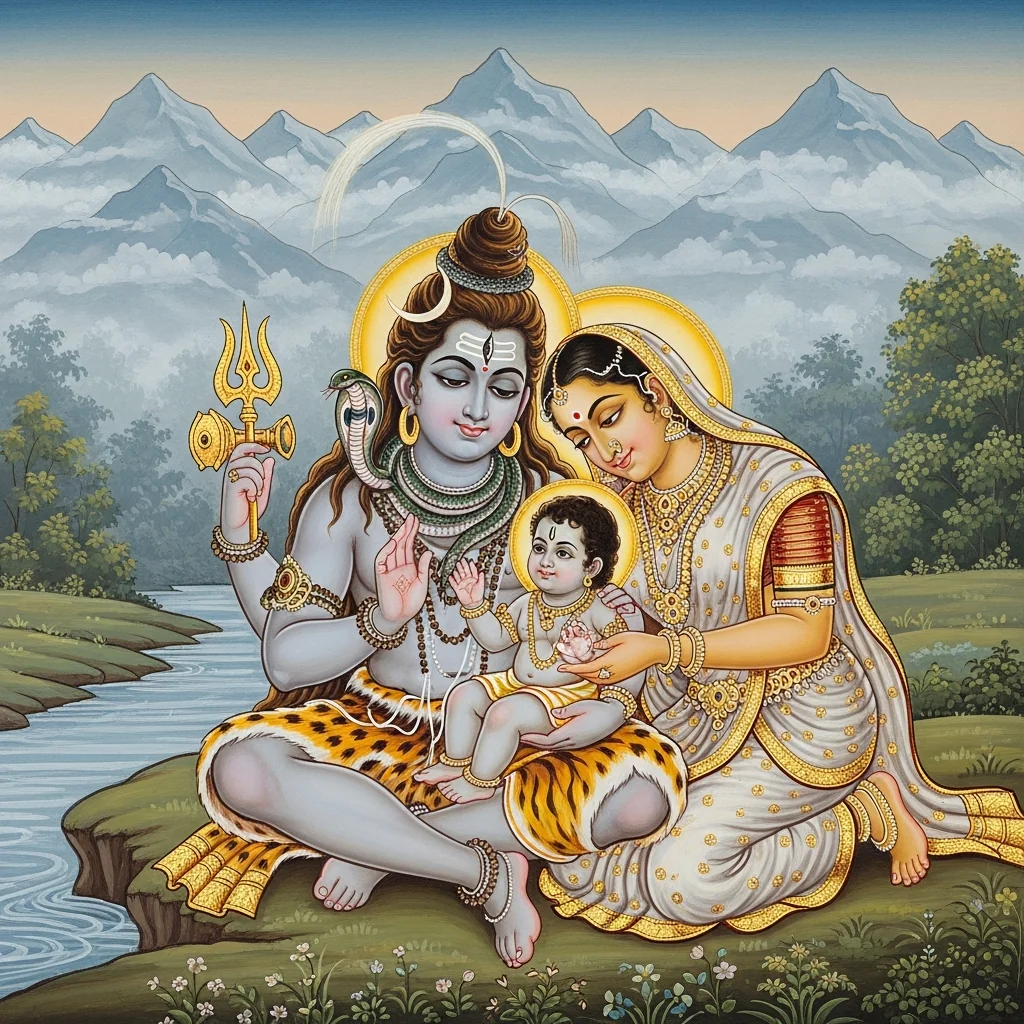
Adhyaya 27
Lomāśa recounts a ritual honoring of the great mountains performed by Viṣṇu with Brahmā’s participation, naming renowned peaks as sacred recipients of worship. The scene then shifts into a “varayātrā” (processional journey) where devas, gaṇas, and mountain-personifications assemble, and Śiva and Pārvatī are portrayed as an inseparable pair through closely linked metaphors—fragrance and flower, speech and meaning. A crisis follows: the overwhelming potency of Śiva’s generative energy (retas) brings cosmic distress to the gods. Brahmā and Viṣṇu enlist Agni, who enters Śiva’s abode to contain or consume that power, yet further complications arise and the devas grow anxious. Viṣṇu urges that Mahādeva be praised; after hymns, Śiva appears and instructs the gods to expel (vamanam) the burden. The expelled energy manifests as a vast radiant mass, is managed through Agni and the Kṛttikās, and becomes linked to the advent of the mighty child Kārttikeya (Ṣaṇmukha), born on the bank of the Gaṅgā. In the closing celebration, devas, sages, and attendants gather as Śiva and Pārvatī approach, embrace the child, and all conclude with auspicious rites and festival-like acclamation.
Shlokas
Verse 1
लोमश उवाच । तथैव विष्णुना सर्वे पर्वताश्च प्रपूजिताः । सह्याचलश्च विंध्यश्च मैनाको गंधमादनः
Lomaśa said: Likewise, all the mountains were duly honoured by Viṣṇu—Sahyācala, Vindhya, Maināka, and Gandhamādana.
Verse 2
माल्यवान्मलयश्चैव महेंद्रो मंदरस्तथा । मेरुश्चैव प्रयत्नेन पूजितो विष्णुना तदा
Mālyavān and Malaya, Mahendra and Mandara—and Meru as well—were then worshipped by Viṣṇu with earnest effort and due care.
Verse 3
श्वेतः कृतः श्वेतगिरिर्निलाद्रिश्च तथैव च । उदयाद्रिश्च श्रृंगश्च अस्ताचलवरो महान्
Śveta was honoured; so too Śvetagiri and Nīlādri; likewise Udayādri and Śṛṅga, and the great and excellent Astācala.
Verse 4
मानसाद्रिस्तथा शैलः कैलासः पर्वतोत्तमः । लोकालोकस्तथा शैलः पूजितः परमेष्ठिना
Mānasādri was honoured, and the mountain Kailāsa—the best of mountains. Likewise the Lokāloka mountain was worshipped by Parameṣṭhin (Brahmā).
Verse 5
एवं ते पर्वतश्रेष्ठाः पूजिताः सर्व एव हि । तथान्ये पूजितास्तेन सर्वे पर्वतवासिनः
Thus, all those foremost mountains were indeed worshipped; and in the same way, all other mountain-dwellers were also honoured by him.
Verse 6
विष्णुना ब्रह्मणा सार्द्धं कृतं सर्वं यथोचितम् । अन्येहनि च संप्राप्ते वरयात्रा कृता तथा
With Brahmā accompanying him, Viṣṇu had everything arranged in the proper manner. Then, when the next day arrived, the bridal procession (varayātrā) was likewise set in motion.
Verse 7
हिमाद्रिणा बंधुभिश्च पर्वतं गंधमादनम् । ययुः सर्वे सुरगणा गणाश्च बहवस्तथा
Along with Himādri and his kinsmen, all the hosts of gods—and many other groups as well—set out for Mount Gandhamādana.
Verse 8
प्रमथाश्च तथा सर्वे तथा चंडीगणाः परे । ये चान्ये बहवस्तत्र समायाता हिमालया
All the Pramathas too were there, and likewise the other companies of Caṇḍī. And many others also assembled there, having come from Himālaya.
Verse 9
शिवस्योद्वहनं विप्राः शिवेन परिभाविताः । परं हर्षं समापन्ना दृष्ट्वा तौ दंपती तदा
O brāhmaṇas, beholding Śiva’s wedding procession, and being inwardly suffused with Śiva’s own presence, they were filled with supreme joy upon seeing that divine couple.
Verse 10
पार्वतीसहितः शंभुः शंभुना सह पार्वती । पुष्पगन्धौ यथा स्यातां वागर्थाविव तत्त्वतः
Śambhu was with Pārvatī, and Pārvatī with Śambhu—inseparable in truth, like a flower and its fragrance, like speech and its meaning.
Verse 11
तथा प्रकृतिपुंसौ च ऐकपद्येन नान्यथा । दंपती तौ गजारूढौ शुशुभाते महाप्रभौ
So too, Prakṛti and Puruṣa stand upon one footing—never otherwise. That mighty, radiant couple shone forth, mounted upon an elephant.
Verse 12
विमास्थस्तदा ब्रह्मा विष्णुश्च गरुडोपरि । ऐरावतगतश्चेंद्रः कुबेरः पुष्पकोपरि
Then Brahmā was seated in a celestial chariot; Viṣṇu upon Garuḍa; Indra mounted on Airāvata; and Kubera upon the Puṣpaka aerial car.
Verse 13
पाशी च मकरा रूढो यमो महिषमेव च । प्रेतारूढो नैरृतः स्यादग्निर्बस्तगतो महान्
Varuṇa, bearing the noose, rode upon a makara; Yama upon a buffalo. Nairṛta rode upon a preta, and mighty Agni went mounted upon a goat.
Verse 14
मृगारूढोऽथ पवन ईशो वृषभमेव च । इत्येवं लोकपालाश्च सग्रहाः परमेष्ठिनः
Then Vāyu rode upon a deer, and Īśāna upon a bull. Thus, in this manner, the Lokapālas—together with their attendant hosts—came, led by the exalted ones.
Verse 15
स्वैः स्वैर्बलैः परिक्रांतास्तथान्ये प्रमथादयः । हिमाद्रिश्च महाशैल ऋषभो गंधमादनः
Surrounded by their own respective forces, other beings too—such as the Pramathas—came forth. Himādri (the Himalaya), the great mountain Mahāśaila, Ṛṣabha, and Gandhamādana also joined.
Verse 16
सह्याचलो नीलगिरिर्मंदरो मलयाचलः । कैलासो हि महातेजा मैनाकश्च महाप्रभः
Sahyācala, Nīlagiri, Mandara, and Malayācala came. Radiant Kailāsa too was present, and the splendid, mighty Maināka.
Verse 17
एते चान्ये च गिरयः क्षीमंतो हि महाप्रभाः । सकलत्राश्च ते सर्वे ससुताश्च मनोरमाः
These and other mountains—prosperous and greatly radiant—were all present, together with their consorts and their sons, delightful to behold.
Verse 18
बलिनो रूपिणः सर्वे मेर्वाद्यास्तत्र पर्वताः । वरयात्राप्रसंगेन शिवार्चनपराभवन्
All those mountains there—beginning with Meru—were powerful and took on visible forms. On the occasion of the wedding procession, they became devoted to the worship of Śiva.
Verse 19
नंदिना ह्युपविष्टास्ते मेर्वाद्यास्तत्र पर्वताः । वरयात्रा कृता ते यथोक्ता च हिमाद्रिणा । सर्वैस्तैर्बंधुभिः सार्द्धं पुनरागमनं कृतम्
Seated there by Nandin, the mountains—headed by Meru—remained assembled. The wedding procession was performed exactly as Himālaya had prescribed; and afterwards, along with all those kinsmen, the return journey was duly made.
Verse 20
स्वकालयस्थो हिमवान्स रेजे हि महा यशा । शिवसंपर्कजेनैव महसा परमेम च । विख्यातो हि महाशैलस्त्रिषु लोकेषु विश्रुतः
Abiding in his own proper abode, the glorious Himavān shone resplendently—by the supreme radiance born of contact with Śiva. That great mountain became renowned and celebrated throughout the three worlds.
Verse 21
कन्यादानेन महता तुष्टो यस्य च शंकरः । ते धन्यास्ते महात्मानः कृतकृतत्यास्तथैव च
Blessed indeed are those great-souled ones by whose noble gift of a daughter Śaṅkara is pleased; they are truly fulfilled, their duty accomplished.
Verse 22
द्व्यक्षरं नाम येषां च जिह्वाग्रे संस्थितं सदा । शिवेति द्व्यक्षरं नाम यैर्हृदीरितमद्य वै । ते वै मनुष्यरूपेण रुद्रा एव न संशयः
Those upon whose tongue the two-syllabled Name ever abides—and by whom the two-syllabled ‘Śiva’ is uttered from the heart—those persons, though in human form, are Rudras indeed; of this there is no doubt.
Verse 23
किंचिद्दानेन संतुष्टः पत्रेणापि तथैव च । तोयेनापि हि संतुष्टो महादेवो निरन्तरम्
Mahādeva is ever pleased—by even a small gift, by a mere leaf, and likewise even by water.
Verse 24
पत्रेण पुष्पेण तथा जलेन प्रीतो भवत्येष सदाशिवो हि । तस्माच्च सर्वैः प्रतिपूजनीयः शिवो मद्दाभाग्यकरो नृणामिह
By a leaf, by a flower, and likewise by water, this Sadāśiva is pleased. Therefore Śiva should be duly worshipped by all, for here he becomes the bestower of great good fortune upon people.
Verse 25
एको महाञ्ज्योतिरजः परेशः परापराणां परमो महात्मा । निरंतरो निर्विकारो निरीशो निराबाधो निर्विकल्पो निरीहः
He is One—the great radiant Light, the Supreme Lord; the highest Self of all that is higher and lower. Ever-present, changeless, without dependence, untroubled, beyond alternatives, and without desire—such is He.
Verse 26
निरंजनो नित्यरूपो निरोधो नित्यानन्दो नित्यमुक्ताः सदेव । एवंभूतो देवदेवोऽर्च्चितश्च तैर्देवाद्यर्विश्ववेद्यो भवश्च । स्तुतो ध्यातः पूजितश्चिंतितश्च सर्वज्ञोऽसौ सर्वदा सर्वदश्च
Stainless, of eternal form, the restrainer; eternal bliss; ever-liberated and ever divine—such is the God of gods, Bhava, worshipped even by the gods and known throughout the universe. Praised, meditated upon, adored, and remembered, He is omniscient—at all times and in every way.
Verse 27
यथा वरिष्ठो हिमवान्प्रसिद्धः सर्वैर्गुणैः सर्वगुणो महात्मा । विश्वेशवंद्यो हि तदा हिमालयो जातो गिरीणां प्रवरस्तदानीम्
Thus Himavān became famed as the foremost—endowed with every virtue, a great-souled one. Then the Himālaya became worthy of the Lord of the Universe’s reverence, and at that time he rose as the chief among mountains.
Verse 28
मेनया सह धर्मात्मा यथास्थानगतस्ततः । सर्वान्विसर्जयामास पर्वतान्पर्वतेश्वरः
Then the righteous lord of mountains, together with Menā, returned to his proper place and dismissed all the mountains, sending each back to its own abode.
Verse 29
गतेषु तेषु हिमवान्पुत्रैः पौत्रैः प्रपौत्रकैः । राजा गिरीणां प्रवरो महादेवप्रसादतः
When they had departed, Himavān—surrounded by his sons, grandsons, and great‑grandsons—became, by the grace of Mahādeva, the foremost king among mountains.
Verse 30
अथो गिरिजया सार्द्धं महेशो गन्धमादने । एकांते च मतिं चक्रे रमणार्थं स्वरूपवान्
Then Maheśa, the radiant Lord, together with Girijā, in the solitude of Gandhamādana, set his mind upon sporting in loving union.
Verse 31
सुरतेनैव महता तपसा हि समागमे । द्वयोः सुरतमारब्धं तद्द्वयोश्च तदाऽभवत्
In their union, that great act of love itself became like mighty tapas; for the two of them the rite of union began, and it truly came to pass between them then.
Verse 32
अनिष्टं महदाश्चर्यं प्रलयोपममेव च । तस्मिन्महारते प्राप्ते नाविंदंत सुखं परम्
A dreadful and astonishing event—like a pralaya, a cosmic dissolution—arose; and when that great calamity came, none could find the highest peace or happiness.
Verse 33
सर्वे ब्रह्मादयो देवाः कार्याकार्यव्यवस्थितौ । रेतसा च जगत्सर्वं नष्टं स्थावरजंगमम्
All the gods—beginning with Brahmā—stood perplexed about what should and should not be done; and by that seed, the entire world, both the immovable and the moving, was brought to ruin.
Verse 34
सस्मार चाग्निं ब्रह्मा च विष्णुश्चाध्यात्मदायकः । मनसा संस्मृतः सद्यो जगामाग्निस्त्वरान्वितः
Then Brahmā remembered Agni, and Viṣṇu—bestower of inner spiritual strength—also did so; and Agni, recalled in the mind, came at once with haste.
Verse 35
ताभ्यां संप्रेषितोऽपश्यद्रुचिरं शिवमांदिरम् । द्वारि स्थितं नंदिनं च ददर्शाग्रे महाप्रभम्
Sent by those two, he beheld a splendid temple‑palace of Śiva; and at the doorway he saw Nandin standing in front, the great and radiant lordly guardian.
Verse 36
अग्निर्ह्रस्वस्तदा भूत्वा काश्मीरसदृशच्छविः । प्रविष्टोंतः पुरं शंभोर्नानाश्चर्यसमन्वितम्
Agni then became small in stature, with a lustre like saffron; and he entered the inner city of Śambhu, filled with manifold wonders.
Verse 37
अनेकरत्नसंवीतं प्रासादैश्च स्वलं कृतम् । तदंगणमनुप्राप्य उपविश्याह हव्यवाट्
Adorned with many kinds of gems and beautified by palaces, he reached that courtyard; and sitting down, Havyavāṭ (Agni) spoke.
Verse 38
पाणिपात्रस्य मे ह्यम्ब भिक्षां देह्यवरोधतः । तच्छ्रुत्वा वचनं तस्य पाणिपात्रस्य बालिका
“Mother, give alms to me, for I am a mendicant with a hand‑held bowl, held back at the door.” Hearing those words of the one with the hand‑bowl, the young maiden…
Verse 39
यावद्दातुं च सारेभे भिक्षां तस्मै ततः स्वयम् । उत्थाय सुरतात्तस्माच्छिवो हि कुपितो भृशम्
But when he delayed in giving alms to that mendicant, Śiva Himself rose up from that divine union and became intensely enraged.
Verse 40
रुद्रस्त्रिशूलमुद्यम्य भैरवो ह्यऽभवत्तदा । निवारितो गिरिजया वधात्तस्माच्छिवः स्वयम् । भिक्षां तस्मै ददौ वाचा अग्नये जातवेदसे
Rudra, raising His trident, became Bhairava at that very moment. Yet Girijā restrained Śiva from striking. Then Śiva Himself, by His sacred word, granted the alms to Agni—Jātavedas, the all-knowing.
Verse 41
पाणौ भिक्षां गृहीत्वाथ प्रत्यक्षं तेन चाग्निना । भिक्षिता कुपिता तं वै शशाप गिरिजा ततः
After taking the alms into his hand—and there openly revealing himself as Agni—Girijā, angered at that beggar, then pronounced a curse upon him.
Verse 42
रे भिक्षो भविता शापात्सर्वभक्षो ममाशु वै । अनेन रेतसा सद्यः पीडां प्राप्स्यसि सर्वतः
“O beggar! By my curse you shall quickly become an eater of everything. And by this seed you will at once suffer affliction on every side.”
Verse 43
इत्युक्तो भक्षयित्वाग्नी रेत ईशस्य हव्यवाट् । यत्र देवाः स्थिताः सर्वे ब्रह्माद्याश्चैव सर्वशः
Thus addressed, Agni—the bearer of oblations—consumed the seed of the Lord and went to the place where all the gods, beginning with Brahmā, were assembled.
Verse 44
आगत्याकथयत्सर्वं तद्रेतोभक्षणादिकम् । सर्वे सगर्भा ह्यभवन्निन्द्राद्या देवतागणाः
Having arrived, he reported everything, beginning with the consuming of that seed. Thereupon all the hosts of gods—Indra and the rest—became pregnant.
Verse 45
अग्नेर्यथा हविश्चैव सर्वेषामुपतिष्ठति । अग्नेर्मुखोद्भवेनैव रेतसा ते सुरेश्वराः
Just as the oblation (havis) offered into Agni reaches all the gods, so too—by the seed that arose from Agni’s mouth—those lords of the gods were affected.
Verse 46
सगर्भाह्यभवन्सर्वे चिंतया चप्रपीडिताः । विष्णुं शरणमाजग्मुर्द्देवदेवेश्वरं प्रभुम्
All of them became pregnant and were tormented by anxiety. Therefore they went for refuge to Viṣṇu, the Lord who rules over the gods.
Verse 47
देवा ऊचुः । त्वं त्राता सर्वदेवानां लोकानां प्रभुरेव च । तस्माद्रक्षा विधातव्या शरणागतवत्सल
The gods said: “You are the savior of all the gods, and the true Lord of the worlds. Therefore grant us protection, O lover of those who seek refuge.”
Verse 48
वयं सर्वे मर्तुकामा रेतसानेन पीडिताः । असुरेभ्यः परित्रस्ता वयं सर्वे दिवौकसः
“All of us, the dwellers of heaven, are afflicted by this seed and feel as though we are ready to die. We are also terrified of the asuras.”
Verse 49
शरणं शंकरं याताः परित्रातुं कृतोद्वहाः । यदा पुत्रो हि रुद्रस्य भविष्यति तदा वयम् । सुखिनः स्याम सर्वे निर्भयाश्च त्रिविष्टपे
Having taken refuge in Śaṅkara, resolved to be protected, the gods said: “When indeed a son of Rudra comes into being, then we all shall become happy and fearless in Triviṣṭapa (heaven).”
Verse 50
एवं विष्टभ्यमानानां सर्वेषां भयमागतम् । अनेन रेतसा विष्णो जीवितुं शक्यते कथम्
Thus, as all were pressed down and restrained, fear came upon everyone. “With this mighty seed—this potent energy—how can Viṣṇu even continue to live?”
Verse 51
त्रिवर्गो हि यथा पुंसां कृतो हि सुपरिष्कृतः । विपरीतो भवत्येव विना देवेन नान्यथा
Even the well-ordered “three aims of life” for human beings—dharma, artha, and kāma—surely turn into their opposite without the Deva, the Divine Lord; it cannot be otherwise.
Verse 52
तस्मात्तद्वै बलं मत्वा सर्वेषामपि देहिनाम् । कार्याकार्यव्यवस्थायां सर्वे मन्यामहे वयम्
Therefore, recognizing that divine power as the true strength of all embodied beings, we all hold it to be decisive in discerning what should be done and what should not be done.
Verse 53
तथा निशम्य देवानां परेशः परिदेवनम् । उवाच प्रहसन्वाक्यं देवानां देवतारिहा
Hearing thus the lamentation of the gods, the Supreme Lord spoke with a smile—words meant for the gods—He who removes their distress.
Verse 54
स्तूयतां वै महादेवो महेशः कार्यगौरवात्
“Let Mahādeva, Maheśa, indeed be praised—for the task before us is weighty.”
Verse 55
तथेति गत्वा ते सर्वे देवा विष्णुपुरोगमाः । तथा ब्रह्मादयः सर्व ईडिरे ऋषयो हरम्
Saying, “So be it,” all those gods—led by Viṣṇu—went forth; likewise Brahmā and the others, and the sages too, praised Hara (Śiva).
Verse 56
ओंनमो भर्गाय देवाय नीलकंठाय मीढुषे । त्रिनेत्राय त्रिवेदाय लोकत्रितयधारिणे
“Oṃ, homage to the radiant Deva; to the Blue-throated benefactor; to the Three-eyed One; to the Lord of the three Vedas; to Him who upholds the three worlds.”
Verse 57
त्रिस्वराय त्रिमात्राय त्रिवेदाय त्रिमूर्त्तये । त्रिवर्गाय त्रिधामाय त्रिपदाय त्रिशूलिने
“Homage to Him of the three sacred sounds; to Him of the three measures; to the Lord of the three Vedas; to the three-formed One; to the source of the three aims of life; to Him of the three abodes; to Him of the three steps; to the wielder of the trident.”
Verse 58
त्राहित्राहि महादेव रेतसो जगतः पते
“Protect us, protect us, O Mahādeva—O Lord of the world—before this overwhelming divine potency (retas)!”
Verse 59
ब्रह्मणा तु स्तुतो यावत्तावद्देवो वृषध्वजः । प्रादुर्बभूव तत्रैव सुराणां कार्यसिद्धये
As long as Brahmā continued his praise, so long did the Bull-bannered Lord (Śiva) manifest right there, in order to accomplish the gods’ purpose.
Verse 60
दृष्टस्तदानीं जगदेकबंधुर्महात्मभिर्देववरैः सुपूजितः । संस्तूयमानो विविधैर्वचोभिः प्रत्यग्रूपैः श्रुतिसंमतैश्च
Then the One Friend of the world was beheld—honoured with excellent worship by the great-souled, foremost gods—praised with many kinds of words, fresh in expression and in harmony with the Vedas.
Verse 61
स्तुवतां चैव देवानामुवाच परमेश्वरः । त्रासं कुर्वंतु मा सर्वे रेतसानेन पीडिताः
And while the gods were praising Him, Parameśvara spoke: “Let none of you be afraid, though you are afflicted by this vital seed (retas).”
Verse 62
वमनं वै भवद्भिश्च कार्यमद्यैव भोःसुराः । तथेति मत्वा ते सर्व इंद्राद्या देवतागणाः । वेमुः सर्वे तदा विप्रास्तद्रेतः शंकरस्य च
“Indeed, today you must perform an expulsion (vomiting), O gods.” Thinking, “So be it,” all the divine hosts—beginning with Indra—then expelled it; and all the sages witnessed that retas of Śaṅkara.
Verse 63
ऐकपद्येन तद्रेतो महापर्वतसन्निभम् । तप्तचामीकरप्रख्यं बभूव परमाद्भुतम्
In a single moment, that retas became like a great mountain—radiant like molten gold—utterly wondrous.
Verse 64
सर्वे च सुखिनो जाता इंद्राद्या देवतागणाः । विना ह्यग्निं च ते सर्वे परितुष्टास्तदाऽभवन्
Then all the hosts of deities—beginning with Indra—became happy; and even without Agni, they all were satisfied at that time.
Verse 65
तेनाग्निनापि चोक्तस्तु शंकरो लोकशंकरः । किं मयाद्य महा देव कर्तव्यं देवतावर
Then Agni too addressed Śaṅkara, the benefactor of the worlds: “O Mahādeva, best among the gods, what should I do today?”
Verse 66
तद्ब्रूहि मे प्रभोऽद्य त्वं येनाहं सर्वदा सुखी । भविष्यामि च येनाहं देवानां हव्यवाहकः
“Tell me today, O Lord—by what I may ever remain at ease, and by what I may become the bearer of the gods’ offerings (havyavāhaka).”
Verse 67
तदोवाच शिवः साक्षाद्देवानामिह श्रृण्वताम् । रेतो विसृज्यतां योनौ तदाग्निः प्रहसन्नवि
Then Śiva himself spoke, as the gods listened there: “Let the retas be released into a yoni (womb).” At that, Agni laughed.
Verse 68
उवाच शंकरं देवं भवत्तेजो दुरासदम् । इदमुल्बणवत्तेजो धार्यते प्राकृतैः कथम्
He said to Lord Śaṅkara: “Your radiance is unapproachable. How can ordinary beings bear this fierce, overwhelming tejas?”
Verse 69
ततः प्रोवाच भगवानग्निं प्रति महेश्वरः । मासिमासि प्रतप्तानां देहे तेजो विसृज्यताम्
Then Lord Maheśvara spoke to Agni: “Month after month, let this fiery tejas be released into the bodies of those who have been scorched (by austerity and hardship).”
Verse 70
तथेति मत्वा वचनं महाप्रभः स जातवेदाः परमेण वर्चसा । समुज्ज्वलंस्तत्र महाप्रभावो ब्राह्मे मुहूर्त्ते हि सचोपविष्टः
Accepting the command as “So be it,” that mighty one—Jātavedas (Agni)—with supreme splendour blazed forth there in great power; and at the brāhma-muhūrta he sat down to accomplish the ordinance.
Verse 71
तदा प्रातः समुत्थाय प्रातः स्नानपराः स्त्रियः । ययुः सदा ऋषीणां च सत्यस्ता जातवेदसम्
Then, rising in the early morning, those women—devoted to morning bathing and true to their vows as the wives of sages—went to Jātavedas (Agni).
Verse 72
दृष्ट्वा प्रज्वलितं तत्र सर्वास्ताः शीतकर्षिताः । तप्तुकामास्तदा सर्व्वा ह्यरुधत्या निवारिताः
Seeing the fire blazing there, all of them—afflicted by cold—desired to warm themselves; but they were all restrained by Arundhatī.
Verse 73
तया निवारिताश्चापि तास्तेपुः कृत्तिकाः स्वयम् । यावत्तेपुश्च ताः सर्व्वा रेतसः परमाणवः । विविशू रोमकूपेषु तासां तत्रैव सत्वरम्
Though restrained by her, the Kṛttikās themselves then performed tapas. And while all of them were engaged in that austerity, the subtle particles of the seed entered swiftly into the pores of their skin, right there.
Verse 74
नीरेतोग्निस्तदा जातो विश्रांतः स्वयमेव हि
Then the ‘fire without seed’ arose, and indeed it became calm of its own accord.
Verse 75
ततस्ता ऋषिभार्या हि ययुः स्वभवनं प्रति । ऋषिभिस्तु तदा शप्ताः कृत्तिकाः खेचराभवन्
Thereafter the sages’ wives returned to their own dwellings; but then, cursed by the ṛṣis, the Kṛttikās became beings who move through the sky.
Verse 76
तदानीमेव ताः सर्वा व्यभिचारेण दुःखिताः । तत्ससर्जुस्तदा रेतः पृष्ठे हिमवतो गिरेः
At that very time, all of them, distressed by the (charge of) transgression, released that seed upon the back of Mount Himavat.
Verse 77
एकपद्येन तद्रेतस्तप्तचामीकरप्रभम् । गंगायां च तदा क्षिप्रं कीचकैः परिवेष्टितम्
In a single stride, that seed—shining like heated gold—was swiftly cast into the Gaṅgā, and there it became surrounded by reeds.
Verse 78
षण्मुखं बालकं ज्ञात्वा सर्वे देवा मुदान्विताः । गर्गेणोक्तास्तदंते वै सुखेन ह्रियतामिति
Recognizing the child as Ṣaṇmukha, all the gods were filled with joy; and in the end, as Garga declared, it was said: “Let him be carried away safely and with ease.”
Verse 79
शंभोः पुत्रः प्रसादेन सर्वो भवति शाश्वतः । गंगायाः पुलिने जातः कार्त्तिकेयो महाबलः
By Śambhu’s grace, all becomes enduring and auspicious; upon the sandy bank of the Gaṅgā was born the mighty Kārttikeya.
Verse 80
उपविष्टोथ गांगेयो ह्यहोरात्रोषितस्तदा । शाखो विशाखोऽतिबलः षण्मुखोऽसौ महाबलः
Then the son of the Gaṅgā sat there and remained for a full day and night. That supremely strong one—Śākha and Viśākha—was the six-faced, mighty Lord.
Verse 81
जातो यदाथ गंगायां षण्मुखः शंकरात्मजः । तदानीमेव गिरिजा संजाता प्रस्नुतस्तनी
When Ṣaṇmukha, the son of Śaṅkara, was born in the Gaṅgā, at that very moment Girijā became filled with flowing milk in her breasts.
Verse 82
शिवं निरीक्ष्य सा प्राह हे शंभो प्रस्नवो महान् । संजातो मे महादेव किमर्थस्तन्निरीक्ष्यताम् । सर्वज्ञोऽपि महादेवो ह्यब्रवीत्तामथाज्ञवत्
Looking at Śiva, she said: “O Śambhu, a great flow of milk has arisen in me, O Mahādeva—what is its purpose? Let this be considered.” Though all-knowing, Mahādeva then replied to her as if unaware.
Verse 83
नारदस्तत्र चागत्य प्रोक्तवाञ्जन्म तस्य तत् । शिवाय च शिवायै च पुत्रो जातो हि सुंदरः
Then Nārada came there and announced that birth: “To Śiva and to Śivā, a beautiful son has indeed been born.”
Verse 84
तदाकर्ण्य वचो विप्रा हर्षनिर्भरमानसाः । बभूवुः प्रमथाः सर्वे गंधर्वा गीततत्पराः
Hearing those words, the sages were filled with joy. All the Pramathas assembled, and the Gandharvas became intent on song.
Verse 85
अनेकाभिः पताकाभिश्चैलपल्लवतोरणैः । तथा विमानैर्बहुभिर्बभौ प्रज्वलितो महान् । पर्वतः पुत्रजननाच्छंकरस्य महात्मनः
Adorned with many banners, with festoons of cloth and leaves like ceremonial gateways, and with numerous celestial vimānas, the great mountain shone as though aflame—celebrating the birth of the magnanimous Śaṅkara’s son.
Verse 86
तदा सर्वे सुरगणा ऋषयः सिद्धचारणाः रक्षोगंधर्वयक्षाश्च अप्सरोगणसेविताः
Then all the hosts of the gods—together with the Ṛṣis, the Siddhas and Cāraṇas, and also the Rākṣasas, Gandharvas, and Yakṣas—assembled, attended by companies of Apsarases.
Verse 87
एकपद्येन ते सर्वे सहिताः शंकरेण तु । द्रष्टुं गांगेयमधिकं जग्मुः पुलिनसंस्थितम्
In but a single stride, all of them—accompanied by Śaṅkara—went to behold the most exalted son of the Gaṅgā, stationed upon the riverbank.
Verse 88
ततो वृषभमारुह्य ययौ गिरिजया सह । अन्यैः समेतो भगवान्सुरैरिंद्रादिभिस्तथा
Then the Blessed Lord mounted the bull and proceeded, accompanied by Girijā, and attended as well by other gods led by Indra.
Verse 89
तदा शंखाश्च भेर्यश्च नेदुस्तूर्यीण्यनेकशः
Then conches and kettle-drums resounded, and many kinds of trumpets and festive instruments blared on all sides.
Verse 90
तदानीमेव सर्वेशं वीरभद्रादयो गणाः । अन्वयुः केलिसंरब्धा नानावादित्रवादकाः । वादयन्तश्च वाद्यानि ततानि विततानि च
At that very moment, Vīrabhadra and the other gaṇas followed the Lord of all, eager for a sacred, sportive celebration—players of many kinds of instruments—sounding as they went the stretched and resounding instruments, of strings and of percussion.
Verse 91
केचिन्नृत्यपरास्तत्र गायकाश्च तथा परे । स्तावकाः स्तूयमानाश्च चक्रुस्ते गुणकीर्तनम्
Some there were devoted to dancing; others were singers. Some were chanters of hymns, and others were being praised—thus they performed kīrtana, the glorification of His virtues.
Verse 92
एवंविधास्ते सुरसिद्धयक्षा गंधर्वविद्याधरपन्नगा ह्यमी । शिवेन सार्द्धं परिहृष्टचित्ता द्रष्टुं ययुस्तं वरदं च शांकरिम्
Such were they—gods, siddhas, yakṣas, gandharvas, vidyādharas, and nāgas. With Śiva, their hearts brimming with delight, they went to behold that boon-giving divine child, and the Śāṅkarī as well.
Verse 93
यावत्समीक्षयामासुर्गांगेयं शंकरोपमम् । ददृशुस्ते महत्तेजो व्याप्तमासीज्जगत्त्रयम्
As they looked upon Gaṅgeya, resembling Śaṅkara, they beheld a great radiance that had pervaded the three worlds.
Verse 94
तत्तोजसावृतं बालं तप्तचामीकरप्रभम् । सुमुखं सुश्रिया युक्तं सुनसं सुस्मितेक्षणम्
They saw the child enveloped in that radiance, shining like heated gold—fair-faced, endowed with splendid beauty, with a fine nose and eyes gently smiling.
Verse 95
चारुप्रसन्न वदनं तथा सर्वागसुंदरम् । तं दृष्ट्वा महदाश्चर्यं गांगेयं प्रथितात्मकम्
With a lovely, serene face and beauty in every limb—beholding that renowned Gaṅgeya, they were filled with great wonder.
Verse 96
ववंदिरे तदा बालं कुमारं सूर्यवर्चसम् । प्रमथाश्च गणाः सर्वे वीरभद्रादयस्तथा
Then all the Pramathas and gaṇas—Vīrabhadra and the rest—bowed down to the child Kumāra, radiant as the sun.
Verse 97
परिवार्योपतस्थुस्ते वामदक्षिणभागतः । तथा ब्रह्मा च विष्णुश्च इंद्रश्चापि सुरैर्वृतः
They stood attending Him, gathered around on His left and right. Brahmā and Viṣṇu too were there, and Indra as well, surrounded by the gods.
Verse 98
ऋषयो यक्षगंधर्वाः परिवार्य कुमारकम् । दंडवत्पितिता भूमौ केचिच्च नतकंधराः
Sages, yakṣas, and gandharvas surrounded the young Kumāra. Some fell to the ground in full prostration, and some bowed with necks bent in humility.
Verse 99
प्रणेमुः शिरसा चान्ये मत्वा स्वामिनमव्ययम् । अवाद्यंत विचित्राणि वादित्राणि महोत्सवे । एवमभ्युदये तस्मिन्नृषयः शांतिमापठम्
Others bowed their heads, knowing the Lord to be imperishable. In that great festival, wondrous instruments of many kinds were played. Thus, amid that auspicious celebration, the sages recited hymns of peace.
Verse 100
एतस्मिन्नंतरे यातः शंकरो गिरिजापतिः । अवतीर्य वृषाच्छीघ्रं पार्वत्या सहसुव्रताः
Meanwhile, Śaṅkara—the Lord of Girijā—arrived, swiftly dismounting from the bull Nandī, together with Pārvatī, the noble-vowed one.
Verse 101
पुत्रं निरैक्षत तदा जगदेकबंधुः प्रीत्या युतः परमया सह वै भवान्या । स्नेहान्वितो भुजगभोगयुतो हि साक्षात्सर्वेश्वरः परिवृतः प्रमथैः प्रहृष्टः
Then the One Friend of the whole world gazed upon his son, filled with supreme joy together with Bhavānī. The Lord of all—adorned with serpent-coils—overflowing with affection and surrounded by delighted Pramathas, shone forth in person.
Verse 102
उपगुह्य गुहं तत्र पार्वती जातसंभ्रमा । प्रस्नुतं पाययामास स्तनं स्नेहपरिप्लुता
There, Pārvatī, overcome with tender excitement, embraced Guha and—flooded with motherly love—nursed him at her breast, which had begun to flow with milk.
Verse 103
तदा नीराजितो देवैः सकलत्रैर्मुदान्वितैः । जयशब्देन महता व्याप्तमासीन्नभस्तलम्
Then the gods—together with their families, rejoicing—performed ārati (nīrājana) in honor of him; and the whole sky was filled with a mighty cry of “Victory!”
Verse 104
ऋषयो ब्रह्मगोषेण गीतेनैव च गायकाः । वाद्यैश्च वादकाश्चैव उपतस्थुः कुमारकम्
The sages attended the divine child with Vedic acclamations; singers attended him with song; and musicians attended him with instruments and music.
Verse 105
स्वमंकमारेप्य तदा गिरीशः कुमारकं तं प्रभया महाप्रभम् । बभौ भवानीपतिरेव साक्षाच्छ्रिया युतः पुत्रवतां वरिष्ठः
Then Girīśa set that child, radiant with mighty splendor, upon his own lap. Bhavānī’s Lord himself shone forth in visible glory—most excellent among those blessed with sons.
Verse 106
दंपती तौ तदा तत्र ऐकपद्येन नंदतुः । अभिषिच्यमान ऋषिभिरावृतः सुरसत्तमैः
There and then the divine couple rejoiced in perfect oneness. The child was being anointed in consecration by the sages, surrounded by the most excellent of the gods.
Verse 107
कुमारः क्रीडयामास उत्संगे शंकरस्य च । कंठे स्थितं वासुकिं च पाणिभ्यां समपीडयत्
The child Kumāra played upon Śaṅkara’s lap, and with his little hands he squeezed Vāsuki, who rested upon the Lord’s neck.
Verse 108
मुखं प्रपीडयित्वाऽसौ पाणीनगणयत्तदा । एकं त्रीणिदशाष्टौ च विपरीतक्रमेण च
Pressing his mouth in childish play, he then counted on his fingers: “one, three, ten, eight”—and even in reverse order as well.
Verse 109
प्रहस्य भगवाञ्छंभुरुवाच गिरिजां तदा
Then the Blessed Lord Śambhu, smiling, spoke to Girijā (Pārvatī).
Verse 110
मंदस्मितेन च तदा भगवान्महेशः प्राप्तो मुदंच परमां गिरिजासमेतः । प्रेम्णा सगद्गदगिरा जगदेकबंधुर्नोवाच किंचन तदा भुवनैकभर्ता
Then the Blessed Lord Maheśa, with a gentle smile and accompanied by Girijā, attained supreme joy. Yet the sole kinsman of the world—the one Lord of the universe—his voice trembling with love, spoke nothing at that moment.