Adhyaya 5
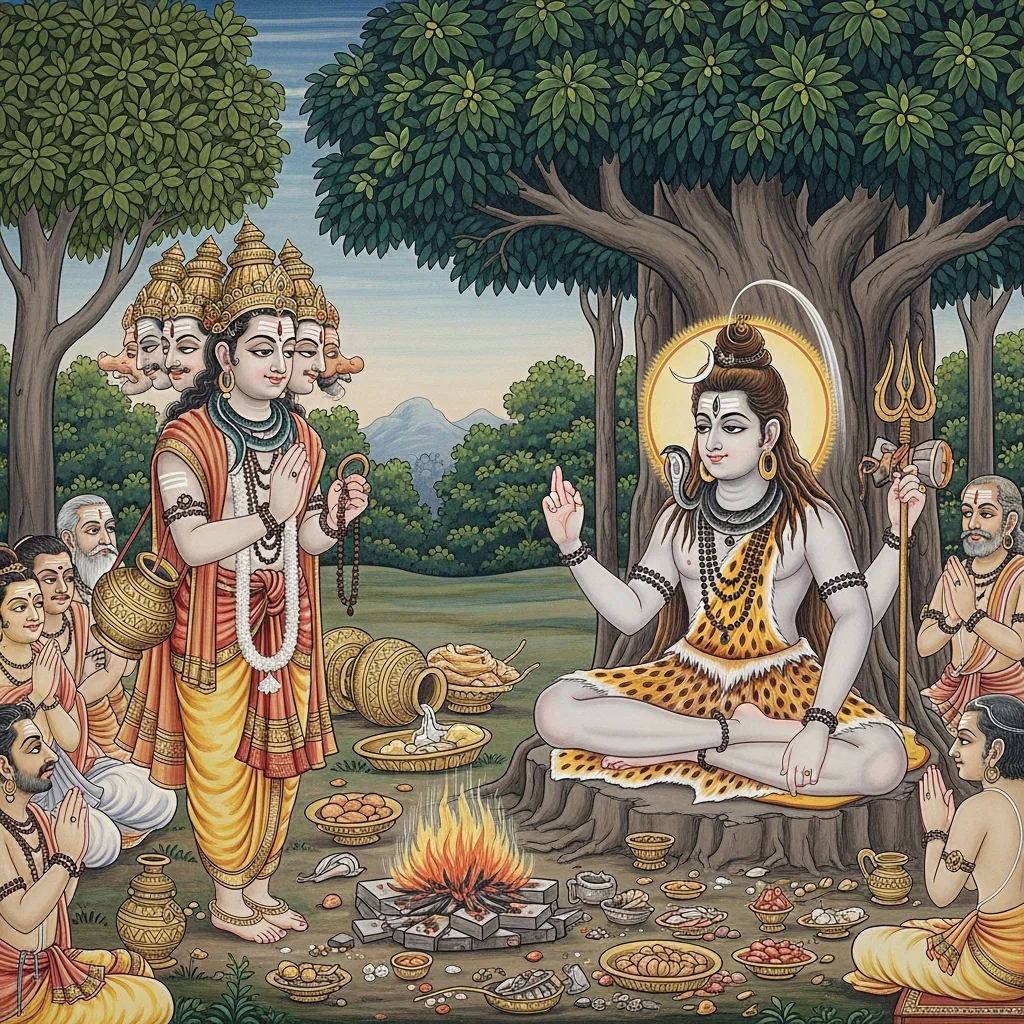
After Viṣṇu departs from Dakṣa’s sacrificial arena, Śiva’s gaṇas overrun the ritual assembly, humiliating many participants and throwing gods, sages, and even celestial bodies into turmoil. Distressed, Brahmā journeys to Kailāsa and offers a formal stuti to Śiva, acknowledging him as the transcendent source of cosmic order and the true efficacy of sacrifice. Śiva explains that the breaking of Dakṣa’s yajña is not arbitrary divine malice but the karmic consequence of Dakṣa’s own deeds, and that conduct causing others’ suffering is condemned by dharma. Śiva then goes to Kanakhala, reviews Vīrabhadra’s actions, and restores Dakṣa to life by reconstituting him with a substitute animal head—an emblem of reconciliation and the reordering of ritual under higher dharma. Dakṣa praises Śiva, after which Śiva teaches a graded typology of devotees (ārta, jijñāsu, arthārthī, jñānī), exalting jñāna-oriented devotion above mere ritual works. The chapter also lists the merits and fruits of temple service and offerings, and illustrates them through narratives: King Indrasena is saved through inadvertent utterance of Śiva’s name; the power of vibhūti and the pañcākṣara is affirmed; and a longer exemplum contrasts wealth-based formal worship (Nandī the merchant) with the intense, unconventional devotion of a hunter (Kirāta), culminating in Śiva’s grace and his appointment as a divine attendant and gatekeeper (pārṣada/dvārapāla).
Shlokas
Verse 1
लोमश उवाच । विष्णौ गते तदा सर्वे देवाश्च ऋषिभिः सह । विनिर्जिता गणैः सर्वे ये च यज्ञोपजीविनः
Lomaśa said: When Viṣṇu had departed, all the gods, together with the ṛṣis, were utterly defeated by the gaṇas, and so too were all who lived by the sacrifices.
Verse 2
भृगुं च पातयामास स्मश्रूणां लुंचनं कृतम् । द्विजांश्चोत्पाटयामास पूष्णो विकृतविक्रियान्
He struck down Bhṛgu and tore out his beard. He also dragged away the twice-born, and Pūṣan was left with his faculties grotesquely distorted.
Verse 3
विडंबिता स्वधा तत्र ऋषयश्च विडंबिताः । ववृषुस्ते पुरीषेण वितानाग्नौ रुपान्विताः
There, Svadhā was mocked, and the ṛṣis too were humiliated. Those gaṇas, assuming various forms, rained filth upon the altar-fire beneath the sacrificial canopy.
Verse 4
अनिर्वाच्यं तदा चक्रुर्गणाः क्रोधसमन्विताः । अंतर्वेद्यंतरगतो दक्षो वै महतो भयात्
Then the gaṇas, filled with wrath, wrought deeds beyond description; and Dakṣa, seized by great fear, slipped away into the inner precincts of the sacrificial altar-enclosure.
Verse 5
तं निलीनं समाज्ञाय आनिनायरुषान्वितः । कपोलेषु गृहीत्वा तं खड्गेनोपहतं शिरः
Learning that he was hiding, Vīrabhadra, filled with fury, dragged him out; seizing him by the cheeks, he struck at his head with a sword.
Verse 6
अभेद्यं तच्छिरो मत्वा वीरभद्रः प्रतापवान् । स्कंधं पद्भ्यां समाक्रम्य कधरेऽपीडयत्तदा
Thinking that his head was hard to break, mighty Vīrabhadra pressed down then—planting his feet upon the shoulders and crushing at the neck.
Verse 7
गंधरात्पाट्यमानाच्च शिरश्छिन्नं दुरात्मनः । दक्षस्य च तदा तेन वीरभद्रेण धीमता । तच्छिरः सुहुतं कुंडे ज्वलि
As it was being wrenched from the neck, the evil-minded Dakṣa’s head was then severed by the wise Vīrabhadra; and that head was offered into the sacrificial fire-pit—ablaze therein.
Verse 8
ये चान्य ऋषयो देवाः पितरो यक्षराक्षसाः । गणैरुपद्रुताः सर्वे पलायनपरा ययुः
And the other sages, gods, Pitṛs, Yakṣas, and Rākṣasas—harried by the Gaṇas—all became intent on flight and fled.
Verse 9
चंद्रादित्यगणाः सर्वे ग्रहनक्षत्रतारकाः । सर्वे विचलिता ह्यासन्गणैस्तेपि ह्युपद्रुताः
All the hosts of the Moon and Sun—planets, lunar mansions, and stars—were thrown into disarray; for even they too were afflicted by the Gaṇas.
Verse 10
सत्यलोकं गतो ब्रह्मा पुत्रशोकेन पीडितः । चिंतयामास चाव्यग्रः किं कार्यं कार्यमद्य वै
Brahmā went to Satyaloka, afflicted by grief for his son, and he pondered with steady mind: “What must be done today? What duty still remains to be fulfilled?”
Verse 11
मनसा दूयमानेन शंन लेभे पितामहः । ज्ञात्वा सर्वं प्रयत्नेन दुष्कृतं तस्य पापिनः
With his mind burning in distress, the Grandfather (Brahmā) found no peace; for with utmost effort he had learned with certainty the entire evil deed of that sinful one (Dakṣa).
Verse 12
गमनाय मतिं चक्रे कैलासं पर्वतं प्रति । हंसारूढो महातेजाः सर्वदेवैः समन्वितः
He resolved to go toward Mount Kailāsa; mounted upon his swan, the greatly radiant Brahmā set out accompanied by all the gods.
Verse 13
प्रविष्टः पर्वतश्रेष्ठं स ददर्श सदाशिवम् । एकांतवासिनं रुद्रं शैलादेन समन्वितम्
Entering that best of mountains, he beheld Sadāśiva—Rudra dwelling in solitude—attended by Śailāda (Nandin).
Verse 14
कपर्द्दिनं श्रिया युक्तं वेदांगानां च दुर्गमम् । तथाविधं समालोक्य ब्रह्म क्षोभपरोऽभवत्
Seeing the matted-haired Lord (Kapardin), radiant with divine splendour and unfathomable even to the Vedāṅga disciplines, Brahmā was inwardly shaken and deeply stirred.
Verse 15
दंडवत्पतितो भूमौक्षमापयितुमुद्यतः । संस्पृशं स्तत्पदाब्जं च चतुर्मुकुटकोटिभिः । स्तुतिं कर्तुं समारेभे शिवस्य परमात्मनः
Falling full-length upon the earth in daṇḍavat reverence, intent on seeking forgiveness, he touched Śiva’s lotus-feet with the countless crowns of his four faces and began to offer a hymn to Śiva, the Supreme Self.
Verse 16
ब्रह्मोवाच । नमो रुद्राय शांताय ब्रह्मणे परमात्मने । त्वं हि विश्वसृजां स्रष्टा धाता त्वं प्रपितामहः
Brahmā said: Salutations to Rudra, the peaceful one—to Brahman, the Supreme Self. You indeed are the creator among the creators of the universe; you are the sustainer, you are the Great-Grandfather of all.
Verse 17
नमो रुद्राय महते नीलकंठाय वेधसे । विश्वाय विश्वबीजाय जगदानंदहेतवे
Salutations to great Rudra, to Nīlakaṇṭha, to the Ordainer; to the All, to the Seed of the universe, to the very cause of the world’s bliss.
Verse 18
ओंकारस्त्वं वषट्कारः सर्वारंभप्रवर्तकः । यज्ञोसि यज्ञकर्मासि यज्ञानां च प्रवर्तकः
You are the syllable Oṃ; you are the Vaṣaṭ exclamation; you set every undertaking in motion. You are the sacrifice itself, you are the sacrificial act, and you are the one who impels all sacrifices.
Verse 19
सर्वेषां यज्ञकर्तॄणां त्वमेव प्रतिपालकः । शरण्योसि महादेव सर्वेषां प्राणिनां प्रभो । रक्ष रक्ष महादेव पुत्रशोकेन पीडितम्
You alone protect all who perform sacrifices. You are the refuge, O Mahādeva—the Lord of all beings. Protect, protect, O Mahādeva, one afflicted by grief for a son.
Verse 20
महादेव उवाच । श्रृणुष्वावहितो भूत्वा मम वाक्यं पितामह । दक्षस्य यज्ञभंगोयं न कृतश्च मया क्वचित्
Mahādeva said: Listen with full attention to my words, O Pitāmaha. This disruption of Dakṣa’s sacrifice was never done by me at any time.
Verse 21
स्वीयेन कर्मणा दक्षो हतो ब्रह्मन्न संशयः
By his own deed Dakṣa was brought to ruin, O Brahmā—of this there is no doubt.
Verse 22
परेषां क्लेशदं कर्म न कार्यं तत्कदाचन । परमेष्ठिन्परेषां यदात्मनस्तद्भविष्यति
An act that brings suffering to others should never be done. O Parameṣṭhin, whatever one does toward others—so it becomes for oneself.
Verse 23
एवमुक्त्वा तदा रुद्रो ब्रह्मणा सहितः सुरैः । ययौ कनखलं तीर्थं यज्ञवाटं प्रजापतेः
Having spoken thus, Rudra then—accompanied by Brahmā and the gods—went to the sacred ford of Kanakhala, to the sacrificial enclosure of Prajāpati (Dakṣa).
Verse 24
रुद्रस्तदा ददर्शाय वीरभद्रेण यत्कृतम् । स्वाहा स्वधा तथा पूषा भृगुर्मतिमतां वरः
Then Rudra beheld what Vīrabhadra had done—how Svāhā and Svadhā, as well as Pūṣan, and Bhṛgu, the foremost among the wise, had been dealt with in that upheaval of the sacrifice.
Verse 25
तदान्य ऋषयः सर्वे पितरश्च तथाविधाः । येऽन्ये च बहवस्तत्र यक्षगंधर्वकिन्नराः
Then the other sages as well, and the Pitṛs of that same assembly—and many others there, including Yakṣas, Gandharvas, and Kinnaras—were also swept up in that calamity.
Verse 26
त्रोटिता लुंचिताश्चैव मृताः केचिद्रणाजिरे
Some were shattered, some were torn apart, and some even died upon that ground that had become like a battlefield.
Verse 27
शंभुं समागतं दृष्ट्वा वीरभद्रो गणैः सह । दंडप्रणामसंयुक्तस्तस्थावग्रे सदाशिवम्
Seeing Śambhu arrive, Vīrabhadra—together with the Gaṇas—stood before Sadāśiva, offering full prostration (daṇḍavat).
Verse 28
दृष्ट्वा पुरः स्थितं रुद्रो वीरभद्रं महाबलम् । उपाच प्रहसन्वाक्यं किं कृतं वीर नन्विदम्
Seeing mighty Vīrabhadra standing before him, Rudra spoke with a smile: “O hero, what indeed is this that has been done?”
Verse 29
दक्षमानय शीघ्रं भो येनेदं कृतमीदृशम् । यज्ञे विलक्षणं तात यस्येदं फलमीदृशम्
“Bring Dakṣa quickly, O one!—he by whom this has been brought about in such a manner. Strange indeed is this sacrifice, dear one, whose fruit has turned out like this.”
Verse 30
एवमुक्तः शंकरेण वीरभद्रस्त्वरान्वितः । कबंधमानयित्वाथ शंभोरग्रे तदाक्षिपत्
Thus addressed by Śaṅkara, Vīrabhadra—filled with haste—brought the headless trunk and cast it down before Śambhu.
Verse 31
तदोक्तः शंकरेणैव वीरभद्रो महामनाः । शिरः केना पनीतं च दक्षस्यास्य दुरात्मनः
Then Śaṅkara asked, and the great-minded Vīrabhadra (was addressed thus): “By whom was the head of this wicked-souled Dakṣa removed?”
Verse 32
दास्यामि जीवनं वीर कुटिलस्यापि चाधुना । एवमुक्तः शंकरेण वीरभद्रोऽब्रवीत्पुनः
(Śiva said:) “I shall grant life now—even to this crooked one, O hero.” Thus spoken to by Śaṅkara, Vīrabhadra replied again.
Verse 33
मया शिरो हुतं चाग्नौ तदानीमेव शंकर । अवशिष्टं शिरःशंभो पशोश्च विकृताननम्
Vīrabhadra said: “I offered the head into the fire just then, O Śaṅkara. What remains, O Śambhu, is the head of the sacrificial beast—its face distorted.”
Verse 34
इति ज्ञात्वा ततो रुद्रः कबंधोपरि चाक्षिपत् । शिरः पशोश्च विकृतं कूर्चयुक्तं भयावहम्
Knowing this, Rudra then cast upon the headless trunk a terrifying, altered head of a beast—fitted with a tuft of hair—making it fearsome to behold.
Verse 35
स दक्षो जीवितं लेभे प्रसादाच्छंकरस्य च । स दृष्ट्वाग्रे तदा रुद्रं दक्षो लज्जासमन्वितः । तुष्टाव प्रणतो भूत्वा शंकरं लोकशंकरम्
Thus Dakṣa regained life through Śaṅkara’s grace. Then, seeing Rudra before him, Dakṣa—filled with shame—bowed down and praised Śaṅkara, the benefactor of the worlds.
Verse 36
दक्ष उवाच । नमामि देवं वरदं वरेण्यं नमामि देवेश्वरं सनातनम् । नमामि देवाधिपमीश्वरं हरं नमामि शंभुं जगदेकबंधुम्
Dakṣa said: I bow to the God who grants boons, the most worthy of worship. I bow to the eternal Lord of the gods. I bow to Hara, the sovereign Lord, ruler of the devas. I bow to Śambhu, the sole true kinsman of the entire world.
Verse 37
नमामि विश्वेश्वरविश्वरूपं सनातनं ब्रह्म निजात्मरूपम् । नमामि सर्वं निजभावभावं वरं वरेण्यं नतोऽस्मि
I bow to the Lord of the universe, whose form is the universe—eternal Brahman, whose very nature is the Self. I bow to Him who is all, the inner ground of every state of being—supreme, most worthy; I am prostrate before Him.
Verse 38
लोमश उवाच । दक्षेण संस्तुतो रुद्रो बभाषे प्रहसन्रहः
Lomaśa said: Thus praised by Dakṣa, Rudra spoke—smiling softly and with a gentle laugh.
Verse 39
हर उवाच । चतुर्विधा भजंते मां जनाः सुकृतिनः सदा । आर्तो जिज्ञासुरर्थार्थी ज्ञानी च द्विजसत्तम
Hara said: O best of twice-born, people of merit always worship Me in four ways: the distressed, the seeker of knowledge, the seeker of worldly gains, and the knower of truth.
Verse 40
तस्मान्मे ज्ञानिनः सर्वे प्रियाः स्युर्नात्र संशयः । विना ज्ञानेन मां प्राप्तुं यतंते ते हि बालिशः
Therefore, all who possess true knowledge are dear to Me—of this there is no doubt. Those who strive to reach Me without knowledge are truly childish.
Verse 41
केवलं कर्मणा त्वं हि संसारात्तर्तुमिच्छसि
You, indeed, wish to cross beyond saṃsāra by action alone.
Verse 42
न वेदैश्च न दानैश्च न यज्ञैस्तपसा क्वचित् । न शक्नुवंति मां प्राप्तुं मूढाः कर्म्मवशानराः
Not by the Vedas, nor by gifts, nor by sacrifices, nor by austerity at any time can deluded men—enslaved to mere action—attain Me.
Verse 43
तस्माज्ज्ञानपरो भूत्वा कुरु कर्म्म समाहितः । सुखदुःखसमो भूत्वा सुखी भव निरंतरम्
Therefore, become devoted to knowledge and perform your actions with a collected mind. Becoming equal in pleasure and pain, abide in unbroken inner happiness.
Verse 44
लोमश उवाच । उपदिष्टस्तदा तेन शंभुना परमेष्ठिना । दक्षं तत्रैव संस्थापाय ययो रुद्रः स्वपर्वतम्
Lomaśa said: Thus instructed by Śambhu—the Supreme Lord—Rudra established Dakṣa right there, and then departed to His own mountain abode.
Verse 45
ब्रह्मणापि तथा सर्वे भृग्वाद्याश्च महर्षयः । आश्वासिता बोधिताश्च ज्ञानिनश्चाभवन्क्षणात्
Likewise, Brahmā comforted and instructed all the great sages—beginning with Bhṛgu—and in a moment they became established in true knowledge.
Verse 46
गतः पितामहो ब्रह्मा ततश्च सदनं स्वकम्
Then Pitāmaha Brahmā departed to his own abode.
Verse 47
दक्षोपि च स्वयं वाक्यात्परं बोधमुपागतः । शिवध्यानपरो भूत्वा तपस्तेपे महामनाः
Dakṣa too, by those very words, attained the highest understanding. Devoted to meditation on Śiva, that great-souled one performed austerities (tapas).
Verse 48
तस्मात्सर्वप्रयत्नेन संक्षेव्यो भगवाञ्छिवः
Therefore, with every effort, one should diligently serve and worship Bhagavān Śiva.
Verse 49
संमार्जनं च कुर्वंति नरा ये च शिवांगणे । ते वै शिवपुरं प्राप्य जगद्वंद्या भग्सि च
Those who sweep and clean in Śiva’s courtyard truly reach Śiva’s city, and they too become worthy of veneration in the world.
Verse 50
ये शिवस्य प्रयच्छति दर्प्पणं सुमहाप्रभम् । भविष्यंति शिवस्याग्रे पार्षदत्वेन ते नराः
Those who offer to Śiva a splendid, greatly shining mirror shall become pāṛṣadas—attendants in Śiva’s presence.
Verse 51
चामराणि प्रयच्छंति देवदेवस्य शूलिनः । चामरैर्वीज्यपानास्ते भविष्यंति जगत्त्रय
Those who offer cāmara whisks to the Trident-bearing Lord, the God of gods, shall in the three worlds be fanned with cāmaras—honoured with royal-like service.
Verse 52
दीपदानं प्रयच्छंति महादेवालये नराः । तेजस्विनो भविष्यंति ते त्रैलोक्यप्रदीपका
People who offer lamps in Mahādeva’s temple become radiant; they become like lamps that illumine the three worlds.
Verse 53
धूपं ये वै प्रयच्छन्ति शिवाय परमात्मने । यशस्विनो भविष्यंति उद्धरन्ति कुलद्वयम्
Those who indeed offer incense to Śiva, the Supreme Self, become renowned—and they uplift both family lines.
Verse 54
नैवेद्यं ये प्रयच्छंति भकया हरिहराग्रतः । सिक्थेसिक्थे क्रतुफलं प्राप्नुवंति हि ते नराः
Those who, with devotion, offer naivedya—food-offerings—before Hari and Hara attain the fruit of sacrifices; indeed, at every step and in every small measure, they receive the merit of a yajña.
Verse 55
भग्नं शिवालयं ये च प्रकुर्वंति नरोत्तमाः । प्राप्नुवति फल ते वै द्विगुणं नात्र संशयः
Those best among people who restore a broken temple of Śiva surely obtain a double reward—of this there is no doubt.
Verse 56
नूतनं ये प्रकृर्वंति इष्टकैरश्मनापि वा । स्वर्गे हि ते प्रमोदंते यावत्तिष्ठति निर्मलम् । यशो भूमौ द्विजश्रेष्ठा कार्या विचारणा
Those who build anew—whether with bricks or even with stone—rejoice in heaven for as long as that pure shrine endures. Their fame remains upon the earth; O best of the twice-born, reflect upon this duty.
Verse 57
कारयंति च ये विप्राः प्रासादं बहुभूमिकम् । शिवस्याथ महाप्राज्ञाः प्राप्नुवंति परां गतिम्
And those brāhmaṇas who commission the building of a multi-storeyed temple-palace for Śiva—those greatly wise ones attain the supreme state.
Verse 58
शुद्धं धवलितं ये च कुर्वन्ति हरमंदिरम् । स्वीयं परकृतं चापि तेऽपि यांति परां गतिम्
Those who cleanse and whitewash Śiva’s temple—whether their own or one built by another—those too go to the supreme state.
Verse 59
वितानं ये प्रयच्छति नराः सुकृतिनोपि हि । तारयति कुलं कृत्स्नं शिवलोकं गताः पुनः
Even virtuous people who donate a canopy (vitāna) for the shrine uplift their entire lineage; having gone to Śiva’s world, by that merit they again become saviors of their whole family.
Verse 60
ये च नादमयीं घंटां निबध्नंति शिवालये । तेजस्विनः कीर्तिमंतो भविष्यंति जगत्त्रये
Those who install a resonant bell in a Śiva-temple shall become radiant and renowned throughout the three worlds.
Verse 61
एककालं द्विकालं वा त्रिकालं चानुपश्यति । आढ्यो वापि दरिद्रो वा सुखं दुःखात्प्रचुच्यते
Whether one beholds the Lord once, twice, or three times a day—be one rich or poor—one is released from suffering and attains well-being.
Verse 62
श्रद्धावान्भजते यो वा शिवाय परमात्मने । कुलकोटिं समुद्धृत्य शिवेन सह मोदते
Whoever, endowed with faith, worships Śiva—the Supreme Self—uplifts ten million of his lineage and rejoices together with Śiva.
Verse 63
अत्रैवोदाहरंतीम मितिहासं पुरातनम् । ऐंद्रद्युम्नेश्च संवादं यमस्य च महात्मनः
Here itself we shall cite an ancient sacred account: the dialogue of Aindradyumna and the great-souled Yama.
Verse 64
पुरा कृतयुगे ह्यसीदिन्द्रसेनो नराधिपः । प्रतिष्ठानाधिपो वीरो मृगयारसिकः सदा
In ancient times, in the Kṛta Yuga, there was a king named Indrasena—lord of men—who ruled at Pratiṣṭhāna. Though a valiant ruler, he was ever addicted to the passion of hunting.
Verse 65
अब्रह्मण्यः सदा क्रूरः केवलासुतृपः सदा । परप्राणौर्निजप्राणान्पुष्णाति स खलः सदा
He was ever hostile to the Brāhmaṇas, ever cruel, and never satisfied—nourishing his own life and pleasure upon the very lives of others; thus he lived as a constant villain.
Verse 66
परस्त्रीलं पटोऽत्यंतं परद्रव्येषु लोलुपः । ब्राह्मणा घातितास्तेन सुरापश्च निरंतरम्
He was exceedingly crafty in pursuing other men’s wives and greedy for others’ wealth. Brāhmaṇas were slain by him, and he drank liquor without cease.
Verse 67
गुरुलत्पगतोत्यर्थं सदा सौवर्णतस्करः । तथाभूतानुगाः सर्वे राज्ञस्तस्य दुरात्मनः
He had fallen far from reverence for elders and teachers, and was always a thief of gold. All the followers of that wicked king became of the same nature.
Verse 68
एवं बहुविधं राज्यं चकार स दुरात्मवान् । ततः कालेन महता पंचत्वं प्राप दुर्मतिः
Thus, in many wicked ways he carried on his rule. Then, after a long passage of time, that evil-minded man met his end and returned to the five elements.
Verse 69
तदा याम्यैश्च नीतोऽसाविंद्रसेनो दुरात्मवान् । यमान्तिकमनुप्राप्तस्तदा राजा सकल्मषः
Then the wicked Indrasena was led away by Yama’s attendants. The king, stained with sins, was brought into Yama’s very presence.
Verse 70
यमेन दृष्टस्तत्रासाविंद्रसेनोग्रतः स्थितः । अभ्युत्थानपरो भूत्वा ननाम शिरसा शिवम्
When Yama beheld him there, Indrasena stood before him. Rising in reverence, he bowed his head and paid homage to Śiva.
Verse 71
दूतान्संभर्त्सयामास यमो धर्मभृतां वरः । पाशैर्बद्धं चंद्रसेनं मुक्त्वा प्रोवाच धर्मराट्
Yama, foremost among the upholders of dharma, rebuked his messengers. Releasing Candrasena from the noose-bonds, the Lord of Justice spoke.
Verse 72
गच्छ पुण्यतमांल्लोकान्भुंक्ष्व राजन्यसत्तम । यावदिंद्रश्च नाकेऽस्ति यावत्सूर्यो नभस्तले
“Go to the most meritorious worlds and enjoy their fruits, O best of kings—so long as Indra remains in heaven and so long as the sun shines in the sky.”
Verse 73
पंचभूतानि यावच्च तावत्त्वं च सुखी भव । सुकृती त्वं महाराज शिवभक्तोऽसि नित्यदा
“And as long as the five elements endure, so long may you be happy. You are a doer of merit, O great king, for you are ever a devotee of Śiva.”
Verse 74
यमस्य वचनं श्रुत्वा इंद्रसेनोभ्यभाषत । अहं शिवं न जानामि मृगयारसिको ह्यहम्
Hearing Yama’s words, Indrasena replied: “I do not know Śiva; indeed, I am one who delights in hunting.”
Verse 75
तच्छ्रुत्वा वचनं तस्य यमो भाष्यमभाषत । आहर प्रहरस्वेति उक्तं चेदं सदा त्वया
Hearing his words, Yama replied: “Yet you have ever uttered this very command: ‘Bring it! Strike!’”
Verse 76
तेन कर्मविपाकेन सदा पूतोसि मानद । तस्मात्त्वं गच्छ कैलासं पर्वतं शंकरं प्रति
“By the ripening of that karma you are ever purified, O bestower of honor; therefore go to Mount Kailāsa, to Śaṅkara.”
Verse 77
एवं संभाषमाणस्य यमस्य च महात्मनः । आगताः शिवद्वतास्ते वृषारूढा महाप्रभाः
As the great-souled Yama was thus conversing, the mighty, radiant messengers of Śiva arrived, mounted upon bulls.
Verse 78
नीलकंठा दशभुजाः पंचवक्त्रास्त्रिलोचनाः । कपर्द्दिनः कुंडलिनः शशंकांकितमौलयः
They were blue-throated, ten-armed, five-faced, and three-eyed—wearing matted locks and earrings, with the moon marked upon their crowns.
Verse 79
तान्दृष्ट्वा सहसोत्थाय यमो धर्मभृतां वरः । पूजयामास तान्सर्वान्महेंद्रप्रतिमांस्तदा
Seeing them, Yama—foremost among upholders of Dharma—rose at once and worshipped them all, who shone like Mahendra (Indra).
Verse 80
त्वरीरेनैव ते सर्वे ऊचुर्वैवस्वतं यमम् । अत्रागतो महाभाग इंद्रसेनोऽमितद्युतिः । नाम्नाः प्रवर्त्तको नित्यं रुद्रस्य च महात्मनः
Swiftly, they all addressed Vaivasvata Yama: “O fortunate one, Indrasena of immeasurable splendor has come here—he who ever sets the great-souled Rudra’s holy Name in motion upon his lips.”
Verse 81
श्रुत्वा च वचनं तेषां यमेन च पुरस्कृतः । इंद्रसेनो विमानस्थः प्रेषितो हि शिवालयम्
Hearing their words, and being duly honored by Yama, Indrasena—seated in a celestial vimāna—was indeed dispatched to Śiva’s abode.
Verse 82
आनीतोयं तदा तैश्च पार्षदप्रवरोत्तमैः । शंभुना हि तदा दृष्ट इंद्रसेनोऽमितद्युतिः
Then he was brought by those attendants, foremost and most excellent; and at that time Indrasena of boundless radiance was beheld by Śambhu (Śiva).
Verse 83
अभ्युत्थायागतो रुद्रः परिष्वज्य तदा नृपम् । अर्द्धासनगतं कृत्वा इंद्रसेनं ततोऽब्रवीत्
Rudra rose and came forward; embracing the king, He seated Indrasena upon half His seat and then spoke to him.
Verse 84
किं दातव्यं नृपश्रेष्ठ प्रयच्छामि तवेप्सितम् । इति श्रुत्वा वचस्तस्य महेशस्य तदा नृपः । आनंदाश्रुकणान्मुंचन्प्रेम्णा नोवाच किंचन
“O best of kings, what shall be given? I shall grant you whatever you desire.” Hearing these words of Maheśa, the king shed tears of joy and, overwhelmed with love and devotion, could not speak at all.
Verse 85
तदा कृतो महेशेन पार्षदो हि महात्मना । चंडो नाम्नाच विख्यातोमुण्डस्य च सखा प्रियः
Then the great-souled Maheśa made him a pārṣada, an attendant among the gaṇas. He became renowned by the name Caṇḍa, and was also the dear friend of Muṇḍa.
Verse 86
नामोच्चारणमात्रेण रुद्रस्य परमात्मनः । सिद्धिं प्राप्तो हि पापिष्ठ इद्रसेनो नराधिपः
Merely by uttering the Name of Rudra, the Supreme Self, even the most sinful king Idrasena attained siddhi, spiritual fulfillment.
Verse 87
रहेहरेति वै नाम्ना शंभोश्चक्रधरस्य च । रक्षिता बहवो मर्त्याः शिवेन परमात्मना
By the sacred cry “Rahe Hare”—a Name associated with Śambhu and also with the Cakra-bearer—many mortals have been protected by Śiva, the Supreme Self.
Verse 88
महेशान्नापरो देवो दृश्यतेभुवनत्रये । तस्मात्सर्वप्रयत्नेन पूजनीयः सदाशिवः
No god greater than Maheśa is seen in the three worlds. Therefore, with every effort, Sadāśiva should be worshipped.
Verse 89
पत्रैःपुष्पैः फलैर्वापि जलैर्वा विमलैः सदा । करवीरैः पूज्यमानः शंकरो वरदो भवेत्
Whether with leaves, flowers, fruits, or ever with pure water—when Śaṅkara is worshipped, especially with karavīra flowers, he becomes the giver of boons.
Verse 90
करवीराद्दशगुणमर्कपुष्पं विशिष्यते । विभूत्यादिकृतं सर्वं जगदेतच्चराचरम्
The arka flower is said to be ten times superior to karavīra for worship. Truly, this entire world—moving and unmoving—is fashioned from His glorious power (vibhūti) and the like.
Verse 91
शिवस्यांगणलग्ना या तस्मात्तां धारयेत्सदा । ततस्त्रिपुंड्रे यत्पुम्यं तच्छृणुध्वं द्विजोत्तमाः
Therefore one should always wear what is attached to Śiva’s body—His sacred ash (vibhūti). Now, O best of the twice-born, listen to the merit that abides in the tripuṇḍra, the three lines of ash.
Verse 92
सर्वपापहरं पुण्यं तच्छृणुध्वं द्विजोत्तमाः । स्तेनः कोऽपि महापापो घातितो राजदूतकैः
Hear, O best of the twice-born, of that holy merit which removes all sins. A certain thief—greatly sinful—was put to death by the king’s officers.
Verse 93
तं खादितुं समायातः श्वाशिरस्युपरिस्थितः । नखांतरालसंलग्ना रक्षा तस्यैव पापिनः
As a dog came to devour him, standing above his head, a protective charm—lodged between his fingernails—became the very protection of that sinner.
Verse 94
ललाटे पतिता तस्य त्रिपुंड्रांकिंतमुद्रया । चैतन्येन विना तस्य देहमात्रैकलग्नया
Marked with the seal of the tripuṇḍra, the three sacred ash-lines, it fell upon his forehead; yet, lacking conscious devotion, it clung to him only as a mere bodily sign.
Verse 95
कैलासं तस्करो नीतो रुद्रदूतैस्ततस्तदा । विभूतेर्महिमानं तु को विशेषितुर्महति
At that very time, the thief was borne to Kailāsa by Rudra’s messengers. Truly, who can fully proclaim the great glory of vibhūti, the sacred ash?
Verse 96
विभूत्वा मंडितांगानां नराणां पुण्यकर्मणाम् । मुखे पंचाक्षरो येषां रुद्रास्ते नात्र शंशयः
Those meritorious ones whose limbs are adorned with vibhūti, and in whose mouth the five-syllabled mantra abides—such are Rudras in human form; of this there is no doubt.
Verse 97
जटाकलापिनो ये च ये रुद्राक्षविभूषणाः । ते वै मनुष्यरूपेण रुद्रा नास्त्यत्र संशयः
Those who wear matted locks, and those adorned with rudrākṣa beads—truly they are Rudras appearing in human form; of this there is no doubt.
Verse 98
तस्मात्सदाशिवः पुंभिः पूजनीयो हि नित्यशः । प्रातर्मध्याह्नकाले च सायं संध्या विशिष्यते
Therefore, Sadāśiva should indeed be worshipped by people every day—especially in the morning, at midday, and at the evening twilight (sandhyā).
Verse 99
प्रातस्तु दर्शनाच्छंभोर्नैशमेनो व्यपोहति । मध्याह्ने दर्शनाच्छंभोः सप्तजन्मार्जितं नृणाम् । पापं प्रणाशमायाति निशायां नैव गण्यते
By beholding Śambhu in the morning, the sins of the night are driven away. By beholding Śambhu at midday, the sins people have amassed over seven births are destroyed. As for the merit of the night, it is beyond all measure.
Verse 100
शिवेति द्व्यक्षरं नाम महा पापप्रणाशनम् । येषां मुखोद्गतं नॄणां तैरिदं धार्यते जगत्
“Śiva”—this two-syllabled Name—destroys great sins. By those from whose mouths it arises, this very world is upheld.
Verse 101
शिवांगणे तु या भेरी स्थापिता पुण्यकर्मभिः । तस्या नादेन पूता वै ये च पापरता जनाः । पाषंडिनोऽप्यसद्वादास्तेऽपि यांति परां गतिम्
The bherī drum set in Śiva’s courtyard by righteous deeds—by its very sound even those devoted to sin are purified; even heretics and speakers of false doctrines, too, attain the highest state.
Verse 102
पशोर्यस्य च संबद्धा चर्मणा च शिवालये । नृभिर्या स्थापिता भेरी मृदंगमुरजादि च । स पशुः शिवसान्निध्यमाप्नोत्यत्र न संशयः
Even the animal whose hide is used in Śiva’s temple for instruments installed by people—such as the bherī drum, mṛdaṅga, and muraja—attains proximity to Śiva; of this there is no doubt.
Verse 103
तस्मात्ततं च विततं घनं सुषिरमेव च । चामराणि महार्हाणि मंचकाः शयनानि च
Therefore, one should offer and arrange instruments of every kind—stringed, stretched-skin, solid, and hollow—along with precious chāmara fly-whisks, couches, and beds.
Verse 104
गाथाश्च इतिहासाश्च गायनं च यथाविधि । बहुरूपादिकं शंभोः प्रियान्येतानि कल्पयेत्
One should duly arrange recitations of sacred songs and ancient legends, and proper devotional singing as prescribed; for such offerings—manifold forms of praise and celebration—are dear to Śambhu (Śiva).
Verse 105
कल्पयित्वा च गच्छंति शिवलोकं हि पापिनः । सुधर्माणो महात्मानः शिवपूजाविशारदाः
Even those burdened with sin, having thus fulfilled these observances, truly go to Śiva’s world—becoming righteous, great-souled, and skilled in the worship of Śiva.
Verse 106
गुरोर्मुखाच्च संप्राप्तशिवपूजारताश्च ये । शिवरूपेण ये विश्वं पश्यंति कृतनिश्चयाः
Those who have received the teaching from the guru’s own mouth and delight in Śiva-worship—those resolute ones who behold the entire universe as the very form of Śiva—are supremely blessed.
Verse 107
सम्यग्बुद्ध्या समाचारा वर्णाश्रमयुता नराः । ब्राह्मणाः क्षत्रिया वैश्वयाः शूद्राश्चान्ये तथा नराः
Men established in right understanding and good conduct, living within the disciplines of varṇa and āśrama—whether brāhmaṇas, kṣatriyas, vaiśyas, śūdras, and other people as well—are included in this path.
Verse 108
श्वपचोऽपि वरिष्ठः स शंभोः प्रियतरो भवेत् । शंभुनाधिष्ठितं सर्वं जगदेतच्चराचरम्
Even a dog-cooker (one of the lowest-born), if devoted, becomes the best and most beloved of Śambhu; for this entire world—moving and unmoving—is governed and pervaded by Śambhu.
Verse 109
तस्मात्सर्वं शिवमयं ज्ञातव्यं सुविशेषतः । वेदैः पुराणैः शास्त्रैश्च तथौपनिपदैरपि
Therefore one should understand—most especially—that everything is filled with Śiva; this is taught by the Vedas, the Purāṇas, the Śāstras, and the Upaniṣads as well.
Verse 110
आगमैर्विविधैः शंभुर्ज्ञातव्यो नात्र संशयः । निष्कामैश्च सकामैश्च पूजनीयः सदा शिवः
Śambhu is to be known through the many Āgamas—of this there is no doubt. Whether one is desireless or desire-driven, Śiva should always be worshipped.
Verse 111
लोमश उवाच । कथयामि पुरावृत्तमितिहासं पुरातनम् । नंदी नाम पुरा वैश्यो ह्यवंतीपुरमावसत्
Lomaśa said: I shall relate an ancient legend from times past. Long ago there lived a vaiśya named Nandī, who dwelt in the city of Avantī (Ujjayinī).
Verse 112
शिवध्यानपरो भूत्वा शिवपूजां चकार सः । नित्यं तपोवनस्थं हि लिंगमेकं समर्चयत्
Absorbed in meditation on Śiva, he performed Śiva-worship. Every day, indeed, he reverently worshipped a single liṅga situated in a forest of ascetics.
Verse 113
उषस्युषसि चोत्थाय प्रत्यहं शिववल्लभः । नंदीलिंगार्च्चनरतो बभूवातिशयेन हि
Rising at dawn each day, that beloved of Śiva became intensely devoted to the worship of the Nandī-liṅga indeed.
Verse 114
लिंगं पंचामृतेनैव यथोक्तेनाभ्यषेचयत् । विप्रैः समावृतो नित्यं वेदवेदांगपारगैः
He bathed the Śiva-liṅga with the prescribed pañcāmṛta, exactly as enjoined. Daily he was surrounded by brāhmaṇas—masters of the Vedas and the Vedāṅgas—while the worship proceeded.
Verse 115
यथाशास्त्रेण विधिना लिंगार्चनपरोऽभवत् । स्नापयित्वा ततः पुष्पैर्नानश्चर्यसमन्वितैः
In accordance with the śāstras and the proper rite, he became wholly intent on worship of the Liṅga. Having bathed it, he then honored it with flowers of many wondrous kinds.
Verse 116
मुक्ताफलैरिंद्रनीलैर्गोमेदैश्च निरंतरम् । वैडूर्यैश्चैव नीलैश्च माणिक्यैश्च तथार्चयत्
Continuously he worshipped it with pearls, sapphires (indranīla), gomedaka gems, cat’s-eye stones (vaidūrya), blue gems, and rubies (māṇikya), adorning the Liṅga with precious offerings.
Verse 117
एवं नंदी महाभागो बहून्यब्दानि चार्च्चयत् । विजनस्थं तदा लिंगं नानाभोगसमन्वितम्
Thus the greatly fortunate Nandī worshipped for many years. In that solitary place stood the Liṅga, furnished with manifold offerings and sacred services.
Verse 118
एकदा मृगयासक्तः किरातो भूतहिंसकः । अविवेकपरो भूत्वा मृगयारसिकः सदा
Once, a Kirāta, addicted to hunting and given to harming living beings, wandered on—ever delighting in the chase, having become devoted to thoughtlessness.
Verse 119
पापी पापसमाचारो विचरन्गिरिकंदरे । अनेकश्वापदाकीर्णे हन्यमान इतस्ततः
Sinful and engaged in sinful conduct, he roamed through mountain caves. In regions crowded with many wild beasts, he was struck and harried from place to place.
Verse 120
एवं विचरमाणोऽसौ किरातो भूतहिंसकः । यदृच्छयागतस्तत्र यत्र लिंगं सुपूजितम्
Thus, as he wandered, that creature-harming Kirāta arrived there by sheer chance—at the very place where the liṅga was being most excellently worshipped.
Verse 121
उदकं वीक्ष्माणोऽसौ तृषया पीडितो भृशम् । ततो वने सरः शीघ्रं दृष्ट्वा तोये समाविशत्
Severely afflicted by thirst, he searched for water. Then, quickly seeing a lake in the forest, he entered into its waters.
Verse 122
तीरे संस्थाप्य दुष्टात्मा तत्सर्वं मृगयादिकम् । गंडूषोत्सर्जनं कृत्वा पीत्वा तोयं च निर्गतः
That wicked-minded man set all his hunting gear and spoils on the bank. After rinsing his mouth and spitting out the water, and then drinking, he came out from the lake.
Verse 123
शिवालयं ददर्शाग्रे अनेकाश्चर्यमंडितम् । दृष्टं सुपूजितं लिंगं नानारत्नैः पृथक्पृथक्
Before him he saw a Śiva-temple adorned with many marvels. He beheld the liṅga, excellently worshipped and separately decorated with many kinds of jewels.
Verse 124
तथा लिंगं समालक्ष्य यदा पूजां समाहरत् । रत्नानि सर्वभूतानि विधूतानि इतस्ततः
Then, having carefully observed the liṅga, when he set about arranging the worship, jewels and various offerings—scattered here and there—were gathered together from all sides.
Verse 125
स्नपनं तस्य लिंगस्य कृतं गंडूषवारीणा । करेणैकेन पूजार्थं बिल्वपत्राणि सोऽर्पयत्
He performed the sacred bathing (abhisheka) of that liṅga with water held in his mouth, and with one hand he offered bilva leaves for worship.
Verse 126
द्वितीयेन करेंणैव मृगमांसं समर्पयत् । दण्डप्रणामसंयुक्तः संकल्पं मनसाऽकरोत्
With his second hand he offered deer meat, and, joined with a full prostration (daṇḍa-praṇāma), he inwardly formed his vow (saṅkalpa) in the mind.
Verse 127
अद्यप्रभृति पूजां वै करिष्यामि प्रयत्नतः । त्वं मे स्वामी च भक्तोहमद्यप्रभृति शंकर
“From today onward, I shall indeed perform worship with earnest effort. You are my Lord, and I am your devotee—from today onward, O Śaṅkara.”
Verse 128
एवं नैयमिको भूत्वा किरातो गृहमागतः । नन्दी ददर्श तत्सर्वं किरातेन इतस्ततः
Thus, having become a disciplined observer of religious practice, the hunter returned home. Nandī saw all that the hunter had done, here and there.
Verse 129
चिंतायुक्तोऽभवन्नंदी जातं किं छिद्रमद्य मे । कथितानि च विघ्नानि शिवपूजारतस्य च । उपस्थितानि तान्येव मम भाग्यविपर्ययात्
Nandī became filled with anxiety: “What flaw has arisen in me today? The obstacles spoken of for one devoted to Śiva’s worship—those very obstacles have appeared, due to my ill fortune.”
Verse 130
एवं विमृश्य सुचिरं प्रक्षाल्य शिवमंदिरम् । यथागतेन मार्गेण नंदी स्वगृहमागतः
Thus, after reflecting for a long time and washing the Śiva-temple to purity, Nandī returned to his own dwelling by the very path by which he had come.
Verse 131
ततो नंदिनमागत्य पुरोधा गतमानसम् । अब्रवोद्वचनं तं तु कस्मात्त्वं गतमानसः
Then the household priest came to Nandī and, seeing him downcast, said: “Why is your mind so troubled?”
Verse 132
पुरोहितं प्रति तदा नन्दी वचनमब्रवीत्
Then Nandī spoke to the priest.
Verse 133
अद्य दृष्टं मया विप्र अमेध्यं शिवसंनिधौ । केनेदं कारितं तत्र न जानामि कथंचन
Nandī said: “Today, O brāhmaṇa, I beheld something impure in Śiva’s very presence. By whom it was done there, I do not know at all.”
Verse 134
ततः पुरोधा वचनं नन्दिनं चाब्रवीत्तदा । येन विस्खलितं तत्र रत्नादीनां प्रपूजनम् । सोऽपि मूढो न संदेहः कार्याकार्येषु मंदधीः
Then the priest said to Nandī: “He by whom the worship there—together with offerings of gems and the like—was disrupted is, without doubt, deluded, slow of understanding in discerning what ought and ought not to be done.”
Verse 135
तस्माच्चिंता न कर्तव्या त्वया अमुरपि प्रभो । प्रभाते च मया सार्द्धं गम्यतां तच्छिवालयम्
Therefore, O lord, do not be anxious about him. At dawn, come with me to that shrine of Śiva.
Verse 136
निरीक्षणार्थं दुष्टस्य तत्कार्यं विदधाम्यहम् । एतच्छ्रुत्वा तु वचनं नन्दी तस्य पुरोधसः
To observe and test that wicked man, I myself will carry out that matter.” Hearing these words of his priest, Nandin…
Verse 137
आस्थितः स्वगृहे नक्तं दूयमानेन चेतसा । तस्यां रात्र्यां व्यतीतायामाहूय च पुरोधसम्
He stayed at home through the night, his mind burning with distress. When that night had passed, he summoned the priest.
Verse 138
गतः शिवालयं नन्दी समं तेन महात्मना । ततो दृष्टं पूर्वदिने कृतंतेन दुरात्मना
Nandin went to the temple of Śiva together with that noble priest. There he saw what had been done the previous day by that wicked man.
Verse 139
सम्यक्प्रपूजनं कृत्वा नानारत्नपरिच्छदम् । पञ्चोपचारसंयुक्तं चैकादस्यन्वितं तथा
Having performed the worship properly, with many jewels and ritual requisites, furnished with the fivefold offerings (pañcopacāra), he also duly observed the Ekādaśī vow.
Verse 140
अनेकस्तुतिभिः स्तुत्वा गिरीशं ब्राह्मणैः सह । तदा यामद्वयं जातं स्तूयमानस्य नंदिनः
After praising Girīśa, Lord of the Mountain—Śiva—with many hymns together with the brāhmaṇas, two watches of time passed as Nandin continued his praise.
Verse 141
आयातो हि महाकालस्थारूपो महाबलः । कालरूपो महारौद्रो धनुष्पाणिः प्रतापवान्
Indeed there arrived a mighty one, in the form abiding in Mahākāla—Time embodied, exceedingly fierce, bow in hand, radiant with power.
Verse 142
तं दृष्ट्वा भयवित्रस्तो नन्दी स विललाप ह । पुरोधाश्चैव सहसा भयभीतस्तदाभवत्
Seeing him, Nandin was shaken with fear and cried out; and the priest too suddenly became terrified.
Verse 143
किरातेन कृतं तत्र यथापूर्वमविस्खलम् । तां पूजां प्रपदाहत्य बिल्वपत्रं समर्पयत्
There, what the Kirāta (hunter) had done remained as before, without any disruption. Approaching that worship, he offered a bilva leaf.
Verse 144
स्नपनं तस्य कृत्वा च ततो गंडूषवारिणा । नैवेद्यं तत्पलं चैव किरातः शिवमर्पयत्
Having bathed that (Śiva-liṅga) in the rite of snāpana, and then offering a libation with water held in his mouth, the Kirāta presented to Śiva both the naivedya (food-offering) and that very fruit.
Verse 145
दण्डवत्पतितो भूमावुत्थाय स्वगृहं गतः । तद्दृष्ट्वा महदाश्चर्यं चिंतयामास वै चिरम्
Falling full-length upon the earth in reverent prostration, he rose and went to his own home; having beheld that great marvel, he pondered it for a long time.
Verse 146
पुरोधसा सह तदा नंदीव्याकुलचेतसा । तेन चाकारिता विप्रा बहवो वेदवादिनः
Then, together with his household priest, Nandī—his mind troubled—summoned many Brahmins who were expounders of the Vedas.
Verse 147
निवेद्य तेषु तत्सर्वं किरातेन च यत्कृतम् । किं कार्यमथ भो विप्राः कथ्यतां च यथातथम्
After reporting to them everything that had been done by the Kirāta, he asked, “What should be done now, O Brahmins? Please tell it exactly as it ought to be.”
Verse 148
संप्रधार्य ततः सर्वे मिलित्वा धर्मशास्त्रतः । ऊचुः सर्वे तदा विप्रा नंदिनं चातिशंकिनम्
Then all of them deliberated together according to the Dharmaśāstras, and the Brahmins spoke to Nandī, who was exceedingly anxious.
Verse 149
इदं विघ्नं समुत्पन्नं दुर्निवार्यं सुरैरपि । तस्मादानय लिंगं त्वं स्वगृहं वैश्यसत्त्
“This obstacle has arisen—hard to avert even by the gods. Therefore bring the liṅga to your own house, O excellent Vaiśya.”
Verse 150
तथेति मत्वासौ नंदी शिवस्योत्पाटनं तदा । कृत्वा स्वगृह मानीय प्रतिष्ठाप्य यताविधि
Thinking, “So be it,” Nandī then uprooted Śiva’s liṅga; bringing it to his own house, he established it according to the proper rite.
Verse 151
सुवर्णपीठिकां कृत्वा नवरत्नसुशोभिताम् । उपचारैरनेकैश्च पूजयामास वै तदा
Making a golden pedestal adorned with nine gems, he then worshipped the liṅga with many offerings and acts of service.
Verse 152
अथापरे द्युरायातः कितरातः शिवमंदिरम् । यावद्विलोक्यामास लिंगमैशं न दृष्टवान्
Then, on another day, the Kirāta came to Śiva’s temple; looking about, he did not see the Lord’s liṅga.
Verse 153
मौनं विहाय सहसा ह्याक्रोशन्निदमब्रवीत् । हे शंभो क्व गतोसि त्वं दर्शयात्मानमद्य वै
Abandoning silence, he suddenly cried out: “O Śambhu, where have You gone? Show Yourself to me today, indeed!”
Verse 154
न दृष्टोसि मया त्वं हि त्यजाम्यद्य कलेवरम् । हे शंभो हे जगन्नाथ त्रिपुरांतकर प्रभो
“Since I have not beheld You, today I will abandon this body. O Śambhu, O Jagannātha, Lord of the universe, O glorious Slayer of Tripura!”
Verse 155
हे रुद्र हे महादेवदर्शयात्मानमात्मना
O Rudra, O Mahādeva—reveal Your very Self by Your own power!
Verse 156
एवं साक्षेपमधुरैर्वाक्यैः क्षिप्तः सदाशिवः । किरातेन ततो रंगैर्वीरोसौ जठरं स्वकम्
Thus addressed by the Kirāta with sweet yet reproachful words, Sadāśiva watched as the heroic hunter struck his own belly.
Verse 157
विभेदाशु ततो बाहूनास्फोट्यैव रुषाब्रवीत् । हे शंभो दर्शयात्मानं कुतो मां त्यज्य यास्यसि
Then, quickly tearing himself and striking his arms in agitation, he spoke in anger: “O Śambhu, reveal Yourself! Where will You go, abandoning me?”
Verse 158
इति क्षित्वा ततोंत्राणि मांसमुकृत्त्य सर्वतः । तस्मिन्गर्ते करेणैव किरातः सहसाक्षिपत्
Saying so, he tore out his entrails and cut away flesh on all sides; then the Kirāta suddenly cast it into that pit with his own hand.
Verse 159
स्वस्थं च हृदयं कृत्वा सस्नौ तत्सरसि ध्रुवम् । तथैव जलमानीय बिल्वपत्त्रं त्वरान्वितः
Then, steadying his heart, he surely bathed in that lake. Likewise, bringing water and bilva leaves in haste,
Verse 160
पूजयित्वा यथान्यायं दंडवत्पतितो भुवि
Having worshipped according to the proper rite, he fell upon the earth in full daṇḍavat prostration.
Verse 161
ध्यानस्थितस्ततस्तत्र किरातः शिवसंनिधौ । प्रादुर्भूतस्तदा रुद्रः प्रमथैः परिवारितः
Then, as the Kirāta remained absorbed in meditation there in Śiva’s presence, Rudra manifested, surrounded by the Pramathas.
Verse 162
कर्पूरगौरोद्युतिमान्कपर्दी चंद्रशेखरः । तं गृहीत्वा करे रुद्र उवाच परिसांत्वयन्
Rudra—radiant with camphor-white splendor, matted-haired, the Moon-crested—took him by the hand and spoke, consoling him.
Verse 163
भोभो वीर महाप्राज्ञ मद्भक्तोसि महामते । वरं वृणीष्वात्महितं यत्तेऽभिलषितं महत्
“O hero, O greatly wise one, O noble-minded—truly you are My devotee. Choose a boon for your own highest good, whatever great desire you have.”
Verse 164
एवमुक्तः स रुद्रेण महाकालो मुदान्वितः । पपात दंडवद्भूमौ भक्त्या परमया युतः
Thus addressed by Rudra, Mahākāla—filled with joy—fell upon the earth like a staff, endowed with supreme devotion.
Verse 165
ततो रुद्रं बभापे स वरं सम्प्रार्थयाम्यहम् । अहं दासोस्मि ते रुद्र त्वं मे स्वामी न संशयः
Then he spoke to Rudra: “I seek a boon. I am your servant, O Rudra; you are my Lord—of this there is no doubt.”
Verse 166
एतद्बुद्धात्मनो भक्तिं देहि जन्मनिजन्मनि । त्वं माता च पिता त्वं च त्वं बंधुश्च सखा हि मे
Grant to me—whose heart is set on this—devotion in birth after birth. You are my mother and my father; you are my kinsman and truly my friend.
Verse 167
त्वं गुहुस्त्वं महामंत्रो मंत्रवेद्योऽसि सर्वदा । तस्मात्त्वदपरं नान्यत्त्रिषु लोकेषु किंचन
You are the hidden mystery; you are the great mantra, and you are ever the One known through mantra. Therefore, beyond you there is nothing at all in the three worlds.
Verse 168
निष्कामं वाक्यमाकर्ण्य किरातस्य तदा भवः । ददौ पार्षदमुख्यत्वं द्वारपालत्वमेव च
Hearing the Kirāta’s desireless words, Bhava then granted him the rank of chief among his attendants, and also the office of gatekeeper.
Verse 169
तदा डमरुनादेन नादितं भुवनत्रयम् । भेरीभांकारशब्देन शंखानां निनदेन च
Then the three worlds resounded with the sound of the ḍamaru, with the blare of kettledrums, and with the reverberation of conches.
Verse 170
तदा दुंदुबयो नेदुः पटहाश्चसहस्रशः । नंदी तं नादमाकर्ण्य विस्मयात्तवरीतो ययौ
Then the dundubhi kettle-drums thundered, and the paṭaha drums resounded by the thousands. Hearing that uproar, Nandī, astonished, hurried forth.
Verse 171
तपोवनं यत्र शिवः स्थितः प्रमथसंवृतः । किरातो हि तथा दृष्टो नंदिना च तदा भृशम्
Nandī came to the grove of austerities where Śiva was abiding, surrounded by the Pramathas; and there he clearly beheld the Kirāta.
Verse 172
उवाच प्रश्रितो वाक्यं स नंदी विस्मयान्वितः । किरातं स्तोतुकामऽसौ परमेण समाधिना
Astonished, Nandī spoke with humility; desiring to praise the Kirāta, his mind was settled in the highest contemplation.
Verse 173
इहानीतस्त्वया शंभुस्त्वं भक्तोसि परंतप । त्वं भक्तोऽहमिह प्राप्तो मां निवेदय शंकरे
“Śambhu has been brought here by you; you are a devotee, O subduer of foes. I too am a devotee who has come here—please announce me to Śaṅkara.”
Verse 174
तच्छ्रुत्वा वचनं तस्य किरातस्त्वरयान्वितः । नंदिनं च करे गृह्य शंकरं समुपागतः
Hearing his words, the Kirāta, filled with urgency, took Nandin by the hand and approached Śaṅkara.
Verse 175
प्रहस्य भगवान्रुद्रः किरातं वाक्यमब्रवीत् । कोऽयं त्वया समानीतो गणानामिह सन्निधौ
Smiling, the Blessed Rudra spoke to the Kirāta: “Who is this person you have brought here into the presence of my Gaṇas?”
Verse 176
किरात उवाच । विज्ञप्तोऽसौ किरातेन शंकरो लोकशंकरः । तव भक्तः सदा देव तव पूजारतो ह्यसौ
The Kirāta said: “O Śaṅkara, benefactor of the worlds—this man has been introduced to me by a Kirāta. He is always your devotee, O Lord, and ever devoted to your worship.”
Verse 177
प्रत्यहं रत्नमाणिक्यैः पुष्पैश्चोच्चावचैरपि । जीवितेन धनेनापि पूजितोऽसि न संशयः
“Day after day, with jewels and gems, with many kinds of flowers, and even with his very life and wealth—he has worshipped you, without doubt.”
Verse 178
तस्माज्जानीहि मन्मित्रं नंदिनं भक्तवत्सल
“Therefore, O lover of devotees, please recognize Nandin—my friend.”
Verse 179
महादेव उवाच । न जानामि महाभाग नंदिनं वैश्यचर्चितम् । त्वं मे भक्तः सखा चेति महाकाल महामते
Mahādeva said: “O fortunate one, I do not know this Nandin who is spoken of among the Vaiśyas. But you are my devotee and also my friend, O Mahākāla, O wise-minded one.”
Verse 180
उपाधिरहिता च येऽपि चैव मनस्विनः । तेऽतीव मे प्रिया भक्तास्ते विशिष्टा नरोत्तमाः
Those who are free from upādhi—worldly labels and distinctions—and who are steadfast in mind: such devotees are exceedingly dear to me; they are the most distinguished among men.
Verse 181
तव भक्तो ह्यहं तात स च मे प्रियकृत्तरः । तावुभौ स्वीकृतौ तेन पार्षदत्वेन शंभुना
Father, I am your devotee, and he is even more devoted in pleasing me. Therefore, by that Śambhu, both of us were accepted into the status of his attendants (pārṣadas).
Verse 182
ततो विमानानि बहूनि तत्र समागतान्येव महाप्रभाणि । किरातवर्येण स वैश्यवर्य उद्धारितस्तेन महाप्रभेण
Then many radiant celestial chariots (vimānas) arrived there. By that illustrious Kirāta leader, the foremost among the Vaiśyas was uplifted and delivered by that great Lord.
Verse 183
कैलासं पर्वतं प्राप्तौ विमानैर्वेगवत्तरैः । सारूप्यमेव संप्राप्तावीश्वरेण महात्मना
They reached Mount Kailāsa in swift-moving vimānas, and by the great-souled Lord they attained sārūpya—likeness in form to the divine.
Verse 184
नीराजितौ गिरिजया शिवेन सहितौ तदा । उवाचेदं ततो देवी प्रहस्य गजगामिनी
Then Girijā, with Śiva beside her, honored those two with nīrājana—the reverential waving of lights. Thereupon the Goddess, whose gait was like that of an elephant, smiled and spoke these words.
Verse 185
यथा त्वं हि महादेव तथा चैतौ न संशयः । स्वरूपेण च गत्या च हास्यभावैः सुपूजितौ
O Mahādeva, just as they honored You, so too these two—without doubt—have been well revered, by their very form, by their manner of movement, and by their playful, smiling demeanor.
Verse 186
मया त्वमेक एवासीः सेवितो वै न संशयः । देव्यास्तद्वचनं श्रुत्वा किरातो वैश्य एव च
“By me, You alone have indeed been served—there is no doubt.” Hearing the Goddess’s words, the Kirāta and the Vaiśya standing there then reacted.
Verse 187
सद्यः पराङ्मुखौ भूत्वा शंकरस्य च पश्यतः । भवावस्त्वनुकंप्यौ च भवता हि त्रिलोचन
At once they turned their faces away, even as Śaṅkara watched. The Goddess said: “O Trilocana, they are indeed to be shown compassion by You.”
Verse 188
तव द्वारि स्थितौ नित्यं भाववस्ते नमोनमः
“Ever stationed at Your doorway—such is their intent. To You, O Bhava, repeated salutations.”
Verse 189
तयोर्भावं स भगवान्विदित्वा प्रहसन्भवः । उवाच परया भक्त्या भवतोरस्तु वांछितम्
Knowing the inner feeling of those two, the Blessed Lord Bhava smiled and said: “With your supreme devotion, may your desired wish be fulfilled.”
Verse 190
तदा प्रभृति तावेतौ द्वारपालौ बभूवतुः । शिवद्वारि स्थितौ विप्रा मध्याह्ने शिवदर्शिनौ
From that time onward, those two became the gatekeepers. Stationed at Śiva’s doorway, O Brāhmaṇas, they beheld Śiva at midday.
Verse 191
एको नंदी महाकालो द्वावेतौ शिववल्लभौ । ऊचतुस्तौ मुदायुक्तावेक एव सदाशिवः
One became Nandī, the other Mahākāla—these two, beloved of Śiva. Filled with joy, they declared: “Only One indeed is Sadāśiva.”
Verse 192
एकांगुलिं समुद्धृत्य महादेवोभ्यभाषत । तथा नंदी उवाचेदमुद्धृत्य स्वांगुलिद्वयम्
Raising one finger, Mahādeva spoke. Then Nandī likewise spoke, raising his own two fingers.
Verse 193
एवं संज्ञान्वितौ द्वारि तिष्ठतस्तौ महात्मनः । शंकरस्य महाभागाः श्रृण्वंतु ऋषयो ह्यमी
Thus, instructed by these signs, the two great-souled ones stood at the gate. O fortunate ones, hear of Śaṅkara—these sages indeed listen attentively.
Verse 194
शैलादेन पुरा प्रोक्तं शिवधर्ममनंतकम् । प्राणिनां कृपया विप्राः सर्वेषां दुष्कृतात्मनाम्
O Brāhmaṇas, long ago Śailāda, out of compassion, taught the endless Dharma of Śiva for living beings—even for all whose nature is steeped in evil deeds.
Verse 195
ये पापिनोऽप्यधर्मिष्ठा अंधा मूकाश्च पंगवः । कुलहीना दुरात्मानः श्वपचा अपि मानवाः
Even those who are sinful and devoted to adharma—blind, mute, or lame; those without noble lineage, of wicked disposition, even people born among dog-cookers—
Verse 196
यादृशास्तादृशाश्चान्ये शिवभक्तिपुरस्कृताः । तेऽपि गच्छंति सांनिध्यं देवदेवस्य शूलिनः
Whatever people may be like, and others of every kind—when led by devotion to Śiva—they too attain the presence of the Trident-bearing Lord, the God of gods.
Verse 197
लिंगं सिकतामयं ये पूजयंति विपश्चितः । ते रुद्रलोकं गच्छंति नात्र कार्या विचारणा
Those discerning devotees who worship even a liṅga made of sand go to Rudra’s world; on this there is no need for doubt or deliberation.