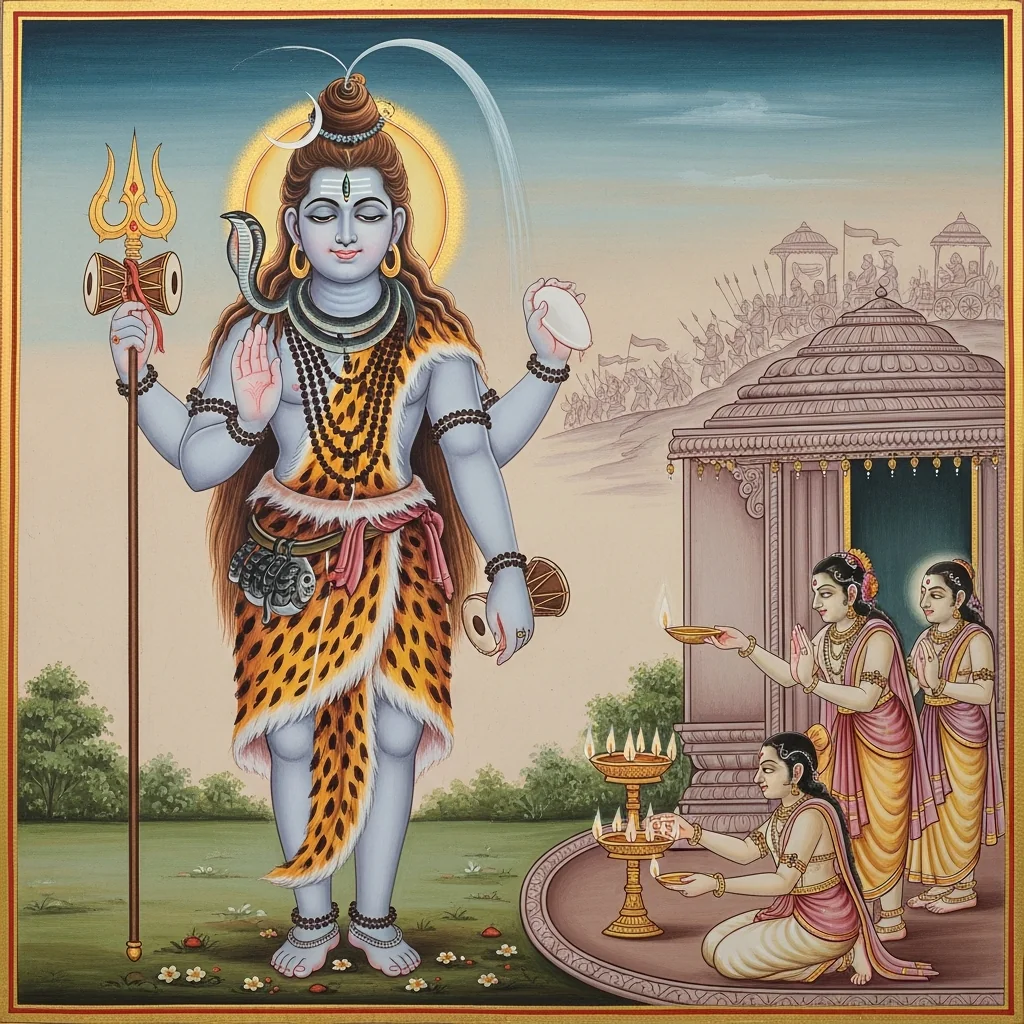
Adhyaya 13
Lomāśa begins by recounting a renewed war between devas and asuras. The daityas gather in vast numbers with varied mounts, weapons, and aerial vehicles, while the devas—strengthened by amṛta—prepare under Indra and pray for auspicious victory. A fierce battle follows, vividly marked by arrows, tomara and nārāca, shattered standards, and severed bodies, until the devas gain the upper hand. The narrative then turns to doctrine in the setting of the Rahu–Candra episode, declaring Śiva the universal support and beloved of both suras and asuras. Śiva’s sacred motifs are recalled: his becoming Nīlakaṇṭha through the Kālakūṭa event and the origin of the muṇḍamālā, along with the teaching that Śiva-bhakti equalizes all, beyond social rank. The latter half is strongly prescriptive: it extols Kārttika dīpadāna before the liṅga, specifies oils/ghṛta and their fruits, praises daily ārātrika with camphor and incense, and codifies Śaiva conduct—rudrākṣa types (notably ekamukha and pañcamukha), their power to amplify rites, and methods of applying vibhūti and tripuṇḍra. The chapter closes by returning to the war: Indra duels Bali, Kālanemi arises with boon-backed invincibility, and Nārada urges remembrance of Viṣṇu; the devas hymn him, and Viṣṇu appears on Garuḍa to challenge Kālanemi to battle.
Shlokas
Verse 1
लोमश उवाच । ततस्ते गर्ज्जमानाश्च आक्षिपंतः सुरान्रणे । शतक्रतुप्रमुख्यांस्तन्महाबलपराक्रमान्
Lomaśa said: Then, roaring, they assailed the Devas in battle—those mighty and valiant ones headed by Śatakratu (Indra).
Verse 2
विमानमारुह्य तदा महात्मा वैरोचनिः सर्वबलेन सार्द्धम् । दैत्यैः समेतो विविधैर्महाबलैः सुरान्प्रदुद्राव महाभयावहम्
Then the great Vairocani, mounting a vimāna with his entire force, and accompanied by many mighty Daityas, drove the Devas into flight, bringing about great terror.
Verse 3
स्वानि रूपाणि बिभ्रंतः समापेतुः स हस्रशः । केचिद्व्याघ्रान्समारूढा महिषांश्च तथा परे
Assuming their own forms, they gathered by the thousands. Some mounted tigers, and others likewise rode buffaloes.
Verse 4
अश्वान्केचित्समारूढा द्विपान्केचित्तथा परे । सिंहांस्तथा परे रूढाः शार्दूलाञ्छरभांस्तथा
Some mounted horses; some, elephants; others rode lions, and likewise tigers and even śarabhas.
Verse 5
मयूरान्राजहंसांश्च कुक्कुटांश्च तथा परे । केचिद्धयान्समारूढा उष्ट्रानश्वतरानपि
Others rode peacocks, royal swans, and even cocks. Some mounted steeds, and even camels and mules as well.
Verse 6
गजान्खरान्परे चैव शकटांश्च तथा परे । पादाता बहवो दैत्याः खङ्गशक्त्यृष्टिपाणयः
Others had elephants and asses, and others still had carts. Many Daityas fought on foot, holding swords, javelins, and spears in their hands.
Verse 7
परिघायुधिनः पाशशूलमुद्गरपाणयः । असिलोमान्विताः केचिद्भुशुंडीपरिघायुधाः
Some bore iron clubs as their weapons; others held nooses, tridents, and hammers. Some were clad in sword-like mail, and some carried bhuśuṇḍīs and heavy clubs as their arms.
Verse 8
हयनागरथाश्चान्ये समारूढाः प्रहारिणः । विमानानि समारूढा बलिमुख्याः सहस्रशः
Others, mounted on horses, elephants, and chariots, struck fiercely. And by the thousands, leaders headed by Bali mounted vimānas as well.
Verse 9
स्पर्द्धमानास्ततान्योन्यं गर्जंतश्च मुहुर्मुहुः । वृषपर्वा ह्युवा चेदं बलिनं दैत्यपुंगवम्
Rivalling one another and roaring again and again, Vṛṣaparvan and other youthful chiefs addressed Bali, that mighty bull among the Dānavas.
Verse 10
त्वया कृतं महाबाहो इंद्रेण सह संगमम् । विश्वासो नैव कर्तव्यो दुर्हृदा च कथंचन
O mighty-armed one, you have forged an alliance with Indra; yet one should never place trust in an enemy of hostile heart—by any means.
Verse 11
ऊनेनापि हि तुच्छेन वैरिणापि कथंचन । मैत्री बुद्धिमता कार्या आपद्यपि निवर्तते
Even with one inferior or insignificant—even with an enemy—the wise may forge friendship, for in times of calamity it can turn danger back.
Verse 12
न विश्वसेत्पूर्वविरोधिना क्वचित्पराजिताः स्मोऽथ बले त्वयाधुना । पुराणदुष्टाः कथमद्य वै पुनर्मंत्रं विकर्तुं न च ते यतेरन्
One should never trust a former adversary. We were once defeated, but now we stand strong through your power. Those wicked from of old—how would they not even today strive again to overturn our counsel and plans?
Verse 13
इत्यूचुस्ते दुराधर्षा योद्धुकामा व्यवस्थिताः । ध्वजैश्छत्रैः पताकैश्च रणभूमिममंडयन्
So spoke those unassailable warriors, arrayed and eager to fight; with banners, parasols, and pennants they adorned the battlefield.
Verse 14
चामरैश्च दिशः सर्वा लोपितं च रणस्थलम् । तथा सर्वे सुरास्तत्र दैत्यान्प्रति समुत्सुकाः
With yak-tail fans (cāmara) the directions seemed veiled, and the battlefield was obscured. There, all the Devas were eager to confront the Daityas.
Verse 15
पीत्वामृतं महाभागा वाहान्यारुह्य दंशिताः । गजारूढो महेंद्रोपि वज्रपाणिः प्रतापवान् । सूर्यश्चोच्चैः श्रवारूढो मृगा रूढश्च चन्द्रमाः
The blessed, having drunk the nectar and mounting their steeds, stood armed and ready. Great Indra too, the mighty bearer of the Vajra, rode upon an elephant. Sūrya rode upon Uccaiḥśravas, and Candra rode upon a deer.
Verse 16
छत्रचामरसंवीताः शोभिता विजयश्रिया । प्रणम्य विष्णुं ते सर्व इंद्राद्या जयकांक्षिणः
Surrounded by parasols and yak-tail fans, radiant with the splendor of victory, all of them—Indra and the rest—bowed to Viṣṇu, yearning for triumph.
Verse 17
ते विष्णुना ह्यनुज्ञाता असुरान्प्रति वै रुषा । असुराश्च महाकाया भीमाक्षा भीमविक्रमाः
Granted leave by Viṣṇu, they advanced against the Asuras in wrath. And the Asuras too were of massive bodies, with fearsome eyes and dreadful might.
Verse 18
तेषां बोरमभूद्युद्धं देवानां दानवैः सह । तुमुलं च महाघोरं सर्वभूतभयावहम्
Then their war broke out—of the Devas together with the Dānavas—clamorous and exceedingly dreadful, bringing fear to all beings.
Verse 19
शरधारान्वितं सर्वं बभूव परमाद्भुतम् । ततश्च टचटाशब्दा बभूवुश्च दिशोदश
Everything became wondrous indeed, filled with torrents of arrows; and then, in all ten directions, the clattering “ṭacaṭā” sounds arose.
Verse 20
ततो निमिषमात्रेण शरघातयुता भवन् । शरतोमरनाराचैराहताश्चापतन्भुवि
Then, in but a moment, the onslaught of arrows grew fierce; struck by arrows, javelins, and iron shafts, they fell upon the ground.
Verse 21
विध्यमानास्तथा केचिद्विविधुश्चापरान्रणे । भल्लैर्भग्नाश्च पतिता नाराचैः शकलीकृताः
Some, though being pierced, struck down others in the fight; some were shattered by barbed arrows and fell, and others were cut to pieces by iron shafts.
Verse 22
क्षुरप्रहारिताः केचिद्दैत्या दानवराक्षसाः । शिलीमुखैर्मारिताश्च भग्नाः केचिच्च दानवाः
Some Daityas, Dānavas, and Rākṣasas were struck by razor-edged missiles; others were slain by śilīmukha arrows, and some Dānavas were broken and routed.
Verse 23
एवं भग्नं दानवानां च सैन्यं दृष्ट्वा देवा गर्जमानाः समंतात् । हृष्टाः सर्वे संमिलित्वा तदानीं लब्ध्वा युद्धे ते जयं श्लाघयन्ते
Seeing the Dānavas’ army thus shattered, the Devas roared on all sides; all rejoiced, gathered together at that time, and—having gained victory in battle—proclaimed their triumph.
Verse 24
शंखवादित्रघोषेण पूरितं च जगत्त्रयम् । देवान्प्रति कृतामर्षा दानवास्ते महाबलाः
With the blare of conches and instruments, the three worlds were filled; but those mighty Dānavas, enraged against the Devas, grew fierce again.
Verse 25
बलिप्रभृतयः सर्वे संभ्रमेणोत्थिताः पुनः । विमानैः सूर्यसंकासैरनेकैश्च समन्विताः
Bali and the others rose up again in agitation, attended by many vimānas—celestial chariots radiant like the sun.
Verse 26
द्वंद्वयुद्धं सुतुमुलं देवानां दानवैः सह । संप्रवृत्तं पुनश्चैव परस्परजिगीषया
A fiercely tumultuous duel-battle between the Devas and the Dānavas began again, each side longing to conquer the other.
Verse 27
बलिना दानवेंद्रेण महेंद्रो युयुधे तदा । तथा यमो महाबाहुर्नमुच्या सह संगतः
Then Mahendra fought with Bali, the lord of the Dānavas; likewise mighty-armed Yama engaged in combat with Namuci.
Verse 28
नैरृतः प्रघसेनैव पाशी कुंभेन संगतः । निकुंभेनैव सुमहद्युद्धं चक्रे सदारयः
Nairṛta met Praghasena in battle; the wielder of the noose (pāśa) confronted Kumbha; and Sādāraya waged a very great fight with Nikumbha.
Verse 29
सोमेन सह राहुश्च युद्धं चक्रे सुदारुणम् । राहुणा चन्द्रदेहोत्थममृतं भक्षितं तदा । संपर्कादमृस्यैव यथा राहुस्तथाऽभवत्
Rāhu fought a most terrible battle with Soma (the Moon). At that time Rāhu swallowed the amṛta, the nectar that had arisen from the Moon’s very body; and by that contact with the nectar, Rāhu became as he is—immortal in form, yet ever opposed to the Moon.
Verse 30
तानि सर्वाणि दृष्टानि शंभुना परमेष्ठिना । आश्रयोऽहं च सर्वेषां भूतानां नात्र संशयः । असुराणां सुराणां च सर्वेषामपि वल्लभः
All those events were beheld by Śambhu, the Supreme Lord. “I am the refuge of all beings—of this there is no doubt. To asuras and to devas alike, I am dear to all.”
Verse 31
एवमुक्तस्तदा राहुः प्रणम्य शिरसा शिवम् । मौलौ स्थितस्तदा चंद्रो अमृतं व्यसृजद्भयात्
Thus addressed, Rāhu bowed with his head to Śiva. Thereupon the Moon, stationed upon Śiva’s crown, released the nectar (amṛta) out of fear.
Verse 32
तेन तस्य हि जातानि शिरांसि सुबहून्यपि । एकपद्येन तेषां च स्रजं कृत्वा मनोहराम् । बबंध शंभुः शिरसि शिरोभूषणवत्कृतम्
From that, indeed, many heads came into being for him. And with a single garland-string, Śambhu fashioned those heads into a charming wreath and bound it upon His own head like a crown-ornament.
Verse 33
अशनात्कालकूटस्य नीलकंठोऽभवत्तदा । देवानां कार्यसिद्ध्यर्थं मुंडमाला तथा कृता
By swallowing the Kālakūṭa poison, He then became Nīlakaṇṭha, the Blue-throated One. And for the fulfillment of the gods’ purpose, the muṇḍamālā—the garland of skulls—was likewise made.
Verse 34
दधार शिरसा तां च मुण्डमालां महेश्वरः
And Maheśvara bore that muṇḍamālā, the garland of skulls, upon His head.
Verse 35
तया स्रजाऽसौ शुशुभे महात्मा देवादिदेवस्त्रिपुरांतको हरः । गजासुरो येन निपातितो महानथांधको येन कृतश्च चूर्णः
Adorned with that garland, the great-souled Hara—God of gods, the destroyer of Tripura—shone resplendently: He by whom the mighty Gajāsura was felled, and He by whom Andhaka was crushed to dust.
Verse 36
गंगा धृता येन शिरस्सुमध्ये चंद्रं च चूडे कृतवान्भयापहः । वेदाः पुराणानि तथागमाश्च तथैव नानाश्रुतयोऽथ शास्त्रम्
He who held the Gaṅgā in the midst of His head, and who placed the Moon upon His crest—He, the remover of fear. The Vedas, the Purāṇas, the Āgamas, and likewise the many sacred traditions and treatises (all proclaim Him).
Verse 37
जल्पंति नानागमभेदैर्मीमांसमानाश्च भवंति मूकाः । नानागमार्चायमतप्रभेदैर्निरूप्यमाणो जगदेकबंधुः
People prattle on, dividing the traditions into many Āgamas; and those who merely dispute and analyze become mute (before the Truth). Though described through many Āgamic forms of worship and differing doctrinal views, He remains the one Friend of the world.
Verse 38
शिवं हि नित्यं परमात्मदैवं वेदैकवेद्यं परमात्मदिव्यम् । विहाय तं मूढजनाः प्रमत्ताः शिवं न जानंति परात्मरूपम्
Śiva is eternal—the Supreme Self, the Divine—knowable through the Veda alone, the radiant Supreme Reality. Yet, abandoning Him, deluded and heedless people do not recognize Śiva in His form as the Highest Self.
Verse 39
येनैव सृष्टं विधृतं च येन येन श्रितं येन कृतं समग्रम् । यस्यांशभूतं हि जगत्कदाचिद्वेदांतवेद्यः परमात्मा शिवश्च
He by whom this universe is created, by whom it is sustained, in whom it abides, and by whom the whole of it is fashioned—of whom, indeed, the world is at times but a portion—He is Śiva, the Supreme Self, known through the teaching of the Vedānta.
Verse 40
आढ्यो वापि दरिद्रो वा उत्तमो ह्यधमोऽपि वा । शिवभक्तिरतो नित्यं शिव एव न संशयः
Whether wealthy or poor, noble or lowly—whoever is ever absorbed in Śiva-bhakti is truly Śiva himself; of this there is no doubt.
Verse 41
यो वा परकृतां पूजां शिवस्योपरि शोभिताम् । दृष्ट्वा संतोषमायाति दायं प्राप्नोति तत्समम्
Whoever, upon seeing another’s splendid worship offered to Śiva, feels sincere joy—obtains a share of merit equal to that act of worship.
Verse 42
ये दीपमालां कुर्वंति कार्तिक्यां श्रद्धयान्विताः । यावत्कालं प्रज्वलंति दीपास्ते लिंगमग्रतः । तावद्युगसहस्राणि दाता स्वर्गे महीयते
Those who, with faith, arrange a garland of lamps in the month of Kārttika before the Śiva-liṅga—so long as those lamps continue to burn, for that many thousands of yugas the donor is honored in heaven.
Verse 43
कौसुंभतैलसंयुक्ता दीपा दत्ताः शिवालये । दातारस्तेऽपि कैलासे मोदन्ते शिवसंनिधौ
Lamps offered in a Śiva-temple filled with safflower oil—those donors, too, rejoice on Kailāsa in the very presence of Śiva.
Verse 44
अतसीतैलसंयुक्ता दीपा दत्ताः शिवालये । ते शिवं यांति संयुक्ताः कुलानां च शतेन वै
Lamps offered in a Śiva-temple filled with linseed (atasī) oil—those donors attain Śiva, accompanied indeed by a hundred generations of their family.
Verse 45
ज्ञानिनोऽपि हि जायंते दीपदानफलेन हि
Through the fruit of offering lamps, even the wise and the enlightened are born; such merit brings forth spiritual wisdom.
Verse 46
तिलतैलेन संयुक्ता दीपा दत्ताः शिवालये । ते शिवं यांति संयुक्ताः कुलानां च शतेन वै
Lamps filled with sesame oil and offered in a Śiva-temple—those donors attain Śiva, accompanied indeed by a hundred generations of their family.
Verse 47
घृताक्ता यैः कृता दीपा दीपिताश्च शिवालये । ते यांति परमं स्थानं कुललक्षसमन्विताः
Those who prepare lamps anointed with ghee and light them in a Śiva-temple reach the supreme abode, accompanied by a lakṣa (a hundred thousand) of their family line.
Verse 48
कर्पूरागुरुधूपैश्च ये यजंति सदा शिवम् । आरार्तिकां सकर्प्पूरां ये कुर्वंति दिनेदिने । ते प्राप्नुवंति सायुज्यं नात्र कार्या विचारणा
Those who ever worship Śiva with fragrant offerings of camphor and aguru-incense, and those who perform daily ārati with camphor—such devotees attain sāyujya, complete union with the Lord; of this there is no need for doubt or debate.
Verse 49
एककालं द्विकालं वा त्रिकालं ये ह्यतंद्रिताः । लिंगार्चनं प्रकुर्वंति ते रुद्रा नात्र संशयः
Those who, without negligence, worship the Śiva-liṅga once, twice, or three times a day become Rudras themselves; of this there is no doubt.
Verse 50
रुद्राक्षधारणं ये च कुर्वंति शिवपूजने । दाने तपसि तीर्थे च पर्वकाले ह्यतंद्रिताः । तेषां यत्सुकृतं सर्वमनंतं भवति द्विजाः
O twice-born, those who diligently wear rudrākṣa beads during Śiva-worship, charity, austerity, at sacred fords, and on festival times—whatever merit they perform becomes endless.
Verse 51
रुद्राक्षा ये शिवेनोक्तास्ताच्छृणुध्वं द्विजोत्तमाः । आरम्भैकमुखं तावद्याबद्वक्त्राणि षोडश । एतेषां द्वौ च विज्ञेयौ श्रेष्ठौ तारयितुं द्विजाः
O best of the twice-born, hear of the rudrākṣas spoken of by Śiva: beginning with the one-faced and extending up to sixteen-faced. Among these, two are to be known as supreme for granting deliverance, O brāhmaṇas.
Verse 52
रुद्राक्षाणां पंचमुखखस्तथा चैकमुखः स्मृतः । ये धारयंत्येकमुखं रुद्राक्षमनिशं नराः । रुद्रलोकं च गच्छंति मोदन्ते रुद्रसंनिधौ
Among rudrākṣas, the five-faced and also the one-faced are especially remembered. Men who continually wear the one-faced rudrākṣa go to Rudra’s world and rejoice in Rudra’s presence.
Verse 53
जपस्तपः क्रिया योगः स्नानं दानार्चनादिकम् । क्रियते यच्छृभं कर्म्म ह्यनंतं चाक्षधारणात्
Japa, austerity, ritual action, yoga, bathing, charity, worship, and the like—whatever auspicious act is performed becomes inexhaustible through the wearing of rudrākṣa.
Verse 54
शुनः कंठनिबद्धोऽपि रुद्राक्षो यदि वर्तते । सोऽपि संतारितस्तेन नात्र कार्या विचारणा
Even if a rudrākṣa is tied around a dog’s neck, that being too is carried across (saved) by it—there is no need for doubt or further debate here.
Verse 55
तथा रुद्राक्षसंबंधात्पापमपिक्षयं व्रजेत् । एवं ज्ञात्वा शुभं कर्म कार्यं रुद्राक्षबंधनात्
Likewise, through association with rudrākṣa, even sin goes to destruction. Knowing this, one should perform auspicious deeds while wearing rudrākṣa.
Verse 56
त्रिपुण्ड्रधारणं येषां विभूत्वा मन्त्रपूतया । ते रुद्रलोके रुद्राश्च भविष्यंति न संशयः
Those who wear the Tripuṇḍra with vibhūti purified by mantra—such persons, in Rudra’s world, become Rudras; there is no doubt.
Verse 57
कपिलायाश्च संगृह्य गोमयं चांतरिक्षगम् । शुष्कं कृत्वाथ संदाह्यं विभूत्यर्थं शिवप्रियैः
Śiva’s beloved devotees should collect the dung of a tawny (kapilā) cow, dry it, and then burn it, in order to prepare vibhūti, the sacred ash.
Verse 58
विभूतीति समाख्याता सर्वपापप्रणाशिनी । ललाटेंऽगुष्ठरेखा च आदौ भाव्या प्रयत्नतः
It is called “vibhūti,” and it destroys all sins. At the outset, one should carefully make the thumb-mark (line) upon the forehead.
Verse 59
मध्यमां वर्जयित्वा तु अंगुलीक्द्वयेन च । एवं त्रिरेखासंयुक्तो ललाटे यस्य दृश्यते । स शैवः शिववज्ज्ञेयो दर्शनात्पापनाशनः
Leaving aside the middle finger and using two fingers, one who is seen to bear on the forehead the mark joined with three lines should be known as a Śaiva—indeed, like Śiva; merely by beholding him, sins are destroyed.
Verse 60
जटाधराश्च ये शैवाः सप्त पंच तथा नव । जटा ये स्थापियिष्यंति शैवेन विधिना युताः
Those Śaivas who bear jaṭās, the matted locks—seven, five, or nine (in number); and those who will set their jaṭās in accordance with the Śaiva rule—
Verse 61
ते शिवं प्राप्नुवं तीह नात्र कार्या विचारणा । रुद्राक्षधारणं कार्यं शिवभक्तैर्विशेषतः
They attain Śiva here (and hereafter); of this there is no need for doubt. Rudrākṣa should certainly be worn—especially by devotees of Śiva.
Verse 62
अल्पेन वा महत्त्वेन पूजितो वा सदाशिवः । कुलकोटिं समुद्धृत्य शिवेन सह मोदते
Whether worshipped with little or with great offerings, Sadāśiva—having uplifted crores of one’s lineage—rejoices together with Śiva.
Verse 63
तस्माच्छिवात्परतरं नास्ति किंचिद्द्विजोत्तमाः । यदैवमुच्यते शास्त्रे तत्सर्वं शिवकारणम्
Therefore, O best of the twice-born, there is nothing higher than Śiva. Whatever is thus declared in the scriptures—all of it has Śiva as its cause.
Verse 64
शिवो दाता हि लोकानां कर्ता चैवानुमोदिता । शिवशक्त्यात्मकं विश्वं जानीध्वं हि द्विजोत्तमाः
Śiva is indeed the giver to the worlds, and also the doer and the one who grants approval. Know, O best of the twice-born, that the universe is of the nature of Śiva and Śakti.
Verse 65
शिवेति द्व्यक्षरं नाम त्रायते महतो भयात् । तस्माच्छिवश्चिंत्यतां वै स्मर्यतां च द्विजोत्तमाः
The two-syllabled name “Śiva” delivers one from great fear. Therefore, O best of the twice-born, let Śiva be contemplated and remembered.
Verse 66
ऋषय ऊचुः । सोमनाथस्य माहात्म्यं ज्ञातं तस्य प्रसादतः । राहोः शिरोभयात्सर्वे रक्षिताः परमेष्ठिना
The sages said: “Through your grace we have understood the greatness of Somanātha. From the fear of Rāhu’s head, all were protected by Parameṣṭhin (Brahmā).”
Verse 67
सुराश्चेंद्रादयश्चान्ये तस्मिन्युद्धे सुदारुणे । अत ऊर्ध्वं सुराः सर्वे किमकुर्वत उच्यताम्
“And the gods—Indra and the others—during that exceedingly dreadful battle: thereafter, what did all the gods do? Please tell.”
Verse 68
शिवस्य महिमा सर्वः श्रुतस्तव मुखोद्गतः । अथ युद्धस्य वृत्तान्तः कथ्यतां परमार्थतः
“We have heard the entire greatness of Śiva as it issued from your mouth. Now, please narrate the true account of the battle in its real purport.”
Verse 69
लोमश उवाच । यदा हि दैत्यैश्च पराजिताः सुराः शम्भुं च सर्वे शरणं प्रपन्नाः । शिवं प्रणेमुः सहसा सुरोत्तमा युद्धाय सर्वे च मनो दधुस्तदा
Lomaśa said: When the gods had been defeated by the Daityas, all of them sought refuge in Śambhu. The foremost of the devas at once bowed to Śiva, and then they all set their minds upon battle.
Verse 70
तथैव दैत्या अपि युध्यमाना उत्साहयुक्तातिबलाश्च सर्वे । देवैः समेताश्च पुनः पुनश्च युद्धं प्रचक्रुः परमास्त्रयुक्ताः
Likewise the Daityas, fighting on with zeal and surpassing might, again and again joined battle with the gods, armed with supreme missiles.
Verse 71
एवं च सर्वे ह्यसुराः सुराश्च शक्त्यृष्टिशूलैः परिघैः परश्वधैः । जयार्थिनोमर्षयुताः परस्परं सिंहा यथा हैमवतीं दुरात्ययाः । निहन्यमाना ह्यसुराः सुरैस्तदा नानास्त्रयोगैः परमैर्निपेतुः
Thus all the Asuras and the Suras fought with spears, javelins, tridents, clubs, and axes—seeking victory and filled with fierce wrath—clashing like lions in the hard-to-cross Himalayan region. Then, struck down by the gods with many combinations of supreme weapons, the Asuras fell.
Verse 72
चक्रुस्ते सकलामुर्वी मांसशोणितकर्दमाम् । महीं वृक्षाद्रिसंयुक्तां ससागरवनाकराम्
They turned the whole earth into mire of flesh and blood—this very world with its trees and mountains, with its oceans, forests, and mines.
Verse 73
शिरांसि च कबन्धानि कवचानि महांति च । ध्वजारथाः पताकाश्च गजवाजिशिरांसि च
Heads and headless trunks, great armors, chariots bearing banners and flags—and the heads of elephants and horses as well—lay strewn about.
Verse 74
बहन्त्यश्चापगा ह्यासन्नद्यो भीरुभयावहाः । अगाधाः शोणितोदाश्च तरंतो ब्रह्मराक्षसाः । तयंति परान्भूतप्रतप्रमथराक्षसान्
Rivulets and rivers flowed there, terrifying to the timid—deep streams whose waters were blood. Brahma-rākṣasas swam across, and they tormented other beings: fierce bhūtas, pramathas, and rākṣasas.
Verse 75
शाकिनीडाकिनीसंघा यक्षिण्योऽथ सहस्रशः । नानाकेलिषु संयुक्ताः परस्परमुदान्विताः
Hosts of Śākinīs and Ḍākinīs, and Yakṣiṇīs by the thousand, joined in many frenzied sports, exulting among themselves.
Verse 76
एवं संक्रीडमानास्ते भूतप्रमथराक्षसाः । रणे तस्मिन्महारौद्रे देवासुरसमागमे
Thus those bhūtas, pramathas, and rākṣasas sported about in that battle—most dreadful—when devas and asuras met in combat.
Verse 77
बलिना सह देवेन्द्रो युयुधेऽद्भुतविक्रमः । शक्त्या जघान देवेंद्रं वैरोचनिरमर्षणः
Indra, lord of the devas, of wondrous valor, fought with Bali. Then Virocani (Bali), unendurable in wrath, struck Indra with a spear.
Verse 78
तां शक्तिं वञ्चयामास महेन्द्रो लघुविक्रमः । जघान स बलिं यत्नाद्दैत्येंद्रं परमेण हि
Mahendra, swift in prowess, evaded that spear. Then with determined effort he struck down Bali, the lord of the Daityas, with a supreme blow.
Verse 79
वज्रेण शितधारेण बाहुं चिच्छेद विक्रमी । गातासुरपतद्भूमौ विमानात्सूर्यसंन्निभात्
With the sharp-edged thunderbolt, the valiant one severed his arm; and the lord of the Asuras fell to the ground from his sun-bright aerial car.
Verse 80
पतितं च बलिं दृष्ट्वा वृषपर्वा रूपान्वितः । ववर्ष शरधाराभिः पयोद इव पर्वतम्
Seeing Bali fallen, Vṛṣaparvan—splendid in form—rained down torrents of arrows, like a rain-cloud showering a mountain.
Verse 81
महेंद्रं सगजं चैव सहमानं शिताञ्छरान् । तदा युद्धमभूद्वोरं महेन्द्रवृषपर्वणोः
Then there was a dreadful battle between Mahendra (Indra) and Vṛṣaparvan—Indra with his elephant, enduring the sharp arrows.
Verse 82
निपात्य वृषपर्वाणमिंद्रः परबलार्दनः
Having struck down Vṛṣaparvan, Indra—the crusher of enemy forces—prevailed.
Verse 83
ततो वज्रेण महता दानवानवधीद्रणे । शिरसि च्छेदिताः केचित्केचित्कंधरतो हताः
Then, with the mighty thunderbolt, he slew the Dānavas in battle—some were beheaded, and others were struck down at the neck and shoulders.
Verse 84
विह्वलाश्च कृताः केचिदिंद्रेण कुपितेन च । तथा यमेन निहता वायुना वरुणेन च
Some were left stunned by Indra in his wrath; likewise others were slain by Yama, by Vāyu, and by Varuṇa.
Verse 85
कुबेरेण हताश्चान्ये नैरृतेन तथा परे । अग्निना निहताः केचिदीशेनैव विदारिताः
Others were slain by Kubera, and others by Nairṛta; some were struck down by Agni, and some were torn asunder by Īśa himself.
Verse 86
एवं तदा तैर्निहता बलीयसो महासुरा विक्रमशानिनश्च । सुरैस्तु सर्वैः सह लोकपालैः शिवप्रसादा भिहतास्तदानीम्
Thus at that time the mighty, heroic great Asuras were slain—by all the gods together with the Lokapālas—through the grace of Śiva.
Verse 87
ततो महादैत्यवरो दुरात्मा स कलानेमिः परमास्त्रयुक्तः । ययौ तदानीं सुरसत्तमांस्तान्हंतुं सदा क्रूरमतिः स एकः
Then that wicked, foremost of the great Daityas—Kalānemi, armed with supreme weapons—advanced alone, ever cruel of intent, to slay those best of the gods.
Verse 88
सिंहारूढो दंशितश्च त्रिशुलेन हि संयुतः । दैत्यानामर्बुदेनैव सिंहारूढेन संवृतः
Mounted upon a lion and clad in armour, wielding a trident, he was surrounded by a vast multitude of Daityas—also lion-mounted.
Verse 89
ते सिंहा दंशिताः सर्वे महाबलपराक्रमाः । तेषु सिंहेषु चारूढा महादैत्याश्च तत्समाः
All those lions were armed and accoutred, mighty in strength and prowess; and mounted upon those lions were great Dānavas (Daityas), matching them in ferocity.
Verse 90
आयांतीं दैत्यसेनां तां सर्वां सिंहविभूषिताम् । कालनेमियुतां दृष्ट्वा देवा इंद्रपुरोगमाः । भयमाजग्मुरतुलं तदा ध्यानपरा भवन्
Seeing that Daitya host approaching—wholly adorned with lions—and accompanied by Kālanemi, the Devas led by Indra were seized by incomparable fear; then they became intent on meditation.
Verse 91
किं कुर्मोऽद्य वयं सर्वे कथं जेष्याम चाद्भुतम् । एतादृशमसंख्याकमनीकं सिंहसंवृतम्
“What shall we do today, all of us? How could we possibly conquer this astounding force—such a countless host, surrounded by lions?”
Verse 92
एवं विचिंत्यमानास्ते ह्यागतस्तत्र नारदः । नारदेन च तत्सर्वं पुरावृत्तं महत्तरम्
As they were thus deliberating, Nārada arrived there; and through Nārada, the entire weighty account of what had happened before was related.
Verse 93
कथितं च महेंद्राय कालनेमेस्तपोबलम् । अजेयत्वं च संग्रामे वरदानबलेन तु
And to great Indra was explained Kālanemi’s power gained from austerities, and also his invincibility in battle, arising from the strength of a boon.
Verse 94
विष्णुं विना वयं देवा अशक्ता रणमंडले । जेतुं च स ततो विष्णुः स्मर्यतां परमेश्वरः । तमालनीलो वरदः सर्वैर्विजयकांक्षिभिः
“Without Viṣṇu, we Devas are powerless on the field of battle. Therefore let Viṣṇu—the Supreme Lord—be remembered: dark as the tamāla tree, the granter of boons, to be invoked by all who seek victory.”
Verse 95
नारदस्य वचः श्रुत्वा तदा देवास्त्वरान्विताः । ध्यानेन च महाविष्णुं ततः परबलार्द्दनम् । स्मरंतः परमात्मानमिदमूचुश्च तं विभुम्
Hearing Nārada’s words, the Devas—filled with urgency—meditated upon Mahāviṣṇu, the crusher of the enemy’s strength; remembering the Supreme Self, they spoke these words to that all-pervading Lord.
Verse 96
देवा ऊचुः । नमस्तुभ्यं भगवते नमस्ते विश्वमंगलम् । श्रीनिवास नमस्तुभ्यं श्रीपते ते नमोनमः
The Devas said: “Salutations to You, O Blessed Lord; salutations to You, the auspiciousness of the whole universe. O Śrīnivāsa, salutations to You; O Lord of Śrī, again and again we bow to You.”
Verse 97
अद्यास्मान्भयभीतांस्त्वं कालनेमिभयार्दितान् । त्रातुमर्हसि दैत्याच्च देवानामभयप्रद
“Today, you ought to protect us—terrified and tormented by fear of Kālanemi—from the Daitya; O giver of fearlessness to the Devas!”
Verse 98
एवं ध्यातः संस्मृतश्च प्रादुर्भूतो हरिस्तदा । नीलो गरुडमारुह्य जगतामभयप्रदः
Thus meditated upon and remembered, Hari then manifested—dark-hued—mounting Garuḍa, the giver of fearlessness to the worlds.
Verse 99
चक्रपाणिस्तदायातो देवानां विजयाय च । गगनस्थं महाविष्णुं गरुडोपरि संस्थितम् । श्रीवासमेनं दुर्द्धर्षं योद्धुकामं ददर्शिरे
Then the Discus-bearing Lord arrived for the victory of the gods. They beheld Mahāviṣṇu stationed in the sky, seated upon Garuḍa—Śrīvāsa (the abode of Śrī), unconquerable, and eager for battle.
Verse 100
तथा दृष्ट्वा कालनेमिस्तदानीं प्रहस्यमानोऽतिरुषा बलान्वितः । कस्त्वं महाभाग वरेण्यरूपः श्यामो युवा वारणमत्तविक्रमः । करे गृहीतं निशितं महाप्रभं चक्रं च कस्मात्कथयस्व मे प्रभो
Seeing him thus, Kālanemi—laughing scornfully, filled with fierce anger and strength—said: “Who are you, O fortunate one of admirable form—dark-hued, youthful, with the might of an intoxicated elephant? And why do you hold in your hand that sharp, splendid discus? Tell me, O lord.”
Verse 101
श्रीभगवानुवाच । युद्धार्थमिह चायातो देवानां कार्यसिद्धये । त्वं स्थिरो भव रे मंद दहाम्यद्य न संशयः
The Blessed Lord said: “I have come here for battle, to accomplish the gods’ purpose. Stand firm, O fool—I shall burn you today; of this there is no doubt.”
Verse 102
श्रुत्वा भगवतो वाक्यं कालनेमिः प्रतापवान् । उवाच रुषितो भूत्वा भगवंतमधोक्षजम्
Hearing the Lord’s words, the mighty Kālanemi, becoming enraged, spoke to the Blessed One, the transcendent Adhokṣaja.
Verse 103
मूलभूतो हि देवानां भगवान्युद्धदुर्मदः । युद्धं कुरु मया सार्द्धं यदि शूरोऽसि संप्रति
“You are indeed the very root-support of the gods, O Lord—mad with the pride of battle! Fight with me, if you are truly a hero now.”
Verse 104
प्रहस्य भगवान्विष्णुरुवाचेदं महाप्रभः । गगनस्थो भव त्वं हि महीस्थोऽहं भवामि वै
Smiling, the mighty Lord Viṣṇu said: “You remain in the sky indeed; I shall stay upon the earth.”
Verse 105
अप्रशस्तं च विषमं युद्धं चैव यथा भवेत् । तथा कुरु महाबाहो गगनो वा महीतले
Let the battle be neither improper nor unfair. Fight accordingly, O mighty-armed one—whether in the sky or on the earth.
Verse 106
तथेति मत्वा हि महानुभावो दैत्यैः समेतोऽर्बुदसंख्यकैश्च । सिंहोपरिस्थैश्च महानुभावैर्महाबलैः क्रूरतरैस्तदानीम्
Thinking, “So be it,” that great one advanced, accompanied by daityas numbering in the tens of millions—along with mighty, fierce warriors mounted upon lions at that time.
Verse 107
गगनमथ जगाहे मंदमंदं महात्मा ह्यसुरगणसमेतो विश्वरूपं जिघांसुः । त्रिशिखमपरमुग्रं गृह्य संदेशचेष्टादशनविकृतवक्त्रो योद्धुकामो हरिं सः
Then that great asura, joined by hosts of demons and intent on slaying Viṣṇu of universal form, slowly entered the sky. Grasping a supremely dreadful trident, his face distorted in grim gestures, he longed to fight Hari.