Adhyaya 33
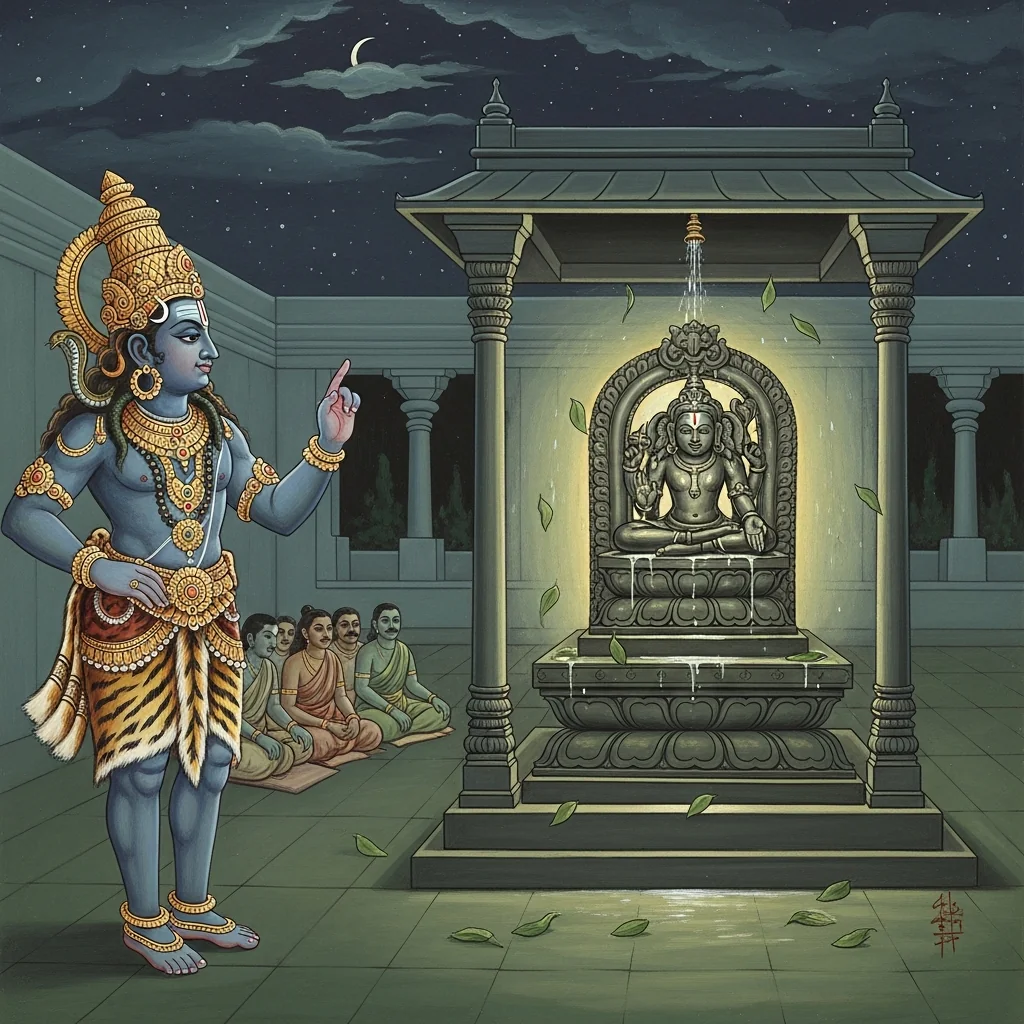
The chapter begins with sages asking Lomāśa to identify a kirāta (hunter) and explain his vow. Lomāśa tells of Caṇḍa, also called Puṣkasena—violent and morally wayward, living by hunting and harming beings. In Māgha, on the kṛṣṇapakṣa-caturdaśī night, he waits in a tree to kill a boar; yet he accidentally cuts and drops bilva leaves, and water from his mouth falls upon a liṅga beneath. Unintentionally, this becomes liṅga-snapana and bilva-arcana, and his wakefulness becomes a Śivarātri vigil. A domestic scene follows: his wife Ghanodarī/Caṇḍī worries through the night, later finds him by a river, and brings food; a dog eats it, stirring anger. Puṣkasena calms himself and teaches about impermanence, relinquishing pride and wrath, so that the night’s fasting and vigil are strengthened by ethical counsel. As amāvasyā approaches, Śiva’s gaṇas arrive in vimānas, declaring that the karmic fruit of this incidental Śivarātri worship grants him nearness to Śiva. When Puṣkasena doubts how a sinful hunter could deserve it, Vīrabhadra explains that bilva offerings, vigil, and upavāsa on Śivarātri uniquely please Śiva. The chapter then unfolds a calendrical-cosmological doctrine—Brahmā’s kālacakra, the structure of tithis, and why the dark-fortnight caturdaśī with niśītha is Śivarātri—praised as sin-destroying and bestowing Śiva-sāyujya. A second example shows another fallen person attaining a higher birth and ultimately liberation through keeping Śivarātri awake near a Śiva shrine and sustaining Shaiva devotion; the chapter closes with Śiva and Pārvatī seen in divine play.
Shlokas
Verse 1
ऋषय ऊचुः । किन्नामा च किरातोऽभूत्किं तेन व्रतमाहितम् । तत्त्वं कथय विप्रेंद्र परं कौतूहलं हि नः
The sages said: “What was the Kirāta’s name, and what vow did he undertake? O best of brāhmaṇas, tell us the truth—our curiosity is great.”
Verse 2
तत्सर्वं श्रोतुमिच्छामो याथातथ्येन कथ्यताम् । न ह्यन्यो विद्यते लोके त्वद्विना वदतां वरः । तस्मात्कथ भो विप्र सर्वं शुश्रूषतां हि नः
We wish to hear all of that; let it be told exactly as it happened. For in this world there is none other, apart from you, who is the best of narrators. Therefore, O brāhmaṇa, relate everything—for we are eager to listen.
Verse 3
एवमुक्तस्तदा तेन शौनकेन महात्मना । कथयामास तत्सर्वं पुष्कसेन कृतं यत्
Thus addressed by the great-souled Śaunaka, he then narrated in full everything that Puṣkasena had done.
Verse 4
लोमश उवाच । आसीत्पुरा महारौद्रश्चडोनाम दुरात्मवान् । क्रूरसंगो निष्कृतिको भूतानां भयवाहकः
Lomaśa said: Long ago there lived a wicked man named Caḍa, fiercely violent—one who kept cruel company, rejected all atonement, and became a source of terror to living beings.
Verse 5
जालेन मत्स्यान्दुष्टात्मा घातयत्यनिशं खलु । भल्लैर्मृगाञ्छापदांश्च कृष्णसारांश्च शल्लकान्
That evil-hearted man, indeed, would ceaselessly kill fish with nets; and with arrows he would strike down deer, wild beasts, blackbuck, and porcupines.
Verse 6
खड्गांश्चैव च दुष्टात्मा दृष्ट्वा कांश्चिच्च पापवान् । पक्षिणोऽघातयत्क्रुद्धो ब्राह्मणांश्च विशेषतः
That wicked sinner, on seeing certain rhinoceroses, would kill them too; and in anger he would strike down birds—and even, most especially, brāhmaṇas.
Verse 7
लुब्धको हि महापापो दुष्टो दुष्टजनप्रियः । भार्या तथाविधआ तस्य पुष्कसस्य महाभया
For he was a hunter—greatly sinful, depraved, and fond of the company of the wicked. His wife too was of the same kind—Puṣkasa’s (Puṣkasena’s) woman, a source of great fear.
Verse 8
एवं विहरतस्तस्य बहुकालोत्यवर्तत । गते बहुतिथेकाले पापौघनिरतस्य च
As he lived in this manner, a long time passed. And when many days had gone by, he remained wholly absorbed in a flood of sin.
Verse 9
निषंगे जलमादाय क्षुत्पिपासार्द्दितो भृशम् । एकदा निशि पापीयाच्छ्रीवृक्षोपरि संस्थितः । कोलं हंतुं धनुष्पाणिर्जाग्रच्चानिमिषेण हि
Carrying water in his quiver and sorely tormented by hunger and thirst, the sinful man once, at night, sat upon the Śrīvṛkṣa tree. Bow in hand, he kept awake without blinking, intent on slaying a boar.
Verse 10
माघमासेऽसितायां वै चतुर्दश्यामथाग्रतः । मृगमार्गविलोकार्थी बिल्वपत्राण्यपातयत्
Then, in the month of Māgha, on the fourteenth day of the dark fortnight, as he peered ahead to spy the animals’ path, he caused bilva leaves to fall.
Verse 11
श्रीवृक्षपर्णानि बहूनि तत्र स च्छेदयामास रुषान्वितोपि । श्रीवृक्षमूले परिवर्तमाने लिंगं तस्योपरिदृष्टभावः
There he cut many leaves of the Śrīvṛkṣa, even though he was filled with anger. And as he shifted about near the tree’s root, a liṅga came into his view beneath him.
Verse 12
ववर्ष गंडूषजलं दुरात्मा यदृच्छया तानि शिवे पतंति । श्रीवृक्षपर्णानि च दैवयोगाज्जातं च सर्वं शिवपूजनं तत्
The wicked man let fall the water held in his mouthful (gaṇḍūṣa), and by mere chance those offerings fell upon Śiva. The leaves of the Śrīvṛkṣa too, by the turning of fate, became—altogether—an act of Śiva-worship.
Verse 13
गंडूषवारिणा तेन स्नपनं च कृतं महत् । बिल्वपत्रैरसंख्यातैरर्चनं महत्कृतम्
With the water held in his mouth he performed an abundant ablution (abhiṣeka); and with countless bilva leaves he carried out a great act of worship (arcana).
Verse 14
अज्ञानेनापि भो विप्राः पुष्कसेन दुरात्मना । माघमासेऽसिते पक्षे चतुर्दश्यां विधूदये
O brāhmaṇas, even unknowingly—through the wicked Puṣkasena—this took place in the month of Māgha, in the dark fortnight, on the fourteenth lunar day, as the moon was rising.
Verse 15
पुष्कसोऽथ दुराचारो वॉक्षादवततार सः । आगत्य जलसंकाशं मत्स्यान्हंतुं प्रचक्रमे
Then Puṣkasa, of wicked conduct, climbed down from a tree; coming to the water-like expanse, he began to kill fish.
Verse 16
लुब्ध कस्यापि भार्याभून्नाम्ना चैव घनोदरी । दुष्टा सा पापनिरता परद्रव्यापहारिणी
A certain hunter had a wife named Ghanodarī; she was depraved, devoted to sin, and a thief of others’ property.
Verse 17
गृहान्निर्गत्य सायाह्ने पुरद्वारबहिः स्थिता । वनमार्गं प्रपश्यंती पत्युरागमनेच्छया
Leaving the house at evening, she stood outside the city gate, looking toward the forest path, longing for her husband’s return.
Verse 18
चिराद्भर्तरी नायाते चिन्तयामास लुब्धकी । अद्य सायाह्नवेलायामागताः सर्वलुब्धकाः
When her husband did not come even after a long time, the hunter’s wife began to worry: “Today, by evening time, all the hunters have returned.”
Verse 19
तमः स्तोमेन संछन्नाश्चतस्रो विदिशो दिशः । रात्रौ यामद्वयं यातं किं मतंगः समागतः
The four directions were shrouded in masses of darkness. Two watches of the night had passed—had an elephant perhaps come upon him?
Verse 20
किं वा केसरलोभेन सिंहेनैव विदारितः । किं भुजंगफणारत्नहारी सर्पविषार्दितः
Or was he torn apart by a lion, greedy for its mane? Or was he afflicted by serpent-venom—he who steals the jeweled gems from a snake’s hood?
Verse 21
किं वा वराहदंष्ट्राग्रघातैः पंचत्वमागतः । मधुलोभेन वृक्षाग्रात्स वै प्रपतितो भुवि
Or did he meet death by the blows of a boar’s tusk-tips? Or, greedy for honey, did he fall from the top of a tree down to the ground?
Verse 22
क्वान्वेषयामि पृच्छामि क्व गच्छामि च कं प्रति । एवं विलप्य बहुधा निवृत्ता स्वं गृहं प्रति
“Where shall I search? Whom shall I ask? Where shall I go, and to whom?”—lamenting thus in many ways, she turned back toward her own house.
Verse 23
नैवान्नं नो जलं किंचिन्न भुक्तं तद्दिने तया । चिंतयंती पतिं चापि लुब्धकी त्वयन्निशाम्
That huntress ate nothing at all that day—neither food nor even water. Thinking only of her husband, she passed the night in anxious waiting.
Verse 24
अथ प्रभाते विमले पुष्कसी वनमाययौ । अशनार्थं च तस्यान्नमादाय त्वरिता सती
At the pure break of dawn, the huntress went into the forest. Bearing food for her husband’s meal, that virtuous woman hastened on.
Verse 25
भ्रममाणावने तस्मिन्ददर्श महतीं नदीम् । तस्यास्तीरे समासीनं स्वपतिं प्रेक्ष्य हर्षिता
Wandering through that forest, she beheld a mighty river. On its bank she saw her own husband seated there, and she was filled with joy.
Verse 26
तदन्नं कूलनः स्थाप्य नदीं तर्तुं प्रचक्रमे । निरीक्ष्य चाथ मत्स्यान्स जालप्रोतान्समानयत्
Placing that food upon the riverbank, he began to cross the river. Then, looking about, he gathered the fish caught fast in his net.
Verse 27
तावत्तयोक्तश्चण्डोऽसावेहि शीघ्रं च भक्षय । अन्नं त्वदर्थमानीतमुपोष्य दिवसं मया
Then she said to Caṇḍa, “Come quickly and eat. I have brought this food for your sake, having fasted through the day.”
Verse 28
कृतं किमद्य रे मंद गतेऽहनि च किं कृतम् । नाऽशितं च त्वया मूढ लंघितेनाद्य पापिना
“What have you done today, you dull one—what have you accomplished as the day has passed? You have not eaten at all, foolish man; today you have transgressed and become blameworthy.”
Verse 29
नद्यां स्नातौ तथा तौ च दम्पती च शुचि व्रतौ । यावद्गतश्च भोक्तुं स तावच्छ्वा स्वयमागतः
Then the husband and wife bathed in the river, both observing pure vows. As soon as he went to eat, a dog arrived there of its own accord.
Verse 30
तेन सर्वं भक्षितं च तदन्नं स्वयमेव हि । चंडी प्रकुपिता चैव श्वानं हंतुमुपस्थिता
That dog, indeed, ate all of that food by itself. Caṇḍī became enraged and stepped forward, ready to kill the dog.
Verse 31
आवयोर्भक्षितं चान्नमनेनैव च पापिना । किं च भक्षयसे मूढ भविताद्य वुभुक्षितः
“This sinner has eaten the food meant for us both! What will you eat now, you fool? Today you are sure to go hungry.”
Verse 32
एवं तयोक्तश्चण्डोऽसौ बभाषे तां शिवप्रियः । यच्छुना भक्षितं चान्नं तेनाहं परितोषितः
Thus addressed, Caṇḍa—dear to Śiva—replied to her: “The food that was eaten by the dog has satisfied me by that very fact.”
Verse 33
किमनेन शरीरेण नश्वरेण गतायुषा । शरीरं दुर्लभं लोके पूज्यते क्षणभंगुरम्
What use is this perishable body, whose lifespan is already slipping away? Though the body is rare to obtain in this world, it is still only momentary and fragile—soon to break.
Verse 34
ये पुष्णंति निजं देहं सर्वभावेन चाहताः । मूढास्ते पापिनो ज्ञेया लोकद्वयबहिष्कृताः
Those who, afflicted in every way, still nourish only their own body with total obsession—know them to be deluded and sinful, cut off from both worlds (here and hereafter).
Verse 35
तस्मान्मानं परित्यज्य क्रोधं च दुरवग्रहम् । स्वस्था भव विमर्शेन तत्त्वबुद्ध्या स्थिरा भव
Therefore, abandon pride and anger—so hard to restrain. By thoughtful reflection, become inwardly steady; with insight into truth, become firmly established.
Verse 36
बोधिता तेन चंडी सा पुष्कसेन तदा भृशम् । जागरादि च संप्राप्तः पुष्कसोऽपि चतुर्दशीम्
Then Caṇḍī was strongly awakened by him—by Puṣkasena. And Puṣkasa too undertook the vigil and related observances upon the fourteenth lunar day.
Verse 37
शिवरात्रिप्रसंगाच्च जायते यद्ध्यसंशयम् । तज्ज्ञानं परमं प्राप्तः शिवरात्रिप्रसंगतः
From association with the observance of Śivarātri there arises—beyond doubt—what is truly transformative; through that very Śivarātri occasion he attained the supreme knowledge.
Verse 38
यामद्वयं च संजातममावास्यां तु तत्र वै । आगताश्च गणास्तत्र बहवः शिवनोदिताः
When two watches of the night had passed on the new-moon night there, many gaṇas arrived at that place, dispatched by Śiva.
Verse 39
विमानानि बहून्यत्र आगतानि तदंतिकम् । दृष्टानि तेन तान्येव विमानानि गणास्तथा
There, many celestial chariots (vimānas) came close at hand. He beheld those very vimānas—and the gaṇas as well.
Verse 40
उवाच परया भक्त्या पुष्कसोऽपि च तान्प्रति । कस्मात्समागता यूयं सर्वे रुद्राक्षधारिणः
Then Puṣkasa, filled with supreme devotion, addressed them: “For what reason have you all come here, all of you wearing rudrākṣa beads?”
Verse 41
विमानस्थाश्च केचिच्च वृषारूढाश्च केचन । सर्वे स्फटिकसंकाशाः सर्वे चंद्रार्द्धशेखराः
Some were seated in celestial vimānas, and some were mounted upon bulls. All shone like crystal, and all bore the crescent moon upon their crowns.
Verse 42
कपर्द्दिनश्चर्मपरीतवाससो भुजंगभोगैः कृतहारभूषणाः । श्रियान्विता रुद्रसमानवीर्या यथातथं भो वदतात्मनोचितम्
O you with matted locks, clad in hides, adorned with ornaments fashioned from coiled serpents—radiant with splendor and equal in valor to Rudra—please speak truthfully what is fitting to tell of yourselves.
Verse 43
पुष्कसेन तदा पृष्टा ऊचुः सर्वे च पार्पदाः । रुद्रस्य देवदेवस्य संनम्राः कमलेक्षणाः
When Puṣkasa questioned them, all the attendants of Rudra—bowed low before the God of gods, lotus-eyed—spoke in reply.
Verse 44
गणा ऊचुः । प्रेषिताः स्मो वयं चंड शिवेन परमेष्ठिना । आगच्छ त्वरितो भुत्वा सस्त्रीको या नमारुह
The Gaṇas said: “O fierce one, we have been sent by Śiva, the Supreme Lord. Come quickly—together with your wife—do not mount your vehicle; come at once.”
Verse 45
लिंगार्च्चनं कृतं यच्च त्वया रात्रौ शिवस्य च । तेन कर्मविपाकेन प्राप्तोऽसि शिवसन्निधिम्
Because you worshiped Śiva’s liṅga at night, by the ripening of that very karma you have now reached the presence of Śiva.
Verse 46
तथोक्तो वीरभद्रेण उवाच प्रहसन्निव । पुष्कसोऽपि स्वया बुद्ध्या प्रस्तावसदृशं वचः
Thus addressed by Vīrabhadra, Puṣkasa spoke as if with a slight smile, and by his own understanding uttered words suited to the occasion.
Verse 47
पुष्कस उवाच । किं मया कृतमद्यैव पापिना हिंसकेन च । मृगयारसिकेनैव पुष्कसेन दुरात्मना
Puṣkasa said: “What good deed could have been done by me today—by a sinner, a violent man, a hunter addicted to the chase, Puṣkasa of wicked mind?”
Verse 48
पापाचारो ह्यहं नित्यं कथं स्वर्गं व्रजाम्यहम् । कथं लिंगार्चनमिदं कृतमस्ति तदुच्यताम्
“My conduct is ever sinful—how could I go to heaven? And how was this worship of the liṅga performed by me? Please explain that.”
Verse 49
परं कौतुकमापन्नः पृच्छामि त्वां यथातथम् । कथयस्व महाभाग सर्वं चैव यथाविधि
Overcome with great wonder, I ask you plainly. O fortunate one, tell me everything—just as it happened, and in proper order.
Verse 50
इत्येवं पृच्छतस्तस्य पुष्कसस्य यथाविधि । कथयामास तत्सर्वं शिवधर्म मुदान्वितः
Thus, when Puṣkasa questioned in the proper manner, he joyfully expounded to him the entire teaching of Śiva-dharma.
Verse 51
वीरभद्र उवाच । देवदेवो महादेवो देवानां पतिरीश्वरः । परितुष्टोऽद्य हे चंड स महेश उमापतिः
Vīrabhadra said: “The God of gods, Mahādeva—the Lord and ruler of the devas—Maheśa, the consort of Umā, is pleased today, O fierce one.”
Verse 52
प्रासंगिकतया माघे कृतं लिंगार्चनं त्वया । शिवतुष्टिकरं चाद्य पूतोऽसि त्वं न संशयः । शिवरात्र्यां प्रसंगेन कृतमर्चनमेव च
Incidentally, in the month of Māgha you performed worship of the liṅga. That act pleases Śiva; therefore today you are purified—without doubt. And on Śivarātri as well, by circumstance, worship was indeed performed.
Verse 53
कोलं निरीक्षमाणेन बिल्वपत्राणि चैव हि । च्छेदितानि त्वया चंड पतितानि तदैव हि । लिंगस्य मस्तके तानि तेन त्वं सुकृती प्रभो
O Caṇḍa! While you were watching the boar, you cut bilva leaves, and at once they fell upon the top of the Śiva-liṅga. By that act, O lord, you have become a man of merit.
Verse 54
ततश्च जागरो जातो महान्वृक्षोपरि ध्रुवम् । तेनैव जागरेणैव तुतोष जगदीश्वरः
Then indeed a great vigil arose for him upon the tree; and by that very vigil alone, the Lord of the worlds was pleased.
Verse 55
छलेनैव महाभाग कोलसंदर्शनेन हि । शिवरात्रिदिने चात्र स्वप्नस्ते न च योषितः
O fortunate one! By a mere pretext—indeed, by seeing the boar—on this very day of Śivarātri you had neither sleep nor the company of a woman.
Verse 56
तेनोपवासेन च जागरेण तुष्टो ह्यसौ देववरो महात्मा । तव प्रसादाय महानुभावो ददाति सर्वान्वरदो महांश्च
By that fasting and by that vigil, that great-souled, best of gods is indeed pleased. Wishing to show you favor, the mighty, boon-giving Lord grants all desired blessings.
Verse 57
एवमुक्तस्तदा तेन वीरभद्रेण धीमता । पुष्कसोऽपि विमानाग्र्यमारुहोह च पश्यताम्
Thus addressed at that time by the wise Vīrabhadra, Puṣkasa too—while all looked on—mounted the foremost celestial chariot.
Verse 58
गणानां देवतानां च सर्वेषां प्राणिनामपि । तदा दुंदुभयो नेदुर्भेर्यस्तूर्याण्यनेकशः
Then, for the gaṇas, the gods, and indeed all beings, kettle-drums resounded, and many kinds of drums and trumpets were sounded.
Verse 59
वीणावेणुमृदंगानि तस्य चाग्रे गतानि च । जगुर्गंधर्वपतयो ननृतुश्चाप्सरोगणाः
Vīṇās, flutes, and mṛdaṅgas went before him; the leaders of the Gandharvas sang, and hosts of Apsarases danced.
Verse 60
विद्याधरगणाः सर्वे तुष्टुवुः सिद्धचारणाः । चामरैवर्वीज्यमानो हि च्छत्रैश्च विविधैरपि । महोत्सवेन महता आनीतो गंधमादनम्
All the Vidyādharas praised him, as did the Siddhas and Cāraṇas. Fanned with chowries and honored with various parasols, he was brought with a grand festival to Gandhamādana.
Verse 61
शिवसान्निध्यमागच्चंडोसौ तेन कर्मणा । शिवरात्र्युपवासेन परं स्थानं समागमत्
By that deed, Caṇḍa reached the presence of Śiva; and through the Śivarātri fast he attained the supreme abode.
Verse 62
पुष्कसोऽपि तथा प्राप्तः प्रसंगेन सदाशिवम् । किं पुनः श्रद्धया युक्ताः शिवाय परमात्मने
Even the Puṣkasa thus reached Sadāśiva by mere association and circumstance; how much more will those, endowed with faith, attain by devoting themselves to Śiva, the Supreme Self!
Verse 63
पुष्पादिकं फलं गंधं तांबूलं भक्ष्यमृद्धिमत् । ये प्रयच्छंति लोकेऽस्मिन्रुद्रास्ते नात्र संशयः
Those who, in this world, give offerings such as flowers, fruits, fragrance, tāmbūla (betel), and rich foods—know them to be Rudras indeed; of this there is no doubt.
Verse 64
चंडेन वै पुष्कसेन सफलं तस्य चाभवत् । प्रसंगेनापि तेनैव कृतं तच्चाल्पबुद्धिना
Indeed, by Caṇḍa—also called Puṣkasena—this act became fruitful for him. Though done only incidentally by that man of little understanding, it still bore results.
Verse 65
ऋषय ऊचुः । किं फलं तस्य चोद्देशः केन चैव पुना कृतम् । कस्माद्व्रतमिदं जातं कृतं केन पुरा विभो
The sages said: “What is its fruit, and what is its intended purpose? By whom was it performed again? From what cause did this observance arise, and by whom was it done in ancient times, O venerable one?”
Verse 66
लोमश उवाच । यदा सृष्टं जगत्सर्वं ब्रह्मणा परमेष्ठिना । कालचक्रं तदा जातं पुरा राशिमन्विताम्
Lomaśa said: “When the entire universe was created by Brahmā, the Supreme Lord (Parameṣṭhin), then, in ancient times, the Wheel of Time arose—endowed with the zodiacal divisions.”
Verse 67
द्वादश राशयस्तत्र नक्षत्राणि तथैव च । सप्तविंशतिसंख्यानि मुख्यानि सिद्धये
There were the twelve zodiacal signs, and likewise the lunar mansions (nakṣatras)—twenty-seven in number—chiefly established to order accomplishment and efficacy in time.
Verse 68
एभिः सर्वं प्रचंडं च राशिभिरुडुभिस्तथा । कालचक्रान्वितः कालः क्रीडयन्सृजते जगत्
With these—through the zodiacal signs and the stars (nakṣatras)—Time, united with the Wheel of Time, playfully brings forth the universe in all its mighty variety.
Verse 69
आब्रह्मस्तंबपर्यंतं सृजत्य वति हंति च । निबद्धमस्ति तेनैव कालेनैकेन भो द्विजाः
From Brahmā down to the tiniest blade of grass, Time (Kāla) creates, sustains, and destroys. All this is bound by that one Time alone, O twice-born sages.
Verse 70
कालो हि बलवांल्लोके एक एव न चापरः । तस्मात्कालात्मकं सर्वमिदं नास्त्यत्र संशयः
In this world, Time (Kāla) alone is mighty—there is no other. Therefore everything here is of the nature of Time; of this there is no doubt.
Verse 71
आदौ कालः कालनाच्च लोकनायकनायकः । ततो लोका हि संजाताः सृष्टिश्च तदनंतरम्
In the beginning was Time, and the reckoning of it; Time became the ruler over the rulers of the world. Thereafter the worlds came into being, and creation followed immediately after that.
Verse 72
सृष्टेर्लवो हि संजातो लवाच्च क्षणमेव च । क्षणाच्च निमिषं जातं प्राणिनां हि निरंतरम्
From creation arose the unit called lava; from lava came the moment called kṣaṇa; from kṣaṇa came the blink called nimiṣa—unceasingly for living beings.
Verse 73
निमिषाणां च षष्ट्या वै फल इत्यभिधीयते । पंचदश्या अहोरात्रैः पक्षैत्यभिधीयते
Sixty nimeṣas (eye-blinks) are called a phala, a unit of time; and fifteen day-and-night cycles (ahorātras) are called a pakṣa, a fortnight.
Verse 74
पक्षाभ्यां मास एव स्यान्मासा द्वादश वत्सरः । तं कालं ज्ञातुकामेन कार्यं ज्ञानं विचक्षणैः
By two fortnights a month is formed; by twelve months a year. Therefore, one who wishes to understand time should cultivate this knowledge with discerning wisdom.
Verse 75
प्रतिपद्दिनमारभ्य पौर्णमास्यंतमेव च । पक्षं पूर्णो हि यस्माच्च पूर्णिमेत्यभिधीयते
Beginning from the Pratipad day and extending up to the full-moon day (Paurṇamāsī)—because that fortnight becomes “complete” (pūrṇa), it is therefore called “Pūrṇimā,” the full moon.
Verse 76
पूर्णचंद्रमसी या तु सा पूर्णा देवताप्रिया । नष्टस्तु चंद्रो यस्यां वा अमा सा कथिता बुधैः
The night in which the moon is full is called Pūrṇā, dear to the deities; and that in which the moon is “lost” and not seen is called Amā (Amāvāsyā), as the wise declare.
Verse 77
अग्निष्वात्तादिपितॄणां प्रियातीव बभूव ह । त्रिंशद्दिनानि ह्येतानि पुण्यकालयुतानि च । तेषां मध्ये विशेषो यस्तं श्रृणुध्वं द्विजोत्तमाः
These days are exceedingly dear to the Pitṛs such as the Agniṣvāttas. These thirty days are also endowed with puṇya-kāla, auspicious sacred timing. Among them there is a special distinction—hear it, O best of the twice-born.
Verse 78
योगानां वा व्यतीपात ऊडूनां श्रवणस्तथा । अमावास्या तिथीनां च पूर्णिमा वै तथैव च
Among the yogas, Vyatīpāta is especially auspicious; among the lunar mansions, Śravaṇa likewise. And among the tithis, Amāvāsyā and Pūrṇimā too are noted as sacred.
Verse 79
संक्रांतयस्तथाज्ञेयाः पवित्रा दानकर्मणि । तथाष्टमी प्रिया शंभोर्गणेशस्य चतुर्थिका
Saṅkrāntis (solar ingresses) should likewise be known as purifying for acts of charity. The Aṣṭamī tithi is dear to Śambhu (Śiva), and the Caturthī tithi is dear to Gaṇeśa.
Verse 80
पञ्चमी नागराजस्य कुमारस्य च षष्ठिका । भानोश्च सप्तमी ज्ञेया नवमी चण्डिकाप्रिया
The Pañcamī tithi belongs to the King of Nāgas; the Ṣaṣṭhī to Kumāra (Skanda). The Saptamī should be known as belonging to Bhānu (the Sun); and the Navamī is dear to Caṇḍikā.
Verse 81
ब्रह्मणो दशमी ज्ञेया रुद्रस्यैकादशी तथा । विष्णुप्रिया द्वादशी च अंतकस्य त्रयोदशी
The Daśamī tithi should be known as belonging to Brahmā; the Ekādaśī likewise to Rudra. The Dvādaśī is dear to Viṣṇu, and the Trayodaśī belongs to Antaka (Death).
Verse 82
चतुर्द्दशी तथा शंभोः प्रिया नास्त्यत्र संशयः । निशीथसंयुता या तु कृष्णपक्षे चतुर्द्दशी । उपोष्या सा तिथिः श्रेष्ठा शिवसायुज्यकारिणी
So too, the Caturdaśī tithi is dear to Śambhu—of this there is no doubt. But that Caturdaśī in the dark fortnight which is joined with midnight is to be observed as a fast; that tithi is supreme, bestowing union with Śiva.
Verse 83
शिवरात्रितिथिः ख्याता सर्वपापप्रणाशिनी । अत्रैवोदाहरंतीममितिहासं पुरातनम्
The lunar day of Śivarātri is renowned as the destroyer of all sins. In this very context, I shall cite an ancient sacred narrative (itihāsa) as an illustration.
Verse 84
ब्राह्मणी विधवा काचित्पुरा ह्यासीच्च चंचला । श्वपचाभिरता सा च कामुकी कामहेतुतः
Long ago there was a Brāhmaṇa woman, a widow, fickle in conduct. Driven by lust, she became attached to a śvapaca—an outcaste, a cooker of dog-meat—burning with infatuation for desire’s sake.
Verse 85
तस्यां तस्य सुतो जातः श्वपचस्य दुरात्मनः । दुः सहो दुष्टनामात्मा सर्वधर्मबहिष्कृतः
From her a son was born to that wicked śvapaca. He was hard to endure, evil in nature and in name, and cast out from all righteous dharma.
Verse 86
महापापप्रयोगाच्च पापमारभते सदा । कितवश्च सुरापायी स्तेयी च गुरुतल्पगः
Engaged in great sins, he continually took up wrongdoing—he was a gambler, a drinker of liquor, a thief, and even one who violated the teacher’s bed, a most grievous transgression.
Verse 87
मृगयुश्च दुरात्मासौ कर्मचण्डाल एव सः । अधर्मिष्ठो ह्यसद्वृत्तः कदाचिच्च शिवालयम् । शिवरात्र्यां च संप्राप्तो ह्युषितः शिवसन्निधौ
That evil-minded man was also a hunter—truly a ‘caṇḍāla’ by his deeds. Most unrighteous and vile in conduct, he once came to a temple of Śiva; and on the night of Śivarātri he arrived and stayed there, in Śiva’s very presence.
Verse 88
श्रवणं शैवशास्त्रस्य यदृच्छाजातमंतिके । शिवस्य लिंगरूपस्य स्वयंभुवो यदा तदा
There, close by, he happened—by sheer chance—to hear the teachings of the Śaiva scripture; and at that very time he was near Śiva’s self-manifest (svayambhū) liṅga-form.
Verse 89
स एकत्रोषितो दुष्टः शिवरात्र्यां तु जागरात् । तेन कर्मविपाकेन पुण्यां योनिमवाप्तवान्
Though wicked, he stayed there in one place and kept awake on Śivarātri. By the fruition of that deed, he attained a virtuous birth.
Verse 90
भुक्त्वा पुण्यतामांल्लोकानुषित्वा शाश्वतीः समाः । चित्रांगदस्य पुत्रोभूद्भूपालेश्वरलक्षणः
After enjoying the most meritorious worlds and dwelling there for countless years, he was born as the son of Citrāṅgada, endowed with the marks of a lordly king.
Verse 91
नाम्ना विचित्रवीर्योऽसौ सुभगः संदुरी प्रियः । राज्यं महत्तरं प्राप्य निःस्तंभो हि महानभूत्
He was named Vicitravīrya—fortunate, well-loved, and dear. Having obtained a vast kingdom, he became truly great, free from arrogance.
Verse 92
शिवे भक्तिं प्रकुर्वाणः शिवकर्मपरोऽभवत् । शैवशास्त्रं पुरस्कृत्य शिवपूजनतत्परः । रात्रौ जागरणं यत्नात्करोति शिवसन्निधौ
Cultivating devotion to Śiva, he became devoted to Śiva-centered actions. Honouring the Śaiva scriptures, intent on Śiva’s worship, he diligently performed the night-vigil in Śiva’s presence.
Verse 93
शिवस्य गाथा गायंस्तु आनंदाश्रुकणान्मुहुः । प्रमुंचंश्चैव नेत्राभ्यां रोमांचपुलकावृतः
Singing the praises of Śiva, he again and again shed tears of bliss; and from his eyes tears streamed forth, while his body was covered with horripilation in rapture.
Verse 94
आयुष्यं च गतं तस्य शिवध्यानपरस्य च । शिवो हि सुलभो लोके पशूनां ज्ञाननिनामपि
Even as his lifespan ebbed away, he remained wholly intent on meditating upon Śiva; for in this world Śiva is truly easy to attain—even by bound souls, and even by those of little understanding.
Verse 95
संसेवितुं सुखप्राप्त्यै ह्येक एव सदाशिवः । शिवरात्र्युपवासेन प्राप्तो ज्ञानमनुत्तमम्
For gaining true well-being, the One to be served is only Sadāśiva. By fasting on Śivarātri, he attained unsurpassed spiritual knowledge.
Verse 96
ज्ञानात्सर्वमनुप्राप्तं भूतसाम्यं निरंतरम् । सर्वभूतात्मकं ज्ञात्वा केवलं च सदा शिवम् । विना शिवेन यत्किंचिन्नास्ति वस्त्वत्र न क्वचित्
From that knowledge, everything was realized—an unbroken sameness toward all beings. Knowing that the Self of all beings is none other than the One, eternal Śiva, he understood that apart from Śiva nothing whatsoever exists anywhere in this realm.
Verse 97
एवं पूर्णं निष्प्रपंचं ज्ञानं प्राप्नोति दुर्लभम् । प्राप्तज्ञानस्तदा राजा जातो हि शिववल्लभः
Thus he attained the rare, complete knowledge that is beyond worldly entanglement. Having gained that knowledge, the king indeed became beloved of Śiva.
Verse 98
मुक्तिं सायुज्यतां प्राप्तः शिवरात्रेरुपोषणात् । तेन लब्धं शिवाज्जन्म पुरा यत्कथितं मया
By observing the fast of Śivarātri, he attained liberation in the form of union (sāyujya) with Śiva. Thus he obtained a birth granted by Śiva—just as I had narrated earlier.
Verse 99
दाक्षायणीवीयो गाच्च जटाजूटेन विस्तरात् । य उत्पन्नो मस्तकाच्च शिवस्य परमात्मनः । वीरभद्रेति विख्यातो दक्षयज्ञविनाशनः
From the expansive matted locks (jaṭā-jūṭa) of Śiva, the Supreme Self, there sprang forth a mighty hero for Dākṣāyaṇī. Born from Śiva’s head, he became famed as Vīrabhadra—the destroyer of Dakṣa’s sacrifice.
Verse 100
शिवरात्रिव्रतेनैव तारिता बहवः पुरा । प्राप्ताः सिद्धिं पुरा विप्रा भरताद्याश्च देहिनः
By the Śivarātri vow alone, many in ancient times were carried across saṃsāra. Formerly, brāhmaṇas and embodied beings such as Bharata and others attained siddhi, spiritual accomplishment.
Verse 101
मांधाता धुन्धुमारिश्च हरिश्चन्द्रादयो नृपाः । प्राप्ताः सिद्धिमनेनेव व्रतेन परमेण हि
Māndhātā, Dhundhumāri, Hariścandra and other kings attained siddhi by this very supreme vow.
Verse 102
ततो गिरीशो गिरिजासमेतः क्रीडान्वितोऽसौ गिरिराजमस्तके । द्यूतं तथैवाक्षयुतं परेशो युक्तो भवान्या स भृशं चकार
Then Girīśa (Śiva), together with Girijā (Pārvatī), sported joyfully upon the summit of the King of Mountains. The Supreme Lord, joined by Bhavānī, played intensely at dice with the dice-cubes.