Adhyaya 35
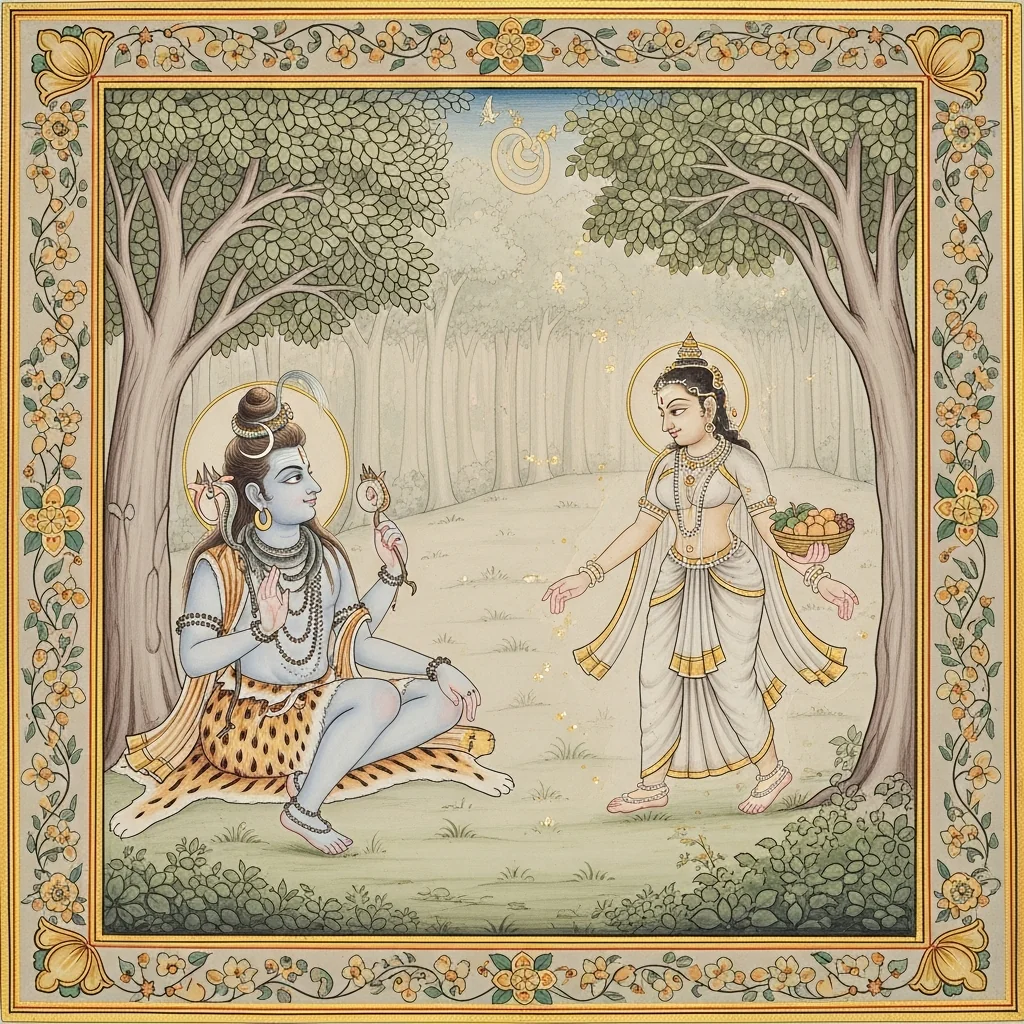
The chapter begins with Lomaśa describing Girijā’s anguish when Mahādeva departs for the forest; neither palace life nor secluded retreats bring her peace. Her companion Vijayā urges swift reconciliation, warning of the faults of gambling and the harm that comes from delay. Girijā replies with a theologically charged self-understanding, affirming her sovereignty over form and cosmos: Maheśa’s saguṇa/nirguṇa manifestation and even the universe’s līlā, she says, lie within her creative power. Girijā then assumes a richly described Śabarī (forest-woman/ascetic) guise and approaches Śiva as he sits in samādhi. By sound and presence she breaks his absorption, producing a momentary bewilderment and desire. Śiva questions the unknown woman; the dialogue turns ironic as he offers to find her a suitable husband, then declares himself the proper spouse. As Śabarī, Girijā critiques the tension between yogic detachment and sudden attachment; when Śiva grasps her hand, she rebukes the impropriety and directs him to seek her properly from her father, Himālaya. The scene shifts to Kailāsa, where Himālaya praises Śiva’s cosmic sovereignty. Nārada arrives and admonishes Śiva about the ethical and reputational danger of association driven by desire. Śiva concedes, calls his conduct astonishing and improper, and withdraws by yogic means onto an inaccessible path. Nārada then urges Girijā, Himālaya, and the attendants to seek forgiveness and venerate Śiva; the chapter closes with collective prostration and praise, celestial celebration, and the assurance that hearing Śiva’s wondrous deeds is purifying and spiritually fruitful.
Shlokas
Verse 1
लोमश उवाच । वनं गते महादेवे गिरिजा विरहातुरा । सुखं न लेभे तन्वंगी हर्म्येष्वायतनेषु वा
Lomaśa said: When Mahādeva had gone to the forest, Girijā, afflicted by separation, found no happiness—neither in palaces nor even in sacred dwellings.
Verse 2
चिंतयंती शिवंतन्वी सर्वभावेन शोभना । चिंतमानां शिवां ज्ञात्वा ह्युवाच विजया सखी
That beautiful, slender one, thinking of Śiva with her whole being—when her friend Vijayā understood that Śivā (Pārvatī) was lost in such thoughts, she spoke to her.
Verse 3
विजयोवाच । तपसा महता चैव शिवं प्राप्तासि शोभने । मृषशा द्यूतं कृतं तेन शंकरेण तपस्विना
Vijayā said: By great austerity you attained Śiva, O lovely one. Yet that ascetic Śaṅkara has played with you a deceitful game of dice.
Verse 4
द्यूते हि वहवो दोषा न श्रुताः किं त्वयाऽनघे । क्षमा पय शिवं तन्वि त्वरेणैव विचक्षणे
In gambling, indeed, there are many faults—have you not heard of them, O blameless one? Therefore, O slender and discerning lady, quickly go and seek Śiva’s forgiveness.
Verse 5
अस्माभिः सहिता देवि गच्छगच्छ वरानने
O Goddess, O fair-faced one—come, come, accompanied by us.
Verse 6
यावच्छंभुर्दूरतो नाभिगच्छेत्तावद्गत्वा शंकरं क्षामयस्व । नो चेतन्वि क्षामयेथाः शिवं त्वं दुःखं पश्चात्ते भविष्यत्यवश्यम्
Before Śambhu comes from afar, go at once and ask Śaṅkara’s pardon. If you do not, O slender one—if you fail to appease Śiva—sorrow will surely come upon you afterward.
Verse 7
निशम्य वाक्य विजयाप्रयुक्तं प्रहस्यामाना समधीरचेताः । उवाच वाक्यं विजयां सखीं च आश्चर्यभूतं परमार्थयुक्तम्
Hearing the words spoken by Vijayā, she smiled, steady and composed in mind; and she replied to her friend Vijayā with a statement wondrous in nature and grounded in the highest truth.
Verse 8
मया जितोऽसौ निरपत्रपश्च पुरा वृतो वै परया विभूत्या । किंचिच्च कृत्यं मम नास्ति सद्यो मया विनासौ च विरूप आस्थितः
“I have already conquered him—once before that shameless one was overwhelmed by my supreme power. For me, there is nothing more to be done at this moment; and without me, he remains disfigured and incomplete.”
Verse 9
रूपीकृतो मया देवो महेशो नान्यथा वद । मया तेन वियोगश्च संयोगो नैव जायते
By me the god Maheśa has been made manifest in form—speak not otherwise. With him, both separation and union arise only through me, not of themselves.
Verse 10
साकारो हि निराकारो महेशो हि मया कृतः
Indeed, the formless Maheśa has been made “with form” by me.
Verse 11
कृतं मया विश्वमिदं समग्रं चराचरं देववरैः समेतम् । क्रीडार्थमस्योद्भववृत्तिहेतुभिश्चिक्रीडितं मे विजये प्रपश्य
By me this entire universe has been fashioned—moving and unmoving—together with the best of the gods. For the sake of divine play, through the causes of its arising and continuance, I have sported; behold my victory!
Verse 12
एवमुक्त्वा तदा देवी गिरिजा सर्वमंगला । शबरीरूपमास्थाय गंतुकामा महेश्वरम्
Having spoken thus, the Goddess Girijā—all-auspicious—assumed the form of a Śabarī (forest-woman) and, desiring to go, set out toward Maheśvara.
Verse 13
श्यामा तन्वी शिखरदशना बिंबबिंबाधरोष्ठी सुग्रीवाढ्या कुचभरनता गिरिजा स्निग्धकेशी । मध्ये क्षामा पृथुकटितटा हेमरंभोरुगौरी पल्लीयुक्ता वरवलयिनी बर्हिबर्हावतंसा
Girijā appeared as a dark-hued, slender maiden, with pointed teeth and lips like ripe bimba fruit; her neck was graceful, her body bending beneath the weight of her bosom, and her hair smooth and glossy. Slim at the waist and broad at the hips, she was fair, with thighs like golden plantain-stems—clad in forest attire, wearing splendid bangles, and crowned with peacock-feather ornaments.
Verse 14
पाणौ मृणालसदृशं दधती च चापं पृष्ठे लसत्कृतककेतकिबाणकोशम् । सा तं निरीशमलोकयति स्म तत्र संसेविता सुवदना बहुभिः सखीभिः
In her hand she bore a bow like a tender lotus-stalk, and on her back a shining quiver of arrows fashioned from ketakī reeds. That fair-faced one, attended by many of her companions, beheld the Lord there.
Verse 15
भृंगीनादेन महता नादयंती जगत्त्रयम् । गिरिजा मन्मथं सद्यो जीवयंती पुनःपुनः
With a mighty humming sound, Girijā made the three worlds resound, reviving Manmatha at once, again and again.
Verse 17
एकाकी संस्थितो यत्र यमाधिस्थो महेश्वरः । दृष्टस्ततस्तया देव्या भृंगीनादेन मोहितः
Where Maheśvara stood alone, seated in samādhi, the Goddess beheld him there; and by that humming sound he became enchanted.
Verse 18
प्रबद्धो हि महादेवो निरीक्ष्य शबरीं तदा । समाधेरुत्थितः सद्यो महेशो मदनान्वितः
Indeed, when Mahādeva looked upon the Śabarī then, Maheśa at once rose from samādhi, filled with the stirrings of desire.
Verse 19
यावत्करे गृह्यमाणो गिरिजां स समीपगः । तावत्तस्य पुरः सद्यस्तिरोधानं गता सती
Just as he drew near and was about to take Girijā by the hand, Satī, the virtuous one, instantly vanished from before him.
Verse 20
तद्दृष्ट्वा तत्क्षणादेव देवो भ्रांतिविनाशनः । भ्रममाणस्तदा शंभुर्नापश्यदसितेक्षणाम्
Seeing that, at that very moment the Lord—the destroyer of delusion—began to wander about; yet Śambhu could not behold the dark-eyed one.
Verse 21
विरहेण समायुक्तो हृच्छयेन समन्वितः । मदनारिस्तदा शंभुर्ज्ञानरूपो निरंतरम्
Joined to the pain of separation and filled with heart-anguish, Śambhu—the foe of Kāma—remained continually established in the very form of knowledge.
Verse 22
निर्मोहो मोहमापन्नो ददर्श गिरिजां पुनः । उवाच वाक्यं शबरीं प्रस्ताव सदृशं महत्
Though free from delusion, he entered into bewilderment; then he saw Girijā again and spoke to the Śabarī a weighty statement fitting the occasion.
Verse 23
शिव उवाच । वाक्यं मे श्रृणु तन्वंगि श्रुत्वा तत्कर्तुमर्हसि । कासि कस्यासि तन्वंगि किमर्थमटनं वने । तत्कथ्यतां महाभागे याथातथ्यं सुमध्यमे
Śiva said: “Hear my words, slender-limbed one; having heard, you should act accordingly. Who are you, and whose are you? For what purpose do you wander in the forest? O fortunate lady of fair waist, tell me this truthfully, exactly as it is.”
Verse 24
शिवोवाच । पतिमन्वेषयिष्यामि सर्वज्ञं सकलार्थदम् । स्वतंत्रं निर्विकारं च जगतामीश्वरं वरम्
Śiva said: “I shall seek a husband—omniscient, bestower of every aim, independent, unchanging, the excellent Lord of the worlds.”
Verse 25
इत्युक्तः प्रत्युवाचेदं गिरिजां वृषभध्वजः । अहं तवोचितो भद्रे पतिर्नान्यो हि भामिनि
Thus addressed, Vṛṣabhadhvaja replied to Girijā: “O auspicious one, I am the fitting husband for you—there is no other, O proud lady.”
Verse 26
विमृश्यतां वरारोहे तत्त्वतो हि वरानने । वचो निशम्य रुद्रस्य स्मितपूर्वमभाषत
“Reflect upon it, O fair-thighed one—truly, O lovely-faced one, in accordance with reality.” Hearing Rudra’s words, she spoke, first with a smile.
Verse 27
मयार्थितो महाभाग पतिस्त्वं नान्यथा वद । किं तु वक्ष्यामि भद्रं ते निर्गुणोऽसि परंतपः
“I sought you, O greatly fortunate one—do not say otherwise: you are my husband. Yet I shall say this for your good: you are beyond qualities, O subduer of foes.”
Verse 28
यया पुरा वृतोऽसि त्वं तपसा च परेण हि । परित्यक्ता त्वयारण्ये क्षणमात्रेण भामिनी
“She by whom you were formerly won through supreme austerity—she, the spirited woman—was abandoned by you in the forest in but a moment.”
Verse 29
दुराराध्योऽसि सततं सर्वेषां प्राणिनामपि । तस्मान्न वाच्यं हि पुनर्यदुक्तं ते ममाग्रतः
You are ever difficult to propitiate for all living beings. Therefore, do not speak again of what you said before me.
Verse 30
शबर्या वचनं श्रुत्वा प्रत्युवाच वृषध्वजः । मैवं वद विशालाक्षि न त्यक्ता सा तपस्विनी । यदि त्यक्ता मया तन्वि किं वक्तुमिह पार्यते
Hearing Śabarī’s words, Vṛṣadhvaja replied: “Do not speak so, O wide-eyed one. That ascetic woman has not been forsaken by me. If I had forsaken her, O slender one, what could be said here at all?”
Verse 31
एवं ज्ञात्वा विशालाक्षि कृपणं कृपणप्रियम् । तस्मात्त्वया हि कर्तव्यं वचनं मे सुमध्यमे
Knowing this, O wide-eyed one—that I am simple-hearted and fond of the simple—therefore, O fair-waisted one, you should indeed comply with my request.
Verse 32
एवमभ्यर्थिता तेन बहुधा शूलपाणिना । प्रहस्य गिरिजा प्राह उपहासपरं वच
Thus repeatedly entreated by the trident-bearing Lord, Girijā smiled and spoke words tinged with playful teasing.
Verse 33
तपोधनोऽसि योगीश विरक्तोऽसि निरंजनः । आत्मारामो हि निर्द्वंद्वो मदनो येन घातितः
“You are rich in austerity, O Lord of yogins; you are detached and stainless. You delight in the Self, free from dualities—he by whom even Kāma was struck down.”
Verse 34
स त्वं साक्षाद्विरूपाक्षो मया दृष्टोसि चाद्य वै । अशक्यो हि मया प्राप्तुं सर्वेषां दुरतिक्रमः । तस्मात्त्वया न वक्तव्यं यदुक्तं च पुरा मम
“And you—Virūpākṣa himself—have truly been seen by me today. You are indeed impossible for me to attain, the One whom all find hard to surpass. Therefore you should not repeat what I said earlier.”
Verse 35
तस्यास्तद्वचनं श्रुत्वा प्रोवाच मदनांतकः । मम भार्या भव त्वं हि नान्यथा कर्तुमर्हसि
Hearing her words, the Slayer of Madana said: “You must become my wife; it is not proper for you to act otherwise.”
Verse 36
इत्युक्त्वा तां करेऽगृह्णाच्छबरीं मदनातुरः । उवाच तं स्मयंती सा मुंचमुंचेति सादरम्
Having said this, love-stricken with desire, he took Śabarī by the hand. Smiling, she addressed him respectfully: “Let go, let go.”
Verse 37
नोचितं भगवान्कर्तुं तापसेन बलादिदम् । याचयस्व पितुर्मे त्वं नान्यथाभिभविष्यसि
“O Lord, it is not proper for an ascetic to do this by force. Seek me from my father; otherwise you will not prevail.”
Verse 38
महादेव उवाच । पितरं कथयाशु त्वं स्थितः कुत्र शुभानने । द्रक्ष्यामि तं विशालाक्षि प्रणिपातपुरःसरम्
Mahādeva said: “Tell me at once where your father is staying, O fair-faced one. O wide-eyed one, I shall go to see him, preceded by my reverent prostration.”
Verse 39
एतदुक्तं तदा तेन निशम्यासितनेत्रया । आनीतो हि तया तन्व्या पितरं वृषभध्वजः
When he had spoken thus, the dark-eyed, slender maiden heard it and brought her father; and Vṛṣabhadhvaja (Śiva, whose banner bears the bull) was brought before him.
Verse 40
स्थितं कैलासशिखरे हिमवंतं नगोत्तमम् । अहिभिर्बहुभिश्चैव संवृतं च महाप्रभम्
He beheld Himavān, the foremost of mountains, standing upon the summit of Kailāsa—mighty and radiant—encircled by many serpents.
Verse 41
द्वारि स्थितं तया देव्या दर्शितं शंकरस्य च । असौ मम पिता देव याचस्व विगतत्रपः । ददाति मां न संदेहस्तपस्विन्मा विलंबितम्
Standing at the doorway, the Goddess pointed him out to Śaṅkara: “O Deva, this is my father. Ask him without hesitation. He will give me to you—of this there is no doubt. O ascetic, do not delay.”
Verse 42
तथेति मत्वा सहसा प्रणम्य हिमालयं वाक्यमिदं बभाषे । प्रयच्छ तां चाद्य गिरीशवर्य ह्यार्ताय कन्यां सुभगां महामते
Thinking, “So be it,” he swiftly bowed to Himālaya and spoke: “O best of mountain-lords, O great-minded one, grant me that auspicious maiden today, for I stand in longing.”
Verse 43
कृपणं वाक्यमाकर्ण्य समुत्थाय हिमालयः । महेशं च समादाय ह्युवाच गिरिराट् स्वयम्
Hearing those plaintive words, Himālaya rose; and drawing Maheśa close, the king of mountains spoke in person.
Verse 44
किं जल्पसि हि भो देव तावयुक्तं च सांप्रतम् । त्वं दाता त्रिषु लोकेषु त्वं स्वामी जगतां विभो
“Why do you speak so, O God? Such words are not fitting now. You are the giver in the three worlds; you are the Lord of all beings, O All-pervading One.”
Verse 45
त्वया ततमिदं विश्वं जगदेतच्चराचरम् । एवं स्तुतिपरोऽभूच्च हिमालयागिरिर्महान् । आगतो नारदस्तत्र ऋषिभिः परिवारितः
By you this entire universe is pervaded—this world of the moving and the unmoving. Thus the great mountain Himālaya remained absorbed in praise. Then Nārada arrived there, surrounded by sages.
Verse 46
उवाच प्रहसन्वाक्यं शूलपाणे नमः प्रभो । हे शंभो श्रृणु मे वाक्यं तत्त्वसारमयं परम्
Smiling, he spoke: “O Lord, obeisance to you, O Śūlapāṇi, bearer of the trident. O Śambhu, hear my words—supreme, filled with the essence of truth.”
Verse 47
योषिद्भिः संगति पुंसां विडंबायोपकल्पते । त्वं स्वामी जगतां नाथः पराणां परमः परः । विमृश्य सर्वं देवेश यथावद्वक्तुमर्हसि
“Association with women is often fashioned as a cause of ridicule for men. Yet you are the Lord of the worlds, the Nātha, the Supreme beyond the supreme. O Lord of gods—consider everything and speak as is proper.”
Verse 48
एवं प्रबोधितस्तेन नारदेन महात्मना । प्रबोधमगमच्छंभुर्जहास परमेश्वरः
Thus awakened by the great-souled Nārada, Śambhu came to full awareness; and the Supreme Lord laughed.
Verse 49
शिव उवाच । सत्यमुक्तं त्वया चात्र नान्यथा नारदक्वचित् । योषित्संगतिमात्रेण नृणां पतनमेव च
Śiva said: “What you have stated here is true—never otherwise, O Nārada. By mere association driven by lust for women, men indeed come to downfall.”
Verse 50
भविष्यति न संदेहो नान्यथा वचनं तव । अनया मोहितोऽद्याहमानीतो गंधमादनम्
It shall surely be so—there is no doubt; your words cannot be otherwise. Bewildered by her, I have today been brought to Gandhamādana.
Verse 51
पिशाचवत्कृतमिदं चरितं परमाद्भुतम्
This deed—done as if by a piśāca—is a most astonishing episode.
Verse 52
तस्मान्न तिष्ठामि गिरेः समीपे व्रजामि चाद्यैव वनांतरं पुनः । इत्येवमुक्त्वा स जगाम मार्गं दुरत्ययं योगेनामप्यगम्यम्
Therefore I shall not remain near the mountain; today itself I will go again into the inner forest. Having spoken thus, he took a path difficult to traverse—unapproachable even by yogic means.
Verse 53
निरालंबं स विज्ञाय नारदो वाक्यमब्रवीत् । गिरिजां च गिरींद्रं च पार्षदान्प्रति सत्वरम्
Understanding that he had become without support (and was departing), Nārada quickly spoke to Girijā, to the lord of mountains, and to the attendants.
Verse 54
वंदनीयश्च स्तुत्यश्च क्षाम्यतां परमार्थतः । महेशोऽयं जगन्नाथस्त्रिपुरारिर्महायशाः
He is worthy of reverence and praise—may he truly forgive this fault. This is Maheśa, the Lord of the world, the glorious foe of Tripura.
Verse 55
एतच्छ्रुत्वा तु वचनं नारदस्य मुखोद्गतम् । गिरिजां पुरतः कृत्वा गिरयो हि महाप्रभाः
Hearing these words spoken from Nārada’s mouth, the mighty mountains, placing Girijā (Pārvatī) in front, prepared to act.
Verse 56
दण्डवत्पतिताः सर्वे शंकरं लोकशंकरम् । तुष्टुवुः प्रणताः सर्वे प्रमथा गुह्यकादयः
All of them fell prostrate like a staff (daṇḍavat) before Śaṅkara, the benefactor of the worlds. Bowed down, all the Pramathas, the Guhyakas, and others praised him.
Verse 57
स्तूयमानो हि भगवानागतो गंधमादनम् । अंगिरसा हि सर्वेशो ह्यभिषिक्तो महात्मभिः
Thus praised, the Blessed Lord came to Gandhamādana. There the Lord of all was consecrated (abhiṣeka) by Aṅgiras and by great-souled sages.
Verse 58
तदा दुन्दुभयो नेदुर्वादित्राणि बहूनि च । इन्द्रादयः सुराः सर्वे पुष्पवर्षं ववर्षिरे
Then the dundubhi drums resounded, and many musical instruments played. Indra and all the gods showered a rain of flowers.
Verse 59
ब्रह्मादिभिः सुरगणैर्बहुभिः परीतो योगीश्वरो गिरिजया सह विश्ववंद्यः । अभ्यर्थितः परममंगल मंगलैश्च दिव्यासनोपरि रराज महाविभूत्या
Surrounded by Brahmā and many hosts of gods, the Lord of Yogins—universally adored—sat with Girijā (Pārvatī). Thus entreated with supremely auspicious praises, he shone upon a divine throne with great majesty.
Verse 60
एवंविधान्यनेकानि चरितानि महात्मनः । महेशस्य च भो विप्राः पापहारीणि श्रृण्वताम्
O brāhmaṇas, many such deeds of great-souled Maheśa are of this kind—deeds that remove sin for those who hear them.
Verse 61
यानियानीह रुद्रस्य चरितानि महांत्यपि । श्रुतानि परमाण्येव भूयः किं कथयामि वः
Whatever great deeds of Rudra are found here—those most excellent accounts have already been heard; what more shall I tell you again?
Verse 62
ऋषय ऊचुः । एव मुक्तं त्वया सूत चरितं शंकरस्य च । अनेन चरितेनैव संतृप्ताः स्मो न संशयः
The sages said: O Sūta, you have indeed narrated the deeds of Śaṅkara. By this very account we are satisfied—of this there is no doubt.
Verse 63
सूत उवाच । व्यासप्रसादाच्छ्रुतमस्ति सर्वं मया ततं शंकररूपमद्भुतम् । सुविस्तृतं चाद्भुतवेदगर्भं ज्ञानात्मकं परमं चेदमुक्तम्
Sūta said: By the grace of Vyāsa I have heard it all—this wondrous teaching pervaded by Śaṅkara’s very form. Vast in scope, marvelously containing the essence of the Vedas, it has been spoken as supreme and consisting of spiritual knowledge.
Verse 64
श्रद्धया परयोपेताः श्रावयंति शिवप्रियम् । श्रृण्वंति चैव ये भक्त्या शंभेर्माहात्म्यमद्भुतम् । शिवशास्त्रमिदं प्रीत्या ते यांति मरमां गतिम्
Those endowed with supreme faith who cause this Śiva-beloved teaching to be recited, and those who listen with devotion to the wondrous greatness of Śambhu—lovingly receiving this Śiva-śāstra—attain the highest state.
Verse 3516
सकामना राजहंसा बभूवुस्तत्क्षणादपि । द्विरेफा बर्हिणश्चैव सर्वे ते हृच्छयान्विताः
In that very instant, those who harbored desires became royal swans; others became bees and peacocks as well—each of them filled with the heart’s longing.