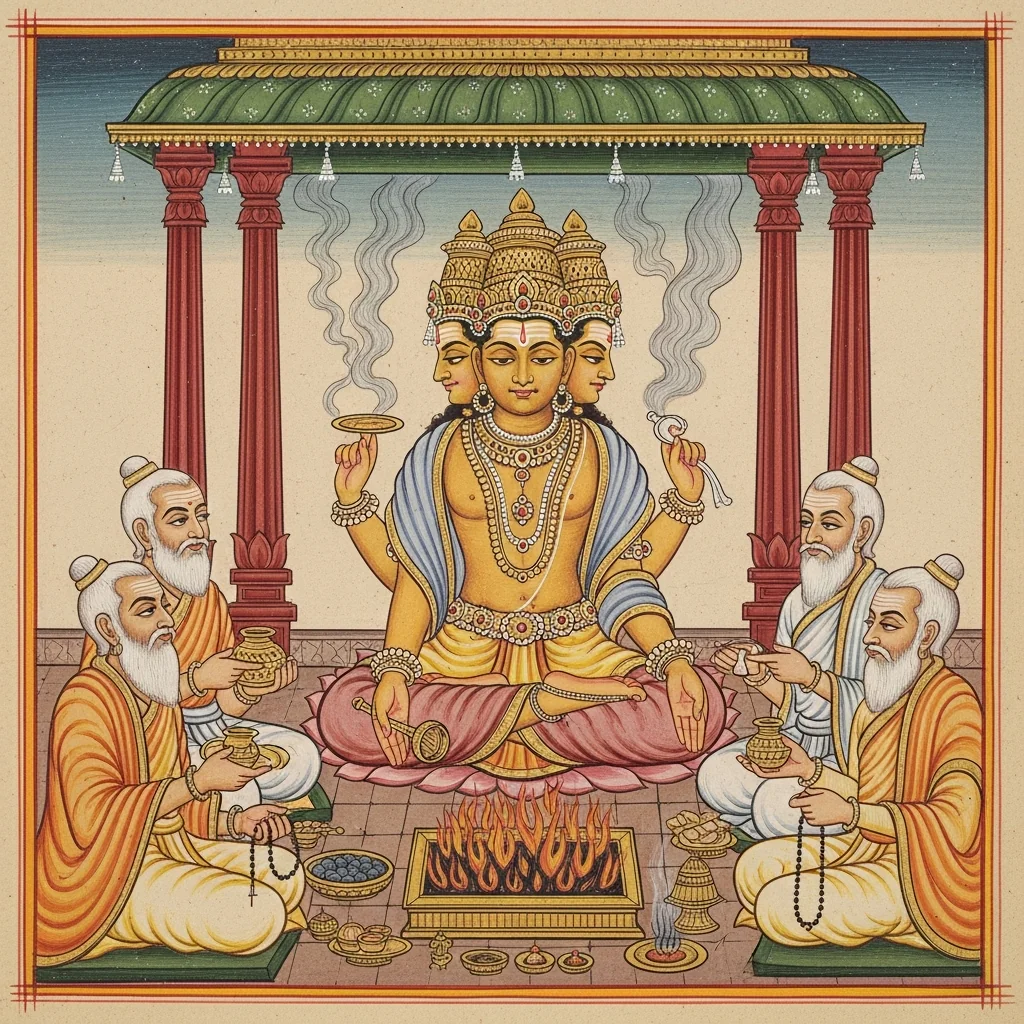
Adhyaya 15
This adhyāya presents a layered ethical tale of authority, transgression, and social order. The sages ask how Indra, though restored to sovereignty, again fell into distress; Lomaśa recounts that Indra relied on Viśvarūpa (Triśiras), a priest of extraordinary ritual power who distributed offerings with partiality—audibly for the devas, silently for the daityas—thereby stirring Indra’s suspicion. In disregard of his guru and in impulsive violence, Indra kills Viśvarūpa, and the sin of Brahmahatyā becomes personified and pursues him relentlessly. Indra hides in the waters for a long time, creating an interregnum (arājaka) in heaven. The text states a political-ethical principle: a sinful ruler, or an unexpiated brahmahatyā, brings famine, calamity, and untimely death. The devas consult Bṛhaspati, who stresses the gravity of intentionally killing a learned priest and the collapse of prior merit—even that of a hundred aśvamedhas. To restore governance, Nārada proposes Nahūṣa; enthroned, he is driven by desire, insults the sages by forcing them to bear his palanquin, and is cursed by Agastya into a serpent, returning disorder. A further attempt with Yayāti also fails when he publicly proclaims his merits and immediately falls, leaving the devas once more without a worthy ritual-king.
Shlokas
Verse 1
। ऋषय ऊचुः । राज्यं प्राप्तो हि देवेंद्रः कथितस्ते गुरुं विना । गुरोरवज्ञया जातो राज्यभ्रंशो हि तस्य तु
The sages said: “It is said that Devendra (Indra) attained sovereignty without his guru. Yet by disrespecting the guru, a fall from kingship befell him.”
Verse 2
केन प्रणोदितश्चेंद्रो बभूव चिरमासने । तत्सर्वं कथयाशु त्वं परं कौतूहलं हि नः
“By whom was Indra prompted, that he remained long upon the throne? Tell us all of that quickly, for our curiosity is great.”
Verse 3
लोमश उवाच । गुरुणापि विना राज्यं कृतवान्स शचीपतिः । विश्वरूपोक्तविधिना इंद्रो राज्ये स्थितो महान्
Lomāśa said: “Even without his guru, Śacī’s lord (Indra) won the kingdom; by the rite taught by Viśvarūpa, the great Indra remained firmly established in sovereignty.”
Verse 4
विश्वकर्मसुतो विप्रा विश्वरूपो महानृपः । पुरोहितोऽथ शक्रस्य याजकश्चाभवत्तदा
“O brāhmaṇas, Viśvarūpa—son of Viśvakarman, a great lord—then became Śakra’s family priest (purohita) and also the officiating sacrificer (yājaka).”
Verse 5
तस्मिन्यज्ञेऽवदानैश्च यजने असुरान्सुरान् । मनुष्यांश्चैव त्रिशिरा अपरोक्षं शचीपतेः
“In that sacrifice, through offerings and acts of worship, Triśirā—the three-headed one—served Asuras, Suras, and even humans, openly, in the very presence of Śacī’s lord (Indra).”
Verse 6
देवान्ददाति साक्रोशं दैत्यांस्तूष्णीमथाददात् । मनुष्यान्मध्यपातेन प्रत्यहं स ग्रहान्द्विजः
“He gave to the Devas with loud utterance, but to the Daityas he gave in silence; and to humans he allotted a ‘middle portion’. Thus, day by day, that twice-born priest distributed the shares.”
Verse 7
एकदा तु महेंद्रेण सूचितो गुरुलाघवात् । अलक्ष्यमाणेन तदा ज्ञातं तस्य चिकीर्षितम्
“Once, by a subtle sign from Mahendra (Indra)—a hint weighed with both lightness and gravity—the unobserved one (Viśvarūpa) understood what Indra intended to do.”
Verse 8
दैत्यानां कार्यसिद्ध्यर्थमवदानं प्रयच्छति । असौ पुरोहितोऽस्माकं परेषां च फलप्रदः
For the success of the Daityas’ undertakings he grants oblations and ritual portions. This priest of ours bestows results not only for us, but even for others.
Verse 9
इति मत्वा तदा शक्रो वज्रेण शतपर्वणा । चिच्छेद तच्छिरांस्येव तत्क्षणादभवद्वधः
Thinking thus, Śakra (Indra) then, with his thunderbolt of a hundred joints, cut off his heads; in that very instant the slaying was accomplished.
Verse 10
येनाकरोत्सोमपानमजायंत कपिंजलाः । ततोन्येन सुरापानात्कलविंका भवन्मुखात्
From the mouth (of the slain one), from that head by which Soma-drinking was performed, kapiñjala birds were born; then, from another head—because of liquor-drinking—kalaviṅka birds arose.
Verse 11
अन्याननादजायंत तित्तिरा विश्वरूपिणः । एवं हतो विश्वरूपः शक्रेण मंदभागिना
From yet another mouth, partridge-birds (tittira) were born from Viśvarūpa. Thus was Viśvarūpa slain by Śakra (Indra), the ill-fated one.
Verse 12
ब्रह्महत्या तदोद्भूता दुर्धर्षा च भयावहा । दुर्धर्षा दुर्मुखा दुष्टा चण्डालरजसान्विता
Then Brahmahatyā sprang forth—unassailable and terror-bringing: fierce, foul-faced, wicked, and smeared with the dust of a caṇḍāla.
Verse 13
ब्रह्महत्या सुरापानं स्तेयं गुर्वंगनागमः । इत्येषामप्यघवतामिदमेव च निष्कृतिः
Brahmahatyā, drinking liquor, theft, and approaching the wife of one’s guru—even for those burdened with such sins, this alone is declared to be the expiation.
Verse 14
नामव्याहरणं विष्णोर्यतस्तद्विषया मतिः । त्रिशिरा धूम्रहस्ता सा शक्रं ग्रस्तुमुपाययौ
Because her mind was fixed upon that—namely, the utterance of Viṣṇu’s Name—she (Brahmahatyā), three-headed and with smoke-dark hands, came forward to seize Śakra (Indra).
Verse 15
ततो भयेन महता पलायनपरोऽभवत् । पलायमानं तं दृष्ट्वा ह्यनुयाता भयावहा
Then, seized by great fear, he became intent on flight. Seeing him fleeing, the terror-bringing Brahmahatyā pursued him.
Verse 16
यतो धावति साऽधावत्तिष्ठंतमनुतिष्ठति । अंगकृता यथा छाया शक्रस्यपरिवेष्टितुम् । आयाति तावत्सहसा इंद्रोऽप्यप्सु न्यमज्जत
Wherever he ran, she ran; when he stopped, she stopped beside him—like a shadow born of one’s own body, coming to envelop Śakra. Then, suddenly, Indra too plunged into the waters.
Verse 17
शीघ्रत्वेन यथा विप्राश्चिरंतनजलेचरः
O brāhmaṇas, swift indeed—like an age-old creature that moves within the waters.
Verse 18
एवं दिव्यशतं पूर्णं वर्षाणां च शचीपतेः । वसतस्तस्य दुःखेन तथा चैव शतद्वयम् । अराजकं तदा जातं नाकपृष्ठे भयावहम्
Thus a full hundred divine years passed for Indra, lord of Śacī; and through his anguish, another two hundred passed as well. Then the heavenly realm became rulerless, terrifying even upon the face of heaven.
Verse 19
तदा चिंतान्विता देवा ऋषयोऽपि तपस्विनः । त्रैलोक्यं चाऽपदा ग्रस्तं बभूव च तदा द्विजाः
Then the gods were filled with anxiety, and even the ascetic sages. O twice-born, at that time the three worlds were seized by calamity.
Verse 20
एकोऽपि ब्रह्महा यत्र राष्ट्रे वसति निर्भयः । अकालमरणं तत्र साधूनामुपजायते
Even if a single slayer of a brāhmaṇa dwells fearlessly in a kingdom, there untimely death arises for the righteous.
Verse 21
राजा पापयुतो यस्मिन्राष्ट्रे वसति तत्र वै । दुर्भिक्षं चैव मरणं तथैवोपद्रवा द्विजाः
In whatever kingdom a king tainted with sin dwells, there indeed arise famine and death, and likewise many afflictions, O brāhmaṇas.
Verse 22
भवंति बहवोऽनर्थाः प्रजानां नाशहेतवे । तस्माद्राज्ञा तु कर्तव्यो धर्म्मः श्रद्धापरेण हि
Many misfortunes arise, becoming causes for the ruin of the people. Therefore a king must uphold dharma, devoted to faith (śraddhā) and conscientious care.
Verse 23
तथा प्रकृतयो राज्ञः शुचजित्वेन प्रतिष्ठिताः । इन्द्रेण च कृतं पापं तेन पापेन वै द्विजाः । नानाविधैर्महातापैः सोपद्रवमभूज्जगत्
Likewise, the king’s subjects became firmly established in conquering sorrow and in purity. But when Indra committed sin, by that sin—O brāhmaṇas—the world was afflicted, beset with many kinds of great torments and disturbances.
Verse 24
शौनक उवाच । अश्वमेधशतेनैव प्राप्तं राज्यं महत्तरम् । देवानामखिलं सूत कस्माद्विघ्रमजायत । शक्रस्य च महाभाग यथावत्कथयस्व न
Śaunaka said: “By a hundred Aśvamedha sacrifices, a very great sovereignty was obtained. Yet, O Sūta, why did an obstacle arise for all the gods? And, O fortunate one, tell us properly about Śakra (Indra).”
Verse 25
सूत उवाच । देवानां दानवानां च मनुष्याणां विशेषतः । कर्म्मैव सुखदुःखानां हेतुभूतं न संशयः
Sūta said: “For gods, dānavas, and especially for human beings, karma alone is the cause that becomes pleasure and pain—there is no doubt.”
Verse 26
इन्द्रेण च कृतं विप्रा महद्भूतं जुगुप्सितम् । गुरोरवज्ञा च कृता विश्वरूपवधः कृतः
And Indra, O brāhmaṇas, committed a great and reprehensible deed: he showed contempt for his teacher, and he slew Viśvarūpa.
Verse 27
गौतमस्य गुरोः पत्नी सेविता तस्य तत्फलम् । प्राप्तं महेंद्रेण चिरं यस्य नास्ति प्रतिक्रिया
Mahendra (Indra) long endured the consequence of having violated the wife of Gautama’s guru; for that deed there was no counteraction, no easy remedy.
Verse 28
ये हि दृष्कटतकर्म्माणो न कुर्वंति च निष्कृतिम् । दुर्दशां प्रप्नुवन्त्येते यथैवेन्द्रः शतक्रतुः
Those who commit grievous misdeeds and yet do not perform expiation fall into misery—just as Indra, Śatakratu, the performer of a hundred sacrifices, did.
Verse 29
दुष्कृतोपार्जितस्या तः प्रायाश्चित्तं हि तत्क्षणात् । कर्तव्यं विधिवद्विप्राः सर्वपापोपशांतये
Therefore, for sin accumulated through wrongdoing, expiation must be undertaken immediately and according to rule, O brāhmaṇas, so that all sins may be pacified.
Verse 30
उपपातकमध्यस्तं महापातकतां व्रजेत्
One who remains stuck in a minor sin (upapātaka) may thereby fall into the state of a great sin (mahāpātaka).
Verse 31
ततः स्वधर्मनिष्ठां च ये कुर्वंति सदा नराः । प्रातर्मध्याह्नसायाह्ने तेषां पापं विनश्यति
Then, those people who remain constantly established in their own dharma—their sin is destroyed at the three daily junctures: morning, midday, and evening.
Verse 32
प्राप्नुवंत्युत्तमं लोकं नात्र कार्या विचारणा । तस्मादसौ दुराचारः प्राप्ते वै कर्मणः फलम्
They attain the highest world—there is no need for doubt about it. Therefore that evil-doer indeed received the fruit of his own action.
Verse 33
स प्रधार्य तदा सर्वे लोकपालास्त्वरान्विताः । बृहस्पतिमुपागम्य सर्वमात्मनि धिष्ठितम् । कथयामासुरव्यग्रा इंद्रस्य च गुरुं प्रति
Having considered it, all the Lokapālas then—hastening—approached Bṛhaspati; and, without confusion, they reported everything as it had occurred, to Indra’s guru.
Verse 34
देवैरुक्तं वचो विप्रा निशम्य च बृहस्पतिः । अराजकं च संप्राप्तं चिंतयामास बुद्धिमान्
O brāhmaṇas, hearing the words spoken by the gods, the wise Bṛhaspati reflected, seeing that a kingless disorder had arisen.
Verse 35
किं कार्यं चाद्य कर्तव्यं कथं श्रेयो भविष्यति । देवानां चाद्य लोकानामृषीणां भावितात्मनाम्
‘What must be done today, and what course should be undertaken? How will welfare arise—for the gods, for the worlds, and for the self-disciplined sages?’
Verse 36
मनसैव च तत्सर्वं कार्याकार्यं विचार्य च । जगाम शक्रं त्वरितो देवैः सह महायशाः
Having mentally weighed all that was to be done and not to be done, the illustrious one (Bṛhaspati) quickly went to Śakra (Indra), together with the gods.
Verse 37
प्राप्तो जलाशयं तं च यत्रास्ते हि पुरंदरः । यस्य तीरे स्थिता हत्या चंडालीव भयावहा
He reached that lake where Purandara (Indra) was staying; upon its bank stood the sin of brahmin-slaying (Brahmahatyā), like a terrifying outcaste woman, striking fear into the heart.
Verse 38
तत्रोविष्टास्ते सर्वे देवा ऋषिगणान्विताः । आह्वानं च कृतं तस्य शक्रस्य गुरुणा स्वयम्
There all the gods sat together, accompanied by hosts of sages; and the Guru himself, Bṛhaspati, summoned Śakra (Indra).
Verse 39
समुत्थितस्ततः शक्रो ददर्श स्वगुरुं तदा । बाष्पपूरितवक्त्रो हि बृहस्पतिमभाषत
Then Śakra rose and beheld his own Guru; his face filled with tears, he spoke to Bṛhaspati.
Verse 40
प्रणिपत्य च तत्रत्यान्कृताञ्जलिरभाषत । तदा दीनमुखो भूत्वा मनसा संविमृश्य च
Bowing to those present, with folded hands he spoke; then, with a downcast face, he reflected deeply in his mind.
Verse 41
स्वयमेव कृतं पूर्वमज्ञानलक्षणं महत् । अधुनैव मया कार्यं किं कर्तव्यं वद प्रभो
Formerly I myself committed a grave deed, marked by ignorance. Now what should I do? Tell me, O Lord.
Verse 42
प्रहस्योवाच भगवान्बृहस्पति रुदारधीः । पुरा त्वया कृतं यच्च तस्येदं कर्मणः फलम्
Smiling, the blessed Bṛhaspati—firm in understanding—said: “Whatever you did long ago, this is the fruit of that action.”
Verse 43
मां च उद्दिश्य भो इंद्र तद्भोगादेव संक्षयः । प्रायश्चितं हि हत्याया न दृष्टं स्मृतिकारिभिः
O Indra, when your conduct is directed toward me, its exhaustion comes only through undergoing its own experience. For the expiation for the slaying of a brāhmaṇa is not found prescribed by the authors of the Smṛtis.
Verse 44
अज्ञानतो हि यज्जातं पापं तस्य प्रतिक्रिया । कथिता धर्म्मशास्त्रज्ञैः सकामस्य न विद्यते
Sin that arises from ignorance has a remedy taught by those who know the Dharmaśāstras; but for sin committed deliberately, such a remedy is not acknowledged.
Verse 45
सकामेन कृतं पापमकामं नैव जायते । ताभ्यां विषयभेदेन प्रायश्चित्तं विधीयते
A sin done with deliberate intent is not the same as one done without intent; and according to this difference in circumstance, expiation (prāyaścitta) is prescribed.
Verse 46
मरणांतो विधिः कार्यो कामेन हि कृतेन हि । अज्ञानजनिते पापे प्रायश्चित्तं विधीयते
For a deed done willfully, the ordinance extends even to death (the gravest penalty). But for sin born of ignorance, expiation is prescribed.
Verse 47
तस्मात्त्वया कृतं यच्च स्वयमेव हतो द्विजः । पुरोहितश्च विद्वांश्च तस्मान्नास्ति प्रतिक्रिया
Therefore, since by your own act the brāhmaṇa—who was also your learned priest (purohita)—has been slain, for this there is no counter-remedy, no easy expiation.
Verse 48
यावन्मरणमप्येति तावदप्सु स्थिरो भव
Remain steadfast in the waters, and continue so until even death draws near.
Verse 49
शताश्वमेधसंज्ञं च यत्फलं तव दुर्मते । तन्नष्टं तत्क्षणादेव घातितो हि द्विजो यदा
O misguided one, whatever merit you had—reckoned as equal to a hundred Aśvamedha sacrifices—was destroyed at that very instant, the moment the brāhmaṇa was slain.
Verse 50
सच्छिद्रे च यथा तोयं न तिष्ठति घटेऽण्वपि । तथैव सुकृतं पापे हीयते च प्रदक्षिणम्
Just as water does not remain even a little in a pot full of holes, so too good deeds diminish in the presence of sin—indeed, even acts like reverential circumambulation lose their power.
Verse 51
तस्माच्च दैवसंयोगात्प्राप्तं स्वर्गादिकं च यैः । यथोक्तं तद्भवेत्तेषां धर्मिष्ठानां न संशयः
Therefore, whatever heaven and other attainments are obtained by the righteous through the conjunction of destiny—exactly as declared—so it indeed comes to pass for those devoted to dharma; of this there is no doubt.
Verse 52
एतच्छ्रुत्वा वचस्तस्य शक्रो वचनमब्रवीत् । कुकर्मणा मदीयेन प्राप्तमेतन्न संशयः
Hearing his words, Śakra (Indra) replied: “There is no doubt—this condition has come upon me because of my own evil deed.”
Verse 53
अमरावती माशु त्वं गच्छ देवर्षिबिः सह । लोकानां कार्यसिद्ध्यर्थे देवानां च बृहस्पते । इंद्रं कुरु महाभाग यस्ते मनसि रोचते
Do not delay—go to Amarāvatī together with the divine seers. For the successful accomplishment of the worlds’ affairs, and for the gods as well, O Bṛhaspati: appoint as Indra, O greatly fortunate one, whomever pleases your mind.
Verse 54
यथा मृतस्तथा हं वै ब्रह्महत्यावृतो महान् । रागद्वेषसमुत्थेन पापेनास्मि परिप्लुतः
I am as good as dead, truly—enveloped by the great sin of brahmahatyā. I am flooded over by the wrongdoing born of passion and hatred.
Verse 55
तस्मात्त्वरान्विता यूयं देवराजानमाशुः वै । कुर्वतु मदनुज्ञाताः सत्यं प्रतिवदामि वः
Therefore, hasten and quickly install a king of the gods. Do so with my permission—I speak the truth to you.
Verse 56
एवमुक्तास्तदा सर्वे बृहस्पतिपुरोगमाः । एत्यामरावतीं तूर्णं पुरंदरविचेष्टितम् । कथयामासुरव्यग्रा शचीं प्रति यथा तथा
Thus addressed, all of them—led by Bṛhaspati—quickly went to Amarāvatī, stirred by Purandara’s (Indra’s) situation, and without confusion reported everything, just as it had happened, to Śacī.
Verse 57
राज्यस्य हेतोः किं कार्यं विमृशंतः परस्परम्
As they deliberated among themselves, they considered: “What should be done for the sake of the kingdom (the governance of heaven)?”
Verse 58
एवं विमृश्यमानानां देवानां तत्र नारदः । यदृच्छयागतस्तत्र देवर्षिरमितद्युतिः
As the gods were thus deliberating, the divine sage Nārada—of immeasurable splendor—arrived there by chance.
Verse 59
उवाच पूजितो देवान्कस्माद्यूयं विचेतसः । तेनोक्ताः कथयामासुः सर्वं शक्रस्य चेष्टितम्
Honored with worship, he said to the gods, “Why are you so downcast?” Thus questioned, they told him everything about Śakra’s (Indra’s) deeds.
Verse 60
गतमिंद्रस्य चेंद्रत्वमेनसा परमेण तु । ततः प्रोवाच तान्देवान्देवर्षिर्नारदो वचः
“Indra’s lordship has departed because of a grievous sin.” Then the divine sage Nārada spoke these words to the gods.
Verse 61
यूयं देवाश्च सर्वज्ञास्तपसा विक्रमेण च । तस्मादिंद्रो हि कर्तव्यो नहुषः सोमवंशजः
“You gods are all-knowing, and endowed with austerity and valor. Therefore, Nahūṣa—born of the Soma dynasty—should indeed be made Indra.”
Verse 62
सोऽस्मिन्राष्ट्रे प्रतिष्ठाप्यस्त्वरितेनैव निर्जराः । एकोनमश्वमेधानां शतं तेन महात्मना । कृतमस्ति महाभागा नहुषेण च यज्वना
“So, O deathless ones, install him swiftly in this sovereignty. For that great-souled and fortunate sacrificer Nahūṣa has performed ninety-nine Aśvamedha sacrifices.”
Verse 63
शच्या श्रुतं च तद्वाक्यं नारदस्य मुखोद्गतम् । गतांतःपुरमव्यग्रा बाष्पपूरितलोचना
Śacī heard those words spoken from Nārada’s mouth. Unagitated, she went into the inner palace, her eyes brimming with tears.
Verse 64
नारदस्य वचः श्रुत्वा सर्वे देवान्वमोदयन्
Hearing Nārada’s words, all the gods rejoiced.
Verse 65
नहुषं राज्यमारोढुमैकपद्येन ते यदा । आनीतो हि तदा राजा नहुषो ह्यमरावतीम्
When the gods sought to have Nahūṣa ascend the sovereignty, King Nahūṣa was indeed brought in a single stride to Amarāvatī.
Verse 66
राज्यं दत्तं महेंद्रस्य सुरैः सर्वैर्महर्षिभिः । तदागस्त्यादयः सर्वे नहुषं पर्युपासत
The sovereignty of Mahendra (Indra) was bestowed by all the gods and great sages. Then Agastya and the others all attended upon Nahūṣa.
Verse 67
गंधर्वाप्सरसो यक्षा विद्याधरमहोरगाः । यक्षाः सुपर्णाः पतगा ये चान्ये स्वर्गवासिनः
Gandharvas and Apsarases, Yakṣas, Vidyādharas, great serpents, the Suparṇas and other winged beings—indeed all the dwellers of heaven—gathered there.
Verse 68
तदा महोत्सवो जातो देवपुर्यां निरंतरः । शंखतूर्यमृदंगानि नेदुर्दुंदुभयः समम्
Then, in the city of the gods, an unbroken great festival arose; conches, trumpets, and drums resounded, and kettledrums thundered in unison.
Verse 69
गायकाश्च जगुस्तत्र तथा वाद्यानि वादकाः । नर्तका ननृतुस्तत्र तथा राज्यमहोत्सवे
There the singers sang, the instrumentalists played their instruments, and the dancers danced as well—so it was at that great festival of royal consecration.
Verse 70
अभिषिक्तस्तदा तत्र बृहस्पतिपुरोगमैः
Then and there he was consecrated, with Bṛhaspati leading the officiants.
Verse 71
अर्चितो देवसूक्तैश्च यथा वद्ग्रहपूजनम् । कृतवांश्चैव ऋषिभिर्विद्वद्भिर्भावितात्मभिः
He was honored with hymns to the gods, in the manner of due worship of the planets; and the learned, self-controlled sages performed the rites as well.
Verse 72
तथा च सर्वैः परिपूजितो महान्राजा सुराणां नहुषस्तदानीम् । इंद्रासने चेंद् समानरूपः संस्तूयमानः परमेण वर्चसा
Thus, at that time, the great king Nahuṣa—ruler among the gods—was honored by all. Seated upon Indra’s throne, resembling Indra himself, he shone with supreme splendor while being praised.
Verse 73
सुगंधदीपैश्च सुवाससा युतोऽलंकारभोगैः सुविराजितांगः । बभौ तदानीं नहुषो मुनीद्रैः संस्तूयमानो हि तथाऽमरेंद्रैः
Adorned with fragrant lamps and fine garments, his limbs made splendid by ornaments and enjoyments, Nahuṣa shone then—praised by lordly sages and likewise by the kings of the immortals.
Verse 74
इति परमकलान्वितोऽसौ सुरमुनिवरगणैश्च पूज्यमानः । नहुषनृपवरोऽभवत्तदानीं हृदि महता हृच्छयेनतप्तः
Thus endowed with the highest accomplishments, and being worshiped by hosts of gods and eminent sages, that best of kings—Nahuṣa—at that time became inwardly scorched in his heart by a great, burning desire.
Verse 75
नहुष उवाच । इंद्राणी कथमद्यैव नायाति मम सन्निधौ । तां चाह्वयत शीघ्रं भो मा विलंबितुमर्हथ
Nahuṣa said: “Why does Indrāṇī not come into my presence today itself? Summon her quickly, sirs—do not delay.”
Verse 76
नहुपस्य वचः श्रुत्वा बृहस्पतिरुदारधीः । शचीभवनमासाद्य उवाच च सविस्तरम्
Hearing Nahuṣa’s words, the noble-minded Bṛhaspati went to Śacī’s dwelling and spoke to her at length.
Verse 77
शक्रस्य दुर्निमित्तेन ह्यनीतो नहुषोऽत्र वै । राज्यार्ते भामिनि त्वं च अर्द्धासनगता भव
Because of an inauspicious portent befalling Śakra (Indra), Nahuṣa has indeed been brought here. O passionate lady, for the sake of the kingdom, you too must take your place upon half the throne.
Verse 78
शची प्रहस्य चोवाच बृहस्पतिमकल्मषम् । असौ न परिपूर्णो हि यज्ञैः शक्रासने स्थितः । एकोनमश्वमेधानां शतं कृतमनेन वै
Śacī, smiling, spoke to the stainless Bṛhaspati: “Though he sits upon Śakra’s throne, he is not yet complete in the merit of sacrifices. Truly, he has performed a hundred Aśvamedhas, lacking one.”
Verse 79
तस्मान्न योग्यो प्रहस्य चोवाच बृहस्पतिमकल्पणषम् । असौ न परिपूर्णो हि यज्ञैः शक्रासने स्थितः । अवाह्यवाहनेनैव अत्रागत्य लभेत माम्
“Therefore he is not fit,” she said with a smile to Bṛhaspati. “Though seated upon Śakra’s throne, he is not complete in sacrificial worth. Let him come here only by a conveyance ‘unfit to be drawn’—then he may obtain me.”
Verse 80
तथेति गत्वा त्वरितो बृहस्पतिरुवाच तम् । नहुषं कामसंतप्तं शच्योक्तं च यथातथम्
“So be it.” And Bṛhaspati went swiftly and told Nahūṣa—burning with desire—exactly as Śacī had spoken.
Verse 81
तथेति मत्वा राजासौ नहुषः काममोहितः । विमृश्य परया बुद्ध्या अवाह्यं किं प्रशस्यते
Thinking, “So it shall be,” King Nahūṣa—deluded by desire—reflected with keen intellect: “What kind of ‘undrawable’ conveyance is praised for this?”
Verse 82
स बुद्ध्या च चिरं स्मृत्वा ब्राह्मणाश्चतपस्विनः । अवाह्याश्च भवंत्यस्मादात्मानं वाहयाम्यहम्
After long considering, he concluded: “Brahmins—men of austerity—are truly ‘unfit to be made to draw.’ Therefore, I shall have myself carried by them.”
Verse 83
द्वाभ्यां च तस्याः प्राप्त्यर्थमिति मे हृदि वर्तते । शिबिकां च ददौ ताभ्यां द्विजाभ्यां काममोहितः
“By means of those two I shall attain her”—thus it abode within his heart. Deluded by desire, he bestowed a palanquin upon those two brāhmaṇas.
Verse 84
उपविश्य तदा तस्यां शिवबिकायां समाहितः । सर्पसर्पेति वचनान्नोदयामास तौ तदा
Then, seated in that palanquin with his mind composed, he commanded the two with the words, “Move on, move on!”, driving them onward.
Verse 85
अगस्त्यः शिबिकावाही ततः क्रुद्धोऽशपन्नृपम् । विप्राणामवमंता त्वमुन्मत्तोऽजगरो भव
Agastya, bearing the palanquin, grew wrathful and cursed the king: “Since you dishonour brāhmaṇas, become a maddened python!”
Verse 86
शापोक्तिमात्रतो राजा पतितो ब्राह्मणस्य हि । तत्रैवाजगरो भूत्वा विप्रशापो दुरत्ययः
At the mere utterance of the curse, the king fell before the brāhmaṇa; right there he became a python, for a brāhmaṇa’s curse is hard to overcome.
Verse 87
यथा हि नहुषो जातस्तथा सर्वेऽपि तादृशाः । विप्राणामवमानेन पतिन्ति निरयेऽशुचौ
Just as Nahuṣa fell into such ruin, so too do all who act likewise: by dishonouring brāhmaṇas, they swiftly fall into the impure hells.
Verse 88
तस्मासर्वप्रयत्नेन पदं प्राप्य विचक्षणैः । अप्रमत्तैर्नरैर्भाव्यमिहामुत्र च लब्धये
Therefore, the wise—having attained a worthy station—should live with utmost effort and unceasing vigilance, so that welfare may be gained both here and hereafter.
Verse 89
तथैव नहुषः सर्प्पो जातोरण्ये महाभये । एवं चैवाभवत्तत्र देवलोके ह्यराजकम्
So indeed Nahuṣa became a serpent in a dreadful forest; and thus, in that divine realm, there came to be a state of kinglessness.
Verse 90
तथैव ते सुराः सर्वे विस्मयाविष्टचेतसः । अहो बत महत्कष्टं प्राप्तं राज्ञा ह्यनेन वै
Then all the gods, their minds seized by astonishment, exclaimed: ‘Alas! What a great calamity this king has truly brought upon himself!’
Verse 91
न मर्त्य लोको न स्वर्गो जातो ह्यस्य दुरात्मनः । सतामवज्ञया सद्यः सुकृतं दग्धमेव हि
For that wicked-souled one, neither the mortal world nor heaven remained attainable; by scorning the virtuous, his accumulated merit was instantly burned away.
Verse 92
याज्ञिको ह्यपरो लोके कथ्यतां च महामुने । तदोवाच महातेजा नारदो मुनिसत्तमः
‘Another sacrificer (fit to rule) is spoken of in the world—tell us of him, O great sage.’ Then the splendid Nārada, best of sages, spoke.
Verse 93
ययातिं च महाभागा आनयध्वं त्वरान्विताः । देवदूतास्तु वै तूर्णं ययातिं द्रुतमानयन्
“Bring Yayāti, O blessed ones—quickly!” Thus the divine messengers swiftly brought Yayāti at once.
Verse 94
विमानमारुह्य तदा महात्मा ययौ दिवं देवदूतैः समेतः । पुरस्कृतो देववरैस्तदानीं तथोरगैर्यक्षगंधर्वसिद्धैः
Then that great-souled one, mounting a celestial vimāna and accompanied by the divine messengers, went to heaven—honoured then by the foremost gods, and also by nāgas, yakṣas, gandharvas, and siddhas.
Verse 95
आयातः सोऽमरावत्यां त्रिदशैरभितोषितः । इंद्रासने चोपविष्टो बभाषे च स सत्वरम्
Arriving in Amarāvatī, he was welcomed and gladdened by the gods; seated upon Indra’s throne, he spoke at once without delay.
Verse 96
नारदेनैवमुक्तस्तु त्वं राजा याज्ञिको ह्यसि । सतामवज्ञया प्राप्तो नहुषो दंदशूकताम्
Thus addressed by Nārada: “You, O king, are indeed a performer of yajña. Through contempt for the virtuous, Nahuṣa has fallen into the state of a serpent.”
Verse 97
ये प्राप्नुवंति धर्मिष्ठा दैवेन परमं पदम् । प्राक्तनेनैव मूढास्ते न पश्यंति शुभाशुभम्
Even the righteous may, by the force of destiny, attain the highest state; yet, deluded by former karma, they fail to discern what is auspicious and what is inauspicious.
Verse 98
पतंति नरके घोरे स्तब्धा वै नात्र संशयः
The arrogant surely fall into a dreadful hell—of this there is no doubt.
Verse 99
ययातिरुवाच । यैः कृतं पुण्यं तेषां विघ्नः प्रजायते । अल्पकत्वेन देवर्षे विद्धि सर्वं परं मम
Yayāti said: For those who have performed meritorious deeds, obstacles arise. O divine seer, know this as my final word: all of it is due to the smallness and limitation of one’s own effort.
Verse 100
महादानानि दत्तानि अन्नदानयुतानि च । गोदानानि बहून्येव भूमिदानयुतानि च
Great gifts were given—along with gifts of food; many gifts of cows as well, and gifts of land too.
Verse 101
तथैव सर्वाण्यपि चोत्तमानि दानानि चोक्तानि मनीषिभिर्यदा । एतानि सर्वाणि मया तदैव दत्तानि काले च महाविधानतः
Likewise, whenever the wise have prescribed the highest forms of charity, all of those I gave at that very time—at the proper season and in full accordance with the great ordinances.
Verse 102
यज्ञैरिष्टं वाजपेयातिरात्रैर्ज्योतिष्टोमै राजसूयादिभिश्च । शास्त्रप्रोक्तैरश्वमेधादिभिश्च यूपैरेषालंकृता भूः समंतात्
Sacrifices were performed—Vājapeya, Atirātra, Jyotiṣṭoma, Rājasūya, and others; and those taught in the scriptures such as the Aśvamedha. On every side the earth was adorned with sacrificial posts.
Verse 103
देवदेवो जगन्नाथ इष्टो यज्ञैरनेकशः । गालवाय पुरे दत्ता कन्या त्वेषा च माधवी
The God of gods, the Lord of the world, was worshipped many times through sacred sacrifices. And in that city, this maiden Mādhavī was given in marriage to Gālava.
Verse 104
पत्नीत्वेन चतुर्भ्यश्च दत्ताः कन्या मुने तदा । गालवस्य गुरोरर्थे विश्वामित्रस्य धीमतः
O sage, then the maiden was given as a wife to four men, for the sake of Gālava’s teacher—the wise Viśvāmitra.
Verse 105
एवं भूतान्यनेकानि सुकृतानि मया पुरा । महांति च बहून्येव तानि वक्तुं न पार्यते
Thus, long ago I performed many good deeds—great and numerous indeed; they cannot be fully recounted.
Verse 106
भूयः पृष्टः सर्वदेवैः स राजा कृतं सर्वं गुप्तमेव यथार्थम् । विज्ञातुमिच्छाम यथार्थतोपि सर्वे वयं श्रोतुकामा ययाते
Questioned again by all the gods, that king kept everything he had done concealed, just as it truly was. Yet we all wish to know it in truth, O Yayāti—we are eager to hear.
Verse 107
वचो निशम्य देवानां ययातिरमितद्युतिः । कथयामास तत्सर्वं पुण्यशेषं यथार्थतः
Hearing the words of the gods, Yayāti—of immeasurable splendor—truthfully recounted in full the entire remainder of his accumulated merit (puṇya), exactly as it was.
Verse 108
कथितं सर्वमेतच्च निःशेषं व्यासवत्तदा । स्वपुण्यकथनेनैव ययातिरपतद्भुवि
Then he recounted all this in full, in the manner of Vyāsa; and merely by speaking of his own merit, Yayāti fell down upon the earth.
Verse 109
तत्क्षणादेव सर्वेषां सुराणां तत्र पश्यताम् । एवमेव तथा जातमराजकमतंद्रितम्
At that very instant, as all the gods looked on there, it came to pass just so: the realm became kingless, and none could remain carefree.
Verse 110
अन्यो न दृश्यते लोके याज्ञिको यो हि तत्र वै । शक्रासनेऽभिषे कार्यं श्रूयतां हि द्विजोत्तमाः
In the world, no other qualified sacrificer is seen there. Therefore an anointing (abhiṣeka) for Indra’s throne must be performed—listen, O best of Brahmins.
Verse 111
सर्वे सुराश्च ऋषयोऽथ महाफणींद्रा गन्धर्वयक्षखगचारणकिंनराश्च । विद्याधराः सुरगणाप्सरसां गणाश्च चिंतापराः समभवन्मनुजास्तथैव
All the gods and sages, the great serpent-lords, gandharvas, yakṣas, birds, cāraṇas and kiṃnaras—vidyādharas, hosts of devas, and companies of apsarases—humans too, indeed, became filled with anxious concern.